Manly

When we lived in Sydney for three years, way back in 1989-1992, I think we visited Manly once. It was (and is) a long drive from Gordon (where we lived). We had pool at our house and there are closer beaches, so we never felt like it was something we had to do.

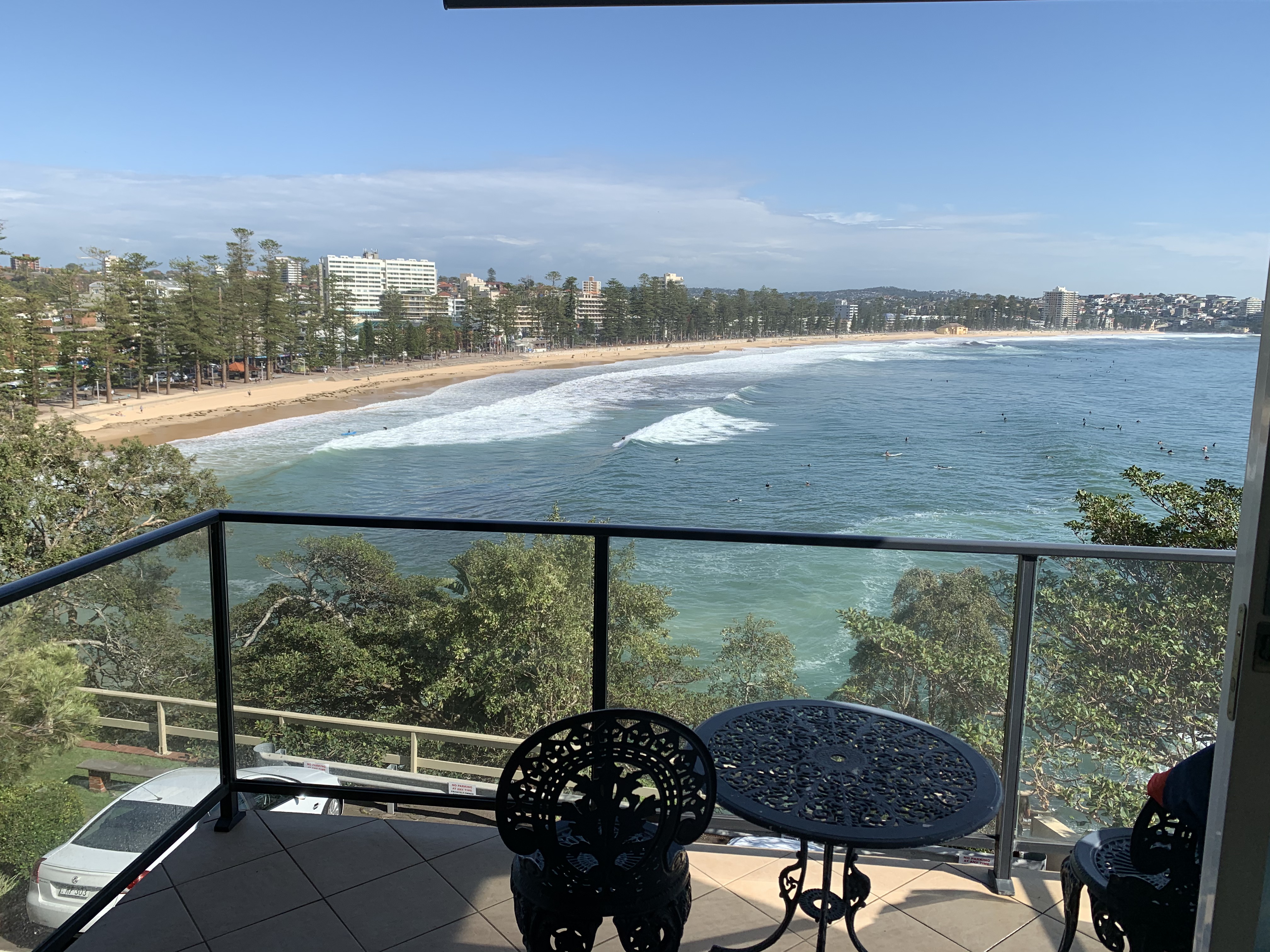
We ended up staying here kind of accidentally. Judie had to call the head of HR in the firm’s Sydney office about something and she asked him if he had any ideas about where we might stay. He said that he and his family live in Manly and that, for the past 25 years or so, his in-laws from Seattle had come every Seattle winter to see their daughter and grandchildren. Every year they had stayed in this wonderful apartment. But this year, they decided they were just too old to travel. He asked if we wanted him to contact the apartment owners to ask whether they would be willing rent it to us. (It is not really a rental apartment. It is shared by two families.) They said yes and sent us some photos and we decided to go for it. The photos below give an idea of the view from our porch.
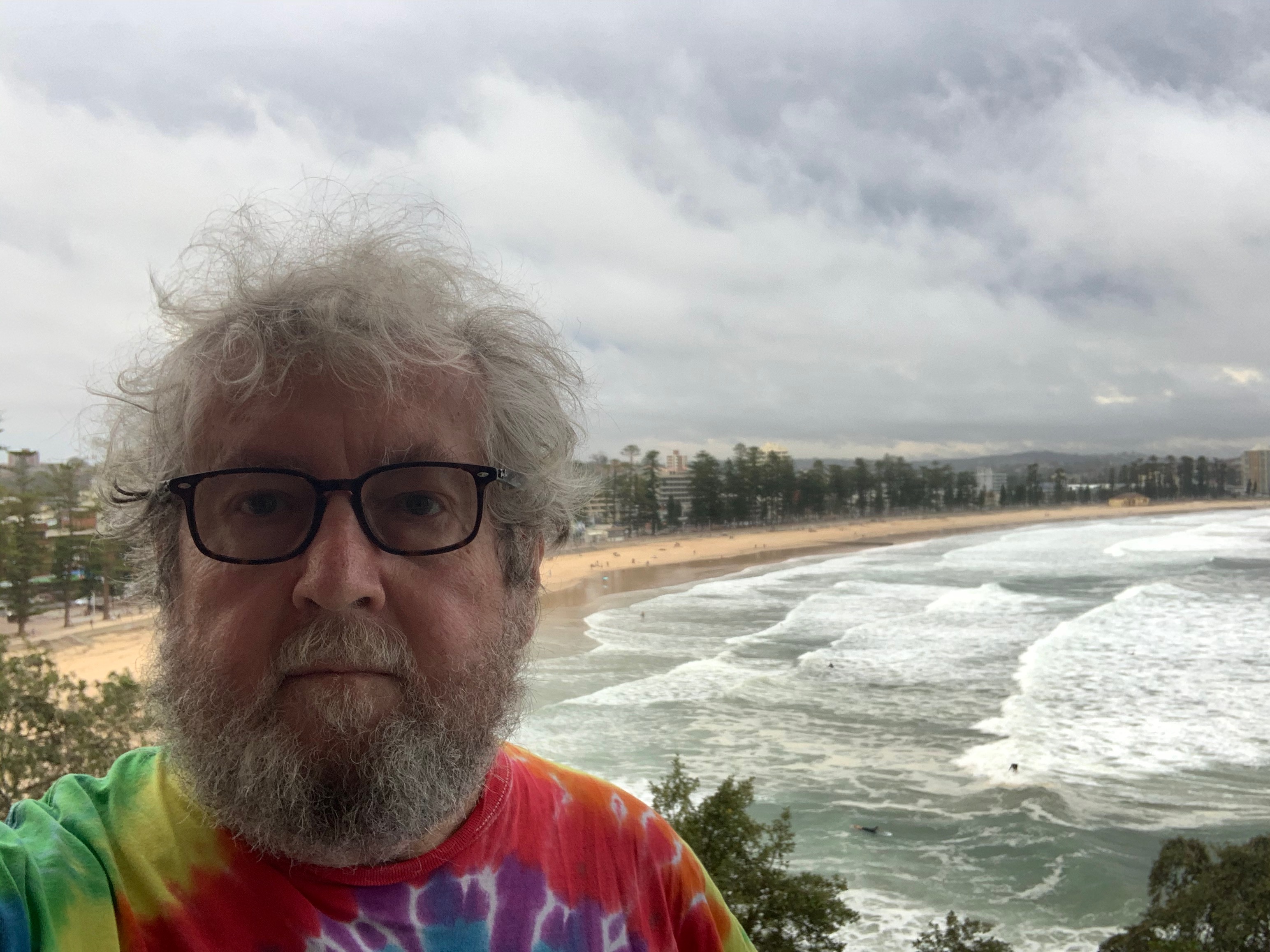
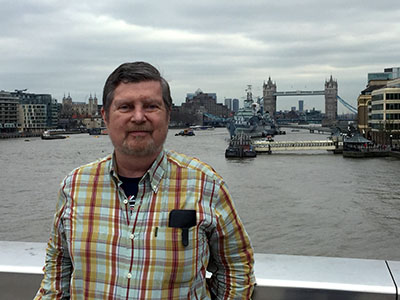
Nick at Manly

IMG_1029A Little Geography Lesson: As you should know, Sydney is built on a gigantic harbor. Downtown Sydney (referred to here as “the CBD” for Central Business District), is several miles into the harbor from the Pacific and is where the iconic Harbor Bridge and the possibly more iconic Sydney Opera House are. The opening of the Harbor to the Pacific is between two big sandstone bluffs and is relatively small given the size of the harbor that it opens up into. The northern of the two headlands is Manly. And just up the coast from the headlands is Manly Beach, a long, sandy beach, which is one of the two major surfing beaches in Sydney. (Bondi Beach is the other.) About five blocks from the beach, at Manly thinnest point, is the harbor and a ferry terminal. The ferry is the main way to and from Manly and goes to Circular Quay, which is the main ferry terminal and is right between the Bridge and the Opera House. I’ll talk more about the ferry later.

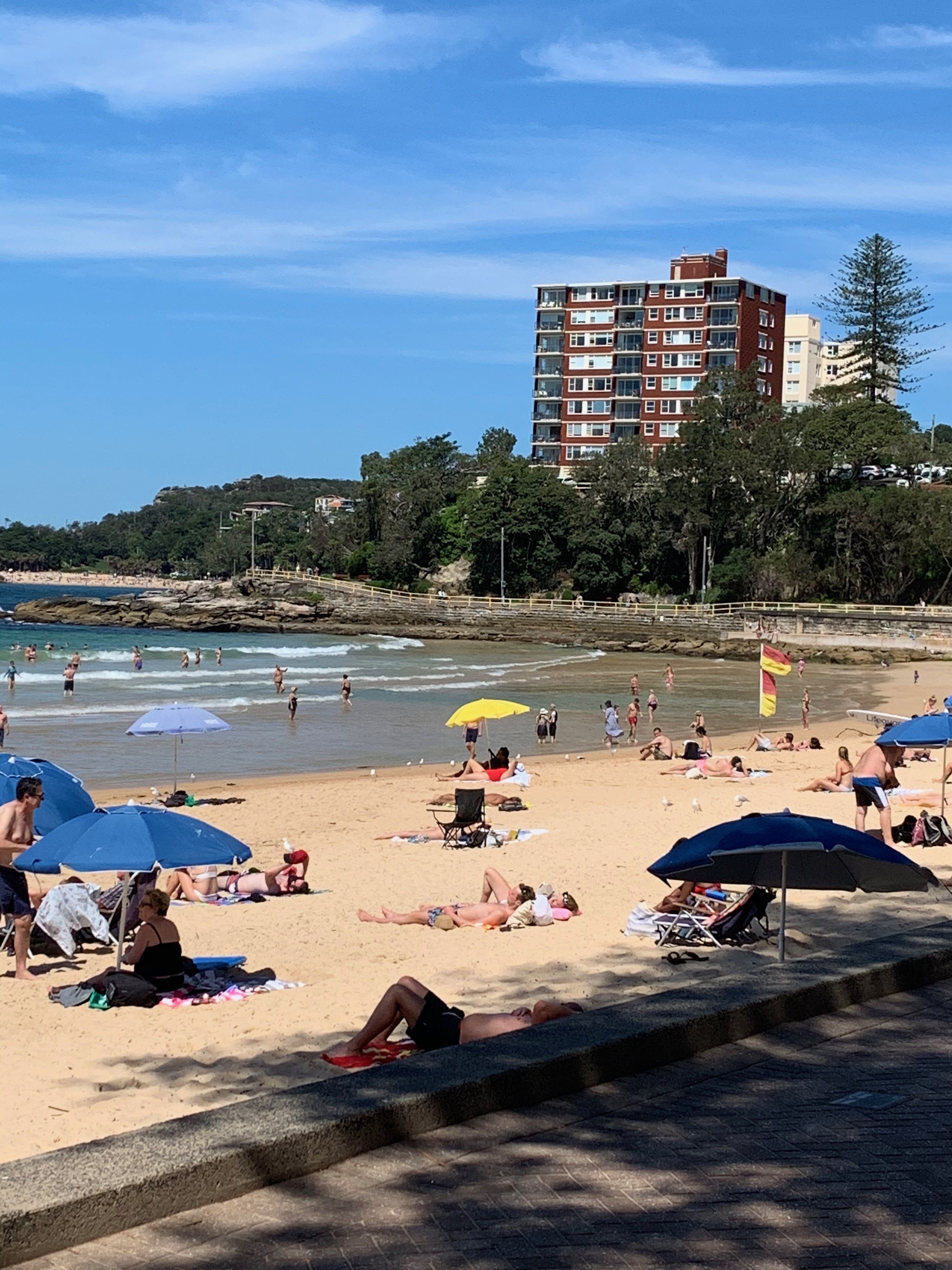
Climbing home: Our apartment/flat (both terms are used here) is on the corner of a bluff at the south end of the Beach. We are on the corner, so we have view of the length of the big beach and we can look around the other way and see Cabbage Palm Aquatic Preserve and Shelly Beach, a smaller beach, good for swimming and families. In order to get here from the beach, one has to walk up about 45 steps and then an additional 20 or more feet to reach the level of our building. It’s like walking up six flights of stairs, which isn’t too bad unless you are carrying groceries. I’m sure it is good for me. In the photo below of our building from the beach, we are on a lower floor on the left side of the building. You can see Shelly Beach in the distance.
IMG_1461

The Town of Manly: The town of Manly is a summer community, so it is pretty busy right now. Very young and a surfer dude vibe. Lots of teenagers and young people looking for a good time. There are hotels and lots of tourists and people from around Sydney come here by ferry or car to enjoy the beach and the scene. Lots of seafood restaurants overlooking the water or the ferry wharf, lots of surf shops, lots of places to drink, large number of surfers at all hours and in virtually all weather. Fish and chips shops abound. There is a mostly pedestrian-only main street called the Corso that goes from the Manly Wharf and the ferry to the beach. It is lined with pubs and shops.

While there is this surfer dude feel on the one hand, one of things that is noticeable about this area is the number of babies in strollers and other small children. There are also what appear to be school classes that come to beach in the afternoon for surfing lessons or swimming. As I write this, they seem to be gearing up for a big pro surfing competition. Unfortunately, it looks like it is going to be more down towards the other end of the beach.

As I mentioned earlier, this is big surfer beach and one of the things we do is watch the surfers, who are out there all hours and in all conditions. Beach closed by rip tides or pollution? They’re out there. Big storm coming? They’re definitely out there. There are sometimes so many you them that you wonder how they don’t kill each other. The one time the beach was surfer free was when we had a storm with strong winds and rain blowing sideways.

When Jim was here, he joined an informal swimming group known as the Bold and the Beautiful. They meet every morning on the beach right under our apartment and swim out and around the point and all the way to Shelly Beach. It’s got to be at least a half a mile. The boldest and beautifulest would then turn around and swim back, often through a current at the end that made them look like they were swimming in place. Jim walked back. They all got pink bathing caps, which made them easy to spot. We assumed that was to keep the surfers from running them down, but we were never able to confirm that theory.

The big drawback to being here is that it is pretty inconvenient to the rest of Sydney. The ferry is great, but it takes 20-30 minutes to get to Circular Quay and then you have to get from there to wherever else you have to go. There is also a bus that you can take, but the traffic is often terrible since there is really only one road that goes here. We’ve ended up spending a lot of money on Ubers.

More to come….
Hello from Australia

Judie and I are in Australia, staying at a spectacular place overlooking Manly Beach. We’ve been here about a month and have another two weeks to go. Judie’s sister Kathy and her husband Jim were here with us for the first two weeks, which was a whirlwind of seeing the sights in Sydney. Much more on all of this later.

Things have calmed down quite bit with Kathy and Jim gone. I’ve been trying watercolors, without striking success, and I thought it might be fun to write some blog posts about this whole experience. I never turned off the NickinShoreditch site (and have been paying Word Press to keep it active for the past three or more years), so it seemed like a good idea to just add this all to the original collection of essays and photos. If I’d known that this site might have life beyond the two years in London, I suppose I might have named it something else.

Since I have already been here for a month, what will follow will not try to be chronological. Instead, I think it will end up being random stories, thoughts and photos. In the unlikely even that I produce a non-terrible watercolor, I’ll publish it, but don’t hold your breath on that.

How we ended up here for six weeks

Last fall, Judie and I were talking about going somewhere to escape at least some of the winter. Judie suggested that we could go to Miami and she could work out of the K&L Gates offices there. I had the idea of going to Sydney, where she could work out of the Sydney office. Judie liked the idea and had the idea of combining it with a speaking gig at Money 2020 Asia, a huge payments conference happening in Singapore at the end of March. She managed to convince her firm that this was a good idea, so here we are. Unfortunately, the conference was cancelled due to the coronavirus, but Judie’s work experience here has been very productive so far.

More to come.

More Catch-up Thoughts

We are into the last week of our London experience. Alex arrives tomorrow morning. I have just finalized the food and wine for our good-bye party on Saturday. There is apparently a tradition of “Leaving Drinks” (at least in law firms, but knowing the British love of booze, probably everywhere). So Judie is organizing drinks for her firm and some clients on Thursday. We’ve got two more plays to see (“Travesties” and “Twelfth Night”) and I want to go to the Royal Academy to see the exhibits there. Judie has a final Women’s Group meeting at the flat. And we have to pack (although I have started and there isn’t that much besides paintings). It is going to be a busy week. I’ll be happy when it is over and we are back home.

Hockney: While Paul was here, we took a boat down the Thames to Tate Britain to take in the Hockney Retrospective (and to make the obligatory pilgrimage to the stunning Turner wing). I had loved the Hockney portraits exhibition at the Royal Academy and this exhibit confirmed that I am now a big Hockney lover. I didn’t used to be a fan at all and the retrospective reminded me why. I was not all that crazy about his early period and there were moments over the last 40-50 years where his stuff was less interesting than others. But, when you get to see the entire progression of his life’s work (the show goes from a self-portrait drawn in high school to recent works done on an iPad), you have to come away convinced that he is a great talent. Most of his art life was spent in Southern California, but he did return to England (mainly to visit his mother) and I really loved some of the resulting work, which is entirely different from the California stuff, probably because the English palette is so different.

John Soane House: Judie and Paul went to the John Soane House, which I wrote about a year ago. It is a jewel of a museum. I stayed home to get some stuff done and let them have an adventure on their own. And they did. The museum has a small elevator to get around the front steps and somehow it jerked or something, throwing Paul and the chair backwards onto Judie. This all happened in front of the head of the museum, who was understandably mortified and invited them to have cup of tea with him. They managed to tour the museum with no further hiccups and then went for lunch at the Seven Stars, an old pub behind the Courts, which is one of the stops on the Gent’s Holiday Outing. They got to meet the owner, Roxy Beaujolais, but the equally renowned cat was not around. Here is one more classic shot of Paul in London:

Paul

A Quick Trip Back to Montclair: Last week, I took a brief trip back to Montclair. I went on the same flight as Paul. There had been a blizzard in the Northeast the day before (which made everything involved with the trip more complicated), so the plane was packed. We bounced in at the end, leading to a serious bout of motion sickness. The tenants were a little late moving out due to the snow, but left everything reasonably nice. I was worried that the snow would make it impossible to do what needed to get done, but it turned out OK. I hired some friends of James and Hannah to move our furniture back into the house from the basement and the carriage house. There is still a lot to do before the house is back to being completely fixed up, but it is at least livable. Alex will be coming up to drop off Stella shortly after we return.

Exercising Like a Baby: I have been doing this exercise with Massimo, my trainer, in which you lie on your back with your back pressed into the floor, breathing through your stomach. You then raise your arms and legs and alternate moving them back and forth. It is quite a workout for your core. The other day he told me that the exercise is based on what a three-month old does, while lying in a crib. By lying there, waving their arms and legs around, they build up the strength that allows them to crawl and stand. He had gone to a course on this and there is a whole system of exercise based on the movements of babies.

Brexit Begins: The whole Brexit thing will begin on Wednesday, when Teresa May issues the long-awaited Article 50 notification, beginning the two-year withdrawal process. It is very tempting to compare Brexit with Trump. While both are short-term disasters, there is at least a pretty good chance that the Donald will be gone by 2020 and much of the damage that he and the Republicans will do in that period could theoretically be undone. But Brexit is a more permanent mistake and the British are going to have to live with it for a long time.

It didn’t necessarily have to be this way. Buy May has been seduced by the dark side, the far right anti-Europe Tories, who have pushed her and her government into the most strident and destructive position possible. This lunatic fringe that is now in control of policy would be perfectly happy if the negotiations with the EU failed and Britain found itself with no trading agreement, leaving it stuck trading under WTO rules. The financial industry will take a big hit either way and London will lose a lot of jobs, but no agreement will make it worse. And it is hard to see how Britain’s car industry will work without the free-flowing of parts from Europe to English factories. And the country cannot actually function without migrants. The hospitals are already becoming stressed as EU nurses are deciding to leave and go back to where they feel welcome. They won’t be able to close the borders to all immigration as monsters like Farage want, so the xenophobes will be unhappy and the economy will suffer. Right now they won’t even do something as simple as guarantee that EU citizens in Britain (many for a long time) will be protected. What some of the Tories are clearly hoping for is that they will be able to undo the environmental and working protections which are part of the EU, changing the UK into a low-cost, no regulation “Free Market”, which will help the rich, but further harm the poor voters who supported Brexit. The chances of this not being an ugly disaster seem very slim. Trump is more obviously horrifying, but Brexit could prove to be much worse.

Another Thing I’ll Miss: It isn’t just the restaurants, which are very good in our neighborhood. It is the fact that we have become regulars at a number of restaurants and are recognized as such.

Almost caught up.


Paul’s Visit: Part 2-Theatre and Stuff

During Paul’s stay, we went to the Hampstead Theatre and the Old Vic, two of our favorite theatres, each for the last time during our current stay here. We will certainly be back and will see productions at both venues, but we will never have the chance again to religiously attend every performance they produce.

“Filthy Business”: First, we went to the Hampstead Theatre (after dinner at Bradley’s, our favorite restaurant in an area surprisingly devoid of good places to eat). We saw what I am pretty sure was the first performance ever of a new play, “Filthy Business”, by Ryan Craig. It is a story about a family that owns a shop in East London that sells scrap rubber products. The matriarch of the family has her two boys in the business and wants to keep them there. And there is another generation that she has her eye on to continue the business. Sara Kestelman (who we saw in the “Intelligent Homosexual’s Guide….” last fall) was stunning as the conniving matriarch, Yetta. She dominated the stage in much the same way that Yetta dominates her family. Yetta is a Jewish immigrant and a survivor and an archetype of all of the hard-working immigrants who built London (and, as such, has a relevancy in the era of Brexit) and Kestelmen gives an award-winning performance. Dorian Lough was wonderful as Leo, the son who wanted to get out of the business but could never escape Yetta’s manipulations. And Callum Woodhouse (seen in “The Durrels” on TV), as Leo’s son Mickey, who clearly doesn’t belong in the shop, becomes the real focus of the play in the second act. The real dramatic tension in both acts is whether Leo or Mickey can escape the business and Yetta. Leo can’t but Mickey ultimately does after some entertaining twists, turns and surprises. The supporting cast of family and shop employees is typically first-rate. The set is interesting (although the turntable broke own briefly) and the scene changes were a bit clunky in the first preview performance. Judie complained that she didn’t find any of the characters likable. I’m not sure I agree with that, but even if it is true, I think it is far more important for a play to set up a situation with plausible dramatic tension involving well-developed characters. I think “Filthy Business” clearly accomplished this. I enjoyed myself. (It opened to great reviews.) I am going to miss the Hampstead Theatre a lot.

“Rosencrantz and Guildenstern are Dead”: It is the 50th anniversary of this play, which burst onto the scene and made Tom Stoppard famous, beginning his remarkable career. For the occasion, The Old Vic cast Daniel Radcliffe and Joshua McGuire as the title characters, with David Haig as the Player. The writing is stupendously clever, so densely packed that you feel pressed to keep up with the flow of words. The conceit of having the two characters and the Player occasionally finding themselves in the middle of “Hamlet” and then, just as suddenly, on their own again is brilliant. It was interesting that Radcliffe chose to play (or was cast as) Rosencrantz, as he is the slower and less glib of the two leads. Guildenstern gets much more of the clever and funny lines. It is not that Radcliffe wasn’t very good. He just seemed to be playing against type or at least eschewing the flashier part. I also don’t recall the Player as being as powerful a character as Haig played him. He is an important balance to the confused and somewhat helpless pair. Indeed, one of the thoughts which I had as the play progressed (which I’m sure is not an original insight) is how much the play owes to “Waiting for Godot”. Both feature a bewildered couple, waiting for something to happen to them–probably death. Sporadic busts of activity fail to clarify anything and only lead to a sort of despair, although Stoppard’s existential losers are far funnier than Becket’s. I’ve been wondering since seeing this play whether it is one of those plays that is somewhat foolproof–so clever that it will aways be good if you can maintain the pace. I’ve concluded that it would be pretty easy to do an unsatisfying production. Director David Levaux and the cast deserve credit for a production that seems as fresh and shockingly inventive as it must have seemed fifty years ago.

St. Paul’s Cathedral: Paul and I decided to go to St. Paul’s Cathedral. I’d been once before with someone who was visiting (Peter and Andrea?) We got the audio guide, which does a surprising amount of proselytizing until you figure out which parts to skip. The original St.Paul’s, which was made of wood, with a lead roof, burned to the ground in the Great Fire. (The nearby booksellers all moved their merchandise there in the face of the inferno, which couldn’t have helped.) Wren’s design for the new cathedral was controversial, not the least because it was reminiscent of the hated Vatican. Wren had to do away with much of the ornamentation that he wanted because it was seen as too Catholic. Much of the current mosaics and painting was not added until the Victorian Era. The whole thing is very impressive. You can climb to the top of the dome, if you like doing that. I made it up to the Whisper gallery that looks down into the cathedral. (There are better view points in London that the top of St. Paul’s, partly because in other view points, you get to see St. Paul’s.)

I though that the best part of St. Paul’s was the crypt. It contains all kinds of interesting tombs. They were mostly of dead military officers for a while, but then it was apparently opened to enlisted men (in plaques) and artists and politicians and others. The biggest displays were for Lord Nelson, The Duke of Wellington and Winston Churchill, the only three people to have state funerals in the Cathedral (although Winston is actually buried elsewhere). The one with the best story is Nelson’s. Nelson, as every British school child knows, was killed by a French sniper, just as his victory at the Battle of Trafalgar was assured. At the end of a spectacular hero’s funeral, Nelson’s sarcophagus, which was under the dome of St; Paul’s, was lowered through a hole cut in the marble floor to its current resting place. The sarcophagus itself was designed for Cardinal Woolsey, when he was still in Henry VIII’s good graces. Woolsey fell very much out of favor and among the many things he lost (including his life), was the vessel for his burial, which Henry appropriated. Henry was planning to adapt it for his use, but he died before it was finished and succeeding monarchs never got around to doing anything with it either. So the thing ended up sitting in Windsor Castle, losing bits of ornamentation along the way, until it was donated by the crown to be used for Nelson’s funeral.

Bunhill Cemetery: Continuing in the same vein, we took Paul to see Bunhill Cemetery, which is near our flat and across the street from where John Wesley lived. (It is possible I wrote about this place before.) Bunhill is short of Bone Hill and it is where the non-conformists, i.e., the people  who weren’t Anglican, were buried (if they were sufficinetly important). (It was illegal for Anglicans to be buried in The City and Bunhill is just outside where the wall had been and where the line of the City ends.) Lots of famous folks are buried there, including DeFoe, Blake, Bunyan and Richard Price, the radical Unitarian Minister who preached at our New Unity church at Newington Green. In early spring it is beautiful with daffodils and other flowers profusely blooming. The most interesting tomb in Bunhill is for Dame Mary Page, not because of who she was, but because the inscription on the back, which says “In 67 months, she was tapped 66 times. Had taken away 240 gallons of water without ever repining at her case or ever fearing the operation.” It is thought that she had Meig’s Syndrome, which caused water to build up around her lungs. Stop for a second and think about 240 gallons of water and just how much that is. Photos follow.


Catch Up: Paul’s Visit Part 1-The Old Bailey

I think this may be the longest I’ve gone without posting since I started this blog. I got completely distracted by the visit of Paul Weeks, my friend from college, which was immediately followed by a short and exhausting trip to the US to get our house back from the tenants. So I will probably do two or three posts, as opposed to one gigantic post, in order to catch up.

General Thoughts on Paul’s Visit: Paul was my friend and my suite-mate for my last semester at Bowdoin. He wound up marrying Judie’s roommate and best college friend, Gigi. Paul and Gigi ended up in Bangor, Maine (Paul is a Maine guy), where Paul practiced law for many years. Gigi had a long fight with cancer and died about a year ago. About three years ago, Paul had a blood clot on his spine, which, despite various surgeries and treatments, has left him semi-paralyzed from the waist down. He can walk short distances with a walker, but for the kind of traveling around London that was required for his visit, he needed a wheelchair, which we borrowed from a friend.

Dealing with someone in a wheelchair was a new experience for me. To begin with, there were places where we simply could not go (i.e.: the Underground, The Tower of London, Kew Gardens, etc.) And everything took a lot longer, for a variety of reasons. Bathrooms were sometimes an issue. On the plus side, everyone we met (who wasn’t walking along obliviously staring at their smart phone) was incredibly nice and went out of their way to try to be helpful. The London buses are great for wheelchairs and the entrance fees for everything was reduced and I got to go in free as his companion/pusher. Taxis here hold a wheelchair in the back seat easily and have ramps. I developed a whole new appreciation of sidewalks. Is it smooth? (Cobblestones must be avoided at all costs.) Is it level? Where is the curb cut-out? Small steps which I had never even noticed (like the ones to get into New Unity) were suddenly an obstacle to be taken seriously. It is a bit tiring too. Paul and the chair probably weighed in the range of 200 pounds. And I had to lean forward a bit while pushing, which eventually got to my back. I was happy to push him about, just I was delighted to have him visit. But the added complexities caused by Paul’s relatively manageable disabilities was a revelation.

Our Visit to The Old Bailey: One of the things that Paul expressed interest in doing was a visit to see a part of a trial at The Old Bailey. If you have ever been a litigator (or a fan of “Rumpole of The Bailey”), it is just one of those things you have to do. I contacted our friend, Phil Saunders, who is a barrister with the City of London, and asked for advice on getting Paul in and on what case to see. To my surprise and delight, he and his fellow City barrister (also named Phil Saunders), arranged for us to be let in the back entrance and to be met by their friend, Charlie. This turned out to be Charles Hently, who is in charge of the operations at The Old Bailey. His official titles are The Secondary of London and Under Sheriff, and High Bailiff of Southwark. He took us up to his office, served us coffee and sat with us for 40 minutes telling us stories about the problems running an old courthouse, which sometimes host trials of terrorists. He is worried about the Conservative government’s budget cuts (in the name of austerity and shrinking the size of government) which has forced him to layoff guards and make do with an antiquated security system. He had some great stories about fights that had to be broken up during trials and recesses and told us another about having snipers on the roof for a big case and subsequently having the roof spring leaks because the snipers coffee cups had blocked the downspouts. He then took us on a short personal tour of the old part of the building, featuring a truly spectacular Grand Hall with a dome. (While there has been a court and/or a prison on this site for many centuries, the actual building today was built in 1907 and expanded in 1972. But a part of it is still built on the old Roman wall.) There are six old courtrooms and twelve new ones.

Mr. Hently told us that he had planned to take us to a murder trial involving four defendants (The Old Bailey is reserved for trials for murder, terrorism or especially ugly and notorious felonies), but he had found out that morning that three of the defendants were planning to turn on the fourth and he didn’t want us in the public gallery with the families in case a fight started. So he dropped us at a murder trial and introduced us to one of the defendant’s barristers, who gave us a little background. The victim had been slashed and stabbed in the chest, following a prolonged session of drinking and drug taking with the accused, who left and returned with his brother after an argument. The defense was apparently that the victim was depressed and crazy and killed himself. (A bit unlikely, but I guess you have to go with what you’ve got.) The part of the trial we got to see was a bit boring, as it involved a professional crime scene investigator identifying photos of the carnage (but not including the body) and of the remains of the emergency medical crew’s attempts to save the victim. The barrister for the prosecution asked so many leading questions that Paul and I were looking at each other, thinking “Why no objection?” It reached the point where the barrister was basically testifying and the witness had nothing to do but say yes once in a while. A bit weird from a lawyer’s point of view. (I could see why the defense didn’t want to interrupt too often and prolong the obvious, thereby possibly annoying the jury. But I would have said something.) Anyway, it was a truly memorable morning.

I’d encourage you to read up on the history of the Old Bailey. Here is my favorite story: In 1670 William Penn (later to found Pennsylvania) and William Mead were tried for preaching to a crowd in the street, after having been ejected from their meeting-house. (It was illegal to have non-Anglican services at the time.) After the trial and instructions from the judge, four members of the jury refused to vote guilty. They were berated by the Judge and sent back. After further deliberation, the jury acquitted Mead and found Penn guilty of a lesser charge (“preaching to an assembly”). The jury was locked up overnight without food or heat. The next day, the jury stuck to their verdict, despite bullying from the bench, and were locked up fora second night. On the third day, the jury acquitted both Mead and Penn. The judges accepted the verdict after quizzing each juror and then fined each one for following their own “judgments and opinions” rather than the advice given by the court and imprisoned them until the fines were paid. Four of the jurors refused to pay (you’ve got to love them by this point) and remained in prison while they appealed the fines. The higher court threw out the fines as improper and set the precedent that jurors should rule according to their conscience, the rule of jurisprudence that has been followed ever since.

More to come

Miami, March 1 and Martha and George

Well, it is March 1st and the finishing line of our London adventure is now clearly in sight. Frankly, I’m not really looking forward to this last month or so, since it will involve lots of logistics and packing and flying and figuring out details, some of which I will almost certainly miss and have to scramble to fix. I hope I will be able to ignore the stress and annoying details of the next month and enjoy our last weeks here. Helping me do that will be the visit of Paul Weeks, my long-time friend (suite-mate at Bowdoin and married to Judie’s college roommate Gigi). I am looking forward to that.

Miami Beach: Judie had been encouraged to take some vacation time and travel outside of the UK in connection with the visa issue we had. So about two weeks ago, we decided to go to Florida. Judie wanted to visit the K&L Gates office there and we needed to get something notarized to open trust accounts in connection with bequests to our kids and their cousins under the will of Judie’ Aunt Neanie (too long a story). (One of the things we discovered here is that, consistent with the British desire to make simple administrative acts as difficult as possible, it is very difficult to get things notarized. While in the US, everyone can be a notary, in the UK there are very few. And it was not clear that a British notarization would work for the US bank, which meant making an appointment at the US Embassy and paying $50 per signature.) So going to Miami to get something notarized is not quite as ridiculous as it sounds. We contacted Chris and Nancy, who often spend time in Miami Beach at this time of year and, although they hadn’t really planned to go, they decided it would be fun to meet us there. So we made our airline and hotel reservations and spent 23-27 February at the Setai Hotel, a place that they had been to many times.

The Setai is a ridiculously fancy and expensive hotel. We managed to get a deal that brought the price down to simply expensive from the normal stratospheric, although they got us back on the drinks and lunches, etc. ($28 hamburgers, $15 and up and up for a glass of wine, etc.) But it was great fun lounging by the pool in sunny low 80s weather each day, taking walks to see the art deco buildings, going out to increasingly great dinners and just generally relaxing. There was some sort of food and wine festival going on up and down the Beach, but the tickets were pricy and that wasn’t why we were there, so we skipped it. After living in London, Miami Beach seemed particularly exotic. All of the semi-clothed, tanned people walking, biking, jogging and skate boarding around the place in their brightly colored clothes was quite the contrast to the poor Londoners marching through one gray day after another, all fashionably dressed in black. It felt incredibly self-indulgent just walking down the street in shorts, sandals and a Hawaiian shirt.

“Who’s Afraid of Virginia Woolf?”: Since 1 March is also the first Wednesday of the month, it was time for Judie’s Women’s Group to take the flat for the evening, which means that I was off for a solo theatre experience. So I went to see “Who’s Afraid of Virginia Woolf?” at the Harold Pinter Theatre in the West End. I’d seen the Burton and Taylor movie any number of times. The most memorable viewing was when I saw it at Smith College and left the Hall where it was shown and came out to the house and swing where it was filmed. Very eerie. About ten years ago, we saw a wonderful version on Broadway with Bill Irwin (amazing–won the Tony) and Kathleen Turner. In this production, Martha was played by Imelda Staunton, who was the big draw as she is a multiple Olivier Award winner, albeit mostly for performances in musicals. I thought she was extremely good. Her Martha was earthy, smart, bitter, angry, frustrated, funny and sad. Each time you see the play, you should see a different Martha and that was the case here. It is really such a wonderful part and such a great play that I think you inevitably have a good to great production if you have actors willing to give their all to the characters. I do think that the greater role in the play is George as he goes from utter degradation in the first act (“Humiliate the Host”) and cuckolding in the second act (“Hump the Hostess”) to taking control and getting in his own punches, leading to the shattering conclusion (“Get the Guests” and “Bringing Up Baby”). Conleth Hill (probably best known for his role in “Game of Thrones”) was funny, weak, exhausted, furious, impotent and powerful in a fascinating performance. The visitors, Nick (Luke Treadway, winner of awards for his role in “Curious Incident”) and Honey (Imogene Poots) were both very effective in creating fully-realized characters in a play that is dominated in so many ways by their hosts. I particularly like Poots’ Honey, who was not simply a mousy, drunken, vomiting cipher, but had some real personality buried down there. The part of Nick is the hardest to play since you are not supposed to like him, but I thought Treadway’s Nick managed to combine attractiveness with repulsiveness effectively. The direction allowed George and Martha to start lightly, making anyone who didn’t know what was coming to feel like it was a comedy (although if you did know what was coming, it was hard to laugh too hard). Then, of course it builds and builds to a series of flagellations. The set was wonderful. It captured a lovely living room that had been lived in for a long time, was crowded with stuff and not very neat and had seen better days–a visual parable for George and Martha themselves. “Virginia Woolf” is not exactly a comfortable play to sit through, but it is one of the great works of American Theatre and is something that you have to see once in a while to remind yourself just how powerful the theatre can be. I’m glad I got to see this again.

Punishment for our Self-Indulgence: I suppose it was the fates’ retribution for having too much fun in Miami. Our trip back was the worst flight ever. It began innocently enough when American Airlines could not find our reservations and told us we had to check  in at British Air, even though it was a joint flight. We walked a quarter mile to BA and found a long check in line with two agents and at least a 45 minute wait. (At least when we made it to the front, we were helped. Some people waited in line for as long as an hour only to be sent over to American.) Of course, by the time we reached an agent, we could not sit together and there were only middle seats. Bad news for a nine hour flight in economy. But worse was to come. I found myself seated next to a woman with a 20 month old on her lap. To make matters worse, the child had not yet learned to talk at all and could only communicate with grunts and screams. She had one of those bulkhead crib things for him, but seemingly every time she got him into it and asleep, the seatbelt light would come on and the flight attendants would come and insist that he be removed, thereby waking him up and causing him to cry/shriek. So between the tiny seats and my little neighbor doing an audition for “The Miracle Worker”, I didn’t get much sleep and ended up feeling like I’d been in an accident. Then, after staggering off the plane, we got to sit around trapped for ten minutes in a golf cart thing that we had gotten to ease Judie’s walk with her bad knee. And finally, after fighting our way through customs and laboriously explaining our visa situation to a skeptical border agent, we went to the baggage claim for Miami to find no bag for us. After another ten minutes, we were told that there were separate baggage claims for American and British Air, even though all the bags came off the same plane and our bag was there. We slept well when we finally got back to the flat.

New Paintings, Rock Stars In London and “Buried Child”

Painting progress: I feel a bit like I’ve lost my mojo when it comes to painting. It seems like I’ve been doing it less. I’ve been working on three things: (1) a portrait of my Uncle Bill, where I am having trouble capturing his smile and the twinkle in his eye, (2) a painting of a tennis player that I’ve been meaning to do for a while but now that I am doing it, I’m wondering why and (3) a landscape vaguely based on a painting I saw at a museum in Paris, using gouache paints that Karen Fried gave me a year ago. It’s been fun trying a new medium, but it is taking a while for me to figure out how it works. I’m actually closing in on completing all three of them.

As it turns out, since drafting this, I did finish the portrait of Bill. He and his wife Marie were very close to my parents and in a lot of ways, he was like a second father for us. He was an amazing guy. He could walk into a room or a bar and within 20 minutes would be friends with everyone in the room. A quick Bill story (there are so many): We showed up at my parent’s house for Thanksgiving or some other Mahoney family reunion and it was a big Mahoney turnout. Judie had never met any of them and was understandably nervous. Bill picked up on this instantly and took us around, introducing us as “Judie and her boyfriend Nick”, a cute juxtaposition that relaxed everyone. Here is the painting. I still did not capture the twinkle in his eye or his mischievous grin, but it’s close (and probably as good as I can do).

uncle-bill

Frideric and Jimi: On the last day that Peter and Andrea were in London, we went to the Handel and Hendrix Museum. Frideric Handel lived in this house on Brook Street in Mayfair from 1723 to his death in 1759. This was the period of Handel’s greatest popularity and power. He really was the rock star of the period. His house has been restored and decorated with period paintings and furniture and some lovely musical instruments. They occasionally have concerts there, as Handel certainly did during his lifetime. You can see where his bedroom was and where he entertained notables of the day and rehearsed with singers.

A little over 200 years after his death, Jimi Hendrix rented a third floor flat in the same building (different entrance) shortly after arriving in England to become incredibly famous. A museum celebrating all of this opened a year ago immediately above the Handel one. Hendrix lived there with his girlfriend for a couple of years, composing, playing and partying. He actually became interested in Handel and bought some albums of his music. All sorts of famous musicians visited him there to jam, hang out and sometimes crash in a spare room. They have recreated his bedroom, based on photos from the time. Hendrix was interested in design and spent a fair amount of time shopping for rugs and other things to decorate the flat. His girlfriend, who left him in about 1969, possibly upset by his drug use, has lived the last 40 something years in Australia, but has come back and donated a few items. There are videos, music, what purports to be Jimi’s record collection, some guitars, etc.

It is a wonderful coincidence that these two superstar musicians lived in the same place. Little things like this are what make London so much fun.

“Buried Child”: We went with Peter and Andrea to see “Buried Child”, a play by Sam Shepard, which won the Pulitzer Prize for Drama in 1979, catapulting his career into the stratosphere. The play is largely centered around the character Dodge, played by (the) Ed Harris, in what I understand is his first London appearance. When you enter the theater, Dodge is already on the couch in a run-down house, coughing and having sips of whiskey. He stays on that couch for entire play, except for times when he ends up on the floor. He is sitting in Middle America waiting to die, his sons are disappointments, his farm is not productive (and hasn’t been for years), he has dark secrets that haunt him and his wife no longer loves him (and hasn’t for years). It’s quite a part and Ed Harris is quite brilliant in the role. His real-life wife, Amy Madigan, plays his wife in the play. She is the strongest figure in a family of men who have been broken one way or another. In the first act, you think at least one person in this family (her) isn’t crazy. In the last act, you find out you are wrong. Upsetting this disturbing apple cart is the surprise visit of Dodge’s grandson Vince, who comes with his girl friend Shelly and then leaves her there when he ostensibly goes to buy whiskey for Dodge but does not return. Shelly, ferociously portrayed by Charlotte Hope, proceeds to expose the dark secrets that have tormented Doge and his family for many years. You eventually discover that Dodges wife had a child with Tilden, Dodge’s now demented son, and that Dodge eventually killed the baby and buried it (thus the title), driving Tilden over the edge.By the end of the play, Dodge has died (but is still next to the couch), Vince is back and is going to stay (but Shelly has enough sense to leave) and Tilden has dug up the baby. This is a powerful and deeply disturbing play that is very well written and sublimely acted and produced. It was not exactly fun to watch, but I won’t forget it. Although it is set in the malaise of the Ford-Carter years on the 1970s, I think the sort of desperation and sense of failure and loss that permeates the play should have resonance in these days of Trump and Brexit. This was once a functioning family with a working business and dreams. Now that is all gone. They may not be a Trump/Brexit voters, but they fits the caricature.

Closing words: Last Sunday, I did the reading at New Unity. It was poem called “”If You Could”by Danny Bryck. I thought it was timely and powerful. Follow this link: if-you-could

Lisbon: Sintra, Fado and More

On our third day in Portugal, we went on an all-day tour of Sintra, the mountain town that was the summer retreat of the monarchy and other assorted rich people for many centuries. It is a place of great beauty which would probably take a long weekend or more to see properly. It is a 30-40 minute drive from Lisbon. We climbed hills until we reached the center of the town of Sintra, which is dominated by the Palácio Nacional de Sintra, an imposing building with weird conical towers. It is on the site of an old Moorish fort, captured as the Portuguese moved down the peninsula, gradually taking the country back from the Moors. The fort was converted to the current palace during the 14th to 16th centuries. We stopped to take pictures, but didn’t go in as there were more spectacular sights awaiting us.

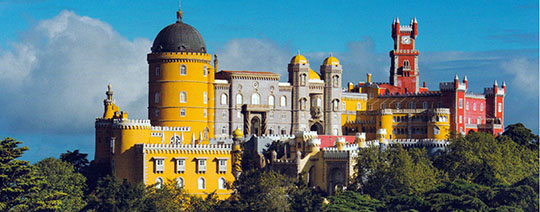
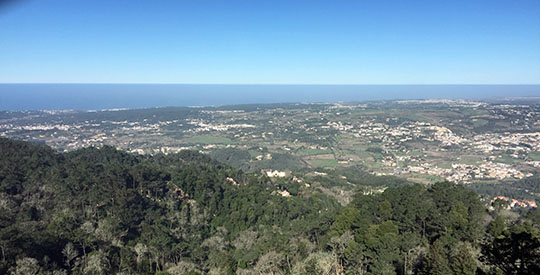
From the town, we drove all the way to the top of the mountain. It was a long way up. Perched at the very top is the Palácio Nacional de Pena, an utterly remarkable building. It was built by the German-born Dom Fernando, the King of Portugal and a cousin of Prince Albert. (Actually, by the 1800s pretty much all of European nobility was related.) Fernando was known as the “artist king” and he bought the abandoned monastery at the top of the mountain to build his dream palace. It is preserved in the same state as when the royal family lived there. (The end came for the royal family in 1908, when Dom Carlos and his 8-year old son were assassinated–in suspicious circumstances–and his elder son abdicated two years later, leading to creation of the Republic of Portugal.) The palace is surrounded by a massive park, with many structures, but we did not have the time to do the exploration, which would have taken the rest of our day. So we confined our stay to marveling at the extravagant architecture of the palace and admiring the views. You had to keep reminding yourself that people actually lived here.

sintra6

sintra7

After the palace, we really only had the time to see one more thing, as we had decided to go back to Lisbon along the ocean, a much longer route. So we decided to go to the Quinta de Regaleira, a spectacular palace of an eccentric millionaire. (Sintra was the place where all the rich people in Lisbon built their summer homes, many of which are still used by the same families, although some are now museums.) The palace itself is ornate, if not exactly beautiful. But the real thing you go to see is the gardens. They were apparently designed with references to Masonic orders, the Knights Templar, alchemy and the like. There are lots of buildings and small towers, waterfalls, grottos and mysterious tunnels. One of the tunnels leads to the Initiatic Well, a subterranean 100 foot tower complete with a spiral staircase. It is all very unusual and oddly beautiful.

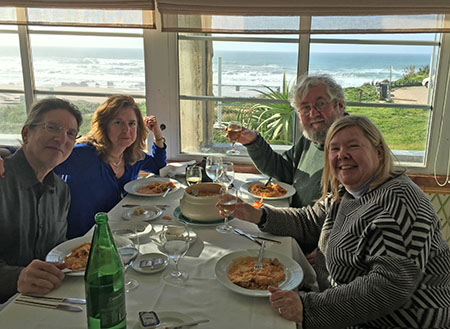
After this, we drove through Sintra and down to the Atlantic coast, which took quite a while as there were hills and mountains in the way. The ocean drive was very pretty, interspersed with small villages and dunes until we got close to Lisbon. We stopped for lunch along the way at a restaurant recommended by our driver and had seafood with rice and vinho verde. (One of the odd things about Portuguese menus is that they offer red, white and green wines.) It was all delicious and scenic. As we went further, we came to Cascais, a very toney suburb, which our driver told us is where rich people now live. It was a fishing village at one point, but underwent a big change during World War II, when a number of rich Brits built estates along the water as sanctuaries from the war. After the war they built hotels and made other investments and the area is now booming.

sintra12

That night, we went to a restaurant, Senhor Vinho, noted for its Fado performances. The food was good (we took a break from seafood), but the performances were what was really memorable. Fado is a style of Portuguese singing. Accompanied by two guitarists, the singers are incredibly emotive. Imagine Edith Piaf or Billy Holiday in Portuguese, only more so. It was fun to see a series of singers (three women and one man) each sing their hearts out. By the last set, we were the only patrons left (it was a Monday night), which could have been uncomfortable, but was kind of a treat.

We woke to rain our final day, so we went to the Museu Nacional de Arte Antiga, Portugal’s National Gallery. Some nice paintings. My favorite part was the Japanese screens commemorating the Portuguese traders arrival in old Japan. Judie and I wandered around a bit after that, had a bite eat at a sidewalk cafe and stopped for a glass of cherry liqueur at A Ginjinha, a tiny storefront bar that has been selling this cherry liqueur and only that cherry liqueur for that 150 years.

Lisbon: Exploration

When Peter and Andrea came to visit us again, it was understood that part of their visit would be another trip to somewhere on the continent. Last year, we went to Vienna, which was lovely but cold and this time, Judie and I were in favor some place warmer. So we suggested Lisbon. We didn’t really know much about it. It turned out to be a good choice. A few interesting facts:

  • Lisbon is pretty small and quite hilly. I was afraid that this would be a problem for Judie and her bum knee, but it turns out that the taxis (and most everything) are cheap (nothing is far away and the traffic isn’t bad), so when we had to go somewhere up a hill, we got a ride up and walked down. They also have these cute funiculars, which go straight up the steeper hills.
  • Lisbon is built on large river, just before it empties out into the Atlantic. It seems to be a natural port and you can see why it was a great spot for fifteenth and sixteenth explorers to use as a starting point.
  • Pretty much the entire old, walled city of Lisbon was destroyed in an earthquake in 1755, so there are very few really old buildings. But most of downtown Lisbon was built during the next hundred years in the same architectural style.
  • Although Portuguese is a romance language and it is almost possible to read it if you know Spanish or Italian well, the pronunciation makes it completely impossible to understand. It sounds more eastern European that western European. Fortunately, virtually everyone seems to speak English.
  • While Portugal was a colonial power for a long time, thanks mainly to their explorers getting around the Cape of Good Hope first and just being the first Europeans to show up in places like Japan, they were more of a trading-centered colonial master. Not remotely as bloodthirsty as the Brits. They ended up giving up their colonies without major wars. But you can see the influence of China, Japan, India and Brazil everywhere.
  • Portugal somehow seems to have missed most of the Twentieth century. It wasn’t really involved in either World War or the Spanish Civil War and was ruled by Antonio Salazar from 1933 to 1974. His dictatorial rule left Portugal as a pleasant backwater in Europe. It took Portugal a while to emerge from all of that and I think you can argue that it still something of an afterthought in Europe.

Day One: We arrived late in the afternoon. Taxi from the airport was under €20–a good sign for the expenses to follow. We were in a nice Boutique hotel that Andrea found and had rooms with lovely views. We had made reservations for dinner at well-known seafood restaurant called Solar Des Presuntos and discovered that it was so close that we could see it out our window. See below for room views.

With time to kill, we strolled around the neighborhood before dinner, taking in the Rossio, Lisbon’s main square since Roman times, and the Praça dos Restauradores, which commemorates throwing the Spanish out in 1640 and restoring the monarchy. The area is filled with restaurants and people milling around and drinking at cafés. Our restaurant was in a lovely tile-covered building right next to a funicular. The food was great and the waiters sang happy birthday to Andrea. After dinner, we took a different funicular up to Bairro Alto, an old district on a high hill, filled with bars and clubs. We wandered around looking for a Fado (a type of Portuguese music) club, but couldn’t find one. We ended up at a fun bar where we drank caipirinhas and the bartended gave us shots of cachaça (sugarcane liquor) when he heard it was Andrea’s birthday. We somehow stumbled bak to the hotel.

Day Two: Andrea had arranged for a half-day private tour of Lisbon for our first full day, so George picked us up in van and drove us up to his favorite lookout. The classic viewing spot is Castelo de São Jorge, a restored medieval castle which overlooks the old city. The guide said that there isn’t that much to see when you are inside and if you are really just going for the view, the one we went to was better because it was (a) free and (b) had the castle as part of the view. We proceeded to drive all around old Lisbon and out along the river toward Belém. It had once been the port of Lisbon and was where Vasco de Gama departed on his famous exploration. It had been made up of docks and warehouses and the like, but as the harbor moved to a place that was better for container ships (a familiar story), the area gradually gentrified around the beautiful old buildings and the entire shoreline was turned into museums and various monuments. We stopped to check out the Torre de Belém, a spectacular defensive tower built into the edge of the river. It is built in what is called the Manueline architecture style, a sort of hodgepodge of Moorish, Gothic and Renaissance influences that is typical of the construction following the earthquake. You see a lot of it around Lisbon. We also stopped at the Mosterio dos Jerónimos, a large monastery along the river which houses the remains of national heroes such as de Gama (who actually died in Goa and was brought back decades later). The exterior is lovely and Peter and Andrea went back to see the interior and Vasco, who they felt a special kinship with, having seen the place in Goa where he was originally buried.

By this time, it was early afternoon and our guide dropped us off at the Praça do Comércio, a large square surrounded on three sides by imposing buildings and by the water on the fourth. There were a number of cafés with seating on the square, so we chose one and had lunch. It was a sunny day in the mid 60s and the view was wonderful and the food and wine were good. A lot more fun than shivering in London or New York. After lunch, we wandered around the square taking pictures and checking out the tables under the arches where folk-ware and knickknacks were for sale. I realized as we were leaving that we were pretty close to The Sé, Lisbon’s cathedral. So we walked over there. It was a short, uphill hike and on the way we passed the Igreja de Santo António, a church built on the spot where St. Anthony was supposedly born. St. Anthony actually went to Italy, where he did all his saintly stuff in Parma, but Lisbon adopted the hometown boy as their patron saint. The little church (reconstructed after the earthquake) was very cute. In some ways, it was nicer than the cathedral (built in 1147 where the Moor’s old mosque had been, destroyed by the earthquake and reconstructed over centuries in a variety of styles).

Judie and I took a small tourist vehicle back to hotel, so she could rest her leg and do some work. I took it easy for a while and then decided to take the funicular behind the building up to the top of the hill and wander around up there. As I was leaving, I met Peter and Andrea, returning from shopping and walking. They came with me. It turned that the funicular is the oldest in Lisbon and has a cute little “station” at the top of the hill. We walked over the Jardin de Torel, a jewel of a little park overlooking Lisbon. The ridge of the hill we were on was lined with large palaces, a few of which had been converted into what I’m guessing are very snazzy hotels. As the sun was setting, it was a great spot of photos, some of which follow.

That evening, we went back up to the Bairro Alto for more seafood, this time at Mar ao Carmo, a restaurant on a cute square. Since we were leaving to go for a tour of Sintra the next morning, we decided to skip exploring the bars and clubs again and just walked back down the hill to our hotel. To be continued…..

Visitors, “Art” and News from London

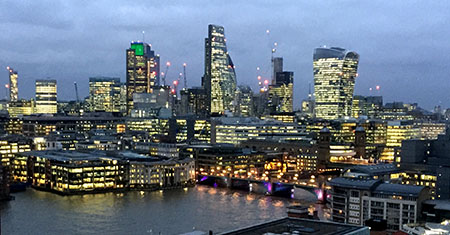
Our friends Peter and Andrea Rothberg are visiting (since Thursday). They are back for a second time and we have just returned from a wonderful long weekend in Lisbon. (More about that in a different post.) We went to the Tate Modern to see the Sir Elton John photography exhibit which I wrote about earlier. We also had time to see some of the other permanent exhibits. We were in the Rothko Room, full of paintings that were originally painted for the Four Seasons restaurant in New York, when the museum closed and we were asked to leave. (Rothko cancelled the commissions and gave the works to the Tate. He committed suicide the week after they were installed.) I also discovered that the new wing of Tate Modern has a great view-point of London. See below.

london-tate-view

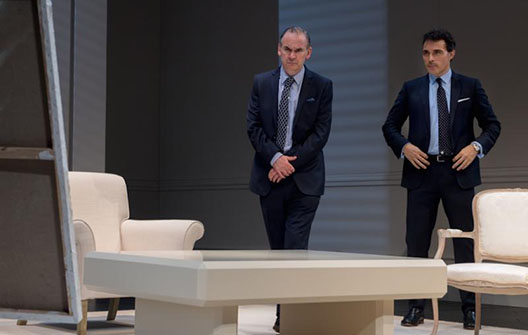
“Art”: On the Friday after Andrea and Peter arrived, we went to the Old Vic to see “Art”, a play by the French playwright, Yazmina Reza, translated by Christopher Hampton. It is the 20th anniversary of its first production in London. (We saw it on Broadway with Alan Alda, Joe Morton and George Wendt sometime around 1999.) It is a play that is really about the relationships between three men. One of the three friends, Serge, has purchased an expensive, large painting that is entirely white. Serge, played by Rufus Sewall (probably best known for his recent portrayal of Lord M in the TV series “Victoria”) is a fan of this minimalist modern style and loves his painting. He invites his best friend, Marc (played by Paul Ritter), over and proudly shows it to him. Marc immediately hates it and is aghast that Serge bought it. He cannot conceal his alarm, anger and disgust. The rest of the play is about how their friendship is almost destroyed by the purchase of the painting. Marc feels betrayed and furious that Serge could have bought such a thing. And Serge is equally furious at what he sees as Marc’s condescending attitude and rigidity. Along the way, their other friend, Yvan (hysterically played by Tim West), finds himself in the middle of the argument. He tries to like the painting (even though he doesn’t really), which infuriates Marc and then infuriates Serge when he admits he doesn’t really like it that much. He becomes their punching bag as they fight with each other. It is a fascinating look at the nature of male friendship, as the rift caused by the disagreement about art escalates into increasingly hurtful statements about other, more personal subjects. And you could say that it is about men’s lack of empathy and the inability of individuals with strongly held beliefs to admit that someone with equally strong opposing beliefs may not be a fool. As the director’s notes point out, this second underlying theme has a great resonance today, in an England divided by Brexit and a world divided by Trump, where the opposing camps cannot bring themselves to even talk civilly to each other. It is wonderful and cleverly written in a style that is reminiscent of Stoppard. It takes a simple concept and creates a parable about life and friendship. And it manages the seemingly impossible by coming up with a resolution that does not seem contrived and is somehow satisfying. Another thing I’m going to miss about London: The Old Vic.

art

It Looks Like We Will Avoid Deportation: You may recall that we were somewhat concerned that our visas are scheduled to expire on the 9th of February, but we intend to keep living here until early April. We were concerned that Judie might be closely questioned upon our return from Lisbon and she had letters from the law firm explaining that she was now officially working in the New York office (and therefore no longer needs anything more than a visitor’s visa). The immigration law specialist hired by the firm seemed to think that there was a possibility that it would not work and we would have to leave or something. But, as it turned out, the Immigration person had no interest in Judie’s letters and just let us in on visitor’s visas with virtually no fuss at all. It was a relief for us, as this particular detail of our repatriation has been worrying us for weeks.

Brexit Update: May Wins, Labour in Disarray: This week the entire Breixt process leading to the UK leaving the EU became officially irreversible (although it has seemed like an unstoppable lava flow for months). In response to the High Court’s ruling that the Article 50 notice (beginning the process of leaving the EU) had to be approved by Parliament, the Conservative submitted a very short bill that gives Theresa May a blank check. The Tories were solidly behind it (except for Kenneth Clark, a voice crying out in the darkness that has become the Conservative Party) and beat back efforts by some MPS to amend the bill. The Scottish National Party was opposed. Corbyn and Labour found themselves in a difficult spot. Many of the traditional Labour constituencies in the Midlands and elsewhere voted heavily to leave and they were justifiably concerned that voting against the triggering of Article 50 might lead to an electoral rout. So Corbyn decided that Labour had to support the bill and ordered a “Three-line whip” be issued. (This is a message to the Labour MPs about an upcoming vote. If the message is underlined once, the members are urged to come and vote, underlined twice and the members are told that this is a very important matter. If it is underlined three times, the MPs are told that they must vote and are instructed on how they must vote.) About 50 Labour MPs defied Corbyn (and the three-line whip) and voted against the bill. They were from places that voted overwhelmingly to remain in the EU and really had to oppose it. But this is simply not done in Parliament and this sort of rebelliousness is unusual. Several front-benchers in the shadow cabinet voted against the bill and therefore had to resign their positions. Why Corbyn couldn’t have given his members a “free vote”, avoiding the inevitable resistance is beyond me. It all just reinforces the pre-existing story line that he doesn’t know what he is doing and that Labour is in disarray. So May wins overwhelmingly (so overwhelmingly that there is no chance of the House of Lords doing anything) and the Brexit process will start in the next six weeks. The two-year negotiations are unlikely to go well or even be completed, so this could turn out to be a Pyrrhic victory for her.

A Brief Political Rant: We are living in such a weird time. A few hundred thousand votes and Hillary is President, there might be a Democratic majority in the Senate and all the pundits would be writing about the dismal future of the GOP. But for whatever reason, those votes did not materialize and we are faced with Trump, which would be bad enough for one lifetime, but also a Republican Party whose awful partisanship and refusal to govern has been rewarded. With Republicans in charge, one would expect all sorts of terrible things–giveaways to the rich, attempts to shred the safety net as much as possible, attacks on the EPA, the CFPB and Dodd-Frank. Elections have consequences and at least some of these horrible things will inevitably happen. I’m not sure that we can fight all of them. And I don’t know where Democrats would get by being simply the party of “No”, as the GOP was for six years, especially since they are in the minority. There has to be resistance, but it has to be smart and constructive resistance, with apositive message underlying it. And there are lines in the sand that must be drawn that will lead to bloody fights.

Trump is a sort of different matter. It is important to call him out on his endless false statements and the fact that his administration is utterly feckless and incompetent. I  personally have no real hope that the Republicans will impeach him, but I think he can and will be weakened. But to obsess on every stupid tweet and crazy statement seems also to be self-defeating. It is important to make some distinctions over the merely idiotic and venal things he says and the things he says that threaten tyranny. There really is a difference between complaining about Nordstom’s and threatening the judiciary. We are teetering on the edge of an abyss. It is not hard to envision a situation in which the USA slips into tyrrany. What we do as a country over the next several months and years will have an inordinate impact on the future of the world. This is all frightening in a way that Reagan or W were not.