Spain, Part 2: Madrid

On Friday morning, we left Barcelona, taking a high-speed train to Madrid. It is a two and a half hour ride, mostly through the countryside. I’d like to be able to report more on the scenery, but trains seem to put me to sleep, so I missed a big chunk of it. Judie told me that there were castles and vistas.

Madrid: I don’t think that Madrid is one of the cities that is viewed as a must-see destination and, having been there, Judie and I could not figure out why that is.  It has beautiful architecture, great museums, good restaurants, an efficient subway system and it is much warmer than places like London. The part where most of the tourist stuff is located is walkable and not too big. It is inexpensive to go there from London, which is probably why there seemed to be countless “hen parties” and bachelor parties featuring oddly-dressed, inebriated Brits.

We stayed at very nice hotel on The Grand Via, which appeared to have just been renovated and reopened. The Grand Via is a major street in Madrid and is lined with a series of lovely buildings, mostly made of white stone with balconies and turrets and bay windows, interrupted occasionally by wide avenues and squares containing outdoor cafes. The street is home to many hotels and theatres. At one end is the beautiful City Hall, a former communications building of all things, and the Prado and the other main museums. At the other end is the Palace and Cathedral. While Judie was working on Friday afternoon, I wandered around for an hour or two and finally parked myself at an outdoor cafe and just enjoyed the early summer weather and watched people walk by. When I finally returned and Judie finished her last call, we retreated the roof of the hotel, where there was a bar with nice views and comfy places to sit.
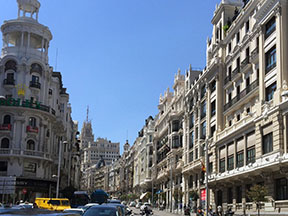
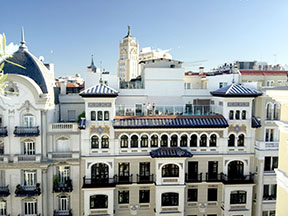
Grand Via   Madrid

That night, we went to a restaurant called La Baracca. I had looked into going to Botin, reputed to be the oldest restaurant in the world, but couldn’t get reservations. So I made reservations at this other one and it turned out to be across the street from the back door of our hotel. They specialize in paella and it really was delicious. The seafood in it was just OK, but the rice was just wonderful. It had great flavor and was both fully cooked a just a little crunchy, which we guessed may have come from cooking it in individual paella pans. The best we’d ever had.
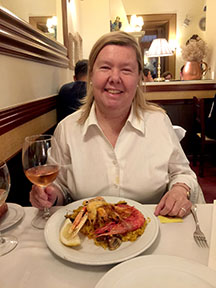
Paella

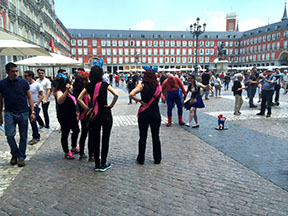
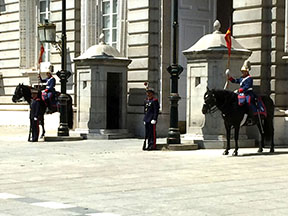
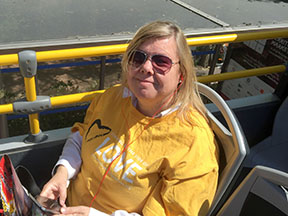
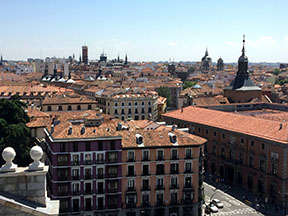
The next day, we took one of those on-off tourist buses, taking a full loop around Madrid to decide where to get off. We got to see everything and get slightly sun burned at the same time.The Palace and the surrounding parks are up on a hill (which is why Madrid is where it is), with some pretty views. We decided to skip going into the Place since the lines were too long and went to the Cathedral next door instead. (I have become pretty sick of hearing about royal families and their histories. All of the European capitals seem to have this stuff. At a certain point, it just gets to be boring stories about a rich families. We did happen to walk by the Palace when the guards in funny uniforms out front were marching about and shouting.) We went up to the dome of the Cathedral (elevator part of the way made it easier) for some great views of the city. We continued on for a fairly long walk back to our hotel, via Plaza Mayor, a gorgeous square in the middle of Madrid with a long history. It is ringed by restaurants with alfresco dining and drinking.
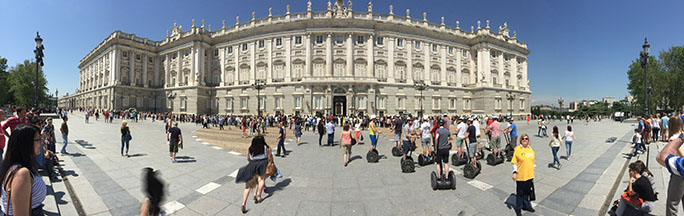
Madrid Palace

Plaza Mayor  Madrid Palace guards   Madrid Bus   Madrid 2

Catastrophe Averted: By mid-afternoon on Saturday trying to find Plaza Mayor, Judie and I gave up and were sitting at an outdoor cafe (little did we know that we were two blocks from the Plaza we were tying to find), surrounded by hen party groups, tourists and families. We were eating Iberian ham, gazpacho, patatas bravas and fresh anchovies and washing it down with sangria and beer, when this kid comes up with a menu, puts it on the table and begins talking to us and pointing at it. There is a moment of confusion and then all of a sudden my old NYC radar kicked in. What is he doing here? He’s not my waiter! Why is that black peddler looking at him like that from over there? I instinctively slam my hand onto the table, moving the menu and instantly both of our hands are on my iPhone, which he had put the menu on top of. He gave up and ran away as I was screaming at him. A really close call…..

The Prado: On Sunday morning, we decided to go to the Prado. It was tempting to go to the Reina Sofia Museum, which is where Picasso’s “Guernica” is, but the Prado was a shorter walk and it is hard to go to Madrid and not go there. It was a pretty spectacular museum, although I have to admit hat I eventually got sick of all of the paintings of Jesus, Mary and various saints and martyrs in various states of torment and torture. But getting to see Hieronymus Bosch’s “Garden of Earthly Delights” was a treat, as was a room of paintings by Goya from his “Black period”. There were lots a lovely paintings and the museum was very well laid out. Here is one of those Goyas I particularly liked:
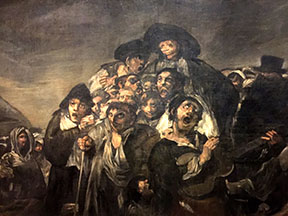
Black Goya

As a bonus, there was a special exhibit of the paintings an artist named George de La Tour, an Alsatian painter who seemed to be influenced by Caravaggio. There are only 40 of his works known to exist and the exhibit had 31 of them. The were just spectacular. Who is this guy? Two of them are below.
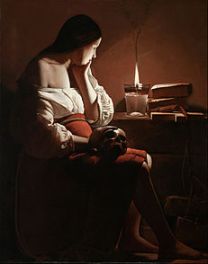
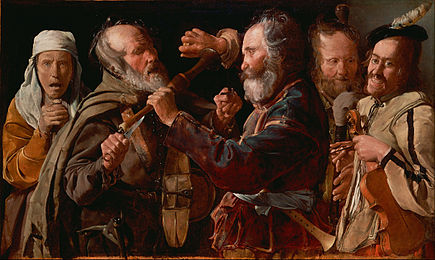
Georges_de_La_Tour_-_The_Magdalen_with_the_Smoking_Flame_-_Google_Art_Project.jpg      Georges_de_La_Tour_(French_-_The_Musicians'_Brawl_-_Google_Art_Project-1

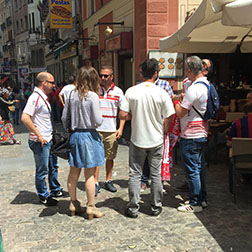
Copa Del Rey: After the Prado, I convinced Judie to go back to Plaza Mayor for a final visit and alfresco drink. It turned out to be a little further than I though and, even worse, all uphill, so I was not dealing with a happy camper by the end of the walk. But it really turned out great. The Plaza was hopping because it happened to be the day of the Copa del Rey, basically the Super Bowl for the Spanish football (soccer) league. The game was to be played in Madrid (at Athletico’s stadium) and featured mighty Barcelona (with their front line of Messi, Suarez and Nemar that is so great that it is almost unfair, plus great players like Ineinesta, Pique, etc.) vs. Sevilla, who are also no slouches (but without the star power). Fans for both teams, in full regalia, converged on the Plaza Mayor and were drinking and singing and marching and waving their colors. It was all high spirited and great fun. (Barca won 2-0 in overtime later that night.)
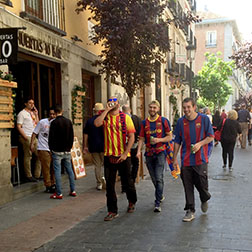
Barca fans   Seville fans

Spain, Part 1: Barcelona

Judie and I went to Spain last weekend. The trip was to be centered around going to see Bruce Springsteen in Madrid on Saturday night (Judie’s birthday), which I’ll describe in greater length later. But about two weeks before we left, Judie found out that she had been scheduled to speak at a conference in Barcelona the day before our trip to Madrid, so the whole thing turned into a grand Spanish tour.

A Short Walk Around Barcelona While Judie Was Working: I had wandered around Barcelona quite a bit in the past, since Judie had been sent to two conferences there while she was at American Express and, as a result, I’d already seen most of the major sites. Since I had only part of an afternoon to do some exploring (on a stunningly beautiful day), I decided to take the Metro down into the city center and concentrate on my two favorites things about Barcelona: Gaudi and the food.

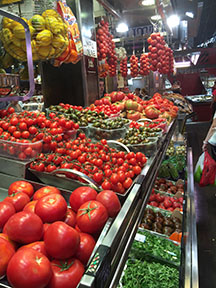
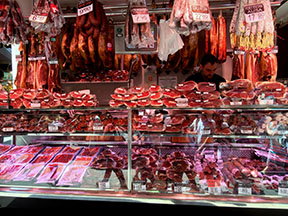
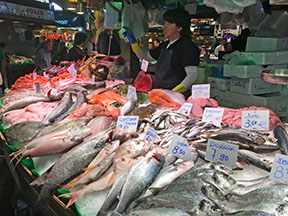
Boqueria: My first stop was the Boqueria Market, which is just off the Ramblas, a beautiful, tree-lined boulevard that cuts from the waterfront up into the city. I had forgotten what an incredible place it is. As much as I love Borough Market in London, the size and selection of the Boqueria really puts London to shame. The colors of the vegetables and fruit and ham and fish and meat and everything else was just kaleidoscopic.

Boqueria 1  Boqueria2  Boqueria6

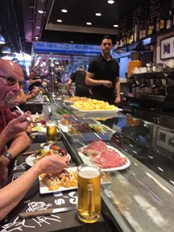
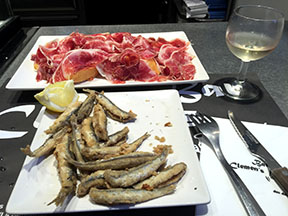
The market, of course, has lots of little places to eat, so I stopped for lunch at one of them and had Iberian ham, which they seem to routinely serve on crusty bread with a little tomato sauce, fresh, fried whitebait and fried artichokes. All with a couple of glasses of white wine. Really heavenly.

Boqueria3  Boqueria4  Boqueria5

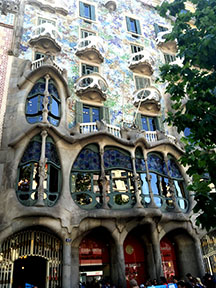
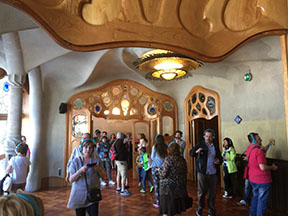
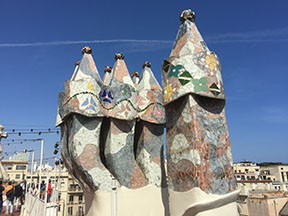
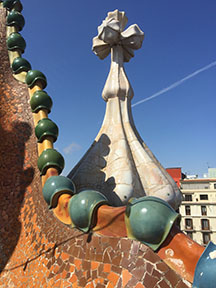
Casa Battlo: Now fortified, I proceeded to stroll up the Ramblas, checking out all of the beautiful buildings and the people sitting at outdoor cafes enjoying the wonderful weather. Barcelona is a city that was laid out with a number of large and wide boulevards, which then have smaller streets off of them. It allows for lovely vistas and the planting of trees along the streets, something that is missing (and perhaps not possible) in the small and narrow old streets of London. It is also a city that seems to be aware of design and seems to be concerned that, at least in the older parts of the city, the overall presentation is harmonious. Very unlike the hodgepodge that is New York or London. My destination on the walk was Casa Battlo,  one of the great Gaudi landmarks. It is not as famous as Casa Mila, with its iconic helmet-like chimneys, or Sagrada Familia, the church that is his masterwork, or Park Guell. But I’d had tours and visits of those landmarks on prior trips. Just the walk to Casa Battlo was great, because it is along an avenue where the homeowners seem to have been competing to build the most spectacular building. Casa Battlo is a six-story townhouse, so it is on a smaller scale than Casa Mila, which is an apartment building. The facade is a profusion of colorful tiles and organic shapes and is really unlike any building you have ever seen. I suppose one could call Gaudi’s style Art Nouveau, but it is so original and unique that it is really not fair to even try to categorize it. I went into the building for the tour and the organic shapes and colors continued inside and onto a back terrace and finally onto the roof, which feature incredibly sensuous tiled chimneys. The various Gaudi architectural gems are so memorable that it is impossible for me to really name a favorite. But this place is right up there. A few photos, which hardly do it all justice:

Barca Battlo  Barca Battlo 2  Barca Battlo 3   BArca Gaudi

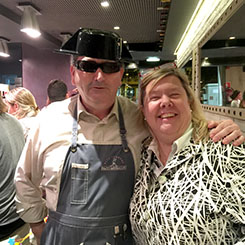
Dinner: Eventually, Judie got away from the conference and endless phone calls with some very needy and difficult clients and we stopped in the hotel bar, where we met a few interesting industry people (including a guy I met at a dinner in Copenhagen) and then went to dinner. Since it is Spain, nobody eats until 9:00 (although the restaurants do open at 8:00, probably for tourists). I assume that they must work later in the day. The owner of our favorite Shoreditch restaurant, Super Tuscan, had recommended Paco Meralgo, which turned out to be a tapas place with seemingly a very hip, young clientele. The food was delicious and the service was great. At one point, the entire staff stopped working, put on silly hats and wigs and went to sing Happy Birthday to someone. On the way back, one of them posed for this picture with Judie (soon to be a birthday girl).

Paco Meralgo

“Lawrence After Arabia” and Fun in Oxford

Lawrence After Arabia”: Last Thursday we went to the Hampstead Theatre (which has turned into our “go-to” theatre—a bit like The New York Theatre Workshop or the Public) with Barbara and Mike (Judie’s friend from high school in Korea and her husband who are visiting) to see “Lawrence After Arabia”. This was another one of those historical dramas, which they seem to do very well here. Of course, often history can be so interesting that it really beats anything that you might make up. T.E. Lawrence was certainly such a figure. This play focuses mostly on the time after World War I, when Lawrence wanted to get away form the limelight and enlisted in the RAF under a false name. At the same time, he was friends with George Bernard Shaw and his wife and was spending some time with them and trying to edit a sort of memoir he had written about his experiences. Most of the play takes place in Shaw’s sitting room. While Shaw is trying to finish “St. Joan” (by dictating to his long suffering secretary, Blanche Patch), Shaw’s wife, Charlotte is looking after Tom (Lawrence) and helping him with his book. There are occasional flashbacks to the war and scenes with Prince Feisal and Field Marshall Edmund Allenby. And Lowell Thomas, the American journalist who became famous by covering the story of Lawrence of Arabia, appears occasionally to show the sort of pressure that Lawrence was under. One of the big points of the play is that Lawrence was tormented by his role in World War I and felt that he had double-crossed Prince Feisal by assuring him that there would be a unified Arabia after the war with a capital in Damascus. Feisal and the Arabs fought successfully against the Ottoman (Turks) (it is referred to as the Arab Revolt) and helped the British win that part of the war. But at the Peace conference, the winners simply went back to their old, misguided colonial habits and arbitrarily divided Arabia into “countries” that the French and English got to exploit. Lawrence argued that this would never work and that Europe would be reaping a whirlwind. In a private meeting with King George V, he declined a knighthood for his services in the Arab Revolt in protest of the treatment of the Arabs. So there is a contemporary political element to the play, as it portrays Prince Feisal as a potentially effective leader, who might have unified an Arabia that would have been functional, independent and friendly. Instead, we have ended up with dysfunctional countries like Iraq and Syria, etc. and our current mess, which one might arguably trace back to this mistake As is always the case at the Hampstead Theatre, this was a wonderful production with particularly great sets and a top-notch cast. Jack Laskey (who you would know if you watch “Endeavor” on PBS) was very good as Lawrence and Jeff Rawle was a very convincing and charming Shaw. Probably the most famous actor in the cast was Geraldine James, who has been in countless plays movies and television dramas and played Charlotte. William Chubb had a few great moments as Filed Marshall Allenby and Rosalind March’s understated portrayal of Shaw’s secretary was just great.

Oxford Pub Crawl: On Saturday we took the train up to Oxford (seventy minute from Paddington Station) to meet Jane and Paul Jee and their friends for the day. The plan was that Mike and I were to join Paul and his friend Jeremy for a pub crawl, while Judie and Barbara were to join Jane and her daughters and Jeremy’s wife and her daughters for sightseeing and shopping. (Actually, in the end it turned out that one of Paul’s daughters, Charlotte, and a friend of hers, Lizzie, joined the pub crawl, so it wasn’t as sexist as it looked like it was going to be.) We met everyone at the Turf Tavern for lunch and a couple of pints. The Turf Tavern is a very old pub, reputedly the last place where cockfighting was legal in London and the spot where Bill Clinton didn’t inhale while he was at Oxford and, I’m pretty sure, a regular location on “Inspector Morse”. I’m not certain of the names all the pubs we went to on the crawl. I know that we went to The Bear Inn, one of the oldest pubs in Oxford and one which, for some reason, displays pieces of ties, presumably worn (and then donated) by patrons. We also went to the Eagle and Child, a pub famously frequented by the Inklings, a literary and drinking group whose members included J.R.R. Tolkien and C.S Lewis. I’m pretty sure that we ended up at the Rose and Crown, a pretty little pub recommended by Lizzie, Charlotte’s friend who was just finishing her degree at Oxford. (It was her “local”.) And we went to two others, whose names I’ve forgotten, including one where we ate some scotch eggs and pork pies and another where we had an extended Brexit debate led by the spectacularly conservative Jeremy on one side and by Charlotte and me on the other (the debate was somewhat heated, probably because it was at pub number 4 or 5, but friendly). Finally, somewhere between eight and ten pints of beer  and three or four miles of walking later, we met up again with Judie and Barbara (who at one point had left the other women shopping and had gone to the Ashmolean Museum) and the others at a restaurant (whose name I had no hope of recalling at that point) and had a wonderful multi-course meal that Paul had arranged (with each course accompanied by wine). We then fell into a cab with Barbara and Mike and went back to our hotel, although we did stop at a nearby pub for a final “cleansing ale”. Quite a day. Certainly the most beer I had drunk in a single day in over 40 years.

Punting in the Thames: Sunday was a lovely and sunny day in Oxford and we spent a lot of it just wandering around the impossibly beautiful town. We spent some time checking out the Botanical Garden, which was in full bloom, and walked past the various colleges to Balliol College, where we met Anna Geier, the daughter of one of our friends, who spent the better part of last year living with us in Montclair. She took us around Balliol, which may be the oldest college in Oxford University (there is apparently some dispute between the colleges), including the Hogwarts-like eating hall. After a lunch at the White Horse pub, we said goodbye to Anna and continued to wander about. I had the idea of going punting on the Thames, since it was such a lovely day. It turned out that lots of people had the same idea and the river was very crowed, which made getting around hard, since the punts are difficult to control. You have long poles that you stick in the water and push off the bottom and then try to control the direction by swinging the pole through the water off the back. It is pretty easy to end up going sideways into a bank or slowly ramming another boat. Shortly after Mike had turned us around to head back (no small feat), I took my turn again. I was pushing us upstream and suddenly the pole got stuck in the mud and I was trying pull it out as the boat drifted along. I should have just let go of the pole, since it turns out that they float, but I had pictures of the pole sinking and us being stuck in the river with no means of propulsion. While all of this is flashing through my mind, the boat just moved out from under me and all of a sudden I realized that I was about to fall in the water and there was nothing I could do to stop it. Sure enough, I fell off the back. It might have been worse. I had given Judie my phone to hold and taken off my shoes since my feet were killing me the first time I did the poling. But I was soaking wet and lost my glasses. A number of other punts came over to help out (holding onto the pole for me was very useful) and I managed to get back into the boat eventually. The river is pretty shallow and I found that as we got near to the shore I could reach the bottom and then get to a point where it was very shallow and easier to get in. But I was soaking wet and fairly muddy and we still had 20-30 minutes of poling to get back to return the punt. But we made it and everyone at the punt rental place was amused. But I was still soaked so, as a result, I now own a new pair of Oxford University sweat pants and tee shirt, which I wore back to London. Oh well, at least I created a memorable experience for our guests (but at the cost of my glasses).

New Painting and Other Notes

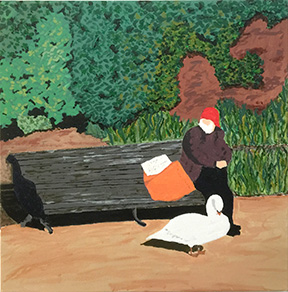
New Painting: I’ve been fiddling with this one for a while. It is based on a picture I took while walking around Hyde Park with Karen and Jerry Fried. I got the napping guy on the bench and the bird done pretty quickly and then got stuck on the background. Maybe I should have done it in a different order. Anyway, the background got to be too complicated and I kept trying to get it right and then finally put the damn thing aside to start anther one. I came back to it, made a few changes and decided to call it a day. Actually the one I’m currently working on is also very detailed. I think I’m going to switch and do something with bigger fields of color after that one is done. Here is the one that is finished:

Man and duck

Geffrye Museum: This museum is right up the road in the Hoxton area of Shoreditch, a fifteen minute walk. We went with Linda and Chris last Saturday. Geffrye was a self-made man who came to London and became an ironmonger and eventually Lord Mayor and head of the Ironmongers Guild. He died in 1714 without a family and left a portion of his large fortune in a trust to provide for an almshouse for retired ironmongers or their widows who were needy. A number of the guilds in the City built almshouses in Shoreditch, but this is the only one that survived. On Saturday, the only part of the structure that still looks like it did originally is open for special tours. In seeing the rooms, you realized that it wasn’t a very cushy deal for those needy ironmongers. They got a room, an allotment of coal and one shirt a year, so the rooms were sparely furnished. Chapel was compulsory and there was a curfew. Eventually, as the number of ironmongers fell, the rooms began to be filled by retired school mistresses or nannies and the like. The rooms become better decorated. (They had such a room decorated as if it was occupied by a woman in the Victorian age.) Eventually, the train line came along, built by the back of the almshouse, and the city reached the formerly bucolic site with a vengeance. By the end of the 1800s, the almshouse was in the midst of such a cesspool of humanity and industry that the residents petitioned to be moved out. Fortunately for them, old Geffrye’s trust still had money in it and they were all moved to Kent or somewhere like that. That left the question of what do with the now former almshouse. All the other ones in the neighborhood had been demolished or repurposed, but this one was saved, although not for the buildings. It was saved because its large gardens were more than 10% of the open space in the borough and the local government bought it to keep the area as a park. It is now a museum with a series of rooms that show how people lived over the centuries and a rear garden, which illustrates the evolution of garden design over the same period. The formal front garden is quite big and is open to the public, which uses it as a park.

Other Thoughts: I occurred to me recently that we have gone through a stretch where the visitors we have had included a number of accomplished artists, all of whom have actually sold paintings. (Karen Fried, Judie’s sister, Linda, and my sister, Sally.) They all work in different mediums and are all talented. They were all very encouraging about my efforts and gave me some good suggestions. In looking back, while having them visit me wasn’t exactly intimidating, I wonder if I actually painted less while they were here. Of course, just having visitors cuts down on my painting time and is otherwise distracting. I do seem to be doing more art right now, for whatever reason.

“The Suicide”, “Sunny Afternoon”

“The Suicide”: On Thursday, we went with Sally and Alan to see “The Suicide” at the National Theatre. It is a dark comedy, adapted by Suhayla El-Bushra from a play be the same name by Nikolai Erdman. Erdman was a noted poet and comic writer in Russia during the 1920s, when he wrote “The Suicide”. Unfortunately for him, Stalin and his friends didn’t appreciate the humor and Erdman ended up in Siberia. The play was banned before it was even rehearsed and was not performed until 1969, after the script was smuggled out of the Soviet Union. El-Bushra updated the play extensively, while retaining the central idea.

In the play, Sam (played brilliantly by Javonne Prince), is depressed because he is chronically unemployed and has lost his benefits for being late to meet his social worker. He is fighting with his wife and his life seems to be a disaster to him. So it is all very real life in terms of problems faced by poor people in London today. He is thinking about suicide and it standing on a bridge at night when his suicidal angst is filmed by some kids, who put it on line, where it goes viral. Sam is then beset by people who want to use his suicide to make one point or another, including a documentary filmmaker who wants to use his suicide as a revolutionary act, a social worker who want to use it to attack the local MP, the local MP who wants to use it to attack the psychiatric services provided through the NHS, a restauranteur who wants to get famous by making his last meal, a buddy who becomes famous by reciting poetry jam verse about his impending death and others. There were all of these great little parts in the play of people wanting to get something out of him and some memorable little performances. Sam is offered fame and money and all the things he never had in his life, but only if he kills himself the next day at noon. He gets swept up in the momentum of it all and the desire to show that he can support his wife, even if he can only do it by killing himself. It is a bit creepy, but had a black humor that worked. It is very cleverly written and wonderfully staged. It was very funny and a bit sad, while making some serious points about the state of our society, the sorry state of politics and government and the warping impact of social media on everything. I think this one will stay with me for a while.

“Sunny Afternoon”: We saw this with Linda and Chris on Saturday night, after visiting the TKTS booth in Leicester Square. It is a musical based on the music of the Kinks. It started at the Hampstead Theatre (one of our favorites) and moved to the West End when it became a big hit. It is essentially about the Davies brothers, Ray (the songwriter and lead singer) and Dave (the lead guitarist and wild little brother). It had most of the great Kinks songs, so it couldn’t be too bad and it was pretty cleverly done. I guess they could figure out how to work “Lola” into the plot, so it ended up being used as a big audience sign-along at the end. The guys who played the Davies brothers were talented and the actor playing Ray was especially good, and he had to be, since the who show really centered around him (not a big surprise, since the real Ray Davies helped to write it). I really like the Kinks, so I was more interested in seeing this that something like “Jersey Boys”. If you think about this as an example to of the “Rock Musical” genre, it is certainly one of the best. (Off the top of my head, I’d say that “Tommy” would be the best of that genre. It is a lot easier to come up with mediocre ones.) An enjoyable night in the theatre, but, unlike “The Suicide”, ultimately forgettable.

Gull Eggs: When were were over at Jane and Paul Jee’s house for Easter, their friend Jeremy told me that I had to try gull eggs, which were just coming into season. According to him, they are harvested by people who climb up or down cliffs to take them out of gull’s nests. He said that the government licensed individuals to harvest gull eggs in World War II to deal with food shortages and that there are very few left. (According to a Daily Mail article from 2015 that I found, there are only twelve licensed gull egg collectors left.) The classic way to eat them is with celery salt. After we saw “Sunny Afternoon”, we took Linda and Chris to dinner at Sheekey’s, a famous seafood restaurant in the West End. There on the menu were gull eggs with celery salt and mayonnaise. (£7.50 per small egg, soft boiled.) I had to try it. The taste was slightly more delicate than a regular chicken egg, but still definitely an egg. I’m not sure what I was expecting…..


Election Results

From the Ridiculous to the Sublime: Britain is building a state-of-the-art, sea-going research lab and someone had the bright idea of letting the public name the ship through an on-line vote. The winner, by a landslide, was “Boaty McBoatface”, a joke suggestion which went viral. (Repeat after me: “You can’t make this stuff up”.) As you can imagine, the government was not keen on the idea of attaching a stupid name to its expensive new vessel. So they decided to name it after David Attenborough, in honor of his 90th birthday. But they are going to name a small, remote-controlled research submarine Boaty McBoatface. In response, there is apparently an online petition seeking to change David Attenborough’s name to Boaty McBoatface.

And in the Real Election: As you may recall if you have been reading this blog, Britain had local elections on Thursday. The Mayor of London and four other cities was decided, as was the Sottish and Welsh Assemblies (and maybe the Norther Ireland one too) and various local councils around England. At the same time, the Brexit vote is looming in six weeks and the Conservative Party is in chaos, caused by a series of missteps as well as internal disagreements about Brexit. And Jeremy Corbyn’s Blairite enemies in the Labour Party were sharpening their knives and predicting a bad result due to his unpopularity.

On Election Night, the BBC and the other networks had all of their spiffy sets and electronic gizmos all ready. The problem was that there was nothing to report. They seem to have this habit in Britain of waiting for the votes to actually be counted, rather than breathlessly calling the result based on exit polling or whatever. (What would Wolf Blitzer think?) To make matters even slower, the television coverage of election official actually counting the votes revealed that they were all dealing with huge piles of paper ballots which all had to be separated, unfolded and put into piles. (No computerized or mechanical voting machines for these Brits. I guess the good thing is that there are no hanging chads.) And as if the paper ballots didn’t slow things enough, after the first preferences are counted, they have to go back and count the second preferences. It is all such a time-consuming mess that the results of the London election were not announced until late on Friday afternoon. (Actually, that was the point when the papers were willing to report the result even though the actual counting had not finished completely.) That London election was not all that close and you can bet that in the USA, the networks would have announced the winner about 15 seconds after the polls closed. Here they acted like it was all a big mystery for almost a day.

So what exactly happened and what does it all mean? Here is what I think:

  • Sadiq Khan (Labour) won the London mayoral election pretty easily. Zac Goldsmith (Conservative), risked his reputation on racist attacks on Khan late in the election, trying to link him to Radical Islamists. It backfired and you’d think that Goldsmith’s political career is over. (Kind of tough in a way because he was pretty progressive for a Tory and was very good on a number of issues, especially the environment. But he’ll just have to go back to being absurdly wealthy.) Khan basically ran away from Corbyn during the election, especially at the end, so it is hard to see how Corbyn and the Labour leadership can claim much credit for this win, although they will try.
  • Scotland had traditionally been Labour territory, but in recent elections they had been losing out to the Scottish National Party (SNP) and had dropped to second place. This election was the only real disaster for Corbyn, as Labour lost a lot of seats and dropped to third, behind the Conservatives. (It seems like the Tories took over the spot in the electorate that opposes leaving the UK, which, while not nearly enough to give them a chance at governing, did make them the choice of those who want to restrain the SNP.)
  • Wales is even stronger Labour country and they kept control, although they did lose a few seats. Interestingly, the party who picked off the Labour seats in Wales was UKIP, a right-wing, anti-immigrant party that probably got a boost from all of the the anti-immigration talk surrounding Brexit. They are pretty close to being fascists, so it is a bit worrying that they are showing any strength at all.
  • As for the local Council elections, Labour looks like it will lose somewhere around 25 seats. Normally a party out of power gains seats in one of these by-elections, just the way the Republicans usually pick up sets in an off year election when there is a Democratic President, and vice versa. So on one hand, Labour should have been expected to pick up seats. One the other hand, Labour picked up a large number of seats (for the same reasons) in by-elections four years ago, so it may not have been realistic to expect another huge gain. A large cohort of Corbyn haters were predicting that he was leading Labour off an election cliff and that they were going to loose 150-200 seats. So basically it wasn’t that bad for Corbyn, although the haters are switching to complaining that Labour didn’t add seats. (Although, you have to wonder if you can glean anything about Corbyn’s leadership from local Council elections, which are more about local than national issues.)
  • In the end, Corbyn survived. He didn’t do well enough to silence his many critics but he also didn’t do badly enough to embolden those critics to try a coup. It is not hard for me to see Corbyn hanging around until the big Parliamentary elections in 2020, constantly besieged by unhappy MPs (with rumors of plots) and belittled by much of the press, but ultimately supported by enough of the membership that he makes it to the big election, when I have no doubt he will lose spectacularly and fade into oblivion. If that scenario is correct, the big winner tonight is the Conservative Party, since they get to keep their favorite punching bag and don’t have to deal with a stronger leader (although it is not entirely clear who such a leader would be at this point). Of course, the whole Brexit thing is the real wild card in the whole equation and the aftermath of the vote is likely to throw the Tories into absolute turmoil. In such a circumstance and without Cameron’s ability to mask their true colors, it is possible that the electorate could be well and truly sick of the current government (if not actually repulsed) and ready for any sort of change. That would be the Corbyn pipe dream.

More News from London

Spring and the Long Weekend: Monday was a Bank Holiday, giving everyone a long weekend. (Well, everybody but Judie, who still had to deal with American clients who were unaware that England was off work.) No one seemed to be able tell me precisely why the first Monday in May is chosen for the holiday. Maybe it is is honor of May Day (International Workers’ Day), although that doesn’t sound like something banks would want to celebrate.

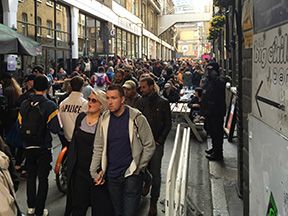
Fortunately for everyone, Spring decided to arrive for the Long Weekend. OK, maybe not spring in the sense of beautiful days in the mid 70s, but at least it was pushing 60 and wasn’t cloudy or drizzling. As a result Shoreditch was an absolute madhouse. My sister Sally and her husband Alan arrived on Sunday afternoon from Denver (just as Linda left to visit Chris, her new friend (and possibly more) in Harrogate). We took a walk around the neighborhood and it was actually tough to walk down Brick lane, which was jammed with people drinking beer, eating street food, listening to street musicians and shopping at pop-up places. It was like a giant, impromptu festival. (See below.) At the same time, Old Spitalfields Market had been cleared out of the usual vendors and they were replaced by a Barcelona Boqueria food fair, with all kinds of ham, croquettes, fried fish, sausages, padron peppers, anchovies, paella and mass quantities of Estella beer.

May Day crowd

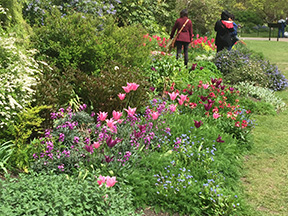
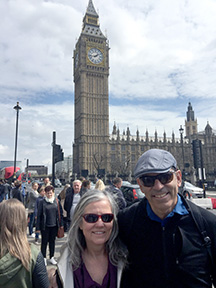
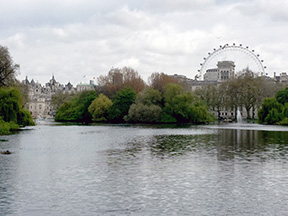
I went out with Sally and Alan the next day, saw an exhibit about Georgione at the Royal Academy and then walked around London. Green Park and St. James Park were both lovely. The trees finally are starting to have leaves and there were tulips and other flowers everywhere. We walked past Buckingham Palace, Big Ben, The Eye and all the way down to London Bridge along the south bank of the Thames. On the way back to the flat, I took the wrong bus and we had to get off, so we walked by the Bank of England and Mansion House. We took a detour to see the Ai WeiWei sculpture under “The Gherkin” and discovered a work crew taking it down. That was a little upsetting since I really liked it (and the Damien Hirst one that was already gone). The workers told me that the sculptures were only supposed to be there for six months and would be replaced shortly. Incredibly long (22,000 steps) walk though and my feel were killing me that night.

St.James4   S&A Big Ben  St.James11

Mayoral Vote Approaches: The mayoral election to replace Boris Johnson will take place on Friday. It has not really gotten the kind of exhaustive coverage that I expected. Perhaps all of the fury (and colorful name calling) about the upcoming Brexit vote has overwhelmed this election. Or it might be that there is a perception that the election is not going to be all that close. It seems to me that Sadiq Khan, the Labour candidate really should win, but there has not been extensive coverage on the BBC about polling for the election (making it very different from a US election). It would be nice to say that the lack for focus on polls means that the news focuses more on the issues. But that hasn’t really been the case. Hopefully, the desperate and racist attacks on Khan by the Conservative (about which I have previously written) will backfire. It will be interesting to see if a Khan win gives any boost to Jeremy Corbyn, who seems to be besieged yet again, this time over anti-semitic comments made by a Labour MP. Corbyn and the Labour leadership came down hard and seem to have said the right things, so it is a little hard for me to see how that has become a leadership issue. I suspect that the still-irate losers from last year’s leadership vote (the Blairites) are just looking for any excuse to trash Corbyn and create a series of phony crises in hopes that they can eventually topple him and get back into power.

Leicester City Wins the Premier League: It is hard to describe what an enormous upset this is. Leicester City has been playing 132 years and has never won anything of significance. This is more incredible than the Cubs finally finning the World Series. I can’t come up with a good American analogy. The bookies are apparently taking a huge bath, since they gave incredibly long odds of this happening before the season (5,000 to 1). Everyone loves an underdog, so this has gotten tremendous coverage (and not just in England–all over Europe).

Mets and Yankees: Part of my routine now is to get up in the morning and see what happened with the Mets (and watch the MLB.TV highlight package). I sometime see the beginning of the games and, very rarely, a whole game if it happens to be a day game. (I really miss the Mets announcers.) It is all looking pretty good for the Mets and their pitching hasn’t even been as good as it should be. If the Nationals stay hot, the Mets may not win the division, although my bet is that they will. But I’m certain that both team will make the playoffs, in the absence of a bizarre series of injuries. The Yankees, in contrast, are off to a terrible start. It is a team of formerly great players increasingly past their prime and for the past couple of years I’ve been waiting for the wheels to fall off. Until this year, the Yankee superstars, even diminished, could play well enough for the team to contend. But now it is beginning to look like the clock has struck midnight and they are all turning into pumpkins (or mice or whatever you like in your Cinderella analogy). It could be an ugly summer in the Bronx.


“The Painkiller” and Other Musings

“The Painkiller”: On Thursday night, we went back to the Garrick Theatre (with Linda) to see the Kenneth Branagh Theatre Company’s production of “The Painkiller”. It was hilarious. The play was adapted by its director, Sean Foley, from a farce by the French writer Francis Veber. It is set in two hotel rooms with a connecting door. In one is Dudley (played by Rob Brydon), a depressed photographer, in town to take pictures of a big trial across the street, who is planning to kill himself if he cannot convince his wife to return to him. In the other room is Ralph (played by Branagh), a hired killer who is there to assassinate the defendant in the trial as he arrives at the courthouse. What could go wrong? Well, pretty much everything in this wild farce. There the dialog is very funny and there is a large amount of truly brilliant slapstick humor. Branagh is constantly being hit by doors or other objects or kneed in the groin. At one point he is mistakenly given a shot of a narcotic (intended to calm down the suicidal Dudley) and has a stretch in which he is barely able to stand and slides down seats lands on the floor in a number of riotous ways. It all goes on at an appropriately breakneck pace, which accelerates when a policeman comes to ask about someone who was seen out on the ledge of Ralph’s room (one of Dudley’s suicide attempts) and the arrival of Dudley’s wife. The lunacy is punctuated by appearances by the hotel clerk (played by Mark Hadfield, who we had seen earlier in the year in “The Meeting” at Hampstead) who seems to arrive just as Dudley and Ralph have fallen in to a position of apparent sex. There is no point in trying to describe the action any further, since it is so antic and so much of the humor is pure slapstick. The leads were wonderful, as was Hadfield and rest of the cast. It is just great to go to the theatre once in while and laugh hysterically.

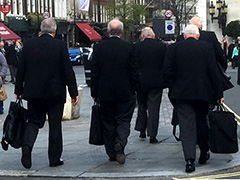
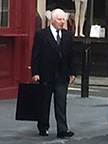
More on the Freemasons: So it turns out that those big briefcases that the masons were bringing to their big meeting (see the prior post) contained their aprons, which apparently you wouldn’t want to wear dirty or wrinkled to such an event. According the site for the Freemason’s Hall in London (I have to go to visit the museum and library some time):

The Masonic apron is the badge of membership for Freemasons. It symbolises the protective apron worn by stonemasons and in its original form was a complete lambskin. When a member joins he completes three ceremonies or ‘degrees’. After finishing the first he receives a plain white apron, for completing the second the apron has sky blue rosettes on the lower corners. The master mason’s apron with its sky blue edges and rosettes is the sign of completing the degree ceremonies. If a mason progresses through the ranks of freemasonry the apron becomes more elaborate with upside down ‘T’ shapes replacing the rosettes for lodge masters and dark blue and gold decoration for more senior ranks. These more senior ranks have two aprons, one richly decorated in gold embroidery for best and one in blue silk embroidery for normal wear.
So I’m guessing the guys with huge square cases were the senior masons with the really snazzy embroidered aprons and that having one of those big, fancy, leather cases is a masonic status symbol.
The Hillsborough disaster: Sometimes stuff happens here that creates a huge response and I have no idea why it is such a big deal. Earlier in the month, the comedienne, writer and actor Victoria Wood died and commentators were near tears. I had no idea who she was. More recently an inquest verdict about the Hillsborough disaster got banner headlines and CNN-like news coverage. Again, I had no idea. It turned out that about 27 years ago, 96 people died at a Liverpool football game when too many fans were allowed into the stands, leading to fans being crushed to death. The whole thing was initially blamed on drunken louts and hooligans. But what really happened was that the police had mistakenly left a gate open and allowed too many people into one part of the stands, which were terribly designed. The inquest not only established this, but found that, almost as the incident was occurring, the police began a cover up that was designed at denigrating and blaming the dead and injured for the the police incompetence. It goes very high up, including some Conservative politicians, although there may not be enough evidence to show that the politicians were complicit in the earlier cover up. It is pretty disgusting and the newspapers, which printed all the awful things the police told them, are falling over themselves apologizing. It is all pretty disgusting. Some officials, including the Chief of Police at the time, are going to end up going to jail.
Not a Good Time to Get Sick: The junior doctors went out on strike this week. They had been staging smaller actions for the past few months, but this was a full-scale strike. The Tory Health Minister is Jeremy Hunt, a typical rich twit whose main claim to fame is that he co-wrote a book on how to dismantle the National Health Service (NHS). He is predictably attacking the doctors, even as he has ignored all efforts to reach a settlement of the dispute. (Perhaps he views the doctors to be like the miners in the 1980s and thinks that this is his Thatcher moment.) The underlying problem is that the Conservatives have been gradually cutting support for the NHS. leading to a shortage of doctors, without any plan to train new ones or to allow for immigrant doctors. So the doctors, especially the junior doctors in the hospitals where most of the NHS action takes place, are terribly overworked and the patient experience is gradually degrading (which some argue is exactly what the Conservatives want since it will allow them the privatize the NHS more easily). The current dispute is due to the government imposing a contract without the Doctors Union’s agreement, which will require doctors to work more on the weekends. The theoretical excuse for this is that the death rate is higher on the weekend (but that may be because sick people stay in the hospital over the weekend, while healthier people are generally released). The doctors point out that this change will only make them work even longer hours or decrease the number of doctors during the week when most patients are there. Either is bad for the doctors and terrible for the patients. It has been suggested that the Conservative theory about weekend death rates be addressed in some sort of trial rather than changing the whole NHS structure, but Hunt won’t agree, which makes the theory that this is part of an insidious Tory plot to destroy the NHS seem plausible.

“The Caretaker” and the Soane’s Museum

Judie’s sister Linda arrived as Jane and Judy left on Tuesday and I spent Wednesday doing some London Stuff with her.

“The Caretaker”: We went to the Old Vic to see a production of “The Caretaker”. It is one of Harold Pinter’s earlier great plays, first performed in 1960 with Donald Pleasance and Alan Bates. It is a play about three men who are broken in various ways. It all takes place in a wreck of an attic festooned with junk. It begins as Aston, the tenant of this dump, brings a vagrant (Davies) back with him. The vagrant ends up staying there for some time. Aston has a threatening younger brother, Mike, who actually owns the place, who comes around periodically. Actually very little happens over almost three fascinating hours, over-layered with a feeling that something just dreadful will befall these guys. This is the kind of play that you can probably play in different ways. In this version, the humor is stressed, but only up to a point. Daniel Mays is just terrific as Aston, who  has a famous speech in which he talks about his time in an asylum, delivered in a masterful low-key way. (Pinter’s directorial instructions had been that Aston should be a man who has not had a conversation with any one for ten years and will not peak to anyone for twenty more when the play ends.) Mick, played by George MacKay, is also wonderful and is menacing just in the way he speaks and pauses and stares at Davies. He has some famous long riffs which he delivers in a stunning way. The play really revolves around Davies, who never leaves the stage. He is played by Timothy Spall (probably best known for playing Peter Pettigrew in the “Harry Potter”movies and J.M.W. Turner in the recent biopic). He plays him as a disgusting, smelly, selfish bum, who is simultaneously repulsive and appealing, funny and horrifying, dangerous and helpless. I thought it was an effective interpretation and it was certainly entertaining. It’s Pinter, so it is an odd and sometimes uncomfortable night out. But by the end, you are glad that you went, which I think is the essence of good theatre.

Sir John Soane’s Museum: This is a museum I had been meaning to go to and, since Linda wanted to go, I went along. John Soane was a well-known neo-classical architect in the the period 1780-1830. He was the youngest son of a bricklayer, but apprenticed to an architect and created himself. Much of his walth came from his wife’s uncle. He designed a great number of buildings in the neo-classical style (including the Bank of England) and believed that building in this style would cause Londoners to behave like the great Greek and Roman civilizations and lead to a sort of golden age. But his theory never really caught on and eventually the neo-classic style fell out of favor and many of his buildings were torn down, often replaced by neo-gothic structures, which Soane hated, (The neo-gothic architects had the own, similar theory that the gothic look would recall the piety of the middle ages and lead to a religious rebirth. It turns out that architecture can do many things, but it cannot change the behavior of men.) Anyway, over aperiod of years, Soane purchased three buildings at Lincoln Inn Fields and completely renovated them. The interior is designed in a unique and clever way. He is responsible for the design of art museums that brings in natural light through skylights, etc. and he uses these ideas to bring light into his house, even the basement. His picture room, which holds paintings by Hogarth and Canaletto and others, is relatively small but holds a large number of paintings by having a number of walls that swing out to reveal more artwork. Very clever. And he also collected all sorts of classical statuary and remnants, which are in a colonnade and in his study and other places. His oldest son died and his youngest was a gambler and a reprobate, so Soane decided to leave his homes and their contents to the people of England and the museum was created by a Act of Parliament shortly before his death. It is quite a place.

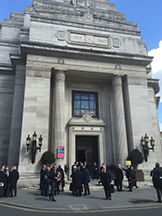
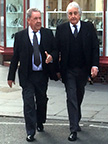
Freemasons: After that museum, Linda and I were walking toward Covent Garden when we saw a big building with Stars of David on the doors and a large crowd outside. It was a great big Art Deco building and it turned out to be the Freemason’s Grand Temple. Normally, we might have been able to go in (as I understand the interior is striking), but on Wednesday there seemed to be a big freemason’ enclave and literally countless older men in black suits were all converging on the place. There was camera crew there filming it. I looked it up later and it was the annual investiture of Grand Officers, a big ceremony for which tickets are required. (Since Freemasons are believed by conspiracy nuts to control the world secretly, I had been hoping that their meeting had some more interesting purpose–to decide how the Brexit vote would turn out or figure out what to do about Trump. So the stated purpose was disappointingly pedestrian, but, of course, who knows what they were really doing!?) Here are some shots of the guys in suits arriving, which don’t really do justice to the weirdness of it all. They were all carrying briefcases or bags that were a bit too large. Suspicious yet?

Freemasons6  Freemason 12  Freemasons9  Freemasons2

Miscellaneous Doodling and a New Painting

English Spring: As of yet, there has been little sign of anything I’d call spring. It is basically days struggling to get over 50 and night dropping below 40, with mostly cloudy days mixed with equal amounts of sun and rain. It’s not exactly depressing, but I am ready to put my L.L.Beans coat away. It is hard to imagine how bleak it must have been back when the air was incredibly polluted. There was actually a brief snow flurry today–first snow I’d seen all year here.

More Racist Comments from Boris: Not content to muck up the London mayoral election with a racist and anti-Muslim attack on Labour candidate Sadiq Khan, Boris and the “Leave” campaign did it again in responding to Obama’s support of the remain people. Incredibly, Johnson actually said that it was all because of Obama’s Kenyan heritage and resulting anti-British Empire upbringing (or something) that causes him to take the position, citing as proof that Obama had taken the bust of Churchill out of the Oval Office. (Obama coolly responded that he would think that most people would understand that he thought it appropriate to have bust of Rev. Martin Luther King Jr. in his office and that Churchill is well represented in the White House.) It is a kind of a minor tiff, but a sign that the “Leave” side are very concerned about the impact of Obama’s remarks, just as the attack on Khan is a sure sign that the Tories are going to lose the mayoral election. But the fact that they are pulling out the race card is disturbing. I had hoped that British politics was above American-style race-baiting. Nope.

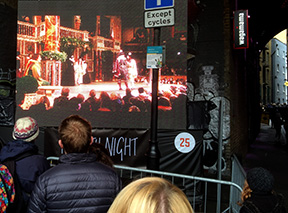
Shakespeare on the Thames: Over the weekend, it was the 400th anniversary of Shakespeare’s death. (Actually, it is unlikely that anyone really know the exact day that he died, but one of the days this past week is the one that is accepted.) They set up 37 video screen along the south side of the Thames and each one had an excerpt of one of his plays. (One screen for each play and each video was around 8-10 minutes.) Jane and Judy went earlier than me and saw close to 25 of them. I had a New Unity meeting and only saw about eight or nine. The films were often taken from productions at the Globe, but a number of them were filmed on location. The “Hamlet” I saw was filmed in Elsinore (and had the soliloquies done in Greek Chorus fashion by five great actors) and the “Henry V” was filmed in Agincourt. All the little films were good or even great and it was a tremendous concept.The whole thing was really a lot of fun and there were pretty big crowds, given the crummy weather. I am watching “Twelfth Night”with Mark Rylance below.

Shakespeare Thames.jpg

New Painting: This one is based on a photo I took in Italy over a decade ago. I started it about a month ago and couldn’t finish it before we went to Copenhagen and America. And then when I got back, I wasn’t sure what to do to it, so I started another one. I think I like working on multiple paintings at the same time. It gives me something to do even if I am sick of one of them or just stuck. I keep thinking I might go back and add some stuff to this one or one of the earlier ones. I’m somewhat torn about this. I have little doubt that I could improve some of my earlier paintings, since I have taught myself better technique over the last six plus months. But I also think that the most interesting this about these paintings, as a group, is the progression from start to now, and, if I go back and fix up the earlier ones, that will be lost. So I guess I won’t.

Tuscany Sunflowers