The Globe and Brexit Vote Near

The Globe Theatre and “Taming of the Shrew”: Last night, we went to the Globe Theatre with Kathy and Jim and saw “Taming of the Shrew”. We had never been to the Globe before. It attempts to be a re-creation of the original theatre, although no one really know what that building looked like. It has three levels of benches (they will rent you cushions) surrounding a standing area which contains the stage. (In Elizabethan times, the poor would stand and the upper classes and nobility would sit on the stalls.) There is no roof over the standing area and a only part of the stage is covered, so you can get quite wet going to a play there. I took a picture before the play started, which you can see below. It gives you a good idea of the theatre layout. Unfortunately, it also illustrates that our view was slightly blocks by the pillar holding up the roof over the stage.

Globe Theatre

The production itself was OK. One of the things they appear to like to do at the Globe is intersperse music in the plays, which I am willing to guess is what they did originally. So there is a small band playing on a level above and behind the stage. This production was pretty broadly played most of the time. There were lots of sight gags and the actors would occasionally break the “fourth wall” and involve the audience, especially those standing along the front of the stage. Between that and the music, it gave the whole thing a feel of what Elizabethan theatre might have been like. I liked that part. Because of where we were sitting  and the fact that the actors are not miked, I missed some of the lines, but I know the play pretty well and really heard all of the important bits. It was enjoyable.

However, I had two complaints about the way it was directed. First, while much of the play was acted broadly and aiming for laughs, the scenes between Petruchio and Kate seemed to go beyond the simple misogyny of the play into a kind of brutality. It was more like Gitmo interrogation than Petruchio taming his shrewish wife. I just couldn’t get any underlying affection, so when Kate finally agrees that the moon is the sun, etc., it is more like she is a broken POW or a hostage suffering from the Stockholm syndrome than a woman having a human relationship. I know that the play is misogynistic and sexist, but this interpretation was really quite creepy.

The other thing that bothered me about the production was the director’s effort to tie “Taming of the Shrew” to the Easter Rebellion in Ireland (it is the hundredth anniversary) and the Irish’s abject failure to produce the promised reforms sought by the many women who fought in that Rebellion. It meant that the acts opened and ended with angry Irish ballads and the actors all had thick Irish brogues (making it all slightly harder to understand) and wore modernish Irish clothes, which was fine I suppose, although you wouldn’t have known that it had anything to do with the Easter Rebellion without reading the programme. I’m guessing that this Easter Rebellion reference influenced the way the Petruchio and Kate scenes were played. I guess the idea was to make the point that women were treated as property and that Petruchio treated Kate as he would a wild horse to be tamed. Its pretty simplistic and it robs the play of any real interpersonal relationship between the two of them, making the end of the play unsatisfying and vaguely depressing. I suppose portraying Petruchio as an awful, hyper-sexist, sadistic jerk might have worked if the rest of the play had been darker and the other men had at least a vaguely similar outlook. But since the rest of the cast was playing it for humor and a more normal interpretation, Petruchio comes off as as psychopath. Oddly, I think this may have been the director’s intent.

The acting was good, of course, and you can’t blame them for the unsettling interpretation of the central relationship. I understand that it is tempting to add a twist to the interpretation of Shakespeare since the plays have been done so often. But sometimes, the director gets in the way of the play itself.

The Vote Approaches: Speaking of unsatisfying and depressing, the campaign leading to vote on the Brexit referendum is winding down and vote will be on Thursday. The two sides took some time off last week after the truly tragic murder of MP Jo Cox, a woman who had spent her entire life trying to help the poor and oppressed, first as an OXFAM worker and later as a charismatic MP. It seems pretty clear to me that ugly, coded racist, and anti-immigrant rhetoric of some of the particularly strident and awful Leave proponents (a minority I grant you), encouraged the far right killer to feel that his act was justified, although few are willing to come out and say it. It probably won’t impact the final outcome, although one might argue that it broke the seeming momentum that the Leave side seemed to have ten days ago and could disgust enough people to make a difference it what will likely be a close vote. It is really a question of turnout. In particular, if young voters, who are said to overwhelmingly support Remain, show up at the polls, that side would easily. But they won’t, so it up in the air. It will be interesting to see the reaction of the losing side.
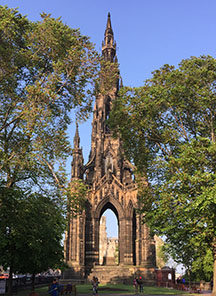
Travel Tales: Scotland

We got back from France and the World War I battlefields and the very next morning we were on the express train to Edinburgh with Chris and Nancy. It is certainly a nice way to get there. A little over four hours from Kings Cross to the center of Edinburgh, with no need to deal with all of the airport stuff. For some reason the first class coach was only slightly more expensive than coach on the way back, so we got to experience that, although the regular coach was really fine. I find that there is less to say about this trip than some others, partly because so much of the trip was enjoying the stunning vistas and I spent less time thinking about history and architecture.

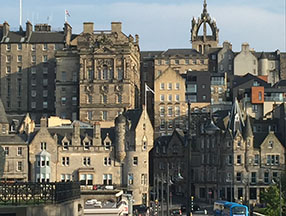
Edinburgh: It really is a lovely city, with most of the buildings a sort of honey-colored sandstone. It has largely escaped being destroyed for centuries (unlike London or even Bath) and much of it is very old and charming. I came to realize as we toured that my knowledge of Scottish history is pretty rudimentary and that the city is, in many ways, a celebration of Scottish history. Now, as it turns out, most of the interesting events in that history occurred before 1600, with endless bloody conflicts with the English (and before them the Vikings and Romans). The Scots were a pretty tough and violent group, much tougher to subjugate than the Welsh or Irish. I wonder if that has something to do with the wild landscape in much of Scotland. The Romans got so sick of dealing with them that they just built Hadrian’s Wall. The English and Scots periodically butchered each other for centuries (often in disgusting ways), but ultimately the Scottish king James I succeeded Elizabeth I and the violent part of their history came to an end. The significant history that followed was mainly literary (Robert Burns, Walter Scott, Robert Louis Stevenson, R. K. Rowling, etc.)

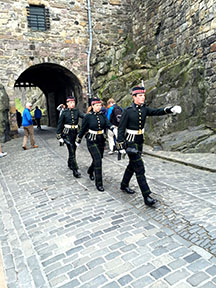
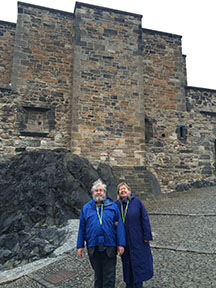
We really only had a about a day and a half in Edinburgh and we were pretty tired from all the travel in France (and Judie had to get some work done), so we really didn’t see as much of the city as we wanted. We did eat at some nice restaurants. There seems to be a serious food scene there and it isn’t all haggis (which I rather like). We did make it up to the castle at the top of the big, volcanic hill at the end of the Royal Mile (the topographic reason why Edinburgh is where it is). It has spectacular views and all kinds of anecdotes about its history (although after three days of Major Tim, I was a bit sick of hearing about battles and slaughter) and guards that periodically change (I’ve seen an awful lot of that over the past several months).  While Judie was working, I was able to wander about and go the the National Museum. We are thinking of going back in August for the Fringe festival. Some photos follow:

Edinburgh 1  Edinburgh 2   Edinburgh 3  Edinburgh 4   Edinburgh 5

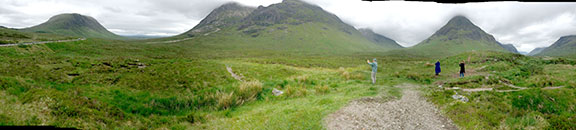
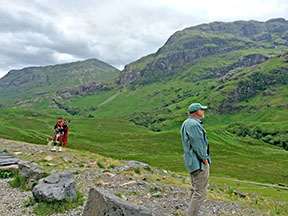
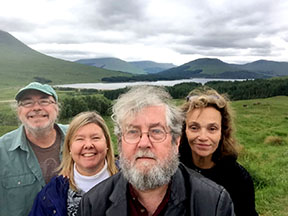
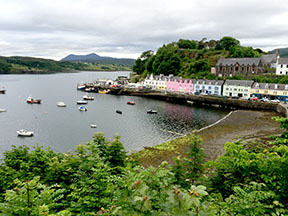
Isle of Skye: I was expecting it to be beautiful, but I really had no idea how spectacular it would be. What was especially surprising was how drop-dead gorgeous the drive was. We rented our car in downtown Edinburgh and drove up through the highlands in western Scotland. Glen Coe is probably the best known of the many lovely areas we went through, but each one was jaw-dropping. Some pictures follow, but they really don’t do justice to the drive:

Skye road 1    Skye road 2   Skye road 3   Skye road 4   skye road 5

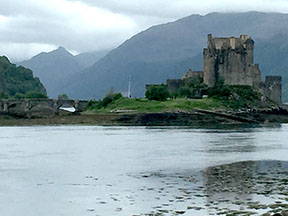
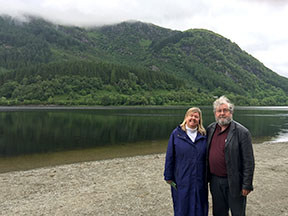
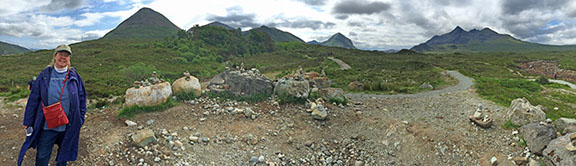
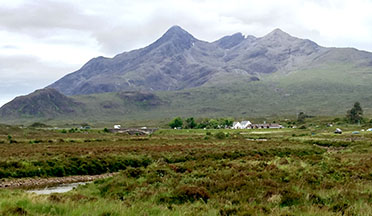
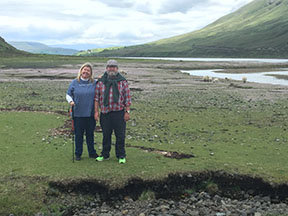
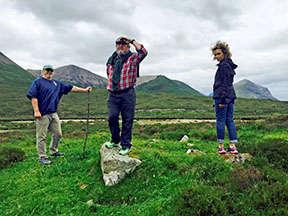
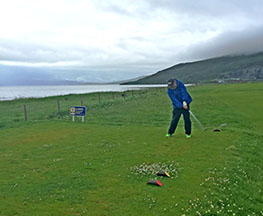
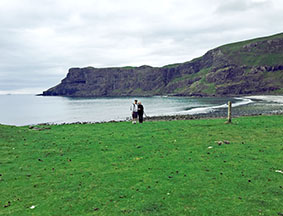
Skye itself was lovely. Out hotel was in the middle of a group of volcanically formed mountains (any peak over 3000 feet is called a “munro” and there are a big number of them in Skye). We took some long hikes, although we didn’t do much climbing. We went once along a lovely long inlet that led out towards the sea from our hotel and which was surrounded by green peaks and once out to Talisker Bay. We went on a tour of the Talisker Distillery and the best thing about it were their self-designed distilling vats, which looked like something out of “Willie Wonka”, bulbous shapes with various pipes going in and out and twisting around, all painted brightly. Rich Lustig and Chris and I played golf on Skye’s small golf course, which was at an impossibly lovely setting. Unfortunately, it began raining just as we started and either poured or drizzled for all nine holes. We persevered, getting utterly soaked. By the time we finished nine, even the Scots were giving up and coming in. We ate lunch at a famous restaurant (absolutely in the middle of nowhere–you had to drive miles on one lane roads to get there) called the Three Chimneys one afternoon and went to the impossibly adorable town of Portree one evening for dinner. Of course, evening is a relative term in Scotland in June, since it doesn’t actually get dark until about 11:00.

We drank a fair amount of scotch whiskey, especially at our hotel’s pub, which had hundred of whiskeys available. I began to get a feeling about the different styles and the terroir that leads to the different flavor profiles. It was a pretty lively place, which had a band and dancing one night as well. (And, weirdly, the young woman who managed the place was from New Jersey.) While sitting and drinking at the bar one evening, we met two older gents from the Midlands, who were on their annual climbing trip to Skye. Each time they try to do the Cuillin traverse, a hike that takes you up and down the spine of that range and over eleven munros. They had quit for the day because the rain (that hit our golf) made it impossible to see more than five feet up there. The had tried that traverse four or five other times and only finished once (taking three or four days, not including going up to stash supplies at various spots). The other times had been stopped by weather that made it too dangerous and once when one of them slipped and was tumbling head over heels toward a cliff when he was saved when he hit a bog. They were entertaining, but, as far I was concerned, crazy. Some Skye pictures follow, but you really had to be there.

Skye 1  Skye 2   Skye 3  Skye 4   Skye 5  Skye 6  Skye 8   Skye 7

Royal Ascot, National Theatre and Other London Thoughts

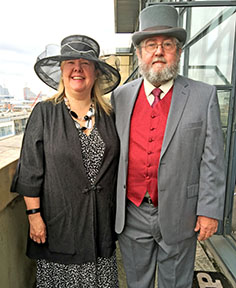
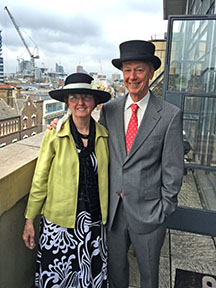
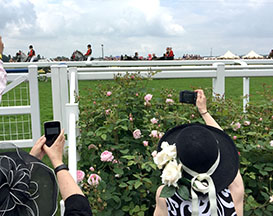
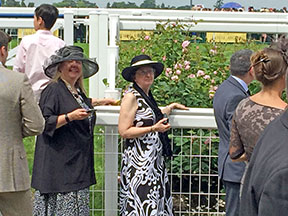
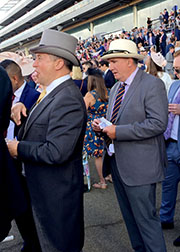
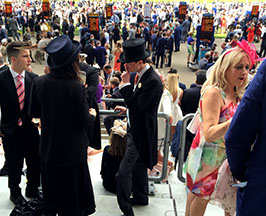
Royal Ascot: On Friday, we went to Royal Ascot with Judie’s sister Kathy and her husband Jim. It is an expensive day out for what is basically just a day of horse racing. There are two things that makes it special. First, the Queen comes to all five days of Royal Ascot and each  of the days open with her being brought down the track in a carriage to the Royal Pavilion. (See the picture below of her passing by while Judie and Kathy are taking pictures.) And second, everyone who goes gets incredibly dressed up, so the real entertainment is looking at the other people there. Photos of us follow:

Ascot 1   Ascot 2   Ascot 3  Ascot 4

A few more notes about the experience. To get there, you need to either drive or take the train from Waterloo (about and hour, as it it past Heathrow.) I felt a bit silly on the Tube wearing my fancy duds and top hat, but when we popped up into Waterloo, there were lots of people similarly overdressed all streaming toward a platform. We barely got seats on the train, which was a good thing because at each of the six or seven stops along the route more and more people got on, until the cars were more crowed than rush hour Underground coaches (excepts that all of the sardines were very well dressed). When we finally got there, it took nearly 10 minutes just to get off the platform. For £78 a person, we had the privilege of being in the Queen Anne Pavilion, which was right along the homestretch. (The British tracks run in the opposite direction of US tracks.) To be there, we needed to adhere to the dress code. Hats for women, suits and ties for men, etc. But we didn’t get anything else with our ticket, not even a seat. Of course for hundreds of pounds more, we could have sat in special boxes or enclosures and had champagne and strawberries, etc. The bars were easier to find than the food and the patrons certainly drank it up. Pitchers of Pimm’s Cup, bottles of sparkling wine, lots of beer, none of it cheap. It was quite the booze-up. If I ever go again (and I have to say that I’m not inclined to do so), I think I’d go completely over the top and opt for one of the expensive enclosures.

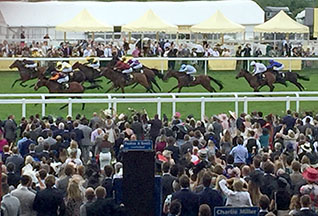
Ultimately, of course, it is just a horse race and you go there to bet on the ponies. When betting, you still have a choice between the parimutuel windows and the bookies on the track, who now have electronic odds boards, rather than the traditional chalk boards. I preferred the bookies, since it made the whole experience feel more like being in a Dick Francis novel. We won £200 on the second race and then proceeded to lose most of it, finishing slightly in the black. Since I had budgeted losing a couple hundred pounds, I felt like we came out way ahead. We skipped the last race in favor of beating the crush on the return trains.

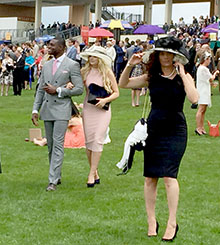
All in all, it was fun and one of those really British experiences. It is hard to imagine any sort of event in America where you would see hundreds of men in morning suits and silk top hats and tens of thousands of women in fancy dresses and either hats or fascinators and not a single person wearing jeans or a tee shirt. It is sort of vestige of the class system, but it allows the hoi polloi to join in if they are willing to pony up for a ticket and get dressed up. This slight democratization of the event makes it less horrifying. Of course, the unwashed masses (including us) can’t go in the Royal Pavilion,  which is limited to those who are recommended somehow. A few more photos follow:

Ascot 8   Ascot 5   Ascot 9   Ascot 6   Ascot 7

“Sunset at the Villa Thalia”: On Thursday night, we went to the National Theatre with Chris and Nancy and Kathy and Jim to see “Sunset at the Villa Thalia”. It is set on a Greek island in 1967 and then in 1976 for the second act. It is about a young British couple (an aspiring playwright and his actress wife), who are visited by an American couple. The American husband, Harvey, played superbly by Ben Miles (who NYC theatre fans may have seen as Cromwell in “Wolf Hall”) is force of nature, who you soon suspect is a CIA operative. He charms and bullies and cajoles everyone around him and ultimately convinces the young couple to buy the villa from the Greek family who are emigrating to Australia, really capitalizing somewhat on their desperation. On the one hand, this was a play about the relationships between these couples. But the characters, except for Harvey are not sufficiently developed for there to be real dramatic tension or compelling theatre. Elizabeth McGovern has moments as Harvey’s wife, but she is never allowed to be much but brainless and ditzy, which seems like a bit of a waste of her talents. Pippa Nixon has a few moments as the young actress/wife, but her character is mostly just strident and lacks much nuance. And poor Sam Crane, as the young playwright, has little to do as his character is an ineffectual cipher. The author tries to add some spice to all of this by setting it at the time of the coup in Greece and then returning in the second act with references to the overthrow of Allende. Harvey gets to make speeches about the importance of democracy and maintaining the world order and that sort of hot air (which no CIA operative would ever have said) and, while Miles is so great that he almost makes the speeches convincing, the key word in that last clause is “almost”. Pippa Nixon has a big speech attacking American foreign policy of the period, but it is all pretty obvious. The whole political subplot was both simplistic as political commentary and clumsily tied to the rest of the plot. By the end of the play, you were left wondering, “What was the point of all of that”. However, despite the weaknesses of the script, it was a pretty entertaining night of theatre, simply because Ben Miles and the rest of the cast squeezed whatever there was to get out of that script and the set and lighting were lovely.

Brexit: If you care anything about this issue, you have recently had the opportunity to read countless articles about it in the NY Times and probably other sources. (It would seem to be a great vehicle for John Oliver, but he hasn’t touched it as far as I can tell.) It is certainly the second most important vote that will occur in 2016. Right now, it is beginning to look like the “Leave” group will win, which would certainly be a short-term economic disaster for Britain and bad news generally for the world. It is all a result of a toxic blend of anti-immigrant racism, jingoistic nationalism and a conservative wish to return to days that have long since passed. (Sound a little like Trump?) In addition to causing a recession and a permanent shrinking of the economy here, Brexit could lead to the break-up of the United Kingdom, God only knows what in Europe and Ireland and will lead to the demise of David Cameron. It will set the stage for the vicious far-right wing of the Conservative Party to take control, with their agenda of finally eviscerating unions, privatizing and/or eliminating the Nation Health Service, lowering taxes on the rich,  dispensing with regulations, etc. It could be a very ugly period coming up and I think getting back to the US next Spring will look pretty good, assuming the American electorate doesn’t do the unthinkable.


Travel Tales. Part 2: War! What is it Good For?

Our trip to France was filled with all sorts of interesting events and places where we learned a great deal about what happened a hundred years ago. Before I go through them, though, I have say that our overall feeling was one of sadness, mixed with a certain bewilderment at the totality of what we were seeing and hearing. The war itself was unspeakably awful. The trench warfare, the endless bombing, the sides separated by less than 100 yards at many points, forested areas reduced to stubby and muddy rubble, the ever-present danger of poison gas attacks, and countless men dying in miserable conditions. And what for? So the Kaiser could have an empire to match the English and French? Because the British seemed incapable of going more that 20 years without getting  into a war? Just because these nations and monarchs had been fighting in Europe for untold centuries and just did it out of habit? Just a mind boggling waste of human life.

Nobody was there: One of the eerie thing about touring around this area was how empty it was. There were very rarely other people at any of the battle sites or monuments, except for an occasional American at a cemetery. And much of the area is farm land, so, other than a random guy on a tractor there was no sign of life between the towns. But what was really weird was that the towns themselves were empty as we drove through them and most of the houses were shuttered. Maybe they all go to work in the bigger towns like Verdun? But we also didn’t see any kids. It gave it all a surreal quality.

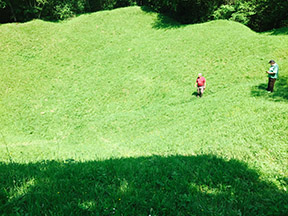
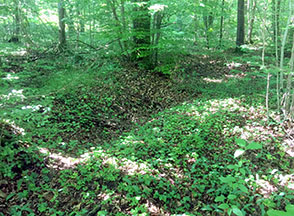
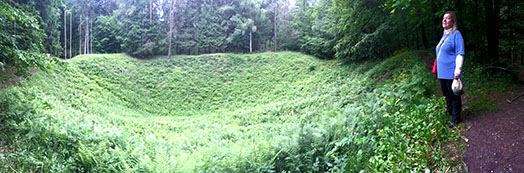
Trenches, bomb craters and other remains of war: Early on the first day of touring (as opposed to traveling), we stopped along the side of a road through the wood that had once been a Roman road. When I stepped a few feet off the road into the woods, I immediately saw a large hole and then about ten or twenty feet to my right was another hole. And crisscrossing area were linear cuts into the earth. These were old trenches that had been built along the road and artillery craters caused when the trench system along the road had been systematically bombed. The craters and trenches had been filled in over the years by leaves and stuff, but they were still clearly visible. The incredible thing was that they were just everywhere you looked that wasn’t being farmed for miles and miles. The landscape was still seriously scarred, even after over a century. But these weren’t the biggest scars. Those were enormous craters, often twenty or more feet deep even today and up to hundred feet or more in diameter, caused by mines. Both sides had engineers who would dig underground tunnels out to a certain point, fill the end with explosives, backfill and then set it off. This mining could be offensive, since it would destroy whatever was above it, but it was also defensive, as it would create a deep crater that would stop tanks and that no soldier in his right mind would venture into. These were everywhere too. The first place we saw a lot of them was at a bluff overlooking the Saint Mihiel Salient, a hell hole similar to the one I describe below. This is where Great Uncle Arthur’s regiment had left for the Battle of Saint Mihiel. We also saw the remains of concrete bunkers and fortified gun emplacements.

Mine Hole   Craters   Mine Hole2

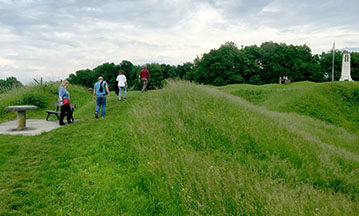
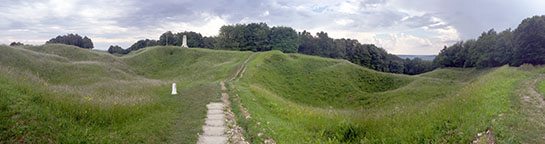
Butte de Vauquois: This was an incredibly powerful example of the lunacy of the War. Vauquois had been a little town up on a woodsy hill, overlooking the valley leading to Verdun. The French and Germans fought over it for four years. The town was completely destroyed, all the vegetation was blown to bits and the two sides were dug in on opposite sides of the top of the butte, separated by around 30-40 yards. In between them were a series of extremely deep, undoubtedly muddy craters caused by huge mine explosions, which must have made any direct assault all but impossible. But, just in case, there was barbed wire and those iron spike things, which are sill rusting away there. The trenches and craters are also still there, as are the communication trenches snaking down the hill and many smaller craters caused by artillery attacks. You can stand there now, surrounded by grass and trees and flowers and can admire the view down the valley and the small monument. But it doesn’t take that much imagination to realize that you are standing in a place that was once hell on earth.

Vauquois   Vauquois3Vauquois2

Machine guns and other weaponry: I think I had always imagined World War I as soldiers in trenches firing at each other across a no-man’s land in a sort of fighting that was essentially close quartered. It turns out that, while that was true, weapon technology had changed the style of war in the Twentieth Century. Large artillery could fire accurately over ten miles and the smaller artillery had ranges of many miles. What was even more surprising to me was the range of the fixed machine guns, which was well over a mile. If you were charging across a field, you wouldn’t even hear the shots before the bullets reached you. The machine games were positioned and aimed so that they would fire obliquely against an advancing line, trying to hit down the line, rather than spraying fire by moving the gun. As a result, when troops were advancing across open terrain, they would avoid staying in a line and would be separated by as much ass 30 yards, so that incoming artillery could not take out groups of men. You had to imagine those poor soldiers going through an open field, probably slogging through mud and over barbed wire, sometimes up and down steep hills and getting mowed down by machine guns and artillery so far off that they couldn’t possibly see them. And the soldiers they were trying to actually engage might be ahead in the tree line, in trenches or other reinforced places, firing at them as well, and possible also out of sight.

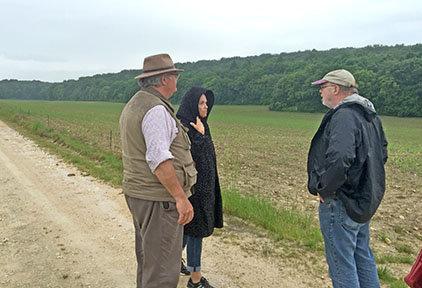
Uncle Arthur: I have to admit that I was a bit skeptical about going on a trip that was focused on Nancy’s Great Uncle’s death. It seemed like we would be spending too much time on a trivial moment in a larger story. But it turned out that the focus personalized the tour in a way and gave it a larger meaning. Rather than simply going from monument to cemetery to the next battle site or line of trenches (which we did plenty of), we were either following his trail or at least relating what we were seeing to what he must have experienced. His regiment had been in support at the beginning of the Meuse-Argonne campaign, but they eventually switched and relieved the unit in front of them. Major Tim determined from the maps and other research that he had been fighting in a forest near Brieulles-sur-Meuse and Dannevoux when he was killed. In the photo below, you can see Major Tim and Nancy, next to those exact woods and certainly no more than a quarter mile from where he died.

Uncle Arthur

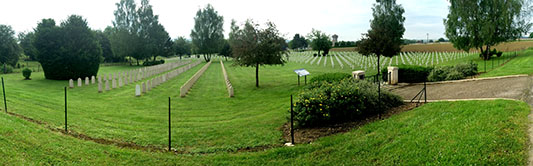
Cemeteries: This whole area is dotted with cemeteries. There are a huge number of French cemeteries, which tend to be smaller. (The one below is bigger than most.) Their crosses are often made of concrete, which degrades and, perhaps because there are so many little cemeteries to maintain, they are sometimes slightly overgrown with broken crosses (which Major Tim, of course, attributed to French character flaws). Most of the French cemeteries had Muslim tombstones, which were in a different shape. In some, these were put in a separate area and set facing Mecca (see below), while others were just mixed in and facing like all of the others.

Cemetery3

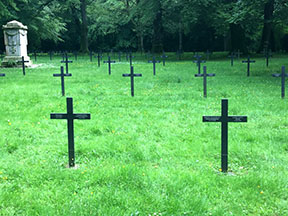
There were also a surprising number of German cemeteries. The regular German soldiers were not sent home for burial and I was mildly surprised that the French didn’t get rid of them. These cemeteries would often have as many as four soldiers to a cross. The crosses were thinner and made of metal and were very attractive. I was interested to see stars of David on many of the crosses, representing, of course, German Jews who had died. Major Tim told us that Hitler had issued an order that prohibited his German troops fro desecrating those Jewish burial sites, on the grounds that they had died for the Fatherland.

Cemetery4

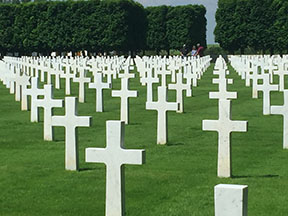
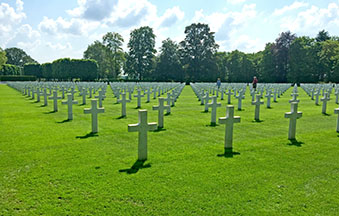
The American cemeteries were very different, in that they are very large and immaculately maintained. American families had a choice between bringing their dead home for burial or leaving them to be interred with their comrades in arms. The two that we visited, one for Saint Mihiel, containing nearly 5000 dead and the one for Meuse-Argonne, which contained over 14,000, were gorgeous, with grass that would make a golf course jealous and beautiful rows of trees and flower beds. Nancy was able to visit the graves of four other Maine farmboys who had been in Great Uncle Arthur’s regiment, although he had been sent home for burial.

There is something about the geometry of all of those crosses, especially all of the white marble crosses in the large American cemeteries that was incredibly powerful. The patters and the lines of sight keep changing as you walk through, which somehow reinforces the fact of the number of dead that are present. Some pictures follow, but don’t really capture this.

Cemetery1  Cemetery2

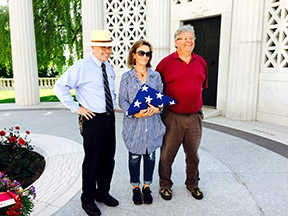
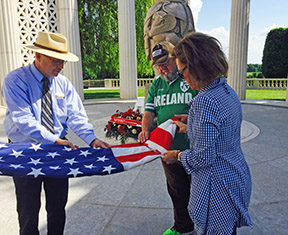
Flags: While we were at the American cemetery for Saint Mihiel, we were looking at the views when Major Tim said “Hey. That looks my friend Jeff.” Jeff was someone who he knew as the superintendent of a different cemetery. He had been transferred and was now in change of this one. He greeted us, showed us around, answered our questions and showed us where they are systematically replacing the old headstones. He took us to his office, where he gave Nancy advice on her searching and told us anecdotes. As that was ending, he said “It’s almost five o’clock. Would you like to help me take down the flags?” The cemetery had two big poles with large flags and we got to take them down. And then he directed us on how to properly fold a flag, so that you end up with a perfect triangle. Doing that, surrounded by thousands of headstones, was a powerful moment.

Flag fold    Flag Fold 2


“The Deep Blue Sea” and More

This is a bit of a catch-up post, most of which was composed before we left on our various trips over the past ten days.

The Deep Blue Sea: We went with Chris and Nancy to the National Theater to see “The Deep Blue Sea”, a play by Terrence Rattigan first performed in 1952. (It was later a film, starring Vivian Leigh in 1955.) It is a story of a woman who has left a loveless marriage and run away with a handsome pilot who can’t seem to get over the War. But it turns out that he is really incapable of loving her and the attempted suicide ends up terminating their doomed relationship. The play begins with her attempted suicide and doesn’t get much happier from there. Helen McCrory plays the central role of Hester with the usual good supporting cast. (She is one of those actors who is more famous in British theater, although she did play Mrs. Malfoy in the “Harry Potter” movies.) Her dissolute love interest is played by Tom Burke, whom we saw playing a strikingly similar role in the much more modern “Reasons to be Happy” at the Hampstead. There are some melodramatic moments, but over all the play is so well constructed that it maintains your attention, even if it is a bit dated in some respects. The central psychological drama manages to ring true today, possibly because Hester was an atypical and modern woman for 1950s Britain. The push and pull of her relationship with her ex-husband and lover are key to developing her character, but it is her scenes with the upstairs doctor that are most compelling. The dramatic tension comes from your doubts as to whether she will end up killing herself or pull herself together and get on with the rest of her life. The play does not clearly resolve this question in the dialog, but a the end Hester is left alone and is staring at her lover’s clothing as she is packing it up to send to him and you think, “Uh oh. This is it.” But she had just put an egg on the stove to fry and she is startled out of her reverie and goes and finishes cooking the egg and then sits down to eat her egg sandwich as the play ends. This little bit of stage business gave the feeling that the urge to end it all had past and that she was going to move on with some sort of life. I wonder if it was in the original stage direction?

Painting slow-down: I haven’t been able to get to my paintings much lately, although I have two in process which I can’t seem to finish. One is a study of Jerry Fried and me standing at the end of a nearby alley. Right now it is in a sort of nether world between being realistic and impressionistic. I’m beginning to think it is more cartoonish than anything else, so I may go that way. As for the second one, I’d decided to do something without some much little detail and started painting two frogs sitting on lily pads. I discovered that I am incapable of drawing a decent looking frog, so after several attempts, I just painted the damn things over and now have a perfectly pleasant, if slightly boring, painting of some lily pads. I’m not sure where to go with that one….

Travel Tales, Part 1: World War I in France

We are finally back from a fairly exhausting trip with our old friends, Chris and Nancy, that saw us go to World War I battlefields around Verdun in France and then up to Edinburgh and the Isle of Skye. Lots of driving and riding in cars (something we haven’t done much in many months), plus trains and the ferry across the Channel (so we got to see the White Cliffs of Dover, which always remind me of the movie “Help!”).

The World War I trip was one that we would never have planned, but Nancy has been researching her family history and wanted to go to where her Great Uncle Arthur had been killed. She arranged the whole thing, including our own tour guide, so all Judie and I had to do was get out our credit cards and tag along. I was worried it might be a bit tedious, but it turned out to be both fascinating and fun, thanks in large part to our guide, Major Tim Pritchard-Barrett.

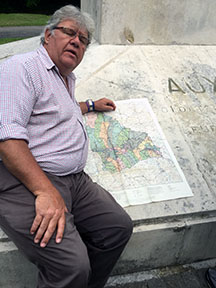
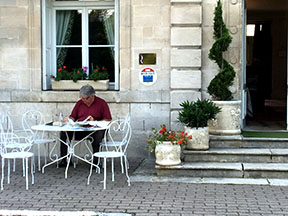
Major Tim: Our guide was a former major in the Welsh Guards (who fought in the Falklands War). He was from an upper crust family in Northern England and went to private schools and Sandhurst (the UK equivalent of West Point). (One twist for him is that he also had roots in South Carolina.) He had that patrician sort of snobby English accent and freely expressed his prejudices against immigrants, gypsies and, especially, the French (lazy sods). So on the one hand he was a bit of a jerk, but at the same time he was interesting and had one of those dry, British senses of humor. Most important, he had encyclopedic knowledge about World War I and military history and really knew the ground we were covering. He had done research specifically for Nancy and was able to pinpoint, with amazing precision, where her Great Uncle Arthur had marched and fought and where he had died when the hand grenade he was carrying was hit by a shot and exploded. While he was a bit of a mixed bag personally (especially since we spent so much time in a car with him), as a guide he could not have been better. Photos below. Notice him studying up for the day.

Major Tim   Major tim 2

Where We Were and Some Historical Context: Most World War I tours, especially the British ones, concentrate in the Somme area, near Flanders, where the British French and German armies slaughtered each other for four years for no particularly good reason. The American forces never got up to that part of the War and, instead ended up near Verdun, supporting the French troops. This was partly because General “Black Jack” Pershing, who led the American Army, rejected the French idea that American troops be slotted into the lines wherever needed in a piecemeal fashion. Pershing insisted that the Americans be together in one fighting force. So they ended up West, around Verdun. That area is one of those places where battles had been taking place for centuries. It is near Waterloo and other Napoleonic battles, was the center of the Franco-Prussian War of 1871 (in which the Germans had taken back most of Alsace and Lorraine, leaving France only the area around Verdun) and later World War II. I’d guess that people like Charlemagne marched through there and neolithic cave men probably smashed each other with bones there. The French were absolutely determined to keep Verdun and the Germans were determined to take it, so there had been years of awful fighting in the area by the time the Americans showed up with their impossibly green troops. (Major Tim told us that shortly after the Americans arrived at the lines, the Germans did a quick “Welcome to France” raid in which they killed a bunch of soldiers and withdrew taking over 100 prisoners.) But, of course, more and more American soldiers kept arriving and by the time of the Armistice, Pershing had two full armies and plans to march well into Germany. America may have formally joined the war in 1917, but by the time the Americans were really ready to fight, it was the summer of 1918 and there were only two campaigns in which they fought:

The Saint Mihiel Salient: Saint Mihiel is a town south of Verdun on the Meuse River and on the train line which was supposed to supply the French in Verdun. The Germans managed to capture it early in the War and had never lost it. Their successful offensive had created a kind of triangle sticking into French territory along the battle front, which for some reason is called a salient. It is mostly flat fields along the middle of the salient with wooded hills along the sides. In a battle that went from the 12th to 15th of September, the American and French forces attacked from the sides of the triangle, leaving Saint Mihiel itself alone, until they met in the middle, effectively cutting of the German troops in the town and forcing their surrender.

Meuse-Argonne Campaign: This is the more difficult and well-known American war effort. It is where Sgt. York became famous, where the “Lost Battalion” fought and where Great Uncle Arthur died. The American forces attacked to the North over a terrain of forested hills and ravines, separated by open fields. The Americans, did great the first two days, as the Germans dropped back to heavily fortified lines and then the offensive bogged down and the fighting got very ugly. At one point, there was some pressure to replace Pershing, according to Major Tim, but that never really got anywhere.

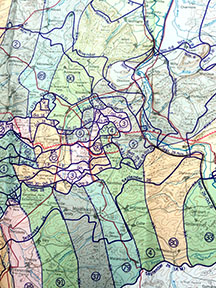
Helping us understand all of this were some incredible maps of the American battles, created after the war by Major Dwight D. Eisenhower for book he wrote analyzing the U.S. operations in France. The maps seem to be staple part of many of the newer monuments. See below.

Argonne Map

I’ll write more about my impressions of all of this and add some more stories in the next post. But before that, I need to mention a few non-War things:

There had been torrential storms before we came and the rivers in the area were over their banks in many places. You may have read that the had to close the Louvre at that time to move artwork to higher floors. This made the off-road explorations that Major Tim took us on a bit problematic. But it meant that everything was beautifully green and the poppies were growing like crazy.

Poppies

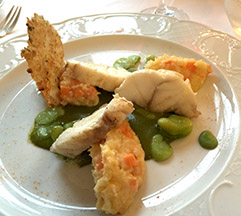
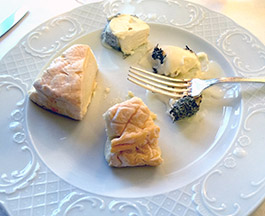
We stayed at an amazing French chateau (see below) called Chateau du Monthairons. In addition to being beautiful, it had wonderful meals and we ate there twice and once in Verdun. During World War I, it had been used as a French Field Hospital and it had lots of pictures of that. During that period, the composer Maurice Ravel worked there as an ambulance driver and there is a story posted about a moment when this unknown driver found a piano in the hospital and shocked everyone by sitting down and playing beautiful music. (During World War II, the Chateau was German Officers’ Headquarters. There were no pictures displayed of that.)

Chateau   Chateau fish   Chateau cheese


Standing on the Side of Love UK

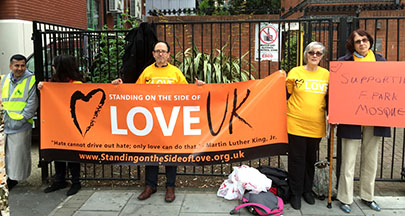
Today, Standing on the Side of Love UK held its first action. Five of us went to Finsbury Park to stand in support of the Finsbury Park Mosque, which had been the victim of a hate crime the prior week, when a bag of raw pork was thrown over their wall. Our SSL-UK group had finally gotten beyond it initial organizing phase and it was time to get out and do something positive. It went very well.

As hundreds of individuals and families flowed down the street and into the mosque, most smiled at us and our banner and some stopped to thank us for coming to support them. A few even took our picture. The head of the mosque came out to greet us and had one of his staff stand with us for a time (that’s him in the photo below) and later sent us some lunch and bottles of water. The local police came by and chatted with Rev. Andy and were very friendly and supportive. It was an overwhelmingly positive experience.

It was a reminder of the power of love and the simple effectiveness of “Standing on the Side of Love” as a social action tool. As people approached the mosque and saw a group there with a sign, you could see them relax and often smile as they read the message. It is a simple one, but it works. It is nice to be one of the “Love People”. When we departed, we left some little biodegradable hearts on the sidewalk as a reminder that we were there.

We are off to a very encouraging start and I am looking forward to seeing where this movement can go. Here is a picture I took of us next to the mosque:

SSLUK1

Trip to Bath and Stonehenge

My last post got a bit long. I was trying to get ready for our two-day trip with Robbie and Bob and didn’t have the time to break it up. I appear to have made this one a bit long too.

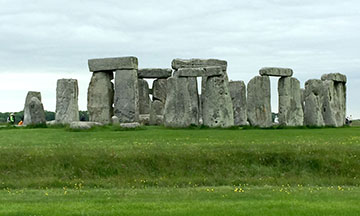
Stonehenge: On Tuesday morning, we caught a train to Salisbury, rented a car and drove to Stonehenge. Judie and I had been there over 30 years ago and I recall it as a muddy path from a car park to a monument surrounded by a chain link fence and a few signs. It has been fixed up in quite a nice way in the decades since, with a big visitors center, car park and a bus to the site. The admission includes an audioguide, which provides all kinds of information about who built Stonehenge (not the Druids, who came much later), where the stone came from (some of it was a special, magical blue stone all the way from Wales) and speculation on what it was used for. A great deal of archaeological work has been done, both at the site and in the surrounding area in the past thirty years and they know a lot more about it. The weather that day was overcast and threatening and there was a gale-like wind blowing, making for an evocative, if chilly, experience. It really is quite amazing. The idea that Stone Age people hauled chunks of rock weighing as much as 30 tons for many miles and then shaped it using nothing but stone tools and ended up with mortise and tenon joints and rocks that line up perfectly with the solstice is mind-boggling. It had to have taken a big part of the population of the day, not only simply to move and shape the stones, but to feed the workers, make the tools and rope , and organize things. On top of all of that, it is also a simply beautiful piece of sculpture.

Stonehenge1   Stonehenge2   Sonehenge3

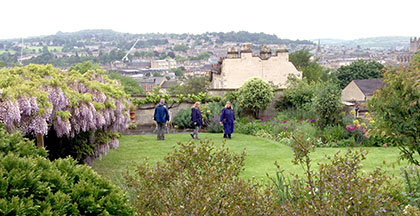
Bath: There are at least three things that make Bath a very special place. First, it is ancient. The mineral spring that is the reason for its existence drew pagan tribes to the area for religious and possibly healing purposes for many of thousands of years. (A lot like Stonehenge.) The Romans found the springs and built a large complex of Baths on the site, which were covered over for a thousand years or more and then rediscovered (more about that below). Second, it is an architectural treat. When Bath was rediscovered in the Georgian Age by the gentry desiring to get the health benefits of a mineral water spa, the town was redesigned and built-in honey colored local sandstone, mostly under the direction of George Wood and his son, creating a lovely cityscape that is essential unchanged in the intervening 250 years. And third, partly because it is so unchanged, it evokes thoughts of Jane Austen, who lived there, set two of her books, “Persuasion” and “Northanger Abbey” there and whose other books often seem informed by her experiences there.

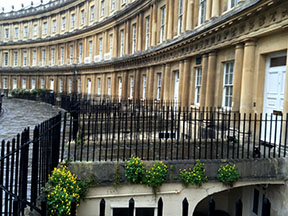
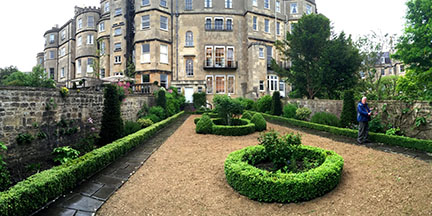
Because Stonehenge required a lot more time than we’d planned and we decided to stop at lovely country pub for lunch, we didn’t get to Bath until late in the afternoon. We went to our hotel, Paradise House, a small place located on a hillside overlooking Bath and the surrounding countryside. It had a delicious breakfast, great service and a spectacular garden. It is actually one of the few older buildings in that neighborhood, as most of the area was wiped out in the “Bath Blitz”. (In 1942, the Germans bombed Bath, supposedly in retaliation for earlier RAF bombings of two German town with little military importance. You can still see scars on the buildings in Bath and many had to be substantially restored after the war.) Judie stayed in the room to work and Robbie and Bob and I walked down the hill into Bath, but by the time we got there it was after 5:00 and most of the tourist things to do were closed. With three hours to kill before dinner (Judie had a 7:00 call), we walked around the town , checking out the architecture and general scene, stopping for a glass of wine to rest (Bath is hilly), and then walking some more. The streets of the town are lovely, especially if you ignore the fact that the street level on the commercial streets is mostly chain stores. We walked up a long curving path to the Royal Park to see the Royal Crescent. The Crescent is a spectacular semi-circular ring of buildings built high on a hill overlooking Bath. It was designed by George Wood, who died five days after the first foundation stone was laid, and finished by his son. The most unusual thing about it is that it was built as a facade and then sections were sold to wealthy individuals who had their own architects build the actual premises out the back. So a lovely unified face and a hodgepodge rear. It turned out that the path we walked was built later so that the wealthy people in the crescent could be transported down to the baths without having to go down the main streets. But our favorite place was The Circus, a complete circle of three of these crescents, with a park with big old sycamores in the middle. It was designed by the younger George Wood and was just perfection. We finally made it to the Olive Tree for dinner, footsore and hungry, where Judie met us and we were rewarded with a truly delicious meal.
Bath1   Bath2  Bath4Bath3

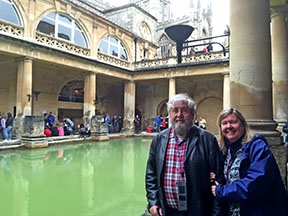
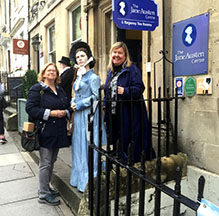
The next day, after spending some time in the hotel’s marvelous garden, we went into Bath and headed for the Roman Baths. Just like Stonehenge, it was much better than the place we recalled visiting over 30 years ago. A lot more excavation had been done and the whole museum area was more informative. And once again the admission included an audioguide, which added to the information about the whole thing that we were able to learn. (The audio guide included additional commentary by Bill Bryson, which sounds like a great idea, but it turned out that he merely stated the obvious or resorted to being annoying.) You could see the spring bubbling and steam rising from it and the whole thing is great feat of engineering. Since we were lat there, they appear to learned a lot more about the religious functions of the baths and the range of people who came from all over the Roman Empire to visit them. Their excavation of the Temple was impressive and cleverly presented, using video to fill in the missing bits and pieces. You could see where the water of the old spring area had been lifted to provide for the King’s Bath in the 1500s. It is kind of incredible that the whole thing was covered over and “rebuilt” by the Brtish and eventally virtually forgotten. The whole tour concluded with an opportunity to taste the spring water, which was warm and oddly “minerally”, but not really unpleasant. The whole tour took a long time, but ti was worth it. With our time to leave on the horizon, we chose to go to the Jane Austen Museum. We learned quite a bit about her life in Bath. She resided in a number of places in the city, partly because she and her sister and mother lost most of their income after her father’s untimely death. Although she wrote “Nothanger Abbey” on her first visit to a relative, the period when she actually lived there was relatively unproductive. But it led to a number of her great works, until she died too young at the age of 41. I suspect there are better places to visit in Bath, but Judie and Robbie are big Austen fans. One other thing about Bath are the references to the fact that it was a social hub in Georgian England, with the entertainment and social scene directed for 50 years by Beau Nash, a dandy and gambler, whose semi-official tile was Master of Ceremonies.

Bath5  Bath6  Bath7   Bath8

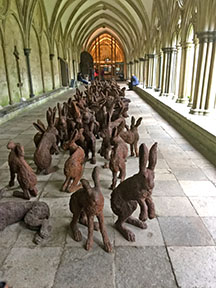
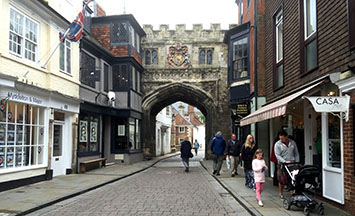
Salisbury: Annoyingly, our rental car company closed at 5:30 and had no provision for dropping the car outside of office hours, so we had to leave Bath a bit earlier than we would have liked (or we would have been stuck with the car until the next morning with nowhere to stay). We made good time returning and had an extra 45 minutes or so to go and check out Salisbury Cathedral. It is one of the biggest cathedrals in England and has the tallest spire. The interior is very impressive and suitably ancient, with things like choir stalls dating from the 1200s and the oldest working clock (1386). The interior is immense with high, vaulted ceilings. The choir was rehearsing for an upcoming service, which added a nice touch. There were a few pleasant surprises. First, the walk to get to the Cathedral, through an old part of the town, was lovely. Second, the Cathedral was surrounded, by large modern sculptures, most of anthropomorphic rabbits, and there were more inside. See below. And finally, the Cathedral contains one of only four known copies of the Magna Carta (and it is said to be the best preserved one), set in its own special Charter House, which is a little jewel of a building in intself. (Probably not coincidentally, King John’s brother, who helped negotiate the Magna Carta, is buried in the Cathedral.) We got to go in a see it, accompanied by a guide/docent. Very cool.
Salisbury1   Salisbury2  Salisbury4Salisbury3

A Busy Week: Traditional Activities and two plays

Judie and returned from Spain Sunday night and were greeted in our flat by Barbara and Mike, who had just finished their tour of Northern England and Scotland.They are a couple we only see rarely and it is fun to catch up with them. Mike is someone who, like me, likes to stay up drinking red wine and talking. Let me just say that I had a lot of recycling to do by the time he left. They left at the crack of dawn on Wednesday to return to Albuquerque. The next day, Judie’s sister Robbie and her husband Bob arrived and a whole new round of events started.

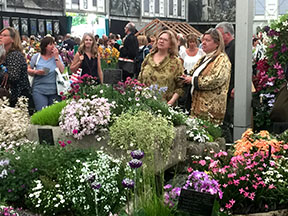
The Chelsea Flower Show: On Friday, we met Robbie and Bob at the Flower Show, after they had spent the early afternoon at the V&A Museum. It is one of the biggest flower shows around and was quite an event. It was mobbed with people checking out an endless number of beautiful flowers and a number of show gardens. It is run by  the Royal Horticultural Society and a good part of it is an incredibly fancy trade show, where you can get seeds and flowers for you own garden, along with garden sculptures, garden furniture, garden gates and pretty much anything that might be possible to put in a garden. Jenny Bakshi, who isa landscape designer in Montclair, was there with Phil and her brother, so we got to meet up with them. There was one “eccentric” garden that would activate every 15 minutes and the trees and topiaries would spin around and bushes would come up out of the ground and flowers would rotate around a little house. Ridiculous , but cute. There was another one that was dedicated to the end of slavery. Many of the big ones had water and/or sculptures and/or houses. And then there were little cute ones that were more like incredibly nice backyard gardens. I’ve been thinking about doing some gardening improvements in Montclair when we get back (and have been since the “Painting the Modern Garden” exhibit at the Royal Academy), so this all gave me some ideas.

Flower Show

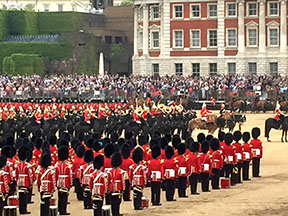
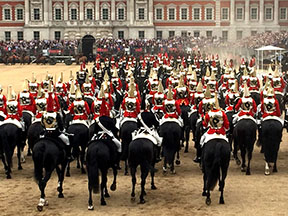
Trooping the Colors: The next morning, we were off to see Trooping the Colors. Actually, what we were seeing was a rehearsal of the event. The formal Trooping the Colors before the Queen will be held on June 11th and televised around the country. It is something like the Changing of the Guard at Buckingham Palace, only on steroids. It takes place on the Horse Guards Parade Ground, just across for St. James Park, which is about the size of two football fields. A huge number of soldiers with the red coats and black fur hats marched in, each with its own band. There was all of this very fancy marching around, with one of the groups carrying the Colors (which appeared to be a fancy UK flag). Everyone stood when it went by, like a slow motion wave. There were also guardsmen on horses, some with red highlights in their uniforms and others with black, but all wearing shiny helmets. And there was horse-drawn artillery too. There were hundreds of them all on the field. It was really an amazing spectacle, and we didn’t even get the flyover that will end the real event. One has to wonder what all of that pomp and circumstance costs and whether it is really worth it. But it is one of those things that the British do and it has to be said that they do it really well. A few pictures follow:

Trooping 1   Trooping 2

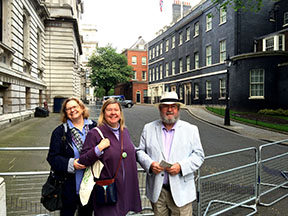
One of the special benefits of going to this event was that our seats required us to enter via Downing Street, which is normally closed to the public. Here we are 100 feet from Cameron’s front door:

10 Downing

A Guided Walk: On Saturday afternoon, we went on a guided walk from St. Paul’s to the Monument to the Great Fire of 1666, via Bankside. We had an entertaining guide (Johnnie) who delivered a sort of stream of consciousness patter as we walked from place to place. A few of the best nuggets:
  • An artist named Ben Wilson became famous for creating tiny painting on the chewing gum left on Millennium Bridge. He apparently lies on a yoga mat and paints the tiny bits of gun pushed in the bridge grating. The police arrested him once for doing this, but he could not be convicted since he pointed out that he was not defacing public property by painting on the bridge because he was actually painting on garbage. He may have moved on to different locations (or perhaps a different medium), but there are still numerous of these little paintings all along the bridge. Most people, including me, never see them because your eye is drawn to the beautiful views of St.Paul’s, Tower Bridge, the skyline and the Thames. A sample gum painting is below.
  • Next to the Globe Theatre on Bankside is a small and old white building, which has a plaque stating that Christopher Wren lived there while building St. Paul’s, so he could watch the progress from across the river. Good story, but it isn’t true. In fact the sign was put on the house by its Norwegian owner in the 1930s as a joke. That area had been nearly destroyed during the blitz and there were plans to knock down that house and the two old houses next to it for a development, but the sign made it appear to be an important landmark, so it was spared from the wrecking ball.
  • All along Borough High Street, there used to be alleys containing pubs and inns. This is where travelers would pull in with their horses or coaches as they approached London Bridge, which was the only way to cross the Thames for hundreds of years. There is only one of these places left, a pub called The George. Its buildings are pretty ancient and it is actually owned by the National Trust, which operates the pub. I have to go sometime. It is nearby the place where the tavern that is in Canterbury Tales was located. It was the place where the pilgrims met and told their stories before leaving.
  • There were a series of bridges at the site of the current London Bridge. The most noted one was the one that was covered with a virtual little city of buildings. At the southern edge was a gate and on top of the gate were heads of traitors and criminals and pirates, mounted on pikes. According to Johnnie, the reason it was the only bridge across the Thames for centuries was that the boatmen’s guild was able to pressure the government into not constructing new bridges, thereby protecting their trade. When the Westminster Bridge was finally built, the guild received a large compensation payment.
  • There is a theory that theaters like the Globe based their designs on the big inns like the George. The inns would have pubs with rooms to let above them which had balconies overlooking the alley. This would be on both sides of the alley and it is thought that there would b performances at one eld of the alley, with most just standing in the alley and the more well off being able to watch from the balconies.

“Showboat”: On Saturday night, we went to see a production of “Showboat”, the Hammerstein and Kern musical that gave us “Old Man River”. It is seen by some as the first true piece of modern musical theatre, premiering in 1927. It was the first time that the songs in a theatrical piece were completely linked to the plot. And there were scenes about black and white relations that must have seemed revolutionary at the time. We had front row seats, which were actually cheaper than the seats behind us. It was a good production. It actually had an American, Chris Peluso, playing the leading man, which seems unusual in a London production. It seems to me that you see more Brits on Broadway than vice versa.) Gina Beck, who played Nola, the female lead, had a great voice. The actor playing Captain Andy, Malcolm Sinclair, was someone we’d enjoyed in the Hampstead Theatre production of “The Meeting” and he was quite good, although his Southern accent sort of came and went. It was fun and there are a few great songs besides “Old Man River” (the show’s presentation of this song was very moving), like “Only Make Believe’, “Can’t Stop Lovin’ That Man of Mine”, “After the Ball” and “Bill”.

“Elegy”: Tonight, we went to see “Elegy” at the Donmar Warehouse, a famous small theater in the West End. Written by Nick Payne, it is based on the premise that a form of brain surgery can correct brain diseases, but that in curing the disease, you lose parts of your memory. This presents an impossible dilemma to the main characters. Do they do nothing and let a loved one slowly die an ugly death. Or do they save the person, knowing that in doing so they will not be the same person. And by waiting to do the surgery, savoring the relationship that still exists, they cause more memory to be lost in the surgery, leading to a situation in  which all memory of the relationship is erased. The play begins post surgery as Carrie (played by Barbara Flynn) tries to cope with the fact that her wife, Lorna (played by Zoe Wanamaker), who she still loves deeply, doesn’t know who she is. The play then proceeds in backward chrononology, until the end, when the first scene is replayed, but now the audience has the memory or what has led up to it and it resonates completely differently. It is like the first scene is Lorna’s point of view and the last scene is from Carrie’s.

We are off to Bath tomorrow morning with Robbie and Bob, so I have to finish this…..

Spain, Part 3: BRUCE!

Saturday night. Madrid. Judie’s Birthday. The Bruce Springsteen concert. The stadium was too far to walk, so we had to figure out how to get there on the Metro. Finding the route was easy and the trains were nice and well mapped (although not in English at all) and the only real trouble we had was working the ticket machines. (Getting back at nearly 1:00 AM was a snap and the streets were crowded along the Grand Via as we walked back to our hotel. Much more so than London, which shuts down the Underground by that time.)

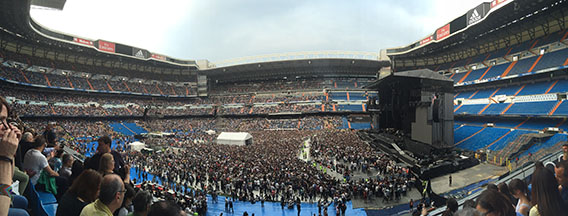
The stadium itself was pretty enormous. It is where Real Madrid plays and is comparable to a football stadium in the US. The security was significant. First we had to go through one long line in order to get on another long line for our gate. The throng was pretty huge but organized and patient. I wonder if this is the same routine that they follow for big football matches there. We noticed that a fair number of people bought beers before getting on  line. It took 10-15 minutes to reach the front, where there were big recycling bins to throw the beer cans. So maybe that is what fans in the know do.

Once inside, we noticed a few things. The directional signs said “vomitorio” with a section number and we found ourselves wondering whether this had something to do with over-drinking footie fans. It turned out that vomitorio refers to the way for fans to spew out of the stadium. Cigarette smoking was permitted in the stadium, something that has been banned in the States or restricted to some special area for years. And beer is sold by vendors withe small kegs attached to their backs.

Bruce2  Bruce 1

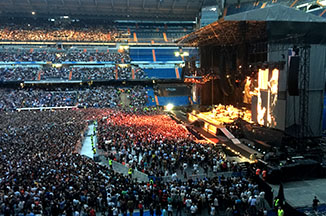
Bruce: We were wondering what sort of concert this would be. Would the Spanish fans know the words to the songs? Would they be into it? As it turned out, they knew the words and how to participate in the various Springsteen singalong moments and when to wave their hands or turn on their cell phone lights. The concert began at a little after its announced starting time of 9:00 (everything starts later in Spain, I guess), with Bruce opening with “Badlands”. It was still light and it was impressive to see the entire stadium floor bouncing with people. We had pretty good seats really, but recently we’ve seen Bruce from the floor or from fairly low down in an arena, so it was different being slightly more of an observer than a participant. Being on the floor is a more overwhelming experience, particularly when the crowd is all singing and rocking away.

This was “The River” tour, so they played a lot of songs off that album, including things like “Sherry Darling”, which we hadn’t seen him do for a long time. Bruce also covered the Patti Smith song “Because the Night”, which we’d never seen him do, although it is a natural fit. He and the E Street Band play continuously for three and half hours, playing a lot of the big hits (although not “Rosalita”). The stage was set up so that Bruce (and sometimes other band members) could get out into the crowd. They did all of the usual Bruce things, like the “Hungry Heart” singalong and getting a woman out of the crowd to dance with Bruce (and have now added having  a guy picked out of the crowd to dance with Patti.

Bruce3   Bruce 4

All in all, it was a classic Springsteen concert. High energy, entertaining, good-natured. The energy level remains astonishing. The E Street Band is still incredible, despite the loss of Clarence. Bruce tried to speak to the crown in  Spanish once in a while although you could tell he was reading it off papers taped to the floor. The crowd didn’t care. They at it up.  For anyone really into Bruce and the E Street Band, her is a link for the setlist for the concert. (I thought initially that it also included links to You Tube videos from the concert, but they are from other concerts. Of course, there are videos on You Tube if you search. Here’s a link to the acoustic version of “Thunder Road” that ended the concert.)

Happy Birthday Judie.