New Paintings, Rock Stars In London and “Buried Child”

Painting progress: I feel a bit like I’ve lost my mojo when it comes to painting. It seems like I’ve been doing it less. I’ve been working on three things: (1) a portrait of my Uncle Bill, where I am having trouble capturing his smile and the twinkle in his eye, (2) a painting of a tennis player that I’ve been meaning to do for a while but now that I am doing it, I’m wondering why and (3) a landscape vaguely based on a painting I saw at a museum in Paris, using gouache paints that Karen Fried gave me a year ago. It’s been fun trying a new medium, but it is taking a while for me to figure out how it works. I’m actually closing in on completing all three of them.

As it turns out, since drafting this, I did finish the portrait of Bill. He and his wife Marie were very close to my parents and in a lot of ways, he was like a second father for us. He was an amazing guy. He could walk into a room or a bar and within 20 minutes would be friends with everyone in the room. A quick Bill story (there are so many): We showed up at my parent’s house for Thanksgiving or some other Mahoney family reunion and it was a big Mahoney turnout. Judie had never met any of them and was understandably nervous. Bill picked up on this instantly and took us around, introducing us as “Judie and her boyfriend Nick”, a cute juxtaposition that relaxed everyone. Here is the painting. I still did not capture the twinkle in his eye or his mischievous grin, but it’s close (and probably as good as I can do).

uncle-bill

Frideric and Jimi: On the last day that Peter and Andrea were in London, we went to the Handel and Hendrix Museum. Frideric Handel lived in this house on Brook Street in Mayfair from 1723 to his death in 1759. This was the period of Handel’s greatest popularity and power. He really was the rock star of the period. His house has been restored and decorated with period paintings and furniture and some lovely musical instruments. They occasionally have concerts there, as Handel certainly did during his lifetime. You can see where his bedroom was and where he entertained notables of the day and rehearsed with singers.

A little over 200 years after his death, Jimi Hendrix rented a third floor flat in the same building (different entrance) shortly after arriving in England to become incredibly famous. A museum celebrating all of this opened a year ago immediately above the Handel one. Hendrix lived there with his girlfriend for a couple of years, composing, playing and partying. He actually became interested in Handel and bought some albums of his music. All sorts of famous musicians visited him there to jam, hang out and sometimes crash in a spare room. They have recreated his bedroom, based on photos from the time. Hendrix was interested in design and spent a fair amount of time shopping for rugs and other things to decorate the flat. His girlfriend, who left him in about 1969, possibly upset by his drug use, has lived the last 40 something years in Australia, but has come back and donated a few items. There are videos, music, what purports to be Jimi’s record collection, some guitars, etc.

It is a wonderful coincidence that these two superstar musicians lived in the same place. Little things like this are what make London so much fun.

“Buried Child”: We went with Peter and Andrea to see “Buried Child”, a play by Sam Shepard, which won the Pulitzer Prize for Drama in 1979, catapulting his career into the stratosphere. The play is largely centered around the character Dodge, played by (the) Ed Harris, in what I understand is his first London appearance. When you enter the theater, Dodge is already on the couch in a run-down house, coughing and having sips of whiskey. He stays on that couch for entire play, except for times when he ends up on the floor. He is sitting in Middle America waiting to die, his sons are disappointments, his farm is not productive (and hasn’t been for years), he has dark secrets that haunt him and his wife no longer loves him (and hasn’t for years). It’s quite a part and Ed Harris is quite brilliant in the role. His real-life wife, Amy Madigan, plays his wife in the play. She is the strongest figure in a family of men who have been broken one way or another. In the first act, you think at least one person in this family (her) isn’t crazy. In the last act, you find out you are wrong. Upsetting this disturbing apple cart is the surprise visit of Dodge’s grandson Vince, who comes with his girl friend Shelly and then leaves her there when he ostensibly goes to buy whiskey for Dodge but does not return. Shelly, ferociously portrayed by Charlotte Hope, proceeds to expose the dark secrets that have tormented Doge and his family for many years. You eventually discover that Dodges wife had a child with Tilden, Dodge’s now demented son, and that Dodge eventually killed the baby and buried it (thus the title), driving Tilden over the edge.By the end of the play, Dodge has died (but is still next to the couch), Vince is back and is going to stay (but Shelly has enough sense to leave) and Tilden has dug up the baby. This is a powerful and deeply disturbing play that is very well written and sublimely acted and produced. It was not exactly fun to watch, but I won’t forget it. Although it is set in the malaise of the Ford-Carter years on the 1970s, I think the sort of desperation and sense of failure and loss that permeates the play should have resonance in these days of Trump and Brexit. This was once a functioning family with a working business and dreams. Now that is all gone. They may not be a Trump/Brexit voters, but they fits the caricature.

Closing words: Last Sunday, I did the reading at New Unity. It was poem called “”If You Could”by Danny Bryck. I thought it was timely and powerful. Follow this link: if-you-could

Marching on May and Other Thoughts

Another March: It seems like the Trump administration will feature an endless series of protests. His recent ban on Muslim immigration has led to protest rallies and marches around the globe. You have to wonder if these protests really accomplish anything. I certainly have absolutely no hope that they will sway Trump. And they are unlikely to move Theresa May much either (more on her below). But there is a chance that Members of Parliament and Senators and Congressmen will begin to have second thoughts. And it is also possible, if this level of activism can be maintained for two years, that we might be able to see some local electoral success, as Americans tire of Trump and the politicians who are too spineless to stand up to him.

The protest of Monday was at No. 10 Downing Street. (Well, actually near it. Downing Street is always blocked off and guarded. So the rally was at the Whitehall end of that block-long street.) It was mainly in response to Trump’s horrifying, unconstitutional and foolish executive order banning certain Muslim immigration, which has Bannon’s fingerprints all over it. But it was as much an anti-Theresa May march as an anti-Trump one. She had a fawning visit with Trump last Friday, the very day of the executive order. It is clear that she had some knowledge of the order in advance and said nothing. When it came out, she refused to denounce it or even take a position. It was only as the ban and May were roundly criticized, that she issued a weak statement. The turning point was probably when Mo Farah, the four-time gold medal winning distance runner (who was recently knighted), wrote that, because he was born in Somalia, he would not be able to train in America, which is where his family currently lives. Perhaps it was the idea of Donald mistreating Sir Mo that moved May to act. May seems to feel that she has to support Trump. The prospect of a trade deal with the US as some sort of window dressing to counter the clear disaster that losing access to the EU market poses, has May panting at Donald’s heels like a forlorn puppy. Ans since she has completely given in to the anti-immigration position of the far right, she may feel that she has to support all anti-immigration efforts, no matter how ill-conceived and unlawful.

The New Unity group managed to get itself organized without my help and we had a decent turnout. We carried both our banners and were in the midst of a crowd of more than 20,000 (possibly quite a bit more). Photos below. While all of this was going on, a petition to Parliament seeking the withdrawal of the invitation to a royal visit given to Trump got over a million signatures in hours. The House of Commons has to debate a petition that gets over 100,000 signatures, which should be entertaining. But there is no chance that May will withdraw the invitation to her new BFF and imagined lifeline.

Another Thing I will Miss About London: The New Unity Congregation. Last Sunday was typical in some ways and not at all typical in others. Judie was out of the country, so went alone, which meant that I didn’t get there early so Judie could go to choir practice. It was the beginning of the pledge drive. The had never really done a UU-style drive before. This was partly because they own two buildings in fairly high-end areas and thus can cover 60-70% of their budget with rental income. And the government supports charities like New Unity, adding more to budget line. As a result, they only need to raise £35,000 or so from the congregation, an absurdly small figure. Of course, it is an unusually young group, with a good number of students and twenty-somethings Just beginning their working careers, so it is not a terribly well-heeled bunch. I had been giving the new treasurer some advice on fundraising and one bit of wisdom was to have a time for testimonials in the services during the pledge drive period. To open the drive, they had four testimonials plus me. I ended up giving the final little speech about why we were making a significant pledge to New Unity and everyone else should as well. It was a good one (a barn-burner), in which I went through the many things that we get from New Unity and concluding that making a pledge is not an obligation, but a privilege. I will miss the opportunity to speak at New Unity.

After the service, I decided to go to the first meeting of the New Unity Men’s Group, even though I was not going to be around much longer. Compared to the UU Montclair group, it was more than a generation younger. In Montclair, the ages of the group ran from about 40 to the 80s. At New Unity, I was the second oldest participant and over half the men who showed up for the first meeting were under 30. There was a very open discussion, including a fascinating time when we talked about what it means to be a man today. I’m sorry that I won’t get to see how this group develops.

Painting: I’ve just started two new paintings. In one of them, I am trying out the gouache paint that I received as a gift from Karen and Jerry Fried. I was having so much fun that I utterly forgot that Judie’s Women’s Group was using the flat on Wednesday night. Fortunately the place was not a mess. I’m starting to think about when I will have to stop painting and start packing up the paintings and supplies. I’d say no more than two more after the current three in progress.

Off to Lisbon Soon: Our old friends, Andrea and Peter, are arriving literally any moment and we will leave with them on Saturday for a long weekend in Lisbon. So I really need to wind this up.


Out On The Town

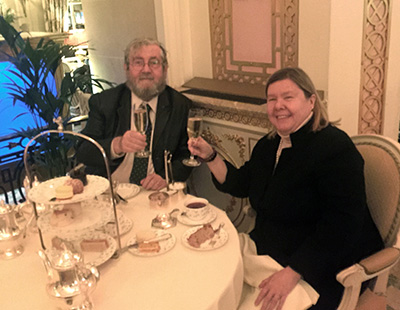
I was sitting at home last Thursday a little after 4:45, thinking I needed to get ready to leave to go to dinner and the theatre, when my phone buzzed and, when I looked at it, I was stunned to discover that we had a reservation for high tea at The Ritz at 5:30. This was a present from Judie’s sister, Linda, for Christmas and we had booked it some time ago and then completely forgotten about it. Thankfully, my phone hadn’t.

I called Judie and broke the news to her. She had a conference call scheduled for 5:00, so she called The Ritz to see if we could reschedule. We couldn’t, but they told her that we could be late. I went on line and cancelled our dinner reservations. As all that was going on, I was scrambling around to get dressed well enough that I could meet the dress code for tea. (We were going to the damn Ritz and they have standards.) I found our theatre tickets for the night and managed to get downstairs by 5:00. I hit the sidewalk and realized it was raining. No time to go back for an umbrella and by the time I had cut through the Old Spitalfield Market, the rain was beginning to mix with snow, the first I had seen in London. (The next morning it actually snowed less than an inch and London was almost paralyzed.) The one thing about London is that once you make it to the Tube, things move pretty quickly. The trains come every two or three minutes. So it didn’t take that long to get from Liverpool Street Station to Holborn and then switch to the Piccadilly line for Green Park. I got out of the station and there was The Ritz across the street. I had somehow managed to get there by 5:45 and Judie arrived just after 6:00.

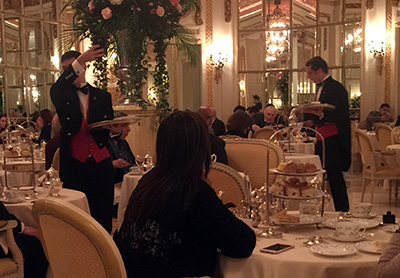
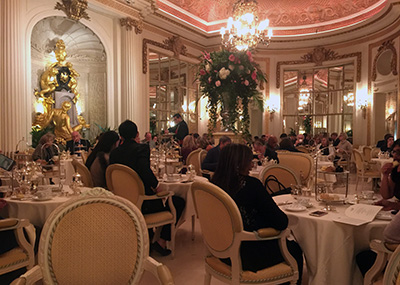
Once we got there (and caught our breath), it really was great fun. The tea is served in a gilded dining room by waiters (all men) in tails and red vests and bow ties. It would have better if the all sounded like Jeeves. But, this being London in 2017, most of them had vaguely Eastern European accents. Linda had given us the Champagne tea, so we got to start with tea (from an extensive tea list) and flutes of their house bubbly. To eat, there were a variety of little crustless sandwiches (I was starving) and scones and clotted cream, and cakes and various little pastries. It was all very delicious, if ridiculously overpriced. But you are paying for the atmosphere and the feeling of being transported back to an earlier, simpler age, when rich people could meet in a golden room and entertain themselves with murmured conversation, while a piano tinkled in the background. A couple of photos follow.

ritz1ritz2ritz3

Love-Lost and Found: The Royal Shakespeare  Company are performing two plays in repertory at the Royal Haymarket Theatre (Samuel Foote’s theatre, if any of you recall me writing about the play “Mr. Foote’s Other Leg”). After tea at The Ritz, we walked over and saw “Love’s Labour’s Lost”. It is one of Shakespeare’s early comedies and is relatively rarely performed, possibly because its references to persons of the day and it literary allusions became less familiar to audiences. It is the story of the King of Navarre and three of his associates, who all agree to foreswear the company of women for three years of philosophical studies. As soon as they do so, of course, the beautiful Princess of France with three lovely members of her court appear. The four men meet them out of politeness, but refuse to let them into the house due to their vow, and are instantly smitten. The play has wonderful language (it is sometime accused of being overwritten, but I found the lines, often in rhyming couplets, to be lovely). It is quite funny. My favorite scene was one in which each of the men appear on the roof, working on their odes of love, hide as each one appears and finally discover each other and the fact that they each are violating their vows. There are a number of other very funny scenes including one in which the four men improbably disguise themselves as Russions to visit the women, who are not fooled in the slightest and end up fooling the men. The was particularly wonderful repartee between Lord Berowne (Edward Bennett) and Rosaline (Lisa Dillon, who we had seen earlier as the lead in Stoppard’s “Hapgood” at Hampstead Theatre). The play is set in pre-World War I England (you just have to ignore all of the French references), which is really more reflected in the overall look of the truly incredible set and the costumes, at least until the end. The end is a bit of a surprise. The women had been rather toying with these four men’s affections for much of the play, but at the end accept their love. But rather than marry on the spot, as would be the conclusion of most Shakespearean plays of this type, they tell the men that they must wait a year, since the King of France has just died. As the play ends, the four men appear in army uniforms and march off to war, leaving you to wonder if the love will ever be consummated or will be lost. It is kind of a bittersweet ending. I have to admit that I probably would have enjoyed this pay more if I had been more familiar with it. As it was, I had to work hard to follow the language and the twists and turns of the plot. Bennett and Dillon were delightful in the leading roles and Nick Haverson, in the comic role of Costard, the gardener, was a riot. Another memorable performance was John Hodgkinson as Don Armando.

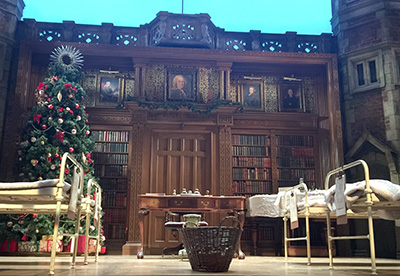
The next night, we were back to see “Much Ado About Nothing”, which was set in England just after World War I. Bennett and Dillon, were back, this time playing the central couple, Benedict and Beatrice. Unlike the prior night’s play, we were familiar with the play (I’d guess that many people are, even if they get confused by the names of Shakespeare’s plays sometimes). We’d seen it back in the 1980s with Derek Jacobi and Sinead Cusack (see related story below) and many people have seen the movie version with Kenneth Branagh and Emma Thompson. I came away even more impressed with Edward Bennett than I had been the night before. He is utterly at ease with Shakespeare’s language and has a true gift for comic timing and was charming in both parts. He looked vaguely familiar and it turns out that we saw him playing one of the scientists opposite Nicole Kidman in “Photograph 51”. He might be best known for appearing in “Hamlet”, where he was the understudy for David Tennant about ten years ago and was called on to perform on opening night when Tennant injured his back and could not go on. “Much Ado” is a tremendously entertaining play that is terribly romantic. It was very clever for the Royal Shakespeare Company to pair it with “Love’s Labour’s Lost”, as there are a number of parallels between the two plots. This production really went for the laughs and had a good deal of slapstick staging. There were some really belly laugh moments. But I did find Haverson’s performance of Dogberry to be so over the top as to be almost painful, even if it was quite funny. The same set was still remarkable (see the photo below that I took before the play began), the cast was top notch and it was a completely satisfying evening of theatre.

set-lll-and-maan

Vaguely Related Story: The same time we saw Derek Jacobi in the Royal Shakespeare production of “Much Ado”, he was also performing in “Cyrano”. He was, as you would expect, just wonderful. We took my father to the show, since it was one of his favorite plays and his response after seeing it was “Yeah. He was good. But he’s no Jose Ferrer.”, which was kind of ridiculous, but reflected his feeling that he had seen the ultimate performance of the part that simply could not be topped. Actually, it seems to me, this sort of attitude interferes with the simple enjoyment and magic of theatre. “He’s no Jose Ferrer” subsequently became a recurring line that we would cite when we would see a play that was a re-staging of something we’d seen earlier (especially when we were with our friends Peter and Andrea). For example, we would see Jim Parsons in “Harvey” and say “He’s no Jimmy Stewart”, not as a criticism, but in recognition that there are many ways to interpret a role and to perform it and that what makes seeing a play again played by a great actor and/or troupe of actors is actually the thrill of seeing something interpreted differently.

London Tales

Stoke Newington: On Monday, I went to Stoke Newington. My reason was to pick up a print of Mary Wollstonecraft in support of a drive to have a statue of her erected on Newington Green. (It really is shocking that she is not honored more in London and surprising that some rich woman has already funded a tribute to the Mother of Feminism.) The other reason for going there is that I have been curious about Stoke Newington, which I understand to be a fashionable, furiously gentrifying section of London. (And I can get there by just taking the 67 bus, which stops right outside the flat.) The part that I went to in order to get the print was very nice, with streets of two story connected houses and the sounds of power equipment indicating that renovations were in full swing. There was also an area of well-maintained estate housing (public housing in the US). As I walked north, the buildings got a bit grander and bigger, but a chilly rain started, so I decided to go back to the High Street and either find a place to eat lunch or go home. The High Street in the southern part of Stoke Newington was certainly bustling, but had more of a working class vibe. There were a lot more nail salons, hairdressers and kebab shops as oppose to barristas, galleries and cute restaurants. It appears that the ongoing gentrification that I’d heard about must be in the northern part of Stoke Newington. I thought about walking up there to check it out, but I was cold and wet and decided to leave it for another, sunnier day.

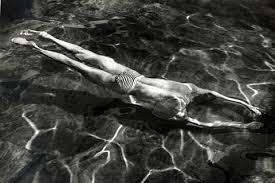
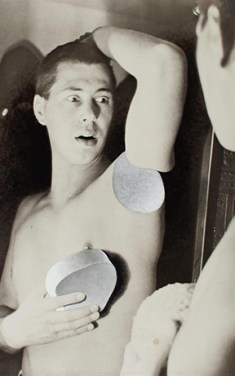
Elton John: Photography Collector: On Tuesday, I went to Tate Modern, where there was an exhibit of photographs from Elton John’s collection, which is one of the largest in the world. This one concentrated on his photos from the Modernist Period, basically 1915-1950. The audio tour featured Sir Elton himself talking about the selected photographs. It was pretty fascinating. It turns out that he began collecting photos in 1991, shortly after becoming sober and became obsessed by it. He now has thousands of photos. Early on, he set a record for the most ever paid for a photograph (since repeatedly broken). See below. It is tiny, taken by André Kertész in 1917, and inspired a generation of photographers, including all of the gay photographers who followed. Elton bought the original picture and the negative. The exhibit is full of iconic images, like Dorothea Lange’s “Migrant Mother”, lots of Man Ray photo-portraits and Weston, , Cunningham, etc. It is spectacular and it is just the tip of the iceberg that is his collection. At one point, he reveals that he has thousands of photos from 9/11, which they bring out every year to see if they should exhibit them. But they decide that, though they are beautiful, it is too soon. One more really amazing thing. Below is a manipulated photo entitled “Humanly Impossible”. In it, the photographer printed out the image and them added things that made it appear that his arm was cut off. He then re-photographed it. and all prints are of the second shot. Except Elton’s. He has the original print with the additions.

images.jpg    Herbert_Bayer,_Self_Portrait-xlarge_trans++1LE_aMoZ4j8b9yBU3fkF9-pCkqavLOFjGjHu2VCbiLk.jpg

A Brexit Note: Judie is a member of the Emerging Payments Association here in London. They represent and advise Fin Tech companies here in London and elsewhere. On Wednesday, they released a report on where they recommend their clients move in light of Brexit. (As you may know, such companies can currently “Passport” their UK license to the EU and need not go through the process of getting a license on the continent. It seems likely that this will end with Brexit. And whether it will or not, nobody can tell, so businesses have to begin taking steps now.) So the EPA was advising on how firms currently in London should consider moving some of their operation to Europe to avoid any Brexit related complications. On one level, this is not terribly big news if you are in the industry or even familiar with banking issues. But I’d say it is significant in that here is a British firm giving advice that will lead to loss of tens of thousands of jobs. Since May and the Conservatives have done little and said less about Brexit in the last six or seven months, it seems like everything has been conjecture. But this is real advice to real firms with real consequences. Of course, the papers didn’t cover it.

Things I Am Going To Miss About London: Taking a bus over London Bridge, getting off, wandering through Borough Market, stopping to get something to eat or buy something for dinner, then going out to the Thames and walking up past the Globe Theatre to the Tate Modern, going in a seeing an exhibit or two, then walking over the Millennium Bridge, checking out both the incredible views and the gum paintings under my feet and the ending up at St. Paul’s.

The Deserving Poor: In the Victorian era, George Peabody, an American merchant, established a trust to build housing for the “deserving poor”. The distinction between deserving and undeserving poor was a big concept in that era (and is an idea that was picked up by Republicans and US conservatives in the 1960s). It turns out that the first such housing that was constructed is directly across the street from our flat, although there is lot of housing for the deserving poor in the area, which has always had a large share of poor people, both deserving and underserving. Of course, if you are like me, you cannot hear that phrase without thinking of Alfred Doolittle’s speech to Henry Higgins, with which I will close this post:

Doolittle: What am I, Governors both? I ask you, what am I? I’m one of the undeserving poor: that’s what I am. Think of what that means to a man. It means that he’s up agen middle class morality all the time. If there’s anything going, and I put in for a bit of it, it’s always the same story: ‘You’re undeserving; so you can’t have it.’ But my needs is as great as the most deserving widow’s that ever got money out of six different charities in one week for the death of the same husband. I don’t need less than a deserving man: I need more. I don’t eat less hearty than him; and I drink a lot more. I want a bit of amusement, cause I’m a thinking man. I want cheerfulness and a song and a band when I feel low. Well, they charge me just the same for everything as they charge the deserving. What is middle class morality? Just an excuse for never giving me anything. Therefore, I ask you, as two gentlemen, not to play that game on me. I’m playing straight with you. I ain’t pretending to be deserving. I’m undeserving; and I mean to go on being undeserving. I like it; and that’s the truth. Will you take advantage of a man’s nature to do him out of the price of his own daughter what he’s brought up and fed and clothed by the sweat of his brow until she’s growed big enough to be interesting to you two gentlemen? Is five pounds unreasonable? I put it to you; and I leave it to you.

Higgins: Pickering, if we were to take this man in hand for three months, he could choose between a seat in the Cabinet and a popular pulpit in Wales.

You’ve got to love Bernard Shaw!

Chris Visits: Part 1

While Judie was off on her bi-coastal tour of the U.S., my old college friend, ex-roommate and best man came for a quick visit. I suspect that Judie helped push him into deciding to come, fearing what I would do if left alone of two full weeks. It was great to have him. We did an awful lot while he was here. I’ll break it up into two or three posts.

Eating: I don’t write all that much about restaurants here, which is a bit shocking considering (a) how wonderful the restaurant scene is in London generally and Shoreditch in particular and (b) how much time I spend eating out. The food scene here has a diversity and a wild willingness to experiment with flavor combinations that makes it very exciting, even more so than NYC in my opinion. To add to all of that ongoing creativity and pushing the envelope, it is now truffle and game season, allowing the British to indulge their love of eating all sorts of birds. (In the following discussion, I will try to provide a link to the restaurant menus where possible the give you a feeling of London cuisine.)

We started at St. John Bread and Wine, just down Commercial Street from the flat, one of the landmarks in the food revolution in London. It is where the great Fergus Henderson’s first restaurant opened. We went there for lunch shortly after Chris arrived. The smoked sprats (sardine-like fish), the cold venison with celeriac slaw, brawn (a sort of pate made out of boiled pig’s head) and the Eccles cake were especially memorable. That evening, we went for food at Sichuan Folk, a shockingly good Chinese place around the corner. The green beans with garlic and pork crumbles and the fish stood out. The next day, we walked through Kensington Gardens, planning to eat at the Serpentine Sackler Gallery, but it was closed so we ate at the Food Hall at Harrods. There are a number of specialty food bars to eat at and we chose the fish one. Lovely meal and the Victorian tile work, made by Royal Doulton, was just stunning. That evening, we ate at Lotus, a sort of haute cuisine Indian restaurant near Trafalgar Square. In keeping with game season, our dishes included Pigeon Masala Dosa and Muntjac Mal Daas (a kind of small deer in aromatic gravy). For old times sake, we also stopped at the Cork and Bottle in Leicester Square, where we had miraculously run into each other over thirty years earlier, for a few glasses of wine.

On Tuesday, we looked around for a pub lunch near Kew Gardens, but ended up settling for Pizza Express, a decent chain and our least memorable meal. That evening, we were in Islington for a play and did get to a local pub for a pre-theater pint and something they called rocks, a sort of English samosa stuffed with savory fillings. After the play, we stopped for a meal at a slightly snooty French restaurant on Upper Street. The next day, we went to Lyle’s, my favorite lunch place. It is run by acolytes of Fergus Henderson and is just a treat every time I go. We had grilled razor clams, grouse, a great pumpkin and shaved chestnut dish with a whey cream sauce (among other delights). That night, we were in the emerging neighborhood behind King’s Cross Station (to see David Bowie’s “Lazarus”) and ate at Caravan , where the highlights included blue cheese and peanut wontons, jalapeno corn bread, soft shell crabs with kimchi and wonderful croquettes. We closed Chris’ culinary tour with lunch on Thursday at Super Tuscan, our favorite restaurant in London, where we concentrated on truffles; gnudi with black truffle sauce, truffle arancini, little stuffed pastas with shaved black truffles and fresh tagliatelle with cream sauce and two ounces of shaved white truffles. (We finished with a bang.) And all of this talk of eating delicious fungus is a great segue to a marvelous adventure earlier in the week:

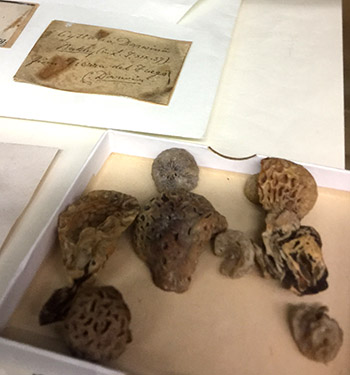
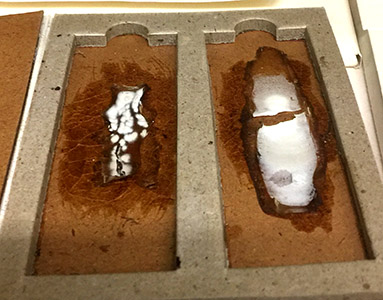
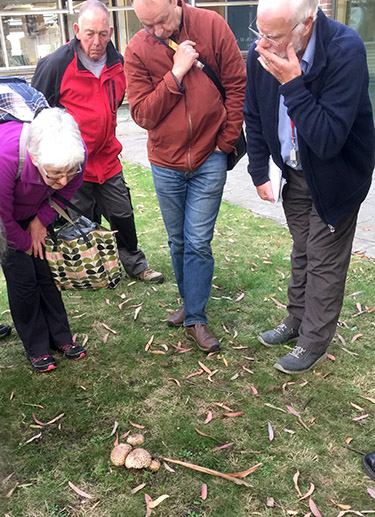
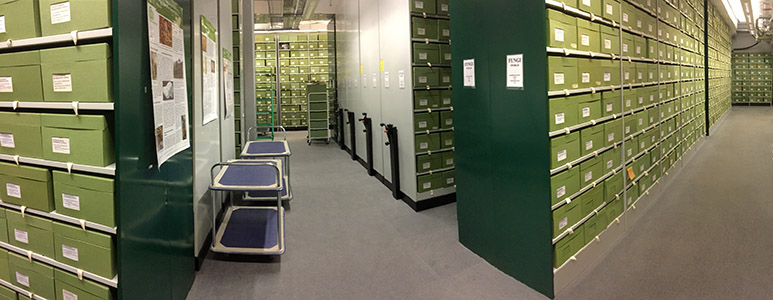
Kew Botanical Gardens: I had actually never been to Kew Gardens, but it was a reasonably nice day, which got better as it went along and ended up beautiful, so we took the Tube out there. We discovered that on Tuesdays (which it was) they had special tours led by scientists working in the labs there. So we signed up for a tour about fungi at Kew and, after wandering about the greenhouses for an hour or so, we presented ourselves to be guided. Our leaders were charmingly eccentric and nerdy and advised us, straight off, that there were far more varieties of fungi at Kew than plants, leading to their opening quip that it really should be called Kew Fungus Gardens. They led a group of about twenty hearty souls tromping to all sorts of corners of Kew that we might not have seen, poking around under trees and in piles of wood chips. We saw many varieties of toadstools and other sorts of fungus growing on and under the trees. There was a young guy of the tour in a singlet, who initially looked more like a soccer hooligan than a nature lover, but he ending up knowing almost as much about fungus as the guides and was even better at finding samples. Having him along really go our mycologist leaders even more geekily wound up about the fungus they were seeing than one might have expected. The tour, which was supposed to be an hour, took far longer and was a really great jaunt. It ended in front of the lab building, which had a huge set of mushrooms growing right out front, which they excitedly advised us had been coming back every fall since 2012. Then they invited us down into the lab, where they have endless number of boxes containing fungus samples, over 1,300,000 in all. All pretty incredible, but they saved the best fungus for last, showing us a fungus sample that Charles Darwin had picked off a tree in South America and some of the actual, original penicillin culture that Alexander Fleming had used in (accidentally) discovering antibiotics in 1928. Seeing the latter was a little like seeing the Rosetta Stone. They don’t give these tours very often, so probably something like 100 non-scientists a year get to see this stuff. Some photos of all of this follow. The first one is the Darwin fungus, the second one is the original penicillin culture and the bottom one is some of the fungi collection.

fungus-darwinfungus-penicillinfungus1fungus2

Four Plays and 100 Kazoos

Administrative Note: I’m probably going to change to the premium version of Word Press, so that I can publish photos of higher quality and you won’t have to see advertising. This will change the address of this blog to nickinshoreditch.com. If you are signed up to get notifications by e-mail, this may not matter, but if you are used to just seeing it through a browser, you won’t be able to find this using the current URL. So this is a warning: If you are looking for nickinshoreditch and it isn’t popping up, then I’ve made the change. I’ll post more warnings as it happens.

Four Plays in Twenty-Seven Hours: This was a kind of a crazy idea. The National Theatre has been having a special “Young Chekhov” event in which you see three plays normally done in repertory on individual nights, all in one day. I signed us up for it, not realizing that we also had tickets at the Old Vic the night before. So it really was a marathon.

It all started with “No’s Knife” at the Old Vic. It isn’t exactly a play. It was more of a performance piece based on selections from Samuel Becket’s “Texts for Nothing”. On one level, it was an amazing interpretation by Lisa Dwan, a dancer, actor, writer and Beckett expert, as she used movement and voice changes and odd, bleak scenery and a mist machine to enliven some of Beckett’s most obscure ramblings. On the other hand, it was so plotless that it made “Waiting for Godot” seem like “The Importance of Being Ernest”. There was a lot of existential despair, reflections on nothingness and ruminations about death. There were many good moments, but the whole thing wasn’t cohesive and, in fairness, was not intended to be. We both found it difficult to concentrate fully on the stream of thoughts that were being expressed for the full 70 or 80 minutes. It was one of those things that made you feel intellectual for simply being there and a dolt for not being able to find some sort of deep theme (beyond misery and death) or a trenchant comment on the modern world. An odd evening.

The next morning, we were off to the National Theatre, which was made difficult by the weekend closure of all of the tube lines that went anywhere close to it. The three plays on the day were the early works of Chekhov and the whole thing was the inspiration of David Hare, who also created new versions of the plays. The first play, which began at 11:45, was “Platonov”, also known as “The Play Without a Title” when Chekhov wrote it at about age 20, while a medical student. It was discovered 20 years after his death and performed sporadically until 1960, when an edited version first to use the tile “Platonov” was performed with Rex Harrison as the lead. Like most Chekhov plays, it is set in a country villa and I think might be characterized as a tragic farce. The set, which was used for all three plays (since they are all mostly set in country villas) was absolutely spectacular. In this case, the villa was the home of the widow Anna Petrova, played by the wonderful Nina Sosanya, who we’d seen before. The main character, played by Scottish actor James McArdle, is supposed to be the most interesting and handsome man in the community. Like seemingly all Chekhov characters, he has money problems and is unhappy with how his life has gone. He is a bit of a misogynist but is also irresistible to women, with whom he has a series of affairs, despite being married and a father. The fact that the women in play fall for him unhesitatingly, despite his flaws, really annoyed Judie (and she regards this portrayal of women as typical of Russian writers). Putting that reasonable objection aside, McArdle did play Platonov with considerable charm and humor and there were large sections of the play that were very funny, at least until it all begins to catch up with him in the last act and a tragic ending is assured. I found the whole production to be lively and immensely enjoyable. It is a play with a number of juicy parts and the cast was great. It turns out that “Wild Honey”, by Michael Frayn, which we are going see at the Hampstead Theatre later this year, is his adaptation of “Platonov”. I’ll be curious to see if it is different.

After  a quick lunch at House, the National Theatre’s on-site restaurant, we were back in our seats at 4:00 for “Ivanov”. This was Chekhov’s first complete play and the first ever performed (in 1887). It was an initial disaster, but was restaged triumphantly two years later after Chekhov rewrote it. This play is also set in country villas and has more tragedy and less humor than “Platonov”. Ivanov, played by Geoffrey Streatfeild,  is unhappy, has money troubles, and feels like he has wasted his life. In short, he is a typical Chekhov character. (What must life have been like in the late 1800s in Russia?) His wife, played by Nina Sosanya, is dying of TB and her doctor, played by James McArdle, is an insufferable prig whose idea of the truth helps to ruin the lives of both of them. There are some other characters who give a truly amusing view of the life in that era and who keep the proceedings moving. Unfortunately, Ivanov, at the center of the action, is simply clinically depressed for the entire play and cannot get himself out of it, despite the efforts of a young neighbor, played by Olivia Vinall, to pull him out of it. It is all a effective and dauntingly realistic realistic look at dealing with profound depression. (You keep thinking “Give this guy some medication!”) But it seems to me that the main character must develop over the course of a play and Ivanov cannot and does not. It isa one note role, leading to a one note performance. We are ultimately left waiting for his inevitable suicide. The play had moments, but was the least satisfying of the three, one I would not be tempted to see again.

Finally, it was back to the Olivier Theatre at 8:00 for “The Seagull”, a more familiar Chekhov work. The set contained a good deal of water, which was used somewhat in the first two productions, but was more central to this one, which is set in a country villa on a lake. There are two interconnected plots. One concerns the relationship between Irina, the owner of the estate, a spectacularly vain and famous actress, played with wonderful self-centered energy by Anna Chancellor, and her son Konstantin, played by Joshua James, who had also had a central role in”Platonov”. Her belittling of him and the destruction of his dreams is one theme. The other involves Nina, a young, talented and beautiful woman, played by Olivia Vianall (again–more on that below), who is a neighbor and beloved by Konstanin. She is casually seduced and ruined by Trigorin, (Streatfeild is back in this role), a famous author and the lover of the actress. As in all of three plays, there is a large company of interesting characters, all played with wonderful gusto. This play is ultimately about the dreams and ambitions of the young being thwarted by their elders and is consistent with the prior two plays, in which both the two young protagonist’s youthful dreams and ideals have been unmet, leaving them in a state of perpetual disappointment. And it turns out that the other running theme of the three plays is that if you are a character in a relationship with one played by Olivia Vinall, you are doomed. In “Platonov”, she is the jilted mistress whose life is ruined by Platonov and who shoots him at the end. In “Ivanov”, she is the well-meaning young woman intent on saving Ivanov by marrying him, only to see him shoot himself. And in “The Seagull”, she is the lovely, ruined Nina, who returns in the final act to see Konstantin and delivers the final blow to him by saying that she will always love Trigorin (thereby providing more evidence for Judie’s theory about female characters and Russian authors), which leads Konstantin to shoot himself. Which is how our day of theater ended, shortly after 10:30.

100 Kazoos: The next morning, we went to New Unity. It was the tenth anniversary of Rev. Andy’s first service there and a group from the Sunday Gatherings Team decided it was important to celebrate it and finally roped me into participating. I had two ideas which I implemented when the group agreed. First, I bought blank cards and envelopes and markers, so that everyone could create a card for him at a point during the service. (I didn’t think that the organizers gave people enough time  to finish, but I suspect some people just continued to work on their messages during the collection.) The planning group wanted to do something special and less serious and I suggested that we play “For He’s a Jolly Good Fellow” on kazoos. It seemed like something that had both English and American elements. So we did it. I bought 100 plastic kazoos, which we passed out at the end of the service, as the Music Director gave a quick lesson on kazoo playing. (Most of the congregation had never touched a kazoo before!) A joyful noise was made.

The End of Alex’s Visit and a new Painting

A New Painting: I think it is easier to start with this and I’ve decided I like having the new paintings lead off these blog posts. The painting below is based on a photo that Nancy Prince took and published on Facebook. I liked the composition. It could probably go with my earlier painting from the Isle of Skye to begin a Stone Wall Series, although I’m not really that interested in stone walls as a theme. I actually had this essentially done weeks ago, but kept fiddling with it and, I suppose, improving it very slightly. I seem to have recently settled into a semi-realistic, semi-impressionistic style. It’s not that I mind it, because I think some of the resulting paintings are visually pleasing, but I also feel like I should be pushing myself a bit more. This led me to try the Georgia O’Keeffe tribute and the more recent foray into portraiture, based vaguely on the Hockney show I saw. I’m not ready to settle down yet. Here’s the latest one:

mailboxes

The End of Alex’s Visit or “Oh, My Aching Feet”: There was one thing that was noticeably different about Alex’s visit from any prior visits by our children in that it was the first time a child visited who was working (in the sense of having a real job) and actually had to take time out to answer e-mails, take a call and do some work. Alex is working on the first draft of his story for Audible about life in America during World War II. The first episode for which he is responsible focusses on the lead up to the war and the fight between the isolationists, like Lindbergh and Father Coughlin, and Roosevelt and those who saw the dangers ahead and the need to get involved int he war. So he had to spend about ten hours of his trip (at various times) researching the story and listening to potential audio clips.

It was probably just as well because it allowed me to keep up with things a little. And it turned out that I developed a mild case of gout in my right toe. I’d had it once or twice before and it always went right away when I blasted it with a pain-killer like Aleve. Unfortunately, you can’t take them when you are taking blood thinners, so I was in this annoying pain when I walked, which made me limp and which made my other leg eventually get sore, particularly since I ended up doing a lot of walking around with Alex. It has been a weird few weeks, health-wise.

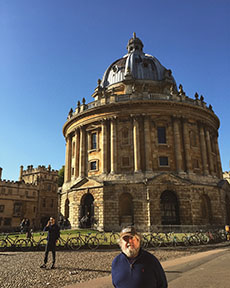
Oxford: Alex really wanted to go back to see his old haunts at Oxford, so last Wednesday we took the train up and spent the day wandering about, seeing his old college and where he had classes, visiting pubs and the like. As I turned out, it was moving in day for freshmen, so we were actually able to get into St. Ann’s College (which is noramlly off-limits) and walk around a bit and take a picture of Alex in front of his old room. St. Ann’s is one of the newest colleges at Oxford and a little outside the center of town, which led to more walking. It is a bit of an architectural hodgepodge and, while it is not really ugly, it lacks the drop-dead gorgeousness of most of Oxford. To make up for that, we walked over to Magdalen College (pronounced “maudlin”) and paid to get in and wander about. It was started in the fifteenth century and is constructed of that lovely honey-colored stone that dominates much of Oxford. What makes Magdalan especially memorable is that within its grounds is a deer park–and not a small one–complete with what looked like several dozen deer, including a large stag off in the distance. There is a tradition, undoubtedly centuries old, that when the monarch visits Oxford, he or she comes to eat at Magdalan College and a deer is killed and served. We also visited the Royal Oak pub (Alex’s favorite from his St. Ann’s days), the Bear Inn (famous for it collection of hundreds of school ties all over the walls and ceilings and which allegedly dates from 1242), and The Eagle and Child (where C.S. Lewis and Tolkien and their buddies drank). We had a wonderful lunch at the scenic Cherwell Boathouse (Great wine list) and dinner at the Turf Tavern (the legendary ancient pub where, among other things, Bill Clinton did not inhale). Throw in a walk to see the music faculty’s building and it was quite a day. According to my iPhone, we walked over 20,000 steps, more than eight miles. Some photos of the day follow:

oxford1   oxford2oxford3   oxford4

Friezing in Regent’s Park: For anyone who has been reading this from the beginning (and thank you for your patience), you may recall that last year at about this time I went to the Frieze Art Fair in Regent’s Park. It is a massive fair of modern art, featuring scores of galleries selling their art in a huge tent that must cover several acres. It was not the greatest idea to go there with aching feet the day after the Oxford trip, but I wanted to see it with Alex and it was fun, if a bit painful to the pedal extremities. There was, once again, some interesting sculptures in Regent’s Park, but the real show was inside. As you walked in there was a sculpture overhead, which you realized, as you got closer, was made of pantyhose. Odd but attractive. One of the early things we went to was a virtual reality work in which you sat on a sculpture of a giant snake, put on a virtual reality mask and found yourself on the snake and surrounded by all sort of weird figures and scenes. That experience alone made the whole visit worthwhile. As was the case last year, there was an awful lot of works which seemed to me to be pointless at best. Maybe I just need to hear the artist’s rap about why this scribble/pile of meaningless junk/splashes of paint are a meaningful reflection of society or whatever. It seemed to me that the ratio of things that I thought were clever/pretty/interesting to just pure crap was lower this year. But there were still some remarkable items. A sinuous, acrylic, wall-mounted sculpture, which refracted light and constantly changed colors as you moved around it. Small clear boxes containing the most intricate tiny sculptures, seemingly made of tiny threads, which turned out to be webs made by tiny spiders. Some interesting exhibits using live people. Some lovely sculptures in various mediums. And on top of all of the art were the people. It was the first day, so a lot of potential buyers were there, in expensive yet casual attire, talking seriously with gallery reps and air kissing each other. It was quite the scene. Some photos follow:

Alex Visits: Art, Spurs and Branagh

Alex has been visiting the past week or so from Philadelphia. So I have been doing a lot a stuff with him and doing less painting and writing and New Unity stuff. I have also been distracted by doctor’s appointments and medical tests about my swollen left leg. It turned out to be blood clots and I am now on blood thinner medication. Not great news, but at least I know what it is and I’m being treated. The only real bad thing is that this means that I cannot fly long distance for three or four weeks, so I am going to miss accompanying Judie on her next big tour of the U.S., which starts in about a week. That trip includes a visit to see Hannah in Olympia, which is the only part of it that I am upset about not doing. Anyway, enough about my health, which I don’t like to write about.

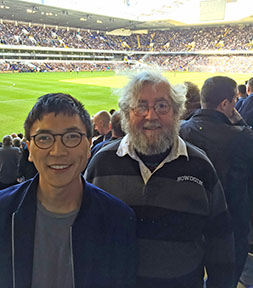
White Hart Lane: White Hart Lane is the name of the stadium where the Tottenham Hot Spurs play. Alex has always wanted to go to a Premier League football (soccer) match and I managed to find tickets on Stub Hub for a game between Tottenham and Manchester City. (All the Premier League games are sold out, at least around London, so it was surprising to get tickets for a game, especially one between two top squads.) Manchester City came into the game undefeated under their new coach, Pep Guardiola, who they lured from Bayern Munich for a gigantic amount of money. (Man City is the richest team in the Premier League and also routinely buys all the best players, so they are a kind of international squad.) Tottenham is also very good, but the Spurs’ best player, Harry Kane, was injured for the match.

White Hart Lane turned out to be a relatively intimate stadium, holding 35,000 or so. It is being replaced by a big, new stadium, which is under construction next to it. I’m sure it makes economic sense and the amenities at the current stadium are a bit primitive, but I’m glad we got to experience what seemed to us to be more of the real thing. One of the things we noticed right away was all of the Korean fans. The Spurs have a forward, Son Heung-Min, who has recently been scoring a lot of big goals, especially with Kane out, and he has become a fan favorite. So there were lots of Korean (and probably other Asian) fans in attendance, many sporting Son jerseys. Our seats were in the corner, right near the goal line and seventeen rows up, so we had a great view of the action at our end, but couldn’t see one of the far corners.

We got there entirely too early since we had to pick up tickets and were expecting a lot more security than there was, but game time finally came and the stands filled up. As the game began, the stadium began singing a Spurs song to the tune of the “Battle Hymn of the Republic”. We were thinking “Isn’t that cool” and then we figured out that we were seated in the part of the stadium where the most lunatic and loyal Tottenham supporters sat. The entire corner of the stadium we were in neither sat down or stopped singing (except to cheer or scream at the ref or the Man City players) for the entire rest of the game. It was deafening. I am certain that the players on the field couldn’t hear each other at all. And the fans didn’t have just one song. They had a whole repertoire and seemed to magically go from song to song in unison. Some were just things like “When the Spurs Go Marching In”, while others were tributes to individually players or the coach. There was a  subset of anti-Arsenal songs and they sang a few. (I assume this is something like Red Sox fans chanting “Yankees suck” even when the Yankees aren’t there.) All the songs were to popular tunes and, when I looked on line, I discovered there are 200 songs in the Tottenham fan’s catalog.. They kept singing the song for the teenage future superstar Dele Alli, since he had a great game, but Son is apparently too new to have his own song yet. (I hope it doesn’t turn out to be racist.) The game was very exciting. The Spurs dominated the favored City squad and won by a very convincing 2-0 score, which might have been worse but they missed a penalty kick. Both teams were in attack mode for the whole game. It appears that is Tottenham’s style and City fell behind early and were under so much pressure that they had to attack. Son is great and, if he isn’t already the biggest deal in Seoul, he will be shortly. In the end,though, it wasn’t the game that I’ll remember. It will be the experience of being surrounded by fans singing and bellowing so loud that it was actually blowing my hair.

spurs1

“The Entertainer”: On Thursday night, we all went to see “The Entertainer”, the final production of Kenneth Branagh’s year-long series of plays at the Garrick Theater in the West End. The play, by John Osborne, may be best know as a vehicle for one of Lawrence Olivier’s greatest performances. It is the story of Archie Rice and his family. Archie is a failing Music Hall entertainer, in a time when the Music Halls are about to die. (There is also a side plot about the war in Suez–it is 1956–involving Archie’s two sons, which demonstrates the parallel Osbourne sees between the collapse of the Empire and the collapse of Music Halls.) As usual with Osborne plays, the characters are desperate and unhappy with a life of trying to make ends meet in an unfair social order. There are a number of scenes set in the Music Hall, in which Branagh is maniacally trying to entertain what you guess is a minuscule crowd, but his joke fall flat and he neither sings or dances all that well. (I suspect it is difficult to play a mediocre talent.) And then in the other scenes at Archie’s flat, the family just tears into each other. Gawn Grainger, who plays Archie’s dad (a legendary Music Hall performer who Archie cannot live up to), was especially memorable. But, typically, the entire ensemble of actors were terrific and it was fun to see Sophie McShera (Daisy in “Downton Abby”) do something very different. Branagh was wonderful, a big personality, gradually being beaten down by the new age and his own failings, but refusing to give up.

Ted and Wallace: Ted Hunter, a UUCM friend of ours, was in town this week. He works at the Arms and Armor section of the Metropolitan Museum in NYC and will become the Armorer for the Met when the current one retires later this year. It was lots of fun to see him and to have few beers at pub. He has encyclopedic knowledge of arms and armor and was in London to give a paper on the subject at a conference and to meet with his brethren in the field. He told us some good stories about armor in Britain. Apparently, the Royal Armor was moved from London to Leeds some time ago, apparently on the theory that it would revitalize tourism there. It hasn’t really, which he thinks is partly due to the fact that Leeds Castle is nowhere near Leeds, so that when people (like him) go to the more famous castle (which is this incredibly beautiful, historic castle, built on an island in Kent, by the town of Leeds), figuring to see the armor, they are disappointed because the armor is in the city of Leeds, in Yorkshire, which is many hours to the North.

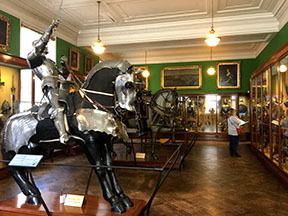
Ted told us that the best armor in London is at The Wallace collection, where I had never been, so Alex and I had a day of art the next day. We started at the Royal Academy to see the Hockney portraits, which I was particularly interested to see again since I had started my own portrait series. I picked up a few things about painting faces, although I also learned that I have no hope in mimicking Hockney’s style which combines unexpected colors in a way I could never hope to do. We dropped by the Abstract Expressionism exhibit too, before walking over to the Wallace Collection to meet Judie. It is housed in a big mansion in Marleybone, once owned by Duke of Hertford (who I think were from the line of Seymours going back centuries and were, in any event rich aristocrats of long-standing). It was an amazing collection of arms and armor (as promised) and each room had several books on reading stands in which you could read more about the individual pieces. Very nice idea. There was also a substantial collection of paintings, including four Rembrandts, “The Laughing Cavalier” by Hals and a number of other impressive works from the 1650-1850 period. It was all accompanied by lots of Louis XIV sort of furniture and decorations and tons of other things that they collected. It is quite a place and you cannot see any of the art or armor anywhere else. When the Duchess of Hertford donated it to the State upon her death in 1897, she stipulated that none of its contents can leave the house.

wallace-coll

I’ll leave the rest to another post. This is getting pretty long….