While Judie was off on her bi-coastal tour of the U.S., my old college friend, ex-roommate and best man came for a quick visit. I suspect that Judie helped push him into deciding to come, fearing what I would do if left alone of two full weeks. It was great to have him. We did an awful lot while he was here. I’ll break it up into two or three posts.
Eating: I don’t write all that much about restaurants here, which is a bit shocking considering (a) how wonderful the restaurant scene is in London generally and Shoreditch in particular and (b) how much time I spend eating out. The food scene here has a diversity and a wild willingness to experiment with flavor combinations that makes it very exciting, even more so than NYC in my opinion. To add to all of that ongoing creativity and pushing the envelope, it is now truffle and game season, allowing the British to indulge their love of eating all sorts of birds. (In the following discussion, I will try to provide a link to the restaurant menus where possible the give you a feeling of London cuisine.)
We started at St. John Bread and Wine, just down Commercial Street from the flat, one of the landmarks in the food revolution in London. It is where the great Fergus Henderson’s first restaurant opened. We went there for lunch shortly after Chris arrived. The smoked sprats (sardine-like fish), the cold venison with celeriac slaw, brawn (a sort of pate made out of boiled pig’s head) and the Eccles cake were especially memorable. That evening, we went for food at Sichuan Folk, a shockingly good Chinese place around the corner. The green beans with garlic and pork crumbles and the fish stood out. The next day, we walked through Kensington Gardens, planning to eat at the Serpentine Sackler Gallery, but it was closed so we ate at the Food Hall at Harrods. There are a number of specialty food bars to eat at and we chose the fish one. Lovely meal and the Victorian tile work, made by Royal Doulton, was just stunning. That evening, we ate at Lotus, a sort of haute cuisine Indian restaurant near Trafalgar Square. In keeping with game season, our dishes included Pigeon Masala Dosa and Muntjac Mal Daas (a kind of small deer in aromatic gravy). For old times sake, we also stopped at the Cork and Bottle in Leicester Square, where we had miraculously run into each other over thirty years earlier, for a few glasses of wine.
On Tuesday, we looked around for a pub lunch near Kew Gardens, but ended up settling for Pizza Express, a decent chain and our least memorable meal. That evening, we were in Islington for a play and did get to a local pub for a pre-theater pint and something they called rocks, a sort of English samosa stuffed with savory fillings. After the play, we stopped for a meal at a slightly snooty French restaurant on Upper Street. The next day, we went to Lyle’s, my favorite lunch place. It is run by acolytes of Fergus Henderson and is just a treat every time I go. We had grilled razor clams, grouse, a great pumpkin and shaved chestnut dish with a whey cream sauce (among other delights). That night, we were in the emerging neighborhood behind King’s Cross Station (to see David Bowie’s “Lazarus”) and ate at Caravan , where the highlights included blue cheese and peanut wontons, jalapeno corn bread, soft shell crabs with kimchi and wonderful croquettes. We closed Chris’ culinary tour with lunch on Thursday at Super Tuscan, our favorite restaurant in London, where we concentrated on truffles; gnudi with black truffle sauce, truffle arancini, little stuffed pastas with shaved black truffles and fresh tagliatelle with cream sauce and two ounces of shaved white truffles. (We finished with a bang.) And all of this talk of eating delicious fungus is a great segue to a marvelous adventure earlier in the week:
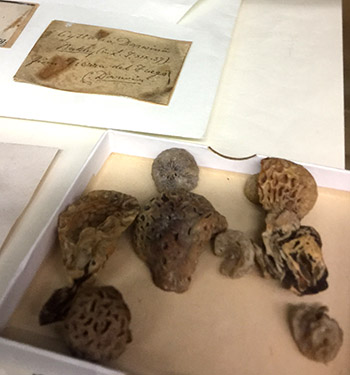
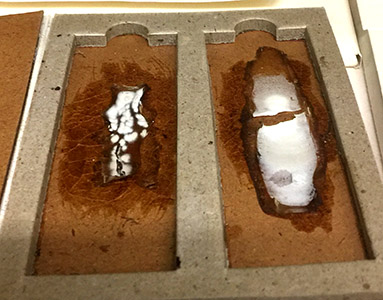
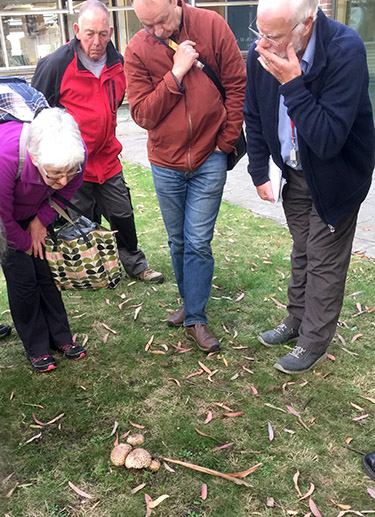
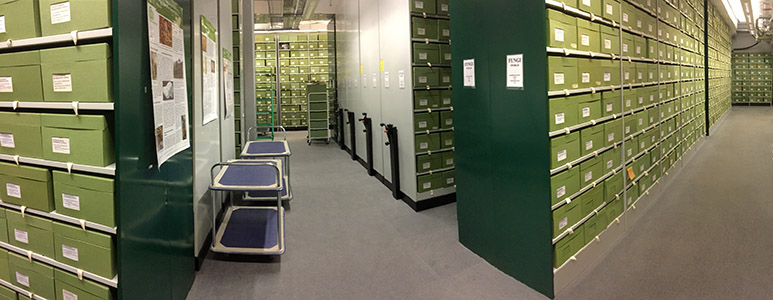
Kew Botanical Gardens: I had actually never been to Kew Gardens, but it was a reasonably nice day, which got better as it went along and ended up beautiful, so we took the Tube out there. We discovered that on Tuesdays (which it was) they had special tours led by scientists working in the labs there. So we signed up for a tour about fungi at Kew and, after wandering about the greenhouses for an hour or so, we presented ourselves to be guided. Our leaders were charmingly eccentric and nerdy and advised us, straight off, that there were far more varieties of fungi at Kew than plants, leading to their opening quip that it really should be called Kew Fungus Gardens. They led a group of about twenty hearty souls tromping to all sorts of corners of Kew that we might not have seen, poking around under trees and in piles of wood chips. We saw many varieties of toadstools and other sorts of fungus growing on and under the trees. There was a young guy of the tour in a singlet, who initially looked more like a soccer hooligan than a nature lover, but he ending up knowing almost as much about fungus as the guides and was even better at finding samples. Having him along really go our mycologist leaders even more geekily wound up about the fungus they were seeing than one might have expected. The tour, which was supposed to be an hour, took far longer and was a really great jaunt. It ended in front of the lab building, which had a huge set of mushrooms growing right out front, which they excitedly advised us had been coming back every fall since 2012. Then they invited us down into the lab, where they have endless number of boxes containing fungus samples, over 1,300,000 in all. All pretty incredible, but they saved the best fungus for last, showing us a fungus sample that Charles Darwin had picked off a tree in South America and some of the actual, original penicillin culture that Alexander Fleming had used in (accidentally) discovering antibiotics in 1928. Seeing the latter was a little like seeing the Rosetta Stone. They don’t give these tours very often, so probably something like 100 non-scientists a year get to see this stuff. Some photos of all of this follow. The first one is the Darwin fungus, the second one is the original penicillin culture and the bottom one is some of the fungi collection.
 nickinshoreditch
Speaking of being nerdy, I must correct you — Fleming did not “discover” the use of penicillin. Old wives, of “old wives’ tales” had been using moldy bread to cure infection for centuries. We have so lost connection with the botanical medicine which surrounds us, which used to be part of the knowledge bank of most women and many men, that we have somehow come to think that everything must come to us through “science.” Most pharmaceuticals find their origins in what we dismissively call “folk medicine,” which thank goodness, the Chinese still respect. All of us have cures, contraceptives, beauty treatments, and balms of all sorts in our front yards, if we have a yard.
LikeLike
I think I would respond, first, that I was not trying to write the definitive history of penicillin and it use over the centuries. I was writing about a serendipitous tour which climaxed by seeing a smear of a kind of fungi that changed modern medicine in a major way and why I found that to be pretty amazing and actually moving. Second, I have no real knowledge of whether your representation of the history of penicillin is actually correct, although it sounds plausible. However, it is worth observing that, even if earlier forms of folk medicine had actually used penicillin, it was Fleming who established the science behind the effect of penicillin and led to the use of antibiotics, which, whether you agree with its subsequent history, certainly changed modern medicine and saved countless lives. Finally, I am sure that there are many types of folk medicine that modern medicine should take more seriously and that might be an interesting topic for a very different sort of blog or an article in a science journal. It is a fascinating topic, but it really isn’t with in the scope of this blog, at least as I perceive it.
LikeLike