Bank Holiday Weekend: Art, a Sermon and Carnival

One of the things they do here is have periodic Bank Holidays, which create a long weekend. Unlike the U.S., these holiday don’t celebrate any person or group. They are just a day off. We had completely forgotten that this past weekend was a long weekend, so we didn’t make any plans to leave and go to the beach or something. And I had agreed to give Andy a break at New Unity by giving the sermon on Sunday, which made going anywhere impossible anyway. We had fun in London instead of traveling.

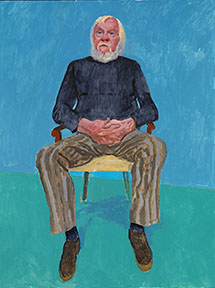
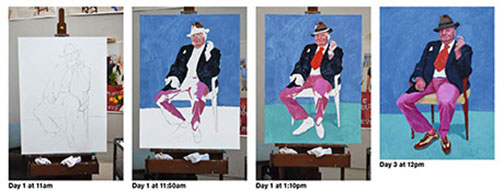
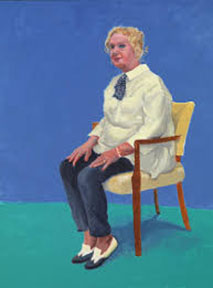
David Hockney and Bill Jacklin: We went to the Royal Academy of Arts on Saturday to see the David Hockney Exhibit, “82 Portrait and 1 Still Life”. It is a result of an ongoing project that Hockney is doing. Over the past two or three years, he has been inviting friends and families to sit for him. They each sit in a white chair and he paints them in three days, beginning with a quick charcoal outline. The paintings are all done with acrylics and are quite large, roughly four feet by three feet, so completing a painting in three days is not easy, even for Hockney. The backgrounds started out varied, but quickly change into two colors, which flip, presumably on what they are wearing. The portraits are pretty wonderful individually, but seeing them all in one place is quite incredible. Hockney is amazingly skillful at faces, so much so that it is hard to take your eyes off them. He captures the face, without it being overly realistic. But it is his rendition of the pose and the clothes and hands and feet that really impart a feeling of the subject. (I was happy to see that even Hockney has trouble painting hands and feet, which I find incredibly difficult. One of the early portraits in the series left off the feet, but Hockney decided it was incomplete and never did that again.) His subjects all get to decide what they would wear for the sitting (saying a lot about them), which made you think about what you would wear if you had the chance to sit for him. The one still-life was from a day when someone was supposed to come and didn’t show up. Hockney was all fired up to paint, so he moved the white chair and replaced in with a blue bench with fruit on it and the result is, of course, striking. I’ve included a few samples of the exhibit below, including an excerpt from the catalog which show the process of painting Barry Humphries, but it really doesn’t capture the exhibit. I am now inspired to paint some portraits (but no white chair and probably just head and shoulder shots for me at first).
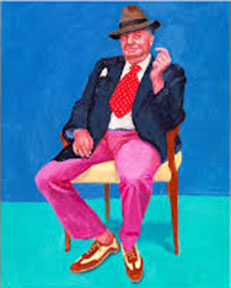
Hockney1  images  David_Hockney_John_Baldessari_RA_INT_7 hockney-work-in-progress

After going through the Hockney exhibit, we decided to take a look at a retrospective of the graphic art done by Bill Jacklin. It was completely different-for one thing it was largely black and white-but it was amazing. This is an artist about whom we knew absolutely noting and we both found his work enchanting. Judie wants to to buy one of his original prints, which it turns out is sort of possible. One of the great things about it from our point of view is that, although he was born in Britain, he was very much a NYC artist and many of his works are from Coney Island or Central Park or Wolman Rink or Grand Central Station. Actually, I think I enjoy discovering a wonderful talent like this as much or more than seeing an incredible exhibit of Calder or O’Keeffe or Hockney. A couple of samples of Jacklin’s stuff follows. He has a technique of spraying oil or turpentine on his engraving block before printing, which creates an etherial kind of effect.

My Sermon/Message: I gave my “sermon”on Sunday, August 28th (at New Unity, they refer to it as a “Message”, since “Sermon” seems too religious). It happens to be the anniversary of the day that we moved to London. I didn’t realize it when I agreed to do it, but it seems appropriate somehow. Rev. Andy was there and did the introductory and concluding stuff, which mean that I only had to do the reading and the sermon. I love the reading, which I excerpted from a TED talk. And my talk was generally about what happens when culture changes and the problems caused when there are winners and losers in a cultural shift. It had a nice structure, although it was hard to really make the point in seven or eight minutes. Everyone seemed to like it and I got a lot of compliments. If you had gotten up at the crack of dawn on the East Coast, you could have watched it live, as New Unity streams the service. If they ever get around to posting the service on the website, I’ll send a link. In the meantime, you could download and read the Reading here and the Sermon here, if you are in the mood.

Notting Hill Carnival: On Monday of the Bank Holiday Weekend, Judie and I went to the Notting Hill Carnival. It sounds like an oxymoron. Who would have thought that such a posh neighborhood would let itself be overrun by a million people furiously drinking Red Stripes and eating jerk chicken by the ton. (I did a little research and it turns out that 50 years ago, when the carnival began, Notting Hill was a West Indian neighborhood that had experienced race riots. Times have changed.) It seemed like every Caribbean person in London was there. It was a mad house and the parade lasts all day since it moves at less than a crawl. When Judie told people at work that we were going to go, they looked askance and said that it was too crowded and dangerous. (And, in fact five people were stabbed on Sunday night, at the end of “Family Day”, and over 450 were arrested over the two days.) But we had fun, despite the mob scene, and left before the crowd became completely drunk and rowdy. A few photos follow:

Banks and Trains and Bishopsgate

It has been hot in London this week. Hot meaning mid 80 °F, which we would not consider really hot in the USA, but it is hot here in the land of no air conditioning. It is especially brutal in our flat, with its glass wall of windows facing west. By late afternoon the place is literally a sauna. We can cool it off (a bit) at night, but that means opening all the windows, which means that we hear every truck, emergency vehicle and drunken groups of yabbos going down Commercial Street (and I have learned there are a lot of them). I know it won’t last long and that cold showers can help, but it really is unpleasant. On the plus side, I’ve been exercising more since our gym is air-conditioned.

The Bank of England: It was so damn hot that, in order to get out of the flat, I went to the Bank of England. I actually had a purpose because Rich and Mair had given me old bank notes that could only be exchanged there (very simply as it turned out). It wasn’t that big of a deal since Threadneedle Street is nearby (guess which of the guilds were in that area). Since I was there, I went to the Museum (which was air-conditioned). It’s a museum about a bank, so even though the Bank is one of the oldest in the world, there is a bit of limit on how much fun it can be. A few highlights:

  • It began in 1694, when the King needed money for yet another war with France. A loan to the Crown of £1.2M was raised in two weeks. An act of Parliament gave all subscribers a guarantee of 8% per annum interest in perpetuity. There were hundreds of subscribers, from all walks of life.
  • There was lots of information about its architectural history. Sir John Soane, the great architect of the 19th century (and the proprietor of the house that is now the Soane Museum), rebuilt the Bank in neo-classical style. It was his greatest work. Unfortunately, after World War I it was decided that the Bank was not big enough and virtually all of Soane’s masterpiece was demolished.
  • Kenneth Grahame worked at the Bank for many years, rising to become the Secretary. He had wanted to go to Oxford, but his parents didn’t have the money and he ended up taking the test to work for the bank and got the highest scores ever. In 1903, he was called out to meet a person asking to see him and was shot at three times (all missed). The assailant was subdued with a fire hose and later found not guilty due to insanity. A few years later, he resigned in a dispute over Bank internal politics and moved to a bucolic spot in the country. In 1908, his book, “Wind in the Willows”, was published.

Jeremy’s Little Engine That Could: The latest bizarre moment from the Labour leadership election (although it doesn’t compare to the Trotskyite stuff) happened this week when Corbyn released a picture of him sitting on the floor of a train on the way to Liverpool or somewhere, saying that he train was too crowded and making the point that the railroads should be nationalized. Kind of pointless, but it backfired because it was a Virgin train and (Sir) Richard Branson got his people on it. They produced a CCTV video showing Corbyn walking past countless open seats in order to sit on the floor. It has become a big deal in a campaign that has no real news and probably did play well with his base. Corbyn responded to this by calling Branson a “foreign tax cheat”, which may be true, but has a sort of Trumpian ring to it.

On the one hand, your reaction has to be “Who cares?” On the other hand, here you have the “Leader” of the Labour Party making a pointless demonstration that would have seemed silly thirty years ago. Should he really be concerned about making these points off of the far-left wing wish list (but which will probably excite the Corbynistas) or should he be concerned about being a credible alternative to Theresa May and the Tories, who seem likely to move increasingly to the right as there is no credible opposition? May has already appointed a woman to be the head of the Ministry in charge of international aid whose position is that Britain should not be providing such aid and has advocated the abolition of the department which she now heads. You can expect the Conservatives to say nice things about National Health while simultaneously trying to destroy it. Who is going to stop this country from veering ver rightward? Parliamentary Democracy is supposed to have two parties. That is not the case now.

“Father Brown”: Having finished watching all of the episodes of the mystery, “Vera” (a great show which may not have made it to the States), we have started to watch the “Father Brown”mysteries, based on the books by G.K. Chesterton. They are nice and gentle shows and Father Brown is played by the same actor who played Arthur Weasley in the Harry Potter movies.

The Old Neighborhood: I am constantly learning things about this neighborhood. The history is fun. Bishopsgate Road is the road that you get on when you leave Liverpool Street Station to get to our flat. It originally emerged through the London Wall, built by the Romans to protect Londonium, at Bishop’s Gate. The gate was one of seven in the Wall and was marked with a bishop’s miter (and the usual heads of traitors and noted criminals presumably not notorious enough to make the spikes on London Bridge). The road led to Shoreditch and beyond and was a major thoroughfare. Shakespeare undoubtedly walked along it to get to “The Theatre” on Curtain Road in Shoreditch. It was run by James Burbage and housed the Lord Chamberlain’s Men, a troupe that employed Shakespeare as an actor and playwright. When Burbage had a dispute with the landlord, The Theatre was dismantled and it wood shipped to Bankside where it was used to build The Globe.

Right near where Liverpool Street Station is today was the original sight of “Bedlam”, the asylum for the insane which coined the word. It became the first psychiatric clinic in the world, after opening in 1257. Located just outside the Wall (which makes sense), it was originally St. Bethlehem Hospital, a general hospital that became a psychiatric hospital in the 1400s. In typical fashion, Bethlehem was gradually shortened to St. Bedlem Hospital and then finally nicknamed Bedlam. In the late 1600s, Beldam was move to a new location in Moorfields.

If you walk away from the old Bedlam site down toward where the old gate was, you come to St. Ethelburga’s Within Church. (Within means that it was within the city wall, as opposed to St. Botolph’s Without Church, which is a few blocks up the street.) It was constructed in 1250 and rebuilt in the early 1400s. Henry Hudson and his crew took communion there before leaving to seek the Northwest Passage. It survived the Great Fire of 1666 and the German Blitz of World War II, but in 1993, half of it was demolished by an IRA truck bomb that exploded on Bishopsgate and at the church’s doorsteps. (The IRA had given enough warning so that the only person killed was journalist, but there was massive property damage.) It was rebuilt as a Center of Reconciliation and Peace and has a lovely, hidden courtyard.

Groundhog Day, Politics and More

I spent entirely too much time last week watching the Olympics, which were on almost all waking hours here. It was fun, but too distracting. Now I can get focused on all of the stuff I need to do.

One of my immediate projects involves coming up with a sermon/message to give at the New Unity congregation next Sunday. Andy, our minister there, is in need of a break and the Unitarian movement is too small to have a system of guest ministers giving sermons, as is done in the U.S. So he asked for volunteers and three of us agreed to take a Sunday. The theme for this quarter has been culture, so I have decided to speak about “When Culture Changes”, thinking about the impact of the cultural shifts that have caused things like Brexit and Trump. I only have the vaguest of outlines at this point.

“Groundhog Day: The Musical”: Last week, we went to see “Groundhog Day” at The Old Vic, a musical version of the classic Bill Murray movie. You could imagine how this could turn out very bad, but this adaptation was a wonderful, fast-paced, sometimes hysterical, sometimes poignant celebration. It kept the basic plot of the movie and even a few of the jokes, without trying to duplicate it. The result was something that was new, but equal to the original in its own way. The book was written by Danny Rubin, who wrote the screenplay for the original movie, and the rest of the creative team was the one behind “Matilda, The Musical” (Tim Minchin-music and lyrics, Director Matthew Warchus, Choreographer Peter Darling, designer Rob Howell and others). It was just incredibly clever in so many ways, from the sets to the choreography to use of illusions. Andy Karl, an American actor, played Phil Connors. He’s been in a lot of productions, both on and off Broadway, most recently playing the lead in “Rocky, the Musical”. He didn’t try to ape Bill Murray’s portrayal and instead played Phil as more of a smarmy, sexist, egomaniacal jerk going through a bit of mid-life crisis. He was great and watching him turn from the initial Phil Connors of the opening scene, through various levels of lunacy, desperation and despair, until his final transformation into his best self, was great theater. It was particularly enjoyable watching him repeatedly staggering back through the same opening production number with bands and townspeople singing and meeting Ned Ryerson and then meeting up with Rita and Larry to cover Punxsutawney Phil’s act, with his Phil Connors changing each time it happened and everything else was the same. One of the things that the production was able to do since it wasn’t a Bill Murray vehicle was to spend a little more time fleshing out some of the other characters, which I thought was mostly successful. (Brantley’s review in the NY Times didn’t like the humanizing of Ned Ryerson, but I though that by the time that happened, they had squeezed all the humor out of the insurance agent running gag.) The character of Rita got a little more depth and Carlyss Peer was very good in the part, although it was impossible for her to recreate the radiance of Andie McDowell from the movie. Finally, I though the sections of the production dealing with the redemption of Phil Connors was truly touching and actually better than that part of the movie. I am quite certain that I just saw the Tony Award winner for best musical in whatever year it arrives in New York (which I think may be late fall, when I am sure it will also have moved to the West End here). It is going to run forever and win lots of awards. I’ve bought a ticket to see it again (something I never do) when Judie has her next Women’s Group meeting in our flat.

Connections: One of the central parts of my life over the past fifteen years has been the community at the UU congregation in Montclair. And it is not just our close friends. It is knowing that this person is going through a major illness or has lost parent or that that person is getting a divorce or has a child who just did something special. One of the most difficult things about living in London is missing out on all of these little things that create that feeling of community. (Although we get a different version of that in New Unity, it is one that lacks the depth, although it would be just as meaningful given enough time). Oddly, my best link to my old community turns out to be Facebook, where I have able to follow some of the comings and goings and trial and triumphs of my community. I honestly never thought I’d appreciate Facebook, but I do.

Political Update: The Labour Party debacle continues to slog along. Sadiq Khan, the new Mayor of London, as well as the head of the Party in Scotland have both recently endorsed Owen Smith, but I find it hard to believe that it will make much difference given the way the leadership election will be run. The debates between the two candidates (which are called “hustings” here) have been pretty unremarkable since both Corbyn and Smith are almost identical on most policy issues. Thus, the debates are reduced to moment like Smith being asked to identify Justin Bieber in a photo (he could) and Corbyn being asked if he preferred Trotskyites or Blairites (he refused to pick one!). I think that latter one was my favorite moment of the campaign so far.

Remember Brexit? I think most people though that Britain would be on the path out of the EU by now. But it’s summer time and everyone is on vacation and not paying that much attention, so not much has happened. The biggest problem facing the government is the realization that they do not have anyone who is experienced or qualified to negotiate the zillion new trade agreements that will be required as Britain leaves. The British government has not had to do that for over a generation, as all such agreements had been negotiated by the EU. So the Tories are scrambling around trying to find hundreds of lawyers, accountants, advisors, etc. to do the job. It is going to be a windfall for private firms and their employees, who appear to be the only logical candidates. It is going to cost a fortune. Partly because of this, there is said to be some thought with in the government that the withdrawal process should not even begin until next year sometime. It is safe to say that this will cause big problems for Theresa May, when the eurosceptics that are in the majority of her party return from vacation. Neil Farage (shudder) may even come out of his announced retirement. The fall will also see a number of legal challenges to the process being heard, including the one that argues (persuasively in my view) that Britain cannot withdraw from the EU without an act of Parliament and another in Norther Ireland arguing that Brexit violates the Sunday Accords somehow. Meanwhile, there is a power struggle going on between Boris Johnson and the other two Ministers May appointed to oversee Brexit in a specially created department. It has been a slow period lately, but it may only be the quiet before the storm.


Summer in the City, Trotsky, Fiji Rugby and a Painting

The Sound of a London Summer: As you walk around London in the summertime, especially around the City on a a Friday night, you constantly hear this loud hubbub. Then you turn a corner toward the noise and discover 20-100 people all standing outside a pub or some other bar, drinking and talking (and smoking). When there are a number of pubs and drinking establishments all close to each other, the sound never stops, it just raises and lowers in intensity. The murmur of the street is often quite noticeable from our flat, even though we are six stories up.

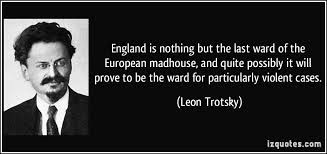
Leon Trotsky Lives!: English politics is different. In the latest craziness gradually reducing the Labour Party to comical irrelevance, a major dispute haas a risen about whether Trotskyite elements are infiltrating the Labour Party. (And Americans were worried that Bernie was kind of a Socialist….) A little background: Back in the 80s, the Labour Party under Ed Miliband decided that, in order to be taken seriously, they had to get the radical Socialists and Trotskyites out of the party and they threw them out. The major organization that they banned was called Militant, which was especially powerful in Liverpool, so Labour adopted a rule that you could not be a party member if you are a supporter of another party. (One of the Labour pols protesting all of this was a young lad named Jermey Corbyn.) Flash forward 30 years and, unsurprisingly, it appears that a variety of far left organizers and lunatics have been joining the Labour Party. Tom Watson, the Deputy Leader of the Party, has raised the alarm and sent a letter to Corbyn detailing the number of Trotskyites joining the party and specific instructions from extreme Socialist parties to their members to do just that. The Cobynistas deride this as a conspiracy theory but, of course, it is in their interest to have these far left types in the party, since they will inevitable support Corbyn. Watson sys it is not a theory, it is a fact. Corbyn responds that he doesn’t have any problem with expanding the rolls of the Party.

So, is this important or just comic relief in a boring campaign that Corbyn appears likely to win, with or without the votes of these far left faolks? Actually, I’d say it is kind of important in that it say a lot about where Corbyn is taking the Party. Corbyn has always been a “movement” guy, more concerned with making philosophical points than in the problems of governing, which was fine when he was a back bencher, but not so much now that he is the alleged “leader”. (Indeed, it was his nonchalance to Parliamentary politics and real power that led to the vote of no confidence by his fellow Labour MPs.) The Trotskyites and the far left Socialists have no interest in governing either, as they are more interested in fomenting discord, gridlock and disappointment, with the hope that this will lead to discontent with the current government system and result in a Marist revolution. (I recognize that this seems like something from the middle of the last century that was utterly discredited by the 1960s and it is a real sign of how messed up Labour is that anyone is talking about it.) Momentum, the movement supporting Corbyn and seemingly in control of Labour membership, is, like the Trotskyites, a group with little interest in Parliamentary democracy or in developing political power. They are more interested in ideological purity and in attacking the mainstream labor leaders, stuff right out of Leon’s playbook. As this far left element gains a foothold in Labour, the idea that Labour should be an effective opposition Parliament becomes less central. The party is in shambles and the fact is that they do not seem to have prayer of being elected and could be destroyed if a General Election was called. But that doesn’t seem to really bother them. Since Democracy does not work if there aren’t two viable parties (something Americans have come to realize), it should. This whole Labour dispute about the Trotskyite entrants makes you wonder whether to laugh or cry.

And while this pathetic sideshow is going on, Labour is tearing itself apart about who should be allowed to vote in the upcoming leadership challenge. I won’t bother to detail the dispute (and the resulting legal challenge) and the twists and turns that have just ended. As one of my favorite Guardian writers, Marina Hyde, puts it, “To the wider public, Labour has become something that life is too short for.”

images.jpg

The Olympics on the BBC: I’ve been watching the Olympics on BBC and it is a completely different experience:

  • To begin with, there are no ads. This leads to lots of kind of entertaining or at least odd air time, where everyone is waiting to start again when NBC tells them that they can.
  • The BBC does not broadcast sports with the polish of American TV. I’ve gotten to see some bad commentators, some broadcasts in which the announcers were utterly absent (which is very strange) and I’ve gotten to stare at green pools while someone is figuring out what to do. It is very odd to be watching the tennis final and to have minutes of silence while the match is stopped for commercials.
  • The Fijian rugby sevens team has been on of the highlights of the Games for me. As you might imagine, they have never even sniffed a medal of any kind, but their rugby team was utterly dominant, playing a confident and flamboyant form of rugby that no other team could imitate. When they destroyed Great Britain to win the gold medal, the team joined in a circle and sang some sort of song at the top of their lungs while sobbing. I don’t imagine that Americans saw any of it.
  • Badminton is an incredibly fast game and fun to watch. Team handball is an utter mystery.
  • The BBC still spent lots of time on gymnastics and swimming, but we also got to see too much of sports that Brits are good at, like rowing and cycling. The Brits are like the USA in concentrating on events where they have shot. There just aren’t as many. The good thing is that the sports are sometimes obscure.
  • On thing that the BBC does is have essentially two channels showing more typical Olympic coverage and then side channels that you can get with buttons on your remote that allows you to watch field hockey or weightlifting or volleyball or cycling to your heart’s content.

Not really a New Picture: I actually wrote about this picture months ago and had put it aside to see if it was finished. It has been sitting out on top of a radiator and I’ve gotten used to it and have decided that I don’t want to play with it any more. It is a picture of lily pads (obviously, I hope), that was supposed to have frogs until I discovered that I couldn’t really paint frogs.

Lily pad

Meanwhile, I have resumed my homage to Georgia O’Keeffe. It has turned out to be time-consuming and a bit less satisfying than I thought it might be. I may take a break and work on something new, hoping to be more inspired when I return to it.

Back in the USA

I’m back in London and, as a result, I’m finally back to my blog. I’m not certain why I can’t seem to keep it up when I am traveling. I guess I just am not in my usual place and I get distracted. And, after all, it is called nickinshoreditch, so maybe I shouldn’t post when I’m not here. My next step is to get back to painting….

It was nice being back in America for a visit, if for no other reason than we got to experience some true, hot summer weather. It’s not so much that going out into a 98 degree day is fun, it is just something that we were never going to do in London (which is a good thing since nothing is air-conditioned, especially our flat).

Liberty: We had a lovely “Rinearson Sisters’ Weekend” at our place in Liberty, NY, which was made extra special by the fact that all of our nieces, nephews and children showed up (for the first time in years), along with my sister Norah. I even got to play a small amount of golf (with Hannah and James). The next weekend, we had our English friends Phil Saunders and Phillip Saunders (both lawyers for the City of London) visit us the second weekend (Phil with Jenny Bakshi). Phillip, who it turns out is a “mad keen fisherman”, hired a guide in Roscoe and went trout fishing in the famous Beaverkill and they all went to the Fly fishing Museum and the Fishing Festival that just happened to be scheduled that weekend. Even more important, we go to spend that weekend with our old friend, Paul Weeks, who drove himself down from Bangor. He has been through a lot in the past couple of years between his illness and injuries and the untimely death of his wife Gig and we really have not been able to be there as much as we would have liked. It was wonderful to be able to spend time with him.

A few things I noticed being in Montclair: In Shoreditch, we feel like we are in a neighborhood completely populated by people between 22 and 32, with very few children. In Montclair, that young adult demographic seems to be utterly missing. Perhaps because I feel a bit less connected to the town after being gone for a year, I also found myself thinking more like a city person as I drove around. We love Montclair and our friends there and look forward to our return, but it is now easier to envision a move into New York City at some point.

Adventures in Bureaucracy: Judie and I flew back to America on the very date that her employment at Bryan Cave officially ended. That meant that Judie’s U.K. visa expired at the same time, raising the issue of how we were going to get back to London. K&L Gates, her new firm, has been very helpful, hiring a boutique immigration firm to help us, and it finally all worked out. We made it infinitely more complicated by having passports due to expire in seven month and, in Judie’s case, completely filled with stamps, etc, leaving no place to put the new visa. So I got to spend the first couple days of this trip figuring out a way to quickly renew our passports with Judie out of town for the week. At the same time, I had to detail every foreign trip each of us took in the last ten years, along with countless other stuff for our visa. (Why they need information about each of my deceased parents is a mystery.) They also wanted my marriage license to prove that I was married to Judie, which meant a trip to Norwalk, Connecticut. Thanks to all of that and spending lots of money of expedited service, we finally got our visas in our new passports on the Friday before we were set to leave. They are only good for six months (because Judie is in a new job), so they expire in early February. This is a bit problematic since our house is rented through March 15th (and the idea of moving late January is not appealing anyway). I’d like to figure out a way to stay until late March. I assume it is possible.

Woodstock Nation Remembered: We decided to go to Bethel Woods Art Center while we were up in the Catskills. It is about 25 minutes from our place and is the site of the original Woodstock concert. There is a big stage and lawn seating right where the original stage had been at Max Yazgur’s farm. We went on a tour of the accompanying Woodstock museum, led by a guy who had been at the festival and appears to have enjoyed the chemical entertainment as well as the music. He was a bit of a comical space cadet, but ultimately really had nothing much to impart. The exhibit itself was a bit repetitive, but kind of interesting. If you lived through the 60s and saw the movie, there were no great revelations, but the sections dealing with how the town dealt with it and how Woodstock ended up in Bethel gave another view of things that made it worthwhile. And the music videos were great.

R.I.P. Mets: I got to go to a Mets doubleheader while I was in the States. It was brutally hot, but fortunately, Bob Benno and I were sitting in the shade. The Mets got good pitching, were unable to score much and split the twin bill, which pretty much sums up their season. The injuries to Wright (it may not be career ending, but he’ll never be the same player), Duda and Harvey for most of the season were huge blows. D’Arnaud, typically, got injured and then did nothing since coming back other than allow everyone to steal bases at will. Conforto and Wilmer did not develop. Cespedes carried them for a while and then he got hurt. It is just not happening for them this year. Their pitching is still impressive and they’ll have it for a few more years, so they ought to be contenders next year when I get back to being a full-time fan.

Trump: It may be that we were in America for the pivotal moments of the election. When we arrived, Trump had gotten his convention bounce and was roughly tied with Hillary. Then came the Democratic convention, which was incredibly well produced and seemed very effective to me, despite the sour grapes of some Bernie supporters. There were great speeches every night, with the Obamas reminding us how much we will miss them. So Hillary got her big post-convention bounce and Trump compounded it with his attack on the Kahns and on babies and on everything but apple pie. The election seemed to turn in those two weeks. It may be that it will turn back, but it may also be that the election narrative has been set and that Trump is stuck as being perceived as the utterly unprepared crazy person that he is. The other thing that I believe is happening is that most people really don’t pay that much attention to the election until about now (unlike me, for instance) and only just started to take a close look at Trump in the last few weeks and were horrified by what they saw. I hope this isn’t just wishful thinking on my part.