On Monday and Tuesday of this week, Judie and I visited Liverpool (she had a conference). I wasn’t expecting much, other than some Beatles stuff. I was expecting to visit a run-down and grubby, kind of depressing old port city. I was pleasantly surprised.
Some Liverpool History: It was formally founded in the early 1200s by King John (of Magna Carta fame) to give him a port for his invasion of Ireland. As our Beatles guide pointed out, this ultimately backfired, as the Irish ended up invading Liverpool as the result of famines, etc. There are more Irish in Liverpool than any city other than Dublin.
The key moment in Liverpool history was when they figured out that, by installing locks in their docks, they could keep the water level high, despite the huge tidal changes in the harbor, making the harbor much more efficient. They eventually built miles and miles of docks, all connected by an elevated railway. It was some impressive engineering. The other thing that helped Liverpool is that it was the closest English port to the New World as well as the new manufacturing and production centers of the nascent Industrial Revolution. This combination led to Liverpool becoming the center of the slave trade from the 1700s until it was finally outlawed in the early 1800s. The boats would be loaded in Liverpool with goods to trade in Africa for slaves, who were transported to various parts of the New World and traded for things like sugar and cotton, which were brought back to Liverpool and sold. The cotton would be sent out to nearby mills and the cloth then sold. Liverpool became an enormous trading center and very rich.
The rich people in Liverpool did what rich people do. They built huge ostentatious buildings. As a result, Liverpool has an amazing collection of 18th and 19th century architecture. And this is just what survived the German bombing in World War II. As an important port and industrial center, Liverpool was a target and suffered extensive damage. But what really destroyed Liverpool was the advent of container ships. They made the old dock system obsolete and eliminated the need for longshoremen and everyone else connected with unloading ships and storing the cargo. (The identical thing happened in New York City.) The unions fought this, but it was a losing battle and Liverpool suffered greatly. It has made a relative comeback. The downtown area is fixed up with museums along the water and the few remaining docks renovated to be tourist destinations with cafes and shops. There are nice restaurants and new hotels. And there is all of that great old architecture. It makes for a nice city to visit, although I wonder if the underlying economy is going that well. I’d guess that globalization has passed a lot of its residents by. The communities surrounding Liverpool all voted to leave the EU.
While I was there, I went to the Tate Museum’s Liverpool Annex and saw a good exhibit of the work of Francis Bacon and Maria Lassnig. There was a Museum of Slavery, which I guess is an effort to atone for the past and was nicely done. And I went to the Maritime Museum, which had big exhibits about the Titanic and the Lusitania. (The Titanic was actually built in Northern Ireland and never docked inLiverpool. But since it was owned and operated by the White Star Line, which like Cunard and other ship lines was headquartered in Liverpool, it went down with Liverpool painted under its name.)
Beatles: The big interest for us in going to Liverpool was to do the Beatles tour. It is really a kind of industry there, with a museum at the Albert Dock, countless shops selling Beatles stuff and various tours available. I’d guess that this is an industry with a shelf life, as I wonder if future generations will have the interest that the baby boomers do. We went to the Beatles Story museum on Albert Dock, which was not as schlocky as I feared it might be. It was mostly recreations of places in Beatles history and lore, but it had lots of information and pictures and a decent audio guide. But the most enjoyable thing we did was a Taxi Beatles Tour with Gareth and his Taxi, Michelle.
We learned a few things about the Beatles that we didn’t know.
- Although The Cavern Club is more famous (but is actually a recreation) since the Beatles played there close to 300 times and were “discovered” by Brian Epstein there, the more significant club is the Casbah Coffee Club. This was in the basement of Pete Best’s house and the walls were painted by John, Paul and George. It is where they first performed. It is still owned by the Best family and can be visited. The original painting is still there.
- Mona Best, Pete’s mom, was the band’s manager until Pete was fired as drummer and replaced by Ringo. The firing of Pete was very unpopular in Liverpool, where he was a local favorite. At the first post-Pete gig, there were protests in the street and George showed up with a black eye when a fan punched him in the face.
- The lads didn’t really want a drummer at all, but had to have one to play in Germany, so they hired Pete.
- The school that Paul and George went to was closed. Paul led a campaign to reopen it and appears there for graduations and to give a master class. The school is now called the Liverpool School of Performing Arts.
- Strawberry Fields was an orphanage that John used to hang out at as an unhappy teen. (His father deserted him and his mother was forced to give him up to a domineering aunt.) It burned down at one point and John paid to have it rebuilt. But it has since closed and is completely overgrown. All you can see is the gate.
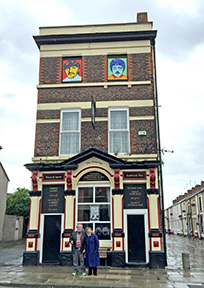
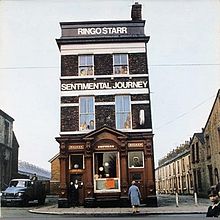
Some Pictures: On the Taxi Tour, we went to homes of all four Beatles. John and Paul’s are owned by the National Trust. Pictured below is the pub where Ringo’s mother would have gone. Their house is down the street to the right. It is on the cover of Ringo’s album “Sentimental Journey”.
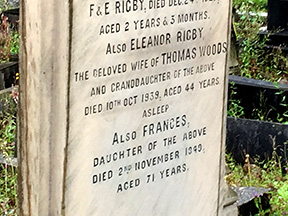
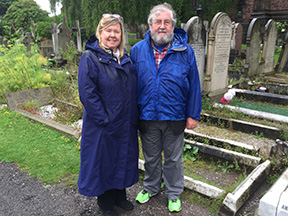
We went to see the grave of Eleanor Rigby. There is also a grave of someone named MacKenzie, but Gareth assured us that it could not be “Father MacKenzie”. It is in a church yard that John, Paul and George would have known and loitered in.
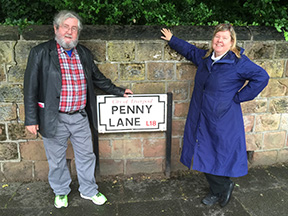
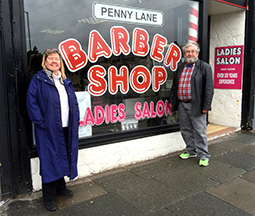
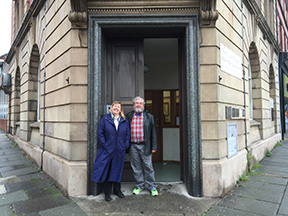
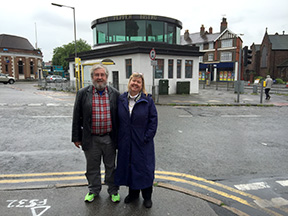
These pictures are from our stop at Penny Lane, both the Lane itself and the shopping district known as Penny Lane where they would have hung out. The pictures are of Penny Lane, the shop of “the barber showing photographs of every head he’s had the pleasure to know”, the corner bank with “the banker with the motorcar”, “the shelter in the middle of the roundabout” (where the bus that Paul and George took to school would have stopped) and the station of “the fireman with the hourglass” (which closed last year). Very strange….
 nickinshoreditch
Thank you for all the information! I visited Liverpool for the first time in June of this year (2017) and, like you, was surprised by how vibrant and beautiful the city is. I’ve come to love it and can hardly wait for my next visit.
LikeLike