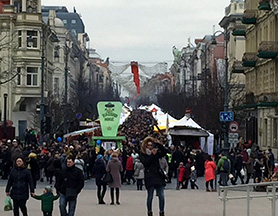
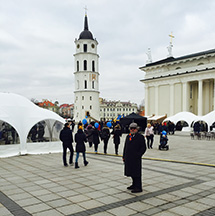
We finally staggered out of the hotel the next morning (slightly hungover) and found ourselves right in the middle of the Fair of St. Casimir. The fair is held every year on the weekend nearest to Casimir’s birthday (March 4th). It was, of course, banned during the Soviet occupation, but has now come back with a vengeance, according to Rimas. It is enormous, radiating out the main streets from Cathedral Square (which is the central square of old Vilnius). It was unbelievably crowded, which was impressive since it seemed like everyone there was Lithuanian. It is not a tourist destination, for some reason, and anyone who wasn’t a native seemed to be there by happenstance, like we were.
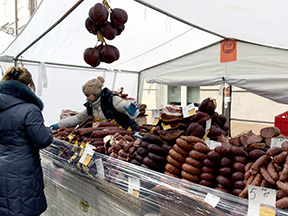
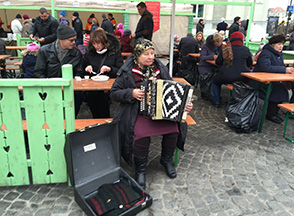
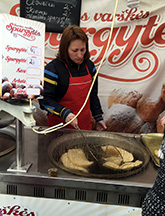
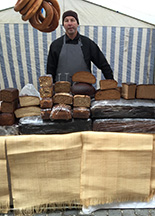
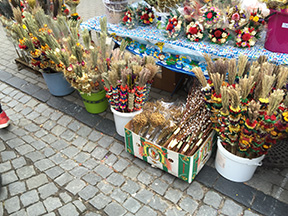
There was tons of stuff to buy. Lots of sausages, smoked meats and fish, cookies, pastries, loaves of rye and brown bread, local beers, wooden carvings, jewelry, traditional clothing, intricate bunches of dried flowers in all sizes, woolen or sheepskin slippers and shoes, paintings and artwork. There were musicians everywhere and stands selling snacks. In Cathedral Square, there was a stage that had singers and dancers performing all day long. Pictures don’t really do it justice, although some follow. Rimas, of course, had strong opinions about which stands had the best and most traditional goods. It was great fun and we kept going back (actually, one couldn’t avoid it).
Trakai: Around noon, we met Rimas and his family for a trip to Trakai. He advised us that you simply cannot come to Lithuania with out going there. With him were his wife Dellia, his fifteen year old daughter, whose name sounded like Lucia, his eight year old daughter Elsa and his six year old son Gita. (These are all shortened versions of their longer full names and I have probably gotten the spelling all wrong.) There are three older sons. Alex’s friend from Oxford is now married and is getting a PhD in Sweden, the second son is also married and is at graduate school at Vilnius University. And the third son is an undergraduate at Oxford. (The fourth child, Lucia, is in high school and wants to go to Oxford or Vilnius U.) This is an absurdly accomplished family and we had to resist the temptation to jump to conclusions about Lithuanians based on them. Anyway, all of us piled into their big van and headed off. We exchanged stories about our families on the drive and learned that son #2 and son#3 have a folk group that was playing in Oxford and London that weekend. The name of the band is Kujeliai, which means something significant, but I’ve forgotten the story. If you search hard enough on the internet, you can find a recording of one of their songs, which are all in Lithuanian. They have a very professional looking CD, which came out last year, so it is slightly surprising that we couldn’t find it. Getting back to the main story, we expressing interest in the music and they put the CD on the car sound system. After a minute or so, the two little kids were singing along in the back seat and within another couple of minutes the parents joined in.
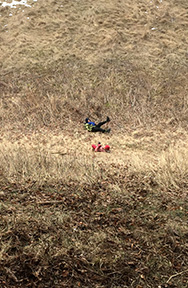
We stopped at old Trakai, which was where the rulers built the first of three castles. Rimas told us that the kings and dukes had built a string of castles and fortresses, spaced about 27 km (I think) apart because that was about how far a horse could go without stopping. That first fortification had been built up on a big hill and surrounded by a moat. But they found a better spot nearby on a peninsula and built a second castle. This is where Trakai is today. The first castle fell into disrepair and was eventually demolished to build a church and monastery and probably some other buildings. We were up on this big steep hill and Rimas was giving us a history lesson about where the moat had been and how much deeper it had been, when his two youngest kids suddenly hurled themselves down the steep slope and rolled and bounced to the bottom. We were startled and a bit concerned but he took it in stride explaining that they had a lot of energy.
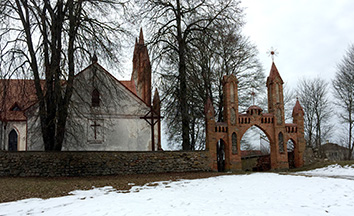
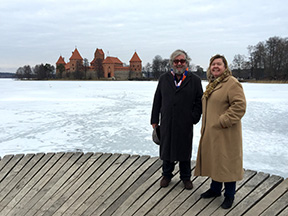
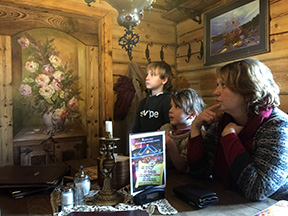
We proceeded on the Trakia, with Rimas explaining the local architecture and in particualr how you could tell the Jewish houses from the Karaite houses (Trakai was the major settlement for those Crimean Jews) from the homes of the regular Lithuanians. It is all about the shape and the number of window facing the street. As I recall, three windows means Karaite and the jewish houses were squarer, usually had two windows and were more often made of brick. Trakai is built on a small strip of land between two large lakes and is quite striking. We decided to skip castle #2 and proceed to castle #3, which is the most famous one. It was built on an island in the lake and was connected to the second cast by a long wooden bridge which would be burned if they were under attack. Nobody ever even tried to attack the castle, although the eventual advent of longer-range canons would have made it possible. We stopped for lunch in a very old and pretty restaurant on the lake. No eating outside though. It was quite cold and, as you can see from the photos below, the lake was frozen. We had Karaite meat pies for lunch. Very tasty.
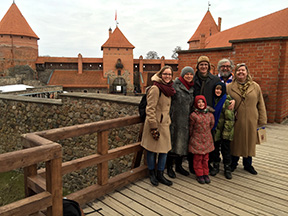
Th main castle itself was extremely beautiful. We took the tour through its many rooms. One of its innovations was a form of central heating in which large fires were lit in the basement and heat and smoke was channelled up trough the wall and under the floors, heating the rooms. The rooms had most likely been brightly painted with various scenes, but there is only vestiges of them left. The most impressive was a large hall in which the rulers had held court. Rimas said that he had been involved in Lithuania’s first international bond issue after independence from the Soviets and that the documents had been signed in that room. It is also used for concerts. To illustrate the point and the lovely acoustics, the eldest daughter began to sing a famous Lithuanian folk song. She was joined by her mother and they sang together in perfect harmony. The both have lovely voices and it was one of the more memorable moments of the whole trip. By the time they finished, a crowd had gathered, possibly thinking this was a scheduled act, and applauded when they were done. Here are some photos, which include the whole family.
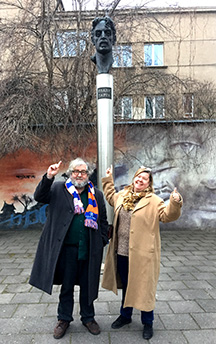
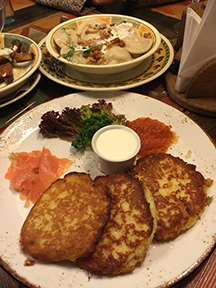
Peaches en Regalia: We drove back into Vilnius to drop us back near the hotel. On the way back, Rimas asked if we wanted to see the statue of Frank Zappa. I had heard of it. It had been erected in 1995, after Frank’s death and I think was supposed to reflect Lithuania’s freedom somehow. (As far as I know, Zappa was not at all Lithuanian.) We of course said yes and the obligatory photo is below. That evening we walked around trying to find a restaurant (after taking a nap), got lost and ended up in the old jewish ghetto. Old, narrow streets and old buildings. A few cute squares. We will have to return when it is day light. Next trip. We ended the day eating koldunais (dumplings), herring, fried rye bread with cheese curds and potato pancakes with smoked salmon at a restaurant specializing in Lithuanian peasant food. (Judie’s grandmother memorably make us koldunais once. I took a video which I think was played at her funeral.)
 nickinshoreditch
I’m getting that feeling that I’ve eaten too much just looking at the photographs.
LikeLike