We spent last weekend in Lithuania. I’m not sure exactly what we were expecting, but we were completely surprised by what we found. Lithuania is country with a rich history and shockingly cosmopolitan capital in Vilnius. There were two fortuitous things that made our trip especially magical: (1) we had Rimas, the father of Alex’s friend from Oxford escorting us around (more on him throughout) and (2) it just happened to be the weekend of the Fair of St. Casimir in Vilnius. It will take at least two posts to describe it all.
It all started inauspiciously. We flew in to Kaunas and Rimas, who had said that he would pick us up, was in Vilnius. We didn’t realize the confusion until we were through customs, but at least we had his cell number. The problem was that he was over an hour away and the Kaunas airport was tiny. (Rimas told us that it had been a military airport that Ryan Air had adopted as a destination.) Not much to do, but we managed to get beers and waited for him.
Rimas: Since he is going to be a central character in much of my descriptions of the trip, it is important to introduce him to you. His full name is Rimantas Juozas Vaicenavicius. He is a college professor, teaching statistics and finance at Vilnius University. He was formerly a government official who worked in those areas and did a fair amount of traveling and was involved in some interesting things. He seems to have encyclopedic knowledge of Lithuanian history and was determined to impart as much of it as he could to us over the course of two days. He is both eccentric and charming. It was a pure pleasure spending time with him (and his family (!)).
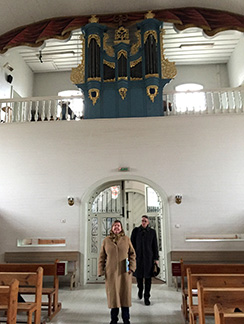
Kedainiai: The whole reason that we wanted to go to Lithuania is that Judie’s mother’s family is from there. Judie’s mother, and her parents and older bother (and some assorted other relatives) emigrated to the USA in the 1920s. Judie’s great-grandmother refused to leave and lived in Kedainiai until her death after World War II. It is relatively close to Kaunas, so we drove there after Rimas picked us up. It is in the more arable and flat part of Lithuania and we drove past fields that Rimas identified as rye and barley. The area is especially known for its cucumbers according to him. We finally found it and went to the Tourist Information office (he had never been there) and found out where some things were located. But they had no idea where Judie’s great-grandmother might be buried. We were hoping that it might be next to the church where her grandfather played the organ, but if there was ever an graveyard there, it was gone. So we never got to visit the grave. (Alex thought he found the graveyard when he visited in 2009, but it was pouring rain and he never found the actual grave.) We went to the church, but on the way, Rimas insisted we stop at a meat shop (these instructional detours were to become a theme of the trip). He showed us traditional sausages and other meats and suggested ones to buy. (He was very impressed by this little shop, which we would have just walked past if we had been there on our own.) The church itself was made entirely of wood and was quite striking. We were able to get inside and look around and see the organ, although we couldn’t get up to the choir loft and there was no one around. See a few photos below:

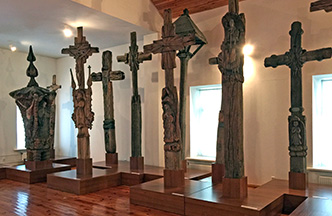
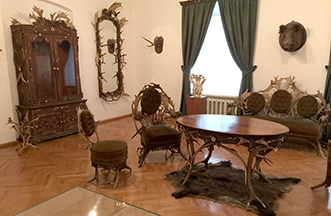
After that, we wandered about the town. We saw some photos at the town’s museum and the place hasn’t changed a whole lot in the past 100 years or so. Mostly old houses, although it is surrounded by newer apartment blocks and factories and stuff probably from the Soviet era. The museum itself was surprisingly informative. There were at least four people working there and I think the three of us may have been the only visitors, so we got a lot of attention and Rimas was full of questions for them. There was a big section about Czeslaw Milosz, a poet and writer who won the Nobel Prize in 1980. Although he was born outside Kedainiai, the world considered him to be Polish. (Poland and Lithuania go back a long way together. They were often jointly governed hundreds of years ago and most Lithuanians speak Polish.) A cultural center was built in his hometown and he returned to dedicate it. Lots of other stuff about the Lithuanian holocaust (more on that later) and a great room full of these carved poles with Jesus or some religious figure atop them and ofter covered by a little roof. They are all over the place, at least in that part of Lithuania, especially at road crossings. Rimas told us that the Russians removed most of these icons when they came in after World War II, although many were taken down and hidden by the populace. Most of the one in the museum were carved by the same artist, Svirskis, who Rimas told us had wandered the country offering to do the carvings for food and shelter. One other notable room contained furniture entirely made of antlers, which of course reminded me of Gaston and “Beauty and the Beast” (“I use antlers in all of my decorating”.) Pictures follow:
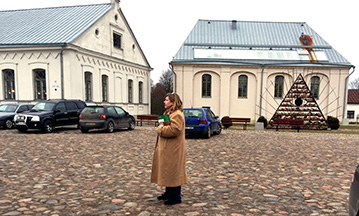
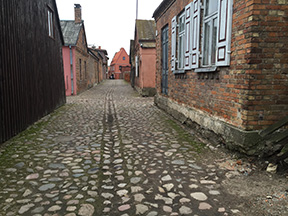
We continued to stroll around, stopping at one point (at Rimas’ insistence) for coffee and to sample traditional Lithuanian pastries. We went to the market square, where there were two old synagogues next to each other. (Photos below.) (Was one male and one female? Or maybe one replaced the first? There was no answer and, in fact, I’m pretty sure that there are no jews left in Kedainiai, which is a story for a later post.) At one point, we walked down a narrow street with impossibly old (and mostly empty) buildings. (Photos below.) If you took away the electric wires, you could have been in 1800s or earlier. Rimas loved it and wants to bring his kids to see it.
I think that is enough for now. I’ll add more tomorrow.
 nickinshoreditch
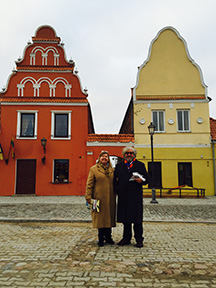
Love these travel adventures and your reportage. I also especially like the last picture of the two of you in front of the red and yellow buildings. You look folkloric.
My brother-in-law Bruno (now deceased), was born in Kaunas, his parents were born in Vilnius. They emigrated to the US in 1948, fleeing the Russian occupation, and having buried the family treasures in the backyard of their little house with the intent of returning to dig it up in better times. Bruno’s parents never returned to their homeland and when Bruno returned many years later as an adult, he wasn’t able to find the house (OR the treasure, whatever it was). Perhaps it’s still in the ground there.
We will see you soon! Can’t wait to make some adventures with you– even if it’s just hanging out at your local pub!
LikeLike
The castle/museum in Trakai has a treasury which is largely made up of silver and other things that have been dug up over the last 50 years. The tradition of burying your stuff to protect it (mainly from Russians) is very old.
LikeLike