Continuing with some more stories from Vienna:
Sigmund Freud and Cafe Central: On Monday we had a late flight, so we went to the Freud Museum. Freud spend virtually all of his professional life in Vienna and lived in the same place for most of that time. The apartment where his practice was is now a museum. Freud abandoned it in 1938, when he fled Vienna, with his family and a few friends, when the Nazis took over. He had to pay a substantial fee to the Nazi government to get exit visas, but, with the help of influential friends, he did get out. (His sisters did not and they perished in the concentration camps.) Freud took all of his furniture, notes and his extensive art collection with him when he moved to London (where he died the next year) and the apartment was used by the Germans during the war and then rented out like any other apartment until around 1970 when a foundation purchased it to create the museum. Freud’s daughter, Anna (a significant figure in psychology in her own right), donated a few of the original pieces of furniture from the original office and the waiting room is supposed to be much like it looked in the 1930s. But the famous couch was not there. There are a few of his books and a some samples from his collection of antiquities. There was, of course, lots of information about Freud’s life and his work, which probably would have been more fascinating if I cared anything about psychoanalysis. There was also a special exhibit about Anna Freud and other trailblazing women in the filed of psychoanalysis, which was both well-done and went along with other things we had seen over the weekend dealing with the changing role of women in the early twentieth century.
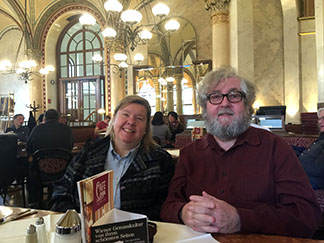
Afterwards, we walked around his old neighborhood and ended up at Cafe Central, where Freud liked to go after his walks and hang out. It really was the place to go in the 1910s, at least for a certain set. Lenin and Trotsky were also regulars at that time, as were Tito and Hitler and a substantial number of the Viennese literati. It was a beautiful room in what had once been a bank and the pastries were to die for. Here we are there:
Lichtenstein: As we wandered around Freud’s neighborhood, we came upon the Lichtenstein Place (now a museum), which had been the home of the family that gave the name to the country. It turns out the Lichtensteins were a very wealthy Austrian family and somewhat influential in the Viennese court, where they wanted to increase their profile. So they bought what is now Lichtenstein and successfully maneuvered to have it recognized as a principality of the Holy Roman Empire, thereby significantly increasing their prestige and power. No one from the family bothered to visit the principality for over 100 years. It is oddly appropriate, in light of that history, that Lichtenstein is now one of the world’s great money laundering centers.
Vienna and the Jews: One of things about traveling in much of Europe is the presence of the Holocaust in the background. Vienna had a substantial Jewish population in 1938 and had one for many centuries. But in March of that year, it was the time of the Anschluss and the “invasion” of the Nazis. It is hard to really characterize it as an invasion, since a significant majority of the population favored the annexation by Germany and greeted Hitler with flags and salutes. Hundreds of thousands of Viennese came to cheer him as he spoke from a balcony of the Hofburg Palace, overlooking the huge Heldenplatz (Square of Heroes). After the war, in what our tour guide characterized as an act of “mass amnesia”, the Austrians convinced themselves that they were were the first victims of Hitler. Many of the wealthy and influential Jews escaped in 1938, as Freud did, but tens of thousands were exterminated. There is a very nice Holocaust memorial–a sort of building made of books–although I wonder if it is a part of the regular tours, as it is a little out of the way and there weren’t many people there. Even move moving was a street in a Vienna neighborhood that had been largely a home to Jews before the War. (If they had stumble stones in Vienna, as they do elsewhere in Europe, it would have been hard to walk down that street and many others.) The current residents had researched the families that had lived on the street and created a memorial of keys with the names of each family attached to the key with a tag. There were over a hundred of them
Final Thoughts on Vienna: It would be easy to go on and on about the history, art and architecture of Vienna. It really is very charming and, unlike Germany and London and other parts of Europe, missed being demolished in the World Wars, giving it a trapped amber quality. It is also a small-feeling city, even though it goes on for quite a way when you drive out of its center and it certainly lacks the energy you feel in vibrant city Like London or Paris or Berlin. It was certainly a fun place to visit though….
 nickinshoreditch
I suppose you learned that one of the only remaining synagogues in Vienna is guarded by special police. (The Jewish Museum in Frankfurt is built like a prison, with no windows on the first floor and entries that are easily guarded.) In other words, the War is not over, not entirely.
Our friend’s grandfather and his best friend were taken to a concentration camp. His wife, our friend’s grandmother, and the wife of the best friend camped out outside of Goehring’s (or was it Goebels’s) office on a hunger strike until the two men were released, but they had been imprisoned as political opposition, not because they were Jewish. the two men were never the same.
When another Austrian friend’s wife spent the day with us in NY we took her on a driving tour, expecting to show her the usual sites, but she wanted to see “the ordinary people” so we took her to Terry’s childhood places in Brooklyn, driving through a section where there were many Hasidim walking around. Her breath was taken away, “it’s just like Vienna before the war,” she said.
LikeLike
I hope other people who come to the blog can see this comment. I think Vienna lost its soul in 1938 and is now the beautiful shell of a city.
LikeLike
The people of Vienna live very well. They have an excellent education system which begins by supporting families with childcare at an early age (well paid teachers. Even our wealthy Viennese/Austrian friends use the public school system), a very good transportation system, a more than adequate health care system, a clean city with copious cultural events, and good, free universities. It may have lost the edge of soul but it still has a lot to teach us. In the field of the arts it remains a leader, with daring art and music productions supported widely by its population.
I believe government’s first duty is to look after the welfare of its citizens, not conquering the world, and Austria does this well. Maybe it is a bit boring, and maybe that is why this system is not embraced more widely, especially in the U.S. Every time I go there, I am more impressed by the quality of life there, more regretful that we cannot accept that such a system could be possible for us.
LikeLike