“Some hae meat and canna eat,
And some wad eat that want it,
But we hae meat and we can eat,
And sae the Lord be thankit.”
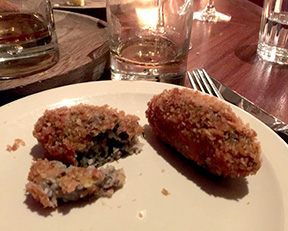
Judie found out at work this morning that Monday Night was Burns Night, so we decided to go out to have Burns Night feast. We probably should have found a place that had bagpipes playing and someone slicing open the haggis with a sword (they do that, we are told), but we settled for going to a nice local restaurant that had a special menu featuring Haggis croquettes, cock-a-leekie soup (which I had made for a themed British dinner before we left), venison, and heather honey tart. We got into the spirit (literally), by doing some scotch tasting. Lots of fun. A few pictures follow:

Judie has been conducting a Cakes for the Queen of Heaven class for the past couple of weeks. It is a UU class about women and goddesses and seems to have an amazing impact on anyone who takes it. Because Judie couldn’t get a room at New Unity or their satellite location in Islington, it ended up being held in our flat. Everyone seems to love doing it this way, although it is not the way they seem to do things here. It is unusual to be invited to someone’s home. (Of course, flats are smaller here. And a lot of the New Unity members are young and somewhat transient and don’t really have places for company. But there is something deeper going on.) For the first two classes, I went out and had dinner (no men are allowed and I didn’t feel like hiding up in our bedroom.) Some appropriate thoughts from Robert Burns:
“While Europe’s eye is fix’d on mighty things,
The fate of empires and the fall of kings;
While quacks of State must each produce his plan,
And even children lisp the Rights of Man;
Amid this mighty fuss just let me mention,
The Rights of Woman merit some attention.”
For Tuesday’s “Cakes” meeting, I got tickets to see “Husbands and Sons”, a play based on the writing of D.H. Lawrence, at the National Theatre, rather than killing time eating and drinking Shoreditch. I was expecting something kind of depressing and bleak and I certainly wasn’t disappointed in that regard, but it was wonderful and surprisingly moving. D.H. Lawrence came for a coal mining family and it is a tribute to his talent that he escaped and became D.H. Lawrence. Once he left Eastwood in the East Midlands, he wrote several plays early in his career that focused on the mines and the families impacted by the mines. I suspect the plays are semi-autobiographical. He wrote three plays early in that period, “The Daughter-in-Law”, “The Widowing of Mrs. Holroyd”and “A Colliers Friday Night”, which all seem to be set in the same town (probably Eastwood). Lawrence’s genius was that in each of these plays he looked at the dynamics of a miner’s life through he eyes of the women in their lives. (This would be a great field trip for Judie’s Cakes class.) Tragically, Lawrence never saw any of these plays produced in his lifetime, but they were discovered later and had notable productions in the 1960s.
This National Theatre production brilliantly combines the three plays mentioned above into a single production (presumably edited), with each of the households in the individual plays occupying an assigned part of the stage. There is minimal scenery and costumes and much of the things like opening doors and putting on and taking off of coat is suggested at through simplistic mime and/or sound. The action moves around the stage between the stories of the three families, sometimes overlapping. One of the really cool things was that I got a ticket in “the pit” and when I got there discovered that this meant that I was in the front row on the same level as the actors (effectively on stage except for the bar between me and the action). But then the play started (with sounds of the mines and blackened men marching across the stage) and the next thing I knew, the bar rose up into the ceiling and there I was on the stage, 10-20 feet from the “homes of two of the families. And then, after the interval, I was move diagonally across the theater to a similar spot near the other family (actually even closer–I could have put my plastic wine glass on to the set in front of me without leaning forward much).
I have to say that I actually resisted being drawn into this. It initially seemed like one of those predictable bleak tales of poor miners and it could have been that, if it had focussed on the men. But the focus on the wives (the new wife whose husband was still too attached to his mother to truly love her–the wife married to drunken brute, scared for her young son and attracted to a man who appreciated her–and a woman dealing with a dismissive husband but with the vaguely Oedipal relationship with a son who was escaping the mines and going to college, which really seemed like Lawrence), it all drew you into the stories in ways that were variously moving. There was no happy ending. One of the husbands dies in mine accident (and his body is put on a table no more than 6 feet from me). No one seems much closer to escaping the mines or even achieving happiness. But, by the end, you had to feel close to these three families and their struggles.
The acting was, of course, superb. I’m not sure this is a complaint, but the Midlands accents were a bit hard to follow, especially at first. A lot of “thees” and “thous” and things like that. and when the men were drunk and yelling, I could barely understand them, although I’m not sure that it mattered (or whether the English in the audience could understand them either). It would be hard to pick out any one performance to laud above the others. I recognized Louise Brealy from “Sherlock”on PBS and Anne Marie Duff is a very famous stage actress. But the acting was uniformly great and the staging was wonderful without calling too much attention to itself.
I’ll close this with another Burns poem:
“Ye see yon birkie, ca’d a lord,
Wha struts, an’ stares, an’ a’ that;
Tho’ hundreds worship at his word,
He’s but a coof for a’ that:
For a’ that, an’ a’ that,
His ribband, star, an’ a’ that:
The man o’ independent mind
He looks an’ laughs at a’ that.
A prince can mak a belted knight,
A marquis, duke, an’ a’ that;
But an honest man’s abon his might,
Gude faith, he maunna fa’ that!
For a’ that, an’ a’ that,
Their dignities an’ a’ that;
The pith o’ sense, an’ pride o’ worth,
Are higher rank than a’ that.
Then let us pray that come it may,
(As come it will for a’ that,)
That Sense and Worth, o’er a’ the earth,
Shall bear the gree, an’ a’ that.
For a’ that, an’ a’ that,
It’s coming yet for a’ that,
That Man to Man, the world o’er,
Shall brothers be for a’ that.”
 nickinshoreditch
Thanks for the Burns. A fitting reminder of his cocky smacks upside the head of the haughty.
LikeLike