It was at least thirty years ago that Judie and I figured out that the Royal Shakespeare Company virtually never misses in its performances and we made an effort to see whatever they brought to New York. They put on most of their performances here at Stratford, which is a bit too far away to comfortably get back to London after a show. So, when we go to a performance there, we’ll have to stay the night. But the RSC does put on some performances at the Barbican Centre, which is a very short walk from Judie’s office. so we bought tickets to “King and Country” months ago.
“King and Country” is a special package of four history plays, “Richard II”, Henry IV, Parts 1 and 2″ and “Henry V”. We saw all four of them last weekend, starting with Richard II on Friday evening and ending with Henry V in a Sunday matinee. One of the many remarkable things about this experience is that, because the tickets were sold in a package of four (you actually got a single ticket for all four shows), the audience was the same for each performance. That meant that you ended up sitting next to the same people for hours and chatting about the performances and about Shakespeare and other plays that they had seen (As you might imagine, anyone who would sign up for that sort of Shakespeare immersion had to be a theatre buff and Shakespeare lover.) It was an unexpected bonus.
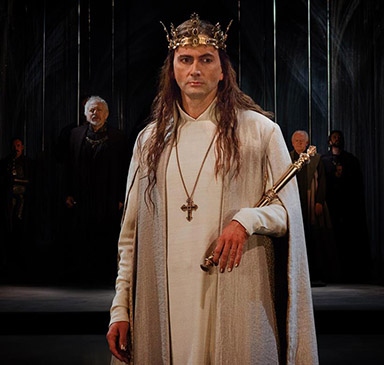
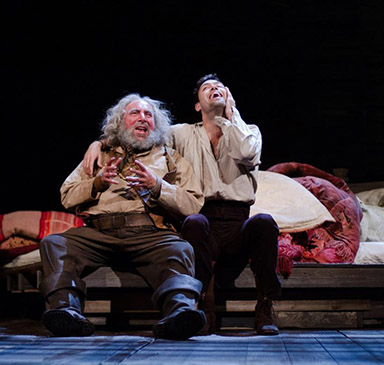
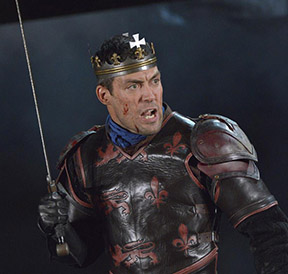
It is hard to put into word what a remarkable experience it was to watch these four plays. It’s a RSC production, so every actor is wonderful, down to the smallest part. David Tennant, who should be familiar to Doctor Who fans, was a memorable Richard II, especially in the later scenes when he first knew that he was going to be usurped and then when he was waiting to die. Alex Hassel, playing Prince Hal, did three performances in the space of just over a day, going from dissolute companion of Falstaff to the heroic King at Agincourt before our eyes. Anthony Sher was nuanced and extremely funny as Falstaff. (All of the comic scenes in the four plays were done brilliantly.) Oliver Ford Davies was also memorable, first playing a tormented Duke of York in Richard II, then reappearing as a hilarious Justice Shallow in Henry IV, Part 2 and finally wowing us as the Chorus in Henry V. Joshua Richards appeared in all four plays, played five parts, most of them comical, and the amazing this was that I didn’t realize it was him playing all of them until I read the programme. I could really go on and on. The musical additions were great. The action scenes were exciting. But the best part, ultimately was being caught up in a story that covered about twenty years of English history and provided Shakespeare with opportunities to wax patriotic.
It was an interesting time. It all begins toward the end of Richard II’s reign, around 1397, when the King has become increasingly tyrannical and the noblemen are chafing under his rule. The breaking point comes in 1399 when Richard first banishes Henry Bolingbroke, his uncle John of Gaunt’s son, and the confiscates all of their land and wealth when John dies. Henry comes back to England to assert his rights and the other nobles join him. Together they depose Richard and Henry takes the throne as Henry IV. It had to be a little tricky for Shakespeare to write a play about a tyrannical deposed monarch in Elizabethan times. But rather than focusing on the politics of the usurpation, the play is more about the sacred authority of the king is undone by Bolingbroke and the psychological anguish of Richard in reaction this. This approach makes Richard a sympathetic and tragic character, undone by his own overreaching for power. While Richard was probably a miserable and cruel dictator and murderer in real life, Shakespeare creates an epic tragic figure that gave David Tennant the opportunity to amaze.
Shakespeare had an even more difficult task writing a play about Henry IV, as you can imagine that Queen Elizabeth would not have looked kindly on a drama which made someone who overthrew a monarch look good. In fact, Henry IV fought a long civil war against various rebelling noblemen, most memorable of whom was Henry Hotspur (spectacularly played by Matthew Needham), and arguably saved the British monarchy and a united England. Shakespeare got around this dilemma in Henry IV, by ignoring the king as much as he could, and making both plays more about Prince Hal, creating the character of Falstaff and the other reprobates of East Cheap. One thing that surprised me is that there is a certain anti-war element to Henry IV, Part 2. Falstaff has been assigned by Hal to recruit a company to fight, which allows us to see war from the soldier’s view, rather than from the court. The resulting scenes of recruitment and then of Falstaff and his friends trying to stay alive in battle are both funny and pointed. (Falstaff was supposed to be a character in Henry V as well, but the actor for whom the part was written quit Shakespeare’s company for a rival one, so he killed Falstaff off at the beginning of Henry V.)
Henry V was written as Elizabeth was embroiled in The Seven Years War in Ireland and is a patriotic rally-the-troops play. (Indeed, Olivier made a movie version in World War II for that reason.) It’s climax is the Battle of Agincourt, when a tired and starving outmanned English army utterly routed the French, killing nearly 10,000 Frenchmen, while losing less than 100. Henry has some unbelievably stirring speeches to his men. By this time on Sunday, Alex Hassel has transformed himself into the charismatic warrior king and it is easy to imagine the impact this all had, both on Elizabethan audiences and on World War II moviegoers.
This is coming to New York in the spring and will be at Brooklyn Academy of Music. Get your tickets before it is too late.
 nickinshoreditch
Oh yes, we will get our tickets. We love Shakespeare marathons. Last summer/fall we saw two companies two various of these plays. In the first one, women played the kings, and in the second, women played all the parts. Can’t get enough of Shakespeare, though this weekend we are going to The Piano Lesson by August Wilson, and he’s a favorite too.
LikeLike