Our friends, Ivy and Debbie have been visiting this week with their daughters , Annie and Charlotte (arrived on Sunday, leaving Friday). It has been wonderful to have them here, especially since it is Thanksgiving week and I think we’d have been feeling a bit lonely if they hadn’t decided to come. And yesterday, we got a surprise visit from my brother-in-law, Hugo, who was on London on a two-day trip finishing up his brother Robert’s estate. We all had dinner at the flat. I tried making popovers, having ordered a pan, but they failed to rise properly (although they tasted good). I think this meant I put too much batter in the cups. I’ll have to try again
Yesterday, we went to do some sightseeing an a chilly day and found ourselves at the British Museum, partly because Charlotte is very interested in Egyptian history. So we wandered around looking at all of the Egyptian artifacts. It really is an incredible collection. Just seeing the Rosetta Stone is fascinating. And you can’t go there without seeing the “Elgin Marbles”, which is the large amount of friezes, sculptures and other stuff that Lord Elgin ripped off of the Parthenon around 1800, brought back to England and presented to the King. The Greeks, not surprisingly would like it all back and the Museum actually has a pamphlet in the hall where the Marbles are displayed explaining their legal position that the Ottomans let Elgin have the stuff (but which boils down to “We have them and we aren’t giving them back.”) It all reminded me of a John Oliver riff in which he said: “The entire British Museum is basically an active crime scene. If we start giving back everything we took from the empire, that building would be completely empty, except for one portrait of Alfred Lord Tennyson and a pair of Gary Oldman’s old running shorts, and that can’t happen.” There is also a similar dust-up with India, which wants the Kohinoor diamond returned, presumably back to the Peacock Throne. The diamond has a Maltese Falcon-like history, as it was repeatedly stolen or seized by various warring parties over hundreds of years in the Near East, until the British East India Tea Company finally took it around 1850. So maybe India’s claim is not as compelling as the Greek’s and, in any event, the diamond is part of the Crown Jewels (and is actually the centerpiece of the Queen’s crown), so it is clearly staying put.
Over lunch at the wonderful restaurant in the British Museum, we were discussing what to do next and we came across the Grant Museum of Zoology and Comparative Anatomy in a guide-book. It is part of the University College of London and short walk from the British Museum. One of the things they do here is put these blue plaques on houses of historical significance, so, as you can imagine, there are lots of them. On the walk over to the Grant Museum, we passed the place where Charles Darwin lived and the place where anesthesia was first administered, among various other sites.
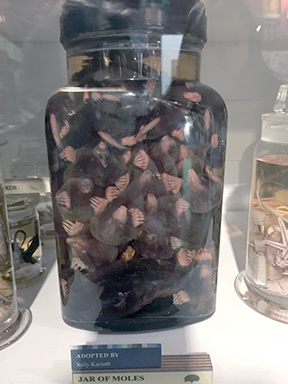 The Grant Museum itself was quite an eccentric treat. There were once lots of museums and university departments that collected skeletons, stuffed animals and other preserved dead things. But now, biological science is past the whole routine of dissecting and looking at and comparing species, presumably preferring to look at DNA–zoology usurped by biochemistry. So the Grant Museum is the last bastion of that lost art and it has been expanding as other universities eliminate their departments and dump their skeletons and skulls and jars of monkey brains in formaldehyde on the Grant, which seems to happily accept them. It really is a delightful, weird little place and the shock was that it wasn’t completely filled with little boys or odd old guys with bushy eyebrows, tweed jackets and hair coming out of their ears. The exhibit which gets the most notice, or at least is the one that seems to appear in guide books, is shown to the left. It is a big jar completely stuffed with all of these little moles floating in formaldehyde. It is hard to tell what it is at first until you look closer and see their little feet. There was also an area of slides of really tiny things, all back-lit, that was strangely beautiful. I also enjoyed the elephant heart and a collection of the skeletons of five dogs that had all been owned by the same person. You can see a Picasso anywhere, but this must be the only place where you can see a preserved monkey head next to the skeleton of an emu next to a case containing dodo bones.
Later, in the evening, we went to the Dennis Severs House, which is a sort of museum just around the corner from our building. Dennis Severs was an artist who lived there and gradually recreated the rooms into time capsules illustrating what life would have been like for a Huguenot silk weaving family over a period of time. Each room is a sort of still-life creation that is meant to give the feeling that you have entered the room just as the owner has left. They insist that you remain quiet as the noises that you hear (and the things that you smell) are part of the experience. It is all candle lit and there is an amazing level of detail. There is even a little bit of a plot to figure out as you move through space and time. Another completely unique experience.
 nickinshoreditch
Nick, is definitely a must-see on our visit to London. Glad you had your extended family with you. On to x-mas for the Lewis/Rinearson reunion. Bob wants to know if the brains were normal or abi-normal?
LikeLike
Karen–
I’m so glad to hear that you are thinking of a visit! Let us know when you are thinking of coming.
LikeLike