Photograph 51 was an x-ray photograph taken in 1952 by Rosalind Franklin and her research assistant Ray Gosling in a basement lab at King’s College in London. It is arguably one of the most important photos ever taken, certainly in the history of science, because it proved, for the first time, that DNA is the form of a helix. It led directly to Krick and Watson’s paper and model showing the building block of life itself. Watson had received a copy of the photograph and other research of Dr. Franklin without her knowledge or consent and never really adequately acknowledged her contribution. She died of cancer at the age of 37.
“Photograph 51”, which we saw last night, is a play by Anna Ziegler which looks at the scientists seeking to discover the nature of genes though the eyes of Rosalind Franklin, who was played by Nicole Kidman. It paints a picture of an incredibly brilliant Jewish scientist fighting the overwhelming sexism (and some anti-semitism) of her day. The rest of the cast are a Greek chorus of men, playing the other scientists and also 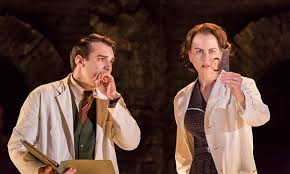 explaining the science and moving the plot along. The play posits that, while Franklin was the greatest pure scientist of the group, it was her personal shortcomings that prevented her from being the person we associate with the discovery of DNA. She was untrusting and preferred to work essentially alone. She either lacked intuition or was afraid to make the intuitive leaps that Krick and Watson were happy to make, possibly because she, unlike them, was afraid to be wrong. She is portrayed as a repressed, almost asexual person (and a significant acting achievement is convincing us that Nicole Kidman is asexual and not good looking). She is respected and slightly feared, but not loved, by the male scientists around her. Her colleague at King’s College, Dr. Wilkins, tries to reach out to her in his own clumsy way, but she utterly rebuffs him. The play hints that, if they had worked together, we would be talking about Wilkins and Franklin as the discoverers of DNA. James Watson is portrayed as a real jerk and, to the extent that the play has a heavy, it is him. It all seems tragic, but in a way it isn’t because Franklin is portrayed as caring only about the science and not the race to be first, a race that she was unaware of. The only real tragedy is that she finally begins to like one of her fellow scientists, but just as there is a glimmering of a romance, she is stricken with cancer, which ultimately kills her fairly quickly. Nicole Kidman was wonderful and the ensemble cast is also great. I loved the set and the staging. It is a play that is more cerebral than visceral and it was enjoyable to learn about something new. But because the main character is so repressed emotionally needy, it was more frustrating than emotionally satisfying, which is not to say it wasn’t well written. Thanks to Kidman, the show is utterly sold out.
Something that Judie and I have noticed in the past and noticed again that night is that applause at the theater is completely different in London. They simply do not do standing ovations here. In New York, standing ovations are so routine as to be meaningless, given for even the most mediocre productions. One would have thought that when Nicole Kidman, a famous star who had just given a great performance, came out for a solo curtain call, the London audience might have risen. But they didn’t. Another difference is that New York audiences often applaud when the star actor first appears on stage (a practice that I don’t particularly like). They just don’t do that here.
5000 bullets. That is the number of bullets that French security forces used in their shootout with the terrorists in St. Denis the other day. Doesn’t that seem like an incredible number of bullets to be shot on a city street? Equally incredible is that all of that flying lead only resulted in the death of a single terrorist. (The other two deaths were the result of them blowing themselves up). This is one of those movie things that aways bothered me–James Bond or John Wayne or Han Solo or whoever running around with the other guys spraying bullets at him but never hitting him. It always seemed ridiculous. The French have shown in real life that maybe it isn’t.
As a result of the Paris attacks, PM David Cameron is having his own George W. Bush moment. He really wants to bomb ISIS in Syria. However, here they have the admirable philosophy that, in a functioning representative democracy, such action should not be taken without the consent of the people’s representatives in the House of Commons. (Constitutionally, that is also the way it should work in the US, but a functional Legislative branch is required and one does not exist at present.) Up until recently, there was limited support for such action, perhaps because the public and the Commons were still feeling burned by Blair’s foray into Iraq with W. Anyway, now the public is nervous and angry and Cameron is pushing for bombing and he will probably win. The Scottish National Party, which had been opposed to such interventions, is now open to considering the idea if there is a plan and, ideally, a UN mandate of some sort. (That may be a problem, since, as far anyone can tell, Cameron’s plan is “Let’s go over to Syria and bomb the crap out of them.”) In the meantime, poor Corbyn, who can’t catch a break (although much of his problems are because he never expected to be Labour leader and really came in without a coherent plan), is in a difficult spot. He is a lifelong, committed pacifist and a large portion, but not all, of Labour are very skeptical about these sort of military responses. They are saying some sensible things, like “We shouldn’t act in the absence of a UN resolution” and “I don’t see what is really accomplished by adding our bombs to all of the bombs being dropped by the US, Russia, France, etc.” But the whole thing is a stampede and Cameron is going to win, getting some disaffected Labour votes along the way, and Corbyn is going to look out of touch and irrelevant (again).


Oh boy, do I agree with you about standing ovations. After seeing a play, whether wonderful or not, I appreciate a moment of reflection, time to gather my coat, purse, and various other paraphernalia, but if I want to see the actors I just enjoyed (and I do), I have to stand up, spilling it all on the floor, disrupting my reflections about the play. If the person in front of you stands up, you are obliged to also. Sometimes I just sit there, the only person sitting, feeling like a grumpy old lady. I popped out of my seat after Hamilton because it was so great, and will pop up tonight for Tom Parente for personal reasons. I guess a personal objection, voice by remaining seated, is the best I can do, like being just one vote against a tide of insanity.
LikeLike
We share at least one pet peeve then.
I hope Tom gets a huge crowd tonight. I know it is incredibly important to him. We saw Hamilton too and thought it was incredible.
LikeLike