On Monday night, Judie and I went to see “The Father”, a pretty incredible play that was essentially about Alzheimer’s Disease. I was kind of dreading it, because I figured that a play with that subject just had to be depressing. And it was, but it was also wonderful. It is written by French playwright and is up for various awards. The main character is André, the father, played by Kenneth Cranham, who seems sort of together at the beginning–a charming but forgetful older gentleman, but gradually deteriorates into addled confusion and finally terror, as his daughter, played by Claire Skinner, tries both to deal with his decline and to 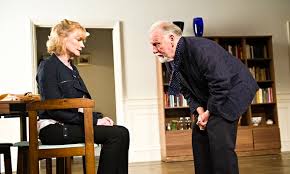 manage her own life. What made the play truly amazing was all the things they did to capture the feelings and changes in perception that one experiences with that disease. For example, the actors playing his daughter or his caregiver or his daughter’s lover would change (but only once in a while, not consistently) from scene to scene, befuddling both André and the audience. The play was a series of vignettes and there was a blackout between each vignette, accompanied by music. As the play went along, the music became more disjointed and increasingly interrupted by pauses and static. There was a single box set and, as each scene began, you began to notice that a piece of the furniture from the prior scene was missing, until there was nothing on the stage. And then comes the last scene, where we find Andre in a hospital bed in a nursing home. It may seem simplistic, but I can’t begin to describe how powerful the effect was of the disjointed music, the disappearing furniture, the actor changes and confusion about where each scene was set. (André’s Apartment? His Daughter’s? London? Paris? It was never completely clear.) It imparted the feeling of confusion and things spiraling out of control and the gradual loss of reality that one supposes that an Alzheimer sufferer feels. It was really very disturbing and I was glad it was only 90 minutes. The final scene where the suave André from the fist scene has been reduced to a fearful and childlike state was really a masterpiece of acting and one I won’t soon forget. This was a production that created a powerful–one might say shattering–effect through a combination of the play, the acting, the staging and the set design. This was one of those things that I think only theatre can do.
It may seem like I am simply indiscriminate in reviewing the various plays we have seen recently, but we really have been on a remarkable run. The only play that I have seen in the last six or seven weeks that I might not recommend was “The Hairy Ape” (and I enjoyed most of it). And I though that “Farinelli and the King” was one of the best pieces of theater I have ever seen.
We went to a place called the “Cork and Bottle” the other night before seeing “Farinelli and the King”. It is an underground wine place near Leicester Square that serves food. It was kind of memory lane choice, because it a place that we went to the first time we visited London in 1984. A quick story about why it is a meaningful location for us: We were staying with our friends in Belgravia back then (they had been transferred by a law firm and we have since completely lost touch and I’m not even sure that I can come up with their names). We had plans to meet up with our friends, Chris and Nancy who were going to be in London at the same time, but lost the paper where we had written the name of their hotel. This was in the days before cell phones (fax machines were probably the state of the art then), so there was really no way to contact them. We even tried calling Chris’s job in Massachusetts, but he hadn’t left any info. So we gave up and went to the Cork and Bottle, which the guidebook said was the top wine bar in London. We were sitting there, sipping and nibbling, and looked up and there they were, standing at the bar right next to us! It is kind of amazing it is still open over 30 years later. Pretty good food and a really fun wine list.
On Friday, we went to Docklands to eat a The Gun, a 250-year-old pub/restaurant on the Thames, across from the O2 Centre. It was near the foundries which made the canons for the warships. Lord Nelson lived nearby and, according to the Gun’s website, would meet Lady Emma Hamilton is a room upstairs for secret assignations. It was nice, but it was too chilly to eat outside where we could have enjoyed the view along with the food. The pub is in a little corner of Canary Wharf where there are still old buildings and a feeling of what life might have been like when Britain ruled the oceans and London was the world’s great harbor. The rest of Canary Wharf is covered with gigantic new glass towers, walkways and little bridges along the water and inlets where ships once docked and the East India Company ruled. It was a bit like Houston with water. It was pretty sterile, I thought. And once you got beyond the center of Canary Wharf (as I walked over to The Gun, it was all construction of more towers and deserted areas of finished residential and office complexes. I found it depressing.
The final season of “Downton Abby” ended on Sunday night. I know I can’t talk about it since it hasn’t played in the US yet, but I will say that they left enough plot lines open that it is hard to believe that it is really over. According the newspapers, they are talking about a movie.
 nickinshoreditch
I thought Downton Abbey ended last season. Good, another chance to bond with my daughter.who, by the way, just started a job. She has been employed, but not earning enough to live on (teaching preschool, waitressing, among many other things) since the great crash of 2008, and she was ebullient at the thought that she could support herself now. She’s managing the book shop and customer service at the Kabbalah Center in New York. Your description of Canary Wharf sounds also a bit like Hoboken, which was once a busy port. There are signs of it everywhere. It was, for example, the place where the ships docked which were taking American soldiers to the First World War. My great uncle would have left from here to become a volunteer ambulance driver before the official opening of the war. There’s the occasional statue or plaque, but now it’s all buildings like ours and and the Hotel W. Of course, we have no sense of what it used to be (Terry does), and it seems welcoming, spacious, and pretty now.
If you can bring yourself to watch Slings and Arrows, a Canadian tv series, do so. One of the best pieces of tv writing/acting/directing I have ever seen, and so funny that you don’t even bother to laugh.
LikeLike
Hoboken has so much more character than Canary Wharf, which seems like it was built yesterday. I’m sure that the architectural renderings were compelling and maybe some day it will seem like it has a soul. But right now, it looks like it was just plopped down there from outer space, eliminating everything that was there before.
I’ll look for Slings and Arrows, but TV here is not as endless as USA TV.
Nick
LikeLike