I braved a steady rain (I’m in London–I might as well get used to it) and a few new lines on the Underground to go visit Tate Britain today. I went to see the Turners and just poke around, but ended up going to a special retrospective they were having on Barbara Hepworth. Never heard of her? I have to admit, I’d never heard of her either, but as I walked through the exhibition, which was pretty amazing, I realized I’d seen her work before, almost certainly at MoMA and probably at other places. The sculptures were just incredible. The question I kept asking myself as I walked through the museum and then on the Tube back, was why isn’t she a household name in the same way that Henry Moore is?
Hepworth is every bit as great a sculptor as Moore. They are both Modernists and essentially contemporaries and their styles are comparable in many ways. I think I might actually like her sculptures a little better, but it is a little like comparing Michaelangelo to Bernini. She started out in the 20s doing these amazing carvings of animals and people that have a sort Native American or African sensibility, which got people’s attention. She then moved on to more the abstract forms that she continued through out her life. She was buddies with and/or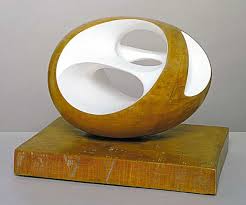 exhibited along side all the great artist of her day–Arp, Mondrian, Man Ray, Calder, Miro,you name it. She was really very famous in the 1950s and 60s, possibly as famous as Moore and the others at that point. She has a sculpture at the UN honoring her friend Daj Hammaskjold. By any measure, she is one of the greatest sculptors of the 20th Century and really one of the great artists of the mid 20th century. So why is it that I don’t know her name in the same way that I know Calder and Moore and Jasper Johns and Richard Serra and plenty of other artists? Is is that she is a woman? Is it just me?
I have no doubt that there is an element of sexism in this. A walk through any museum will demonstrate this. But I’d say that there is more going on. One important factor is the work itself. Hepworth worked for most of her life carving sculptures out of wood or stone. That is labor-intensive and time-consuming, so the simple number of her works has to be relatively smaller, possibly leading to fewer opportunities for collectors and exhibitions. In contrast, If one is casting in bronze (which she only did late in life), one can make multiple copies of a work. And the works themselves are really designed to be in nature and are simply not massive in size, in contrast to artist like Moore or Serra. Thus, if you are a real estate developer, a rich guy with money to spend or a municipality, and you want to buy an “impressive” piece of public art to put in front of your new high-rise, in your yard in the Hamptons or in the reflecting pool at Lincoln Center, you are not going to be interested in her smaller, more contemplative works. But that seems too simple and there are many artist who work on a human scale whose names you know.
This got me thinking about “Sunday in the Park with George”. The first half of the Sondheim musical is about art as an obsession, while the second is about art as a business. To be a successful artist, you have to market, not just your work, but yourself. Simply being talented and creating good art is not enough. You have to be able to present an appealing case of why your art is meaningful and why you are an important artist with a significant point of view. I wonder if this is one of those things that men are better at than women? Or at least were? Of course, Hepworth was a very successful artist who was world-renowned, so it is clear that she was capable in the area of self-promotion. But perhaps she wasn’t as great at it as a Picasso or a Warhol? it is hard to tell if the point is valid for her, but I wonder if it isn’t generally so?
Anyway, do a Google Search on Hepworth and if you happen to be in London, before October 25th, go see the Exhibit at the Tate.
 nickinshoreditch
In literature, it helps if you are a revolutionary or a visionary. I don’t so much enjoy Hemingway’s work, but he invented something new; so did Wagner in the music world, and Beethoven. It’s not enough to be a great artist, you have to go one step beyond and create something new, like the guy who drew those kids with big eyes (lol)
LikeLike
I love this post, Nick. And the way you end it with questioning the issue of self-promotion and the business of art really resonates with me and my plight as an artist who hates the business part of it. I’m hoping that all Art&Soul members are signed up to receive your blogposts, but in any case, I will share this with everyone at our next meeting (which probably WON’T be this evening, as so few can make it).
Keep up the good writing and processing of your London times. Karen
LikeLike