Trump, Shylock and Brexit

Administrative Note: I’m going to change to the premium version of Word Press this weekend. This will change the address of this blog to nickinshoreditch.com. If you are signed up to get notifications by e-mail, this may not matter, but if you are used to just getting it through a browser, you won’t be able to find my blog using the current URL. So if you are looking for nickinshoreditch.wordpress.com and it isn’t popping up, then I’ve made the change. I’ll post an announcement on Facebook and one more right before I make the change.

Trump from a Distance: I have been blessed to be in London for this election season. Things like the interminable primary debates were on to late to watch (and I’m sure that I would have compulsively watched many of them, given the opportunity). I have missed endless Trump stories and hours upon hours of blathering by various talking heads. Which is not to say that the BBC doesn’t pay any attention to the election, it just has other stuff to cover and only spends a few minutes on the proceedings. Trump was, at first, an object of fascination to most Brits, who all wanted to know if he was a serious candidate and could someone like him actually get nominated. I have to say that I discounted Trump for far too long. After he was nominated, the questions changed from “How could he have been nominated?” to “He can’t win, can he?” to “My G0d, what is going on in America?” I have taken to compulsively checking FiveThirtyEight (Nate Silver), as well as the Times and the New Yorker and the Guardian to try to get a sense of what is going on in this miserable excuse for democratic process.

Now that the Trump campaign seems to be in a Trump-perpetuated death spiral, there is a palpable sense of relief here and I suspect in large parts of the US. But, even if Trump does lose and even if he loses in a landslide (which seems more likely than not), it is hard to feel very good about the future. It is difficult to picture Hillary being able to govern effectively, since she is unlikely to have a cooperative Congress, is reviled by so many and faces a Republican machine that will do what they did to Obama only much worse. The Republican Party seems likely to fracture and be in such a mess that it cannot be a responsible partner in government (recognizing that a significant percentage of their leaders have no interest in such a role anyway). And all of those angry Trump people, who have now been energized, are not going to go away. (And, unfortunately, neither will Trump.) Americans should not feel too smug about the defeat of Trump or claim that “It can’t happen here.” In fact, Trump proved that it could happen and if he was a not so clearly a bat shit crazy narcissist and sexual predator, he might very well have been elected  President next month.

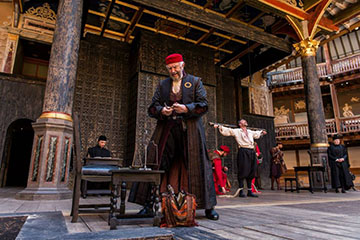
“Merchant of Venice”: On Yom Kippur, of all days, we went to the Globe to see “The Merchant of Venice” with Jonathan Pryce as Shylock. Our seats were not great (don’t get seats on the side there if you ever go) and there was a major rain storm about 30-40 minutes into the play, which soaked the people standing in the pit. (The Globe has no roof, although the seats and the stage are mostly protected.) Then the temperature dropped and the wind kicked up and it was positively frosty. Not at all Venetian. (It is strange commenting on the weather when talking about a play.) Despite all of that, I did enjoy the performance. I had forgotten much of the plot other than the Shylock bits, particularly the sections in which Portia’s suitors are tested to see if they can marry her. These scenes were wonderfully done. The cast was typically very good. British actors just do Shakespeare really well, although sometimes overeager directors with weird interpretations let them down. Perhaps it is part of their training that accounts for it. Shylock’s daughter was played by Pryce’s real-life daughter, which was actually more of an interesting footnote than something which added to the overall performance. Rachel Pickup, who played Portia, the dominant part in the play, was marvelous. I suppose that you could play Shylock differently than Pryce did, but it is hard to imagine it being played any better.
merchant

Of course, the overriding theme that makes the play great and the thing that you come away thinking about is the anti-semitism. It is actually remarkable that Shakespeare was able create the character of Shylock since, as the programme points out, there were virtually no jews in England during Elizabethan times. (It was dangerous enough being the wrong type of Christian in the era.) This actually seemed to make the anti-semitism of that time even worse, as there were no actual humans to put the lie to the crazy tales and conspiracy theories that dominated. Shakespeare’s audience would certainly have been utterly anti-semitic and ready to accept any sort of evil characterization of a jewish money-lender. But Shakespeare went out of his way to make Shylock human (“If you prick us, do we not bleed?”) and, it seemed to me, showed that he was responding to horrible treatment over many years by Antonio and the other merchants of Venice, who repeatedly spit on Shylock in the course of the play. Pryce’s Shylock was so reasoned and aggrieved that I found myself rooting for him to get his pound of flesh. But, of course, there was no way that Shakespeare could allow the Jew to win and Portia snatches victory away from him and replaces it with ruin and the humiliation of forced conversion to Christianity. Pryce’s performance made it clear that it was the latter result that was by far the worst. But in a way, Shylock brought this on himself by his hatred and desire for revenge. And I think that was the real moral of this production: that unreasoning hatred and the compulsion to get revenge can only lead to calamity.

Brexit Update: For some reason, the New York Times has suddenly become interested in Brexit and its impact on the British economy and government and has published a number of articles this week. I suspect this might reflect concern over the weakening pound and how this will play out in the world economy. Here are few impressions from this side of the pond:

  • The pound has started to fall again, after seeming to stabilize after its initial plunge. I’d say that this reflects market worry about the future of the British economy. Until recently, you could kid yourself that it wouldn’t be that bad and that Theresa May wouldn’t let things get out of hand. You’d have been wrong. May made it clear at the Conservative Party Conference recently that Brexit was happening and that Britain would not accept any deal that included freedom of movement. The government later announced that it would not let any foreign nationals (even those who were teaching at the London School of Economics) participate in the Brexit negotiations (even though it is generally agreed that Britain is woefully short of experienced negotiators). And then it was announced that businesses would be required to disclose the number of foreigners it employed. As it became obvious that the xenophobic kooks were taking charge, the pound began to fall.
  • This led to the Great Marmite Controversy. Because the pound had lost almost 20% of it value, Unilever wanted to increase its price for the items it sells to Tesco, the largest grocery chain in Britain. A stalemate ensued and soon Tesco began to run out of the beloved yeast goo. This caused outrage, only in part because Marmite is actually produced in England. I think what really scared people is that this was a clear harbinger of price increases to come.
  • Meanwhile, back in Parliament, the tenuous Conservative majority was facing the same problems with delusional back-benchers that had bedeviled Cameron. This group of 100 or more MPs keep talking about “sovereignty” and returning Britain to it position of greatness. So far, their big idea is to re-commission a Royal Yacht for the Queen, with the supposition that everything will return to Rule Britannia. It would be pathetically funny if it all weren’t so serious. May’s honeymoon period seems to have run its course.
  • Just this week, the highest British court has begun to hear a case which seeks a “constitutional” ruling (there is no written Constitution here) that May and her ministers cannot unilaterally invoke Article 50 to begin the process of leaving the EU. It is argued that the treaty that would be abrogated was ratified by Parliament and therefore can only be terminated by that body. Anther argument that the entire basis of unwritten British constitutional law is that Parliament is paramount and that an irreversible act of that import must be taken by that supreme legislative body. These seems like winning arguments to me. If the suit is indeed successful, turmoil is certain.
  • And then there is Boris Johnson and the Brexit troika of ministers. Last week, BoJo said that the aim of Britain in the negotiations with the EU is to “have our cake and eat it to.” This was instantly denounced by European leaders and seemed to harden their negotiating resolve (not that BoJo and his buddies have any sort of negotiating position beyond bluster). The European President suggested that Johnson buy a cake, eat it and see what he had left.
  • In the background, Judie’s bank clients are asking for advice about where to move their offices. Dublin, Frankfort and Paris may scoop up a lot of EU banking business that has been centered in London, which would be a complete disaster for the post-industrial British economy. A “hard Brexit”, in which the banks would lose their “passporting rights” (i.e., the ability to apply their British license throughout Europe) would make this inevitable. But this complete break from Europe is exactly what the most delusional MPs insist upon.


 

Four Plays and 100 Kazoos

Administrative Note: I’m probably going to change to the premium version of Word Press, so that I can publish photos of higher quality and you won’t have to see advertising. This will change the address of this blog to nickinshoreditch.com. If you are signed up to get notifications by e-mail, this may not matter, but if you are used to just seeing it through a browser, you won’t be able to find this using the current URL. So this is a warning: If you are looking for nickinshoreditch and it isn’t popping up, then I’ve made the change. I’ll post more warnings as it happens.

Four Plays in Twenty-Seven Hours: This was a kind of a crazy idea. The National Theatre has been having a special “Young Chekhov” event in which you see three plays normally done in repertory on individual nights, all in one day. I signed us up for it, not realizing that we also had tickets at the Old Vic the night before. So it really was a marathon.

It all started with “No’s Knife” at the Old Vic. It isn’t exactly a play. It was more of a performance piece based on selections from Samuel Becket’s “Texts for Nothing”. On one level, it was an amazing interpretation by Lisa Dwan, a dancer, actor, writer and Beckett expert, as she used movement and voice changes and odd, bleak scenery and a mist machine to enliven some of Beckett’s most obscure ramblings. On the other hand, it was so plotless that it made “Waiting for Godot” seem like “The Importance of Being Ernest”. There was a lot of existential despair, reflections on nothingness and ruminations about death. There were many good moments, but the whole thing wasn’t cohesive and, in fairness, was not intended to be. We both found it difficult to concentrate fully on the stream of thoughts that were being expressed for the full 70 or 80 minutes. It was one of those things that made you feel intellectual for simply being there and a dolt for not being able to find some sort of deep theme (beyond misery and death) or a trenchant comment on the modern world. An odd evening.

The next morning, we were off to the National Theatre, which was made difficult by the weekend closure of all of the tube lines that went anywhere close to it. The three plays on the day were the early works of Chekhov and the whole thing was the inspiration of David Hare, who also created new versions of the plays. The first play, which began at 11:45, was “Platonov”, also known as “The Play Without a Title” when Chekhov wrote it at about age 20, while a medical student. It was discovered 20 years after his death and performed sporadically until 1960, when an edited version first to use the tile “Platonov” was performed with Rex Harrison as the lead. Like most Chekhov plays, it is set in a country villa and I think might be characterized as a tragic farce. The set, which was used for all three plays (since they are all mostly set in country villas) was absolutely spectacular. In this case, the villa was the home of the widow Anna Petrova, played by the wonderful Nina Sosanya, who we’d seen before. The main character, played by Scottish actor James McArdle, is supposed to be the most interesting and handsome man in the community. Like seemingly all Chekhov characters, he has money problems and is unhappy with how his life has gone. He is a bit of a misogynist but is also irresistible to women, with whom he has a series of affairs, despite being married and a father. The fact that the women in play fall for him unhesitatingly, despite his flaws, really annoyed Judie (and she regards this portrayal of women as typical of Russian writers). Putting that reasonable objection aside, McArdle did play Platonov with considerable charm and humor and there were large sections of the play that were very funny, at least until it all begins to catch up with him in the last act and a tragic ending is assured. I found the whole production to be lively and immensely enjoyable. It is a play with a number of juicy parts and the cast was great. It turns out that “Wild Honey”, by Michael Frayn, which we are going see at the Hampstead Theatre later this year, is his adaptation of “Platonov”. I’ll be curious to see if it is different.

After  a quick lunch at House, the National Theatre’s on-site restaurant, we were back in our seats at 4:00 for “Ivanov”. This was Chekhov’s first complete play and the first ever performed (in 1887). It was an initial disaster, but was restaged triumphantly two years later after Chekhov rewrote it. This play is also set in country villas and has more tragedy and less humor than “Platonov”. Ivanov, played by Geoffrey Streatfeild,  is unhappy, has money troubles, and feels like he has wasted his life. In short, he is a typical Chekhov character. (What must life have been like in the late 1800s in Russia?) His wife, played by Nina Sosanya, is dying of TB and her doctor, played by James McArdle, is an insufferable prig whose idea of the truth helps to ruin the lives of both of them. There are some other characters who give a truly amusing view of the life in that era and who keep the proceedings moving. Unfortunately, Ivanov, at the center of the action, is simply clinically depressed for the entire play and cannot get himself out of it, despite the efforts of a young neighbor, played by Olivia Vinall, to pull him out of it. It is all a effective and dauntingly realistic realistic look at dealing with profound depression. (You keep thinking “Give this guy some medication!”) But it seems to me that the main character must develop over the course of a play and Ivanov cannot and does not. It isa one note role, leading to a one note performance. We are ultimately left waiting for his inevitable suicide. The play had moments, but was the least satisfying of the three, one I would not be tempted to see again.

Finally, it was back to the Olivier Theatre at 8:00 for “The Seagull”, a more familiar Chekhov work. The set contained a good deal of water, which was used somewhat in the first two productions, but was more central to this one, which is set in a country villa on a lake. There are two interconnected plots. One concerns the relationship between Irina, the owner of the estate, a spectacularly vain and famous actress, played with wonderful self-centered energy by Anna Chancellor, and her son Konstantin, played by Joshua James, who had also had a central role in”Platonov”. Her belittling of him and the destruction of his dreams is one theme. The other involves Nina, a young, talented and beautiful woman, played by Olivia Vianall (again–more on that below), who is a neighbor and beloved by Konstanin. She is casually seduced and ruined by Trigorin, (Streatfeild is back in this role), a famous author and the lover of the actress. As in all of three plays, there is a large company of interesting characters, all played with wonderful gusto. This play is ultimately about the dreams and ambitions of the young being thwarted by their elders and is consistent with the prior two plays, in which both the two young protagonist’s youthful dreams and ideals have been unmet, leaving them in a state of perpetual disappointment. And it turns out that the other running theme of the three plays is that if you are a character in a relationship with one played by Olivia Vinall, you are doomed. In “Platonov”, she is the jilted mistress whose life is ruined by Platonov and who shoots him at the end. In “Ivanov”, she is the well-meaning young woman intent on saving Ivanov by marrying him, only to see him shoot himself. And in “The Seagull”, she is the lovely, ruined Nina, who returns in the final act to see Konstantin and delivers the final blow to him by saying that she will always love Trigorin (thereby providing more evidence for Judie’s theory about female characters and Russian authors), which leads Konstantin to shoot himself. Which is how our day of theater ended, shortly after 10:30.

100 Kazoos: The next morning, we went to New Unity. It was the tenth anniversary of Rev. Andy’s first service there and a group from the Sunday Gatherings Team decided it was important to celebrate it and finally roped me into participating. I had two ideas which I implemented when the group agreed. First, I bought blank cards and envelopes and markers, so that everyone could create a card for him at a point during the service. (I didn’t think that the organizers gave people enough time  to finish, but I suspect some people just continued to work on their messages during the collection.) The planning group wanted to do something special and less serious and I suggested that we play “For He’s a Jolly Good Fellow” on kazoos. It seemed like something that had both English and American elements. So we did it. I bought 100 plastic kazoos, which we passed out at the end of the service, as the Music Director gave a quick lesson on kazoo playing. (Most of the congregation had never touched a kazoo before!) A joyful noise was made.

The End of Alex’s Visit and a new Painting

A New Painting: I think it is easier to start with this and I’ve decided I like having the new paintings lead off these blog posts. The painting below is based on a photo that Nancy Prince took and published on Facebook. I liked the composition. It could probably go with my earlier painting from the Isle of Skye to begin a Stone Wall Series, although I’m not really that interested in stone walls as a theme. I actually had this essentially done weeks ago, but kept fiddling with it and, I suppose, improving it very slightly. I seem to have recently settled into a semi-realistic, semi-impressionistic style. It’s not that I mind it, because I think some of the resulting paintings are visually pleasing, but I also feel like I should be pushing myself a bit more. This led me to try the Georgia O’Keeffe tribute and the more recent foray into portraiture, based vaguely on the Hockney show I saw. I’m not ready to settle down yet. Here’s the latest one:

mailboxes

The End of Alex’s Visit or “Oh, My Aching Feet”: There was one thing that was noticeably different about Alex’s visit from any prior visits by our children in that it was the first time a child visited who was working (in the sense of having a real job) and actually had to take time out to answer e-mails, take a call and do some work. Alex is working on the first draft of his story for Audible about life in America during World War II. The first episode for which he is responsible focusses on the lead up to the war and the fight between the isolationists, like Lindbergh and Father Coughlin, and Roosevelt and those who saw the dangers ahead and the need to get involved int he war. So he had to spend about ten hours of his trip (at various times) researching the story and listening to potential audio clips.

It was probably just as well because it allowed me to keep up with things a little. And it turned out that I developed a mild case of gout in my right toe. I’d had it once or twice before and it always went right away when I blasted it with a pain-killer like Aleve. Unfortunately, you can’t take them when you are taking blood thinners, so I was in this annoying pain when I walked, which made me limp and which made my other leg eventually get sore, particularly since I ended up doing a lot of walking around with Alex. It has been a weird few weeks, health-wise.

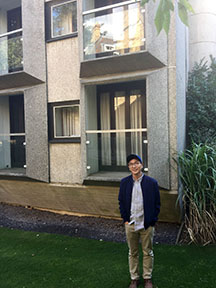
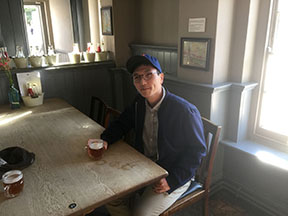
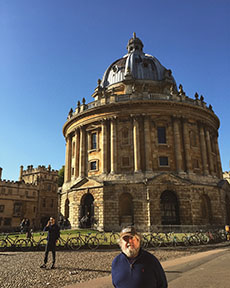
Oxford: Alex really wanted to go back to see his old haunts at Oxford, so last Wednesday we took the train up and spent the day wandering about, seeing his old college and where he had classes, visiting pubs and the like. As I turned out, it was moving in day for freshmen, so we were actually able to get into St. Ann’s College (which is noramlly off-limits) and walk around a bit and take a picture of Alex in front of his old room. St. Ann’s is one of the newest colleges at Oxford and a little outside the center of town, which led to more walking. It is a bit of an architectural hodgepodge and, while it is not really ugly, it lacks the drop-dead gorgeousness of most of Oxford. To make up for that, we walked over to Magdalen College (pronounced “maudlin”) and paid to get in and wander about. It was started in the fifteenth century and is constructed of that lovely honey-colored stone that dominates much of Oxford. What makes Magdalan especially memorable is that within its grounds is a deer park–and not a small one–complete with what looked like several dozen deer, including a large stag off in the distance. There is a tradition, undoubtedly centuries old, that when the monarch visits Oxford, he or she comes to eat at Magdalan College and a deer is killed and served. We also visited the Royal Oak pub (Alex’s favorite from his St. Ann’s days), the Bear Inn (famous for it collection of hundreds of school ties all over the walls and ceilings and which allegedly dates from 1242), and The Eagle and Child (where C.S. Lewis and Tolkien and their buddies drank). We had a wonderful lunch at the scenic Cherwell Boathouse (Great wine list) and dinner at the Turf Tavern (the legendary ancient pub where, among other things, Bill Clinton did not inhale). Throw in a walk to see the music faculty’s building and it was quite a day. According to my iPhone, we walked over 20,000 steps, more than eight miles. Some photos of the day follow:

oxford1   oxford2oxford3   oxford4

Friezing in Regent’s Park: For anyone who has been reading this from the beginning (and thank you for your patience), you may recall that last year at about this time I went to the Frieze Art Fair in Regent’s Park. It is a massive fair of modern art, featuring scores of galleries selling their art in a huge tent that must cover several acres. It was not the greatest idea to go there with aching feet the day after the Oxford trip, but I wanted to see it with Alex and it was fun, if a bit painful to the pedal extremities. There was, once again, some interesting sculptures in Regent’s Park, but the real show was inside. As you walked in there was a sculpture overhead, which you realized, as you got closer, was made of pantyhose. Odd but attractive. One of the early things we went to was a virtual reality work in which you sat on a sculpture of a giant snake, put on a virtual reality mask and found yourself on the snake and surrounded by all sort of weird figures and scenes. That experience alone made the whole visit worthwhile. As was the case last year, there was an awful lot of works which seemed to me to be pointless at best. Maybe I just need to hear the artist’s rap about why this scribble/pile of meaningless junk/splashes of paint are a meaningful reflection of society or whatever. It seemed to me that the ratio of things that I thought were clever/pretty/interesting to just pure crap was lower this year. But there were still some remarkable items. A sinuous, acrylic, wall-mounted sculpture, which refracted light and constantly changed colors as you moved around it. Small clear boxes containing the most intricate tiny sculptures, seemingly made of tiny threads, which turned out to be webs made by tiny spiders. Some interesting exhibits using live people. Some lovely sculptures in various mediums. And on top of all of the art were the people. It was the first day, so a lot of potential buyers were there, in expensive yet casual attire, talking seriously with gallery reps and air kissing each other. It was quite the scene. Some photos follow:

Alex Visits: Art, Spurs and Branagh

Alex has been visiting the past week or so from Philadelphia. So I have been doing a lot a stuff with him and doing less painting and writing and New Unity stuff. I have also been distracted by doctor’s appointments and medical tests about my swollen left leg. It turned out to be blood clots and I am now on blood thinner medication. Not great news, but at least I know what it is and I’m being treated. The only real bad thing is that this means that I cannot fly long distance for three or four weeks, so I am going to miss accompanying Judie on her next big tour of the U.S., which starts in about a week. That trip includes a visit to see Hannah in Olympia, which is the only part of it that I am upset about not doing. Anyway, enough about my health, which I don’t like to write about.

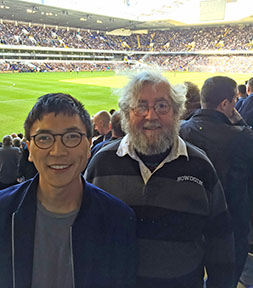
White Hart Lane: White Hart Lane is the name of the stadium where the Tottenham Hot Spurs play. Alex has always wanted to go to a Premier League football (soccer) match and I managed to find tickets on Stub Hub for a game between Tottenham and Manchester City. (All the Premier League games are sold out, at least around London, so it was surprising to get tickets for a game, especially one between two top squads.) Manchester City came into the game undefeated under their new coach, Pep Guardiola, who they lured from Bayern Munich for a gigantic amount of money. (Man City is the richest team in the Premier League and also routinely buys all the best players, so they are a kind of international squad.) Tottenham is also very good, but the Spurs’ best player, Harry Kane, was injured for the match.

White Hart Lane turned out to be a relatively intimate stadium, holding 35,000 or so. It is being replaced by a big, new stadium, which is under construction next to it. I’m sure it makes economic sense and the amenities at the current stadium are a bit primitive, but I’m glad we got to experience what seemed to us to be more of the real thing. One of the things we noticed right away was all of the Korean fans. The Spurs have a forward, Son Heung-Min, who has recently been scoring a lot of big goals, especially with Kane out, and he has become a fan favorite. So there were lots of Korean (and probably other Asian) fans in attendance, many sporting Son jerseys. Our seats were in the corner, right near the goal line and seventeen rows up, so we had a great view of the action at our end, but couldn’t see one of the far corners.

We got there entirely too early since we had to pick up tickets and were expecting a lot more security than there was, but game time finally came and the stands filled up. As the game began, the stadium began singing a Spurs song to the tune of the “Battle Hymn of the Republic”. We were thinking “Isn’t that cool” and then we figured out that we were seated in the part of the stadium where the most lunatic and loyal Tottenham supporters sat. The entire corner of the stadium we were in neither sat down or stopped singing (except to cheer or scream at the ref or the Man City players) for the entire rest of the game. It was deafening. I am certain that the players on the field couldn’t hear each other at all. And the fans didn’t have just one song. They had a whole repertoire and seemed to magically go from song to song in unison. Some were just things like “When the Spurs Go Marching In”, while others were tributes to individually players or the coach. There was a  subset of anti-Arsenal songs and they sang a few. (I assume this is something like Red Sox fans chanting “Yankees suck” even when the Yankees aren’t there.) All the songs were to popular tunes and, when I looked on line, I discovered there are 200 songs in the Tottenham fan’s catalog.. They kept singing the song for the teenage future superstar Dele Alli, since he had a great game, but Son is apparently too new to have his own song yet. (I hope it doesn’t turn out to be racist.) The game was very exciting. The Spurs dominated the favored City squad and won by a very convincing 2-0 score, which might have been worse but they missed a penalty kick. Both teams were in attack mode for the whole game. It appears that is Tottenham’s style and City fell behind early and were under so much pressure that they had to attack. Son is great and, if he isn’t already the biggest deal in Seoul, he will be shortly. In the end,though, it wasn’t the game that I’ll remember. It will be the experience of being surrounded by fans singing and bellowing so loud that it was actually blowing my hair.

spurs1

“The Entertainer”: On Thursday night, we all went to see “The Entertainer”, the final production of Kenneth Branagh’s year-long series of plays at the Garrick Theater in the West End. The play, by John Osborne, may be best know as a vehicle for one of Lawrence Olivier’s greatest performances. It is the story of Archie Rice and his family. Archie is a failing Music Hall entertainer, in a time when the Music Halls are about to die. (There is also a side plot about the war in Suez–it is 1956–involving Archie’s two sons, which demonstrates the parallel Osbourne sees between the collapse of the Empire and the collapse of Music Halls.) As usual with Osborne plays, the characters are desperate and unhappy with a life of trying to make ends meet in an unfair social order. There are a number of scenes set in the Music Hall, in which Branagh is maniacally trying to entertain what you guess is a minuscule crowd, but his joke fall flat and he neither sings or dances all that well. (I suspect it is difficult to play a mediocre talent.) And then in the other scenes at Archie’s flat, the family just tears into each other. Gawn Grainger, who plays Archie’s dad (a legendary Music Hall performer who Archie cannot live up to), was especially memorable. But, typically, the entire ensemble of actors were terrific and it was fun to see Sophie McShera (Daisy in “Downton Abby”) do something very different. Branagh was wonderful, a big personality, gradually being beaten down by the new age and his own failings, but refusing to give up.

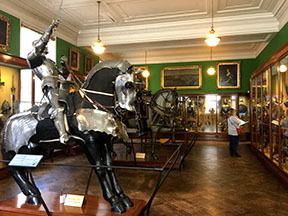
Ted and Wallace: Ted Hunter, a UUCM friend of ours, was in town this week. He works at the Arms and Armor section of the Metropolitan Museum in NYC and will become the Armorer for the Met when the current one retires later this year. It was lots of fun to see him and to have few beers at pub. He has encyclopedic knowledge of arms and armor and was in London to give a paper on the subject at a conference and to meet with his brethren in the field. He told us some good stories about armor in Britain. Apparently, the Royal Armor was moved from London to Leeds some time ago, apparently on the theory that it would revitalize tourism there. It hasn’t really, which he thinks is partly due to the fact that Leeds Castle is nowhere near Leeds, so that when people (like him) go to the more famous castle (which is this incredibly beautiful, historic castle, built on an island in Kent, by the town of Leeds), figuring to see the armor, they are disappointed because the armor is in the city of Leeds, in Yorkshire, which is many hours to the North.

Ted told us that the best armor in London is at The Wallace collection, where I had never been, so Alex and I had a day of art the next day. We started at the Royal Academy to see the Hockney portraits, which I was particularly interested to see again since I had started my own portrait series. I picked up a few things about painting faces, although I also learned that I have no hope in mimicking Hockney’s style which combines unexpected colors in a way I could never hope to do. We dropped by the Abstract Expressionism exhibit too, before walking over to the Wallace Collection to meet Judie. It is housed in a big mansion in Marleybone, once owned by Duke of Hertford (who I think were from the line of Seymours going back centuries and were, in any event rich aristocrats of long-standing). It was an amazing collection of arms and armor (as promised) and each room had several books on reading stands in which you could read more about the individual pieces. Very nice idea. There was also a substantial collection of paintings, including four Rembrandts, “The Laughing Cavalier” by Hals and a number of other impressive works from the 1650-1850 period. It was all accompanied by lots of Louis XIV sort of furniture and decorations and tons of other things that they collected. It is quite a place and you cannot see any of the art or armor anywhere else. When the Duchess of Hertford donated it to the State upon her death in 1897, she stipulated that none of its contents can leave the house.

wallace-coll

I’ll leave the rest to another post. This is getting pretty long….

Myriad Experiences

Judie is off touring America, stopping at various K&L Gates offices, including Boston and Washington, and ending up in Chicago for a conference. When Judie is not around, I have even less order to my life than usual. I tend to eat at odd times and get lost doing projects or watching baseball on my computer. It is actually sort of fun when she is gone for about a week, as she is this time. She returns on Wednesday evening and Alex arrives that morning for an eight-day visit. Alex has finished up with his Every Zip Philadelphia project (which you can see and hear on the WHYY website). It was pretty successful, although I think it was too much management and not enough creativity for him. It wasn’t renewed and he has been hired by Audible to co-produce a multi-part audio series about how Americans experienced World War II at home. He was given a number of books to read and will have access to lots of archive interviews etc. The process of creating his two sections is about to start in earnest, so he is taking this break to visit us.

“There’s no crying in Baseball”: That’s what Tom Hanks’ character memorably said in “A League Their Own”. But it turns out that sometimes there is crying. For some reason, the Mets have been involved in the two most emotionally fraught games in the history of baseball. The first was in 2001, when the Mets played the Braves in the first game played in NYC after 9-11. The atmosphere surrounding the game was incredible and it was punctuated by Mike Piazza’s game-winning home run, the single most dramatic hit I have ever seen and what has to be the highlight of his Hall of Fame career. I thought I would never see another baseball game to compare to that.

Then on Monday night, the Mets visited Miami and the Marlins for the first game after the tragic death of Jose Fernandez, a game that he was actually scheduled to start. Fernandez was incredibly talented, with a simply amazing life story and was supposed to be a wonderful person. There was a very moving opening ceremony, with both teams on the field, which concluded with the Mets players going across the field to hug the Marlins players. Most of the Marlins players were teary-eyed or crying. When they switched to the broadcast booth, Gary Cohen, the main Mets announcer, was so choked up that he could barely talk and Keith Hernandez and Ron Darling were sitting there with conspicuously red eyes. Then, in the bottom the first, Dee Gordon batted right-handed for the first pitch in honor of Fernandez and then switched to his normal side and hit the third pitch for a home run (his first home run of the season and the first time in his career he had hit the ball into the second deck). He was clearly crying as he circled the bases and came back the dugout where he collapsed into the arms of his sobbing teammates. It was just unbelievable on any number of levels. A once in a lifetime baseball moment. Travis d’Arnaud, the Mets catcher, said he was crying watching Gordon round the bases and I doubt he was alone in that. There is crying in baseball after all.

Abstract Expressionism: On Saturday evening, I went to a members’ private tour and party celebrating the opening of the Abstract Expressionism exhibit at the Royal Academy. As our guide/docent pointed out, the name is a bit deceiving, because many of the artists’ styles were neither abstract or impressionistic. It is sometimes called the New York School and NYC certainly became the center of the art world in that period, but many of the artists did not live or paint in NY. Tragedy was one theme as some of the most important artists died young, from suicide (Gorky and Rothko) to car accidents (Pollack). As you might imagine, there were some iconic paintings. There were some great Pollacks, including one huge early one he did on commission for Peggy Guggenheim’s apartment which was a breakthrough moment in that era. And there were great examples from Gorky, Klein, de Kooning (his series of paintings of women were amazing), Rothko (the early works were fascinating), Motherwell and Krasner (a highlight was the first painting she did after Pollack’s death). It was a wonderful exhibit and it was nice to have plenty of time to go back and wander through it after the tour, without being bothered by the usual crowds. For me, the great revelation was Clyfford Still. He became disgusted by the commercialism of the NY art scene and moved to Wyoming, where he painted the rest of his life. He sold practically nothing while he was alive, but now his work is in a museum in Denver, which I have to visit some time. There was a huge gallery of his work, which was breathtaking. See below for an example. There was also a party with a free champagne cocktail and a bar and a jazz singer, so it was all very festive, although I would have had more fun if I’d found someone to go with.

abst-exp

Immigration Detention Seminar: On Monday evening, I went to a meeting at the offices of Amnesty International (which it turns out is about four blocks from our flat) for a conference about the alternatives to Immigration Detention and role of civil society in making those alternatives happen. It was run by an organization called Detention Action. The audience seemed to be mostly immigration insiders–lawyers, advocates, NGO people and a sprinkling of government officials. It was too bad in a way, because some of the speakers were very interesting and for real reform to occur, they are going to need the support of a much wider group. There was a woman who is one of the leading immigration advocates in the Ukraine and, as you might imagine, they have some problems there that are hard to imagine, such as millions of displaced Ukrainians to deal with, in addition to all of the migrants, most of whom are really trying to get to Germany or somewhere. And there was a representative of Freed Voices, a group of former detainees, who spoke very movingly about how de-humanizing detention is and that there is no trust. I was given a big report, which I’m going to read.

Labour Conference: Jeremy : won his election by a landslide and this was followed by a Labour Conference in Liverpool in which the party tried to unify and to explain what they want to do. To me, what was most interesting about the process was the fact that the party out of government actually laid out a fairly detailed program. They take the whole idea of a party platform much more seriously here. It really is a nice political concept, where the opposition party must have a formal “shadow” government which says, with some specifics, what they would do if they were in power. The other nice thing about this system is that the BBC and the media in general (although maybe not the Murdoch press) really give deep coverage these kind of policy matters and engage in a real discussion and questioning about what the party is saying. It is a level of substantive and detailed analysis that is utterly absent in the American media (except on PBS and NPR to some extent). There are a lot of problems with the British system, but they really take politics and the issues much more seriously here, from Question Time to the Shadow Cabinet system to the media coverage.

London News and a Painting

New Painting: I’ve decided that I am going to try having a portrait and another painting going at all times for the next month or more. I’ve just finished my first of those portraits. It is of Judie and it owes a lot to the style of David Hockney. As you can see from below, it’s not a bad painting and I suppose it looks a little like her. I guess that I’m not really displeased with it, but I am a bit annoyed that I didn’t really capture Judie. I kept working on it, trying to get it, until I finally realized that I was doomed from the start. I never had the head shape correct and trying to correct that made the hair wrong. So I decided to accept that it was a decent painting and move on. It was frustrating. But I have learned a lesson–that the initial drawing is the key in a portrait, so in the one I am working on now, I was much more anal in transferring the picture to the canvas. We’ll see.

portrait-judie

Bake-Off News: I don’t know if this news made it to the States, where the Great British Bake-Off is a big hit (I’m told), although it is two seasons behind. The producers of the Bake-Off have sold the show to Channel 4, away from the BBC, after the BBC was outbid by a substantial amount. What Channel 4 failed to do was make sure that the talent was coming along with the big tent and the ovens. This was huge news here, eclipsing even the Brad and Angelina beak-up. Last week, shortly after the announcement, Mel and Sue, the hosts and comediennes who provide the light moments to the show, announced that they were not making the move. This caused a great deal of outcry. But that was nothing compared to yesterday, when Mary Berry announced that she is staying at BBC. She is the heart and soul of the show. It is like you are cooking for your loving grandmother. She will criticize you “soggy bottoms” or dry cakes, but in a loving and gentle way. Now, for £75M, Channel 4 has got the tent and the name and Paul Hollywood, the other judge who needs someone like Mary to be a counterpoint. It’s a bit of a disaster for everyone concerned.

Labour Party Vote to be announced this weekend: There is no drama here. Everyone knows that Corbyn will win, maybe by more than he won the first time. He is utterly beloved by the mostly young, far left voters who make up the membership of the current Labour Party. Whether the membership represents the actually Labour voters int he real electorate is another question, one that is familiar in the context of U.S. primaries, which have tended to skew toward either extreme for the last decade or two. As an article in Friday’s NY Times explained, a lot of this is about taking the Labour Party back from the Blairites, who moved the party away from its socialist base and disenfranchised the activists. I get that, but it seems to me that you still have to have a credible a Parliamentary presence and pose an electoral threat to Theresa May and the Tories. I don’t that Corbyn can do either of those things, and what is worse, especially to the Labour politicians who care about such things, is that he doesn’t seem interested in doing so. This the party divisions will not be resolved by this vote and will grow increasingly ugly.

The Liberal-Democrats, a third/fourth party, which actually seemed like they might be relevant force a decade ago, are hoping to rebound from the brink of extinction, by offering to be the center-left alternative for disenchanted Labour MPs and voters. There is no sign that the Labour MPs are interested in this, although they might be if they are attacked from the Corbyn-loving left in the selection process and are faced with retribution and the loss of their positions for daring to oppose the sainted Jeremy. It is going to be ugly and depressing for most Labour supporter in the coming year.

Theresa May and Brexit, etc.: Because May never went through an election, no one knows exactly what she stands for. She makes Yoda-like statements like “Brexit means Brexit”, which everyone now agrees is utterly meaningless. She is promising to get a “good deal” for Britain in the upcoming negotiations, but what good deal is depends on which of the various wings of her party you talk to. The Brexiteers are pushing her to invoke Article 50 and start the process of leaving the EU immediately or at least very soon. It would probably be a stupid act, but she might get forced into moving too soon. Even if she holds out until late next year, these negotiations are going to be extremely difficult. The eurosceptic wing of her party (especially the ones who go on and on about sovereignty) are absolutely convinced of the importance of British trade in the EU and are convinced that the EU will fold in negotiations. They are almost certainly wrong. (A significant number of the Conservatives believe that once Britain leave the EU, the days of the British Empire will magically be restored. It is pathetic.) The Cameron/Osborne wing of the party are more supportive of a slower process, but Cameron has left Parliament and Osborne et al are pretty discredited and, of course, there is no serious Labour opposition, so it is easy to imagine May being pushed into a process that turns out very badly for Britain.

It is in the non-Brexit areas of policy that things could get very ugly. May and the Tories are very conservative and are now unrestrained. The attack and gradual defunding of the National Health Service will continue, with the idea of eventually privatizing it. They want to reduce the funding of the BBC! The want to go back to the old days of selective grammar schools for the best students (who, despite May’s protestations to the contrary, are likely to be “the right sort of people”). They clearly want to cut back their aid to poor countries and to continue to cut back on welfare benefits. They are absolutely committed to limiting immigration. Labor Unions will see a new wave of attacks. The real economic impact of Brexit has not arrived yet, since nothing has happened. But it will happen and when it does, lots of people will suffer and they will not be “the right sort of people”.

There is a chance that May may call a snap election, which makes good Machiavellian sense to me. Labour is so divided right now that an election might destroy them or at least worsen the divisions. If she waits, there is chance that she could overreach and anger the electorate and even give Corbyn a chance to figure out how to be a leader (although that seems unlikely).

New Medical Mystery: At the beginning of the week, I woke up with my left leg completely swollen. It looked sort of weird, so I went to see a doctor. I’ve ended up getting an ultrasound, a chest x-ray, blood tests and a CAT scan. They have discovered that I am completely healthy. My leg is still swollen and they can’t figure out why. But they have eliminated all the serious things, so maybe it is nothing and it will cure itself. I’m supposed to go back next week.

Surrey Down: Judie and I went to Surrey this week. (By the way, I have always love the song “Stoned Soul Picnic”, but never knew exactly what “surrey”meant. It turns out that no one knows and that there any number of web sites discussing this. Perhaps Laura Nyro knew, but has taken the secret to her grave.) Anyway, we went to a place called Pennyhill Park, where Judie was at a conference. It is a rather historic place that was purchased and converted in a resort with a little golf course and one of the biggest and most elaborate spas I have ever seen. It was very nice. I probably would have done more while I was there, but I was sort of being careful because of my leg. It was fun anyway.

Royal Shakespeare Weekend and More

One of the things I really want to do while I am here is see everything that the Royal Shakespeare Company (RSC) does, at least in London. (Stratford is a bit too far away, unless one stays overnight. We’ll probably do that at some point, but you can see most of the RSC performances at the Barbican or the West End, so it isn’t an essential trip.) We bought tickets to the four plays they are doing at the Barbican as soon as they were released to members. Given Judie’s upcoming travel schedule and the change in routine generally occasioned by the change of law firms, we decided to see the first two RSC productions on consecutive nights.

“The Alchemist”: This is a play by Ben Johnson, a Shakespeare contemporary. As the programme points out, while Shakespeare’s plays were entirely set in the past, Johnson’s were contemporary and, indeed, “The Alchemist” is set in Blackfriars (a part of London) in 1610 and premiered at the The Globe that same year. So the characters would have been recognizable types to those audiences and the references to things like the plague would be things they were familiar with. It is also likely that the audiences of that time believed in the possibility of Alchemy. Unlike Shakespeare, Johnson oversaw the publication of his own Folio and was thought to have expanded the plays to make them seem more serious. This requires some significant cutting of the text to give it a proper running time and to maintain the pace.

The play begins as the master of the house in Blackfriars is fleeing London to his country home to get away from the latest plague epidemic, leaving his servant, Jeremy or “Face”, in charge of the house. The servant sees this as chance to make money and teams up with Subtle, an alchemist and con man, and his colleague Dol. They start a number of elaborate con games, most based on either turning base metals into gold or on creating a philosopher’s stone. (Neither the stone nor Nicholas Flammel were creations of J.K. Rowling. Flammel was a successful merchant who died in 1418, but in the 1600’s rumors began to circulate that he had found both the philosopher’s stone and the elixir of immortality.) The three of them attract an increasing number of victims and, in order for the their cons to succeed, have to string each of them along and try to keep them from meeting each other. It is really a farce, with the three con artists becoming more and more manic as they get closer to succeeding in their various frauds, but also are getting closer and closer to being found out. Of course, Jeremy’s master returns home just as things are reaching their peak. It is really a wonderful play and there is something timeless about con artists and the greed of their victims. It goes without saying that the acting was uniformly wonderful, although none of the actors were familiar to me. Ken Nwosu, as Face, Mark Lockyer, as Subtle, and Siobhan McSweeney, as Dol, managed to be simultaneously reprehensible and lovable. You were horrified by what they were doing, but sort of were rooting for them to succeed. The victims of the frauds were all memorable in their own ways. The unbelievably greedy and lecherous knight, Sir Epicure Mammon (what a great name), played by Ian Redford, was hysterical and Tom McCall, playing a rich country who was willing to pay Subtle to be taught to argue like the suave gallants of the city, absolutely stole several scenes. Judie loved the young actor, Richard Leeming, who played Abel Drugger, a tobacconist seeking magical help to insure his business’s success. It was a thoroughly enjoyable evening of theater.

Doctor Faustus: The next night was a very different theatrical experience. Everyone knows the basic plot–Faustus sells his soul to the devil for a period of personal power. But I didn’t appreciate how terrifying the play would be. It was written by Christopher Marlowe, another Shakespeare contemporary, although the programme notes suggest that it was actually a collaborative work. Two actors, Sandy Grierson and Oliver Ryan, alternate in playing the two main parts, Faustus and Mephistopheles. (We saw Ryan as Faustus.) They were both wonderful, but seem like very different sorts of performers and I would think their performances would be very distinct. One of the interesting things that the production did was use a very dark palette in the sets and in the costumes, with the exception of Mephistopheles and a female Lucifer (the devil), who were dressed in bright white. While I think much of the original dialog was maintained, especially for Faustus, special “devil music” was added. The most memorable scene was when Lucifer appears to Faustus and introduces him to the seven deadly sins. This was done like a musical production number, with each of the sins in outlandish and grotesque costumes. One of the slightly surprising things about the plot was that Faustus used his power in a series of horrifying (one might say devilish) ways and one never got the feeling that he was getting real enjoyment from his power other that by the fact of having it. The programme notes observe that this must all have been especially terrifying to audiences of the day, who believed in the reality of dark arts and intervention of the devil in daily life. So the production stresses the creepiness and terror inherent in the plot. It was done without an interval, so the audience never gets away from the bizarre and horrifying series of events, which occur at an increasing pace, from the time that Faustus calls Mephistopheles to serve him, all the way to his increasing panic as the time approaches when the devil will take him and his soul. There is lots of blood and two great performers, surrounded by a marvelous ensemble cast, with clever direction and eerie music. It made for a memorable evening of theater.

Blueprint for Better Business: Earlier last week, I joined Judie at K&L Gates for a presentation and panel put on by Blueprint for Better Business (BBB), entitled “Uniting Corporate Purpose and Personal Values to Serve Society”. It argues that businesses should be “purpose-driven” and employ the sorts of morality that have been developed by faith and thought traditions. The corporate purpose, under BBB’s thinking, should be to respect the dignity and value of each person and to deliver value by serving society (which sounds a lot like UU principles). BBB seeks to be a movement and to attract a multitude of businesses to this approach. Each business would (1) be honest and fair with its customers and suppliers, (2) treat its employees with dignity, (3) be a good corporate citizen, (4) be a guardian for future generations, thinking of the whole, rather than in terms of self-interest, and (5) operate under a purpose that delivers and long-term and sustainable result for society and responsible investors. It all seems a bit pie-in-the-sky, but the presentation featured a panel of academics, who discussed the research that has been done on the efficacy of this sort of new corporate thinking and whether this idea of “purpose” can avoid becoming just another board of director buzzword, like “sustainability” or “corporate social responsibility”. It turns out that there is data that suggests the intuitively sensible point that such companies are more successful over the long-term. However, they also stressed the obvious point that this type of approach to corporate governance cannot succeed in which the leaders are thinking in the extremely short-term way that characterizes most business today. And it seems to me that here will have to be a fundamental change in the definitions of fiduciary duty and investment goals to state that success in investment is not defined by simply earning as much as possible, but by also figuring in the societal costs of the investments that you are making. It was all very inspiring and gave me something to think about. Theses guys are not in America, as they are a pretty small non-profit, but it seems like something that would make an interesting thing for organizations like the UUA to get behind.

Proms in the Park, a Party and Pinegrove

BBC Proms: The “Proms” refers to a shortened version of “promenade concerts”, an English tradition going back centuries, which originally referred to music being played in parks and pleasure gardens, allowing people to stroll while listening to the music. In the late 1800s, it was formalized into a classical music festival in which a series of concerts are held, most of them at Royal Albert Hall. At some point the BBC became the sponsor. On the final day of the Proms, the last concert at Royal Albert Hall features easier listening classical music and concludes with a series of patriotic tunes. To make this last day more egalitarian, a parallel concert is held next door in Hyde Park, which also ends with the same patriotic spectacle. This has now expanded to Glasgow, Belfast and somewhere in Wales.

Judie and I got tickets for the Hyde Park event and bought hampers, so we could have food and wine. (I bought two hampers and discovered that each hamper was for two, so we had too much food and two bottles of wine. Guess which we finished.) Of course, it rained–either steady drizzle or serious rain for the first three or more hours. Londoners are used to this. The concert itself consisted mostly of old pop acts and some show tunes that were sort of advertising for shows currently running or about to open. James Galway did play a flute piece based on “Carmen”. Sir Andrew Lloyd Weber was there to plug “School of Rock” (coming soon) and Tim Minchin sang songs from “Matilda” and “Groundhog Day”. The pop groups, The Feeling, Rick Astley, ABC and Martin Fry and All Saints, were essentially unknown to me, although one or two of Rick Astley’s tunes sounded familiar. But, when we looked around everyone seemed to be singing along. There is a whole layer of English culture about which we know absolutely nothing. There were some strange moments: weird on-stage interviews by Anneka Rice, along-time BBC radio and television host who looked botoxed and face-lifted to the point of being creepy, and the performance by Martin Fry, whose clothes and hair accentuated that he was an old guy singing pop songs from his youth. Everyone was very friendly and there was a nice spirit, despite the weather. The Hyde Park part of the show ended with Frankie Valli and a set of backup singers. He is 82, but looks pretty good and can still hit those high notes, although he is remarkably stiff. The crowd sang along lustily. We left when the feed from Royal Albert Hall came on the video screens. We decided to miss the patriotic chest-thumping and avoid the crowds on the Tube. Some pictures follow:

Our Party: If any of you have visited, there is a decent chance that we took you to Vagabond’s, a wine tasting place in Old Spitalfield Market, featuring around 80 wines in machines. With a pre-paid card that you insert in a slot in the various machines, you can take a taste or get a glass of wine, with the cost of the wine deducted from your card. The amount varies, depending on the cost of the bottle. It’s a great concept and we wonder if there are any of these in the NY area. We decided to have our party there, since it is like having a wine tasting with very little work. All we had to do was provide cards and buy a few cheese and charcuterie platters and have some bottles available when our guests ran through their cards. It worked out great and everyone had fun. It was a mix of Bryan Cave lawyers, New Unity people and various couples we have met during the year. An eclectic mix. Everyone got along. A great success!

Pinegrove: On Tuesday night, we went to see Pinegrove at club called The Lexington in the Angel section of Islington. It is fairly small (200+ capacity), so it sold out very quickly, since Pinegrove is very hot right now. For those of you who have never heard of them, Pinegrove is a Montclair band led by two friends of Alex. Evan Stevens Hall is the front man, lead singer and composer, who we have known since he was very little. I coached him in Little League at least one year and he was a year behind Alex in school. He has always been obviously talented, which, of course, means nothing in the music business. He has been playing in bands forever with his long-time buddy and drummer Zack Levine, who also went to Northwestern with Alex. Evan and Zack’s bands and Alex and his friends bands were the two most popular bands throughout high school. Evan and Zack have been trying to make it in the music business and have come close to giving up at times, but, at the beginning of the year, Pinegrove released the album “Cardinal” to rapturous reviews and they took off. They have been touring ever since to increasingly large and enthusiastic crowds and getting great publicity. On their current tour, they are joined by another Montclair kid, Aiden Feliciano, a friend of James from drumming classes with Miss Maya and Reggie Workman, who plays the bass now (like James). The concert was good, if a bit short. They played all of the album with the audience singling along. The band is very tight and Evan has developed an appealing stage persona. They are off to the rest of Britain over the next month and then on to Europe.

Random Notes: After my last blog, I went and read the reviews of “Labyrinth” that appeared in the papers. They were more positive than I was. Most of them raved about how deeply researched it was. That’s true, but it doesn’t mean that it is a compelling plot. Ultimately, the biggest difference is that the reviewers liked the equivalences between that crisis and the more recent crisis and felt the fact that it keeps happening is instructive. I suppose so, but how many times do I have to see this point made? The staging was great and the cast was good and it had a lot of energy, but was it a story that needed to be told?

It has gone back to being summer here. On Tuesday, it was hotter in London than in Miami. Sauna like conditions prevail in the flat, although it is merely hot in the kitchen, where I paint, so I’ve been retreating to there.

Judie is involved with person to person lending (I can’t recall if she has a new client or speaking at a conference). So she asked me to try it and report back. I took $2,500 and opened an account at a site called The Lending Club. The idea is that people who need a loan but, for one reason or another, would have trouble getting one from a bank, can borrow money from other people to pay fora home improvement or for debt consolidation or medical bills. It’s like crowd funding, but it is an interest paying loan. The risk is higher (and varies depending on borrower) and there is a real possibility that a borrower might default. So what you do is spread your risk by loaning just $25 on many individual notes. In theory, I should get a good return even if a certain number of the 100 borrowers I have funded end up defaulting. We’ll see how it works in practice.

Plays and a Political Action

“Groundhog Day”: In a case of life imitating art, I went to see “Groundhog Day” again on Wednesday, when Judie’s Women’s Group meeting took over the flat. If anything, I liked it even more the second time. While it is hard to watch it and not think of Bill Murray and Andie McDowell in those leading roles, one of the things that I came away after seeing it again is that the loss of those two stars made the production better in many ways. Some specific thoughts:

  • The musical’s exposition drags a little, despite a breakneck pace, partly because it takes so long to get through. That is because they have to show you that entire first day in detail, so that they can riff off of it and start the real action when Phil Connors wakes up to find himself reliving it again. And again. The exposition was less of an issue in the movie, because Bill Murray can make anything entertaining. (A movie could also probably accomplish a lot in a shorter period of time with cutting.)
  • There is nothing lovable about Phil Connors at the start of the musical or even for most of the first act. His reactions to the town and his situation are funny, but, deep down, he is simply a sexist asshole. This makes his eventual redemption much more satisfying and gives the musical a better story arc. Bill Murray’s character was much more likable from the beginning and the resulting feeling that you had for him did not go through the same sort of development.
  • The Rita in the musical is cute, but not a beauty like Andie McDowell. So in the musical, it seems to make more sense that Phil doesn’t really fall in love with Rita. At the beginning, hr barely notices her. He is really just trying to get into her pants until close to the end. Again this gives the musical more of a story arc than the movie.
  • I don’t think the movie gives you a feeling about just how long Phil is stuck in Groundhog Day. Do you think that the Bill Murray character goes through the day 50 times? Maybe 100? By the beginning of the second act of the musical, you get the feeling that this Phil has been reliving this day for many hundreds, if not thousands of time. He is utterly defeated and desperate. But then he picks up on something Rita says (sings, actually) and decides to live the moment and to try new things and to live for others and not just himself. It is then that we begin to root for this Phil, who was amusing, but never all that likable.

The combination of all of this makes the second act utterly redeem to slightly clunky moments of the first act. That act, beginning with Phil grabbing a shooting the groundhog and then himself, through to his astonishment at finding Rita in his bedroom that final morning is just about as perfecta piece of theater as you could hope for.

Saul Alinsky in Hackney: On Thursday, I went with some folks from New Unity to a meeting held by Citizens Hackney. They were having a meeting with the candidates for Mayor in the upcoming by-election. Citizens Hackney is a classic community organizing organization following the Saul Alinsky playbook and the meeting was a classic “action” that I’d learned about in classes and participated in when connected with Building One New Jersey. So it had an additional layer of interest as I saw them do the classic stuff, like start and end on time, make sure everyone introduces themselves (I represented New Unity in that role), Gave lots of people roles and did not let the politicians dominate the mike. Classically, they had met with the politicians ahead of time and knew what they were going to say. Citizens Hackney had a bunch of positions and asked each of the three candidates if they supported them. They asked about (a) a living wage for government workers and contractors, (b) a job program for youth, (c) more affordable housing, especially at the Olympics site, (d) a crackdown on bad landlords and (e) more consultation between the Mayor and the public (especially Citizens Hackney). They are big issues, but were phrased in non-confrontational ways, and all three candidates agreed to it all (which the organizers knew ould happen in advance). It turned out that the Labor guy is going to win by a mile, since it is a very safe Labor area, so the other two candidates had nothing to lose by agreeing. The Conservative candidate was this very earnest young women, who seemed to normal to be a Conservative and the Lib-Dem was an interesting radical type. The Labour candidate is actually the temporary Mayor already and had some interesting little quibbles to the Citizens Hackney position, based mostly on the fact that he had actually governed and knew how things actually worked. The one weird thing about the proceeding is that after each candidate agreed with everything that they were asked to agree to, a moderator would get up and go through the whole thing again, confirming each point. I’m sure that this was in their script, but it seemed odd–like they hadn’t been listening to what the candidate just said. Democracy in action!

 “Labyrinth”: The next night, we went up to the Hampstead Theatre and saw “Labyrinth”, a new play about the Latin America debt crisis in the 1980s. It looks at the whole thing from American bankers’ points of view, which was (and is) “Let’s make as much money as we can and screw the consequences”. One problem with the play is that it is hardly big news that American and Global bankers are horrible, rapacious, destructive pigs. There have been lots of movies and books making this same point, so there is no real revelatory aspect to the production, even if the plot involves an economic crisis that most people have forgotten. And I don’t think the fact that the world has largely forgotten a crisis of that magnitude (which is admittedly appalling) is enough reason for the play. The thing that almost saves the play is the central character, a very young banker who is swept along in the whole process, becoming increasingly rich and cynical. His father is a small-time con man, who has gone to jail for fraud in the past. I know that the play was trying to contrast the small con with epic fraudulent loans that made entire countries insolvent. But it didn’t really work. Maybe it was too obvious. However, I will say that the scenes between the father and son were some of the best in the play, mostly because they were the only recognizably human people. The other bankers were fast-talking and often funny caricatures. With all of that said, the production was fascinating, espcially if you wanted to learn about that debt crisis. The staging was extremely clever and the acting was compelling, if ultimately a bit pointless. It seems to me that one of the reasons you go to small theaters like this, away from the West End (or Off-Broadway in NYC), is that they take chances. Sometimes. they work sublimely, as most of what we have seen at Hampstead Theatre has. And other times, you leave thinking “Oh well. Nice try.”


A Painting, Taxes and The Dead Have Risen

I’ve been distracted by my weird illness, discussed in the prior blog, and by the necessity to collect information for accountants on both sides of the pond, so that our taxes can get filed. Making this latter effort more complicated is the fact that that the British tax year ends on April 5th, which makes absolutely no sense to me. I looked it up and it is a predictably strange story:

In the old days, the new year in Britain and Ireland began on March 25th. It was called Lady Day and was supposed to commemorate the day that the Angel Gabriel advised the Virgin Mary that she was going to give birth to Jesus. Lady Day, Midsummer, Michaelmas and Christmas were the four most important dates on the old calendar, came along roughly quarterly and evolved to be the dates when debts needed to be settled and rents paid, etc. Lady Day eventually came to be seen as the beginning of the financial year.

In 1582, the rest of Europe switched to the more accurate Gregorian calendar, replacing the Julian one, which had lost ten days over the years. However, the British decided that they weren’t going to let the Pope tell them what their calendar should be (you may recall that they were not getting along), so they kept the Julian calendar. Fast forward to 1752, when the British finally decided that they had to switch over the Gregorian calendar. By this time, they were 11 days off, so to make the correction, September 2 of that year was followed by September 14th. The people were justifiably unhappy (to the point of rioting) about having to pay the same taxes on a year that was 11 days shorter, so to insure revenue collection, the British Treasury just moved the end of the tax year up 11 days to April 4th. And then in 1800, they moved up another day to the 5th, since there was no leap day that year and they wanted to be consistent. They have since dropped that practice.

The use of April 6th as the beginning of the new tax year was formally adopted in 1900. Oddly, the British government’s own fiscal year now begins on April 1st, which is also the beginning of the fiscal year for most businesses here. Curiously, April 1st is the beginning of the tax year for corporations and the 6th only seems to apply to individuals. (The Irish sensibly just had a shortened year at one point and have switched to January 1st.) You cannot make this stuff up!

New Painting: Georgian Skye: As you make recall, I was inspired by the Georgia O’Keeffe exhibit at Tate Modern and decided that I wanted to try painting a landscape in her Ghost Ranch style. I picked a scene from the Isle of Skye. Like New Mexico, it is wild and bleak, but wet rather than dry. It was an interesting experiment and the top half of the painting went fairly well–not Georgia O’Keeffe, but pleasant looking. When I reached the bottom, I kind of lost my way. I tried a few things and didn’t like much of it. I finally gave up working on it. When I started painting some other things, I went back to this and made a few corrections. The last thing I did was add the sheep, which are decidedly not O’Keefe-like, but are quite Lewis-like. It would be cute to say that I learned how hard it is to paint like O’Keeffe, but I really already knew that. From the beginning, and increasingly  as I went along, I was drawn to the thought that I was not copying her, but trying to get some inspiration from her and adapt it to my style (such as it is). I still like the top more than the bottom, but I think I turned out OK. Here it is.

Georgian Skye

Tales of the Undead-The New York Mets: I gave up the Mets for dead about three weeks ago. It was the middle of August and they were even behind Miami, not to mention the Pirates and Cards and Giants and Dodgers. Wright, Duda and Harvey were out for the season. Cespdes, Cabrera and Walker were all hobbling around (and it turned that Walker was done for season). Matz was pitching with a big bone spur in his elbow and Syndegaard with a little one and Neise hurt his knee and went on the DL with Matz. The bullpen was exhausted. Bruce, brought over from the Reds wasn’t producing. They weren’t hitting in the clutch (last in baseball with runners in scoring position), had little team speed and were not great defensively. It seemed like one of those baseball seasons when, unlike the absurd run of 2015, the baseball gods were frowning on my Metsies. I figured, well at least I’ll get to sleep this October.

Then, out of the blue, Jose Reyes starts playing like it is six years ago, Wilmer Flores is hitting like I always thought he might, Cespedes comes back, Cabrera gimps around hitting home runs, and guys like Bruce and d’Arneau and Granderson finally show signs of life. Familia and Reed continue to be a shutdown bullpen at the end of games. Incredibly, even as de Grom joins Matz on the DL, minor league nobodies named Gsellman and Lugo and the failed prospect Montero are thrown into starts and pitch great. Bartolo Colon continues to defy time and even draws the first walk of this career at the age of 43. There is really no way this team should be winning, but they have somehow won something like 12 of 16 and are now a game out of a playoff spot with a month left. I’d still be skeptical, but it turns out that the Mets hardly play anyone decent for the rest of the year. Most of their games area against the Phillies and Reds and the Braves and Twins, and the final two are battling for the worst record in baseball and the #1 pick. It could happen. Hell, it should happen. Ya gotta believe. Terry Collins for Mayor!