Catching Up: Royal Shakespeare and Community Organizing

We are back from our Thanksgiving trip. Before I write anything about that, I want to finish up a post that I couldn’t complete before leaving. I probably should have done this on the plane or while I was in Montclair, but I don’t really like writing on my phone. And I suppose I am a creature of habit.

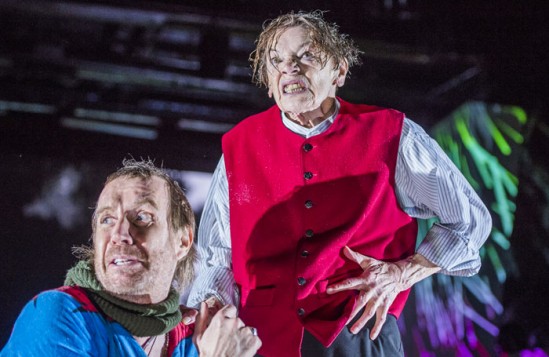
“King Lear”: Samuel Johnson said that he found “King Lear” almost unbearable. Yet here we were at the Barbican, experiencing it for the second time in a week. (According to the programme, the play was adapted in the 1680’s creating a happy ending, which was how Lear was played for the next 200 years.) After seeing Glenda Jackson take on Lear at the Old Vic, we were curious to compare the Royal Shakespeare Company version, starring the great Shakespearean actor Antony Sher, who we had seen memorably playing Falstaff about a year ago.

It is hard to compare the two Lears. The RSC production was in more traditional costumes and didn’t use things like projections. In some ways, I found the overall look of the RSC version preferable, although I thought the storm scene in the Old Vic production was more dramatically staged. One of the interesting little things the RSC production did was have destitute, silent characters often moving about the stage or sitting in corners, stressing the political context of the play, discussed below. Sher’s Lear was a more powerful a figure at the beginning, at least in part because he is not 80 years old like Jackson. So he begins the play as a robust monarch, taken with making declamations to the heavens.  (This production seemed to stress the part of the play that dealt with heavenly orbs and astrology.) The usurpation of his power and his descent into madness is a longer fall, perhaps, than Jackson’s. Glenda Jackson’s Lear was older and frailer and the removal of her knights was more of a personal affront. Sher’s Lear was a more active character so taking away his knights was a profound attack on his lifestyle in addition to his dignity. The daughters were more purely evil in the Jackson version, while the RSC played Goneril as more convinced of her father’s decline and her actions seemed more driven by concern for him, at least at first. (Regan was more the pure evil daughter.) The Fool (Graham Turner) was far more melancholy in the RSC production, as if he could foretell Lear’s upcoming demise. David Troughton as Gloucester was memorable, but with Royal Shakespeare productions it is almost unfair to call attention to any actor since the entire ensemble is always terrific.

I have to say that I wasn’t really that familiar with “King Lear” before this intense exposure. I think I read somewhere that Lear has currently become the most produced of all Shakespeare’s tragedies, passing “Hamlet”. It has almost as many iconic lines, though fewer soliloquies and some of the scenes are more memorable. The storm scene is a classic, but I think my favorite is the one in which Edgar leads Gloucester to what he imagines is the cliffs of Dover, so that the blinded father can jump to what he hopes will be his death. There are countless references to sight throughout the play and the play has a political sensitivity that seems fairly modern. As Lear wanders the heath, he finds himself surrounded by the homeless and starving and clearly is surprised and moved by the discovery of such poverty in his kingdom (“houseless heads and unfed sides”). According to the Programme, this reflected the conditions in Shakespeare’s time, as population growth, food shortages and economic problems lead many peasants to leave the land and move toward the cities. While a system of private social welfare was developing, the government did little to help the destitute migrants crowding into London (who Shakespeare saw on a daily basis) and Lear’s comment “O, I have taken too little care of this” can probably be seen as political commentary. This criticism reaches its peak when Lear urges Gloucester to get a glass eye “and like a scurvy politician seem to see things that thou dost not”.

Another Election: On Thursday, I went with my rabble-rousing New Unity Social Action crew to another meeting of a community organizing group. A few months ago, I went to a meeting of Hackney Citizens, in which the mayoral candidates spoke and were questioned. The time, the meeting was held by TELCO. It sounds like a telephone company or some sort of multinational conglomerate, but it actually stands for “The East London Community Organization”. It is the oldest Saul Alinsky-inspired social action organization in England and one of the biggest and most successful. Now there is a Citizens UK and a Citizens Liverpool and Citizens Brighton, etc., bur TELCO has held on to the name. So as I understood it from Andy that one of the main purposes of the meeting was the change the name to East London Citizens. The meeting was one of those over-programmed type of Alisnky meetings, which stresses participation by many and sticking to a script and to time limits. The whole thing was scripted out to he last word and most people just got up and read their little bit. So as you might imagine, it was stilted and lifeless.

Despite their efforts, they screwed up one thing. They seemed to be under the impression that London had agreed to build 100 affordable units at the old Olympic site in East London, through Community Land Trusts that Telco was pushing. A representative of Mayor Kahn was there. If you are going to have an action like this, you are supposed to meet with the speaker to make sure that you know exactly what he is going to say and, ideally, tell him what to say. They didn’t do that. So when some TELCO guy got up and with great fanfare asked the official to confirm and guarantee that the 100 unit would be built, he would do no such thing. He said nice things about the idea and said they would do some as a pilot, but simply refused to commit to any number. The TELCO guy seemed stunned and, as this was supposed to be a great victory they were highlighting, it made the actual achievement that they did accomplish seem a little like a failure.

Then they had the name change vote. Any member organization with five members present (how they checked the membership was unclear to me) was allowed to vote. They had two speakers for the two options. They did propose changing Community to Citizens in TELCO, which does nothing to deal with the confusion in the name. It seemed like a sure thing that the name would be switched to East London Citizens and I am pretty sure that is what the organizers wanted, but when they counted the ballots, TELCO won. It would have been interesting to attend the post-mortem that is supposed to be a part of every one of these sorts of meetings. The thing seemed like a chaotic disaster to me. It is a shame because they are quite effective in reality and are doing important work.
A new Painting and a Rainy Saturday

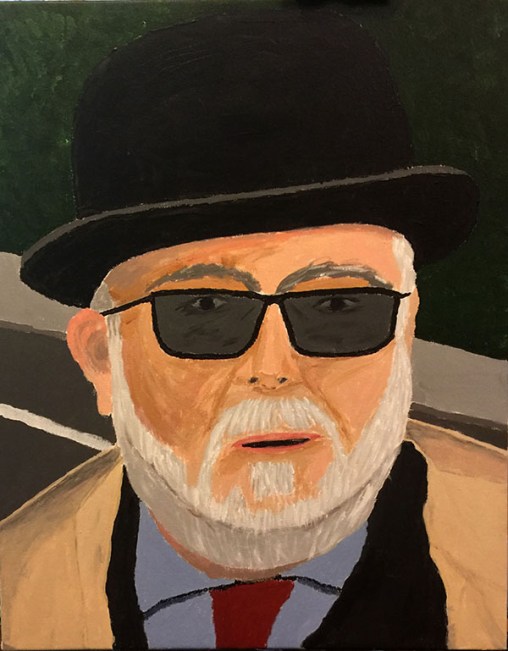
Another painting in the Portrait Series: After my last portrait, I said that I was thinking of doing one of someone I didn’t know and that is what I did. I found a photo I took of a gent with a bowler hat. (I was leaving the Trooping the Colors ceremony and managed to snap a candid shot.) So I was painting without feeling the pressure of capturing the essence of someone I know well. It is an OK effort I think. Painting faces is not easy at all. I find them much harder than landscapes. But I think it is worth persevering. I do think each of these portraits has shown some level of improvement, so maybe I’m just starting to get the hang of things. I’m beginning to think that I should take photos of people when I’m visiting the States in the coming weeks, so that I can get some material for future efforts. Anyway, “Bowler Man” is below. I’m not sure I’ll even start another portrait before our Thanksgiving trip, which begins next Saturday. I still have a landscape in progress.

bowler-man

Rainy Saturday: As the Saturday after Trumpageddon approached, we were considering just getting out London. Maybe a road trip to Cambridge or Windsor or even a quick trip to Paris for lunch. But then we watched the weather and found it would be pouring down rain in all those places. The main event in London that day was the Lord Mayor’s parade, but we had gone to it last year and watched in the rain. (We were told that it always rains on the Lord Mayor’s Parade.) So we decided to go the two movies that afternoon and picked some real escapist ones:

“Doctor Strange”: This was my favorite Marvel character in my sometimes psychedelic youth. I actually have a collection of Doctor Strange comic books from the mid-1970s, which may be valuable for all I know. They certainly have tremendous nostalgic value to me. So I was excited to hear that they were making a Marvel movie based on those comics and that Benedict Cumberbatch was going to play the master of the mystic arts. It struck me (and probably everyone) as inspired casting. The movie was fun. We saw it at an IMAX 3-D theatre in Leicester Square, which made all of the special effects in the film even more awesome. I must say that the film took an awful long time getting to the good part–when Doc Strange meets the Ancient One and the real fun begins. Did I really need all those scenes of brain surgery, etc.? I guess it is background that allows us to “understand” the character, per the Marvel movie playbook. Anyway, once that was behind us, the special effects were spectacular and the plot became increasingly and appropriately spacey. Doctor Strange doesn’t fight mere humans or superheroes. He battles cosmic forces and supernatural villains. And that part was great. Cumberbatch was a wonderful Steven Strange and I could see him developing the character in the inevitable sequels to come. It was a bit weird seeing Tilda Swinton as The Ancient One, but she was fine. This is not a classic movie in any way, but I enjoyed myself thoroughly.

“Arrival”: After lunch at The Cork and Bottle in Leicester Square, we walked over to Piccadilly Circus to see “Arrival”, a science fiction movie starring Amy Adams. It was enjoyable, as long as one didn’t think too much about the details of the plot. Amy Adams is a linguist who is recruited by the U.S. Army to try to communicate with the aliens in one of twelve mysterious large alien vehicles that have parked themselves at various places around the Earth. They look like gigantic, walking octopi (only with seven legs). And it develops that they communicate by squirting black goo to form symbols. Amy Adams has to interpret them and to teach the aliens English in a sort of Anne Sullivan/Helen Keller way. Her performance is convincing as it possibly could be. There are lots of flashbacks about her daughter, who has died form some sort of rare disease. It appears that this history somehow makes the aliens more receptive to her (or something), but this is one of many points when the plot becomes a bit hard to follow. Judie and I left the movie saying “What was going on there in the last ten minutes?” and I’m still not certain. But it doesn’t really matter, since one should suspend belief in such movies anyway. It was cleverly done, without the usual overbearing military/government villains. (Forest Whitaker was nicely normal as the Army guy in charge of things.) After the crazy special effects and loopy plot of “Doctor Strange”, this movie seemed almost intimate, although it really wasn’t at all. But it was satisfying to watch.

A Couple of Books I’ve Read: I went through a longish stretch reading several British history books, including one about the life of Samuel Pepys. interesting, but sort of dry and a bit of a slog. I was ready for something lighter. So I read Michael Chabon’s “Gentlemen of the Road”, a swashbuckling adventure novel set in the Caucasus mountains around 950. In Chabon’s notes at the end, he reveals that the working title was apparently “Jews with Swords” and that gives you just an inkling of the many clever twists and turns that occur in a fairly short book. Great stuff. On Saturday, I finished “A Man Called Ove”, by Fredrik Backman, a book recommended by Judie’s sister, Robbie. It is a Swedish book about an old curmudgeon, whose wife has recently died and who just wants to die himself when we first meet him. He seems like a one-dimensional grumpy jerk at first, but he grows on you and the book is really very sweet. It was nice to read something so gentle after the election. I understand that it has been made into a movie in Sweden and it looks like a TV miniseries to me.

Shakespearean Tragedies

On Election Day, Judie and went to see “King Lear” at the Old Vic, with Glenda Jackson in the title role. There seemed to be something appropriate about going to the play on the day when it appeared that America would elect its first female President. In any event, it would be better than sitting around all evening obsessing about the election when nothing would actually happen here until after midnight. Little did we realize that we were going from a theatrical study of madness and tragedy to a real life experience of madness and tragedy.

It all seemed to be going well at first. Clinton leading in the first reported votes. States like Georgia and South Carolina too close to call, when one would think they would be automatically for Trump. There seemed to be a possibility of going to bed before 3:00. But, as we all know now, it all inexorably shifted and the race became closer and then it all began to fall apart. It didn’t seem possible, but this narcissistic con artist was winning and by 4:30, I had to give up and go to bed. I couldn’t watch the end of this disaster, much less listen to the gloating of people like Giuliani and his ilk.

It all still seems like a bad dream. I have heard people say that maybe it won’t be so bad, but I don’t buy it. It is going to be awful and untold harm will be done to the planet and to the idea of American democracy. A type of visceral hatred has been released by Trump and it is not something you can get back into the bottle easily. I know that we, the majority of the country that actually voted for Clinton, will have to band together to fight this, but there will be a lot of losses along the way. I also know that demographics is destiny and the rule of the angry white men has to end at some point. But by then the rock will be back at the bottom of the damn hill and we will have to start pushing it up all over again. I truly believe that “The arc of the moral universe is long, but it bends towards justice”. It is distressing when it gets bent back the other way, but I guess that has to make us pull harder on the bar.

“King Lear”: I imagine that actors all over England rushed to audition for parts in this. There is something truly epic about Glenda Jackson deciding to play Lear. And it isn’t simply the obvious parallel to Hillary and what seemed like the Year of the Woman until Tuesday, when it turned into the Year of the Sexual Predator. This was her first performance in 25 years, since she left acting to become a member of Parliament from 1992 to 2015. The woman is 80, for God’s sake and she took on an incredibly demanding role. Despite all that, it was not surprising that she was wonderful. Her Lear was a bit old and frail but had her wits about her at the outset, as she made the fateful errors in dividing her kingdom among her daughters. She then moved through anger into fury as her daughters betrayed her, winding up as a mad king cursing the heavens. It was a memorable performance. the rest of the cast was brilliant. In particular, Rhys Ifans was wonderful as the Fool, who at one point launches into a Bob Dylan impersonation for one the Fool’s songs. Harry Melling (Dudley Dursley in Harry Potter) was impressive as Edgar. Jane Horrocks (as Regan) and Celia Imre (Goneril) were suitably evil as the two awful daughters. And Edmund’s first speech was done while he was working out, skipping rope and doing all sorts of physical things. It was amazing that Simon Manyonda could do it without even breathing hard. Finally, I wasn’t crazy about the modern dress costumes or the minimalist scenery, although the way they did the storm scene was sort of clever. In a way that focused everything on the acting, which was amazing.

King-Lear-Old-Vic-697-549x357.jpg

“Julius Caesar” On the night after the election, we went to the Donmar Warehouse to see an all-woman production of “Julius Caesar”. It was good to get out of the flat or we would have just sat around being depressed about the election results. And “Julius Caesar” has a special resonance for me, since I was in possibly the worst production of all time in my first semester at Bowdoin. Miserably acted and directed, all I can say is that I had a very small part as a freshman and mainly watched in a combination of horror and hilarity behind my sword and shield at what transpired. I’d gone to college thinking that I wanted to be an actor and I realized about halfway through the rehearsals that Bowdoin was not going to teach me anything in that area. But I did make some lifetime friends standing and giggling with the Roman Legion upstage, as the “actors” declaimed downstage.

Once again, seeing an all-woman production of this play seemed like it would have a particular relevance on the evening after what we assumed would be Clinton’s election. In light of the reality of what happened, it seemed depressingly appropriate that the play was set in a woman’s prison. It was a fabulous production, fast-moving and well acted. The women were dressed pretty androgynously (since they were in a prison, they were mostly in gray), so the fact that they were woman was not really made a point of. The amazing actor, Harriet Walter, who played Brutus, was one of the creators of the trilogy of which “Julius Caesar” was a part. She was riveting in the role and, in some ways carried the production. I thought that Jackie Clune also stood out playing Caesar. She had a certain charisma and confidence that made her seem like the kind of leader that people would follow and want to make their dictator. (She also had reddish hair cut fairly short, which gave her a vague creepily Trumpian look.) I also liked the actor who played Casca. The staging of the play used the idea of the prison without letting it obscure the Shakespeare. It was sometimes very cleverly done. I was sort of lukewarm about the way that “Friends, Romans and Countrymen” was done, possibly because the woman playing Marc Anthony could not match the gravitas of Walter and be an effective counterpoint to her Brutus.

“Julius Caesar” is a tremendous study of politics and power. It has a number of familiar lines that are a part of the popular lexicon and one of the great speeches in any play. But I have always felt that the play actually becomes a bit dull after Marc Anthony’s speech, which unleashed “the dogs of war”. It kind of goes on and on as you wait for the conspirators to be killed on the battlefield. (When you think about it, Elizabeth I would not have been happy with a play that let regicide go unpunished, so Shakespeare had a point he was compelled to make there.) I suspect it is often edited down and, in this case, the end of the play is simply cut off by the prison guards, shortly after Brutus’ death (“This was the noblest Roman of them all.”), which was an interesting way to deal with the problem.

Election Prediction and Brexit News

It is Going to be Unreasonably Close, But Hillary is Going to Win: It is incredibly frustrating to be watching the election from this side of the pond. I just feel so utterly impotent. If I was back in New Jersey, I’d be volunteering, making calls, going house to house, and taking road trips to swing states. It might not actually do any good (but the chance that it might would be enough). It would at least make me feel better. What I have been doing is compulsively reading about the election, which has mainly served to drive me crazy. But I have become convinced that Hillary is going to pull this out. Here is why:

  • The Democrats always go into Presidential Elections with a large number of electoral votes pretty much in the bag, since they should win the big states on both coasts (except Florida). This election is no exception and Hillary seems to have a base of 260+ relatively sure electoral votes. She doesn’t have to win more than one or two of the toss-up states to win the election and she is ahead in a number of them.
  • Trump, on the other hand needs to run the table of all of the swing states and probably take a surprise state like Michigan. You can’t say it is impossible, especially if you believe the possibility that the polls might be completely off. But it seems very unlikely.
  • People and pundits seem to love to point at the Brexit vote (and the last Cameron victory) as proof of the unreliability of polls, but, in fact, that only shows the unreliability of British polls. I was listening to a 538 podcast the other day and they explained that American polls are simply better. This is partly because we have so many more polls. There is a multi-million dollar election industry in the US that is on a different scale than that of the UK and which relies on and pays for accurate polling. Between money and volume, US polls are more likely to be accurate over all. It is not a sure thing for Hillary to go into Election Day with a three-point lead in the polling average, but it is very meaningful.
  • After this whole horrible endless election, the state of the race is startlingly similar to the place it was in the same point in 2008 and 2012, with a few more undecided votes. It may be that a 3-5 point win for the Democratic candidate is just the equilibrium point and that Clinton and Donald somehow cancelled each other out and we ended up back at square one.
  • It appears from early voting that turnout will be very large, especially among Hispanics. This should favor Clinton. Trumps’ best shot (and what is always the Republican’s best shot) is a low turnout election in which his angry white men turn out in waves.
  • Judie’s mother voted for Clinton and reported that the other people in her assisted living home, mostly conservative church ladies and lifelong Republicans in North Carolina, unanimously voted for Clinton. I find that kind of remarkable.
  • I have an unreasoning and utterly unscientific belief that a majority of the American people will reject Trump.

I think I am right. I certainly hope so.

Brexit Update: the big news last week was that the Court ruled on the challenge to the way Article 50 might be invoked. (That is the Article of the EU Agreement that governs leaving the Union and starts a two-year timetable.) Theresa May and the Conservatives have taken the position that this can be done by Prime Minister, relying on the ancient principle of “royal prerogative”, which was gradually moved from the monarch to the PM. The challengers said that, under British constitutional law, the Parliament is supreme. They argued that since Parliament passed an act joining the EU, which conferred rights to UK citizens, an act of Parliament is needed to reverse that step. The challengers carried the day and the government is appealing to the highest court. (The right-wing, pro-Brexit press immediately engaged in a truly reprehensible attack on the judiciary, which May and the new Lord Chancellor never really denounced and took their time even saying “tsk, tsk”.)

There is a decent argument in favor of overruling the lower court and it might happen. But if it doesn’t, May is in a tricky spot. The Conservative majority is small and many of them were anti-Brexit in the referendum. Indeed, if one had polled Parliament before the referendum, Britain would still be in the EU. But now the MPs are all talking about “the will of the people”. What no one says is that it was only 52% of the people, in a campaign in which it was clear that both sides lied about the impact and a good number of people didn’t completely understand what is that they were voting for. But that doesn’t seem to matter, since many formerly pro-EU MPs are now worried about an electoral backlash. So it has always seemed to me that this fear will trump reason and there is no real likelihood that a majority of the Parliament will reject the referendum result.

But what they might do is insist on some sort of detail about what Brexit means to May and her team. If such a course was possible as a part of an Article 50 Parliamentary approval, the disarray in May’s government would be exposed. It is unclear that the Brexit ministers have a coherent idea of what they are looking for in the break from the EU and it is abundantly clear that members of Conservative party have wildly divergent ideas. You can appreciate that May doesn’t want to go into negotiations having given away their strategy. On the other hand it would be nice to know whether their goal is a hard Brexit, with a complete break from the EU (favored by the far right MPs) or a result which maintains market access while slightly limiting immigration in some way. In two and half years, the negotiations will be over and Britain will be faced with essentially a take it or leave it proposition, since there will be no time to negotiate a further change. So this is probably Parliament’s best shot to direct the outcome.

Faced with that, there is a chance that May will call a snap election, figuring that she could increase the Conservative majority with Labour in disarray. This would make it easier to push through whatever it is they want to do with respect to Brexit, in theory. But maybe not. There would be a danger that such an election could turn into a de facto second referendum on leaving the EU. That is a vote that would not be a sure thing for May. Given the dangers of holding an election that might lead to a weakening of “the will of the people”, I’d guess that is more likely that May and the government will just try to play political hardball with the Parliament if the current judicial decision is upheld.


A Game 7 Blog: A New Painting, Another Guide Play and Election Thoughts.

I have actually avoided watching baseball very much this postseason. It is just too debilitating to stay up until 4:00 AM night after night. But this is going to be a fairly cosmic game 7 And it seems to me that, simply as a baseball fan, I have to watch it. It deserves to be an epic game, which means that it will probably be a blow-out. But I want to see baseball history made, one way or another, so I’ll be on it to the bitter end. This means that I will spend 45 minutes (at least) staring at a screen that says “Commercial Break”. So I’ve decided to be constructive and try to write in the many, many dead moments. I am actually starting a bit early and that you God for ending British daylight savings time earlier than the US.

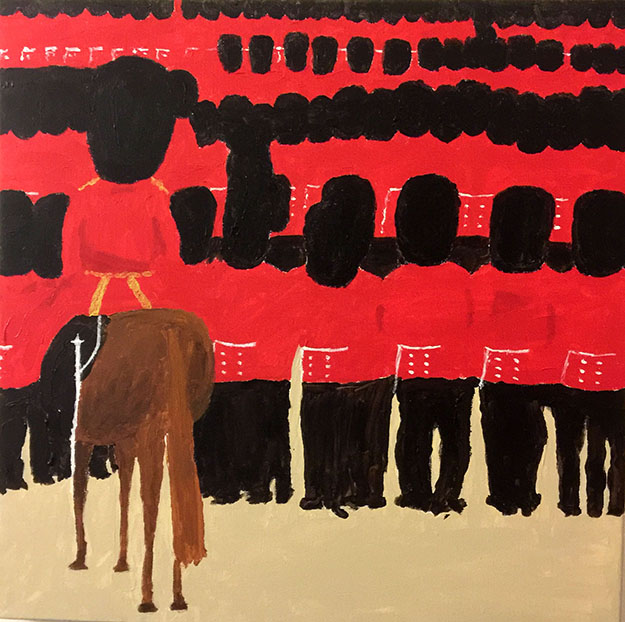
New Painting: This was a fun one, partly because red and black is my favorite color combination. It is based on one of many photos I took when we went with Robbie and Bob to see “Trooping the Colors”, the event where the various costumed soldiers march around and present themselves to the monarch. We actually saw a rehearsal, since we were going to be in Scotland on the big day. (I wrote all about his back in May, with photos and everything). I had a little trouble trying to figure out this painting. I thought at one point of cutting out the guy on the horse and making it a strictly black and red affair, which would have been more abstract than what I ended up with.  I finally decided that the guy on the horse gave the whole thing some context, although I have to admit that the prospect of painting a horse worried me, even without the head visible. After I completed most of it, I had to decide whether to add any detail and if so, how much. I didn’t want to break up the black and red too much. I ultimately decided to give the guy on the horse some gold and white and some darker red to give the impression of arms. Then I added the white on the beefeaters, figuring I could always paint over it if I didn’t like it. As you can see, I left it in. I’m not crazy about the pants on the line in the front, but I decided it’s Ok and the painting is really about the black and red anyway. Here it is:

trooping

“A Pacifist’s Guide to the War on Cancer”:  Judie’s women’s group was meeting in the flat, which meant that I had to vacate. I didn’t know much about this production other that it was at the National Theatre (possibly the best theatre in the world) and it was some sort of musical about cancer and, after “iHo”, it seemed like a fun idea to see consecutive plays with Guide in the title. Kinda weird choice, but it was a good production. [1-1 after three innings.] It follows a women who has to bring her baby back to the hospital for cancer tests. While there, she meets all of these other cancer sufferers. It is kind of cancer “Chorus Line”, as each of the characters has a song. Of course, you figure that they will not all be doing a kick line in sequins, so the issue was how it would end. [The Indian centerfielders may cost them the Series] The set looked like the waiting room of a hospital–same colors, etc–and as the act went along, big balloons with odd cancerous shapes would appear, growing out of the walls or coming out of the doors. [Cubs score two in the top of the fourth to take a 3-1 lead.] There were also moments where Emma, the main tragic mother character, was followed about by actors dressed as cancer cells (sometimes singing and dancing), which was certainly odd. The whole first act was predictably emotional and actually quite moving. [Indians down in order in the fourth. Why do the announcers seem to want to take the Cubs starter out? ] There is something about cancer of course that make you start to thing about all of your friends and relatives who are suffering or who have died. [Baez homers leading off the fifth. Cubs lead 4-1.]

In the second act, Emma (the mom) gets the bad news about her baby and I’m thinking where do we go now? And all of a sudden the actors break character (although it takes a minute to realize it) and begin to lip-sync the recordings of the cancer sufferers whose stories are the basis of the book. Very moving. And then Emma asks the narrating voice “Who am I?” and it turns out that she is playing the Artistic Director of this troupe, who had gone through this with her son, and which inspired the show. Then, to top it all off, a cancer sufferer is called up to stage to say something and the actors all have shout out to someone impacted by cancer. Then they ask the audience to do the same and the show ends with a song. [Cubs leading 5-1, take out their starter. Seems like over-managing, but it may not matter. Well, maybe it might. Strange two-run wild pitch makes it a ball game again. 5-3 after five.]

This whole play leaves me wondering. Is this really a good theatrical production? Or is this a manipulative work about a fraught subject for many people? A little of each, I think. It really was ver effective at making yo think about cancer. In particular, there was a section in the play and in the programme which looked at how we treat people, including friends and family, with cancer. And you find yourself thinking “Do I do that?” I think that it is all a valuable look at cancer and how we think about it. It isn’t exactly “The Sound of Music”, but this is a serious work about a subject that is as serious as it gets.

[So we have passed 2:30 AM and I have been sipping Makers Mark for a while. Enjoying the game. Seventh Inning Stretch. Cubs led 5-3 and the game would be kind of boring, were it not for the two-run wild pitch off the catcher’s head. It is looking like a long night. I’ll have to proofread this mess tomorrow.]

A Break to talk about the US Election:  I haven’t written that much about it because that is there to say that isn’t being said? Which isn’t to say that I am not obsessively checking FiveThityEight to see what Nate et al. are saying. (They are the most sensible people covering the election, I think.) But now I can’t even watch the BBC coverage or because I’m so stressed about all. [Now it is past 3:30 and the Cubs have blown their lead. Maddon is over-managing to a horrible degree. A two-strike Squeeze play? Too much stupid small-ball strategy. He got Lester up too early and then had to bring him in too early, so he had to bring Chapman in too early. What an odd game.] Judie and I are trying to decide what to do on Election Night. We are going to “King Lear” that night and it turns out that there are a number of all-night parties in London. [OK. Now it is 4:00 AM and there is rain delay. Are you kidding me? What am I supposed to do now? Am I supposed to just hang out until Dawn? I can’t really give up on this game now. But when will it end?] I guess if I am willing to stay up to watch the World Series, I should probably stay up to see the future of the world determined.

CUBS WIN! And it isn’t 5:00 PM yet!


Time, Intelligent Guides and iHo

Where Does The Time Go?: We found out today that daylight savings time had ended. We hadn’t even realized it. Our clocks, phones and computers all reset their clocks automatically (which meant that we got up at the “usual” time). My cheap watch that I bought at Spitalfields had stopped because I accidentally wore it into the shower and Judie’s watch was wrong, but we figured that she just hadn’t reset it right after all of the traveling. So we went through the entire day blissfully unaware that the time had changed until it seemed oddly dark at 4:30. Good thing our appliances are more aware than we are.

Intelligent Guides: On Saturday night, we went to see “The Intelligent Homosexual’s Guide to Capitalism and Socialism with a Key to the Scriptures” at Hampstead Theatre (where they refer to it as “iHo”). I’ll get to the play in a minute. But the name gave me a bit of a “madeleine moment”. When we were cleaning out things after Everett (my father) had died, we came upon a book entitled “The Intelligent Woman’s Guide to Socialism” by George Bernard Shaw. It was clearly my mother’s book and I think it may have been inscribed “Elizabeth Mahoney”. It brought to mind a picture of my mother as a young woman living in Greenwich Village, having just met this interesting young lawyer. She realized what his political leanings were and ran out to buy a book to learn more about socialism (maybe on his recommendation). In my mind, I owe my very existence to Shaw and this book. You may think this is a fantasy of my overactive imagination (and maybe it is), but consider that they kept that book for about sixty years and that my middle name Fabian refers to Shaw’s socialist Fabian Society. I’m just sayin’….

Getting back to the play, it was just a fabulous production. It is written by Tony Kushner. In the interview in the programme, Kushner said he had written this big and complicated play around 2009 and that he has been working on it ever since, assisted by the casts that have performed it. He thinks he is now ready to publish it, which he finds difficult to do, since he has trouble finding his works really finished (he is still fiddling around with the second half Angels in America). The director was Michael Boyd, who was the Artistic Director of the Royal Shakespeare Company for ten years, among other things. The cast was incredible and they had to be to perform this.

It is an impossibly layered play. One one level, it uses the classic Miller/O’Neill/Williams device of gathering a family around a kitchen table and having them tear each other to bits. That part alone would have been a great play. But the play was also about the history of radical Italian-Americans, the American Communist Party, the history of the Labor Movement in America, the 1973 Longshoreman’s strike, the guaranteed annual income that certain longshoremen received to settle the strike, and the future of radicalism and the labor movement. I have probably left out a theme or two, but you can see there was a lot to talk about. And the characters did talk and talk (it’s along play of about three and half hours), often at the same time. Just like a real family they did not take turns and there were often two or more arguments going on simultaneously. It was hard to take it all in. And because this a Tony Kushner play, there was whole other layer added about homosexuality and the difficulty of two of the characters to maintain relationships.

The story is about an imagined family of a real person, Vito Marcantonio, who was a radical Congressman, representing East Harlem until his opposition to the Korean War led to his defeat. At the center of the play is Vito’s fictional nephew Gus, a longshoreman and labor organizer and committed lifetime communist, who was one of the guys who received a guaranteed annual income as a result of the 1973 strike and hadn’t worked (except as an organizer) in the ensuing 30+ years. Gus is living in a now very expensive brownstone (I think in Carroll Gardens, Brooklyn) with his sister, a former nun who later went off to work with the Shining Path. Gus has decided he wants to sell the house and kill himself and has called his family together to tell them the news. There is his eldest son Pill, a history teacher living in Minnesota with his long-time husband and who is trying to figure out his relationship with his lover, a male prostitute. The second child is MT, a labor lawyer and lesbian, whose wife is about to have a baby with sperm donated by Vito, the baby of the family, who works as a contractor and has a traditional family. Also wandering through is MT’s ex-husband, who is helping Gus sell the house and a woman who is assisting Gus to kill himself (his earlier attempt to slit his wrists had been unsuccessful). Put that all together, give it a shake and watch it explode. This play was one that hit a lot of buttons for me (besides the mere name, as I discussed above). The fact that the other central character MT was a labor lawyer was one obvious link. And I have met union guys like Gus in my life.

I won’t try to describe this all any further, since it was so complicated with so much going on and so many subplots to follow and thoughts to digest. I found it fascinating. The accents of the British actors were spot on. It never occurred to me that they were anything but New Yorkers. Two particularly stood out: David Calder was just wonderful playing Gus. And Tasmin Grieg was riveting as MT. But the entire cast was terrific. For a play as long and as complicated as it is, the evening seemed to go quickly. The production had an overwhelming momentum, which only let up at the very end, when Gus is trying to decide whether to kill himself.

A great night of theater.

Chris Visits: Part 2-Museums and Theatre

You Say You Want a Revolution?: This was a special exhibit at the Victoria & Albert Museum that got great reviews. It’s basic idea is that the 1960s music and culture changed the world in various ways (feminism, ecology, computers, etc.). It could easily be criticized as a bit Boomer-centric in its pitch, but I think it did capture something about the excitement and feeling of possibilities that were so prevalent in the 1965-1970 period. And the collection of stuff that was in the exhibit was very impressive. There were so many amazing artifacts of the era, that it is hard to pick out any one to talk about here. I was afraid, as we walked through the first gallery, that the whole thing would be about American culture. But, when you think about it, that whole explosion of music and cultural change were at least as big in London, so a lot of the exhibit was about looking at the parallels in what was happening, especially between London and San Francisco. Everyone who attended got an audio set, which automatically picked up different music and other clips as you walked around. So for each subject, you automatically heard music that was appropriate to the gallery that you were in, which worked great. There were lots of album covers and books, which were real trips down memory lane. Chris and I both commented that we felt like we had read many of the books and either owned or knew someone who had a majority of the albums. It was a wonderful multimedia experience, dipped in huge dollops of nostalgia. Walking through it, looking at the various kids and young people checking it all out, I couldn’t help thinking how weird it was that a part of my life is now thought of as history. Ultimately, the final feeling was a sort of regret for me. There had been this feeling, expressed in the exhibit, that there was a real revolution taking place and that, after the sixties, the world was going to be a different and better place. Anything seemed possible, which was made that who time so exciting, but, in the end, the change that occurred was just incremental.

“Oil”: This was a play at Almeida Theatre. I’d never been there, although I knew the neighborhood since it was a block away from New Unity’s Islington building, where I often go for meetings. The play was written by Ella Hickson, a playwright with a good resume and directed by Carrie Cracknell, coming off directing “The Deep Blue Sea” at the National Theatre. And it starred Anne-Marie Duff, who is spectacularly talented (and who I saw last fall in “Husbands and Sons”). But it turned out to be one of those “nice try”sort of productions. It was a series of scenes, most of them pretty good. But each of the scenes were more like mini-plays than part of one coherent story. All were vaguely related to oil and they all featured a mother (Duff) and her daughter (Yolanda Kettle). The two leads were great and supported by a wonderful cast. But the play covers a period of about 150 years, so while the mother and daughter are in each scene (the daughter is in utero in the first), their characters are not consistent and don’t exactly grow in any meaningful way. And the somewhat apocalyptic final scene, when it appears that oil has run out, was trying a bit too hard to make some sort of point about oil. The whole thing was not completely unenjoyable and there were enough good moments and fine acting that it gave you some hope, it ultimately never came together and was just a frustrating mess. Too bad.

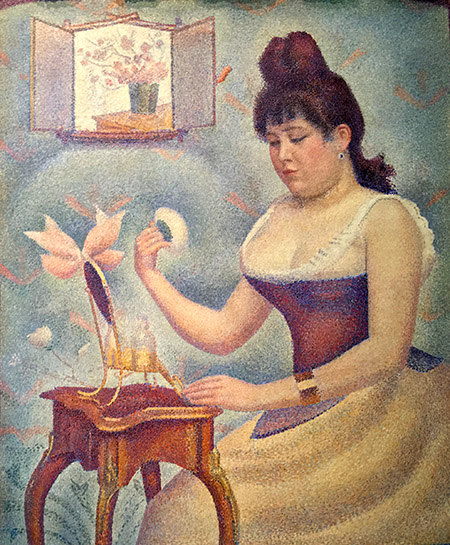
A History of Art in an Afternoon: On Wednesday, we went to Somerset House and the Courtauld Institute. Somerset House is an amazing palace near the Thames. Now it is probably best known for the traditional ice skating there in the Holidays. There is, of course, a great history. The land was given to Jane Seymour’s brother by Henry VIII and Elizabeth I lived there when Mary was Queen. For more history, you can look here if you’re interested. The Courtauld Institute was begun in 1932 and is based on the art collection of Samuel Courtauld, who had a particularly amazing incredible set of Impressionist paintings, with a number of truly iconic canvasses. Going to these sort of galleries always inspires me to go and paint, so I took a lot of photos while I was there. Below is a Seurat painting called “Young Woman Powdering Herself”. It is of his twenty-year old lover, who was pregnant when the portrait was done. It dawned on me that this is “Dot” from “Sunday in the Park with George”! If you are a fan of that musical, as I am, you’ll be interested in seeing this.

dot

The other interesting thing about this painting is that there was an infrared scan done by conservators, which revealed that under that picture of flower in the upper left is the only known self-portrait of Seurat. It is said that a friend made fun of it, so he painted over it. That sounds like the George you get to know through Sondheim.

While we were walking through the galleries, Chris mentioned that Impressionism is his favorite genre of painting and that he doesn’t really like anything that followed it. So I took him to the Abstract Expressionism exhibit at the Royal Academy. It is a bit of a Greatest Hits exhibition of the greatest artists of the period, which made the art hard not to like. I do suspect that second-tier Abstract Expressionist works would not be as enjoyable to view as lesser Monets and van Goghs, and, in that respect I agree with Chris that Impressionism is a greater period. But it was fun to follow one with the other, especially since it was possible to see the progression from one to the other.

“Lazarus”: That evening, we went to see “Lazarus”, the David Bowie musical which has just arrived from its sold-out premier at the New York Theater Workshop (where Judie and I were long-time donors, referred to as Repeat Defenders). I was quite surprised to be able to get tickets, especially since Bowie is an even bigger deal here than he is the States. As you may know, the musical is based on the book and movie “The Man Who Fell to Earth”, which I had unfortunately never seen or read. (I might have been able to figure out what was happening easier.) Most of the music was specifically written for the musical, although there are a few Bowie hits like “Changes” and “Heroes”. It was directed by Ivo van Hove, whose “out there” style we know from NYTW productions. He is now very famous. It stars Michael C. Hall, who most people would know from “Dexter” and “Six Feet Under” on television. He was wonderful and very Bowie-esque, with a singing voice very reminiscent of later Bowie. The other actors were highlighted by Sophie Ann Caruso and Amy Lennox. I think the play follows only the end of the plot of “The Man Who Fell to Earth”. The main character is miserable and just wants to return to his own world, having failed in his first attempt to build a rocket. The whole thing is a bit strange and I have to say I had no idea what was going on for the first 20 minutes (although the music was good). It came into some sort of focus eventually, but was all a bit like a Becket play set to music. I think it is really a rumination about death, which, of course, makes sense as Bowie was dying (although no one knew it). Going to the play was fun since it was at a newly constructed theatre near King’s Cross Station (much bigger than NYTW, but we were in the third row). It is neighborhood that is exploding with interesting new buildings, mostly residential in an area that was once warehouses and a place where no one went, much less lived or went to theatre and restaurants. That was little bonus to going to “Lazarus”, which is quite a remarkable and unusual work of art. It is the kind of thing that I would be tempted to see again, because I suspect that I would get more out it the second time.

Chris Visits: Part 1

While Judie was off on her bi-coastal tour of the U.S., my old college friend, ex-roommate and best man came for a quick visit. I suspect that Judie helped push him into deciding to come, fearing what I would do if left alone of two full weeks. It was great to have him. We did an awful lot while he was here. I’ll break it up into two or three posts.

Eating: I don’t write all that much about restaurants here, which is a bit shocking considering (a) how wonderful the restaurant scene is in London generally and Shoreditch in particular and (b) how much time I spend eating out. The food scene here has a diversity and a wild willingness to experiment with flavor combinations that makes it very exciting, even more so than NYC in my opinion. To add to all of that ongoing creativity and pushing the envelope, it is now truffle and game season, allowing the British to indulge their love of eating all sorts of birds. (In the following discussion, I will try to provide a link to the restaurant menus where possible the give you a feeling of London cuisine.)

We started at St. John Bread and Wine, just down Commercial Street from the flat, one of the landmarks in the food revolution in London. It is where the great Fergus Henderson’s first restaurant opened. We went there for lunch shortly after Chris arrived. The smoked sprats (sardine-like fish), the cold venison with celeriac slaw, brawn (a sort of pate made out of boiled pig’s head) and the Eccles cake were especially memorable. That evening, we went for food at Sichuan Folk, a shockingly good Chinese place around the corner. The green beans with garlic and pork crumbles and the fish stood out. The next day, we walked through Kensington Gardens, planning to eat at the Serpentine Sackler Gallery, but it was closed so we ate at the Food Hall at Harrods. There are a number of specialty food bars to eat at and we chose the fish one. Lovely meal and the Victorian tile work, made by Royal Doulton, was just stunning. That evening, we ate at Lotus, a sort of haute cuisine Indian restaurant near Trafalgar Square. In keeping with game season, our dishes included Pigeon Masala Dosa and Muntjac Mal Daas (a kind of small deer in aromatic gravy). For old times sake, we also stopped at the Cork and Bottle in Leicester Square, where we had miraculously run into each other over thirty years earlier, for a few glasses of wine.

On Tuesday, we looked around for a pub lunch near Kew Gardens, but ended up settling for Pizza Express, a decent chain and our least memorable meal. That evening, we were in Islington for a play and did get to a local pub for a pre-theater pint and something they called rocks, a sort of English samosa stuffed with savory fillings. After the play, we stopped for a meal at a slightly snooty French restaurant on Upper Street. The next day, we went to Lyle’s, my favorite lunch place. It is run by acolytes of Fergus Henderson and is just a treat every time I go. We had grilled razor clams, grouse, a great pumpkin and shaved chestnut dish with a whey cream sauce (among other delights). That night, we were in the emerging neighborhood behind King’s Cross Station (to see David Bowie’s “Lazarus”) and ate at Caravan , where the highlights included blue cheese and peanut wontons, jalapeno corn bread, soft shell crabs with kimchi and wonderful croquettes. We closed Chris’ culinary tour with lunch on Thursday at Super Tuscan, our favorite restaurant in London, where we concentrated on truffles; gnudi with black truffle sauce, truffle arancini, little stuffed pastas with shaved black truffles and fresh tagliatelle with cream sauce and two ounces of shaved white truffles. (We finished with a bang.) And all of this talk of eating delicious fungus is a great segue to a marvelous adventure earlier in the week:

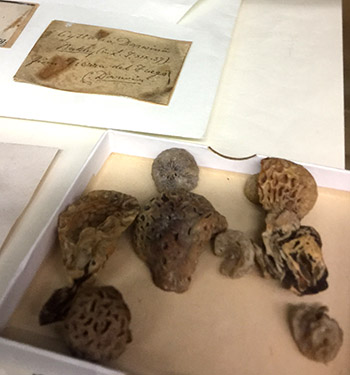
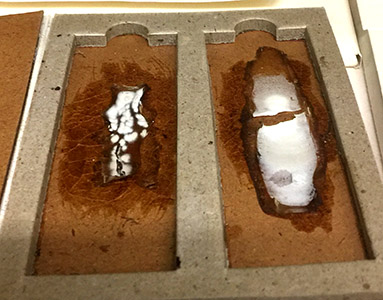
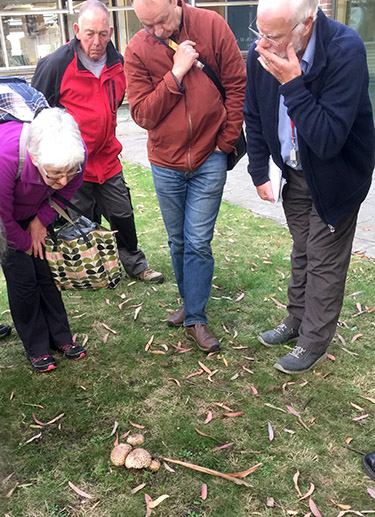
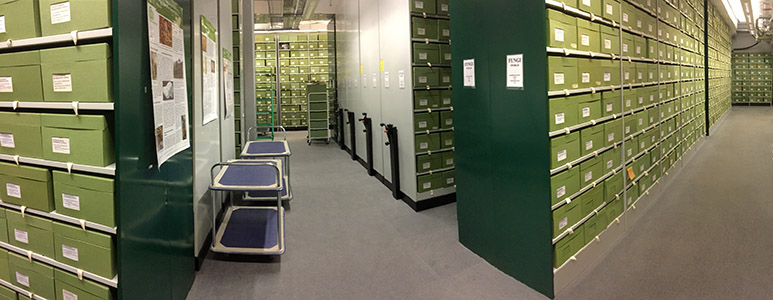
Kew Botanical Gardens: I had actually never been to Kew Gardens, but it was a reasonably nice day, which got better as it went along and ended up beautiful, so we took the Tube out there. We discovered that on Tuesdays (which it was) they had special tours led by scientists working in the labs there. So we signed up for a tour about fungi at Kew and, after wandering about the greenhouses for an hour or so, we presented ourselves to be guided. Our leaders were charmingly eccentric and nerdy and advised us, straight off, that there were far more varieties of fungi at Kew than plants, leading to their opening quip that it really should be called Kew Fungus Gardens. They led a group of about twenty hearty souls tromping to all sorts of corners of Kew that we might not have seen, poking around under trees and in piles of wood chips. We saw many varieties of toadstools and other sorts of fungus growing on and under the trees. There was a young guy of the tour in a singlet, who initially looked more like a soccer hooligan than a nature lover, but he ending up knowing almost as much about fungus as the guides and was even better at finding samples. Having him along really go our mycologist leaders even more geekily wound up about the fungus they were seeing than one might have expected. The tour, which was supposed to be an hour, took far longer and was a really great jaunt. It ended in front of the lab building, which had a huge set of mushrooms growing right out front, which they excitedly advised us had been coming back every fall since 2012. Then they invited us down into the lab, where they have endless number of boxes containing fungus samples, over 1,300,000 in all. All pretty incredible, but they saved the best fungus for last, showing us a fungus sample that Charles Darwin had picked off a tree in South America and some of the actual, original penicillin culture that Alexander Fleming had used in (accidentally) discovering antibiotics in 1928. Seeing the latter was a little like seeing the Rosetta Stone. They don’t give these tours very often, so probably something like 100 non-scientists a year get to see this stuff. Some photos of all of this follow. The first one is the Darwin fungus, the second one is the original penicillin culture and the bottom one is some of the fungi collection.

fungus-darwinfungus-penicillinfungus1fungus2

A New Portrait and Thoughts from London

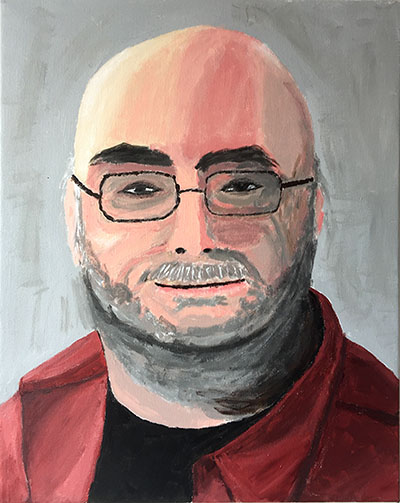
A New Portrait: After going to the Royal Academy and seeing the David Hockney exhibit, “82 Portraits and a Still Life”, I decided that I was going to try to do a series of portraits and to have two paintings going at a time, one a portrait and the other a landscape. (Hockney is said to have quipped that the are really only three kinds of paintings: portraits, landscapes and still lives.) I’ve discovered that it’s hard to do portraits. I guess this isn’t a really great insight, but I thought after my first attempt (a portrait of Judie that wasn’t a bad painting, but didn’t really look like her), I might have learned something that would make the second attempt better.

For the second one, I decided to try a portrait of my friend and former roommate, Chris, based on a good photo of him from our trip to France in June. One of the first things I learned is that it is tricky painting someone with a beard. I even went back to the Hockney exhibit to see how he did it. He didn’t really. Only one of the 82 was not clean-shaven. So that wasn’t all that helpful, but, upon close inspection, I did note how the area under the chins of his portraits were always extra dark, so I tried to incorporate that. The other thing Hockney does that is really kind of magical is to add bright or unusual splotches of colors to the faces that seem like that they can’t work but do. I have no idea how it occurs to him to do that (and I’m not going to try).

I kept at this portrait, pushed along by a deadline in my mind. Chris is coming for a quick visit on Sunday and I decided I should try to finish it before he arrived. The result is below. I actually think it is a pretty good painting and it looks more like Chris than the first one looks like Judie, but it still doesn’t really capture him. Of course, while Hackney’s portraits are great, I don’t really know exactly what his subject actually look like. For all I know, the paintings don’t really look like his subjects (although I kind of doubt it.) So I’ve been thinking that maybe I should try doing portraits of people I don’t know as well (or even don’t know at all). My expectations would probably be different and I might be less disappointed by the results.

chris

When Will the Countdown Begin: For quite a long time, I felt like I was visiting London. And then that changed. Looking back, I’m not sure that I can remember a bright line, where I felt that I actually live here, but I know that it happened. I’ve always known that this time here would be a temporary thing, but the end was sufficiently distant that I didn’t feel like a transient resident. I still don’t, but I can begin to feel that ending. In roughly five months, we will back at our home in Montclair, putting the furniture back in place and trying to restart our lives. I know that it is coming and I occasionally think about the logistics of the move and what I am going to do with myself when I get back. At the same time, I am feeling very present in London here and now and that is a good thing. I have real sense of neighborhood in Shoreditch and Spitalfields and Broadgate, etc. And we both have a strong feeling of commitment to New Unity and its community. I sometimes wonder if I could do more good over the next few years trying to help out with New Unity than in taking some role at UU Montclair. Perhaps that will all change once the countdown to the move begins, which I suspect will be sometime in January. Right now, it is just a faint tug. By then, it will be an increasingly strong pull.

I’m Counting on You, Lord, Please Don’t Let Me Down: I think the following is a sign of something, but I can’t decide what that is. Sir Philip Green is an ostentatiously rich Brit, who is reminiscent of Donald Trump. (According to Wikipedia, he was considered for the Donald role in the UK version of “The Apprentice”.) Unlike Trump, he actually did support a number of charities and in 2007 he was knighted. It gradually emerged that he engaged in all sorts of tax avoidance schemes and conspicuously spent huge amounts of money on himself and his family. He was a Cameron confidante and generally the kind of rich guy lots of people grew to hate. He seemed to buy and sell various retail businesses. His big troubles began after he bought the “High Street” department store chain, BHS. He proceeded to drive it into bankruptcy, not only costing all of the workers their jobs, but also a great chunk of their pensions. It has been an ongoing scandal. Green seems to be perceived as such an awful guy that even lots of Conservatives  hate him and they normally have never met a rich guy they won’t toady up to.

This week, the House of Commons held a hearing about taking his knighthood back. It seemed a bit weird to me that you could do that. I’d think that everyone getting a knighthood assumes that it is lifetime, irrevocable honor. Think again, Elton John and Paul McCartney! The humorous thing about the whole thing is that, while the MPs got to make endless outraged speeches, it turns out that the House of Commons has no power to revoke a knighthood, so it is just a meaningless recommendation to whoever actually does have the power. Is this an act of faux populism? An easy way to fake concern for the little guy, while systematically shredding the NHS and the safety net? Is it some sort of weird Brexit response?

Fawlty Government

My Fawlty Towers Theory of British Politics: Consider Basil Fawlty. He hates the French and the Germans. He dislikes immigrants, although his business relies on one. He toadies up to rich people and loves the monarch. He agrees with the Major that things were so much better in the past, when Britain had an Empire. He isn’t really stupid, but he usually acts without thinking about the consequences or having a coherent plan. When things go wrong, he blames everyone else. I have just described Theresa May and the “Hard Brexit” Conservative Party. The tragedy is that they don’t have the equivalent of Polly to clean up Basil’s messes. (It is impossible to see Jeremy Corbyn filling that role. The NY Times has an op-ed piece describing his many failures including his coddling of anti-semitism in New Labour.)

It would be nice to think that there is a chance that the Tories might come to their senses, but the lunatic fringe seems to be firmly in control and May is so desperate to be Prime Minister that I don’t think she cares. There are a few grown ups in the Conservative Party, but I don’t hold out much hope for them. One especially crazed backbencher has proposed that the Treason Act be amended to include any disparagement of Brexit! The long-standing split in the Conservative Party between delusional eurosceptics and more traditional Conservatives (i.e., between the Basils and the Pollys) is not going away. May might find it harder and harder to keep her coalition together as the reality of Brexit (and the resulting economic hardship) nears.

I sometimes feel that we are living through the end of time here in London. The government seems utterly committed to shortsighted and delusional policies that seem incredibly destructive. This wonderful, multicultural London–the financial center of Europe–seems to be facing a sort of existential threat. It is a great city and always will be, but it seems likely that it will be diminished. I find it depressing.

Are UKIPing me? UKIP is the xenophobic party whose sole purpose was to get Britain out of the EU and to get foreigners out of the country. Their leader was the unspeakably creepy Nigel Farage (most recently seen praising Trump after the second debate as a silver back gorilla). The political pressure of UKIP was a factor in Cameron agreeing to the whole Brexit referendum. Having now achieved his horrible dream, Farage retired as leader of UKIP. All hell then broke loose.

First a woman, Diane James, was elected as the new leader (which surprised me, since I didn’t think they had any women in leadership positions). This arguably progressive step lasted less than three weeks. The she resigned “to spend more time with her family”. My theory is that she suddenly realized that she had become of a leader of party of guys overdosed on testosterone, who were essentially unmanageable. Farage came back briefly and then retired again. One of Farage’s protégé, MEP (Member of the European Parliament) Steven Woolfe, threw his hat into the ring and was the favorite, but then got into a fight with another UKIP member at a meeting at the European Parliament and ended up hospitalized with severe injuries close to a coma. (It is a bit hard to figure what UKIP politicians are even doing in the European Parliament, but they got elected and seem to spend most of their time insulting everyone.) On Monday, Woolfe resigned from UKIP, disclosing what everyone already suspected–that he had been cold cocked by one of his UKIP mates (who claims self-defense). Woolfe said that UKIP is ungovernable (which Diane James had figured out) and that he no longer wanted to lead a party that he described a having “something rotten in its core” (not a big surprise to me) and in a “death spiral”. Yet another British political party falling apart.

Meanwhile in Scotland: The Scottish National Party (SNP), led by the impressive Nicola Sturgeon, has emerged to become the serious opposition party. It is hard for them to be really effective in that role, since they are pretty small in Britain as a whole. The SNP is stepping into a vaccuum, since Corbyn never seems interested in the bother of governing.  They are like the “smart cousin” of UKIP in that their core belief is that Scotland should leave the UK, although that is the only sense in which they are comparable. Having lost the referendum a few years ago, that plan was on the back burner until the Brexit vote, which the people of Scotland rejected. Sturgeon has used this as a rallying cry for a new independence referendum, although at this point, the polls are very close and it is not clear that she would succeed. She is trying to use the threat as a way to get Scotland a seat at the Brexit negotiating table, in order to protect Scotland’s interest in continuing free trade with the EU. She is very savvy and is making no commitments yet. But it seems clear to me that if the hard-core Brexiteers succeed in creating a complete break with the EU, she will have the excuse and the ammunition for a new independence vote.

Health: Since I’ve mentioned this in the past, I’ve raised some concerns with some of you. I’m fine. I’m taking blood thinners for clots in my leg, which is decidedly less balloon-like. I went to my GP for the gout and he gave me medication with the warning that many people become violently nauseous taking it. I took it, didn’t vomit, and can now walk without a limp. I’ve resumed exercising. Judie also lit a candle for me at New Unity a few weeks ago when I wasn’t there and I’ve been deluged with well-meaning expressions of concern whenever I show up. It’s a nice reflection of the sense of community that is so special about the place, but I’m sick of it.