Good Food Show and other thoughts

I went to the BBC Good Food Show last Friday. I’d learned about it at a post-theater dinner with a lawyer from Judie’s office and her sister, who was working an Armenian food booth at the show whose big specialty was chocolate-covered dried fruit (delicious). The show was at a place called The Olympia in West Kensington. It had nothing to do with recent London Olympics. It is a series of big exhibition halls, the first of which was built in 1884 for covered agricultural shows. It was quite trek to the other side of London, but it is always fun to explore a new area and to extend my Underground knowledge. The show itself was about what you’d expect. Lots of booths, selling different sorts of food and expensive pots, pans and knives and lots of clever cooking gadgets (a few of which I got talked into buying and I am determined to use). Probably thanks to the incredible popularity of the Great British Bake-Off TV show on BBC, there was a huge area devoted to baking and cake decorating. There were classes on using fondant to create fancy cakes and all sort of related stuff and the place was mobbed with people of all ages and colors. I was half expecting to see the famous Nadiya (this year’s winner) signing autographs or explaining how to make some intricate dessert (maybe I was just there the wrong day). What I didn’t realize until it was almost time to leave was that on the mezzanine of this huge place, there were at least twenty wine tasting booths. It was probably just as well. I still went to three or four of them and met Oz Clarke, a famous English wine writer, and bought a case of New Zealand wine. The booths were divided by importer or by country (including Brazil–who knew that they make wine there.) While I was wandered around, I learned that flapjacks in England have nothing to do with pancakes and are instead a sort of glorified large granola bar made of oats, butter, brown sugar and “golden syrup” and seem to come with icing (which I’m willing to be they call something else here). I also joined the Royal Society for the Protection of Birds, which is somewhere between the Audubon Society and the Nature Conservancy. I also was proselytized by the Campaign for Real Ale (I may join) and tasted organic beers and obscure single malts.

It is the beginning of the flu season and we learned that flu shots (and all other injections) are called “jabs” here. Does a “jab” sound less painful or scary than a “shot”? At the very least, I’d say it is a better description of what is being done to you.

Last week, we saw the last “Lewis” episode. The left a little wiggle room for Lewis to return, perhaps in a cameo in a subsequent series focused on his partner, Sargeant Hathaway? We had recently been watching the early “Inspector Morse” shows, which featured a very young Kevin Whately as Detective Sergeant Robbie Lewis. So we’ve seen both ends of it and saw the growth of Lewis as a nuanced character. I will miss him, but Whately is getting older and he may have decided it is time. I was much sadder to see this series end than I was to say goodbye to “Downton Abbey”.

How much pomp and circumstance is too much? I suppose there is something very “British” about it and it is sort of fun. But at the same time, there is something that is a little creepy about these ostentatious displays of unearned wealth. And I’m not sure that most normal Londoners pay much attention to it at all. I wonder what the demographics of the spectators are at these events. We are thinking of going to Royal Ascot next July, which I think we have to do just for the sake of “My Fair Lady” alone. But what about the “Trooping of the Colors” in June? It is a hot ticket and, like Wimbledon, mere mortals must send in a letter and try to get tickets by lottery (which they call a ballot here). It is another spectacle and we will probably have visitors around then who would like to go. But I am wondering when (not really if) I am just going to get sick of it all. I am already done with the various Princes and Princesses.

To conclude: we bump into British bureaucracy again. We finally had a call with an accountant about the taxes that we need to pay here. We specifically wanted to know about paying something by the end of the calendar year since it results in a credit against US taxes. We were told that we probably cannot get a tax ID number by the end of the year. I was sunned, since in the US, you can go on-line with the IRS (which is never at the cutting edge of technology), and get a tax number in about five minutes. Even if they don’t have an online application here, you would think you could bring in the application and passport and proof of address to a Post Office and get it on the spot. Nope. It is a country of queues to stand in.
 

The Lord Mayor’s Parade and Paris

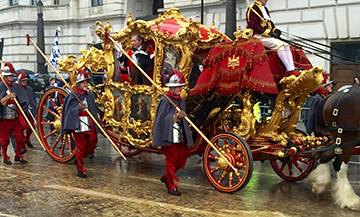
Lord Mayor ParadeJudie and I just got back from the Lord Mayor’s Parade. As faithful readers will recall, this televised ceremony marks the event, 800 years ago, when the King granted the City of London the right of self-government (via a Lord Mayor) on the condition that the Lord Mayor come to Westminster each year to swear allegiance to the crown. Back in those days, it wasn’t easy or safe to travel overland between the City and London, so the Mayor would take a special barge up. And that is how the whole celebration begins today–with a ride in a ridiculous barge up and down the river. As the whole thing evolved over the centuries, the Lord Mayor became elected by the Guilds, which would annually swear allegiance to him at Gulidhall. So that became part of the ceremony (although the election process has changed over the years and there aren’t exactly functioning guilds, which doesn’t stop them from existing in some honorary form and having individual halls–more like clubhouses–around the City). Now a new Lord Mayor is elected each year (in a process I described in an earlier post). It is generally some rich business type from the City, who, in addition to making a huge pile, has done enough good works to be knighted. So the ceremony had to add a swearing-in component, which includes a stop at St. Paul’s. So it is all very complicated. It starts with the morning barge trip. Then it is back to Mansion House (where the Lord Mayor lives) and the parade begins around 11:00 with the newly elected Lord Mayor bringing up the rear. It proceeds to St.Paul’s, for the blessing, and then on to the Royal Courts of Justice for the swearing-in. Then they all parade back to Mansion House n the afternoon.The parade itself lasts close to an hour and half, since there are countless marching bands, universities, business groups, charities, representatives of the old Guilds wearing silly robes and wearing funny hats, various branches of the armed forces carrying guns and waving, lots of groups on horse back and in uniform (including a band on horseback wearing lovely red velour capes), dignities in Rolls Royces and horse-drawn coaches which get increasingly ornate as the parade passes by, until the Lord Mayor of Dublin’s over-the-top coach comes along. And when you think that nothing can top that, the Lord Mayor’s coach absolutely does. The photo doesn’t do it justice. It was lots of fun to watch, even thought there was a light rain which essentially never stopped the whole time. (Brits watching next to us assured us that it always rains on the Lord Mayor’s Parade. No one seemed to care.) The whole thing usually ends with fireworks over the Thames, but they were cancelled in light of the terrorist attacks in paris the night before.

I was planning write about the Spitalfields Market bomb scare the other day. (Two unexploded WW II bombs were uncovered by a crew demolishing a building next door.) But after the real bombings and terrorist action in Paris last night, the old bombs seem quaint. It is truly horrible and very creepy to have this kind of thing happening relatively nearby. It makes one wonder if Europe may be looking at a series of incidents like this. And it certainly makes one think about personal safety in a different way. In a sense, it makes Europe more like America, where you are always wondering if some heavily armed lunatic will spring up and start shooting at people. (Of course, in the USA, we go for “Made in America”. We don’t have to import terrorists from global hot spots to terrorize us. We do it perfectly well ourselves.) Judie and I are scheduled to got to Paris in two weeks for a weekend visit for my birthday. On the one hand, the recent events freaks us out a little, if Paris has become a terrorist focus. On the other hand, after this carnage, Paris will probably be over-policed and very safe. We’ll see. We are also taking the kids there after Christmas.


Two More Paintings

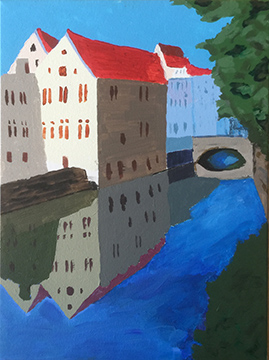
I seem to do these in spurts. After a period when I can’t figure out what to do and spend time looking at photos/pictures and playing around on Photoshop, I finally find a subject (or, in this case, two subjects). At some point in the process, I reach a point where I think the painting just stinks and wonder if I should start over or toss the whole thing. So I take a break and go back later and something more decent begins to emerge. Eventually, it gathers momentum and I become obsessed with finishing it. (These are my “Finishing the Hat” days.)

The two paintings are below. One is based on a picture of Bruges, one of the prettiest places on earth. The other is based on a photo I took of my cousin, Chris Olafson, reading a book or magazine at my sister Sally’s house. There are elements of each that I am pleased with and parts that just look wrong. But I’ve decided that I am finished with them, at least for now. It might be interesting to go back in four or five months and add or edit all of what I have done to date. In the meantime, I’m going for quantity, on the theory that the only way to get better at this is to do it often.

I’ve just bought a 16 x 20 canvas, which is bigger than anything so far, and a big brush. Now I have to figure out what to do with it.

Bruges                  Reader

Political Update and Other Random Thoughts

I went to Borough Market on Wednesday. I’ve complained before about how I’ve come to miss American supermarkets. Perhaps it is just this area of London, but there simply is no place nearby to get fresh fish or fresh meat. It turns out that the closest butcher or fishmonger is at Borough Market, so I will probably end up going there more. I’ve discovered that if I go early enough in the day, I can beat the mob scene that develops over lunchtime. The main reason I went was that couldn’t figure out where to buy a turkey for Thanksgiving. I was able to pre-order one at a butcher there and, while I was at it, bought some pheasant for dinner, tiny tomatoes (like red pearls), purple carrots, cheese and a raspberry tart.

On the way back, I passed Galvin Cafe-A-Vin and recalled that they are having a special breakfast on November 19th for the arrival of Beaujolais Nouveau in England. It’s a nice restaurant, so I reserved two seats. It should be fun.

Political Update: The November 16th issue of The Nation had an article about the election of Jeremy Corbyn as leader of the Labour Party. It seems a little late in picking up on a left-wing victory, one that would have to make the Nation folks happy. They tied it into the other victories that left-wing parties have recently had in Europe (most recently in Portugal)`, but were fairly realistic about Corbyn and his limitations. I’m doubtful that the left is actually on the rise (that is wishful thinking from the Nation, I’m afraid). It seems more likely that the middle is simply collapsing, since far right parties are also doing pretty well in European elections. And I’m not sure that any of this portends anything at all for America.

Meanwhile, George Osbourne continues to flounder about as a result of his ill-advised attempt to close his budget gap and pay for tax cuts for the wealthy by cutting support (tax credits) for the working poor. (The British call people who are working at low paying jobs, trying to support a family and to raise themselves up “Strivers”, which is the perfect word that explains and underscores public sentiment and disgust about how wrong-headed Osborne’s ideas are.) In the latest blow to Osbourne’s plan (and probably his limitless political ambitions as well), a Parliamentary committee controlled by his own party condemned the whole idea and suggested it be shelved for at least a year and then implemented gradually, if at all, while complaining that Osbourne’s Treasury was evasive and engaged in “obfuscation” about the overall impact of the proposals. And then former PM, John Major (Thatcher’s Conservative successor and a pretty right-wing guy himself) joined in the fun of kicking Osborne while he is down, attacking the “shocking” levels of inequality in Britain, a statement that recalled Captain Renault in “Casablanca”.

Not to be outdone by his ham-handed, self-designated successor, Cameron spent much of the week stumbling around trying to figure out what his current position is on British membership in the European Union. I think that Cameron wants to stay in the EU  and secretly realizes that the people who want Britain to leave are a bunch of Trump-like xenophobes and that Britain doesn’t need to shoot itself in the economic foot in that way. But he couldn’t bring himself to be unambiguously pro-EU in the last election, so he talked about how he was going to have some tough negotiations with the EU about Britain’s continued membership and hold a referendum. Faced with this bloviating and annoyed that Britain was insisting on negotiating without any specifics, the EU sensibly asked Cameron to send them (in writing) what he had in mind. Cameron finally got around to sending the letter and the answer was “not much really”. A Eurosceptic Conservative backbencher referred to as “pretty thin gruel” during question time in the House of Commons. Cameron really does not control his party on this issue and leaving the whole thing up to a possibly irrational electorate doesn’t seem like leadership. Although he is moving toward firm EU support and probably wishes he hadn’t promised a referendum, the whole thing is a mess for him and will probably get worse since, no matter what happens, virtually everyone will be unhappy.

While these sort of things sometimes fill the front pages of the newspapers, the back pages are more consistently about the demise of the Chelsea football team. Chelsea won the Premier League last year, but this year has managed to lose more than half the games it has played. This just doesn’t happen to a top Premier League team like Chelsea. There isn’t real parity in the Premier League. The top five or so teams (Chelsea is one of them) are always at the top, sometimes joined by one surprise team (West Ham this year). Chelsea’s collapse is a little like the Red Sox winning the World Series one year and then collapsing the next (oh wait, that happened?) and falling into last place for no apparent reason. Chelsea has a famous coach, who thinks a great deal of himself and is very outspoken and who loves to talk to and insult the press. (If you Boston fans want to continue the analogy, think of Bobby Valentine.)

Judie was invited to go to the Country Living Christmas Fair by the lawyer (actually a barrister) that she is in the process of hiring for Bryan Cave’s Payments Team in London (if the bean counters in America don’t manage to screw the whole thing up). She tried to get me to go, but it seemed like an event for mostly middle-aged white women to look a the sort of fussy decorations and little gifts that I don’t really like any way (not that there is anything wrong with that, he hastened to add). Judie went without me and had a good time.

Another Amazing Play and More Random Thoughts

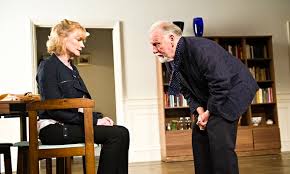
On Monday night, Judie and I went to see “The Father”, a pretty incredible play that was essentially about Alzheimer’s Disease. I was kind of dreading it, because I figured that a play with that subject just had to be depressing. And it was, but it was also wonderful. It is written by  French playwright and is up for various awards. The main character is André, the father, played by Kenneth Cranham, who seems sort of together at the beginning–a charming but forgetful older gentleman, but gradually deteriorates into addled confusion and finally terror, as his daughter, played by Claire Skinner, tries both to deal with his decline and to imgres-2manage her own life. What made the play truly amazing was all the things they did to capture the feelings and changes in perception that one experiences with that disease. For example, the actors playing his daughter or his caregiver or his daughter’s lover would change (but only once in a while, not consistently) from scene to scene, befuddling both André and the audience. The play was a series of vignettes and there was a blackout between each vignette, accompanied by music. As the play went along, the music became more disjointed and increasingly interrupted by pauses and static. There was a single box set and, as each scene began, you began to notice that a piece of the furniture from the prior scene was missing, until there was nothing on the stage. And then comes the last scene, where we find Andre in a hospital bed in a nursing home. It may seem simplistic, but I can’t begin to describe how powerful the effect was of the disjointed music, the disappearing furniture, the actor changes and confusion about where each scene was set. (André’s Apartment? His Daughter’s? London? Paris? It was never completely clear.) It imparted the feeling of confusion and things spiraling out of control and the gradual loss of reality that one supposes that an Alzheimer sufferer feels. It was really very disturbing and I was glad it was only 90 minutes. The final scene where the suave André from the fist scene has been reduced to a fearful and childlike state was really a masterpiece of acting and one I won’t soon forget. This was a production that created a powerful–one might say shattering–effect through a combination of the play, the acting, the staging and the set design. This was one of those things that I think only theatre can do.

It may seem like I am simply indiscriminate in reviewing the various plays we have seen recently, but we really have been on a remarkable run. The only play that I have seen in the last six or seven weeks that I might not recommend was “The Hairy Ape” (and I enjoyed most of it). And I though that “Farinelli and the King” was one of the best pieces of theater I have ever seen.

We went to a place called the “Cork and Bottle” the other night before seeing “Farinelli and the King”. It is an underground wine place near Leicester Square that serves food. It was kind of memory lane choice, because it a place that we went to the first time we visited London in 1984. A quick story about why it is a meaningful location for us: We were staying with our friends in Belgravia back then (they had been transferred by a law firm and we have since completely lost touch and I’m not even sure that I can come up with their names). We had plans to meet up with our friends, Chris and Nancy who were going to be in London at the same time, but lost the paper where we had written the name of their hotel. This was in the days before cell phones (fax machines were probably the state of the art then), so there was really no way to contact them. We even tried calling Chris’s job in Massachusetts, but he hadn’t left any info. So we gave up and went to the Cork and Bottle, which the guidebook said was the top wine bar in London. We were sitting there, sipping and nibbling, and looked up and there they were, standing at the bar right next to us! It is kind of amazing it is still open over 30 years later. Pretty good food and a really fun wine list.

On Friday, we went to Docklands to eat a The Gun, a 250-year-old pub/restaurant on the Thames, across from the O2 Centre. It was near the foundries which made the canons for the warships. Lord Nelson lived nearby and, according to the Gun’s website, would meet Lady Emma Hamilton is a room upstairs for secret assignations. It was nice, but it was too chilly to eat outside where we could have enjoyed the view along with the food. The pub is in a little corner of Canary Wharf where there are still old buildings and a feeling of what life might have been like when Britain ruled the oceans and London was the world’s great harbor. The rest of Canary Wharf is covered with gigantic new glass towers, walkways and little bridges along the water and inlets where ships once docked and the East India Company ruled. It was a bit like Houston with water. It was pretty sterile, I thought. And once you got beyond the center of Canary Wharf (as I walked over to The Gun, it was all construction of more towers and deserted areas of finished residential and office complexes. I found it depressing.

The final season of “Downton Abby” ended on Sunday night. I know I can’t talk about it since it hasn’t played in the US yet, but I will say that they left enough plot lines open that it is hard to believe that it is really over. According the newspapers, they are talking about a movie.

Another Historical Drama

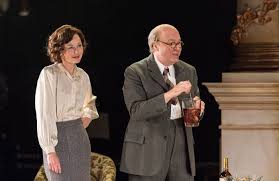
On Wednesday night we went to the Hampstead Theatre and saw “The Moderate Soprano”, a new play by David Hare. Like “Farinelli and the King”, which we saw two days earlier, it was based on a true story. This time it was the creation of Glyndeborne as a British cultural institution, and, like “Farinelli”, it concerned music. It’s not really fair to compare the two plays, since they are so different in time and tone. “The Moderate Soprano” was a delightful evening of theatre, without quite reaching the heights of “Farinelli”.

I think that most people in England have heard of Glyndeborne, although I suspect that many of them think of it it as a place in Sussex where rich people take their hampers from Fortnum and Mason and sit out on a manicured lawn and listen to opera. “The Moderate Soprano” is the story of John Christie and his wife Audrey Mildmay. Christie inherited Glyndeborne shortly after World War I (in which he had been a hero but declined the DSO on the grounds that it should not go to officers, but to the regular soldiers) and planned to live there a a celibate bachelor, while teaching science at Eton. But he had a love of music and built a organ room there and, in 1930, held an event there at which Audrey Mildmay, a noted British Soprano–moderate was said to describe her singing style–was invited to perform. He fell madly in love with her and, although he was quite a bit older than she was, they were married a year later. They decided to expand the estate by adding a small opera house, where John hoped to hear his favorite composer, Wagner. John Christie was a great builder, a classic British eccentric, a fanatical lover of opera (and cars) and a man who deeply believed in getting what he wanted. He wanted to have a great opera house and, in order to reach his dream, ended up hiring three refugees from Nazi Germany, conductor Fritz Busch, director Carl Ebert and young producer Rudolph Bing (the same guy who would later run the Metropolitan Opera for many years). They outraged Christie by telling him that his hall was too small for his beloved Wagner and ultimately convinced him to let them start with Mozart, who he didn’t particularly like at the time. Against all odds, the venture was successful, as Ebert and Busch revolutionized British culture with their brilliant operatic productions. With the exception of the war years, when the house was used to house children evacuated from London, and a short period when Christie finally ran short of funds, the Glyndeborne Festival Opera has been a going concern since 1934. It helped found the Edinburgh Festival in 1947 and is now run by a trust, chaired by John and Audrey’s grandson.

imgres-1So that is the basic story that David Hare was given. (According to the interview in the programme, Hare was raised in Sussex and, of course knew of Glyndeborne, but knew nothing of the story until told of it by a producer of one of his plays.) His play is not simply about the construction of an opera house and the start of on opera festival. It is about the important role played by the German refugees (and thus has a real political resonance today), although the whole explanation of how Busch, Ebert and Bing got to Sussex was a bit long. It is also about the importance of art. (There is a great scene in which Christie why it is important to charge so much for the opera tickets. He says that business isn’t life and art something you do on the side. It is the reverse.) Most importantly it is about the deep love and synergy between Christie and Mildmay. Each was crucial to the enterprise and without the specific skills and determination of each of them, it would have failed. Their love and dependence on each other was played in a real and touching way as the play moved back and forth from scenes in 1934 to scenes where Audrey was nearing death, finally ending with John talking to Rudolph Bing many years later, long after Audrey had died.

This was a wonderful production. The Hampstead Theater seems to be one of those small theatres that acts as a feeder to the big West End houses. The last play we saw there, “Mr. Foote’s Other Leg” has moved there and I’d guess that there is a good chance that same thing happens with this one. “The Moderate Soprano” was directed by Jeremy Herrin, who has directed many productions, most notably, at least for me, “Wolf Hall” for Royal Shakespeare Company, which we saw on Broadway. If I have a complaint, it is that there was no music until the very end of the play, when there is a sort of flashback to opening night and Bush raises his baton for opening notes of the Marriage of Figaro. Roger Allam, a famous British stage actor whose face you’d recognize from PBS series and the first season of Game of Thrones, was simply terrific as John Christie. And the rest of the cast was also first-rate. Nancy Carroll (another familiar PBS face) was very affecting as Audrey, but each actor had wonderful moments.

On Monday we see “The Father”.

Guy Fawkes, Kitchen Confidentials and a New Painting

I don’t know if it is because it is near to Guy Fawkes Day, but there have been lot of fireworks going off around here for the past week. It’s great to view it from our flat since we are up high enough to see over the surrounding buildings. They were even shooting them off when there was a fog layer that made it hard to see more than a block. Thursday was the actual Guy Fawkes Day and there constant pops and booms. Apparently, the big fireworks shows are on Friday Night this year (I’m writing this on Friday morning), although rain is in the forecast.

Guy Fawkes was infamous as the revolutionary who was caught guarding a big pile of dynamite under the House of Parliament, as part of Catholic plot to kill King James I. Poor Guy (and undoubted his co-conspirators and other people he knew), of course, was tortured and killed in that very slow, excruciating and public way that the British seemed to love in that era. In response to the thwarting of the “Gunpowder Plot”, Parliament passed an act in 1605, authorizing celebratory fireworks. It was referred to as the Thanksgiving Act and I wonder if it led to the American holiday. Underlying this whole thing was the fight between the Protestants and the Catholics for control (which is still going on in Northern Ireland), so, for a long time, Guy Fawkes Day was also Attack the Catholics Day. After centuries of this, it has turned into an excuse to set off fireworks (endlessly and apparently for at least a week).

Kitchen Confidential 1: Here is an unanticipated odd thing about living here: The water is so hard that it leaves a lime residue on things that builds up and interferes with things like dishwashers and kettles. So I have to add this special salt to the dishwasher and occasionally use “Scale-away” to clean the kettle.

Kitchen Confidential 2: I have gotten so fed up with the miniature combo washer-dryer in our kitchen that I have decided to just get a big percentage of our clothes (and especially things like sheets and towels) laundered by an outside service. Like the grocery service I use, all I have to do is go on-line and give them pick up and drop off times and someone appears at the door and the whole thing is magically charged to my debit card.

Kitchen Confidential 3: I miss US supermarkets. I’m sure there are good grocers somewhere in London or in the suburbs, but there aren’t any near here. There is no place to get fresh fish. I have no chance of walking anywhere to get a turkey for Thanksgiving (and can’t imagine carrying one on the Tube) and will have to order one on-line. No real butchers in the neighborhood either. The closest place is really Borough Market, which is only a 10-15 minute bus ride from Liverpool Street Station. I’m just going to end up shopping there more, but I have to beat the lunchtime crowds, when it can be hard to even move around.

Kitchen Confidential 4: Every time I try to make something in our kitchen, I realize that I am missing some key pan or tool (or that I can’t possibly get the ingredients because the groceries are so limited). I have been hesitant to buy stuff for the kitchen since we aren’t going to be her that long, but I just weakened and bought an emersion blender and a nice spatula.

Kitchen Confidential 5: The Unitarian Church we attend has a large percentage of vegetarians. We decided to try going to one of their covenant groups, which starts with a meal and I asked Rev. Andy what sort of things people bring. He told me that they usually don’t serve “flesh” when I suggested bringing ceviche. Thanks to years of cooking for Hannah, I was able to come up with something–Roasted Autumn Root Vegetable with a Balsamic Maple Glaze. I also brought wine to the group, which was a change in the culture, but seemingly a welcome one.

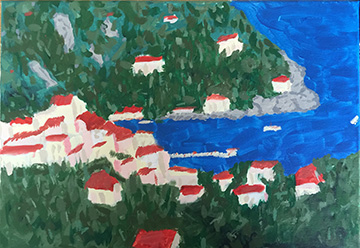
Italy bay 2Here is a new painting that I have just finished. It is loosely based on the view from the incredible villa we stayed in on the Amalfi Coast. (Thanks again Cheryl!) You may or may not recall that I had decided that I was using too much of a paint-by-numbers approach and trying to paint within the lines. So I made a conscious effort here to paint in a freer way. I didn’t sketch out the design on the canvas first and decided to use only a pretty large flat brush and I didn’t worry too much about getting the perspective perfect, which the mathematical side of me likes to do. (I am always attracted to artwork that has a kind of mathematic underpinning. I should probably try that some time.) The one thing about painting this way is figuring out when to stop. (Before I would stop when all the spaces were filled.) I’m not sure that the final result is any better, but I think I find it more satisfying to paint in this way.

The Power of Music

Tom Boswell wrote that “Time Begins on Opening Day”. I’ve always felt that summer ends when the baseball season ends and that the end of the World Series brings on four months of darkness, finally ended by spring training and rebirth. Now is the winter of my discontent….

Judie and I saw an astonishing play Monday night. It was “Farinelli and the King” and it starred Mark Rylance. It was based on the true story of King Philip V of Spain in the early 1700s. Philip, the grandson of Louis XIV (the Sun King), was bipolar and severely depressed and simply unable to function due to mental illness. To try to snap him out of it, his wife, Queen Isabel, went to London and hired the most famous singer of the day, a castrato named Farinelli to come and sing for the King. His singing saved the King’s sanity and allowed him to remain King, but their relationship went much deeper. They were two men who were forced to be kings in different ways and found it to be painful. Philip was, of course, forced by his family to be King of Spain and Farinelli was forced by his family to become a castrato and was the King of opera. He was the most acclaimed singer of the day, having been castrated by his brother at the age of ten to preserve his lovely singing voice. In the 1600s until the beginning of Romanticism, the castrafarinelliti were the superstars of the music scene. This was partly due to fact that women were not permitted to perform in many Catholic countries, but also because of the incredible sound that castrati created. According the program notes, musicologists feel that countertenor and altos do not capture that sound. (The last castrati died in 1924 and there really are no good recordings.) Anyway, Farinelli began singing for Philip and never stopped. He quit performing in public and continued to sing daily for Philip until Philip’s death in 1742. (Some of this comes from the programme. You have to buy them here, which is kind of annoying when you are used to free Playbills on Broadway. But the content is much better and this one had articles about the history of castrati, a long article about Philip V, an article about the history of music therapy and an interview with the playwright, Claire van Kempen, Rylance’s wife. It was worth the £4.)
So you have this incredible story: Crazy king played by the great Mark Rylance, a beautiful and powerful queen determined to save her husband, conniving courtiers trying to get rid of him and/or start a war, the most brilliant singer of his day, not just making all the difference in the KIng’s sanity, in one of the first examples of music therapy, but retiring from public performance and becoming the King’s best friend and confidante. It was put together wonderfully into a compelling play, but what made it utterly memorable was the music. Interspersed in the course of the play were instances in which Farinelli sang for the King. But rather than finding an actor who could sing (or a singer who could act), they simply rotated three famous countertenor who would enter, dressed in the same costume as the Farinelli actor and sing these unbelievably lovely arias. (They were mostly by Handel and were the actual arias that the real Farinelli would have sung.) There was something about the other-worldly countertenor voice and the smallness of the theater (the stage was candle-lit) and the context of the plot that made it just ethereal. It gave me chills. So ultimately the play was not simply about the power of music to restore a person to sanity. It was also about the power of music to transport an audience. If they decide to bring it to Broadway, you must see it. And if you are in London, try to figure out how to get one of the few remaining tickets.

Oh Well, It was a Great Season

I don’t know if losing the lead at 4:00 AM is really more painful than losing it at 11:00 PM, but it sure felt like it. The Mets blew  yet another game in the World Series. They really could have won the Series, but ultimately didn’t deserve it. The Royals just played better this week. Here are some thoughts (if you are not a baseball/Mets fan, feel free to skip this post entirely):

It is pretty easy to second guess Terry Collins: The Mets manager was on a great run where everything he did seemed to work and then in the World Series nothing worked. His robotic approach to his bullpen, which is justifiable (maybe) in the regular season, was exposed. Clippard hasn’t really pitched well in weeks, yet Collins brought him in to pitch a crucial inning in Game Four (rather than Familia) because he was the guy who pitches the eighth. Coming into the Series, one of the Mets’ great weapons was Familia, but in the Fourth and Fifth Games, Collins waited too long to use him and ended up putting him in impossible situations. The Fox guys kept comparing leaving Harvey in the game to Jack Morris and the Twins, which is valid, but they might have also referred to Grady Little leaving Pedro in too long and losing to the Yankees, which, as it turned out was the better analogy. I didn’t mind sending Harvey back out, but I would have brought in Familia after the walk. But I don’t really know what he could have done to get them to hit, which was ultimately the biggest problem.

The aliens who kidnapped Daniel Murphy gave him back: The Murphy in the Series was, unfortunately, the one that Mets fans know: He is a journeyman player whose only real skill is making contact with the baseball when hitting (which is a real skill, not to be minimized). But as the Series showed, he is a barely competent fielder and proved it by making some critical errors. He really is not a power hitter either, despite his post-season heroics. I’m not complaining, since his historic home run binge helped get the Mets to the Series to begin with and was a nice cap for his Mets career. I’d be very surprised if the Mets pay him what it would take to keep him as a free agent and I won’t miss him that much.

The Mets never saw the real Cespedes: In the last two months of the season, especially August, he was just incredible. A Willie Mays-like Superman, having probably the best two month stretch of any position player in Mets history. In October, not so much. He didn’t really hit well at all. He was over-swinging terribly and there seem to be holes in his swing that top pitchers can exploit. To make matters worse, he looked pretty bad in CF, starting with misplaying a fly ball in the fist inning of Game One into an inside-the-park homer. He is a much better player than he was during the World Series and for much of the playoffs and not close to the god-like player he was in August. He is a free agent and someone (maybe the Mets) is going to give him a truck load of money. But what will they be getting?

Defense is key in the post-season: And the Mets didn’t play good defense in the Series. Good teams that are playing well (who are the teams that end up in the World Series) are teams that capitalize on mistakes. If the Mets had played tight defense, they would have won the series. But Cespedes kicked the ball around in the outfield, Murphy’s lousy fielding was exposed, Duda threw the ball away when a good throw would have ended Game Five and Wright made a couple of errors. And d’Arnaud and the Mets pitchers proved incredibly easy to run on, playing right in the Royals strategy. The couldn’t turn double plays against a ground ball hitting team. The often-criticized Wilmer Flores, shockingly, was the steadiest fielder on the team.

The Royals played really well: Their pitching pretty much stopped the Mets offense and their defense was good, although they made a few big errors. And you have to appreciate their approach at the plate and their willingness to cut down on their swings and just try to make contact when they have two strikes. The majority of Mets hitters (and the majority of MLB players) just don’t do that. The Royals give up power and are essentially a singles hitting team, which is a tough way to shape an offense, unless you can take lots of extra bases and keep games close with pitching and defense. They are well designed for their large stadium, although I’d have to say that they had the worst bunch of hitters on their bench that I can recall in a post-season. A team with a tighter middle infield that could control the running game would have given them trouble. But they took advantage of the breaks and lucky bounces they got and never gave up. I’d like to say that the Mets blew it, but, really, the Royals won it.

Wait ‘Til Next Year: The Mets are going to be good for a couple of years going forward, simply because they have historically great young starting pitching, combined with a great closer. Conforto has a chance to be a star and you could do worse that Flores at second or short. D’Arnaud is a good young hitter and catcher, but they need to work on his throwing. I’ve come to really appreciate Granderson, who was the Mets MVP this year. Wright’s a pro, but his back is a perpetual concern. Duda is too streaky, but I don’t know that they can really do any better. Murphy is likely gone, but how much money do they want to blow on Cespedes? I’d like to see him back, but not with contract that cripples their budget for years to come. They have some decisions to make, but, for the first time in a very long time, they are starting from a strong position,

Friendship and Sports

It’s hard to know where to start. It has been a bit of lost period, thanks to the Mets and the damn World Series keeping me up to all hours. Fortunately, that looks like it may end tonight and, in any event will end soon. I will probably devote a future post to thoughts about this whole post-season, so I won’t say much about the Series here. But the Mets could as easily be up three games to one as down by that amount and arguably should be. It has been kind of a Series between old-time small ball strategy and more modern sabremetric thinking, with small ball winning, much to the delight of that antediluvian moron, Harold Reynolds. It will be a pleasure to stop listening to him. There must be hundreds, if not thousands, of baseball commentators, former players, sportswriters without newspapers anymore and random people off the street who would be so much better than him, that you have to wonder what it is that Fox sees in him. I actually tried to switch to the radio feed for the audio, but it is on a ten or more second delay, so it is too out of joint with the game action on the screen.

Regardless of the outcome and the lack of sleep which has left me “Met lagged”, it has been a wonderful run. A week ago, at the Unitarian Church, when I lit a candle to the Mets, I explained that I was really lighting it, not because they had won, but to reflect on the intergenerational ties that they formed in my family and countless others and to be thankful for the joy that they had brought to my son Alex, to my friends and, if you believe in an afterlife, to my father. It is really the interconnected joys, sorrows and frustrations that are what being a Mets fan is all about. It isn’t about winning. (This may be the essential difference between Mets fans and Yankees fans.) But Let’s Go Mets anyway. It’s not over until it’s over.

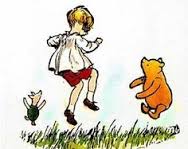
Last Sunday, after the Unitarian service, I went to a meeting of the “Sunday Gatherings Team” to see what it was like. It turned out that Rev. Andy likes to get a lot of input form people about what the services should be like and how the congregation could be better. One of the things he did is break us into small groups to brainstorm ideas on each of the upcoming services for the month. He had already chosen the topics and I chose the service that was today on the topic of friendship. It was fun and a few of my ideas found their way into his message (he doesn’t like the term sermon apparently). He also asked for readings and I found two readings from Winnie the Pooh, which I thought reflected on friendship. One was between Eeyore and Rabbit and was about how you have to have real conversations and go out of your way and make an effort to see others and the other was a wonderful excerpt in which Christopher Robin asks Pooh what he likes best in the world and Pooh says:

imgres“Well,” said Pooh, “what I like best?” and then he had to stop and think. Because although Eating Honey was a very good thing to do, there was a moment just before you began to eat it which was better than when you were, but he didn’t know what it was called. And then he thought that being with Christopher Robin was a very good thing to do, and having Piglet near was a very friendly thing to have: and so, when he had thought it all out, he said, “What I like best in the whole world is Me and Piglet going to see You, and You saying ‘What about a little something?’ and Me saying,’ Well, I shouldn’t mind a little something, should you, Piglet,’ and it being a hummy sort of day outside, and birds singing.”

I ended up actually reciting the the two readings (which brought back repeatedly reading these stories to my kids) and they were incorporated nicely into the message. The people in the congregation loved the readings and came up to me afterward to talk about them. One woman had been to the Hundred Acre Woods with her family in the prior week and played Pooh sticks there (which sounds like something I need to do). Another guy commented that he always thought of Winnie to Pooh as being read with a British accent and the hearing me read it was odd, but not unpleasant. He said that he pictured Pooh and Christopher Robin living somewhere like Vermont as he listened.

It was nice to get involved in this particular service because I have been thinking a lot about friendship in the past few weeks. I’ve realized that what I miss is not my house, or Montclair, or doing things in NYC, or going up to the country, or wine tastings or dinners, or our UU congregation, it is the people. And it isn’t anything big. It is just knowing them and what has happened to them over the years, watching their kids grow up, recalling special moments and just being able to start a conversation in the middle, without an introductory part. It is that sort of deep and regular personal connection that is missing from what is our delightful life here. It is the biggest reason we are going to the New Unity Congregation, which I think is our best hope for making connections of any depth.

I have been thinking about why it seems so difficult to make friends here. Have I been too much like Eeyore, waiting for people to come to me? Not really, although perhaps I could try to get out more to try to meet other people somehow, although I don’t think that mere proximity necessarily leads to any sort of significant friendship. It all seemed so much easier when we moved to Sydney so long ago. Was it because we were different then or that Aussies are friendlier than Brits? The answer to both of those questions is yes, but I think the real reason was Alex. Having a small child is an incredible lubricator in the creation of relationships. It gives you an instant and meaningful connection with other parents and also I think that walking about with a cute, verbal two-year old is a little like walking a puppy. It attracts people who want to come and talk to you and to him. Anyway, we are lacking that lubricator here and Judie working in a smallish branch of a law firm is not like working at American Express in Sydney.

Thinking about our friends in Sydney is a nice segue into the Rugby World Cup. As probably almost no one in America knows, New Zealand beat Australia in a really exciting final yesterday. They are two creative teams that do not play the smash-mouth, run-it-up-the-middle-and-kick-it-away type of game that most teams seem to play. New Zealand took a pretty big lead early in the second half and the game looked over, but Australia came roaring back, scoring 14 straight points, before New Zealand took control at the very end on some wonderful plays and won 34-17. One absolutely delightful discovery that came out of this World Cup was that our old friend Mair Lustig, the Welsh wife of my college roommate Rich, is a fanatical rugby fan. I never would have guessed it, but she followed it all and knows the history, especially of the Wales team. We’ve known Mair for close to forty years and never knew this about her, which I guess fits somewhere into these ruminations about friendship and seems like a reasonable place to conclude.