Stories from Lunch and a new painting

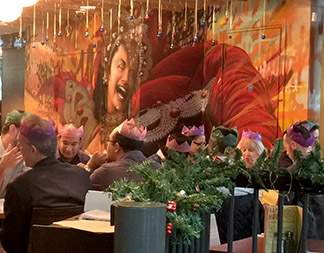
Judie and I decided to go lunch the other day at Spitalfields market. Since we decided to go where we could actually sit down, rather than eat the street food and try to find a place on a bench, we discovered that it was already “Holiday Lunch Season”. There were a number of large parties celebrating the season, probably from the many offices in Broadgate Centre and the other nearby towers. See the photo below of one such group. Christmas crackers and the accompanying silly paper hats are a big thing here and a number of the revelers in the restaurant were snapping their crackers (the first snap makes you turn your head, but after that it becomes background noise) and putting on the paper crowns. It seems to be a universal custom here, while in America, you rarely see it (although it became a Christmas custom for us after we lived in Sydney). You can get cheap crackers at Tescos and seemingly everywhere else. They come in a mind numbing range of prices and sizes. (I do wonder if the crackers on Brick Lane are any different.) And you can spend a small fortune on crackers at Harrod’s of at Fortnum and Mason’s.

xmas party

Fickle Finger Follow-up: While we were having that lunch, I got a call on my mobile. (Practically no one but Judie ever calls me, so it is always a surprise.) The conversation went as follows: “Hello.” “Can I speak to Nick Lewis?” “Speaking.” “This is Royal Hospital. Your surgeon would like you to come in tomorrow.” “What for?” “Um. Well.” “I’ve already got an appointment with a GP to get the dressing changed.” “But this is for your surgery.” “I had the surgery last Friday.” “You did?” “Yes. I can’t recall the surgeon’s name.” Long pause. “Ah…. Yes. I will take you off the waiting list. Please ignore this call. Goodbye.” A call that was both amusing a little frightening. People must get lost on these waiting lists. If I hadn’t called the scheduling clerk last week to see when I was going to be treated, I clearly could have been in that boat.

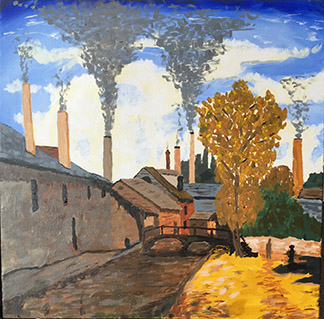
I finished another painting today (with the usual caveat that I am never sure if anything is really finished–that tree still bothers me). This one was based on a portion of a painting that we saw at Musee D’Orsay, while we were in Paris. It was a Monet, but the subject was very un Monet-like. It was in interesting painting exercise, which demonstrated to me, unsurprisingly, just how hard it is to do what Monet did. I am actually not displeased with the result, although comparing it to Claude would only be embarrassing. Here it is:

monet riff

New Painting: From There to Where?

Well, I have finished (I think) a new painting. It is based on a photo of a mosaic at the British  Museum that I took. The photo is below. Somehow, I ended up with the painting that is also below. It kept evolving when I didn’t like earlier version and kept adding paint. I’ve reached the point where it stopped getting any better as I added still more colors, so I decided to stop. This is one that I may come back to at some point. I put another one aside to do this one because it just wasn’t working for me at all. Maybe I can revisit it now. Or maybe not.

Tileman before

Tileman after


Week in Review

Fickle Finger Finally Fixed: On Friday, I got my finger repaired. I was beginning to worry, because it was approaching a week and when I called the scheduling clerk at the Hospital on Thursday, I was told that it would probably be another week before there was room in the surgery queue. I could almost feel my finger starting to knit together in the wrong way, so this seemed like bad news. But he called back later in the day to tell me to come in the next morning. I got there and at 7:00 they announced to a room of waiting people that the wait to be treated could be as long as twelve hours. So getting into surgery by 11:00 and out of the hospital by 12:30 seemed like a victory.

The whole thing could have been so much worse. I really cannot complain at all. And it was a good way to get a look at the operation of the National Health Service. The care was a bit slow in coming, but it was ultimately good. It was pleasant to avoid having to spend time on insurance and how you are going to pay when all you want is treatment. (We are not covered by NHS, which I think is due to the type of visa we have, but no one has even mentioned money to me yet. I assume that they will eventually catch up with me.) And things must be far less litigious here, since I was largely spared signing my life away and getting pages of written warnings and instructions. The delay in getting surgery was only annoying for me, but you could see how this could be a real problem for someone who needs to go to work every day. These delays is a drawback to NHS, which otherwise seems to work pretty well

Another Political Update: On Wednesday, PM Cameron succeeded in getting the authorization to begin bombing Syria. If you are really interested in this story, the basics are covered very well in the New York Times and similar papers. So I thought I’d limit my comments to some side things that might not have been reported:

  • Public support for the bombing had been dropping over the prio week, down 11% to a pretty even split, which may have pushed up the timing of the vote.
  • Since Corbyn lost control of his Labour Party and had to allow his members to vote their conscience, there was no question that the motion would succeed and the big issue was how many would desert him. The final answer was 66. More than some predicted and less than a few other had predicted, but it might have been worse fo rhim.
  • The day before the debate and vote, Cameron suggested that those who opposed the bombing were “terrorist sympathizers”. This was probably a political move aimed at reminding the voters that Corbyn had supported Sinn Fein and other radical groups in the past. It was a dumb move that was universally decried, even by his supporters. He effectively ceded the moral high ground by making the issue political and was faced with endless demands that he apologize or withdraw his remarks during the more than ten hours of debate.
  • The debate went on for so long, even with the result preordained, that the Speaker had to limit the backbenchers to 3 minutes each. There were a number of good speeches on both sides. Cameron was OK. Corbyn seemed disjointed to me, but maybe that is just his speaking style.
  • Each side had good points to make, which is why public opinion was so split. The conservative argued that we are already bombing ISIS in Iraq anyway, the bombing is legal, we are supporting our ally, France, who asked for our aid, we should not let others do our work for us and if there is a chance that the bombing might protect British citizens, it must be done. Those opposed argued that, even if all that was true, there is no plan beyond simply dropping some bombs (Cameron doesn’t seem to have any coherent plan as yet), there is no reason to think that a few UK bombs will really make any difference and they might kill more innocents, shouldn’t we first be working with our allies to come up with something comprehensive and what is the big rush?
  • So the real drama was really whether the Labour party was splitting apart. And this dramatic theme came to a head at the end of the evening when the Labour Shadow Foreign Secretary, Hilary Bend, gave one of the final speeches, a really wonderful one, which was the precise opposite of everything Corby had said and which got a rare ovation from both sides. After that, the actual vote was an anticlimax. (Later in the week, Corby got a little good news when Labour won a by-election. It was traditional Labour seat with a great local candidate, so winning wasn’t that big a deal, but Corbyn sensibly treated it as a personal and party triumph.)

San Bernardino: While the debate and vote was going on in Parliament, the BBC would cut in once in a while with an update from the latest mass shooting, this time in San Bernardino. It was an odd counterpoint to the civilized and actually very thoughtful debate that was going on. The British, quite understandably don’t know quite what to make of all of the US gun violence. Here, the big concern is knife attacks, which have killed a relatively small number of poor and young people. (It is reminiscent of “West Side Story”, whose violence seems almost quaint today.) It seems like these shootings are happening with increasing frequency in America. I have a theory that the fear-mongering in the Republican primary is stirring up and giving the crazy and hateful a feeling of empowerment and justification. In the end, this one had elements of terrorism, although it sounds like it might be more complicated than that, so maybe the trigger was the Paris attack rather than my theory (or maybe a toxic combination of the two).

Other thoughts: I’ve been watching a British police drama called “Whitechapel”. It seems to involve mostly serial killers and is very dark and intense. One of the cool things about it is that is filmed right in our neighborhood, so there is an occasional scene each episode occuring somewhere we have been. I think it has been shown in the US on the BBC cable network. I love it and have been viewing past episodes, but it is too violent for Judie.

I never understood ugly Christmas sweater parties until the past week or two. There are an endless number of ridiculous Christmas sweaters for sale everywhere you look. Clearly, someone is buying these things.

We heard a wonderful sermon at the New Unity Unitarian Church on Sunday (the Minister prefers to call them messages and they are perhaps shorter than a typical sermon) on the subject of Hanukkah and terrorism and purity vs. love. It is supposed to be posted on the church website at some point. If so, I may provide a link at some point.

The took our curtains away for re-lining and for some reason they weren’t returned for weeks. It hardly mattered because the sun virtually never breaks through the clouds. It isn’t particularly cold or wet (unlike Scotland). It is just relentlessly gray.

We are preparing for the family visit. James is the first to arrive–next Sunday morning.

Catching Up, Part 4: Lloyds of London

Who knew Insurance underwriting was interesting? Definitely not me. When Ivy and Debbie were visiting (this was over a week ago–a real catchup story), I joined them for a tour at Lloyd’s of London. I was expecting to meet them at some old building in the City, since Lloyds has been around forever, but it turned out that Lloyds is in a new building designed by the architect responsible for Paris’ Pompidou Center–very modern with all of the internal parts on the outside. I’m sure that it caused a furor when it was built in 1986, but it now something of a landmark and is protected. We joined up with some other Americans with insurance ties and were met by one of the chief lawyers for Lloyds, who told us that we were being given the tour by the Head Waiter. I’m thinking “Head Waiter??”, but, as in many things here, the language was deceiving.

It turns out that Lloyds was started in the late 1600s in a coffee bar in the City. This was shortly after coffee started to be imported to England and coffee was a big and prestigious thing. The coffee bars were the beginnings of business as we know it today. Up until then, businessmen either meet in the street or in a pub to conduct their affairs. Coffee bars were the forerunners of modern offices or businessmen’s clubs. They began to specialize, so that you knew that if you wanted to do a particular sort of business or needed information on cargo on a particular ship, you would go to a particular coffee bar. And businessmen could begin to have something like office hours since one would know when and where they could be found. The coffee bar owned by Mr. Lloyd (there were 80 of them in the City then) came to specialize in men who were willing to insure the cargo being shipped to other places, and sometimes the ships themselves. This was when London was a huge port and international trade was complicated by storms and pirates and other events that made delivery a risky proposition. A group of wealthy individuals had begun to insure such deliveries in exchange for a premium. In order for this to work effectively, these men needed the best information possible and a way to spread the risk. Lloyd’s coffee bar allowed all the men in this field to be in one spot, eliminating the need to run all around the City trying to find other men willing to underwrite the risk. Equally important, that coffee bar became the place which had the information about every ship, its history, where it was going, what it was carrying and whether it was on time. Keeping this whole enterprise operating smoothly were the waiters of the coffee bar. The titles never changed, so the Lloyds Head Waiter is not a waiter in the usual sense, but instead is a significant corporate official.

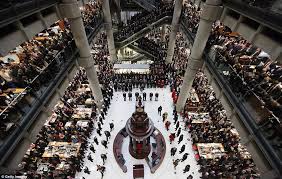
Lloyds’ business is enormous today, but essentially unchanged, except for the fact that it finally allowed women to work there in 1974. (The head waiter explained that this was due to the tradition that women where not allowed in the coffee bars in the 1600s, a pretty weak story, but undoubtedly the corporate line.) It is not an insurance company. Instead, it is a facilitator, a place where a huge number of underwriters from many different companies gather and Lloyds get a cut of the business that goes on there. There are massive floors covered with desks, where the individual underwriters wait for brokers to bring a matter to them. (Each underwriter’s desk has a stool next to it for the brokers.) The brokers move around and eventually pick a lead underwriter (the underwriters specialize in various areas), who writes a policy with the various terms and conditions and agrees to take a portion of the risk, normally 5%. The broker then literally walks the policy around the floor, speaking to other underwriters, who can sign on to the policy, but not change its terms. Lloyds claims that this person to person process is actually more efficient than doing it through computers, which makes some sense. They are apparently running out of room in the gigantic building that they are currently in and are going to have to toss out tenants to fit in even more underwriters, so business remains good for them. The big change is that whole underwriting business is gradually expanding toward Asia, as you might imagine, and Lloyds now has an office in Singapore doing the same thing to eliminate the problems of time and language that would complicate their business model.

Besides getting this whole talk about this history of the insurance industry, there were a few highlights of the tour. On the main floor, there is a book which lists every lost ship in the world, which is updated daily and lists the details about how it was lost. It is still maintained and the head waiter who was giving us the tour is responsible for making the entries with a quill pen. (He has amazing handwriting.) Not many ships sink these days, but he showed us the most recent entry, a ship that had sunk off the coast of Indonesia eight days earlier. Then he showed us a book from 1915 that they have on display in a glass case, which showed seven ship lost on a single day and there may have been more on other pages. Five had been sunk by German submarines. Lloyds has books like this going back over 300 years. There was also a big display about Lord Nelson, which contained the log book from one of the ships on the edge of the British fleet that has a blow-by-blow account of the Battle of Trafalgar based on the semaphore signals that they received.

Lloyds

Probably the most famous thing at Lloyds is the Lutine Bell (above), which sits in the center of the main floor in an impressive wooden stand. Back around 1800, British businessmen agreed to send over £1,000,000 to Hamburg to prevent a market collapse there. The gold and coins were loaded on the HMS Lutine (which itself has an interesting history involving the French Revolution). The Lutine then sank off the coast of Holland in a storm and Lloyds as the insurer, paid back all of the money in several weeks. (They never insured the actual warships though.) Lloyds eventually sent an expedition to try to recover the gold and coins, but the ship had sunk on a sand bar with strong currents and the stuff was all completely dispersed and buried. (No one has found it to this day.) All they found was the bell from the ship, which went back to Lloyds as kind of consolation prize. From then on, it would be rung to signal the status of a missing ship, once if it was found, twice if was sunk. The bell finally cracked and was last rung when Queen Elizabeth came to Lloyds to celebrate its 325th anniversary.

This is a kind of esoteric post, but I found the whole thing to be fascinating.

Catching Up, Part 3: Paris

The idea that one could easily take a short train trip and spend a weekend in Paris was always one of the appealing things about the London move for me. So that made it an obvious choice for my birthday weekend. We made the reservations before the recent terrorist attacks and never considered cancelling them. We figured, I think correctly as it turned out, that Paris would be one of the safest places in the world thanks to government overreaction to the atrocities. The police were everywhere, with security tightened further, at least where we were, by the imminent arrival of countless heads of state for the Climate Conference, with countless guns, cars, trucks, boats along the Seine and all of the police toys in evidence.
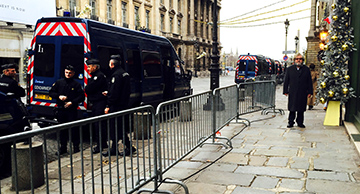
Gendarmes

It was pretty miserable weather. Chilly, windy and grey. The streets were more subdued that usual, thanks to the enormous police presence. But Paris was still absolutely gorgeous. Much prettier than London, although, in fairness, Paris has the advantage of not having been ruthlessly bombed during WWII. But I think that Paris was also one of the early adopters of building codes and urban design principles, which sort of suits the French OCD-like personality. London, in contrast, has always grown more organically, literally layer upon layer, helped along by periodic disasters like the Great Fire and the Blitz.

Taking the Eurostar train is a pleasure, despite starting the journey by going through two customs consecutively. (I wonder where you are when you are waiting on the line in the hundred feet between the English and French customs officials?) On the way back, Judie upgraded us to “premier”, which comes with a snack and wine. All very civilized, especially compared to the horrors of modern plane travel.

We were wondering if the stories of extensive cancellations would impact our trip and perhaps it did. When we checked into the Buddha Bar Hotel (an expensive hotel where we normally would not have stayed, but which Judie had found on sale on one of those websites like Orbitz) and mentioned we had come for my birthday, we were upgraded to an absurdly nice room that should have cost 1500 Euros a night. I am sure that it was because the hotel was surprisingly empty. See the photo below.
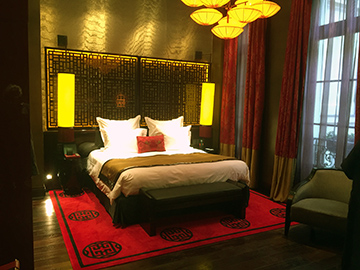
paris hotel

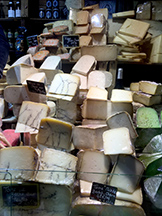
We went out for a stroll. The hotel was right off the ridiculously upscale Rue St. Honoré and near to the Place de la Concorde. Holiday decorations were already up. Very tasteful ones by the hotel, with pretty square lanterns hanging above the street. The Place de la Concorde had a garish ferris wheel and other lights and the Champs Élysées had pulsating lights on the trees lining the boulevard There was a Pére Noel Fair going up from the Place de La Concorde towards the Arc de Triomphe,adding more lights and decoration (and American Christmas music sung by Sinatra and Bing and others, which added a slightly surreal touch). We wandered through it. It seemed very French, with tons of cheese and charcuterie sellers, in addition to the vendors hawking ornaments and other holiday merchandise. There were stands where you could buy Escargot Bourgogne or Foie Gras sandwiches or melted cheese served any number of ways and lots of wine. If we didn’t have reservations for a special meal, we would have been tempted to stuff ourselves. It was hard not to think, as we walked through the masses of Parisians and tourists of all ages, that this would be a great terrorist target. I imagine this had to be in the back of everyone’s minds, but everyone was having a great time.
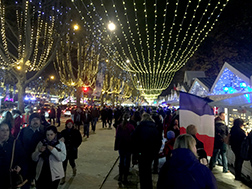
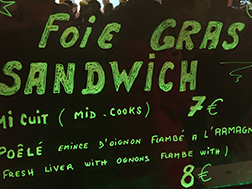
champs  foie gras  vin  cheese

Later that evening, after getting dressed up at the hotel we walked over to Lasserre for dinner. It is an old, two-star Michelin restaurant at which people like Salvator Dali, Audrey Hepburn, Andre Malraux, Marc Chagall, and Jean Paul Belmondo were regulars. It was a memorable evening and not just because it was so expensive. The restaurant itself was beautiful, from the small, brocade covered elevator that takes you from the reception room to the second-floor restaurant, to the multilevel room itself, decorated with yellow wallpaper, chandeliers and orchids everywhere. The ceiling had a painting of nymph-like women in diaphanous dresses. When we had been seated and drinking a glass of champagne, the ceiling opened up and we could see the sky (and a crane, alas) and feel the cool air enter the room. As quickly as it rolled open, it closed, a routine that was repeated about every fifteen minutes throughout the night. The waiter explained that the ceiling had been put in when everyone smoked, to clear the room of the smoke from all of those Gitanes. Now they just do it for tradition and for the fresh air, since one cannot smoke in Parisians restaurants now. We had the Tasting Menu and food was lovely, although not etherial. After looking at the very pricy cartes de vin, we went for the matching wines, which were good, with two memorable ones, a 2004 Puligny Montrachet (I would never had dared order a white wine that old) and a dessert wine from Southern France that was wonderful. It was really just the whole over-the-top experience, the waiters, the attentive service, the beautiful room, the moving ceiling, people watching at the other tables, and all of the little extras that came with the meal, that made the night memorable.
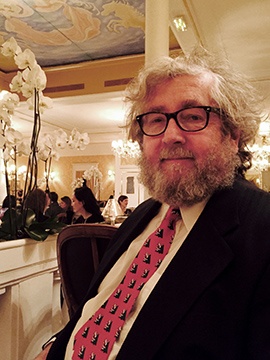
Lasserrre

The next day, we slept in, recovering from our emergency room experience the night before. We walked over the Museé D’Orsay, a former train station which now houses a collection of Impressionist and Post-Impressionist art. We began the visit with an absolutely delightful lunch the museum restaurant, which was in an ornate room with a painted ceiling that had somehow been a part of the original train station. (It really came as no surprise that the food in a French museum would be very good.) The collection at the museum has just an incredible number of the iconic paintings of Renoir, Degas, Van Gogh, Monet, Manet, Toulouse-Lautrec, and all of the rest of that group of artists. You walk around and turn a corner and there is another one. I think that I could get a little closer to the paintings than in US museums. I got close ups of the brush strokes without setting off the alarms that would have sounded at MoMA. It wasn’t all that crowded, which I assume must be an intentional crowd control effort by the museum, since we had to wait on line to get inside. Since I have been painting, I think I look at these museums slightly differently. I marvel even more at technique and look for ideas. One final thought: we had recently seen a lot of relatively mediocre Renoirs (at the Barnes in Philadelphia and other museums), lots of the nudes that he seemed to do towards the end of his career (perhaps to make money from rich Americans?). But here, there was one spectacular Renoir painting after another, reminding me of just how great he was and confirming his place as the father of Impressionism.
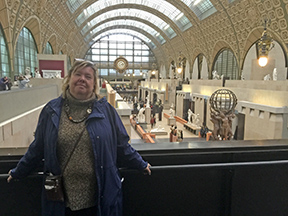
d'orsay

So Paris is alive and well and beautiful. We plan to return with our kids for a few days right after Christmas.
 

Catching Up, Part 2: Political Update

I have to say that I find British politics less depressing that the American variety. It isn’t so much that the end results are much better. It is just that it lacks the undertones of hatred, prejudice and violence that are so prevalent in the American public square. Maybe that is part of America’s unending response to the debt of slavery and racism. Anyway, now for a British political update.

There are three great gravitational forces in British politics right now that all the other figures orbit about in various ways. First is Prime Minister David Cameron, of course, who is planning on retiring in 2020 and is thinking about his legacy. The second is Chancellor of the Exchequer George Osborne, the Paul Ryan of Parliament and Cameron’s choice as successor. Finally, there is Labour Leader Jeremy Corbin, recently chosen to lead the Opposition, who appears utterly lost.

The big news of the past week occurred when Osborne gave a speech in Parliament about the Conservative’s budget proposals. He had planned on cutting tax credits for the working poor in order to balance the budget, which caused a huge blow up that I have written about in the past. Everyone knew that he was going to have to change the idea somehow, phasing it in or finding some other way to soften the blow. But he shocked everyone by simply announcing that he was dropping the whole thing. He claimed that it was because the government receipts were better than anticipated, but it was actually a full-scale political retreat, which had to be somewhat humiliating. This was, after all, an attempt to reduce the social safety net, a central piece of Tory dogma and policy. It looks like Osborne and the party just decided to cut their losses and figured that, with the next election years off, no one will remember this mean spirited proposal when it is time to vote. It is certain that Osborne will find other ways to cut spending (even though polls show that the British public no longer believe that austerity is necessary) that will impact the poor and working class much more than the wealthy. They are cutting support to local councils, a Chis Christie trick that I got to see up close while on the Montclair Town Council, although they backed down on cutting support of the police, which was incredibly  unpopular. So the local councils will be faced with the choice of either cutting services or raising local taxes (or both), which was my Montclair experience.

Now you would think that the Labour Party would have reveled in this retreat on an issue that is important to their base, even though they did very little of the heavy lifting in getting the policy reversed. But Corbyn managed to screw up a simple declaration of victory and came out of what should have been a triumphant moment looking even weaker and besieged. He is personally opposed to Cameron’s plan to bomb Syria, but it seems clear that a significant number of Labour MPs disagree with him, probably because they are cognizant of significant public support of the move. Even the Shadow Foreign Minister, who you would think would have to support her leader on this kind of important issue, is not. The further the whole Corbyn regime goes on, the more it appears that he has no real feel for the realities of governing. He went from being a generally ignored, far-left back bencher to taking a shot a running for leadership, just to offer a left leaning option, to stunningly winning leadership. He is in charge, but doesn’t seem to know quite what to do. He is like a deer in the headlights, managing to avoid being plastered by the cars and truck so far, but seeming increasingly disoriented by everything flashing by. It seems inevitable that he will be replaced as leader at some point in the next year or so, which will anger his supporters (and there are a lot of them in the rank and file) no end.

In the meantime, Cameron is in a pretty good position. He effectively has no opposition and can spend his time pushing Corbyn back into various corners from which he is incapable of escaping. His biggest political nightmare–the unpopular cuts to tax credits–has disappeared and now he and the other Tories can go back to their charade of being “friends of the working class”. It is likely that he will get Parliamentary approval for his desire to bomb Syria (and in the unlikely event that he is blocked, he can blame Corbyn for making England seem weak to the world). He has to deal with a mostly political controversy about building an additional runway at Heathrow, but seems to be trying to duck it for now. The only real thing he has to worry about is the 2017 referendum on whether to leave the EU, but that is years off.

Catching Up, Part 1: The Fickle Finger

It’s been a while since I have written anything and enough has happened, as you will discover, that I’ve decide to break it into parts.

Last Friday, we had a Thanksgiving dinner. It seemed more sensible than trying to have it on Thursday, since it isn’t a holiday here, which would make it complicated to come and to go to work the next day. (One odd thing is that Black Friday isn’t a day off here, so in Britain it is just a seemingly random, American-generated excuse for excessive shopping. It makes no sense, but that doesn’t seem to stop commerce.) Thursday was Ivy and Debbie’s last night in London and our quazi-nephew Nate Anschuetz and his girlfriend Pua were in town for a wedding, so we all went out to La Chapelle, a lovely French-inspired restaurant close to Spitalfield’s Market, set in a beautifully restored old church. It was a great meal and a nice way to end a welcome visit from Ivy , Debbie, Annie and Charlotte.

Earlier on Thursday, I’d gone to Borough Market with a rolling suitcase and literally filled it with a turkey, miscellaneous vegetables and wild mushrooms, spices, oysters, smoked salmon and desserts. The turkey was so fresh that it still had a few feathers on it. On Friday, I spent most of the day cooking it all. We had thought about inviting a bigger group, but ultimately invited six people, which is probably the best size for this flat, given the limited seating and number of dishes we have here. There were two lawyers from Bryan Cave, one with her husband, one with a friend, Phil Saunders, the lawyer for the City of London (and romantic interest of Jenny Bakshi), who we met in Montclair and who later invited us to meet the Lord Mayor, and Anna Gier, who stayed with us during her gap year and is now attending Oxford and came down for the night. It all went very well. Although no one really knew each other, there was a lively conversation. And the food was good, if I do say so myself. (The gravy was the best I’d ever made.) We drank some really nice bottles of wine and everyone tottered out around 10:45. We were left to do the dishes with Anna and get ready for our trip to Paris the next day, where we planned to celebrate my birthday.

In the space of a few seconds, it all went wrong. I went over to pick up the immersion blender on the counter, to check to see if it was clean and put it away. I didn’t notice it was plugged in and I somehow pushed the switch with my little finger in harm’s way and instantly mangled the end of it. It was one of those things where I knew that it was not just a little cut and that I had really damaged myself. Lots of blood.

It was just after 11:00 on a Friday night and after making a phone number and finding out where the nearest emergency room was (they are called A&E rooms here, which stands for Accident and Emergency), we were off by taxi to Royal Hospital on Whitechapel, which is about ten minutes away. Over the next four and half hours, I got to experience the National Health Service first hand. The first thing you notice is that no one asks for insurance information or how you are going to pay for your treatment. I guess this is because at a big public hospital like that, the government essentially pays for everything and no one worries about the finances (except when the government decides to trim expenses, leading to fewer doctors and nurses). Al I really had to do was show them an ID.

I actually got the see the triage nurse pretty quickly. She confirmed that the end of my finger was a mess and that I’d cut an artery, which was why I was bleeding so profusely. She said I would need an x-ray to see if I had broken the end of my finger (which might have led to being admitted) and would have to see a plastic surgeon. Since it was around midnight, there were no plastic surgeons around, which meant coming back the next week. She sent me to get the x-ray and told me to come back to see here. I didn’t have to wait too long for the x-ray, went back, and she told me that the good news was that my finger wasn’t broken, but the bad news was that I had to see a doctor and there would be a two-hour wait.

I had read in the local papers that NHS didn’t employ enough of the young doctors who staff emergency rooms, resulting in tremendously overworked and dispirited doctors who are threatening to strike. An emergency (A&E) room in a public hospital on a Friday night is always going to be miserable place to be and this was an understaffed one in a less well-off area of London. The one saving grace was that the English don’t shoot each other, so there wasn’t that type of awful ER excitement. Still, there were lots of people in various bad states just sitting around waiting to see a doctor. Sometime around 3:00 I finally was seen by a young female doctor. I had never stopped bleeding and the temporary bandage was soaked. She pretty much confirmed what the first nurse had said, adding that I would need antibiotics. But she said that I really needed to stop bleeding or they would have to admit me (Goodbye Paris). She wrapped me up tightly with lots of gauze to absorb the blood and said she would be back to check on the bleeding. Then some other, more important case must have come up because she disappeared for about an hour. I had stopped bleeding and we finally asked a nurse if we could leave. No such luck. We had to wait for the doctor to prescribe the meds.

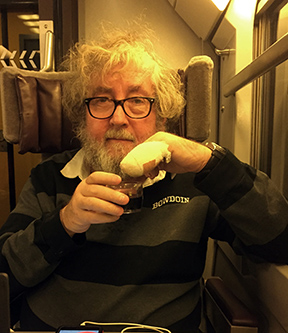
The doctor finally came back, looking harried (who could blame her), talked to someone on the phone and told me to come back on Monday to see the plastic surgeon on the second floor of the clinic at 10:00 and the nurses went through the procedure to get my medications dispensed. Then came the really huge difference between NHS and US medicine. I could just leave. There was nothing to sign. No written instructions about the medications or what to do about my finger. There was no written referral to the plastic surgeon. Still nothing about payment. No diagnosis. Nothing. It was a bit disconcerting. But the good news was that I was getting out of the hospital and going to Paris, albeit with a comically huge bandage on my little finger. See the picture of me below on the Eurostar train:

Train

We got back from Paris (more on that in Part 2 or 3) and this morning I went back the hospital to see the surgeon. I managed to find the right place and discovered that there was no record of any appointment for me and not much of a record of my stay on Saturday night. But I got to see a doctor anyway. First I got to see yet another great nurse, who got my mega bandage off and cleaned it all up and told me what the doctor was going to tell me. The doctor came in and told me that I would have to come back for the surgery and that it would be out-patient since they could just numb the finger. They would then thoroughly clean it up and put it back together. He said I had cut the plate of my fingernail, which would have to be repaired (and the remaining nail removed), so that a new fingernail could grow back properly. He also said that was an outside chance that I would need a skin graft on the end of the finger, but that it was hard to tell until it was all cleaned up. He said it was a fairly small operation and that they would try fit me in by the end of the week. He had written some of this down on a form, which I had to sign (finally), but they didn’t give me a copy. I just got a third of a page sheet titled “Information for patients having surgery” that had be ripped from a larger sheet. The nurse gave me a new, more reasonable sized bandage while all of this was going on and I left.

This all wasn’t much fun, but it really could easily have been so much worse. I’ll write more about this as it happens, but the next few posts will be retrospective. Incidentally, does the phrase “Fickle Finger”make you think of “Laugh-In”? Is there any other connotation?

Museums with Company

Our friends, Ivy and Debbie have been visiting this week with their daughters , Annie and Charlotte (arrived on Sunday, leaving Friday). It has been wonderful to have them here, especially since it is Thanksgiving week and I think we’d have been feeling a bit lonely if they hadn’t decided to come. And yesterday, we got a surprise visit from my brother-in-law, Hugo, who was on London on a two-day trip finishing up his brother Robert’s estate. We all had dinner at the flat. I tried making popovers, having ordered a pan, but they failed to rise properly (although they tasted good). I think this meant I put too much batter in the cups. I’ll have to try again

Yesterday, we went to do some sightseeing an a chilly day and found ourselves at the British Museum, partly because Charlotte is very interested in Egyptian history. So we wandered around looking at all of the Egyptian artifacts. It really is an incredible collection. Just seeing the Rosetta Stone is fascinating. And you can’t go there without seeing the “Elgin Marbles”, which is the large amount of friezes, sculptures and other stuff that Lord Elgin ripped off of the Parthenon around 1800, brought back to England and presented to the King. The Greeks, not surprisingly would like it all back and the Museum actually has a pamphlet in the hall where the Marbles are displayed explaining their legal position that the Ottomans let Elgin have the stuff (but which boils down to “We have them and we aren’t giving them back.”) It all reminded me of a John Oliver riff in which he said: “The entire British Museum is basically an active crime scene. If we start giving back everything we took from the empire, that building would be completely empty, except for one portrait of Alfred Lord Tennyson and a pair of Gary Oldman’s old running shorts, and that can’t happen.” There is also a similar dust-up with India, which wants the Kohinoor diamond returned, presumably back to the Peacock Throne. The diamond has a Maltese Falcon-like history, as it was repeatedly stolen or seized by various warring parties over hundreds of years in the Near East, until the British East India Tea Company finally took it around 1850. So maybe India’s claim is not as compelling as the Greek’s and, in any event, the diamond is part of the Crown Jewels (and is actually the centerpiece of the Queen’s crown), so it is clearly staying put.

Over lunch at the wonderful restaurant in the British Museum, we were discussing what to do next and we came across the Grant Museum of Zoology and Comparative Anatomy in a guide-book. It is part of the University College of London and short walk from the British Museum. One of the things they do here is put these blue plaques on houses of historical significance, so, as you can imagine, there are lots of them. On the walk over to the Grant Museum, we passed the place where Charles Darwin lived and the place where anesthesia was first administered, among various other sites.

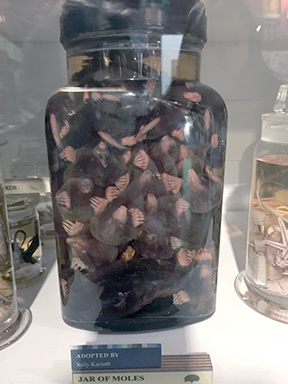
Jar of MolesThe Grant Museum itself was quite an eccentric treat. There were once lots of museums and university departments that collected skeletons, stuffed animals and other preserved dead things. But now, biological science is past the whole routine of dissecting and looking at and comparing species, presumably preferring to look at DNA–zoology usurped by biochemistry. So the Grant Museum is the last bastion of that lost art and it has been expanding as other universities eliminate their departments and dump their skeletons and skulls and jars of monkey brains in formaldehyde on the Grant, which seems to happily accept them. It really is a delightful, weird little place and the shock was that it wasn’t completely filled with little boys or odd old guys with bushy eyebrows, tweed jackets and hair coming out of their ears. The exhibit which gets the most notice, or at least is the one that seems to appear in guide books, is shown to the left. It is a big jar completely stuffed with all of these little moles floating in formaldehyde. It is hard to tell what it is at first until you look closer and see their little feet. There was also an area of slides of really tiny things, all back-lit, that was strangely beautiful. I also enjoyed the elephant heart and a collection of the skeletons of five dogs that had all been owned by the same person. You can see a Picasso anywhere, but this must be the only place where you can see a preserved monkey head next to the skeleton of an emu next to a case containing dodo bones.

Later, in the evening, we went to the Dennis Severs House, which is a sort of museum just around the corner from our building. Dennis Severs was an artist who lived there and gradually recreated the rooms into time capsules illustrating what life would have been like for a Huguenot silk weaving family over a period of time. Each room is a sort of still-life creation that is meant to give the feeling that you have entered the room just as the owner has left. They insist that you remain quiet as the noises that you hear (and the things that you smell) are part of the experience. It is all candle lit and there is an amazing level of detail. There is even a little bit of a plot to figure out as you move through space and time. Another completely unique experience.

A New Panting and Other Musings

We just got back form the O2 Center, where we saw a semi-final match in the ATP Tour finals between Raffa Nadal and Novak Djokovic. Djokovic won pretty easily. Too many unforced error by Nadal. You have to be at the top of your game to stay with Djokovic, and he wasn’t. It was still fun. We were in the Brayan Cave box, with a bunch of lawyers and guests. The O2 Center is pretty unremarkable. A big, typical arena surrounded by new construction. I don’t know what was there before (did they just raze everything that had been there or was there nothing much there?), but it is like a little mini-city rising up along the river. I can’t say it is all especially nice looking and it is a long way from anywhere (except Canary Wharf). I know that China builds entire cities like this out of thin air, designed to hold millions of people. Here they are just building these new, ugly neighborhoods….

After the game, we decided to try taking a boat down the Thames (kind of a huge, floating bus) because they were doing weekend work on some of the Underground and Overground lines and it was really complicated (multiple Tube changes) getting to the O2 for the event. (This comment makes me feel a little like Reginald Perrin. I am afraid that this is an impossibly obscure reference for most people. He was the main character on this old, very odd British comedy, which often began with him arriving to work late-again- and explaining that there was some problem on some road or train line.) Anyway, it was kind of cool taking the boat and we liked it so much we kept going to the Embankment pier, rather than getting off at London Bridge. I think I will add it to London transportation network.

I have been working on a painting for the past four or five days and I got sick of it, so I decided to try something else. I’ll probably get back to the unfinished one at some point. But it felt good to get away from it and  I did the one below in one day. It is also the biggest thing I have done. It’s based on a photo I took of a guy asleep on the Tube. I may call it “Underground Nap”. I find that I work in spurts on these things. When I get excited about something, I can’t stop working on it. The one I stopped doing was starting to seem like work.

Underground Nap

Photograph 51 and other thoughts

Photograph 51 was an x-ray photograph taken in 1952 by Rosalind Franklin and her research assistant Ray Gosling in a basement lab at King’s College in London. It is arguably one of the most important photos ever taken, certainly in the history of science, because it proved, for the first time, that DNA is the form of a helix. It led directly to Krick and Watson’s paper and model showing the building block of life itself. Watson had received a copy of the photograph and other research of Dr. Franklin without her knowledge or consent and never really adequately acknowledged her contribution. She died of cancer at the age of 37.

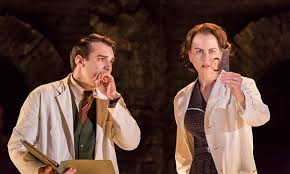
“Photograph 51”, which we saw last night, is a play by Anna Ziegler which looks at the scientists seeking to discover the nature of genes though the eyes of Rosalind Franklin, who was played by Nicole Kidman. It paints a picture of an incredibly brilliant Jewish scientist fighting the overwhelming sexism (and some anti-semitism) of her day. The rest of the cast are a Greek chorus of men, playing the other scientists and also imgresexplaining the science and moving the plot along. The play posits that, while Franklin was the greatest pure scientist of the group, it was her personal shortcomings that prevented her from being the person we associate with the discovery of DNA. She was untrusting and preferred to work essentially alone. She either lacked intuition or was afraid to make the intuitive leaps that Krick and Watson were happy to make, possibly because she, unlike them, was afraid to be wrong. She is portrayed as a repressed, almost asexual person (and a significant acting achievement is convincing us that Nicole Kidman is asexual and not good looking). She is respected and slightly feared, but not loved, by the male scientists around her. Her colleague at King’s College, Dr. Wilkins, tries to reach out to her in his own clumsy way, but she utterly rebuffs him. The play hints that, if they had worked together, we would be talking about Wilkins and Franklin as the discoverers of DNA. James Watson is portrayed as a real jerk and, to the extent that the play has a heavy, it is him. It all seems tragic, but in a way it isn’t because Franklin is portrayed as caring only about the science and not the race to be first, a race that she was unaware of. The only real tragedy is that she finally begins to like one of her fellow scientists, but just as there is a glimmering of a romance, she is stricken with cancer, which ultimately kills her fairly quickly. Nicole Kidman was wonderful and the ensemble cast is also great. I loved the set and the staging. It is a play that is more cerebral than visceral and it was enjoyable to learn about something new. But because the main character is so repressed emotionally needy, it was more frustrating than emotionally satisfying, which is not to say it wasn’t well written. Thanks to Kidman, the show is utterly sold out.

Something that Judie and I have noticed in the past and noticed again that night is that applause at the theater is completely different in London. They simply do not do standing ovations here. In New York, standing ovations are so routine as to be meaningless, given for even the most mediocre productions. One would have thought that when Nicole Kidman, a famous star who had just given a great performance, came out for a solo curtain call, the London audience might have risen. But they didn’t. Another difference is that New York audiences often applaud when the star actor first appears on stage (a practice that I don’t particularly like). They just don’t do that here.

5000 bullets. That is the number of bullets that French security forces used in their shootout with the terrorists in St. Denis the other day. Doesn’t that seem like an incredible number of bullets to be shot on a city street? Equally incredible is that all of that flying lead only resulted in the death of a single terrorist. (The other two deaths were the result of them blowing themselves up). This is one of those movie things that aways bothered me–James Bond or John Wayne or Han Solo or whoever running around with the other guys spraying bullets at him but never hitting him. It always seemed ridiculous. The French have shown in real life that maybe it isn’t.

As a result of the Paris attacks, PM David Cameron is having his own George W. Bush moment. He really wants to bomb ISIS in Syria. However, here they have the admirable philosophy that, in a functioning representative democracy, such action should not be taken without the consent of the people’s representatives in the House of Commons. (Constitutionally, that is also the way it should work in the US, but a functional Legislative branch is required and one does not exist at present.) Up until recently, there was limited support for such action, perhaps because the public and the Commons were still feeling burned by Blair’s foray into Iraq with W. Anyway, now the public is nervous and angry and Cameron is pushing for bombing and he will probably win. The Scottish National Party, which had been opposed to such interventions, is now open to considering the idea if there is a plan and, ideally, a UN mandate of some sort. (That may be a problem, since, as far anyone can tell, Cameron’s plan is “Let’s go over to Syria and bomb the crap out of them.”) In the meantime, poor Corbyn, who can’t catch a break (although much of his problems are because he never expected to be Labour leader and really came in without a coherent plan), is in a difficult spot. He is a lifelong, committed pacifist and a large portion, but not all, of Labour are very skeptical about these sort of military responses. They are saying some sensible things, like “We shouldn’t act in the absence of a UN resolution” and “I don’t see what is really accomplished by adding our bombs to all of the bombs being dropped by the US, Russia, France, etc.” But the whole thing is a stampede and Cameron is going to win, getting some disaffected Labour votes along the way, and Corbyn is going to look out of touch and irrelevant (again).