Vienna, Part 2

Continuing with some more stories from Vienna:

Sigmund Freud and Cafe Central: On Monday we had a late flight, so we went to the Freud Museum. Freud spend virtually all of his professional life in Vienna and lived in the same place for most of that time. The apartment where his practice was is now a museum. Freud abandoned it in 1938, when he fled Vienna, with his family and a few friends, when the Nazis took over. He had to pay a substantial fee to the Nazi government to get exit visas, but, with the help of influential friends, he did get out. (His sisters did not and they perished in the concentration camps.) Freud took all of his furniture, notes and his extensive art collection with him when he moved to London (where he died the next year) and the apartment was used by the Germans during the war and then rented out like any other apartment until around 1970 when a foundation purchased it to create the museum. Freud’s daughter, Anna (a significant figure in psychology in her own right), donated a few of the original pieces of furniture from the original office and the waiting room is supposed to be much like it looked in the 1930s. But the famous couch was not there. There are a few of his books and a some samples from his collection of antiquities. There was, of course, lots of information about Freud’s life and his work, which probably would have been more fascinating if I cared anything about psychoanalysis. There was also a special exhibit about Anna Freud and other trailblazing women in the filed of psychoanalysis, which was both well-done and went along with other things we had seen over the weekend dealing with the changing role of women in the early twentieth century.

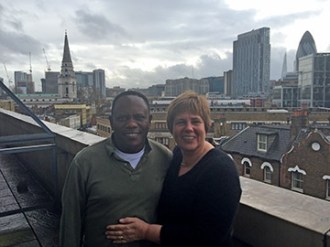
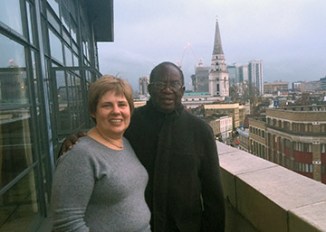
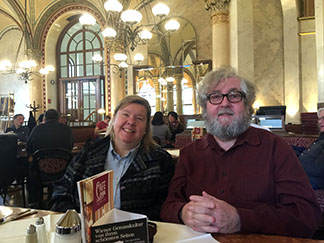
Afterwards, we walked around his old neighborhood and ended up at Cafe Central, where Freud liked to go after his walks and hang out. It really was the place to go in the 1910s, at least for a certain set. Lenin and Trotsky were also regulars at that time, as were Tito and Hitler and a substantial number of the Viennese literati. It was a beautiful room in what had once been a bank and the pastries were to die for. Here we are there:
Cafe Centrale

Lichtenstein: As we wandered around Freud’s neighborhood, we came upon the Lichtenstein Place (now a museum), which had been the home of the family that gave the name to the country. It turns out the Lichtensteins were a very wealthy Austrian family and somewhat influential in the Viennese court, where they wanted to increase their profile. So they bought what is now Lichtenstein and successfully maneuvered to have it recognized as a principality of the Holy Roman Empire, thereby significantly increasing their prestige and power. No one from the family bothered to visit the principality for over 100 years. It is oddly appropriate, in light of that history, that Lichtenstein is now one of the world’s great money laundering centers.

Vienna and the Jews: One of things about traveling in much of Europe is the presence of the Holocaust in the background. Vienna had a substantial Jewish population in 1938 and had one for many centuries. But in March of that year, it was the time of the Anschluss and the “invasion” of the Nazis. It is hard to really characterize it as an invasion, since a significant majority of the population favored the annexation by Germany and greeted Hitler with flags and salutes. Hundreds of thousands of Viennese came to cheer him as he spoke from a balcony of the Hofburg Palace, overlooking the huge Heldenplatz (Square of Heroes). After the war, in what our tour guide characterized as an act of “mass amnesia”, the Austrians convinced themselves that they were were the first victims of Hitler. Many of the wealthy and influential Jews escaped in 1938, as Freud did, but tens  of thousands were exterminated. There is a very nice Holocaust memorial–a sort of building made of books–although I wonder if it is a part of the regular tours, as it is a little out of the way and there weren’t many people there. Even move moving was a street in a Vienna neighborhood that had been largely a home to Jews before the War. (If they had stumble stones in Vienna, as they do elsewhere in Europe, it would have been hard to walk down that street and many others.) The current residents had researched the families that had lived on the street and created a memorial of keys with the names of each family attached to the key with a tag. There were over a hundred of them

Final Thoughts on Vienna: It would be easy to go on and on about the history, art and architecture of Vienna. It really is very charming and, unlike Germany and London and other parts of Europe, missed being demolished in the World Wars, giving it a trapped amber quality. It is also a small-feeling city, even though it goes on for quite a way when you drive out of its center and it certainly lacks the energy you feel in vibrant city Like London or Paris or Berlin. It was certainly a fun place to visit though….
Vienna, Part 1

Our friends, Peter and Andrea arrived last Wednesday for a visit, so I have been preoccupied with them. Then, over the weekend, we spent four days in Vienna, so I’m just getting around to writing and painting, while they go out to visit a friend in Shepherd’s Bush (a leafy London neighborhood near Notting Hill). I had planned to write one post about our trip to Vienna, but it was getting too long, so I’ll cut it off and finish the rest later.

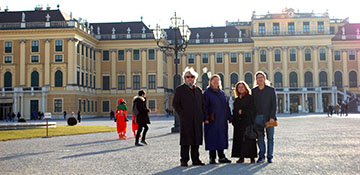
Vienna is a beautiful city, with most of the important things to see concentrated in the center. It is not very big (less than 2 million) and is actually smaller than it was before World War I. It is very walkable and was distinctly uncrowded. I don’t know if we were just out of season, so there were not many tourists or if the place was envisioned by Franz Joseph to be a bigger place than it turned out to be. I won’t try to write a travelogue, which could be boring and will try to concentrate on some highlights of the city and our visit.

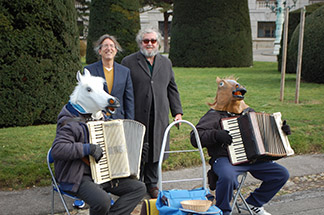
accordians  Vienna

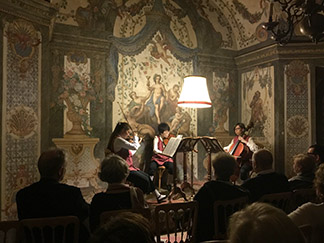
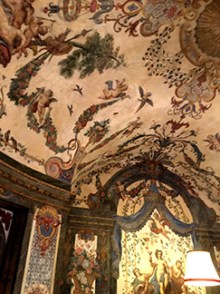
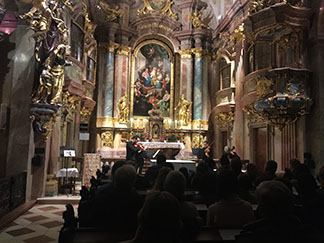
Mozart: Although Mozart was born in Salzburg, he came to Vienna as a child prodigy and his likeness is ubiquitous in the city. We had a tour guide (who was great) on Saturday and, as we walked around, she pointed out things like the building where Mozart gave his first concert in Vienna (at the age of four or five), the room in the Schönbrunn Palace (the Hapsburg’s summer palace, originally built in the woods outside the city, but now absorbed by the city and relatively close to the center) where Mozart first played for the Habsburg rulers, and several of the many places (she said 14) where he lived. (Mozart would move into nice apartment in Vienna when he had made a lot of money and then blow it all and have to move out. He did this repeatedly.) There is Mozart candy and lots of classical music performances, mostly featuring Strauss and Mozart, with Haydn and Beethoven often added. On Saturday night, we went to a concert at a place reputed to be the oldest concert hall in Vienna. Mozart had lived in that building for a period during 1781, when he had returned to Vienna. The hall itself, the Sala Terrena, was small (it seated, at most 70 and was not full), with vaulted ceilings and baroque frescoes from the mid 1700s. The acoustics were wonderful and it was pretty cool to sit there thinking that we were in the same exact spot where Mozart had performed. Inspired by the experience, the next night we went to see a similar performance at a beautiful old church. The music was lovely but it wasn’t quite as magical. A few pictures follow:

Mozart   Mozart2

St Ann Music

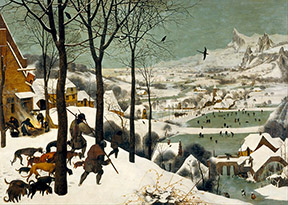
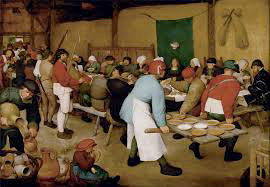
Klimt, Schiele and Kokoschka: Vienna was a city of great music and great composers for a long period, undoubtedly thanks to the support of a series of Habsburg emperors. And I think it might still fairly be characterized as a city of music, with its great Opera House and many other wonderful music venues. As for painting and sculpture, the Habsburg Dynasty had a number of collectors and the museums of Vienna have any number of paintings by the great artists, mainly French and Italian, who were active during the centuries when they held power. The collection of Breugels in the Kunsthistorisches Museum is absolutely incredible, containing several truly iconic works. The museum also has its share of works by Caravaggio, Reubens, Titian, Rafael, etc. And the building itself is striking, built by Emperor Franz Joseph in the 1890s specifically to house his art collection and impress the world.

Hunters snow    Peasant Wedding

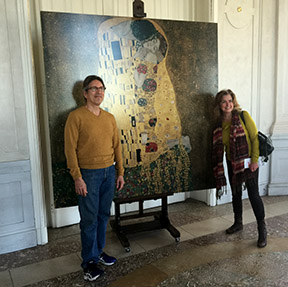
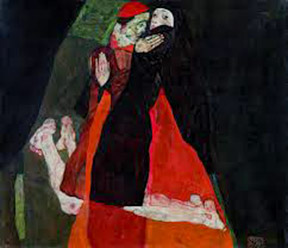
But unlike the world of music, which had its share of renowned Viennese composers, there really weren’t many great Viennese painters. (With the domination of French and Italian and Flemish painters, it sometimes seems hard to appreciate that there were some talented Eastern European painters.) However, Vienna did have one great period of painting, a time that began in the 1890s and ended in 1918 when Klimt and Schiele both died. I’m not sure I ever appreciated how wonderful these artists were until we visited the Belvedere Palace and viewed their extensive collection, which includes Klimt’s masterpiece “The Kiss” (and which has a separate “selfie room” next to the painting with a copy of the work–I forgot to bring my selfie stick however). Here are Peter and Andrea in the selfie room and a striking Schiele work.

Selfie Kiss   Schiele

In addition to the usual collection, the Belvedere had a special exhibit which examined the paintings that Klimt, Schiele and their contemporary Kokoschka of women and how that reflected on the changes in the roles of women that were happening at the time. It was fascinating. Schiele was a genius, but a psychological mess who died very young, and his paintings of women showed it. Klimpt went from doing portraits of the bourgeoisie to increasingly strange and spacey works. Kokoschka, who I had absolutely nver heard of beofre the exhibit, was very talented as well. He hada tumultuous affair with a women named Alma, who hung around with the artist of that era. She dropped poor Kokoschka because he was too nutty and married Mahler (and later Walter Gropius). The distraught Kokoschka joined the army, but managed to survive World War I and went on to have a much longer career than his more noted contemporaries.

The Habsburg Dynasty: Our tour guide did a great job of explaining the Habsburgs to us, even taking us into the crypt of a church where they are all buried and you can walk along through their coffins sequentially. (One weird thing is that their hearts and intestines are embalmed and entombed somewhere else!) The Habsburgs were the leaders of the Holy Roman Empire for a number of centuries (until Napoleon put an end to it) and were an incredibly powerful and wealthy family. However, they intermarried so frequently over the years that they began to look rather strange, with long jaws and drooping lips and big noses. (it must have been a big problems for artists paid to paint or sculpt them. How to make them recognizable but not ugly?) There seem to be two of them that got most of the attention in the tours and museums: Maria Theresia and Franz Joseph. Maria Theresia was notable, in a sense, simply because she was a woman who succeeded in becoming the monarch in the 1700s. She had to win the War of Austrian Succession to accomplish it and ruled from 1740-1780. One of her sixteen children was Marie Antoinette. Among her many accomplishments was the introduction of compulsory education. She also created one of the world’s first public museums when she bought Belvedere Palace and transferred the Imperial art collection there.

Franz Joseph took over from his mentally incompetent uncle in 1848, as part of an effort to deal with the revolutions of the day. He served until 1916. He was a furious builder, expanding the Hofburg Place in central Vienna into a mind-boggling, gigantic complex and also building a number other ornate structures around it that are now museums. He tore down the moat and walls that surrounded the castle and center city and constructed the Ringstrasse, a wide circular boulevard which eventually became lined with palaces of nobles and fine homes of the wealthy. (A part of the plan for the Ringstrasse was to build an avenue too wide to be barricaded by revolutionaries.) Franz Joseph was a workaholic and his apparent building obsession seems odd, since, in many respects, he was glorifying the Habsbug dynasty just as the whole thing was beginning to collapse. (Maybe that was the point of it all.) He led a tragic life. His only son committed suicide after murdering his mistress, a scandal that they somehow managed to cover up for years. His wife, who was said to be the most beautiful woman in Europe, was assassinated in Geneva by an Italian anarchist, whose intended victim had not shown up as scheduled, so he decided to kill the next royal he saw. With no heir, Franz Joseph named his nephew to be his successor, but he famously was assassinated in Sarajevo, starting World War I.

More to follow…..

Unitarian Road Trip and a New Painting

On Sunday, I took at trip to Lewisham to visit another Unitarian Church. Lewisham is a pretty big area of greater London, south of the Thames. It is where some rail lines meet and the DLR ends, so it has become a big shopping area. It is, naturally, very old, having been founded by a Jute invader at the intersection of the Quaggy (really!) and Ravensbourne rivers in the sixth century. I’m sure that for much of its existence it was a town on the outskirts of London and was gradually absorbed. It seems to be a bustling and diverse community, at least judging by my view from the bus. I decided to take the 47 bus to the Unitarian Church (rather than two trains) because I could catch it a few blocks from our flat and be dropped off a few blocks from the Church. It was 55 minute trip getting there, but it was mildly interesting going through parts of London I’d never seen (Bermondsey, Canada Water, Deptford, etc.) But on the way back, I found out that the roads between Lewisham and Canada Water were a parking lot, jammed with drivers, presumably shoppers, and the trip back was agonizing, taking nearly two-hours door-to-door. Next time I take the train.

I usually refer to Unitarian churches as congregations, but this one really was a church. It was housed in a row house, where it apparently has been for decades, and had a distinctly Christian tone. Lots of God and Jesus. I had heard that the Unitarians in Britain were generally more Christian-leaning than the UU version in most of America (with Andy at New New Unity being a notable exception). The sermon was good, I guess, but it was all about Julian of Norwich, a 14th century woman who had a vision and wrote a book. I suppose for the time, she had a relatively liberal take on Catholicism. But it was pretty straight modern Christian theology. It seemed to me to be a sermon of relentlessly standard Christian thought and without any real moderating influence that I would ahve expected. It would have been extremely hard to give that sermon in Montclair and almost impossible to give at Newington Green. I spoke to the minister after the service and she said that her church did have a more Christian and traditional religious approach and that Unitarian churches get more Christian as you move north, with Bible readings common in the northern versions. I was there to check out the congregation in anticipation of leading a service in March and I told the minister that I wasn’t sure that I could really do a Christian service. But she seemed to think it would be fine if I just talked about social justice.

It seems to me that both this Church and the English Unitarian movement are on the wrong track. They are in a country which is distinctly non-religious and skeptical about the value of organized religion. (Much of the U.S. is headed in this direction too, but it has reached the point in England where religion is simply not something that most people (especially young people) even think about.) Offering a sort of Church of England Lite (as opposed to a big tent, make your own theology, non-judgmental organization) seems like an utterly losing proposition. And, in fact the Lewisham Church had ten congregants and no obvious sign of a future. In contrast, New Unity, which stresses community and feminism and being radically welcoming (and has an acknowledged atheist as it minister) is growing so explosively that it will have to consider adding another service. It will be interesting to see how I go over in March……

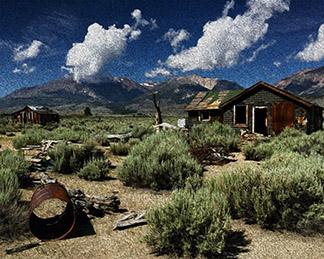
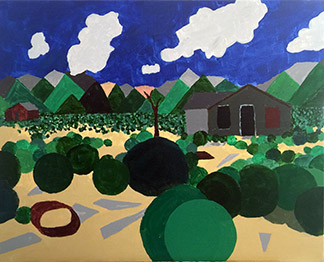
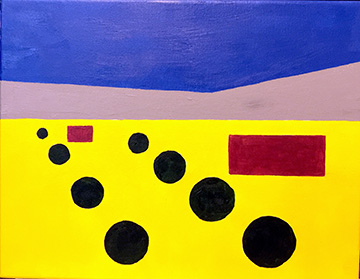
A Progression Leads to a New Painting: I published a blog with a new painting about a week or two ago. It was the painting of the desert scene. I was never quite happy with it. I think it was partly that I decided to make it more geometric than representative, but didn’t end up really following through on the idea and it ended up half way in between. Then I had an idea (in bed or in the shower or one of those other places where you have ideas) that I should really reduce the scene to its simplest form and paint that. I was busy struggling with the winter painting that was in my last post, but, when that was done, I whipped off my idea very quickly. It is sort of an interesting progression. It started with this photo:

desert shack

This led to the painting that I discussed in a prior posting:

Desert Scene

And finally, I ended up with this:

Ghost ranch 2

I’m not sure that the color is reproduced correctly (the balls should be greener and the hills grayer), but you get the idea. I’m glad that I did it, if for no other reason than that it means that I can stop thinking about it. I could probably do a further reduction and end up with something like a Miro. But it is hard to do and I think I’d rather do something else.

Painting the Modern Garden and a New Painting

This week we went to the Royal Academy to see the opening of “Painting the Modern Garden: Monet to Matisse”. This exhibit succeeds the Ai WeiWei exhibit that I loved. Because of the aforementioned screw-up with tickets that compelled me to join the Royal Academy, we went to a member’s preview, but it was still a bit too crowded. This show is going to be very popular and will be hard to get into. It will eventually go to Cleveland.

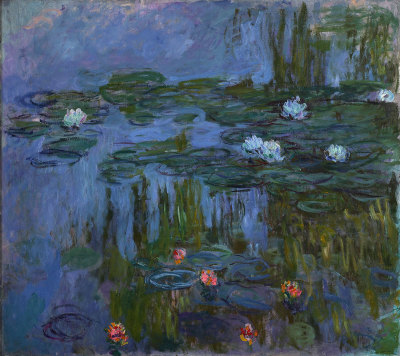
Much of it was focussed on Monet. There were lots of pictures from Giverny, covering the entire period that he lived there, from 1883 to his death in 1926. It included many water lily  and Japanese bridge paintings, which let you see how Monet’s paintings of the same subjects not only differed as he painted them in one period, but also evolved over time. Toward the end of his life, he focussed completely on painting his water garden, continuing to paint as German troops neared his home during World War I and he could hear the artillery fire. While his family fled, Monet continued to stay and paint, feeling that it was his patriotic duty. His weeping willow canvases, finished towards the end of the war, were a haunting statement of his sadness at the inconceivable tragedy that had just occurred and the paintings of water lilies in that period (like the one below) were in darker blue hues. At the end of Monet’s life, he concentrated on his monumental works. Most of them went to the L’Orangerie Museum after his death, but one tryptic remained in his studio until it was sold by his son to three different museums many years later. This exhibit is the first time that the three huge panels have been seen together since that sale and were the climax of the exhibit (and I suspect the initial inspiration). But it was no more astonishing than many of his other canvasses of irises, water lilies, bridges and flowers.

rceqiwuganhcucapt3il.jpg

Just gathering together all of the Monet paintings would have made for an impressive exhibit, but this was so much more than that. It was also about gardening and the creation of the modern garden. Monet and many of his contemporaries were fascinated by gardens as a subject-matter for their art and began to construct their own gardens. This coincided with a huge general boom in gardening, as exotic plants from the Americas, Asia and Africa began to appear in Europe, as new transporting systems had been developed to allow whole plants to be shipped rather than simply seeds. (Phylloxera bugs in such exotic imported plants from the Americas ended up destroying the vineyards of Europe, but that’s another story.) Gardening was booming and an artist like Monet had a huge variety of flowers available as a palette to create their own horticultural art. He began designing gardens when he lived in Argenteuil in the 1870s and considered his garden at Giverny his greatest achievement. And the exhibit showed just how fascinated Monet was with horticulture. It had letters he sent, including one to the local authorities complaining about the delays in approving his water garden, catalogs he read and stories about his purchases. He was at the cutting edge of water lilies and got the new varieties that would grow outdoors in France.

And, the exhibit makes abundantly clear, it wasn’t just Monet. Countless other artists were represented. Renoir was one of the early artists with a garden and there was a wonderful Renoir of Monet painting in it. Camille Pizarro had a garden, but preferred to plant vegetables and was known as the one who painted cabbages. Pierre Bonnard lived nearby Giverny and he and Monet would visit each other’s gardens, although Bonnard preferred to let his grow wild. Max Liebermann developed extensive gardens outside Berlin and spent most of his life painting it (incredible wild brushstrokes). Emil Nolde was so taken with painting flowers that he also had a garden, as did Wassily Kandinsky, and both had works of astonishing colors. Van Gogh, of course was famous for painting flowers and fields (but was too poor to have his own garden), especially while in Provence, and influenced Munck to have a garden. Also represented were the more melancholy garden paintings of Spanish artists Joaquin Sorolla and Joaquin Mir y Trixit. I could go on and on. I don’t know how you could go to this show and not come away wanting to plant a garden. Of course, I can’t do that here, but I will definitely paint some.

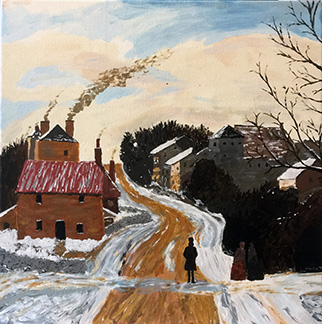
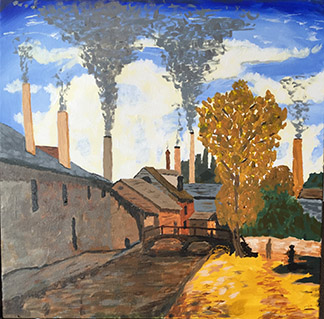
A new painting: The painting below is based on some impressionist painting I saw and photographed at some museum (maybe the National Gallery). I liked the composition and the idea of doing a wintertime picture appealed to me. But when I actually painted it, the whole thing just didn’t work. There were blobs of black and gray, which somehow worked in the original, but just looked like blobs of black and gray when I did it. So, for the first time since I started this painting experiment, I painted over a big part of what I had done. I completely redid the bottom left corner, making it into a path going to the left with some dirty snow representing a filed, perhaps on the edge of the town in front of us. I added stone walls in place of black spots (hedges??) and made the road sweep in a better way. Finally, I changed the gray blob into something that gives the impression of a castle. I like it much better. It has a sort of story now. We’re at the edge of a town, just getting out of the fields, on a winter day, having reached a path crossing the main dirt road. A man is walking up the road, as are two women. Perhaps they are going to market. The painting is below. (It is what I have decided is the second in ma\y smokestack series. I’ve also included the first one for those of who have not been following religiously.)

WINTER

monet riff


Robert Burns and D.H. Lawrence

“Some hae meat and canna eat,
And some wad eat that want it,
But we hae meat and we can eat,
And sae the Lord be thankit.”

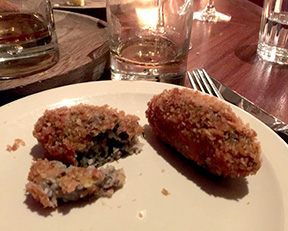
Judie found out at work this morning that Monday Night was Burns Night, so we decided to go out to have Burns Night feast. We probably should have found a place that had bagpipes playing and someone slicing open the haggis with a sword (they do that, we are told), but we settled for going to a nice local restaurant that had a special menu featuring Haggis croquettes, cock-a-leekie soup (which I had made for a themed British dinner before we left), venison, and heather honey tart. We got into the spirit (literally), by doing some scotch tasting. Lots of fun. A few pictures follow:

Haggis Croquette  cockaleekie

Judie has been conducting a Cakes for the Queen of Heaven class for the past couple of weeks. It is a UU class about women and goddesses and seems to have an amazing impact on anyone who takes it. Because Judie couldn’t get a room at New Unity or their satellite location in Islington, it ended up being held in our flat. Everyone seems to love doing it this way, although it is not the way they seem to do things here. It is unusual to be invited to someone’s home. (Of course, flats are smaller here. And a lot of the New Unity members are young and somewhat transient and don’t really have places for company. But there is something deeper going on.) For the first two classes, I went out and had dinner (no men are allowed and I didn’t feel like hiding up in our bedroom.) Some appropriate thoughts from Robert Burns:

“While Europe’s eye is fix’d on mighty things,
The fate of empires and the fall of kings;
While quacks of State must each produce his plan,
And even children lisp the Rights of Man;
Amid this mighty fuss just let me mention,
The Rights of Woman merit some attention.”

For Tuesday’s “Cakes” meeting, I got tickets to see “Husbands and Sons”, a play based on the writing of D.H. Lawrence, at the National Theatre, rather than killing time eating and drinking Shoreditch. I was expecting something kind of depressing and bleak and I certainly wasn’t disappointed in that regard, but it was wonderful and surprisingly moving. D.H. Lawrence came for a coal mining family and it is a tribute to his talent that he escaped and became D.H. Lawrence. Once he left Eastwood in the East Midlands, he wrote several plays early in his career that focused on the mines and the families impacted by the mines. I suspect the plays are semi-autobiographical. He wrote three plays early in  that period, “The Daughter-in-Law”, “The Widowing of Mrs. Holroyd”and “A Colliers Friday Night”, which all seem to be set in the same town (probably Eastwood). Lawrence’s genius was that in each of these plays he looked at the dynamics of a miner’s life through he eyes of the women in their lives. (This would be a great field trip for Judie’s Cakes class.) Tragically, Lawrence never saw any of these plays produced in his lifetime, but they were discovered later and had notable productions in the 1960s.

This National Theatre production brilliantly combines the three plays mentioned above into a single production (presumably edited), with each of the households in the individual plays occupying an assigned part of the stage. There is minimal scenery and costumes and much of the things like opening doors and putting on and taking off of coat is suggested at through simplistic mime and/or sound. The action moves around the stage between the stories of the three families, sometimes overlapping. One of the really cool things was that I got a ticket in “the pit” and when I got there discovered that this meant that I was in the front row on the same level as the actors (effectively on stage except for the bar between me and the action). But then the play started (with sounds of the mines and blackened men marching across the stage) and the next thing I knew, the bar rose up into the ceiling and there I was on the stage, 10-20 feet from the “homes of two of the families. And then, after the interval, I was move diagonally across the theater to a similar spot near the other family (actually even closer–I could have put my plastic wine glass on to the set in front of me without leaning forward much).

I have to say that I actually resisted being drawn into this. It initially seemed like one of those predictable bleak tales of poor miners and it could have been that, if it had focussed on the men. But the focus on the wives (the new wife whose husband was still too attached to his mother to truly love her–the wife married to drunken brute, scared for her young son and attracted to a man who appreciated her–and a woman dealing with a dismissive husband but with the vaguely Oedipal relationship with a son who was escaping the mines and going to college, which really seemed like Lawrence), it all drew you into the stories in ways that were variously moving. There was no happy ending. One of the husbands dies in mine accident (and his body is put on a table no more than 6 feet from me). No one seems much closer to escaping the mines or even achieving happiness. But, by the end, you had to feel close to these three families and their struggles.

The acting was, of course, superb. I’m not sure this is a complaint, but the Midlands accents were a bit hard to follow, especially at first. A lot of “thees” and “thous” and things like that. and when the men were drunk and yelling, I could barely understand them, although I’m not sure that it mattered (or whether the English in the audience could understand them either). It would be hard to pick out any one performance to laud above the others. I recognized Louise Brealy from “Sherlock”on PBS and Anne Marie Duff is a very famous stage actress. But the acting was uniformly great and the staging was wonderful without calling too much attention to itself.

I’ll close this with another Burns poem:

“Ye see yon birkie, ca’d a lord,
Wha struts, an’ stares, an’ a’ that;
Tho’ hundreds worship at his word,
He’s but a coof for a’ that:
For a’ that, an’ a’ that,
His ribband, star, an’ a’ that:
The man o’ independent mind
He looks an’ laughs at a’ that.

A prince can mak a belted knight,
A marquis, duke, an’ a’ that;
But an honest man’s abon his might,
Gude faith, he maunna fa’ that!
For a’ that, an’ a’ that,
Their dignities an’ a’ that;
The pith o’ sense, an’ pride o’ worth,
Are higher rank than a’ that.

Then let us pray that come it may,
(As come it will for a’ that,)
That Sense and Worth, o’er a’ the earth,
Shall bear the gree, an’ a’ that.
For a’ that, an’ a’ that,
It’s coming yet for a’ that,
That Man to Man, the world o’er,
Shall brothers be for a’ that.”

Stories from Across the Pond and a Painting

Preacher Man?: I have somehow volunteered to lead a service at a Unitarian Church in Lewisham. It’s apparently tiny and very new and the new minister sent out a call for service leaders. Andy, the New Unity minister, forwarded it to me, since he knew that I had participated in services in NJ (mainly ones dealing with the UU Legislative Ministry). I expressed some mild interest and, the next thing you know, I am going to Lewisham on 31 January to meet the minister and check it out and I am scheduled to lead the service on 13 March, although I am not sure exactly what that entails. So I’ll get to see a different part of London and meet some new people and do something nice for a new Unitarian congregation. How bad can it be? We’ll see, I guess.

Meanwhile, at New Unity, the focus for the January through March period is Justice and I suggested that a message (Andy doesn’t call them sermons–too religious sounding I guess) could be about Law and Justice and the difference between the two. His reaction was “OK. Good idea. You give it.” I’m not positive that it will happen, but I’ve started researching it and thinking about what I would want to say. I discovered that it is much easier to find quotes decrying the Law and its failures to seek or accomplish justice than it is to extol Law’s virtues in that (or any) area. What am I getting myself into?

More theatre thoughts: They call the intermission between acts an “interval” and ice cream is always sold, usually in the theatre itself. Eating ice cream during the interval seems to be a British tradition. And you can bring the ice cream (or a beer or a glass of wine) to your seats. I wrote earlier that British audiences don’t do stranding ovations. But after the “Henry V” and the conclusion of the “King and Country” marathon, the entire audience did spring to their feet to cheer (justifiably) the performances of the Royal Shakespeare  Company.

BBC Story: The BBC presented a story about global warming and the temperature rise in 2015. They had their science reporter do an introductory piece on it and then turned to conduct a live interview with an expert in the field, as they like to do. So this “Climate Professor” from the University of Leeds came on to opine. Unfortunately, he was a stutterer and very nervous, which made him stutter more. You could see the panic in his eyes as the panic made the stuttering even worse, to the point where you were wondering if he was going to ever get the next word out. (Imagine an even worse stutterer than Colin Firth in the “King’s Speech”, but without Geoffrey Rush to help him.) It was slightly humorous, but mainly incredibly painful to watch. I can only imagine what the BBC newscaster conducting the interview must have been thinking. (“Didn’t my producer talk to this guy before putting him on? How can I end this gracefully?”)

An odd political casualty: The Minister for the Environment (or some such title) was forced to resign recently. One of his duties was to deal with natural disasters, like the flooding in Northern England and Scotland in the weeks before Christmas, which as pretty awful. He never showed up, which in itself isn’t so bad since he would have just gotten in the way. What really got him into trouble was that he said that he was at home with his family and was monitoring the situation. Too bad for him that it emerged that the home was in Barbados! One instantly pictured him on beach sipping pina coladas, while thousands of middle class and poor people were on television crying about their losses and army guys are slogging around in cold water up over their knees. He was doomed.

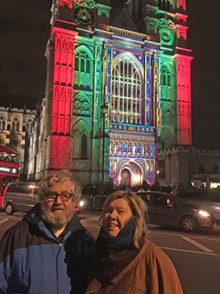
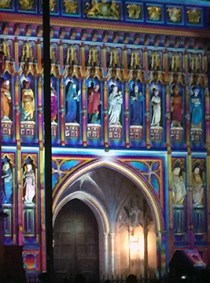
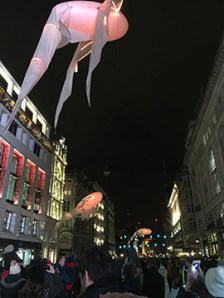
Lumiere: Last weekend, London held a four-day, light-inspired arts festival. There were some indoor exhibits of neon and other types of light art. I went to one at Bloomberg’s offices, but they wouldn’t let me take a picture of it. Most of the event was outside and on Sunday we met up with Jane and Paul Jee (after Henry V) to have look. After a delicious meal of Indian food at Dishoom, we wandered about Regent Street and Carnaby Street, eventually wandering over to Trafalgar Square and then on to Westminster Cathedral, where a projection on the front was supposed to show what it originally looked like when the statues were all painted. Another highlight was an incredible neon light exhibit on Regent Street in which figures jumped, climbed and cavorted in a complex pattern that went for over ten minutes. I also loved the huge movie of an elephant that was projected between two columns on a beaux art building near Piccadilly Circus (complete with sound) and loved it even more when we went around the corner and saw the back of the elephant. There were lots of huge projections and a whole series of men formed of lights floating in the air or sitting on buildings. Many of the pieces had music accompanying them and the crowds were surprisingly enormous, especially since it was pretty cold. All kinds of streets were closed and it was all very festive. A few photos are below.

Westminster Portrait  Westminster closeup  Picadilly baloons

A New Painting: Jamie sent me a picture that one his friends took of shacks in the desert and I liked the composition and decided to painting. Shortly after starting, I decided that I didn’t wan tot try for a realistic or impressionistic rendering of the scene and decided to see if I could create it using largely geometric shapes (triangles for the mountains in the distance, circles for the sagebrush or whatever the cactus was and other shapes for the wood on the ground and the two shacks). It was a kind of instructive exercise. The end product looks kind of like some sort of naive folk art or something. Not what I was expecting. But it is good to try different things since it is not like I am incredibly proficient at some particular style. Here it is:

Desert Scene

Shakespeare Immersion

It was at least thirty years ago that Judie and I figured out that the Royal Shakespeare Company virtually never misses in its performances and we made an effort to see whatever they brought to New York. They put on most of their performances here at Stratford, which is a bit too far away to comfortably get back to London after a show. So, when we go to a performance there, we’ll have to stay the night. But the RSC does put on some performances at the Barbican Centre, which is a very short walk from Judie’s office. so we bought tickets to “King and Country” months ago.

“King and Country” is a special package of four history plays, “Richard II”, Henry IV, Parts 1 and 2″ and “Henry V”. We saw all four of them last weekend, starting with Richard II on Friday evening and ending with Henry V in a Sunday matinee. One of the many remarkable things about this experience is that, because the tickets were sold in a package of four (you actually got a single ticket for all four shows), the audience was the same for each performance. That meant that you ended up sitting next to the same people for hours and chatting about the performances and about Shakespeare and other plays that they had seen (As you might imagine, anyone who would sign up for that sort of Shakespeare immersion had to be a theatre buff and Shakespeare lover.) It was an unexpected bonus.

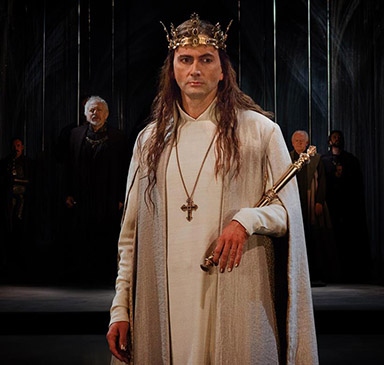
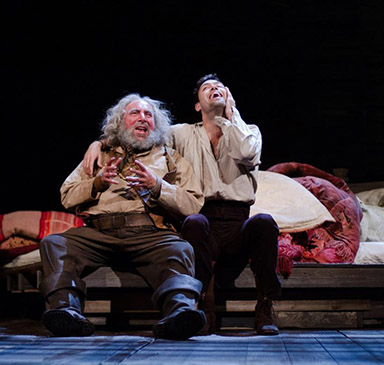
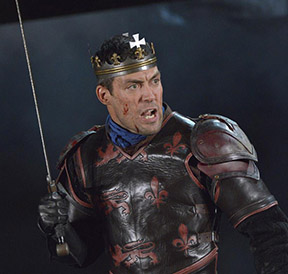
It is hard to put into word what a remarkable experience it was to watch these four plays. It’s a RSC production, so every actor is wonderful, down to the smallest part. David Tennant, who should be familiar to Doctor Who fans, was a memorable Richard II, especially in the later scenes when he first knew that he was going to be usurped and then when he was waiting to die. Alex Hassel, playing Prince Hal, did three performances in the space of just over a day, going from dissolute companion of Falstaff to the heroic King at Agincourt before our eyes. Anthony Sher was nuanced and extremely funny as Falstaff. (All of the comic scenes in the four plays were done brilliantly.) Oliver Ford Davies was also memorable, first playing a tormented Duke of York in Richard II, then reappearing as a hilarious Justice Shallow in Henry IV, Part 2 and finally wowing us as the Chorus in Henry V. Joshua Richards appeared in all four plays, played five parts, most of them comical, and the amazing this was that I didn’t realize it was him playing all of them until I read the programme. I could really go on and on. The musical additions were great. The action scenes were exciting. But the best part, ultimately was being caught up in a story that covered about twenty years of English history and provided Shakespeare with opportunities to wax patriotic.

It was an interesting time. It all begins toward the end of Richard II’s reign, around 1397, when the King has become increasingly tyrannical and the noblemen are chafing under his rule. The breaking point comes in 1399 when Richard first banishes Henry Bolingbroke, his uncle John of Gaunt’s son, and the confiscates all of their land and wealth when John dies. Henry comes back to England to assert his rights and the other nobles join him. Together they depose Richard and Henry takes the throne as Henry IV. It had to be a little tricky for Shakespeare to write a play about a tyrannical deposed monarch in Elizabethan times. But rather than focusing on the politics of the usurpation, the play is more about the sacred authority of the king is undone by Bolingbroke and the psychological anguish of Richard in reaction this. This approach makes Richard a sympathetic and tragic character, undone by his own overreaching for power. While Richard was probably a miserable and cruel dictator and murderer in real life, Shakespeare creates an epic tragic figure that gave David Tennant the opportunity to amaze.

Richard II

Shakespeare had an even more difficult task writing a play about Henry IV, as you can imagine that Queen Elizabeth would not have looked kindly on a drama which made someone who overthrew a monarch look good. In fact, Henry IV fought a long civil war against various rebelling noblemen, most memorable of whom was Henry Hotspur (spectacularly played by Matthew Needham), and arguably saved the British monarchy and a united England. Shakespeare got around this dilemma in Henry IV, by ignoring the king as much as he could, and making both plays more about Prince Hal, creating the character of Falstaff and the other reprobates of East Cheap. One thing that surprised me is that there is a certain anti-war element to Henry IV, Part 2. Falstaff has been assigned by Hal to recruit a company to fight, which allows us to see war from the soldier’s view, rather than from the court. The resulting scenes of recruitment and then of Falstaff and his friends trying to stay alive in battle are both funny and pointed. (Falstaff was supposed to be a character in Henry V as well, but the actor for whom the part was written quit Shakespeare’s company for a rival one, so he killed Falstaff off at the beginning of Henry V.)

Falstaff

Henry V was written as Elizabeth was embroiled in The Seven Years War in Ireland and is a patriotic rally-the-troops play. (Indeed, Olivier made a movie version in World War II for that reason.) It’s climax is the Battle of Agincourt, when a tired and starving outmanned English army utterly routed the French, killing nearly 10,000 Frenchmen, while losing less than 100. Henry has some unbelievably stirring speeches to his men. By this time on Sunday, Alex Hassel has transformed himself into the charismatic warrior king and it is easy to imagine the impact this all had, both on Elizabethan audiences and on World War II moviegoers.

Henry V

This is coming to New York in the spring and will be at Brooklyn Academy of Music. Get your tickets before it is too late.

Rest in Peace

Untimely death was a bit of a theme this week:

I learned during the week that my friend Ed Billy had died. He was a guy I knew from Montclair. Our sons James and Thomas were buddies and we were both UUs. He was a jazz lover and I always looked forward to running into him. Always a smile and a friendly word. When I was the UU Montclair President, he had volunteered to look after the building and we worked together frequently. But one of my strongest memories of Ed was when we were called to the Montclair Police Station, where our sons were being held for trespassing in a parking garage owned by a car dealership. The police were pretty relaxed about it, perhaps in part because I was on the Town Council at the time and knew a lot of them. Ed was simultaneously bemused and annoyed at the kids and forever after referred to them as “the knuckleheads” whenever we met. Ed was one of those people who, while he was not in my inner circle of friends, was an important part of my life for many years and I will feel the hole created by his loss for years to come.

The deaths of Alan Rickman and David Bowie, both coincidentally dying in the same week at the age of 69 from cancers that neither had publicized, probably struck people harder here in London that it did in the U.S. Both were products of London and Londoners and Brits identified with them in a deeper way than most Americans. Bowie in particular seemed to have place deep in the hearts of working class Brits of a certain age.

David Bowie was a larger than life sort of figure, a visionary artist who was one of the first to merge performance art and rock and roll. He was much more than a rocker or a pop star and I always thought that there was a deep intelligence and creativity underlying his many personas. He was introduced to me in the early 1970s by Bill Cifrino, who returned to college in the fall of whatever year it was having become a big fan. (I think this was in the Ziggy Stardust period.) Bowie never fascinated me the way that he did some, but you always were curious about what he was going to do next.

The death of Alan Rickman was a sadder occurrence for me. I think this is partly because of the special feeling of “discovery” Judie and I had seeing him playing the Vicompte de Valmont in “Liaisons Dangereuses” on Broadway in 1987. He was just slimy, repulsive, sexy and brilliant in a performance that combined not just his voice but how he moved his body. You couldn’t take your eyes off him and kept thinking as the play went on “My God, who is this guy?” Within a year or so, he played Hans Gruber in “Die Hard” and the rest of the world had the same feeling. He was not just a great actor, but, according to the many articles about him appearing the media here, was just a very nice person, a fact that was confirmed on Sunday when someone at the New Unity congregation lit a candle for him and reminisced about how well he had treated her when she was a young nobody working at the Donmar Warehouse Theatre.

Sister Visits and Another Painting

This past weekend, my sister Norah and her husband Hugo made a ridiculously quick visit to London. Hugo had to come over to hopefully finish wrapping up his brother’s estate. Robert was a Jesuit minister who died about a year ago while teaching at Roehampton University. Because this was the first anniversary of his death, his parents wanted to come to visit his grave, etc. (The ended up having to fly standby from Uganda, so Hugo spent the first day when he was here checking on which airport they were in and whether they were going to get on a plane.) Since Hugo and his parents was going to be here, Norah decided to come along, even though she needed to get back to work after the holidays. It was wonderful to have them here. Hugo’s parents came to our flat for a visit. Their visit was a bit of a production, since they were staying somewhere southwest of London and Hugo’s mother doesn’t get around well . But they got a ride, we ordered Indian food from Cinnamon on Brick Lane and really had a nice visit. Some pictures of Norah, Hugo and Hugo’s father follow:

Norah and Hugo  Hugo dad

As I noted, Hugo had a hard time getting his parents to London from Uganda. British Airways used to have a direct flight, but they recently abandoned it when Turkish Airways undercut them in price. So now, to get to Uganda, you apparently have to fly via Istanbul or Dubai. It is all a part of the general difficulty of flying in Africa. You can’t fly directly within the continent in most cases and, instead, usually have to go to somewhere in Europe (generally based on colonial history) and then fly back. So to get from Nairobi to Dakar, for example, one would have to fly all the way to Paris (Probably on a British airline) and then fly to Senegal (on a French airline). This lack of the basic travel infrastructure that we take for granted has got to be a severe drag on African economies.

A Day of Theater: On Saturday, we went to both a matinee and an evening show, something we used to do fairly when we were younger. For the matinee, I saw that “Mr. Foote’s Other Leg” was on half-price and recommended it (and then decided to see it agin myself). It really is a wonderful play and a great production. As an added bonus, it had moved from Hampstead Theatre to Haymarket Theatre in the West End, which was the theatre that the real Foote performed in. (I won’t repeat what I wrote about the play back when we saw it in September. You can always go back and read it if you  are curious.) I hope it makes it to NYC. I could definitely picture it at BAM.

In the evening, we went to see “Guys and Dolls”. That musical is a Lewis family favorite, but Hugo had never seen it (not even the Sinatra and Brando movie version). It is such a great show, with a series of memorable songs and a wonderful, funny book, that it is impossible not to have fun watching it. The guy who played Sky Masterson was very good, as was the Nicely-Nicely actor (although I’m not positive that I approve of changing “Sit Down You’re Rocking the Boat” into a big production number). The actor playing Sister Sara Brown was good, although her voice needed to be bigger for at least one of her songs. I was not crazy about the way Adelaide was played. The actor never got Adelaide’s accent right (which is an important part of the humor) and hammed it up too much. She didn’t spoil the part, because it is so inherently funny that you can’t, but she could have been so much better. (In general, the British actors had trouble capturing the Runyanese of the book.) All in all, it was a competent, high-energy production, with some really good performances and we enjoyed it thoroughly.

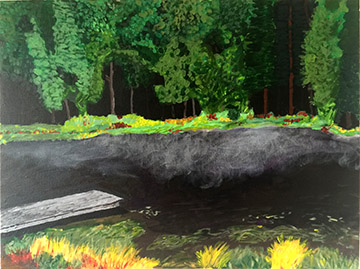
New Painting: Im not entirely sure I’m finished with this one, but I’ve been fiddling with it and I’m getting sick of it and I’m not sure that I can actually improve on it, so I’m calling it done, at least for now. If you have been to our place in the Catskills, you will hopefully recognize is as a painting of the pond (a.k.a. Lake Jim). I’m thinking that I need to do something in a different style next. Anyway, here it is:

Liberty Pond

Holiday Stories, Part 4: The Rest

Christmas: Christmas day is utterly dead in London. The stores are all closed. I imagine that I could have found milk or bread somewhere if I’d had to do so, but I’m glad that I didn’t. In retrospect, it occurs to me that I should have gone over to Brick Lane to see if they stay open. There must be some equivalent tot he Chinese restaurants that feed the Jews in New York on Christmas day. The big difference is that there is no mass transit. Not a switch to a special holiday schedule, it is a complete shut down. That left us with no way to go anywhere, even if there was some place to go. Since this country is not especially Christian, I have to assume that this is all a reflection of tradition and maybe the power of the Unions to insist on a holiday for the workers.

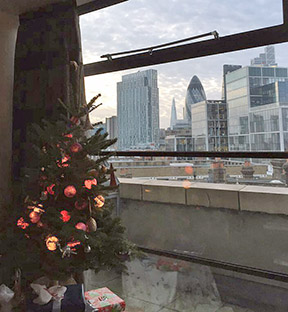
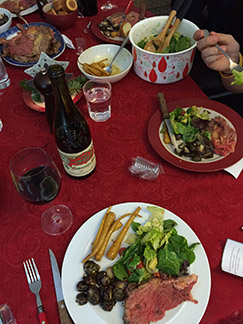
Since we had nowhere to go, we slept in and had a quiet Christmas with the kids. Small presents under our little tree (see photo below). Each of the kids was incredibly thoughtful in picking the gifts they gave. Perhaps the limitations of size, weight and number force you to think a little harder about what to get. We had a nice dinner, featuring free-range prime rib, roasted purple brussels sprouts, glazed small parsnips and popovers that failed to pop. (See photo below.) We watched television, played board games, drank some wine and generally had a very nice family day.

Xmas tree     xmas dinner

The Royal Opera: One night, we went with Alex and Lucy to the Royal Opera in Covent Gardens. We saw Tchaikovsky’s “Eugene Onegin”, an opera which I was not familiar with. The theater was beautiful and I thought the singers were good (especially the tenor), although I’m not sophisticated enough to really judge. The plot is ridiculous, even for an opera, and, at least in this production, there was a certain number of ballet sequences mixed in. This meant that a number of the scenes had separate dancers and singers, sometimes on stage at the same time, which was a bit confusing at first. The Opera House itself seems to be set up with countless ways to take your money, with any number of special rooms where you can eat and drink during the intervals (and pre-order so it is there waiting for you). Maybe the coolest part was that when we got out, it was raining and everyone was scurrying around looking for taxis and hiding under umbrellas. I felt like running over to shelter under the Covent Garden colonnade and see if a flower girl would approach us. (“Look at her a prisoner of the gutter…”) Instead we walked over to a pub across the street, which was surprisingly empty (wrong type of crowd?), had some ales and caught a cab back to the flat when the crowds had thinned out.

James’ Birthday: On the 29th, James turned 23. He had been dying to see the new “Star Wars” movie, so we all went out to a big shopping mall in St. Johns’ Wood where there was big multiplex and saw it. (There really are no movie theaters near us. Other than the Barbican, which doesn’t show first-run movies, the closest is probably in Leicester Square.) We had a great time. It was designed for long-time fans like us, with the return of favorite characters and scenes, great effects and a good amount of humor. I guess you could complain that it was a bit predictable and I’m certain that you could find lots of holes in the plot, if you wanted to go through the process, but I found something joyful about it. James had been waiting to read all the web sites and chat rooms about the movie and spent a few hours being geeky and telling various tidbits that he had learned. Later in the day, we went to the Dennis Severs house, which is a block away from our flat. It is one of those little gems that people recommended to us. Designed by artist Dennis Severs over his lifetime, it attempts to recreate the lives of a Huguenot weaver and his family over a period from the late 1700s to about 1900, by presenting a series of rooms, each carefully composed to look like the residents had just left. We had been there with Ivy and Debbie and their kids and wanted to see the Christmas version. It isn’t one of those things that blows you away, but it is a fascinating work of art. After that, it was on to Koba, a good (and kind of expensive) Korean restaurant in Fitzrovia, as Korean food on birthdays is a bit of a family tradition. It was supposed to be one of the top Korean places in London, but the restaurants in Little Korea in Manhattan or the ones in Bergen County, New Jersey are better.

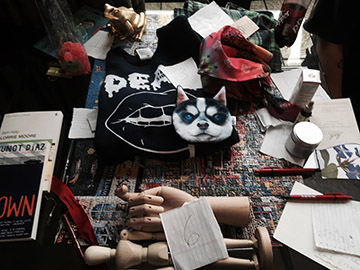
Shopping challenge: Judie had the brilliant idea of giving everyone £20 for Christmas, with the requirement that everyone go out one day and buy themselves a gift and we would then try to guess who bought what and say whether we would want to take it if this were a “Yankee Swap”. The phot below is the result.

Shopping Table

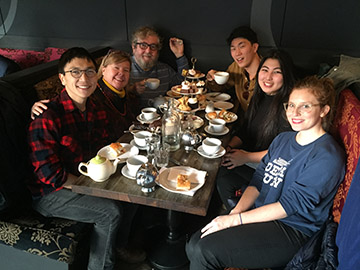
High Tea and other Gourmet treats: As a Holiday gift, Ivy and Debbie treated us to a High Tea in the City. We scheduled it for the afternoon that Alex and Lucy returned from Scotland. They were late, but they finally made it. The tea was fun, with lots of sandwiches and sweets to go along with the tea. That night, we had a fabulous meal at Super Tuscan, which, along with the Rivington Grill, are our current favorite spots to eat. We have been to Super Tuscan enough that the owner came out and chatted with us. He convinced us to get a special dish made with shaved white truffles for Alex, which was delicious, and talked about his favorite restaurants in Paris. High Tea photo follows.

High tea

There are certainly more memories generated over the holidays, but I think it is time for me to move on with the present. Maybe I’ll have finished a painting by my next post!