Lithuania, Part 3

By the time we left Kedainiai, it was after 5:00 and I figured that Rimas would just take us back to Vilnius. But he suggested that, as long as Kaunas was on the way, we should just stop there and he could give us a driving tour. We recalled that Judie’s grandmother had said that it was her favorite city in Lithuania, so we agreed.

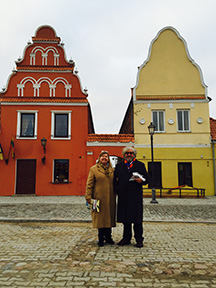
Kaunas: It was getting dark and we didn’t really have enough time to get much of an impression of Kaunas. It’s a fairly large city. We drove in through factories and other building that were probably built in the Soviet era until we reached the old part of the city. Rimas took us to the site of the old fortress, built along the river, which once guarded the city. Unfortunately, over the years a series of floods eroded the towers along the river and they finally collapsed, leaving a remaining complete tower and some walls. (Below) We then proceeded into the town and the main square, which was quite beautiful. (Below) We kept driving about looking at some lovely churches and other buildings. There is a well-known long avenue in Kaunas, which sounds a bit like the Ramblas in Barcelona. But by the time Rimas managed to get to place where you could drive across it (no cars allowed on it), it was so dark that it was hard to see much. A shame. While we were touring Kaunas, we were getting a running lesson on Lithuanian history and culture. One thing we learned is that basketball is the big sport in Lithuania (bigger than soccer) and that Kaunas is the leading basketball city with a huge new arena. The local team is one of the powerhouses in the European League and has been since the days of Arvydas Sabonis in the 80s. Sarunas Marciulionis was born in Kaunas and later played for the NBA’s Warriors. While there, he became friends with the Grateful Dead, which led to the Dead sponsoring the Lithuanian Olympic basketball team, resulting in their memorable tie-dyed warm-up suits. Lithuanian basketball has held a special place in my heart ever since.
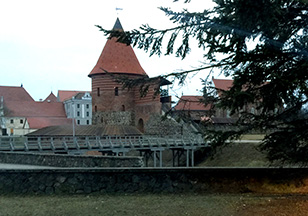
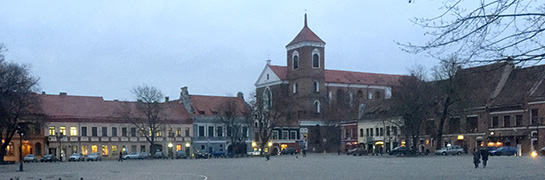
Kaunas1   kaunas2

 Drive to Vilnius: It finally got too dark and too late, so we started back toward Vilnius. We stopped so that Rimas could get a snack and he bought some sour milk for us to try. This, believe it or not, is a Lithuanian specialty and is drunk (at least by Lithuanians) with most meals. I had the commercial version of the sour milk (Judie demurred), which tasted roughly like a mixture of sour cream and yogurt, only with the consistency of buttermilk. Rimas said the traditional version is left to sour naturally (rather than by adding something to speed the process), leading to more distinct flavors. One can only imagine….

On the road back to Vilnius, Judie, trying to make conversation, mentioned that we were thinking of visiting Russia. This led to a long diatribe from Rimas about how the Russians under Putin are thugs and that Russia is a mafia-like state that is not safe. Yes, he conceded, the Hermitage is a great museum, but go to the Louvre instead. If we want to meet Russians, he could introduce us to some, etc. This theme was repeated over the next two days (and was repeated by his wife). I think this reflects the history of Lithuania being invaded, dominated and abused by the Russians over the last several centuries. They are afraid of that happening again, especially after what happened with Putin in Crimea and the Ukraine. Putin justifiably scares the crap out of them and they are doubtful that NATO will protect them if push came to shove. An illustrative story: One the way back to Vilnius, Judie noticed that Rimas was running out of petrol (gasoline). She pointed it out and we came up to a Lukoil gas station, so she said, “Oh. You can fill up here.” but Rimas responded “Oh no. I can’t stop here. That’s Russian station.”

Arrival in Vilnius: As we pulled into Vilnius we stopped on hill to look to down at the old city. Since it was dark, the main thing we could see was a hill with three floodlit crosses. According to legend relayed to us by Rimas, the crosses commemorate the martyrdom of some Franciscan friars in the 1300s, who were murdered and thrown in the river. The crosses, which were first built in the 1600s are perhaps a form of atonement. They disappeared for a while while the Tsarist Russians were in control, were rebuilt but were then torn down by the Soviets (beginning to notice a pattern?) and then replaced after the collapse of the Soviet Union in the 1990s.

We then drove to our hotel, which was right in the heart of the old city. It was a bit hard to get there, since the whole city was setting up for the Fair of St. Casimir and many of the streets were either closed or partially blocked by stalls. We finally got to the Hotel Narutis, which is a wonderful boutique hotel that couldn’t possibly have been nicer. For dinner, they suggested Ertlio Namas, a nearby restaurant in an old historic building. We went expecting some type of heavy Eastern European food and were pleasantly surprised to find an elegant restaurant specializing in old Lithuanian recipes (although this had to be food served to royalty). The menu noted the date for each recipe. There was a nice wine list and, noticing our interest in the wine, our waiter brought us a sample of Lithuanian wine and glasses of Lithuanian dessert wines at the end of the meal. It was a fabulous night, but we paid for it the next morning.
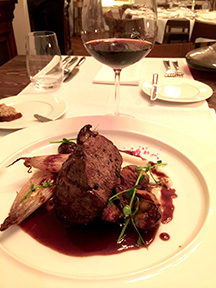
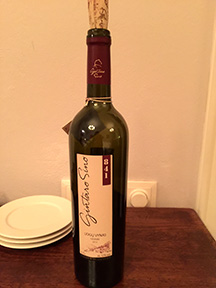
ertlio2     ertlio

Next Chapter: Fair of St. Casimir and our trip to Trakai

We Interrupt this Travelogue for a Message

As many of you may know, when we moved, we rented our house to a seemingly nice couple. Let’s just say first impressions aren’t always correct. They moved out, hired a lawyer and, after some ugly and depressing months, they left permanently. We’ve been trying to re-rent the place, which isn’t so easy in the wintertime.

We just signed a lease with new tenants and are hoping to be luckier this time. The good news is that we are going to stop bleeding money and we don’t have to worry about our home standing empty. The bad news is that the lease it for one year (although we gave them an option to leave early by giving notice), so we won’t be able to move back into it until March of next year.

This was not part of our plan, in which we envisioned returning to Montclair in time for Thanksgiving 2016. So things didn’t go as we expected, and there are certainly worse things than spending some extra months in London. But we really did want to be back in familiar places with all of our friends. Of course, we could come back and rent a place in Montclair or maybe do a house trade or something. We are hopeful of spending the Holidays in New Jersey this year, one way or the other.

This nice thing is that we are about to enter a period in which we are going to have lots of visitors. We are almost completely booked until the end of June! And we will both be back in mid-April for about a week (although Judie will be going to L.A. and Orlando and NYC for business), so that combination should deal with our feelings of homesickness. It should be fun.

And now, back to the travelogue.

Lithuania: Part 2

After went left Kedainiai, our lessons under the tutelage of Rimas began in earnest. Alex had warned us that when he was visiting with his friend (Rimas’ eldest son), they would get detailed instructions on what they were to see each day and would then be quizzed upon their return. So I did some studying before we left. Before resuming the travelogue, here are some of the things I learned. (Hope it isn’t too boring!):

The Last Pagan Country: Lithuania was the last holdout in Europe to Christianity (or to Islam or Judaism for that matter). It didn’t happen until 1387. This made Lithuania a target of crusades by the Teutonic Knights, who spent several hundred years attacking Eastern European countries and acquiring territory in the name of Christianity.

The Biggest Country in Europe: Around the same period, through a combination of diplomacy, marriages and wars, Lithuania became the largest country in Europe. It comprised most of what is now Belarus, the other Balkan states and a large part of Poland. (Rimas told us that Latvia and Estonia had no real history and were creations of other powers, which is essentially right, if a bit Lithuanian-centric. They both had a separate ethnic identity but never existed as independent states until they were created in 1918.) During this period the country was ruled by someone who was the Grand Duke of Lithuania and the King of Poland. From this peak, the country gradually shrunk, under attack from the Tartars and the the Muscovites from the East and groups like the Teutonic Knights from the West.

The Battle of Grunwald: This was one of the biggest and most important battle in the history of Medieval Europe. It has incredible resonance in Lithuania and Poland and altered the course of history. But people in the West have never heard of it. Despite the conversion in 1387, the Teutonic Knights continued their campaign against Lithuania/Poland. In 1410, this all culminated in the battle between the Knights and the Polish and Lithuanian armies. The Knights first attacked the Lithuanian Army and after hours of fighting, the Lithuanians retreated. (The interpretation of this is contested. Some view it as a simple retreat. This is certainly the Polish view. However, Rimas told us the Lithuanian version, which is that Lithuania had learned this tactic in battling the Tartars, who employed it to great effect. It requires great discipline to retreat and then re-form, rather than simply fleeing.) The Teutonic Knights, believing that they had routed the Lithuanians, then turned on the Polish Army and were engaged in battle with them when the Lithuanians returned and attacked them from behind. The Teutonic Knights were essentially completely wiped out. Prussia could probably have been taken, but it was left to survive. But Prussia ceased to be threat or a force in Europe until Bismark, hundreds of years later.

Saint Casimir: He was the younger brother of one of the rulers of Lithuania and Poland. He had short and unsuccessful military career as the equivalent of a prince and concentrated more on doing good works and being generally pious. He died at a young age, probably of tuberculosis. The event that lead to his sainthood occurred about 30 years after his death. Polotsk is a city in what is now Belarus. In the early 1300s, it was absorbed by Lithuania. In 1518, it was under siege by the Muscovite army, in one of the endless number of Lithuanian-Muscoite conflicts. The Russian attackers ran out of food and had to cross the river to find some. This permitted the Lithuanians to reinforce Polotsk and their force then went out to attack the Russians. But they could figure out how to get across the river until a mysterious figure on a horse (you guessed it–the long-dead Casimir) showed up, led them across the river and disappeared. A Lithuanian ruler later petitioned Rome for sainthood for Casimir based on this “miracle” and about a hundred years later it was granted. He is now the Patron Saint of Lithuania and is generally pictured holding lilies, a symbol of purity. There is a miraculous three-handed painting of him in the Vilnius cathedral. According to legend, the artist had tried several times to paint over the hand, but it kept reappearing. So he is often painted with an extra hand, undoubtedly symbolizing something or other.

Lithuanian Tolerance: This was a tolerant country, especially when viewed in the context of its time. They were welcoming of other people and in 1573, the Warsaw Confederation guaranteed religious tolerance (for at least the higher born), the first such document of its type. While the level of tolerance ebbed and flowed, it was certainly far greater than the other nation-states of Medieval Europe. They also invited Germans, Armenians and Jews to come and settle in Lithuania. Crimean Karaites, a group not ethnically Jewish, but who decided to accept the Jewish religion (sans rabbinic teaching) and came to live in and around Trakai. They are pretty much gone now. Less than 500 are left.

Holocausts: The great age of Lithuania ended around 1700, brought on by a combination of a famine, an outbreak of the plague, a Swedish invasion in the 1650s (called the Deluge) and subsequent Russian invasions. What followed was almost three centuries of misery, mostly at the hands of the Russian. During the entire nineteenth century, for example, the Russians closed Vilnius University and generally tried to destroy the Lithuanian people. The Lithuanian language was banned for long periods of time. There was systematic ethnic cleansing. It is hardly surprising that Nazi troops were initially welcomed into the country. And the Soviet occupation following World War II was possibly even worse. Many Lithuanians were sent to Siberia, either to the gulags or to communities set up for them, in an effort to make Lithuania into a Russian state. Rimas’ father and grandfather were both sent to Siberia in the late 1940s and early 1950s. The Lithuanians view this whole history as a form of holocaust, and it seems justified. Vilnius has a Holocaust Museum dedicated to this history, located in the building that was once the KGB headquarters (and previously Gestapo headquarters). (We missed it this trip.)

Vilnius has a second Holocaust Museum, which details the extermination of the 200,000 or more Jews in the country during the Nazi occupation. There can be little question that the Nazis were helped by local collaborators, as is true in the rest of Europe. It is also true that a few jews were saved by Lithuanians. (Rimas told us a story about how his small home village had saved several jewish girls by hiding them and passing them from family to family.) In one notable incident, the Japanese Ambassador in Vilnius save thousands of jews by giving them exit visas. Then Tokyo found out about it and recalled him. He died a pauper. There is now a memorial to him in Vilnius. In some ways the Nazi genocide in Lithuania was even worse than in other parts of Europe (if that is even possible). They didn’t even bother to send tens of thousands of jews to death camps, choosing to just kill them in the woods. The surviving jews, living in the ghettos, were summarily executed as the Nazis retreated the Soviet advance. There is little point in trying to equate the systematic attempts by Russians and later the Soviets to eliminate all Lithuanian culture (as bad a that was) and the wholesale slaughter of the jews. Both were horrible, but the Nazi atrocities were incomparably worse.

There is much more pretty interesting history, but if you have made it this far (congratulations and thanks), I won’t subject you to it. Back the travelogue next time.

Lithuania: Part 1

We spent last weekend in Lithuania. I’m not sure exactly what we were expecting, but we were completely surprised by what we found. Lithuania is country with a rich history and shockingly cosmopolitan capital in Vilnius. There were two fortuitous things that made our trip especially magical: (1) we had Rimas, the father of Alex’s friend from Oxford escorting us around (more on him throughout) and (2) it just happened to be the weekend of the Fair of St. Casimir in Vilnius. It will take at least two posts to describe it all.

It all started inauspiciously. We flew in to Kaunas and Rimas, who had said that he would pick us up, was in Vilnius. We didn’t realize the confusion until we were through customs, but at least we had his cell number. The problem was that he was over an hour away and the Kaunas airport was tiny. (Rimas told us that it had been a military airport that Ryan Air had adopted as a destination.) Not much to do, but we managed to get beers and waited for him.

Rimas: Since he is going to be a central character in much of my descriptions of the trip, it is important to introduce him to you. His full name is Rimantas Juozas Vaicenavicius. He is a college professor, teaching statistics and finance at Vilnius University. He was formerly a government official who worked in those areas and did a fair amount of traveling and was involved in some interesting things. He seems to have encyclopedic knowledge of Lithuanian history and was determined to impart as much of it as he could to us over the course of two days. He is both eccentric and charming. It was a pure pleasure spending time with him (and his family (!)).

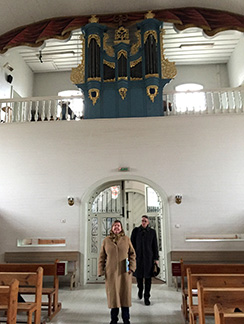
Kedainiai: The whole reason that we wanted to go to Lithuania is that Judie’s mother’s family is from there. Judie’s mother, and her parents and older bother (and some assorted other relatives) emigrated to the USA in the 1920s. Judie’s great-grandmother refused to leave and lived in Kedainiai until her death after World War II. It is relatively close to Kaunas, so we drove there after Rimas picked us up. It is in the more arable and flat part of Lithuania and we drove past fields that Rimas identified as rye and barley. The area is especially known for its cucumbers according to him. We finally found it and went to the Tourist Information office (he had never been there) and found out where some things were located. But they had no idea where Judie’s great-grandmother might be buried. We were hoping that it might be next to the church where her grandfather played the organ, but if there was ever an graveyard there, it was gone. So we never got to visit the grave. (Alex thought he found the graveyard when he visited in 2009, but it was pouring rain and he never found the actual grave.) We went to the church, but on the way, Rimas insisted we stop at a meat shop (these instructional detours were to become a theme of the trip). He showed us traditional sausages and other meats and suggested ones to buy. (He was very impressed by this little shop, which we would have just walked past if we had been there on our own.) The church itself was made entirely of wood and was quite striking. We were able to get inside and look around and see the organ, although we couldn’t get up to the choir loft and there was no one around. See a few photos below:

Kedainiai Church   Kedainiai Organ

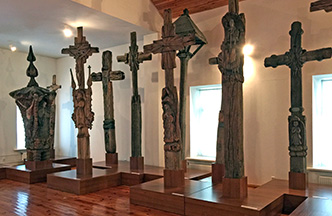
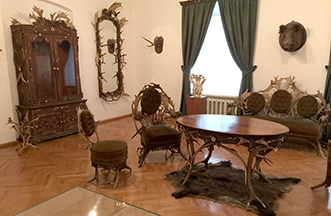
After that, we wandered about the town. We saw some photos at the town’s museum and the place hasn’t changed a whole lot in the past 100 years or so. Mostly old houses, although it is surrounded by newer apartment blocks and factories and stuff probably from the Soviet era. The museum itself was surprisingly informative. There were at least four people working there and I think the three of us may have been the only visitors, so we got a lot of attention and Rimas was full of questions for them. There was a big section about Czeslaw Milosz, a poet and writer who won the Nobel Prize in 1980. Although he was born outside Kedainiai, the world considered him to be Polish. (Poland and Lithuania go back a long way together. They were often jointly governed hundreds of years ago and most Lithuanians speak Polish.) A cultural center was built in his hometown and he returned to dedicate it. Lots of other stuff about the Lithuanian holocaust (more on that later) and a great room full of these carved poles with Jesus or some religious figure atop them and ofter covered by a little roof. They are all over the place, at least in that part of Lithuania, especially at road crossings. Rimas told us that the Russians removed most of these icons when they came in after World War II, although many were taken down and hidden by the populace. Most of the one in the museum were carved by the same artist, Svirskis, who Rimas told us had wandered the country offering to do the carvings for food and shelter. One other notable room contained furniture entirely made of antlers, which of course reminded me of Gaston and “Beauty and the Beast” (“I use antlers in all of my decorating”.) Pictures follow:

Lith Poles   Antlers

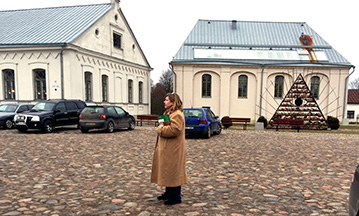
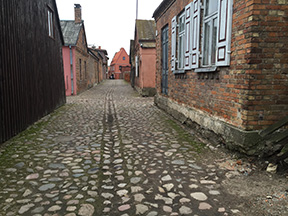
We continued to stroll around, stopping at one point (at Rimas’ insistence) for coffee and to sample traditional Lithuanian pastries. We went to the market square, where there were two old synagogues next to each other. (Photos below.) (Was one male and one female? Or maybe one replaced the first? There was no answer and, in fact, I’m pretty sure that there are no jews left in Kedainiai, which is a story for a later post.) At one point, we walked down a narrow street with impossibly old (and mostly empty) buildings. (Photos below.) If you took away the electric wires, you could have been in 1800s or earlier. Rimas loved it and wants to bring his kids to see it.

Kedainiai Synagogues  Kedainiai Lane

I think that is enough for now. I’ll add more tomorrow.

Kedainiai

Thoughts from London

New Piece of British Slang: A “chugger” is someone who comes up to you on the street and asks you to sign a petition and/or contribute money to their (usually charitable) cause. I looked up the etymology on line and the best I could find is that is a combination of charity and mugger.

Mimes for Queen of Heaven: Judie’s “Cakes” group had a meeting last night (their final one of the first half of the course).I went off to the Soho Theater and saw Trygve Wakenshaw, a mime originally from New Zealand, present his one-man show “Nautilus”. I’ve been a big fan of mime ever since I attended Tony Montanaro‘s mime school at Celebration Barn in South Paris, Maine in January of 1973. In addition to Tony, I have seen Marcel Marceau and, of course, the incredible Bill Irwin many times. Wakenshaw was an interesting mime/comedian. He is not a classic mime in that he uses his voice to add sound effects to what he does and sometimes talks. My first impression was–that seems like mime cheating–and it took me a few minutes to get past that and warm up to him. He is a good mime (you can tell he has trained), but he is after something else. His show, the third of a trilogy according to the handout, was a series of vignettes which gradually merged together and became more manic. A very enjoyable 75 minutes and for £12.50, you couldn’t beat the value.

I got back in time to see all of the ladies leave from the Cakes group and Judie and I went to dinner at Super Tuscan, perhaps our favorite restaurant in London. It is a small Italian restaurant in this little alley about five minutes from our flat. Wonderful, fresh food, with ingredients imported from Italy, an attentive staff (not always the case here) and an interesting wine list, hand picked by the owner, who loves to chat about them. For Montclair restaurant types, imagine a cross between Corso 98 and Fascino.

Vilnius, Here We Come: Judie’s mother was born in Lithuania and immigrated with her family in the 1920s. (Her great grandmother refused to leave and died there after World War II.) So going to Lithuania was on our list of things to do while we are in London. We are going this weekend. Alex has a Lithuanian friend he met while at Oxford. Juoazas is a violinist and he and Alex entered a music competition at Oxford, but unlike the other competitors, who played mostly classical pieces, they played Django Reinhardt and Stephane Grappelli gypsy jazz. They won. During a break, Alex went with Juoazas for a visit to Lithuania and had a memorable tour. He suggested that we contact Juoazas and his family. So we did and they insist that they will pick us up a the airport and give us a personal tour of Kedainiai (where Judie’s family came from) and Vilnius. This weekend is the Feast of Saint Casimir (the Patron Saint of Lithuania). This should be a great trip.

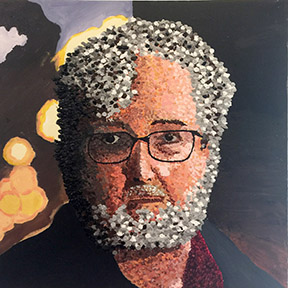
Self-Portrait: I decided to post my self portrait on Facebook and I really got a huge and gratifying response. I do think it is a very good painting and far and away the best thing I have done here. I’m thinking of creating a separate page on this site that will just contain all of the things I have done in chronological order. The progression is quite clear. It is a bit intimidating in a way. Having made this progress and having produced something that is as good as the self portrait turned out to be, what do I do next?

“Rabbit Hole” a Self-Portrait and other thoughts

“Rabbit Hole” On Tuesday night, we went to the Hampstead Theatre to see “Rabbit Hole”, a play by David Lindsay-Abaire. You may know it. It won the Pulitzer Prize for Drama in 2007 (although we didn’t see it because it was at the Manhattan Theatre Club and that was not one of our subscriptions) as well as Tony Awards for Best Play and Cynthia Nixon and Tyne Daly. Then it was made into a movie starring Nicole Kidman that was nominated for a Best Picture Award in 2010. It is the story of a couple whose three-year old son was accidentally killed and their efforts to cope with that tragedy. It is wonderfully written. According to the programme, the author includes instructions in the script that it should not be played for melodrama and that the grief should not overwhelm the personalities of the characters. This is appropriate, because while the play has an undertone of nearly unbearable sadness, it is really about people trying to put their lives back together somehow. It is through their interaction with family members and doing simple things that the powerful emotions are generated. There is wonderful scene in the second act in which the mother who has recently lost her son asks her own mother about her brother’s death year’s earlier. Her mother gives this lovely, moving speech about how it is something that never goes away and that you take with you always, but that at the same time you don’t want it to go away and that you need to keep with you always. I am sure that speech is what won the Tony for Tyne Daly. The main couple has their ups and downs though the scenes, but as it ends you feel some hope that maybe, just maybe, they will get through the grief and reach the point where they are able to carry the grief. As far as I can tell, the Hampstead Theatre is incapable of presenting a play in any way that it less that great and this was no exception. The American accents were all good. Penny Downie, who was very good as the mother of the main character, is a Royal Shakespeare Company star (and a Downton Abbey alumni). But the play is ultimately about the husband and wife, played by Tom Goodman-Hill and Claire Skinner, who are both accomplished actors and were just tremendous. One of the fun things was that we had seen Claire Skinner playing the daughter in “The Father” (the play about Alzheimer’s disease) a few months ago. This was the first time that we have seen an actor playing a second role while we have been here. I’m sure it will happen again.

Super Tuesday: Democratic ex-pats had the opportunity to vote on Super Tuesday in a primary that would help choose the paltry number of delegates set aside for world-wide expats. There was three or four hour window in the evening to go somewhere near Westminster and vote. We had the tickets to “Rabbit Hole” and the timing was very difficult. It became impossible when Judie’s conference call went long and we then got delayed on the Tube. Oh well. We can still vote in New Jersey, although by June it looks like Hillary will have it sewn up. It also looks likely that Trump will be set as the Republican candidate by that time, but I do think there will be some more drama before that happens. I assume that everyone has seen John Oliver’s brilliant rant about Trump. If not, here is the link.

Our House in Montclair: As you may know, our tenant left our Montclair home a few months ago. We are entirely happy never to have anything to do with those people again, but it has been a bit of an economic blow. So we are trying to rent our house again. Our problem is that most potential tenants want a one-year lease, which means we have to face the possibility that we will be staying in London months longer than we originally intended. This is something we view with mixed feelings. London is a wonderful place to live and we really like our neighborhood, but there is a good chance that by the end of this year, we will be ready to go back to our regular life. Well, it’s another nine or ten months and a lot can happen in that period of time, so we might as well enjoy things. Who knows, we may be happy to stay another four or five months by then.

Self-Portrait: I have painted a self-portrait. It seemed like an “artist” thing to do. I decided to do it in a sort of pointillist style and then make my hair and beard three-dimensional by adding structuring compound to the paint, making those points into big blobs. Anyway, and I kind of assume that this must happen to real artists, but about halfway along, I suddenly realized that this thing was looking really good. (Can I picture Monet thinking to himself, “Boy those are some great water lilies”? Maybe not.) This feeling doesn’t happen to me too often. So I have been in a bit of an obsessive “Finishing the Hat” mode for the last few days. (All those dots take a while and I kept painting over areas to get the effect right.) I took more time that I sometimes spend, partly just because I like what it looks like. (I wasn’t as excited about the bus stop scene or even the one of our house in Montclair and just wanted to finish them by the end.) This morning, I fiddled with it a bit more and I think I am finished. Here it is:

Self Portrait


“Hangmen” and My Sermon, etc.

“Hangmen”: On Wednesday afternoon, I went to a matinee performance of “Hangmen” in the West End. I was actually planning to go in the evening until I noticed that seniors get reduced prices for matinees.Since I qualify as a senior over here (you just have to be 60 most of the time), I decided to take advantage of the bargain and got a good seat in an audience that seemed to be made up largely of white-haired people and students. We should take advantage of these discounts more. (I discovered a few weeks ago that we qualify to take London Transport for free since we are seniors and residents. It’s along process, but we should probably do it.

Anyway, back to the play. “Hangmen” is an very funny and extremely dark comedy by Martin McDonagh. If you are familiar with is other plays (“The Beaty Queen of Leenane”, “A Skull in Connemara”, “The Cripple of Inishmaan” and others) or if you saw the movie “In Bruges”, you will have an idea of what it was like. It is loosely based on the story of then end of executions in England in 1964. It centers around the hangman Harry Allen, who actually supervised the last hanging in England, and another character is Albert Pierrepoint, who was Britain’s best know executioner, having dispatched over 400 (although the competitive Harry complains in part of the play that  a lot of them were Germans during and after the war and they shouldn’t count). The play actually begins with a very funny scene(if you can believe it) about Harry overseeing the hanging of someone who is protesting his innocence and refuses to go quietly innocent. The rest of the play is set in Northern England, where Harry is running a pub habituated by a variety of amusing barflies and a strangely threatening stranger for the south. It is the anniversary of that questionable hanging that began the play and a reporter has come back to ask Harry about the recent official end of capital punishment. It is a wonderfully constructed play. It seems like it will just be funny take on capital punishment, but then you begin to think “Wait, what is going on here” as it takes a strange turn and just gets creepier and darker. You can’t help but laugh, but you feel uncomfortable doing so. Very good ensemble cast and a clever set. It got wonderful reviews. All of McDonagh’s plays reach NYC eventually. It is worth seeing when it comes.

An Election Just Happened: Did you know that Ireland had an election this week? I didn’t either, and I live a lot closer than you probably do. The media here is obsessed with the EU referendum, which, admittedly, is wildly entertaining. So the election in Ireland didn’t get much coverage until it happened. It resulted in a loss for the governing center-left party, which has overseen the recovery of the Irish economy after the 2008 meltdown. The center-right party, which had been in power when everything collapsed, made a comeback. But neither is close to a majority, as the results are splintered among multiple parties and it may turn out to be impossible to form a government (or what ever they cobble together won’t last). I have admit that I really don’t know what is going on over there.

My Sermon at New Unity: Today, I gave my sermon at New Unity. I was surprisingly nervous going into it, but it went very well, as far as I could tell. I got applause at the end. The readings worked out wonderfully and the guy who read the Dickens was great. At the end of this post is a link for my message (I think it will download as a Word document. If you can’t read it and want to do so, contact me directly.) It isn’t precisely what I said, since I used it as an outline and generally followed it, but did not read it (except for the quotes, of course). This is basically the way I did appellate arguments and summation when I was a lawyer. It was quite hard to condense all of my thoughts about the intersection of law and justice into a talk of ten minutes or so and make it approachable for non-lawyers.

Message

Law and Justice

I have been spending time this week getting ready for my sermon/message on Sunday about the intersection of law and justice and whether one can get justice in the courts. Early next week, I will either send a copy of my address or (perhaps) a link or something to a recording of it. New Unity streams its services and, I think puts Andy’s messages on line. So you will see something.

It is typical to have reading or two before the sermon in Unitarian or UU congregations. I assume this takes the place of the Bible readings that would have a part of the service in more Christian services. So I have picked two readings to sort of set the tone for my talk and I thought I’d share them with you all.

The first reading is from the first chapter “Bleak House”. It has a special meaning for me beyond the fact that it is an amazing piece of Dickens. My Civil Procedure Professor at Emory Law School read it at our first class with him. I can’t imagine, looking back, what he was thinking. Here it is:

The raw afternoon is rawest, and the dense fog is densest, and the muddy streets are muddiest near that leaden-headed old obstruction, appropriate ornament for the threshold of a leaden-headed old corporation, Temple Bar.…

The Lord High Chancellor [sits there] with a foggy glory round his head, softly fenced in with crimson cloth and curtains, addressed by a large advocate with great whiskers, a little voice, and an interminable brief, and outwardly directing his contemplation to the lantern in the roof, where he can see nothing but fog.

On such an afternoon some score of members of the High Court of Chancery bar … are mistily engaged in one of the ten thousand stages of an endless cause, tripping one another up on slippery precedents, groping knee-deep in technicalities, running their goat-hair and horse-hair warded heads against walls of words and making a pretense of equity with serious faces, as players might.

On such an afternoon the various solicitors in the cause, some two or three of whom have inherited it from their fathers, who made a fortune by it, are ranged in a line, in a long matted well (but you might look in vain for truth at the bottom of it) between the registrar’s red table and the silk gowns, with bills, cross-bills, answers, rejoinders, injunctions, affidavits, issues, references to masters, masters’ reports, mountains of costly nonsense, piled before them.

Well may the court be dim, with wasting candles here and there; well may the fog hang heavy in it, as if it would never get out; well may the stained-glass windows lose their colour and admit no light of day into the place; well may the uninitiated from the streets, who peep in through the glass panes in the door, be deterred from entrance by its owlish aspect and by the drawl, languidly echoing to the roof from the padded dais where the Lord High Chancellor looks into the lantern that has no light in it and where the attendant wigs are all stuck in a fog-bank!

This is the Court of Chancery, which has its decaying houses and its blighted lands in every shire, which has its worn-out lunatic in every madhouse and its dead in every churchyard, which has its ruined suitor with his slipshod heels and threadbare dress borrowing and begging through the round of every man’s acquaintance, which gives to monied might the means abundantly of wearying out the right, which so exhausts finances, patience, courage, hope, so overthrows the brain and breaks the heart, that there is not an honourable man among its practitioners who would not give — who does not often give — the warning, “Suffer any wrong that can be done you rather than come here!”

I really do love this. It is such a pretty powerful indictment of the law. But I’m not as disgusted by the law as Dickens was and that is not my message. (I’m sure a Dickens scholar would know what happened to him to cause this implacable enmity.) So I decided to follow this with a a more positive reading. (These are harder to find than I expected.) My second reading it from Atticus Finch’s jury summation in “To Kill a Mockingbird” and goes as follows:

But there is one way in this country in which all men are created equal- there is one human institution that makes a pauper the equal of a Rockefeller, the stupid man the equal of an Einstein, and the ignorant man the equal of any college president. That institution, gentlemen, is a court. It can be the Supreme Court of the United States or the humblest Justice of the Peace court in the land, or this honourable court, which you serve. Our courts have their faults as does any human institution, but in this country our courts are the great levelers, and in our courts all men are created equal.

It’s a great lead-in to my sermon. I might say that I  recognize that there is a danger in having wonderful readings preceding my remarks–that anything I say afterwards will seem clumsy. We will see.

More from London

It’s a Beautiful Day in the Neighborhood: Judie told me that I sounded kind of depressed and homesick in my prior post. Probably the latter, but not the former. Today, with Judie across the Pond, I finally ventured out of the flat in mid-afternoon to discover an absolutely glorious day that seemed like early spring. I wandered about, bought a paper and ended up at Wright’s Seafood at Spitalfields Market. Oysters a pound a pop. Had 18 of them and a carafe of wine and chatted with Iris, my favorite server there. Then it was down two doors to Androuet, which has French and English cheeses Americans can only dream about. I might go to the National Theater tomorrow to see “All’s Well That Ends Well” or maybe to the West End to see “Hangmen”. I may be a bit homesick, but I’m definitely not miserable.

It Turns Out That it is All a Soap Opera: British politics is so internecine and dominated by a relative small group of people, that coming into it the way I have is a bit like joining a long-running soap opera and trying to figure out what is going on.. Everyone else knows the background stories and I am trying to catch up. A few examples:

  • It turns out that Boris Johnson and David Cameron were at Eton together and were in the the same eating club. Boris was two years older, a prefect and an Etonian superstar. Everyone expected him to be a great leader of the country (and so did he). Cameron, in contrast, was just one of the guys. Don’t you think it must gall Boris to have Cameron become PM, when everyone at Eton thought it would be him? There is play to be written about this. (If you aren’t utterly bored by Brexit stuff, here is link to an Op-Ed piece by Boris from today’s Telegraph which cogently sets forth the case for leaving the EU, although it leaves some questions unanswered.)
  • It turns out that Conservative Mayoral candidate Zac Goldsmith’s billionaire father has been funding a major Out of the EU organization. Had I known that, I would not be surprised that young Zac joined the various rats deserting Cameron’s leaking Tory Party ship. (By the way, isn’t “Goldsmith”a great name for a billionaire?)
  • It turns out that Chancellor Michael Gove, is not just Cameron’s best bud. Some writers insinuate that he is Cameron’s brain as well. According to what I am reading, he is the smart guy in the Tory Party and Johnson/Gove would be the leadership team if Cameron falls. Johnson gives the Out side their popular leader and Gove gives them intellectual heft.
  • Continuing with the soap opera analogy, I am beginning to see Corbyn as a minor character, inserted for comic relief in the past, suddenly elevated to a major role when another character (Milliband) was killed off. Are we supposed to take him seriously or is he just a place holder while the producers try to recruit a more serious star? I’d guess it depends upon the ratings…..
  • Finally, the way Parliament works makes for much more soap-opera like drama. On the Monday after Cameron announced his agreement, he came for Question Time to promote the In side and promptly got into an oh-so-polite cat fight with Boris. It is only vaguely like Trump’s attacks on his opponents, but Trump’s insults are so crude, but the Brits really do it terribly well. (Can one imagine The Donald referring to Jeb as “my learned friend”?) In the US, if things are going bad, the politicians can just disappear and there is not much anyone can do. Here, they pretty much have to show up in the House of Commons and face others who are furious at them. It should be enormously entertaining.

Pitchers and Catchers: It was easy in the wintertime. But now baseball is starting and for the first time in thirty years, the Mets are powerhouse, a team that really should make the playoffs and is a reasonable bet to win it all. I’ve always appreciated Mets GM Sandy Alderson’s post-PED view of baseball and his strategy has been vindicated by what seems to me to be a triumphant off-season. As someone who probably watched at least a part (and too often all) of a hundred Met games a year when they were terrible, it just kills me that I will not be rewarded by wallowing in the upcoming season.

Boris’ Big Gamble and a New Painting

Boris’ Big Gamble: As you probably know if you have any interest at all, Cameron returned from Brussels last Friday with his negotiated deal for a “Reformed EU”. He met with his Cabinet in an apparently rare Saturday meeting and came out to announce that the government would be in favor of remaining in the EU and that the referendum will be held on June 23rd. Other than the US Presidential Election, this is almost the most significant vote that will occur in the world this year.

Right after the cabinet meeting, six cabinet members left by the back door (!) and immediately went to a gathering of the group in favor of leaving the EU. The weren’t really big names, with the biggest being Michael Gove, Cameron’s friend and the Minister for Justice. (This is like the Attorney General opposing the President on a key issue.) But as a group, they are a bit short on charisma. (They make Cameron look dynamic, when he has all the charisma of Hillary Clinton, at best.) So it was very important for the “outters” that the more flamboyant  Boris Johnson (a leading Conservative MP and London’s outgoing Mayor with obvious PM ambitions) joined the cause on Sunday. He instantly becomes the big name leading the effort to leave.

Many suspect that Johnson acted purely out of political calculation, rather than any real conviction. (Cameron said as much in response to the news.) As a political play, it is fascinating. Cameron is in a position in which he is going to lose the support of a significant part of the Conservative Party on this issue. If these rebels succeed in the referendum and Britain leaves the EU, that would have to spell doom for Cameron and he would likely resign or be forced to do so. His successor would presumably have to come from the Out camp and that would have to be Boris. So, if Britain votes out, Boris doesn’t have to wait until 2020 for Cameron’s terms to end and jumps over Osborne and all of the other potential PMs who stuck by Cameron on this issue. On the other hand, if Cameron wins and Britain votes to stay a part of the EU, Boris would be dead meat. The winners would exact vengeance I am quite sure. The only question is whether Boris’ career would be completely over.

Some other Things to Know about Brexit: This referendum will consume the UK over the next four months. And it should, since it will determine the future course of The United Kingdom (and whether it remains united) and possibly the entire idea of a united Europe. Here are some things that you may not hear about it in the States, being completely absorbed by Trump:

  • The election for the new mayor of London will occur in May and it will be interesting to see how it is impacted by the referendum. London is an area that apparently supports remaining in the EU. Will the Conservative candidate, billionaire’s son Zac Goldsmith, side with Cameron or Boris?
  • Scotland also appears to be solidly in favor of staying in the EU and its leaders are already hinting that if Scotland supports staying in and the referendum takes the UK out, they will hold there own vote about leaving the UK so that they can be part of the EU. You can expect the pro-EU side to make the argument that a vote to leave the EU will also be a vote to break up the United Kingdom.
  • Wales, meanwhile, is having its own legislative election in May. Polls seem to show that they are likely to support leaving the EU and that UKIP (a separate right-wing party–a bit like a British Tea Party, only not so batshit crazy) may actually win a few seats in Wales as a result of the xenophobia that seem likely to dominate the referendum. No one seems to be talking about Wales doing anything if the referendum result is opposed to the way the Welsh vote.
  • Northern Ireland also has a legislative election in May. Who knows what they’ll do? Having  Ireland (firmly in the EU) sharing the island (and borders) with them should have some impact (one would guess), but that relationship is so fraught, that it is hard for me to figure anything out over there.
  • So far, the “outters” seem to me to be mostly Trump-like xenophobes and old-line conservatives pining for the good old days when Britain was an Empire. Maybe Boris can widen their appeal. The other side appears to be the moderate Tories and Labour. Early polls seem to favor an out vote, but I wonder if that coalition can really win unless it can appeal more to the middle. But since the Campaign may largely be mindless fear-mongering from both sides, you never know.
  • One final thing: The polls were so utterly wrong in the last election, utterly missing the Conservative sweep, that there is very little faith in their predictive ability right now. And the pollsters themselves were so burned that they do not speak confidently. Will that mean that the referendum politicking will not be poll-driven?

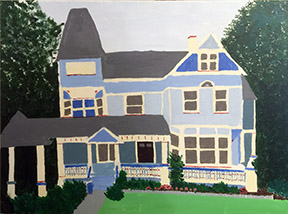
Another New Painting: Below you will see may latest painting, which is, of course, of our house in Montclair. I started out intending to use only really big brushes and to be bold. I didn’t lay the thing out in pencil or use a ruler, so the result is that the whole perspective is a bit off and the house is a bit askew. I thought about trying to fix it, but decided that I like it the way it is. I also though that it had a slight Edward Hopper quality that would be destroyed by detail, so I resisted the temptation to add to it.

One thing the painting almost certainly reflects for me is a bit of homesickness. It’s been nearly six months and, while Judie has been back to the US a few times on business, I have been here. And I recently realized that the initial thrill of living here has dissipated. At first there were countless new discoveries to make and it was just plain exciting to wander around, watch the ads on the telly, learn the language differences and listen to the accents, figure out the politics, see the sights, etc. London is a wonderful place to live and I am absolutely not complaining, but now I feel like I am living here, which is a significant evolution from my initial “stranger in a strange land” feeling. Here’s the painting:

House