London in the Age of Trump

The Women’s March: The highlight of last week came on Sunday when we joined countless thousands of people in London for the Women’s March. I was the organizing force behind the turnout from our New Unity congregation, making announcements, figuring out a meeting place (the Animals in War Memorial on the edge of Hyde Park) and getting everyone formed up to march together. Going in, we had a picture of us all marching along with banners and signs and we believed it would be a good opportunity for a little free publicity for us. So we had a new banner made, which you can see in the photos below. We also had reusable signs made, but they never turned up. I thought we had a banner saying “Birthplace of Feminism” (in reference to Mary Wollstonecraft), but we couldn’t find it. Anyway, 25-30 congregation members met up with us at the Memorial and we added some miscellaneous Unitarians who were attracted by our Standing on the Side of Love shirts. So the organizing worked very well as we set off on the two block walk to Grosvenor Square, where the march to Trafalgar Square was scheduled to start.

Unfortunately, we never really got to march. As I understand was the case at venues around the world, the march organizers were apparently overwhelmed by the size of the turnout. Grosvenor Square was shoulder-to-shoulder and no one could go anywhere. After being there about an hour and half, we had made it half way around the square and were nowhere near starting the two-mile march. But we all had fun together, reading all of the signs and talking to the people around us. Judie and our friend, Susan, had both brought these combination cane/seat things for the march, since their knees are killing them. You can see them in the photo below. We all sang songs. “We Shall Overcome” and the UU standby “We Are a Gentle Angry People” (with improvised lyrics like “We Are Nasty Nasty Women” and the like). We weren’t moving but we were spirited. At about 1:30 Judie, Susan and I decided we’d had enough (and we were meeting people in an hour), so we left the march by getting out a side street. Judie and Susan were resting on their devices when we saw the rest of our group walking down the same street with the banner. They ended up walking along with a large number of people who had given up on the main march route, but they never reached Trafalgar. It was just as well, since I heard the next day from someone who had made it there that when he and his wife arrived it was so packed that no one could enter. (The official police capacity of Trafalgar in 20,000 and the CrowdSize app says it is 35,000. But there were lots of people who, like us, gave up along the way or left when they couldn’t get in there. A total of 50,000-100,000 marchers does not seem unreasonable.)

South Africa and Julia Child: On the same day as the march, we had made arrangements to meet our friends, Jane and Paul Jee, at the British Museum and then have them over to our flat for dinner. They wanted to see the special exhibition there about South African art, having gone on a two-week trip to South Africa in early December. It was a nice, relatively small exhibit, which combined ancient art and more recent native art, with recent works by current artists which drew on the history of art there. The exhibit sort of followed South African history, which for the last 400 years was most about how unspeakably awful the Boers, but more importantly the English, treated the local populace (which in the case of the English include the Boers). It is almost impossible to overstate the genocidal viciousness of the English during their long colonial period.

On the way back, Paul directed us to two wonderful pubs for drinks. The first was The Princess Louise, which featured a late Victorian interior of etched glass and dark wood and a number of little glass booths around a central bar. See below. You could imagine seeing it in a castle or a museum, but it was pub. The next one was the Cittie of York, another very old pub that has gone by different names over the centuries. Its interior had a very high ceiling and it felt like Henry VIII might come in after hunting at any moment.
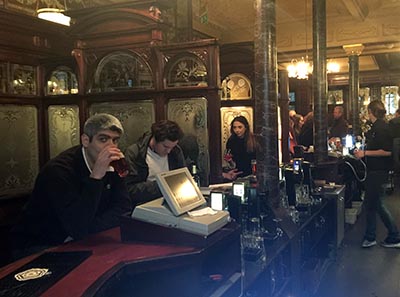
princess-louise-pub

The plans for the march and museum made trying to figure out dinner a bit problematic. (and they had invited us over to eat too often to go out to a restaurant and possibly end up fighting over a check.) So it had to be something that could be mostly made ahead of time. I ended up making the Julia Child’s Boeuf Bourguignon recipe from Mastering the Art of French Cooking. It is perhaps her classic recipe (which is said to have led to the publication of the book), which I’d made before. This was by far the best one I’d ever made and, as a matter fact, was the best one I’d ever tasted anywhere. It may have been the fact that I used really nice meat or that I used a bottle of good Malbec or that I made it the night before and it got a chance to sit and soak up flavors. I served it with the classic sautéed mushroom and braised onions and sliced, boiled baby potatoes and a really nice Aloxe Corton. Heavenly.

The Moth in London: Earlier in the week, we went to a story slam in Shoreditch, which was a part of the NPR show, “The Moth”. Alex gave it to us as a Christmas present. They have these all over the US and they now have them in London once a month in Rich Mix, an arts center on Bethnal Green Road, less than ten minutes from our flat. Each event has a theme. The one this time was “Voyage”. When you arrive, you can put your name in a hat to be called to tell a story that can be no longer than six minutes. There are audience judges who rate each storyteller. Judie and both put our names in. I suspect that in an event like this in New York, there would have been 30 or more names, but the actual stories limited to 10 people. So I doubted that we would get picked. But I did! (We found out later that there were only fifteen volunteers.) I got up and told a story about water communions and the time that Hannah fell into the Nile trying to get some Nile River water to bring home. She was six years old and when she fell in she completely disappeared from view–much to my shock. As adrenaline rushes were coursing through my veins and I was about to race the three or four steps to the water’s edge to dive in, the boatman who had given us a tour of the lake was walking by and casually reached into the water and pulled Hannah out, depositing her, sputtering, sobbing and soaked on the shore, still clutching her film canister of water. It was a good story with a nice arc and a beginning that linked up with the end. (The majority of the other story tellers really did something closer to a stand-up routine about travel, rather than a real story.) I thought my story was pretty good, but I wasn’t close to winning. The judges who were all under 30 (like 95%+ of the crowd) seemed to vote for the ones they thought were funniest, rather than whether they were a coherent stories on the topic. But I’m not really complaining. It was fun. At the end, they had Judie and the other four folks who weren’t picked, get up and tell the first line of their story. Judie’s would have been about the importance of toilet paper when she was a student in Senegal. It was an entertaining evening and I’m glad we discovered the arts center. We’ll try to return.

the-moth

The P.M. is desperate to such up to Donald: British governments, especially the Conservative ones, all go on and on about the UK’s “special relationship” with the US and its president. I’m not sure that US Presidents ever had the same reciprocal warm and fuzzy feeling. As Teresa May has declared in favor of a “Hard Brexit” that will separate Britain from Europe, she needs to find a way to show that this policy is not simply screwing the UK economy by cutting off free access to its largest market. Thus, she hopes that Trump will be her lifeline and that they can develop some sort of trading partnership as soon as possible (which may legally not be for more than two years). Trump said nice things about Britain in a newspaper interview conducted by a creepily sycophantic Michael Gove (Cameron’s former Legal Minister and Brexiteer, who destroyed his career–at least for now–when he double crossed Boris Johnson after Cameron quit). Of course, it is extremely doubtful that Trump knew what he was saying or meant anything by it, but hopes a running high at No 10 Downing Street. May is racing over to visit the Donald shortly.

Health Updates: I don’t ever want this blog to evolve into a health commentary, but having mentioned stuff in the past, it seems fair to give an occasional update. Judie’s knee is not getting any better and she is going in for an MRI shortly. The blot clot in my leg (DVT) is basically resolved and I’ll be off blood thinners in a month or so.

Visa Problems: When we got our new visas last summer after Judie changed firms and our old visas automatically expired, they were good for six months. So they expire on the 9th of February. We had raised this with the K&L Gates immigration lawyer months ago and she advised us that there was no need to get an extension. Now she has changed her mind and we both need to get extensions. The problem is that (a) it will now be much more expensive since we are doing it at the last minute and (b) we have to apply from the US and have our fingerprints retaken there. It is idiotic, but there is not much we can do. Judie was already scheduled to go the D.C. in about a week, so it may be possible for her to get her visa at the same time. In theory, I could go along, but the solicitor hasn’t confirmed that either of us could actually get a visa at the end of January. It is all sort of up in the air. I doubt we will be deported or anything, but it is a bit of a mess.

Something We’ll Miss About London: Free museums and reasonably priced theatre tickets. I was looking at Broadway ticket prices the other day and was horrified.

Something We Won’t Miss About London: How dark it is in the winter time. Between the seemingly perpetual overcast and the shorter days this far North, it is just depressing.

Back in London: Happy New Year

It has been a while since I have posted. I find it somewhat difficult to write on a phone and I am usually too distracted when we travel back to the States to do anything. This last trip was no exception and it didn’t help that I caught a cold upon arriving. It was a nice trip, if generally uneventful. We stayed at an airbnb in Montclair. It was perfectly nice, although it was a little hard to fit all five of us there comfortably, which gave Hannah an easy excuse to spend most nights staying with friends. So we saw a bit less of her that we had hoped, but (perhaps because of that?) she was in a great mood whenever we did see her.

A few highlights of our trip:

  • We went to the UU Montclair Christmas Eve service. It was great seeing everyone and Judie got to sing in the choir. The kids were with us and it was a pleasant evening. The service itself was a bit too Christian for me. This was probably thanks to our Interim Minister, whose style I am not crazy about. But he’s only the Interim and will be gone in six months or so and I know he is supposed to shake things up and challenge us to take a look at how we are doing things. It was certainly a change of pace from Charlie’s services. But the tone of the service was to religious for me and made me uncomfortable.
  • I made J. Sheekey’s fish pie for dinner on Christmas Eve. It turned out great. I think the kids were a little skeptical, but ended up enjoying it. The next day, I made a Rib Roast, with wild mushrooms. The airbnb had a nice kitchen that was well-equipped.
  • The airbnb host allowed us to hold our Yankee Swap party there and we had a big crowd (in a space that was a little too small for all of us). It was the usual good time. The hot gift was a “squatty potty”.
  • We went to the Metropolitan Opera on Boxing Day and saw “The Magic Flute”. It was the Julie Tamor production, so it was visually spectacular, with lots of puppetry and great costumes. It was an abridged version, presumably to make it more child friendly for the holidays, so we got out in less than two hours. But we missed out on a lot of Mozart, although we got to hear two great arias by the Queen of the Night.
  • Lots of dinners with friends.

Back in London: Being “on the road” is wearing, even when you are on the road in your home town. There was something very odd about renting a place and staying within minutes of our house. Not unpleasant, just weird. It was nice to get back to London and to our flat. I do think that I am beginning to feel the end coming, which is simultaneously sad and exciting. I find myself thinking about the move to come and the logistics of moving back into our house. At the same time, I keep thinking of things I really need to do before we leave (Visit Scandinavia? A day at the Old Bailey? More Theatre, naturally! Windsor Castle? Question Time at the House of Commons?) The list goes on, as time flies. We have tentatively planned our good-bye party for Saturday, 1 April (I’ve come to prefer the English way of expressing dates) at Super Tuscan, our favorite restaurant.

New Year’s Eve: We got back late on the 30th, so we had plenty of time to recover for New Year’s Eve night. We decided to skip trying to get to the Thames to see the fireworks near Big Ben and the London Eye. It is a mob scene that is so bad that they now require tickets to get any where near the River. We saw the fireworks last year on our boat excursion with the family, so we felt free to skip it this time.

We began  our evening by going to Ba Shan, a wonderful Hunan restaurant in Chinatown/Soho. Preserved duck eggs with chilis, fried prawns, cute little pork rolls, soft-shell crabs in a wok with tons of dried peppers, lamb in a sauce covered with fresh peppers, bok choy cooked with garlic and rice. I don’t know how anyone can have that meal and eat all of the peppers without spontaneously combusting. We picked most of them out and still had burning lips and tongues.

After dinner, we walked over to the Donmar Warehouse near Covent Garden to see Bernard Shaw’s “St. Joan”, starring the incredible Gemma Arterton. (We had seen her last spring in “Nell Gwynn” and I decided that I had to see her in this. I think I must have lucked out on returned tickets, since we go the last two tickets and they were literally in the center of the front row!) Judie was not sure about seeing a tragedy on New Year’s Eve, but Gemma did not disappoint. The play opens with Joan outside a castle and the lord’s men inside trying to convince him to see her, saying “there is something special about her”. He finally lets her in and when Arterton enters, there is something very special about her. She was transfixing from the moment she appeared on stage. The entire cast (the rest are all men) is superior, with some great performances. I especially liked Fisayo Akinade as a charmingly aware and effeminate Dauphin, Rory Keenan as The Inquisitor, and Elliot Levy as Cauchon, but as usual, it is hard to pick anyone out as the acting was so uniformly great. However, Arterton was just mesmerizing whenever she was on stage. She carries it all before her. It was made even more amazing by being so close. It is a performance I won’t soon forget.

The production itself was interesting. The scenes were all set in corporate board rooms, rather than the courts in a 15th century palace, with the scenes linked by “BBC newscasts”. (The first detailed the raise in egg futures since the hens had stopped laying, a problem that is miraculously solved when Baudricourt agrees to send Joan to see the Dauphin and go on to the siege of Orleans.) It made the point that Shaw’s play has real modern themes, without going overboard on it. (Interesting fact I learned: Shaw did not like to be referred to as “George”.) “St. Joan” was written shortly after she was canonized in 1920 (nearly 500 years after her death–the only saint ever killed by the Church itself and probably one of the few to be un-excommunicated 25 years after her death) and shortly after women’s suffrage was passed. It is sometimes referred to as Shaw’s only tragedy, although it also often said that there are not real villains in the play. And it is actually true that the Church and the various other protagonists were stuck in the middle of a French civil war and a war against the English and were struggling to do the “right thing”, at least from their viewpoint. (But I would have to say that the vile Warwick, the Englishman who arranges Joan’s betrayal, capture and ultimate death, seems pretty damn evil to me.) There is a fascinating scene (that is classic Shaw) in which Warwick and Cauchon, the French prelate, discuss the problems presented by Joan. Cauchon and the Church are concerned that Joan is bypassing them and speaking directly with God. (Only the Church is allowed to do that.) She is an existential threat to the Church’s power. At the same time, Joan is the first “Nationalist”, in that she claims that the king has the divine right to rule and that nationhood is supreme. If it is nation and king, rather than the aristocratic rule that resulted from the Magna Carta, this presents an existential threat to the control of the land and money by the English aristocracy. Warwick plans to spend a great deal of money to capture Joan and turn her over to Cauchon, but wants to be sure that she will be burned at the stake. Cauchon, as a cleric, cannot directly agree to that, but by the end of the scene, Joan’s fate is sealed. So the play is very much about men conspiring to get rid of a powerful  and threatening woman. It might have been interesting to set it in political party offices, since there is an interesting parallel to Hillary Clinton.

We got out after the show and Judie’s knee, which had been bothering her for weeks, was now stiff and very painful. We figured we could just take a taxi home, but discovered that all of London north of the Thames was closed to traffic from Westminster to Blackfriars. So there we were in the Soho/Covent Garden area, completely without traffic for once. It was kind of magical and it would have been fun to experience it. But Judie really couldn’t walk, so we found a pedicab to drive us to where the cars were allowed to go, finally caught a taxi and made it home in plenty of time to ring in the New Year. We went out on the terrace at midnight, but couldn’t see much. But we could certainly hear constant, deafening explosions for the next 10-15 minutes, while we watched the main event on TV. They really do the fireworks celebration well here in London. New York can’t really match it at all, since their ceremony is in Times Square, which is unsuited for a massive fireworks display.

Happy New Year!

A New Painting and Two More Plays

We are going back to the States for the holidays, leaving next Tuesday. We are looking forward to it. It will likely be my last trip back until we move back for good in early April. So I haven’t got too much time to catch up on this blog and finish up paintings in progress.

A New Portrait: Once again, I can’t say that this portrait looks exactly like the subject. The mouth isn’t quite right and he looks older than he should. And I had a lot of trouble with the ears. Despite that, I am fairly pleased with the progress I’m making doing these portraits. I may break down and take a class in it at some point because I suspect there are tricks in painting faces that would make it easier and better. It probably wont be until I get back to Montclair though, since that would be contrary to my ongoing artistic experiment, i.e. to see what happens if I paint without any lessons at all. The new painting follows:

andy-p

“Mary Stuart”: Last Wednesday was another of the New Unity Women’s Group meetings at our flat, so I had to vacate the premises. It’s better than trying to hide upstairs and it gives me an excuse to do something. So I decided to go see “Mary Stuart” at the Almeida Theatre in Islington. It’s blocks from New Unity’s second building and it is where I saw “Oil” with Chris A. last month. It is a play originally written by Friedrich Schiller in 1800 and adapted by the director, Robert Icke. One thing I’ve noticed in the last few months is that many plays make a point in the programs of drawing parallels between Brexit and whatever they are doing. For example, while I suppose that almost all of Shakespeare’s plays have political references, one has to strain to find Brexit in “King Lear” (and who really needs to ultimately when you have superstar actors playing the role). But, actually in this case, I could see it. The play is about the period when Mary Stuart, driven from Scotland and seeking sanctuary from Queen Elizabeth, is being held in jail and has been sentenced to death following a questionable trial. Mary is eloquently arguing for her life and freedom to jailers and ministers who have neither the power or inclination to grant her request. And Elizabeth has no desire to execute Mary, but is under great pressure from the public who hate Mary for being Catholic and suspect her of plotting to overthrow Elizabeth. She is being pushed by court intrigue and public opinion to do things that she doesn’t want to do. That has the whiff of Brexit for me. Ultimately Mary dies when the execution warrant, which Elizabeth means to hold onto, is accidentally delivered (and Mary has a hard Brexit.) One of the more unique things about the play was the beginning when the two main actors Juliet Stevenson and Lia Williams join the cast on stage. They are dressed the same. Lia Williams said “heads” and one of the actors flipped a coin, which determined that she would be playing Mary that night. Both of them were wonderful. The first act is more about Mary and the second more about Elizabeth. Juliet Stevenson is an actor who you would recognize immediately, either from countless BBC roles or for movies like “Bend it Like Beckham”. The supporting cast was typically first-rate. It probably would have been a good thing for the women’s group to go to.

“Wild Honey”: You know that you have become a real theatre geek when you see two different adaptation of Chekhov’s “Platonov” in six weeks. The first one was an adaptation by David Hare at the National Theatre to start the memorable three Chekhov plays in one day marathon. The one we saw last Friday at the Hampstead Theatre is an earlier adaptation by Michael Frayn. (Frayn is fluent in Russian, having been trained by the National Service during the Cold War. The only use he made of it was doing things like translating this play.) They were very different in their approaches. The original, Chekhov’s first play, only discovered after his death, is well over six hours long. So there is plenty to choose from. The Frayn version simply eliminates one of the subplots and characters in the Hare adaptation. He also stresses the farcical nature of the play and spends much less time on the financial problems of Anna Petrova and the other characters or Chekhov’s observations about country living, preferring to concentrate on the humor. Platonov dies completely differently at the end. Platonov was played by Geoffrey Streatfield, who had played the miserable title character, Ivanov, in the earlier Chekhov marathon. His portrayal was very funny, as were the rest of the cast. It was a production that was going for laughs rather than Russian drama and misery. This Anna Petrovna was far less elegant and more of a party girl (which actually made her infatuation with Platonov more believable). An enjoyable evening. Who know Chekhov could be so funny?

Brexit and a Theatre Weekend

Diana (a friend of Judie’s from high school) and here husband Gene have been staying with us. We used to see a lot of them back when we both lived in Brooklyn, a somewhat frighteningly long time ago. They moved off to Seattle years ago and we have rarely seen them since, so it has been fun having them visit.

Brexit Appeal: This week is the argument of the government’s appeal of the High Court decision holding that Parliamentary approval is needed to invoke Article 50 of the Lisbon Treaty, thereby starting the process of leaving the EU. It’s a case of major constitutional importance, so I was anxious to watch the proceedings, both as an interested citizen and as a former appellate lawyer.

Imagine my surprise when it turned out that the appellate proceeding turned out to be a cross between a Cricket Test Match and a particularly endless law school lecture. While the U.S. Supreme Court would have given the parties the usual hour for oral argument (or maybe two since it is such an important case), this proceeding is scheduled for four days. I mean, I know this is a major constitutional issue–but four days!? The lawyers for the government droned on for the entire first day and into the second. It was like one of those especially slow part of a cricket match in which neither side seems to be interested in doing much. But the second day picked, as the judges began to question James Eadie QC (whose is “Treasury Devil”, the term for the main lawyer for the Treasury) and poke holes in the government position. He fumbled about in a rather unimpressive way and the two government lawyers who followed him were worse.

But then Lord Pannick QC took the stage to argue against the government and in favor of parliamentary power. (To continue the cricket analogy, after a desultory first inning, the government declared and a great batsman took the pitch for their opponents.) He is apparently a legal superstar and, over next four or five hours, proceeded to prove it. He has a manner of speaking and explaining matters that makes everything he says seem completely reasonable. (Of course, it is easier when you have won below and have really good arguments.) He had the judges in the palm of his hand and it was a pleasure to watch him work. This is complicated legal matter, tying together the unwritten constitution, the prerogative rights passed down to the ministers from the monarchy, the interpretation of treaties and the laws enacting them and the application of common law and case law. Lord Pannick wove it all together brilliantly.

There were still other issues to be argued as I write this. Since certain Parliamentary powers were supposed to have been devolved to the legislatures of Scotland, Northern Ireland and Wales, don’t they get a say in this? And how about the recent Scottish referendum? And if the whole Brexit thing impacts the Good Friday Accords which settled “the Troubles” in Northern Ireland, how does that factor in? This is just the tip of the iceberg of messy issues that Brexit will engender.

But Brexit appears to be an inexorable thing, something like a lava flow. It almost certainly cannot be stopped, but is there a way to limit the damage that it could easily cause? In the middle of the Court hearing, Labour forced a Parliamentary debate on May’s refusal to reveal anything to them (or anyone else). She reacted by agreeing to provide a “plan” if Parliament agreed that Article 50 would be invoked by the end of March. (I’m betting that the plan won’t contain much.) Since this was just a motion and not an act of Parliament, which Lord Pannick’s argument would require, it doesn’t completely answer the Court case. But is does make it seem pretty irrelevant.

Four plays in Four Days: It all began last Thursday when we went to “Cymbeline”, which wrote about in my prior post. On Friday night, we went to the West End to see “Nice Fish”, a play created by Mark Rylance, based on the poems of Louis Jenkins. It is set on a frozen lake in Minnesota, where Ron (Rylance) and Erik (Jim Lichtscheidl) are ice fishing. The play is sort of about the two guy and about ice fishing, but it really very philosophical and about the nature of life in general. It is directed by Rylance’s wife, Clare Van Kampen. They are a superstar couple and it will be fun to see what they do in the future. (She is writing a screenplay of her amazing play, “Farinelli and the King”, which we saw about a year ago.) “Nice Fish” was originally produced by the Guthrie Theatre in Minneapolis and the cast, which is largely drawn from members of that company, was great. It is an absolutely lovely little play, with language so enjoyable that we bought a copy of the script on the way out.

On Saturday night, we wen tot the National Theatre with Diana and Gene to see their production of “Peter Pan”. This was the J.M Barrie play, not the musical. One major change that they made from the usual staging was to make Mrs Darling turn in Captain Hook, rather than having the husband morph into the role. And they made no effort to hide the wires and guys working the system that make Peter et al. fly about. (The changed “fairy dust” to “fairy string”.) So it was fascinating to see the guys moving into place as the next flying interval approached. There were lots of mainly upper class looking kids all dressed up with their parents in the audience, which was sort of sweet. (I wonder if working class kids get to go to weekday matinees, perhaps with their schools?) The programme had a special kid-friendly design, which was clever. It was all very nice, without exactly knocking your socks off. The most memorable thing about it, other than the staging, was the performance of Anna Francolini as Mrs. Darling/Hook. She was deliciously evil and the way she was swallowed by the crocodile was great theatre. Finally, an interesting factoid: London has one of the original children’s hospitals, now called the Great Ormond Hospital, which was supported by Barrie (and Dickens and Queen Victoria). Barrie ultimately gave the hospital the copyright to “Peter Pan”in 1929 and Parliament amended the Copyright Act in 1988 to provide that the “Peter Pan”copyright would never expire. So every performance of the play anywhere in the world assists sick children.

On Sunday afternoon, we went with Diane and Gene to see David Bowie’s “Lazarus”. I had seen it a month earlier when Chris was visiting. It’s still good and Michael C. Hall is still wonderful. The music is great, especially if you like Bowie’s sound. I found the theme of death and trying to deal with and find death more overwhelming this time. A nice, Bowie-like way to check out? It is a bit of a strange and violent production and I wonder if it will just end up being an oddity–a sort of footnote or coda on Bowie’s career. Or might it have some staying power as a work of theater? It isn’t really set in any time, so it won’t become dated in the way that “Rent” or “Hair” or countless other things have. I guess time will have to tell.

Between Two Continents

Judie and I were back in the States for ten days around the Thanksgiving holidays. We are returning for good sometime around the end of March and the trip was an affirmation of why this is a good thing.

We have a very comfortable life here in London. For me in particular, my routine of writing, painting, exploring, going to theatre and museums, vacationing and working with the people at New Unity is quite satisfying. I don’t miss having a car and we live in a great neighborhood and in a very nice flat. I truly enjoy walking around the neighborhood, going to the markets, eating the street food and generally sightseeing. Livin’ is pretty damn easy.

But returning to Montclair was a reminder that there is much that I am missing while living across the Pond. What it comes down to is community. The evening we arrived in New Jersey, we went to the Annual Auction at the UU Congregation, an event I had run for about ten years and then helped to run for five more. I was wonderful seeing all of our friends, who were excited and surprised to see us. Judie and I did really feel like returning heroes, which was incredibly gratifying. And I just kept running into people I knew, either while walking down the street or going to pick up coffee or standing in line to get bagels. This, of course, virtually never happens to me in London and it is really nice to be in a location where there are connections everywhere you look. We got to stay with Ivy and Debbie and have lunch with Peter and Andrea and then dinner with Karen & Jerry and Bob & Karen. And then we went to Boston for Thanksgiving and got to see family and many of my lifelong friends. We really got to wallow in love and affection for a week. We will never get those sort of feelings here.

For me, probably more that for Judie, there is another dimension to all of this. In London, I am not even a small fish in a big pond. I am more like plankton, except in the little fish bowl that is New Unity. Judie is more recognized through her work and the connections she is making in legal and business circles here. So for me, it was nice to return to a place where I have at least some level of gravitas as a congregational leader, former councilman and serial volunteer for many causes. It is a feeling that I rarely experience in London and the recognition felt good.

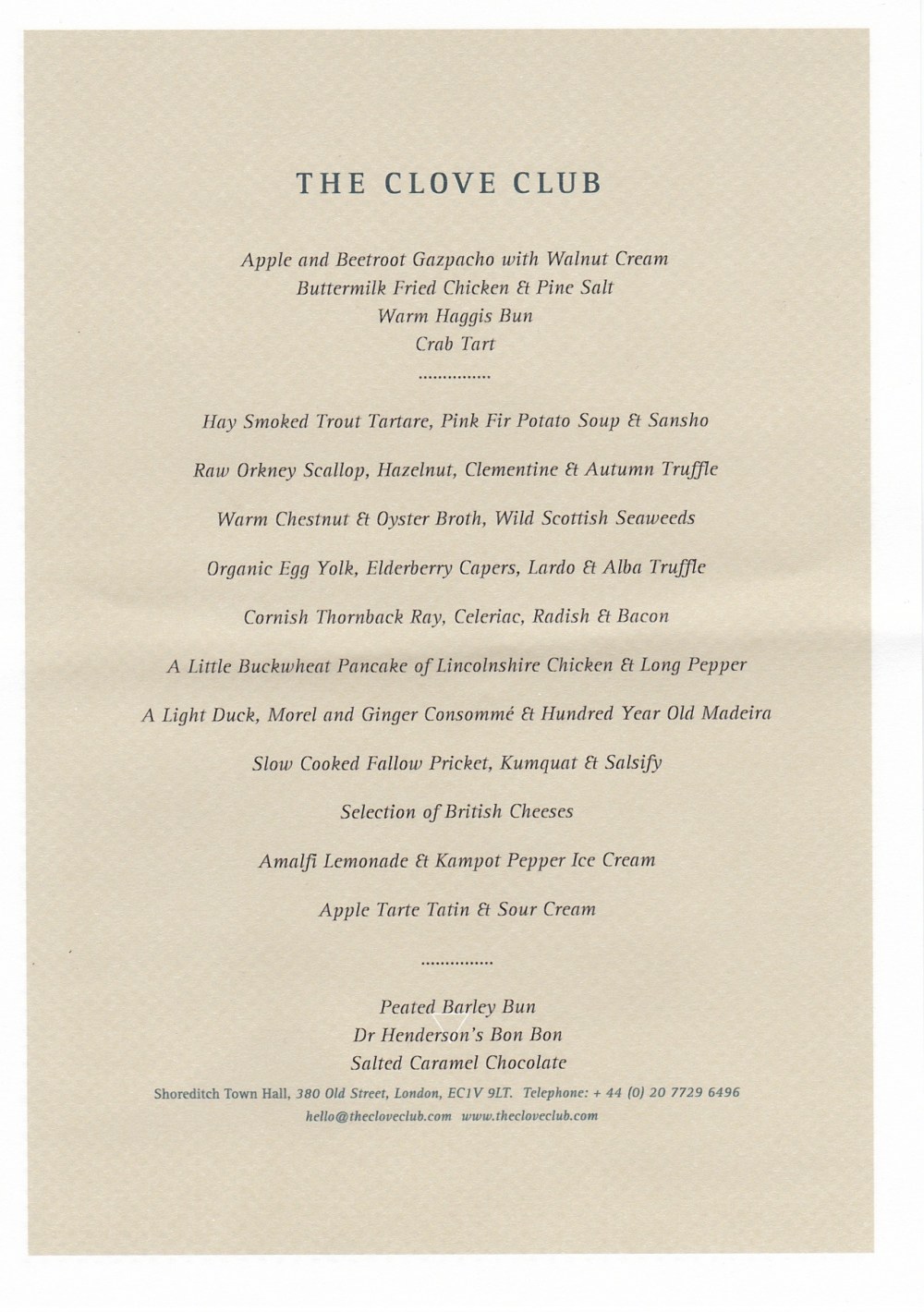
We returned to London, where Judie’s sister Linda and her friend Chris were already at our flat. The next day was my birthday and we went to the Clove Club, a spectacular restaurant located in a part of Shoreditch Town Hall, a 10 minute walk. It was quite a meal, comparable to going to Per Se (only half the price). Very attentive service and a delicious multi-course meal. The menu is below:

clove-club-menu

It is impossible to pick out the most delicious of these dishes. The most memorable was probably the one that started with a glass of 1908 Medeira. We drank that (amazingly layered tastes and a fabulous nose), while the wine steward told us about the house that made it. We left a little in our glasses and he poured a warm consommé of duck, morel and ginger over it. We also ordered the wine pairing. Judie got the regular one and I go the premier one, so we ended up tasting 20 wines while we were at it. When it was all over, almost three hours later, we blissfully walked home. You can’t do that in Montclair.

The next evening, it was another walk, this time a 20 minute stroll to the Barbican Theatre to see the Royal Shakespeare Company’s production of “Cymbeline”. It is one of Shakespeare’s last plays and is rarely performed. It is also one of his few plays that is not based on another story (which he then retells incomparably better than the original). The plot is pretty convoluted. It centers around Innogen, a princess whose two siblings were stolen in infancy. She has displeased Queen Cymbeline (the production changes the king to a queen and the Queen Mother to the Duke) by marrying Posthumus, a commoner, rather than the Duke’s son, Cloten. Her husband is banished and she eventually has to flee as well, dressed as a boy, when Posthumus is fooled in to thinking that she has been unfaithful and tries to have here killed. She is pursued by the vengeful Cloten. In the meantime, in a wonderful parallel to Brexit, Cymbeline and the Duke decide that Britain doesn’t need to be part of the Roman Empire and refuse to pay taxes, causing a war. There are battle scenes, Posthumus returns, Cloten is beheaded by one of the stolen children, now grown, who Innogen unknowingly meets in the forest before taking a draft that makes her appear dead. I’ve left out at least one whole subplot and various twist and turns. There is a pretty implausible denouement in the final scene in which all is revealed and everyone lives happily ever after (except the headless Cloten and the evil Duke). The performances were wonderful, especially Bethan Cullinane as Innogen and Marcus Griffiths as Cloten. We had actually seen much of the cast in “King Lear” a week earlier. There was original music accompanying the play and some clever bits of staging. There is a kind of hilarious scene when Innogen wakes from appearing dead and finds herself lying next to the headless Cloten, dressed in Posthumus’ clothes (too complicated to explain here). It was a bit like the “Romeo and Juliet’ scene on acid. The whole thing was extremely enjoyable, if typically long. So long, in fact, that we had to walk back to the flat to get some food since most of the restaurants in that area were closing.

So the past two weeks was a period in which I was reminded that my heart is in Montclair and that it will be easy to move back home. But at the same time, I was reminded how wonderful it is to live in London. We mean to enjoy the next four months of this experience and look forward to our return to Montclair and to many visits to London.


Catching Up: Royal Shakespeare and Community Organizing

We are back from our Thanksgiving trip. Before I write anything about that, I want to finish up a post that I couldn’t complete before leaving. I probably should have done this on the plane or while I was in Montclair, but I don’t really like writing on my phone. And I suppose I am a creature of habit.

“King Lear”: Samuel Johnson said that he found “King Lear” almost unbearable. Yet here we were at the Barbican, experiencing it for the second time in a week. (According to the programme, the play was adapted in the 1680’s creating a happy ending, which was how Lear was played for the next 200 years.) After seeing Glenda Jackson take on Lear at the Old Vic, we were curious to compare the Royal Shakespeare Company version, starring the great Shakespearean actor Antony Sher, who we had seen memorably playing Falstaff about a year ago.

It is hard to compare the two Lears. The RSC production was in more traditional costumes and didn’t use things like projections. In some ways, I found the overall look of the RSC version preferable, although I thought the storm scene in the Old Vic production was more dramatically staged. One of the interesting little things the RSC production did was have destitute, silent characters often moving about the stage or sitting in corners, stressing the political context of the play, discussed below. Sher’s Lear was a more powerful a figure at the beginning, at least in part because he is not 80 years old like Jackson. So he begins the play as a robust monarch, taken with making declamations to the heavens.  (This production seemed to stress the part of the play that dealt with heavenly orbs and astrology.) The usurpation of his power and his descent into madness is a longer fall, perhaps, than Jackson’s. Glenda Jackson’s Lear was older and frailer and the removal of her knights was more of a personal affront. Sher’s Lear was a more active character so taking away his knights was a profound attack on his lifestyle in addition to his dignity. The daughters were more purely evil in the Jackson version, while the RSC played Goneril as more convinced of her father’s decline and her actions seemed more driven by concern for him, at least at first. (Regan was more the pure evil daughter.) The Fool (Graham Turner) was far more melancholy in the RSC production, as if he could foretell Lear’s upcoming demise. David Troughton as Gloucester was memorable, but with Royal Shakespeare productions it is almost unfair to call attention to any actor since the entire ensemble is always terrific.

I have to say that I wasn’t really that familiar with “King Lear” before this intense exposure. I think I read somewhere that Lear has currently become the most produced of all Shakespeare’s tragedies, passing “Hamlet”. It has almost as many iconic lines, though fewer soliloquies and some of the scenes are more memorable. The storm scene is a classic, but I think my favorite is the one in which Edgar leads Gloucester to what he imagines is the cliffs of Dover, so that the blinded father can jump to what he hopes will be his death. There are countless references to sight throughout the play and the play has a political sensitivity that seems fairly modern. As Lear wanders the heath, he finds himself surrounded by the homeless and starving and clearly is surprised and moved by the discovery of such poverty in his kingdom (“houseless heads and unfed sides”). According to the Programme, this reflected the conditions in Shakespeare’s time, as population growth, food shortages and economic problems lead many peasants to leave the land and move toward the cities. While a system of private social welfare was developing, the government did little to help the destitute migrants crowding into London (who Shakespeare saw on a daily basis) and Lear’s comment “O, I have taken too little care of this” can probably be seen as political commentary. This criticism reaches its peak when Lear urges Gloucester to get a glass eye “and like a scurvy politician seem to see things that thou dost not”.

Another Election: On Thursday, I went with my rabble-rousing New Unity Social Action crew to another meeting of a community organizing group. A few months ago, I went to a meeting of Hackney Citizens, in which the mayoral candidates spoke and were questioned. The time, the meeting was held by TELCO. It sounds like a telephone company or some sort of multinational conglomerate, but it actually stands for “The East London Community Organization”. It is the oldest Saul Alinsky-inspired social action organization in England and one of the biggest and most successful. Now there is a Citizens UK and a Citizens Liverpool and Citizens Brighton, etc., bur TELCO has held on to the name. So as I understood it from Andy that one of the main purposes of the meeting was the change the name to East London Citizens. The meeting was one of those over-programmed type of Alisnky meetings, which stresses participation by many and sticking to a script and to time limits. The whole thing was scripted out to he last word and most people just got up and read their little bit. So as you might imagine, it was stilted and lifeless.

Despite their efforts, they screwed up one thing. They seemed to be under the impression that London had agreed to build 100 affordable units at the old Olympic site in East London, through Community Land Trusts that Telco was pushing. A representative of Mayor Kahn was there. If you are going to have an action like this, you are supposed to meet with the speaker to make sure that you know exactly what he is going to say and, ideally, tell him what to say. They didn’t do that. So when some TELCO guy got up and with great fanfare asked the official to confirm and guarantee that the 100 unit would be built, he would do no such thing. He said nice things about the idea and said they would do some as a pilot, but simply refused to commit to any number. The TELCO guy seemed stunned and, as this was supposed to be a great victory they were highlighting, it made the actual achievement that they did accomplish seem a little like a failure.

Then they had the name change vote. Any member organization with five members present (how they checked the membership was unclear to me) was allowed to vote. They had two speakers for the two options. They did propose changing Community to Citizens in TELCO, which does nothing to deal with the confusion in the name. It seemed like a sure thing that the name would be switched to East London Citizens and I am pretty sure that is what the organizers wanted, but when they counted the ballots, TELCO won. It would have been interesting to attend the post-mortem that is supposed to be a part of every one of these sorts of meetings. The thing seemed like a chaotic disaster to me. It is a shame because they are quite effective in reality and are doing important work.

A new Painting and a Rainy Saturday

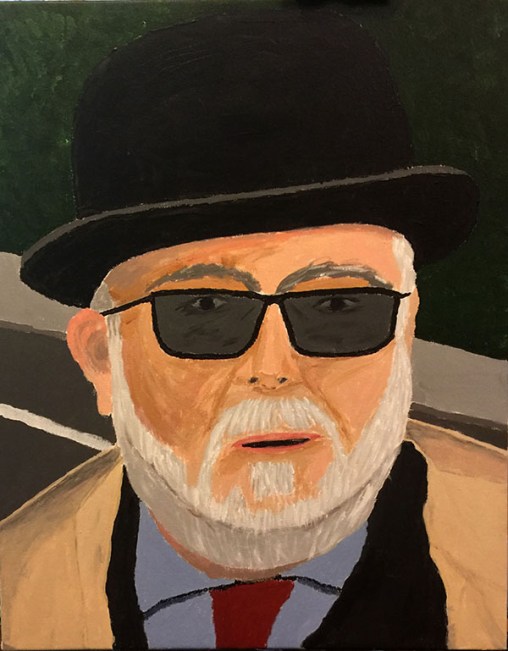
Another painting in the Portrait Series: After my last portrait, I said that I was thinking of doing one of someone I didn’t know and that is what I did. I found a photo I took of a gent with a bowler hat. (I was leaving the Trooping the Colors ceremony and managed to snap a candid shot.) So I was painting without feeling the pressure of capturing the essence of someone I know well. It is an OK effort I think. Painting faces is not easy at all. I find them much harder than landscapes. But I think it is worth persevering. I do think each of these portraits has shown some level of improvement, so maybe I’m just starting to get the hang of things. I’m beginning to think that I should take photos of people when I’m visiting the States in the coming weeks, so that I can get some material for future efforts. Anyway, “Bowler Man” is below. I’m not sure I’ll even start another portrait before our Thanksgiving trip, which begins next Saturday. I still have a landscape in progress.

bowler-man

Rainy Saturday: As the Saturday after Trumpageddon approached, we were considering just getting out London. Maybe a road trip to Cambridge or Windsor or even a quick trip to Paris for lunch. But then we watched the weather and found it would be pouring down rain in all those places. The main event in London that day was the Lord Mayor’s parade, but we had gone to it last year and watched in the rain. (We were told that it always rains on the Lord Mayor’s Parade.) So we decided to go the two movies that afternoon and picked some real escapist ones:

“Doctor Strange”: This was my favorite Marvel character in my sometimes psychedelic youth. I actually have a collection of Doctor Strange comic books from the mid-1970s, which may be valuable for all I know. They certainly have tremendous nostalgic value to me. So I was excited to hear that they were making a Marvel movie based on those comics and that Benedict Cumberbatch was going to play the master of the mystic arts. It struck me (and probably everyone) as inspired casting. The movie was fun. We saw it at an IMAX 3-D theatre in Leicester Square, which made all of the special effects in the film even more awesome. I must say that the film took an awful long time getting to the good part–when Doc Strange meets the Ancient One and the real fun begins. Did I really need all those scenes of brain surgery, etc.? I guess it is background that allows us to “understand” the character, per the Marvel movie playbook. Anyway, once that was behind us, the special effects were spectacular and the plot became increasingly and appropriately spacey. Doctor Strange doesn’t fight mere humans or superheroes. He battles cosmic forces and supernatural villains. And that part was great. Cumberbatch was a wonderful Steven Strange and I could see him developing the character in the inevitable sequels to come. It was a bit weird seeing Tilda Swinton as The Ancient One, but she was fine. This is not a classic movie in any way, but I enjoyed myself thoroughly.

“Arrival”: After lunch at The Cork and Bottle in Leicester Square, we walked over to Piccadilly Circus to see “Arrival”, a science fiction movie starring Amy Adams. It was enjoyable, as long as one didn’t think too much about the details of the plot. Amy Adams is a linguist who is recruited by the U.S. Army to try to communicate with the aliens in one of twelve mysterious large alien vehicles that have parked themselves at various places around the Earth. They look like gigantic, walking octopi (only with seven legs). And it develops that they communicate by squirting black goo to form symbols. Amy Adams has to interpret them and to teach the aliens English in a sort of Anne Sullivan/Helen Keller way. Her performance is convincing as it possibly could be. There are lots of flashbacks about her daughter, who has died form some sort of rare disease. It appears that this history somehow makes the aliens more receptive to her (or something), but this is one of many points when the plot becomes a bit hard to follow. Judie and I left the movie saying “What was going on there in the last ten minutes?” and I’m still not certain. But it doesn’t really matter, since one should suspend belief in such movies anyway. It was cleverly done, without the usual overbearing military/government villains. (Forest Whitaker was nicely normal as the Army guy in charge of things.) After the crazy special effects and loopy plot of “Doctor Strange”, this movie seemed almost intimate, although it really wasn’t at all. But it was satisfying to watch.

A Couple of Books I’ve Read: I went through a longish stretch reading several British history books, including one about the life of Samuel Pepys. interesting, but sort of dry and a bit of a slog. I was ready for something lighter. So I read Michael Chabon’s “Gentlemen of the Road”, a swashbuckling adventure novel set in the Caucasus mountains around 950. In Chabon’s notes at the end, he reveals that the working title was apparently “Jews with Swords” and that gives you just an inkling of the many clever twists and turns that occur in a fairly short book. Great stuff. On Saturday, I finished “A Man Called Ove”, by Fredrik Backman, a book recommended by Judie’s sister, Robbie. It is a Swedish book about an old curmudgeon, whose wife has recently died and who just wants to die himself when we first meet him. He seems like a one-dimensional grumpy jerk at first, but he grows on you and the book is really very sweet. It was nice to read something so gentle after the election. I understand that it has been made into a movie in Sweden and it looks like a TV miniseries to me.

Shakespearean Tragedies

On Election Day, Judie and went to see “King Lear” at the Old Vic, with Glenda Jackson in the title role. There seemed to be something appropriate about going to the play on the day when it appeared that America would elect its first female President. In any event, it would be better than sitting around all evening obsessing about the election when nothing would actually happen here until after midnight. Little did we realize that we were going from a theatrical study of madness and tragedy to a real life experience of madness and tragedy.

It all seemed to be going well at first. Clinton leading in the first reported votes. States like Georgia and South Carolina too close to call, when one would think they would be automatically for Trump. There seemed to be a possibility of going to bed before 3:00. But, as we all know now, it all inexorably shifted and the race became closer and then it all began to fall apart. It didn’t seem possible, but this narcissistic con artist was winning and by 4:30, I had to give up and go to bed. I couldn’t watch the end of this disaster, much less listen to the gloating of people like Giuliani and his ilk.

It all still seems like a bad dream. I have heard people say that maybe it won’t be so bad, but I don’t buy it. It is going to be awful and untold harm will be done to the planet and to the idea of American democracy. A type of visceral hatred has been released by Trump and it is not something you can get back into the bottle easily. I know that we, the majority of the country that actually voted for Clinton, will have to band together to fight this, but there will be a lot of losses along the way. I also know that demographics is destiny and the rule of the angry white men has to end at some point. But by then the rock will be back at the bottom of the damn hill and we will have to start pushing it up all over again. I truly believe that “The arc of the moral universe is long, but it bends towards justice”. It is distressing when it gets bent back the other way, but I guess that has to make us pull harder on the bar.

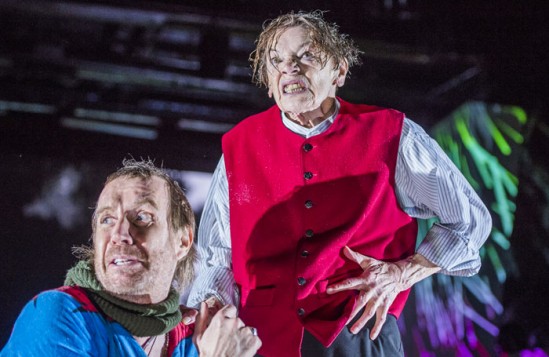
“King Lear”: I imagine that actors all over England rushed to audition for parts in this. There is something truly epic about Glenda Jackson deciding to play Lear. And it isn’t simply the obvious parallel to Hillary and what seemed like the Year of the Woman until Tuesday, when it turned into the Year of the Sexual Predator. This was her first performance in 25 years, since she left acting to become a member of Parliament from 1992 to 2015. The woman is 80, for God’s sake and she took on an incredibly demanding role. Despite all that, it was not surprising that she was wonderful. Her Lear was a bit old and frail but had her wits about her at the outset, as she made the fateful errors in dividing her kingdom among her daughters. She then moved through anger into fury as her daughters betrayed her, winding up as a mad king cursing the heavens. It was a memorable performance. the rest of the cast was brilliant. In particular, Rhys Ifans was wonderful as the Fool, who at one point launches into a Bob Dylan impersonation for one the Fool’s songs. Harry Melling (Dudley Dursley in Harry Potter) was impressive as Edgar. Jane Horrocks (as Regan) and Celia Imre (Goneril) were suitably evil as the two awful daughters. And Edmund’s first speech was done while he was working out, skipping rope and doing all sorts of physical things. It was amazing that Simon Manyonda could do it without even breathing hard. Finally, I wasn’t crazy about the modern dress costumes or the minimalist scenery, although the way they did the storm scene was sort of clever. In a way that focused everything on the acting, which was amazing.

King-Lear-Old-Vic-697-549x357.jpg

“Julius Caesar” On the night after the election, we went to the Donmar Warehouse to see an all-woman production of “Julius Caesar”. It was good to get out of the flat or we would have just sat around being depressed about the election results. And “Julius Caesar” has a special resonance for me, since I was in possibly the worst production of all time in my first semester at Bowdoin. Miserably acted and directed, all I can say is that I had a very small part as a freshman and mainly watched in a combination of horror and hilarity behind my sword and shield at what transpired. I’d gone to college thinking that I wanted to be an actor and I realized about halfway through the rehearsals that Bowdoin was not going to teach me anything in that area. But I did make some lifetime friends standing and giggling with the Roman Legion upstage, as the “actors” declaimed downstage.

Once again, seeing an all-woman production of this play seemed like it would have a particular relevance on the evening after what we assumed would be Clinton’s election. In light of the reality of what happened, it seemed depressingly appropriate that the play was set in a woman’s prison. It was a fabulous production, fast-moving and well acted. The women were dressed pretty androgynously (since they were in a prison, they were mostly in gray), so the fact that they were woman was not really made a point of. The amazing actor, Harriet Walter, who played Brutus, was one of the creators of the trilogy of which “Julius Caesar” was a part. She was riveting in the role and, in some ways carried the production. I thought that Jackie Clune also stood out playing Caesar. She had a certain charisma and confidence that made her seem like the kind of leader that people would follow and want to make their dictator. (She also had reddish hair cut fairly short, which gave her a vague creepily Trumpian look.) I also liked the actor who played Casca. The staging of the play used the idea of the prison without letting it obscure the Shakespeare. It was sometimes very cleverly done. I was sort of lukewarm about the way that “Friends, Romans and Countrymen” was done, possibly because the woman playing Marc Anthony could not match the gravitas of Walter and be an effective counterpoint to her Brutus.

“Julius Caesar” is a tremendous study of politics and power. It has a number of familiar lines that are a part of the popular lexicon and one of the great speeches in any play. But I have always felt that the play actually becomes a bit dull after Marc Anthony’s speech, which unleashed “the dogs of war”. It kind of goes on and on as you wait for the conspirators to be killed on the battlefield. (When you think about it, Elizabeth I would not have been happy with a play that let regicide go unpunished, so Shakespeare had a point he was compelled to make there.) I suspect it is often edited down and, in this case, the end of the play is simply cut off by the prison guards, shortly after Brutus’ death (“This was the noblest Roman of them all.”), which was an interesting way to deal with the problem.

Election Prediction and Brexit News

It is Going to be Unreasonably Close, But Hillary is Going to Win: It is incredibly frustrating to be watching the election from this side of the pond. I just feel so utterly impotent. If I was back in New Jersey, I’d be volunteering, making calls, going house to house, and taking road trips to swing states. It might not actually do any good (but the chance that it might would be enough). It would at least make me feel better. What I have been doing is compulsively reading about the election, which has mainly served to drive me crazy. But I have become convinced that Hillary is going to pull this out. Here is why:

  • The Democrats always go into Presidential Elections with a large number of electoral votes pretty much in the bag, since they should win the big states on both coasts (except Florida). This election is no exception and Hillary seems to have a base of 260+ relatively sure electoral votes. She doesn’t have to win more than one or two of the toss-up states to win the election and she is ahead in a number of them.
  • Trump, on the other hand needs to run the table of all of the swing states and probably take a surprise state like Michigan. You can’t say it is impossible, especially if you believe the possibility that the polls might be completely off. But it seems very unlikely.
  • People and pundits seem to love to point at the Brexit vote (and the last Cameron victory) as proof of the unreliability of polls, but, in fact, that only shows the unreliability of British polls. I was listening to a 538 podcast the other day and they explained that American polls are simply better. This is partly because we have so many more polls. There is a multi-million dollar election industry in the US that is on a different scale than that of the UK and which relies on and pays for accurate polling. Between money and volume, US polls are more likely to be accurate over all. It is not a sure thing for Hillary to go into Election Day with a three-point lead in the polling average, but it is very meaningful.
  • After this whole horrible endless election, the state of the race is startlingly similar to the place it was in the same point in 2008 and 2012, with a few more undecided votes. It may be that a 3-5 point win for the Democratic candidate is just the equilibrium point and that Clinton and Donald somehow cancelled each other out and we ended up back at square one.
  • It appears from early voting that turnout will be very large, especially among Hispanics. This should favor Clinton. Trumps’ best shot (and what is always the Republican’s best shot) is a low turnout election in which his angry white men turn out in waves.
  • Judie’s mother voted for Clinton and reported that the other people in her assisted living home, mostly conservative church ladies and lifelong Republicans in North Carolina, unanimously voted for Clinton. I find that kind of remarkable.
  • I have an unreasoning and utterly unscientific belief that a majority of the American people will reject Trump.

I think I am right. I certainly hope so.

Brexit Update: the big news last week was that the Court ruled on the challenge to the way Article 50 might be invoked. (That is the Article of the EU Agreement that governs leaving the Union and starts a two-year timetable.) Theresa May and the Conservatives have taken the position that this can be done by Prime Minister, relying on the ancient principle of “royal prerogative”, which was gradually moved from the monarch to the PM. The challengers said that, under British constitutional law, the Parliament is supreme. They argued that since Parliament passed an act joining the EU, which conferred rights to UK citizens, an act of Parliament is needed to reverse that step. The challengers carried the day and the government is appealing to the highest court. (The right-wing, pro-Brexit press immediately engaged in a truly reprehensible attack on the judiciary, which May and the new Lord Chancellor never really denounced and took their time even saying “tsk, tsk”.)

There is a decent argument in favor of overruling the lower court and it might happen. But if it doesn’t, May is in a tricky spot. The Conservative majority is small and many of them were anti-Brexit in the referendum. Indeed, if one had polled Parliament before the referendum, Britain would still be in the EU. But now the MPs are all talking about “the will of the people”. What no one says is that it was only 52% of the people, in a campaign in which it was clear that both sides lied about the impact and a good number of people didn’t completely understand what is that they were voting for. But that doesn’t seem to matter, since many formerly pro-EU MPs are now worried about an electoral backlash. So it has always seemed to me that this fear will trump reason and there is no real likelihood that a majority of the Parliament will reject the referendum result.

But what they might do is insist on some sort of detail about what Brexit means to May and her team. If such a course was possible as a part of an Article 50 Parliamentary approval, the disarray in May’s government would be exposed. It is unclear that the Brexit ministers have a coherent idea of what they are looking for in the break from the EU and it is abundantly clear that members of Conservative party have wildly divergent ideas. You can appreciate that May doesn’t want to go into negotiations having given away their strategy. On the other hand it would be nice to know whether their goal is a hard Brexit, with a complete break from the EU (favored by the far right MPs) or a result which maintains market access while slightly limiting immigration in some way. In two and half years, the negotiations will be over and Britain will be faced with essentially a take it or leave it proposition, since there will be no time to negotiate a further change. So this is probably Parliament’s best shot to direct the outcome.

Faced with that, there is a chance that May will call a snap election, figuring that she could increase the Conservative majority with Labour in disarray. This would make it easier to push through whatever it is they want to do with respect to Brexit, in theory. But maybe not. There would be a danger that such an election could turn into a de facto second referendum on leaving the EU. That is a vote that would not be a sure thing for May. Given the dangers of holding an election that might lead to a weakening of “the will of the people”, I’d guess that is more likely that May and the government will just try to play political hardball with the Parliament if the current judicial decision is upheld.


Myriad Experiences

Judie is off touring America, stopping at various K&L Gates offices, including Boston and Washington, and ending up in Chicago for a conference. When Judie is not around, I have even less order to my life than usual. I tend to eat at odd times and get lost doing projects or watching baseball on my computer. It is actually sort of fun when she is gone for about a week, as she is this time. She returns on Wednesday evening and Alex arrives that morning for an eight-day visit. Alex has finished up with his Every Zip Philadelphia project (which you can see and hear on the WHYY website). It was pretty successful, although I think it was too much management and not enough creativity for him. It wasn’t renewed and he has been hired by Audible to co-produce a multi-part audio series about how Americans experienced World War II at home. He was given a number of books to read and will have access to lots of archive interviews etc. The process of creating his two sections is about to start in earnest, so he is taking this break to visit us.

“There’s no crying in Baseball”: That’s what Tom Hanks’ character memorably said in “A League Their Own”. But it turns out that sometimes there is crying. For some reason, the Mets have been involved in the two most emotionally fraught games in the history of baseball. The first was in 2001, when the Mets played the Braves in the first game played in NYC after 9-11. The atmosphere surrounding the game was incredible and it was punctuated by Mike Piazza’s game-winning home run, the single most dramatic hit I have ever seen and what has to be the highlight of his Hall of Fame career. I thought I would never see another baseball game to compare to that.

Then on Monday night, the Mets visited Miami and the Marlins for the first game after the tragic death of Jose Fernandez, a game that he was actually scheduled to start. Fernandez was incredibly talented, with a simply amazing life story and was supposed to be a wonderful person. There was a very moving opening ceremony, with both teams on the field, which concluded with the Mets players going across the field to hug the Marlins players. Most of the Marlins players were teary-eyed or crying. When they switched to the broadcast booth, Gary Cohen, the main Mets announcer, was so choked up that he could barely talk and Keith Hernandez and Ron Darling were sitting there with conspicuously red eyes. Then, in the bottom the first, Dee Gordon batted right-handed for the first pitch in honor of Fernandez and then switched to his normal side and hit the third pitch for a home run (his first home run of the season and the first time in his career he had hit the ball into the second deck). He was clearly crying as he circled the bases and came back the dugout where he collapsed into the arms of his sobbing teammates. It was just unbelievable on any number of levels. A once in a lifetime baseball moment. Travis d’Arnaud, the Mets catcher, said he was crying watching Gordon round the bases and I doubt he was alone in that. There is crying in baseball after all.

Abstract Expressionism: On Saturday evening, I went to a members’ private tour and party celebrating the opening of the Abstract Expressionism exhibit at the Royal Academy. As our guide/docent pointed out, the name is a bit deceiving, because many of the artists’ styles were neither abstract or impressionistic. It is sometimes called the New York School and NYC certainly became the center of the art world in that period, but many of the artists did not live or paint in NY. Tragedy was one theme as some of the most important artists died young, from suicide (Gorky and Rothko) to car accidents (Pollack). As you might imagine, there were some iconic paintings. There were some great Pollacks, including one huge early one he did on commission for Peggy Guggenheim’s apartment which was a breakthrough moment in that era. And there were great examples from Gorky, Klein, de Kooning (his series of paintings of women were amazing), Rothko (the early works were fascinating), Motherwell and Krasner (a highlight was the first painting she did after Pollack’s death). It was a wonderful exhibit and it was nice to have plenty of time to go back and wander through it after the tour, without being bothered by the usual crowds. For me, the great revelation was Clyfford Still. He became disgusted by the commercialism of the NY art scene and moved to Wyoming, where he painted the rest of his life. He sold practically nothing while he was alive, but now his work is in a museum in Denver, which I have to visit some time. There was a huge gallery of his work, which was breathtaking. See below for an example. There was also a party with a free champagne cocktail and a bar and a jazz singer, so it was all very festive, although I would have had more fun if I’d found someone to go with.

abst-exp

Immigration Detention Seminar: On Monday evening, I went to a meeting at the offices of Amnesty International (which it turns out is about four blocks from our flat) for a conference about the alternatives to Immigration Detention and role of civil society in making those alternatives happen. It was run by an organization called Detention Action. The audience seemed to be mostly immigration insiders–lawyers, advocates, NGO people and a sprinkling of government officials. It was too bad in a way, because some of the speakers were very interesting and for real reform to occur, they are going to need the support of a much wider group. There was a woman who is one of the leading immigration advocates in the Ukraine and, as you might imagine, they have some problems there that are hard to imagine, such as millions of displaced Ukrainians to deal with, in addition to all of the migrants, most of whom are really trying to get to Germany or somewhere. And there was a representative of Freed Voices, a group of former detainees, who spoke very movingly about how de-humanizing detention is and that there is no trust. I was given a big report, which I’m going to read.

Labour Conference: Jeremy : won his election by a landslide and this was followed by a Labour Conference in Liverpool in which the party tried to unify and to explain what they want to do. To me, what was most interesting about the process was the fact that the party out of government actually laid out a fairly detailed program. They take the whole idea of a party platform much more seriously here. It really is a nice political concept, where the opposition party must have a formal “shadow” government which says, with some specifics, what they would do if they were in power. The other nice thing about this system is that the BBC and the media in general (although maybe not the Murdoch press) really give deep coverage these kind of policy matters and engage in a real discussion and questioning about what the party is saying. It is a level of substantive and detailed analysis that is utterly absent in the American media (except on PBS and NPR to some extent). There are a lot of problems with the British system, but they really take politics and the issues much more seriously here, from Question Time to the Shadow Cabinet system to the media coverage.