Four Plays and 100 Kazoos

Administrative Note: I’m probably going to change to the premium version of Word Press, so that I can publish photos of higher quality and you won’t have to see advertising. This will change the address of this blog to nickinshoreditch.com. If you are signed up to get notifications by e-mail, this may not matter, but if you are used to just seeing it through a browser, you won’t be able to find this using the current URL. So this is a warning: If you are looking for nickinshoreditch and it isn’t popping up, then I’ve made the change. I’ll post more warnings as it happens.

Four Plays in Twenty-Seven Hours: This was a kind of a crazy idea. The National Theatre has been having a special “Young Chekhov” event in which you see three plays normally done in repertory on individual nights, all in one day. I signed us up for it, not realizing that we also had tickets at the Old Vic the night before. So it really was a marathon.

It all started with “No’s Knife” at the Old Vic. It isn’t exactly a play. It was more of a performance piece based on selections from Samuel Becket’s “Texts for Nothing”. On one level, it was an amazing interpretation by Lisa Dwan, a dancer, actor, writer and Beckett expert, as she used movement and voice changes and odd, bleak scenery and a mist machine to enliven some of Beckett’s most obscure ramblings. On the other hand, it was so plotless that it made “Waiting for Godot” seem like “The Importance of Being Ernest”. There was a lot of existential despair, reflections on nothingness and ruminations about death. There were many good moments, but the whole thing wasn’t cohesive and, in fairness, was not intended to be. We both found it difficult to concentrate fully on the stream of thoughts that were being expressed for the full 70 or 80 minutes. It was one of those things that made you feel intellectual for simply being there and a dolt for not being able to find some sort of deep theme (beyond misery and death) or a trenchant comment on the modern world. An odd evening.

The next morning, we were off to the National Theatre, which was made difficult by the weekend closure of all of the tube lines that went anywhere close to it. The three plays on the day were the early works of Chekhov and the whole thing was the inspiration of David Hare, who also created new versions of the plays. The first play, which began at 11:45, was “Platonov”, also known as “The Play Without a Title” when Chekhov wrote it at about age 20, while a medical student. It was discovered 20 years after his death and performed sporadically until 1960, when an edited version first to use the tile “Platonov” was performed with Rex Harrison as the lead. Like most Chekhov plays, it is set in a country villa and I think might be characterized as a tragic farce. The set, which was used for all three plays (since they are all mostly set in country villas) was absolutely spectacular. In this case, the villa was the home of the widow Anna Petrova, played by the wonderful Nina Sosanya, who we’d seen before. The main character, played by Scottish actor James McArdle, is supposed to be the most interesting and handsome man in the community. Like seemingly all Chekhov characters, he has money problems and is unhappy with how his life has gone. He is a bit of a misogynist but is also irresistible to women, with whom he has a series of affairs, despite being married and a father. The fact that the women in play fall for him unhesitatingly, despite his flaws, really annoyed Judie (and she regards this portrayal of women as typical of Russian writers). Putting that reasonable objection aside, McArdle did play Platonov with considerable charm and humor and there were large sections of the play that were very funny, at least until it all begins to catch up with him in the last act and a tragic ending is assured. I found the whole production to be lively and immensely enjoyable. It is a play with a number of juicy parts and the cast was great. It turns out that “Wild Honey”, by Michael Frayn, which we are going see at the Hampstead Theatre later this year, is his adaptation of “Platonov”. I’ll be curious to see if it is different.

After  a quick lunch at House, the National Theatre’s on-site restaurant, we were back in our seats at 4:00 for “Ivanov”. This was Chekhov’s first complete play and the first ever performed (in 1887). It was an initial disaster, but was restaged triumphantly two years later after Chekhov rewrote it. This play is also set in country villas and has more tragedy and less humor than “Platonov”. Ivanov, played by Geoffrey Streatfeild,  is unhappy, has money troubles, and feels like he has wasted his life. In short, he is a typical Chekhov character. (What must life have been like in the late 1800s in Russia?) His wife, played by Nina Sosanya, is dying of TB and her doctor, played by James McArdle, is an insufferable prig whose idea of the truth helps to ruin the lives of both of them. There are some other characters who give a truly amusing view of the life in that era and who keep the proceedings moving. Unfortunately, Ivanov, at the center of the action, is simply clinically depressed for the entire play and cannot get himself out of it, despite the efforts of a young neighbor, played by Olivia Vinall, to pull him out of it. It is all a effective and dauntingly realistic realistic look at dealing with profound depression. (You keep thinking “Give this guy some medication!”) But it seems to me that the main character must develop over the course of a play and Ivanov cannot and does not. It isa one note role, leading to a one note performance. We are ultimately left waiting for his inevitable suicide. The play had moments, but was the least satisfying of the three, one I would not be tempted to see again.

Finally, it was back to the Olivier Theatre at 8:00 for “The Seagull”, a more familiar Chekhov work. The set contained a good deal of water, which was used somewhat in the first two productions, but was more central to this one, which is set in a country villa on a lake. There are two interconnected plots. One concerns the relationship between Irina, the owner of the estate, a spectacularly vain and famous actress, played with wonderful self-centered energy by Anna Chancellor, and her son Konstantin, played by Joshua James, who had also had a central role in”Platonov”. Her belittling of him and the destruction of his dreams is one theme. The other involves Nina, a young, talented and beautiful woman, played by Olivia Vianall (again–more on that below), who is a neighbor and beloved by Konstanin. She is casually seduced and ruined by Trigorin, (Streatfeild is back in this role), a famous author and the lover of the actress. As in all of three plays, there is a large company of interesting characters, all played with wonderful gusto. This play is ultimately about the dreams and ambitions of the young being thwarted by their elders and is consistent with the prior two plays, in which both the two young protagonist’s youthful dreams and ideals have been unmet, leaving them in a state of perpetual disappointment. And it turns out that the other running theme of the three plays is that if you are a character in a relationship with one played by Olivia Vinall, you are doomed. In “Platonov”, she is the jilted mistress whose life is ruined by Platonov and who shoots him at the end. In “Ivanov”, she is the well-meaning young woman intent on saving Ivanov by marrying him, only to see him shoot himself. And in “The Seagull”, she is the lovely, ruined Nina, who returns in the final act to see Konstantin and delivers the final blow to him by saying that she will always love Trigorin (thereby providing more evidence for Judie’s theory about female characters and Russian authors), which leads Konstantin to shoot himself. Which is how our day of theater ended, shortly after 10:30.

100 Kazoos: The next morning, we went to New Unity. It was the tenth anniversary of Rev. Andy’s first service there and a group from the Sunday Gatherings Team decided it was important to celebrate it and finally roped me into participating. I had two ideas which I implemented when the group agreed. First, I bought blank cards and envelopes and markers, so that everyone could create a card for him at a point during the service. (I didn’t think that the organizers gave people enough time  to finish, but I suspect some people just continued to work on their messages during the collection.) The planning group wanted to do something special and less serious and I suggested that we play “For He’s a Jolly Good Fellow” on kazoos. It seemed like something that had both English and American elements. So we did it. I bought 100 plastic kazoos, which we passed out at the end of the service, as the Music Director gave a quick lesson on kazoo playing. (Most of the congregation had never touched a kazoo before!) A joyful noise was made.
Alex Visits: Art, Spurs and Branagh

Alex has been visiting the past week or so from Philadelphia. So I have been doing a lot a stuff with him and doing less painting and writing and New Unity stuff. I have also been distracted by doctor’s appointments and medical tests about my swollen left leg. It turned out to be blood clots and I am now on blood thinner medication. Not great news, but at least I know what it is and I’m being treated. The only real bad thing is that this means that I cannot fly long distance for three or four weeks, so I am going to miss accompanying Judie on her next big tour of the U.S., which starts in about a week. That trip includes a visit to see Hannah in Olympia, which is the only part of it that I am upset about not doing. Anyway, enough about my health, which I don’t like to write about.

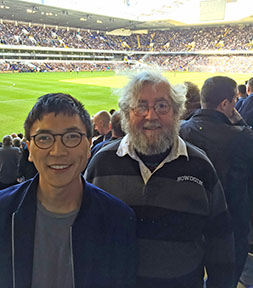
White Hart Lane: White Hart Lane is the name of the stadium where the Tottenham Hot Spurs play. Alex has always wanted to go to a Premier League football (soccer) match and I managed to find tickets on Stub Hub for a game between Tottenham and Manchester City. (All the Premier League games are sold out, at least around London, so it was surprising to get tickets for a game, especially one between two top squads.) Manchester City came into the game undefeated under their new coach, Pep Guardiola, who they lured from Bayern Munich for a gigantic amount of money. (Man City is the richest team in the Premier League and also routinely buys all the best players, so they are a kind of international squad.) Tottenham is also very good, but the Spurs’ best player, Harry Kane, was injured for the match.

White Hart Lane turned out to be a relatively intimate stadium, holding 35,000 or so. It is being replaced by a big, new stadium, which is under construction next to it. I’m sure it makes economic sense and the amenities at the current stadium are a bit primitive, but I’m glad we got to experience what seemed to us to be more of the real thing. One of the things we noticed right away was all of the Korean fans. The Spurs have a forward, Son Heung-Min, who has recently been scoring a lot of big goals, especially with Kane out, and he has become a fan favorite. So there were lots of Korean (and probably other Asian) fans in attendance, many sporting Son jerseys. Our seats were in the corner, right near the goal line and seventeen rows up, so we had a great view of the action at our end, but couldn’t see one of the far corners.

We got there entirely too early since we had to pick up tickets and were expecting a lot more security than there was, but game time finally came and the stands filled up. As the game began, the stadium began singing a Spurs song to the tune of the “Battle Hymn of the Republic”. We were thinking “Isn’t that cool” and then we figured out that we were seated in the part of the stadium where the most lunatic and loyal Tottenham supporters sat. The entire corner of the stadium we were in neither sat down or stopped singing (except to cheer or scream at the ref or the Man City players) for the entire rest of the game. It was deafening. I am certain that the players on the field couldn’t hear each other at all. And the fans didn’t have just one song. They had a whole repertoire and seemed to magically go from song to song in unison. Some were just things like “When the Spurs Go Marching In”, while others were tributes to individually players or the coach. There was a  subset of anti-Arsenal songs and they sang a few. (I assume this is something like Red Sox fans chanting “Yankees suck” even when the Yankees aren’t there.) All the songs were to popular tunes and, when I looked on line, I discovered there are 200 songs in the Tottenham fan’s catalog.. They kept singing the song for the teenage future superstar Dele Alli, since he had a great game, but Son is apparently too new to have his own song yet. (I hope it doesn’t turn out to be racist.) The game was very exciting. The Spurs dominated the favored City squad and won by a very convincing 2-0 score, which might have been worse but they missed a penalty kick. Both teams were in attack mode for the whole game. It appears that is Tottenham’s style and City fell behind early and were under so much pressure that they had to attack. Son is great and, if he isn’t already the biggest deal in Seoul, he will be shortly. In the end,though, it wasn’t the game that I’ll remember. It will be the experience of being surrounded by fans singing and bellowing so loud that it was actually blowing my hair.

spurs1

“The Entertainer”: On Thursday night, we all went to see “The Entertainer”, the final production of Kenneth Branagh’s year-long series of plays at the Garrick Theater in the West End. The play, by John Osborne, may be best know as a vehicle for one of Lawrence Olivier’s greatest performances. It is the story of Archie Rice and his family. Archie is a failing Music Hall entertainer, in a time when the Music Halls are about to die. (There is also a side plot about the war in Suez–it is 1956–involving Archie’s two sons, which demonstrates the parallel Osbourne sees between the collapse of the Empire and the collapse of Music Halls.) As usual with Osborne plays, the characters are desperate and unhappy with a life of trying to make ends meet in an unfair social order. There are a number of scenes set in the Music Hall, in which Branagh is maniacally trying to entertain what you guess is a minuscule crowd, but his joke fall flat and he neither sings or dances all that well. (I suspect it is difficult to play a mediocre talent.) And then in the other scenes at Archie’s flat, the family just tears into each other. Gawn Grainger, who plays Archie’s dad (a legendary Music Hall performer who Archie cannot live up to), was especially memorable. But, typically, the entire ensemble of actors were terrific and it was fun to see Sophie McShera (Daisy in “Downton Abby”) do something very different. Branagh was wonderful, a big personality, gradually being beaten down by the new age and his own failings, but refusing to give up.

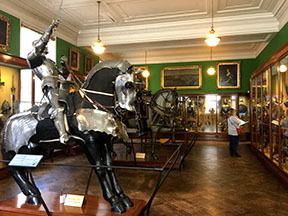
Ted and Wallace: Ted Hunter, a UUCM friend of ours, was in town this week. He works at the Arms and Armor section of the Metropolitan Museum in NYC and will become the Armorer for the Met when the current one retires later this year. It was lots of fun to see him and to have few beers at pub. He has encyclopedic knowledge of arms and armor and was in London to give a paper on the subject at a conference and to meet with his brethren in the field. He told us some good stories about armor in Britain. Apparently, the Royal Armor was moved from London to Leeds some time ago, apparently on the theory that it would revitalize tourism there. It hasn’t really, which he thinks is partly due to the fact that Leeds Castle is nowhere near Leeds, so that when people (like him) go to the more famous castle (which is this incredibly beautiful, historic castle, built on an island in Kent, by the town of Leeds), figuring to see the armor, they are disappointed because the armor is in the city of Leeds, in Yorkshire, which is many hours to the North.

Ted told us that the best armor in London is at The Wallace collection, where I had never been, so Alex and I had a day of art the next day. We started at the Royal Academy to see the Hockney portraits, which I was particularly interested to see again since I had started my own portrait series. I picked up a few things about painting faces, although I also learned that I have no hope in mimicking Hockney’s style which combines unexpected colors in a way I could never hope to do. We dropped by the Abstract Expressionism exhibit too, before walking over to the Wallace Collection to meet Judie. It is housed in a big mansion in Marleybone, once owned by Duke of Hertford (who I think were from the line of Seymours going back centuries and were, in any event rich aristocrats of long-standing). It was an amazing collection of arms and armor (as promised) and each room had several books on reading stands in which you could read more about the individual pieces. Very nice idea. There was also a substantial collection of paintings, including four Rembrandts, “The Laughing Cavalier” by Hals and a number of other impressive works from the 1650-1850 period. It was all accompanied by lots of Louis XIV sort of furniture and decorations and tons of other things that they collected. It is quite a place and you cannot see any of the art or armor anywhere else. When the Duchess of Hertford donated it to the State upon her death in 1897, she stipulated that none of its contents can leave the house.

wallace-coll

I’ll leave the rest to another post. This is getting pretty long….

Royal Shakespeare Weekend and More

One of the things I really want to do while I am here is see everything that the Royal Shakespeare Company (RSC) does, at least in London. (Stratford is a bit too far away, unless one stays overnight. We’ll probably do that at some point, but you can see most of the RSC performances at the Barbican or the West End, so it isn’t an essential trip.) We bought tickets to the four plays they are doing at the Barbican as soon as they were released to members. Given Judie’s upcoming travel schedule and the change in routine generally occasioned by the change of law firms, we decided to see the first two RSC productions on consecutive nights.

“The Alchemist”: This is a play by Ben Johnson, a Shakespeare contemporary. As the programme points out, while Shakespeare’s plays were entirely set in the past, Johnson’s were contemporary and, indeed, “The Alchemist” is set in Blackfriars (a part of London) in 1610 and premiered at the The Globe that same year. So the characters would have been recognizable types to those audiences and the references to things like the plague would be things they were familiar with. It is also likely that the audiences of that time believed in the possibility of Alchemy. Unlike Shakespeare, Johnson oversaw the publication of his own Folio and was thought to have expanded the plays to make them seem more serious. This requires some significant cutting of the text to give it a proper running time and to maintain the pace.

The play begins as the master of the house in Blackfriars is fleeing London to his country home to get away from the latest plague epidemic, leaving his servant, Jeremy or “Face”, in charge of the house. The servant sees this as chance to make money and teams up with Subtle, an alchemist and con man, and his colleague Dol. They start a number of elaborate con games, most based on either turning base metals into gold or on creating a philosopher’s stone. (Neither the stone nor Nicholas Flammel were creations of J.K. Rowling. Flammel was a successful merchant who died in 1418, but in the 1600’s rumors began to circulate that he had found both the philosopher’s stone and the elixir of immortality.) The three of them attract an increasing number of victims and, in order for the their cons to succeed, have to string each of them along and try to keep them from meeting each other. It is really a farce, with the three con artists becoming more and more manic as they get closer to succeeding in their various frauds, but also are getting closer and closer to being found out. Of course, Jeremy’s master returns home just as things are reaching their peak. It is really a wonderful play and there is something timeless about con artists and the greed of their victims. It goes without saying that the acting was uniformly wonderful, although none of the actors were familiar to me. Ken Nwosu, as Face, Mark Lockyer, as Subtle, and Siobhan McSweeney, as Dol, managed to be simultaneously reprehensible and lovable. You were horrified by what they were doing, but sort of were rooting for them to succeed. The victims of the frauds were all memorable in their own ways. The unbelievably greedy and lecherous knight, Sir Epicure Mammon (what a great name), played by Ian Redford, was hysterical and Tom McCall, playing a rich country who was willing to pay Subtle to be taught to argue like the suave gallants of the city, absolutely stole several scenes. Judie loved the young actor, Richard Leeming, who played Abel Drugger, a tobacconist seeking magical help to insure his business’s success. It was a thoroughly enjoyable evening of theater.

Doctor Faustus: The next night was a very different theatrical experience. Everyone knows the basic plot–Faustus sells his soul to the devil for a period of personal power. But I didn’t appreciate how terrifying the play would be. It was written by Christopher Marlowe, another Shakespeare contemporary, although the programme notes suggest that it was actually a collaborative work. Two actors, Sandy Grierson and Oliver Ryan, alternate in playing the two main parts, Faustus and Mephistopheles. (We saw Ryan as Faustus.) They were both wonderful, but seem like very different sorts of performers and I would think their performances would be very distinct. One of the interesting things that the production did was use a very dark palette in the sets and in the costumes, with the exception of Mephistopheles and a female Lucifer (the devil), who were dressed in bright white. While I think much of the original dialog was maintained, especially for Faustus, special “devil music” was added. The most memorable scene was when Lucifer appears to Faustus and introduces him to the seven deadly sins. This was done like a musical production number, with each of the sins in outlandish and grotesque costumes. One of the slightly surprising things about the plot was that Faustus used his power in a series of horrifying (one might say devilish) ways and one never got the feeling that he was getting real enjoyment from his power other that by the fact of having it. The programme notes observe that this must all have been especially terrifying to audiences of the day, who believed in the reality of dark arts and intervention of the devil in daily life. So the production stresses the creepiness and terror inherent in the plot. It was done without an interval, so the audience never gets away from the bizarre and horrifying series of events, which occur at an increasing pace, from the time that Faustus calls Mephistopheles to serve him, all the way to his increasing panic as the time approaches when the devil will take him and his soul. There is lots of blood and two great performers, surrounded by a marvelous ensemble cast, with clever direction and eerie music. It made for a memorable evening of theater.

Blueprint for Better Business: Earlier last week, I joined Judie at K&L Gates for a presentation and panel put on by Blueprint for Better Business (BBB), entitled “Uniting Corporate Purpose and Personal Values to Serve Society”. It argues that businesses should be “purpose-driven” and employ the sorts of morality that have been developed by faith and thought traditions. The corporate purpose, under BBB’s thinking, should be to respect the dignity and value of each person and to deliver value by serving society (which sounds a lot like UU principles). BBB seeks to be a movement and to attract a multitude of businesses to this approach. Each business would (1) be honest and fair with its customers and suppliers, (2) treat its employees with dignity, (3) be a good corporate citizen, (4) be a guardian for future generations, thinking of the whole, rather than in terms of self-interest, and (5) operate under a purpose that delivers and long-term and sustainable result for society and responsible investors. It all seems a bit pie-in-the-sky, but the presentation featured a panel of academics, who discussed the research that has been done on the efficacy of this sort of new corporate thinking and whether this idea of “purpose” can avoid becoming just another board of director buzzword, like “sustainability” or “corporate social responsibility”. It turns out that there is data that suggests the intuitively sensible point that such companies are more successful over the long-term. However, they also stressed the obvious point that this type of approach to corporate governance cannot succeed in which the leaders are thinking in the extremely short-term way that characterizes most business today. And it seems to me that here will have to be a fundamental change in the definitions of fiduciary duty and investment goals to state that success in investment is not defined by simply earning as much as possible, but by also figuring in the societal costs of the investments that you are making. It was all very inspiring and gave me something to think about. Theses guys are not in America, as they are a pretty small non-profit, but it seems like something that would make an interesting thing for organizations like the UUA to get behind.