Visitors, “Art” and News from London

Our friends Peter and Andrea Rothberg are visiting (since Thursday). They are back for a second time and we have just returned from a wonderful long weekend in Lisbon. (More about that in a different post.) We went to the Tate Modern to see the Sir Elton John photography exhibit which I wrote about earlier. We also had time to see some of the other permanent exhibits. We were in the Rothko Room, full of paintings that were originally painted for the Four Seasons restaurant in New York, when the museum closed and we were asked to leave. (Rothko cancelled the commissions and gave the works to the Tate. He committed suicide the week after they were installed.) I also discovered that the new wing of Tate Modern has a great view-point of London. See below.

london-tate-view

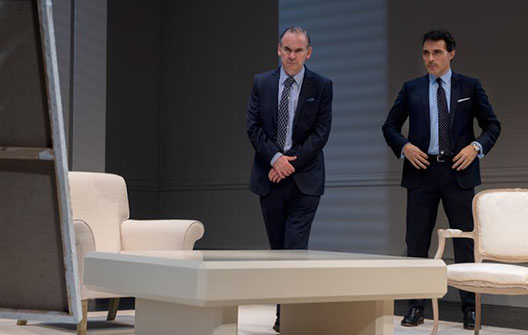
“Art”: On the Friday after Andrea and Peter arrived, we went to the Old Vic to see “Art”, a play by the French playwright, Yazmina Reza, translated by Christopher Hampton. It is the 20th anniversary of its first production in London. (We saw it on Broadway with Alan Alda, Joe Morton and George Wendt sometime around 1999.) It is a play that is really about the relationships between three men. One of the three friends, Serge, has purchased an expensive, large painting that is entirely white. Serge, played by Rufus Sewall (probably best known for his recent portrayal of Lord M in the TV series “Victoria”) is a fan of this minimalist modern style and loves his painting. He invites his best friend, Marc (played by Paul Ritter), over and proudly shows it to him. Marc immediately hates it and is aghast that Serge bought it. He cannot conceal his alarm, anger and disgust. The rest of the play is about how their friendship is almost destroyed by the purchase of the painting. Marc feels betrayed and furious that Serge could have bought such a thing. And Serge is equally furious at what he sees as Marc’s condescending attitude and rigidity. Along the way, their other friend, Yvan (hysterically played by Tim West), finds himself in the middle of the argument. He tries to like the painting (even though he doesn’t really), which infuriates Marc and then infuriates Serge when he admits he doesn’t really like it that much. He becomes their punching bag as they fight with each other. It is a fascinating look at the nature of male friendship, as the rift caused by the disagreement about art escalates into increasingly hurtful statements about other, more personal subjects. And you could say that it is about men’s lack of empathy and the inability of individuals with strongly held beliefs to admit that someone with equally strong opposing beliefs may not be a fool. As the director’s notes point out, this second underlying theme has a great resonance today, in an England divided by Brexit and a world divided by Trump, where the opposing camps cannot bring themselves to even talk civilly to each other. It is wonderful and cleverly written in a style that is reminiscent of Stoppard. It takes a simple concept and creates a parable about life and friendship. And it manages the seemingly impossible by coming up with a resolution that does not seem contrived and is somehow satisfying. Another thing I’m going to miss about London: The Old Vic.
art

It Looks Like We Will Avoid Deportation: You may recall that we were somewhat concerned that our visas are scheduled to expire on the 9th of February, but we intend to keep living here until early April. We were concerned that Judie might be closely questioned upon our return from Lisbon and she had letters from the law firm explaining that she was now officially working in the New York office (and therefore no longer needs anything more than a visitor’s visa). The immigration law specialist hired by the firm seemed to think that there was a possibility that it would not work and we would have to leave or something. But, as it turned out, the Immigration person had no interest in Judie’s letters and just let us in on visitor’s visas with virtually no fuss at all. It was a relief for us, as this particular detail of our repatriation has been worrying us for weeks.

Brexit Update: May Wins, Labour in Disarray: This week the entire Breixt process leading to the UK leaving the EU became officially irreversible (although it has seemed like an unstoppable lava flow for months). In response to the High Court’s ruling that the Article 50 notice (beginning the process of leaving the EU) had to be approved by Parliament, the Conservative submitted a very short bill that gives Theresa May a blank check. The Tories were solidly behind it (except for Kenneth Clark, a voice crying out in the darkness that has become the Conservative Party) and beat back efforts by some MPS to amend the bill. The Scottish National Party was opposed. Corbyn and Labour found themselves in a difficult spot. Many of the traditional Labour constituencies in the Midlands and elsewhere voted heavily to leave and they were justifiably concerned that voting against the triggering of Article 50 might lead to an electoral rout. So Corbyn decided that Labour had to support the bill and ordered a “Three-line whip” be issued. (This is a message to the Labour MPs about an upcoming vote. If the message is underlined once, the members are urged to come and vote, underlined twice and the members are told that this is a very important matter. If it is underlined three times, the MPs are told that they must vote and are instructed on how they must vote.) About 50 Labour MPs defied Corbyn (and the three-line whip) and voted against the bill. They were from places that voted overwhelmingly to remain in the EU and really had to oppose it. But this is simply not done in Parliament and this sort of rebelliousness is unusual. Several front-benchers in the shadow cabinet voted against the bill and therefore had to resign their positions. Why Corbyn couldn’t have given his members a “free vote”, avoiding the inevitable resistance is beyond me. It all just reinforces the pre-existing story line that he doesn’t know what he is doing and that Labour is in disarray. So May wins overwhelmingly (so overwhelmingly that there is no chance of the House of Lords doing anything) and the Brexit process will start in the next six weeks. The two-year negotiations are unlikely to go well or even be completed, so this could turn out to be a Pyrrhic victory for her.

A Brief Political Rant: We are living in such a weird time. A few hundred thousand votes and Hillary is President, there might be a Democratic majority in the Senate and all the pundits would be writing about the dismal future of the GOP. But for whatever reason, those votes did not materialize and we are faced with Trump, which would be bad enough for one lifetime, but also a Republican Party whose awful partisanship and refusal to govern has been rewarded. With Republicans in charge, one would expect all sorts of terrible things–giveaways to the rich, attempts to shred the safety net as much as possible, attacks on the EPA, the CFPB and Dodd-Frank. Elections have consequences and at least some of these horrible things will inevitably happen. I’m not sure that we can fight all of them. And I don’t know where Democrats would get by being simply the party of “No”, as the GOP was for six years, especially since they are in the minority. There has to be resistance, but it has to be smart and constructive resistance, with apositive message underlying it. And there are lines in the sand that must be drawn that will lead to bloody fights.

Trump is a sort of different matter. It is important to call him out on his endless false statements and the fact that his administration is utterly feckless and incompetent. I  personally have no real hope that the Republicans will impeach him, but I think he can and will be weakened. But to obsess on every stupid tweet and crazy statement seems also to be self-defeating. It is important to make some distinctions over the merely idiotic and venal things he says and the things he says that threaten tyranny. There really is a difference between complaining about Nordstom’s and threatening the judiciary. We are teetering on the edge of an abyss. It is not hard to envision a situation in which the USA slips into tyrrany. What we do as a country over the next several months and years will have an inordinate impact on the future of the world. This is all frightening in a way that Reagan or W were not.

Marching on May and Other Thoughts

Another March: It seems like the Trump administration will feature an endless series of protests. His recent ban on Muslim immigration has led to protest rallies and marches around the globe. You have to wonder if these protests really accomplish anything. I certainly have absolutely no hope that they will sway Trump. And they are unlikely to move Theresa May much either (more on her below). But there is a chance that Members of Parliament and Senators and Congressmen will begin to have second thoughts. And it is also possible, if this level of activism can be maintained for two years, that we might be able to see some local electoral success, as Americans tire of Trump and the politicians who are too spineless to stand up to him.

The protest of Monday was at No. 10 Downing Street. (Well, actually near it. Downing Street is always blocked off and guarded. So the rally was at the Whitehall end of that block-long street.) It was mainly in response to Trump’s horrifying, unconstitutional and foolish executive order banning certain Muslim immigration, which has Bannon’s fingerprints all over it. But it was as much an anti-Theresa May march as an anti-Trump one. She had a fawning visit with Trump last Friday, the very day of the executive order. It is clear that she had some knowledge of the order in advance and said nothing. When it came out, she refused to denounce it or even take a position. It was only as the ban and May were roundly criticized, that she issued a weak statement. The turning point was probably when Mo Farah, the four-time gold medal winning distance runner (who was recently knighted), wrote that, because he was born in Somalia, he would not be able to train in America, which is where his family currently lives. Perhaps it was the idea of Donald mistreating Sir Mo that moved May to act. May seems to feel that she has to support Trump. The prospect of a trade deal with the US as some sort of window dressing to counter the clear disaster that losing access to the EU market poses, has May panting at Donald’s heels like a forlorn puppy. Ans since she has completely given in to the anti-immigration position of the far right, she may feel that she has to support all anti-immigration efforts, no matter how ill-conceived and unlawful.

The New Unity group managed to get itself organized without my help and we had a decent turnout. We carried both our banners and were in the midst of a crowd of more than 20,000 (possibly quite a bit more). Photos below. While all of this was going on, a petition to Parliament seeking the withdrawal of the invitation to a royal visit given to Trump got over a million signatures in hours. The House of Commons has to debate a petition that gets over 100,000 signatures, which should be entertaining. But there is no chance that May will withdraw the invitation to her new BFF and imagined lifeline.

Another Thing I will Miss About London: The New Unity Congregation. Last Sunday was typical in some ways and not at all typical in others. Judie was out of the country, so went alone, which meant that I didn’t get there early so Judie could go to choir practice. It was the beginning of the pledge drive. The had never really done a UU-style drive before. This was partly because they own two buildings in fairly high-end areas and thus can cover 60-70% of their budget with rental income. And the government supports charities like New Unity, adding more to budget line. As a result, they only need to raise £35,000 or so from the congregation, an absurdly small figure. Of course, it is an unusually young group, with a good number of students and twenty-somethings Just beginning their working careers, so it is not a terribly well-heeled bunch. I had been giving the new treasurer some advice on fundraising and one bit of wisdom was to have a time for testimonials in the services during the pledge drive period. To open the drive, they had four testimonials plus me. I ended up giving the final little speech about why we were making a significant pledge to New Unity and everyone else should as well. It was a good one (a barn-burner), in which I went through the many things that we get from New Unity and concluding that making a pledge is not an obligation, but a privilege. I will miss the opportunity to speak at New Unity.

After the service, I decided to go to the first meeting of the New Unity Men’s Group, even though I was not going to be around much longer. Compared to the UU Montclair group, it was more than a generation younger. In Montclair, the ages of the group ran from about 40 to the 80s. At New Unity, I was the second oldest participant and over half the men who showed up for the first meeting were under 30. There was a very open discussion, including a fascinating time when we talked about what it means to be a man today. I’m sorry that I won’t get to see how this group develops.

Painting: I’ve just started two new paintings. In one of them, I am trying out the gouache paint that I received as a gift from Karen and Jerry Fried. I was having so much fun that I utterly forgot that Judie’s Women’s Group was using the flat on Wednesday night. Fortunately the place was not a mess. I’m starting to think about when I will have to stop painting and start packing up the paintings and supplies. I’d say no more than two more after the current three in progress.

Off to Lisbon Soon: Our old friends, Andrea and Peter, are arriving literally any moment and we will leave with them on Saturday for a long weekend in Lisbon. So I really need to wind this up.


London Tales

Stoke Newington: On Monday, I went to Stoke Newington. My reason was to pick up a print of Mary Wollstonecraft in support of a drive to have a statue of her erected on Newington Green. (It really is shocking that she is not honored more in London and surprising that some rich woman has already funded a tribute to the Mother of Feminism.) The other reason for going there is that I have been curious about Stoke Newington, which I understand to be a fashionable, furiously gentrifying section of London. (And I can get there by just taking the 67 bus, which stops right outside the flat.) The part that I went to in order to get the print was very nice, with streets of two story connected houses and the sounds of power equipment indicating that renovations were in full swing. There was also an area of well-maintained estate housing (public housing in the US). As I walked north, the buildings got a bit grander and bigger, but a chilly rain started, so I decided to go back to the High Street and either find a place to eat lunch or go home. The High Street in the southern part of Stoke Newington was certainly bustling, but had more of a working class vibe. There were a lot more nail salons, hairdressers and kebab shops as oppose to barristas, galleries and cute restaurants. It appears that the ongoing gentrification that I’d heard about must be in the northern part of Stoke Newington. I thought about walking up there to check it out, but I was cold and wet and decided to leave it for another, sunnier day.

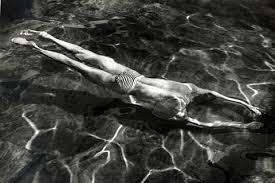
Elton John: Photography Collector: On Tuesday, I went to Tate Modern, where there was an exhibit of photographs from Elton John’s collection, which is one of the largest in the world. This one concentrated on his photos from the Modernist Period, basically 1915-1950. The audio tour featured Sir Elton himself talking about the selected photographs. It was pretty fascinating. It turns out that he began collecting photos in 1991, shortly after becoming sober and became obsessed by it. He now has thousands of photos. Early on, he set a record for the most ever paid for a photograph (since repeatedly broken). See below. It is tiny, taken by André Kertész in 1917, and inspired a generation of photographers, including all of the gay photographers who followed. Elton bought the original picture and the negative. The exhibit is full of iconic images, like Dorothea Lange’s “Migrant Mother”, lots of Man Ray photo-portraits and Weston, , Cunningham, etc. It is spectacular and it is just the tip of the iceberg that is his collection. At one point, he reveals that he has thousands of photos from 9/11, which they bring out every year to see if they should exhibit them. But they decide that, though they are beautiful, it is too soon. One more really amazing thing. Below is a manipulated photo entitled “Humanly Impossible”. In it, the photographer printed out the image and them added things that made it appear that his arm was cut off. He then re-photographed it. and all prints are of the second shot. Except Elton’s. He has the original print with the additions.

images.jpg    Herbert_Bayer,_Self_Portrait-xlarge_trans++1LE_aMoZ4j8b9yBU3fkF9-pCkqavLOFjGjHu2VCbiLk.jpg

A Brexit Note: Judie is a member of the Emerging Payments Association here in London. They represent and advise Fin Tech companies here in London and elsewhere. On Wednesday, they released a report on where they recommend their clients move in light of Brexit. (As you may know, such companies can currently “Passport” their UK license to the EU and need not go through the process of getting a license on the continent. It seems likely that this will end with Brexit. And whether it will or not, nobody can tell, so businesses have to begin taking steps now.) So the EPA was advising on how firms currently in London should consider moving some of their operation to Europe to avoid any Brexit related complications. On one level, this is not terribly big news if you are in the industry or even familiar with banking issues. But I’d say it is significant in that here is a British firm giving advice that will lead to loss of tens of thousands of jobs. Since May and the Conservatives have done little and said less about Brexit in the last six or seven months, it seems like everything has been conjecture. But this is real advice to real firms with real consequences. Of course, the papers didn’t cover it.

Things I Am Going To Miss About London: Taking a bus over London Bridge, getting off, wandering through Borough Market, stopping to get something to eat or buy something for dinner, then going out to the Thames and walking up past the Globe Theatre to the Tate Modern, going in a seeing an exhibit or two, then walking over the Millennium Bridge, checking out both the incredible views and the gum paintings under my feet and the ending up at St. Paul’s.

The Deserving Poor: In the Victorian era, George Peabody, an American merchant, established a trust to build housing for the “deserving poor”. The distinction between deserving and undeserving poor was a big concept in that era (and is an idea that was picked up by Republicans and US conservatives in the 1960s). It turns out that the first such housing that was constructed is directly across the street from our flat, although there is lot of housing for the deserving poor in the area, which has always had a large share of poor people, both deserving and underserving. Of course, if you are like me, you cannot hear that phrase without thinking of Alfred Doolittle’s speech to Henry Higgins, with which I will close this post:

Doolittle: What am I, Governors both? I ask you, what am I? I’m one of the undeserving poor: that’s what I am. Think of what that means to a man. It means that he’s up agen middle class morality all the time. If there’s anything going, and I put in for a bit of it, it’s always the same story: ‘You’re undeserving; so you can’t have it.’ But my needs is as great as the most deserving widow’s that ever got money out of six different charities in one week for the death of the same husband. I don’t need less than a deserving man: I need more. I don’t eat less hearty than him; and I drink a lot more. I want a bit of amusement, cause I’m a thinking man. I want cheerfulness and a song and a band when I feel low. Well, they charge me just the same for everything as they charge the deserving. What is middle class morality? Just an excuse for never giving me anything. Therefore, I ask you, as two gentlemen, not to play that game on me. I’m playing straight with you. I ain’t pretending to be deserving. I’m undeserving; and I mean to go on being undeserving. I like it; and that’s the truth. Will you take advantage of a man’s nature to do him out of the price of his own daughter what he’s brought up and fed and clothed by the sweat of his brow until she’s growed big enough to be interesting to you two gentlemen? Is five pounds unreasonable? I put it to you; and I leave it to you.

Higgins: Pickering, if we were to take this man in hand for three months, he could choose between a seat in the Cabinet and a popular pulpit in Wales.

You’ve got to love Bernard Shaw!

Election Prediction and Brexit News

It is Going to be Unreasonably Close, But Hillary is Going to Win: It is incredibly frustrating to be watching the election from this side of the pond. I just feel so utterly impotent. If I was back in New Jersey, I’d be volunteering, making calls, going house to house, and taking road trips to swing states. It might not actually do any good (but the chance that it might would be enough). It would at least make me feel better. What I have been doing is compulsively reading about the election, which has mainly served to drive me crazy. But I have become convinced that Hillary is going to pull this out. Here is why:

  • The Democrats always go into Presidential Elections with a large number of electoral votes pretty much in the bag, since they should win the big states on both coasts (except Florida). This election is no exception and Hillary seems to have a base of 260+ relatively sure electoral votes. She doesn’t have to win more than one or two of the toss-up states to win the election and she is ahead in a number of them.
  • Trump, on the other hand needs to run the table of all of the swing states and probably take a surprise state like Michigan. You can’t say it is impossible, especially if you believe the possibility that the polls might be completely off. But it seems very unlikely.
  • People and pundits seem to love to point at the Brexit vote (and the last Cameron victory) as proof of the unreliability of polls, but, in fact, that only shows the unreliability of British polls. I was listening to a 538 podcast the other day and they explained that American polls are simply better. This is partly because we have so many more polls. There is a multi-million dollar election industry in the US that is on a different scale than that of the UK and which relies on and pays for accurate polling. Between money and volume, US polls are more likely to be accurate over all. It is not a sure thing for Hillary to go into Election Day with a three-point lead in the polling average, but it is very meaningful.
  • After this whole horrible endless election, the state of the race is startlingly similar to the place it was in the same point in 2008 and 2012, with a few more undecided votes. It may be that a 3-5 point win for the Democratic candidate is just the equilibrium point and that Clinton and Donald somehow cancelled each other out and we ended up back at square one.
  • It appears from early voting that turnout will be very large, especially among Hispanics. This should favor Clinton. Trumps’ best shot (and what is always the Republican’s best shot) is a low turnout election in which his angry white men turn out in waves.
  • Judie’s mother voted for Clinton and reported that the other people in her assisted living home, mostly conservative church ladies and lifelong Republicans in North Carolina, unanimously voted for Clinton. I find that kind of remarkable.
  • I have an unreasoning and utterly unscientific belief that a majority of the American people will reject Trump.

I think I am right. I certainly hope so.

Brexit Update: the big news last week was that the Court ruled on the challenge to the way Article 50 might be invoked. (That is the Article of the EU Agreement that governs leaving the Union and starts a two-year timetable.) Theresa May and the Conservatives have taken the position that this can be done by Prime Minister, relying on the ancient principle of “royal prerogative”, which was gradually moved from the monarch to the PM. The challengers said that, under British constitutional law, the Parliament is supreme. They argued that since Parliament passed an act joining the EU, which conferred rights to UK citizens, an act of Parliament is needed to reverse that step. The challengers carried the day and the government is appealing to the highest court. (The right-wing, pro-Brexit press immediately engaged in a truly reprehensible attack on the judiciary, which May and the new Lord Chancellor never really denounced and took their time even saying “tsk, tsk”.)

There is a decent argument in favor of overruling the lower court and it might happen. But if it doesn’t, May is in a tricky spot. The Conservative majority is small and many of them were anti-Brexit in the referendum. Indeed, if one had polled Parliament before the referendum, Britain would still be in the EU. But now the MPs are all talking about “the will of the people”. What no one says is that it was only 52% of the people, in a campaign in which it was clear that both sides lied about the impact and a good number of people didn’t completely understand what is that they were voting for. But that doesn’t seem to matter, since many formerly pro-EU MPs are now worried about an electoral backlash. So it has always seemed to me that this fear will trump reason and there is no real likelihood that a majority of the Parliament will reject the referendum result.

But what they might do is insist on some sort of detail about what Brexit means to May and her team. If such a course was possible as a part of an Article 50 Parliamentary approval, the disarray in May’s government would be exposed. It is unclear that the Brexit ministers have a coherent idea of what they are looking for in the break from the EU and it is abundantly clear that members of Conservative party have wildly divergent ideas. You can appreciate that May doesn’t want to go into negotiations having given away their strategy. On the other hand it would be nice to know whether their goal is a hard Brexit, with a complete break from the EU (favored by the far right MPs) or a result which maintains market access while slightly limiting immigration in some way. In two and half years, the negotiations will be over and Britain will be faced with essentially a take it or leave it proposition, since there will be no time to negotiate a further change. So this is probably Parliament’s best shot to direct the outcome.

Faced with that, there is a chance that May will call a snap election, figuring that she could increase the Conservative majority with Labour in disarray. This would make it easier to push through whatever it is they want to do with respect to Brexit, in theory. But maybe not. There would be a danger that such an election could turn into a de facto second referendum on leaving the EU. That is a vote that would not be a sure thing for May. Given the dangers of holding an election that might lead to a weakening of “the will of the people”, I’d guess that is more likely that May and the government will just try to play political hardball with the Parliament if the current judicial decision is upheld.


A New Portrait and Thoughts from London

A New Portrait: After going to the Royal Academy and seeing the David Hockney exhibit, “82 Portraits and a Still Life”, I decided that I was going to try to do a series of portraits and to have two paintings going at a time, one a portrait and the other a landscape. (Hockney is said to have quipped that the are really only three kinds of paintings: portraits, landscapes and still lives.) I’ve discovered that it’s hard to do portraits. I guess this isn’t a really great insight, but I thought after my first attempt (a portrait of Judie that wasn’t a bad painting, but didn’t really look like her), I might have learned something that would make the second attempt better.

For the second one, I decided to try a portrait of my friend and former roommate, Chris, based on a good photo of him from our trip to France in June. One of the first things I learned is that it is tricky painting someone with a beard. I even went back to the Hockney exhibit to see how he did it. He didn’t really. Only one of the 82 was not clean-shaven. So that wasn’t all that helpful, but, upon close inspection, I did note how the area under the chins of his portraits were always extra dark, so I tried to incorporate that. The other thing Hockney does that is really kind of magical is to add bright or unusual splotches of colors to the faces that seem like that they can’t work but do. I have no idea how it occurs to him to do that (and I’m not going to try).

I kept at this portrait, pushed along by a deadline in my mind. Chris is coming for a quick visit on Sunday and I decided I should try to finish it before he arrived. The result is below. I actually think it is a pretty good painting and it looks more like Chris than the first one looks like Judie, but it still doesn’t really capture him. Of course, while Hackney’s portraits are great, I don’t really know exactly what his subject actually look like. For all I know, the paintings don’t really look like his subjects (although I kind of doubt it.) So I’ve been thinking that maybe I should try doing portraits of people I don’t know as well (or even don’t know at all). My expectations would probably be different and I might be less disappointed by the results.

chris

When Will the Countdown Begin: For quite a long time, I felt like I was visiting London. And then that changed. Looking back, I’m not sure that I can remember a bright line, where I felt that I actually live here, but I know that it happened. I’ve always known that this time here would be a temporary thing, but the end was sufficiently distant that I didn’t feel like a transient resident. I still don’t, but I can begin to feel that ending. In roughly five months, we will back at our home in Montclair, putting the furniture back in place and trying to restart our lives. I know that it is coming and I occasionally think about the logistics of the move and what I am going to do with myself when I get back. At the same time, I am feeling very present in London here and now and that is a good thing. I have real sense of neighborhood in Shoreditch and Spitalfields and Broadgate, etc. And we both have a strong feeling of commitment to New Unity and its community. I sometimes wonder if I could do more good over the next few years trying to help out with New Unity than in taking some role at UU Montclair. Perhaps that will all change once the countdown to the move begins, which I suspect will be sometime in January. Right now, it is just a faint tug. By then, it will be an increasingly strong pull.

I’m Counting on You, Lord, Please Don’t Let Me Down: I think the following is a sign of something, but I can’t decide what that is. Sir Philip Green is an ostentatiously rich Brit, who is reminiscent of Donald Trump. (According to Wikipedia, he was considered for the Donald role in the UK version of “The Apprentice”.) Unlike Trump, he actually did support a number of charities and in 2007 he was knighted. It gradually emerged that he engaged in all sorts of tax avoidance schemes and conspicuously spent huge amounts of money on himself and his family. He was a Cameron confidante and generally the kind of rich guy lots of people grew to hate. He seemed to buy and sell various retail businesses. His big troubles began after he bought the “High Street” department store chain, BHS. He proceeded to drive it into bankruptcy, not only costing all of the workers their jobs, but also a great chunk of their pensions. It has been an ongoing scandal. Green seems to be perceived as such an awful guy that even lots of Conservatives  hate him and they normally have never met a rich guy they won’t toady up to.

This week, the House of Commons held a hearing about taking his knighthood back. It seemed a bit weird to me that you could do that. I’d think that everyone getting a knighthood assumes that it is lifetime, irrevocable honor. Think again, Elton John and Paul McCartney! The humorous thing about the whole thing is that, while the MPs got to make endless outraged speeches, it turns out that the House of Commons has no power to revoke a knighthood, so it is just a meaningless recommendation to whoever actually does have the power. Is this an act of faux populism? An easy way to fake concern for the little guy, while systematically shredding the NHS and the safety net? Is it some sort of weird Brexit response?

Fawlty Government

My Fawlty Towers Theory of British Politics: Consider Basil Fawlty. He hates the French and the Germans. He dislikes immigrants, although his business relies on one. He toadies up to rich people and loves the monarch. He agrees with the Major that things were so much better in the past, when Britain had an Empire. He isn’t really stupid, but he usually acts without thinking about the consequences or having a coherent plan. When things go wrong, he blames everyone else. I have just described Theresa May and the “Hard Brexit” Conservative Party. The tragedy is that they don’t have the equivalent of Polly to clean up Basil’s messes. (It is impossible to see Jeremy Corbyn filling that role. The NY Times has an op-ed piece describing his many failures including his coddling of anti-semitism in New Labour.)

It would be nice to think that there is a chance that the Tories might come to their senses, but the lunatic fringe seems to be firmly in control and May is so desperate to be Prime Minister that I don’t think she cares. There are a few grown ups in the Conservative Party, but I don’t hold out much hope for them. One especially crazed backbencher has proposed that the Treason Act be amended to include any disparagement of Brexit! The long-standing split in the Conservative Party between delusional eurosceptics and more traditional Conservatives (i.e., between the Basils and the Pollys) is not going away. May might find it harder and harder to keep her coalition together as the reality of Brexit (and the resulting economic hardship) nears.

I sometimes feel that we are living through the end of time here in London. The government seems utterly committed to shortsighted and delusional policies that seem incredibly destructive. This wonderful, multicultural London–the financial center of Europe–seems to be facing a sort of existential threat. It is a great city and always will be, but it seems likely that it will be diminished. I find it depressing.

Are UKIPing me? UKIP is the xenophobic party whose sole purpose was to get Britain out of the EU and to get foreigners out of the country. Their leader was the unspeakably creepy Nigel Farage (most recently seen praising Trump after the second debate as a silver back gorilla). The political pressure of UKIP was a factor in Cameron agreeing to the whole Brexit referendum. Having now achieved his horrible dream, Farage retired as leader of UKIP. All hell then broke loose.

First a woman, Diane James, was elected as the new leader (which surprised me, since I didn’t think they had any women in leadership positions). This arguably progressive step lasted less than three weeks. The she resigned “to spend more time with her family”. My theory is that she suddenly realized that she had become of a leader of party of guys overdosed on testosterone, who were essentially unmanageable. Farage came back briefly and then retired again. One of Farage’s protégé, MEP (Member of the European Parliament) Steven Woolfe, threw his hat into the ring and was the favorite, but then got into a fight with another UKIP member at a meeting at the European Parliament and ended up hospitalized with severe injuries close to a coma. (It is a bit hard to figure what UKIP politicians are even doing in the European Parliament, but they got elected and seem to spend most of their time insulting everyone.) On Monday, Woolfe resigned from UKIP, disclosing what everyone already suspected–that he had been cold cocked by one of his UKIP mates (who claims self-defense). Woolfe said that UKIP is ungovernable (which Diane James had figured out) and that he no longer wanted to lead a party that he described a having “something rotten in its core” (not a big surprise to me) and in a “death spiral”. Yet another British political party falling apart.

Meanwhile in Scotland: The Scottish National Party (SNP), led by the impressive Nicola Sturgeon, has emerged to become the serious opposition party. It is hard for them to be really effective in that role, since they are pretty small in Britain as a whole. The SNP is stepping into a vaccuum, since Corbyn never seems interested in the bother of governing.  They are like the “smart cousin” of UKIP in that their core belief is that Scotland should leave the UK, although that is the only sense in which they are comparable. Having lost the referendum a few years ago, that plan was on the back burner until the Brexit vote, which the people of Scotland rejected. Sturgeon has used this as a rallying cry for a new independence referendum, although at this point, the polls are very close and it is not clear that she would succeed. She is trying to use the threat as a way to get Scotland a seat at the Brexit negotiating table, in order to protect Scotland’s interest in continuing free trade with the EU. She is very savvy and is making no commitments yet. But it seems clear to me that if the hard-core Brexiteers succeed in creating a complete break with the EU, she will have the excuse and the ammunition for a new independence vote.

Health: Since I’ve mentioned this in the past, I’ve raised some concerns with some of you. I’m fine. I’m taking blood thinners for clots in my leg, which is decidedly less balloon-like. I went to my GP for the gout and he gave me medication with the warning that many people become violently nauseous taking it. I took it, didn’t vomit, and can now walk without a limp. I’ve resumed exercising. Judie also lit a candle for me at New Unity a few weeks ago when I wasn’t there and I’ve been deluged with well-meaning expressions of concern whenever I show up. It’s a nice reflection of the sense of community that is so special about the place, but I’m sick of it.

Trump, Shylock and Brexit

Administrative Note: I’m going to change to the premium version of Word Press this weekend. This will change the address of this blog to nickinshoreditch.com. If you are signed up to get notifications by e-mail, this may not matter, but if you are used to just getting it through a browser, you won’t be able to find my blog using the current URL. So if you are looking for nickinshoreditch.wordpress.com and it isn’t popping up, then I’ve made the change. I’ll post an announcement on Facebook and one more right before I make the change.

Trump from a Distance: I have been blessed to be in London for this election season. Things like the interminable primary debates were on to late to watch (and I’m sure that I would have compulsively watched many of them, given the opportunity). I have missed endless Trump stories and hours upon hours of blathering by various talking heads. Which is not to say that the BBC doesn’t pay any attention to the election, it just has other stuff to cover and only spends a few minutes on the proceedings. Trump was, at first, an object of fascination to most Brits, who all wanted to know if he was a serious candidate and could someone like him actually get nominated. I have to say that I discounted Trump for far too long. After he was nominated, the questions changed from “How could he have been nominated?” to “He can’t win, can he?” to “My G0d, what is going on in America?” I have taken to compulsively checking FiveThirtyEight (Nate Silver), as well as the Times and the New Yorker and the Guardian to try to get a sense of what is going on in this miserable excuse for democratic process.

Now that the Trump campaign seems to be in a Trump-perpetuated death spiral, there is a palpable sense of relief here and I suspect in large parts of the US. But, even if Trump does lose and even if he loses in a landslide (which seems more likely than not), it is hard to feel very good about the future. It is difficult to picture Hillary being able to govern effectively, since she is unlikely to have a cooperative Congress, is reviled by so many and faces a Republican machine that will do what they did to Obama only much worse. The Republican Party seems likely to fracture and be in such a mess that it cannot be a responsible partner in government (recognizing that a significant percentage of their leaders have no interest in such a role anyway). And all of those angry Trump people, who have now been energized, are not going to go away. (And, unfortunately, neither will Trump.) Americans should not feel too smug about the defeat of Trump or claim that “It can’t happen here.” In fact, Trump proved that it could happen and if he was a not so clearly a bat shit crazy narcissist and sexual predator, he might very well have been elected  President next month.

“Merchant of Venice”: On Yom Kippur, of all days, we went to the Globe to see “The Merchant of Venice” with Jonathan Pryce as Shylock. Our seats were not great (don’t get seats on the side there if you ever go) and there was a major rain storm about 30-40 minutes into the play, which soaked the people standing in the pit. (The Globe has no roof, although the seats and the stage are mostly protected.) Then the temperature dropped and the wind kicked up and it was positively frosty. Not at all Venetian. (It is strange commenting on the weather when talking about a play.) Despite all of that, I did enjoy the performance. I had forgotten much of the plot other than the Shylock bits, particularly the sections in which Portia’s suitors are tested to see if they can marry her. These scenes were wonderfully done. The cast was typically very good. British actors just do Shakespeare really well, although sometimes overeager directors with weird interpretations let them down. Perhaps it is part of their training that accounts for it. Shylock’s daughter was played by Pryce’s real-life daughter, which was actually more of an interesting footnote than something which added to the overall performance. Rachel Pickup, who played Portia, the dominant part in the play, was marvelous. I suppose that you could play Shylock differently than Pryce did, but it is hard to imagine it being played any better.

merchant

Of course, the overriding theme that makes the play great and the thing that you come away thinking about is the anti-semitism. It is actually remarkable that Shakespeare was able create the character of Shylock since, as the programme points out, there were virtually no jews in England during Elizabethan times. (It was dangerous enough being the wrong type of Christian in the era.) This actually seemed to make the anti-semitism of that time even worse, as there were no actual humans to put the lie to the crazy tales and conspiracy theories that dominated. Shakespeare’s audience would certainly have been utterly anti-semitic and ready to accept any sort of evil characterization of a jewish money-lender. But Shakespeare went out of his way to make Shylock human (“If you prick us, do we not bleed?”) and, it seemed to me, showed that he was responding to horrible treatment over many years by Antonio and the other merchants of Venice, who repeatedly spit on Shylock in the course of the play. Pryce’s Shylock was so reasoned and aggrieved that I found myself rooting for him to get his pound of flesh. But, of course, there was no way that Shakespeare could allow the Jew to win and Portia snatches victory away from him and replaces it with ruin and the humiliation of forced conversion to Christianity. Pryce’s performance made it clear that it was the latter result that was by far the worst. But in a way, Shylock brought this on himself by his hatred and desire for revenge. And I think that was the real moral of this production: that unreasoning hatred and the compulsion to get revenge can only lead to calamity.

Brexit Update: For some reason, the New York Times has suddenly become interested in Brexit and its impact on the British economy and government and has published a number of articles this week. I suspect this might reflect concern over the weakening pound and how this will play out in the world economy. Here are few impressions from this side of the pond:

  • The pound has started to fall again, after seeming to stabilize after its initial plunge. I’d say that this reflects market worry about the future of the British economy. Until recently, you could kid yourself that it wouldn’t be that bad and that Theresa May wouldn’t let things get out of hand. You’d have been wrong. May made it clear at the Conservative Party Conference recently that Brexit was happening and that Britain would not accept any deal that included freedom of movement. The government later announced that it would not let any foreign nationals (even those who were teaching at the London School of Economics) participate in the Brexit negotiations (even though it is generally agreed that Britain is woefully short of experienced negotiators). And then it was announced that businesses would be required to disclose the number of foreigners it employed. As it became obvious that the xenophobic kooks were taking charge, the pound began to fall.
  • This led to the Great Marmite Controversy. Because the pound had lost almost 20% of it value, Unilever wanted to increase its price for the items it sells to Tesco, the largest grocery chain in Britain. A stalemate ensued and soon Tesco began to run out of the beloved yeast goo. This caused outrage, only in part because Marmite is actually produced in England. I think what really scared people is that this was a clear harbinger of price increases to come.
  • Meanwhile, back in Parliament, the tenuous Conservative majority was facing the same problems with delusional back-benchers that had bedeviled Cameron. This group of 100 or more MPs keep talking about “sovereignty” and returning Britain to it position of greatness. So far, their big idea is to re-commission a Royal Yacht for the Queen, with the supposition that everything will return to Rule Britannia. It would be pathetically funny if it all weren’t so serious. May’s honeymoon period seems to have run its course.
  • Just this week, the highest British court has begun to hear a case which seeks a “constitutional” ruling (there is no written Constitution here) that May and her ministers cannot unilaterally invoke Article 50 to begin the process of leaving the EU. It is argued that the treaty that would be abrogated was ratified by Parliament and therefore can only be terminated by that body. Anther argument that the entire basis of unwritten British constitutional law is that Parliament is paramount and that an irreversible act of that import must be taken by that supreme legislative body. These seems like winning arguments to me. If the suit is indeed successful, turmoil is certain.
  • And then there is Boris Johnson and the Brexit troika of ministers. Last week, BoJo said that the aim of Britain in the negotiations with the EU is to “have our cake and eat it to.” This was instantly denounced by European leaders and seemed to harden their negotiating resolve (not that BoJo and his buddies have any sort of negotiating position beyond bluster). The European President suggested that Johnson buy a cake, eat it and see what he had left.
  • In the background, Judie’s bank clients are asking for advice about where to move their offices. Dublin, Frankfort and Paris may scoop up a lot of EU banking business that has been centered in London, which would be a complete disaster for the post-industrial British economy. A “hard Brexit”, in which the banks would lose their “passporting rights” (i.e., the ability to apply their British license throughout Europe) would make this inevitable. But this complete break from Europe is exactly what the most delusional MPs insist upon.


Myriad Experiences

Judie is off touring America, stopping at various K&L Gates offices, including Boston and Washington, and ending up in Chicago for a conference. When Judie is not around, I have even less order to my life than usual. I tend to eat at odd times and get lost doing projects or watching baseball on my computer. It is actually sort of fun when she is gone for about a week, as she is this time. She returns on Wednesday evening and Alex arrives that morning for an eight-day visit. Alex has finished up with his Every Zip Philadelphia project (which you can see and hear on the WHYY website). It was pretty successful, although I think it was too much management and not enough creativity for him. It wasn’t renewed and he has been hired by Audible to co-produce a multi-part audio series about how Americans experienced World War II at home. He was given a number of books to read and will have access to lots of archive interviews etc. The process of creating his two sections is about to start in earnest, so he is taking this break to visit us.

“There’s no crying in Baseball”: That’s what Tom Hanks’ character memorably said in “A League Their Own”. But it turns out that sometimes there is crying. For some reason, the Mets have been involved in the two most emotionally fraught games in the history of baseball. The first was in 2001, when the Mets played the Braves in the first game played in NYC after 9-11. The atmosphere surrounding the game was incredible and it was punctuated by Mike Piazza’s game-winning home run, the single most dramatic hit I have ever seen and what has to be the highlight of his Hall of Fame career. I thought I would never see another baseball game to compare to that.

Then on Monday night, the Mets visited Miami and the Marlins for the first game after the tragic death of Jose Fernandez, a game that he was actually scheduled to start. Fernandez was incredibly talented, with a simply amazing life story and was supposed to be a wonderful person. There was a very moving opening ceremony, with both teams on the field, which concluded with the Mets players going across the field to hug the Marlins players. Most of the Marlins players were teary-eyed or crying. When they switched to the broadcast booth, Gary Cohen, the main Mets announcer, was so choked up that he could barely talk and Keith Hernandez and Ron Darling were sitting there with conspicuously red eyes. Then, in the bottom the first, Dee Gordon batted right-handed for the first pitch in honor of Fernandez and then switched to his normal side and hit the third pitch for a home run (his first home run of the season and the first time in his career he had hit the ball into the second deck). He was clearly crying as he circled the bases and came back the dugout where he collapsed into the arms of his sobbing teammates. It was just unbelievable on any number of levels. A once in a lifetime baseball moment. Travis d’Arnaud, the Mets catcher, said he was crying watching Gordon round the bases and I doubt he was alone in that. There is crying in baseball after all.

Abstract Expressionism: On Saturday evening, I went to a members’ private tour and party celebrating the opening of the Abstract Expressionism exhibit at the Royal Academy. As our guide/docent pointed out, the name is a bit deceiving, because many of the artists’ styles were neither abstract or impressionistic. It is sometimes called the New York School and NYC certainly became the center of the art world in that period, but many of the artists did not live or paint in NY. Tragedy was one theme as some of the most important artists died young, from suicide (Gorky and Rothko) to car accidents (Pollack). As you might imagine, there were some iconic paintings. There were some great Pollacks, including one huge early one he did on commission for Peggy Guggenheim’s apartment which was a breakthrough moment in that era. And there were great examples from Gorky, Klein, de Kooning (his series of paintings of women were amazing), Rothko (the early works were fascinating), Motherwell and Krasner (a highlight was the first painting she did after Pollack’s death). It was a wonderful exhibit and it was nice to have plenty of time to go back and wander through it after the tour, without being bothered by the usual crowds. For me, the great revelation was Clyfford Still. He became disgusted by the commercialism of the NY art scene and moved to Wyoming, where he painted the rest of his life. He sold practically nothing while he was alive, but now his work is in a museum in Denver, which I have to visit some time. There was a huge gallery of his work, which was breathtaking. See below for an example. There was also a party with a free champagne cocktail and a bar and a jazz singer, so it was all very festive, although I would have had more fun if I’d found someone to go with.

abst-exp

Immigration Detention Seminar: On Monday evening, I went to a meeting at the offices of Amnesty International (which it turns out is about four blocks from our flat) for a conference about the alternatives to Immigration Detention and role of civil society in making those alternatives happen. It was run by an organization called Detention Action. The audience seemed to be mostly immigration insiders–lawyers, advocates, NGO people and a sprinkling of government officials. It was too bad in a way, because some of the speakers were very interesting and for real reform to occur, they are going to need the support of a much wider group. There was a woman who is one of the leading immigration advocates in the Ukraine and, as you might imagine, they have some problems there that are hard to imagine, such as millions of displaced Ukrainians to deal with, in addition to all of the migrants, most of whom are really trying to get to Germany or somewhere. And there was a representative of Freed Voices, a group of former detainees, who spoke very movingly about how de-humanizing detention is and that there is no trust. I was given a big report, which I’m going to read.

Labour Conference: Jeremy : won his election by a landslide and this was followed by a Labour Conference in Liverpool in which the party tried to unify and to explain what they want to do. To me, what was most interesting about the process was the fact that the party out of government actually laid out a fairly detailed program. They take the whole idea of a party platform much more seriously here. It really is a nice political concept, where the opposition party must have a formal “shadow” government which says, with some specifics, what they would do if they were in power. The other nice thing about this system is that the BBC and the media in general (although maybe not the Murdoch press) really give deep coverage these kind of policy matters and engage in a real discussion and questioning about what the party is saying. It is a level of substantive and detailed analysis that is utterly absent in the American media (except on PBS and NPR to some extent). There are a lot of problems with the British system, but they really take politics and the issues much more seriously here, from Question Time to the Shadow Cabinet system to the media coverage.

London News and a Painting

New Painting: I’ve decided that I am going to try having a portrait and another painting going at all times for the next month or more. I’ve just finished my first of those portraits. It is of Judie and it owes a lot to the style of David Hockney. As you can see from below, it’s not a bad painting and I suppose it looks a little like her. I guess that I’m not really displeased with it, but I am a bit annoyed that I didn’t really capture Judie. I kept working on it, trying to get it, until I finally realized that I was doomed from the start. I never had the head shape correct and trying to correct that made the hair wrong. So I decided to accept that it was a decent painting and move on. It was frustrating. But I have learned a lesson–that the initial drawing is the key in a portrait, so in the one I am working on now, I was much more anal in transferring the picture to the canvas. We’ll see.

portrait-judie

Bake-Off News: I don’t know if this news made it to the States, where the Great British Bake-Off is a big hit (I’m told), although it is two seasons behind. The producers of the Bake-Off have sold the show to Channel 4, away from the BBC, after the BBC was outbid by a substantial amount. What Channel 4 failed to do was make sure that the talent was coming along with the big tent and the ovens. This was huge news here, eclipsing even the Brad and Angelina beak-up. Last week, shortly after the announcement, Mel and Sue, the hosts and comediennes who provide the light moments to the show, announced that they were not making the move. This caused a great deal of outcry. But that was nothing compared to yesterday, when Mary Berry announced that she is staying at BBC. She is the heart and soul of the show. It is like you are cooking for your loving grandmother. She will criticize you “soggy bottoms” or dry cakes, but in a loving and gentle way. Now, for £75M, Channel 4 has got the tent and the name and Paul Hollywood, the other judge who needs someone like Mary to be a counterpoint. It’s a bit of a disaster for everyone concerned.

Labour Party Vote to be announced this weekend: There is no drama here. Everyone knows that Corbyn will win, maybe by more than he won the first time. He is utterly beloved by the mostly young, far left voters who make up the membership of the current Labour Party. Whether the membership represents the actually Labour voters int he real electorate is another question, one that is familiar in the context of U.S. primaries, which have tended to skew toward either extreme for the last decade or two. As an article in Friday’s NY Times explained, a lot of this is about taking the Labour Party back from the Blairites, who moved the party away from its socialist base and disenfranchised the activists. I get that, but it seems to me that you still have to have a credible a Parliamentary presence and pose an electoral threat to Theresa May and the Tories. I don’t that Corbyn can do either of those things, and what is worse, especially to the Labour politicians who care about such things, is that he doesn’t seem interested in doing so. This the party divisions will not be resolved by this vote and will grow increasingly ugly.

The Liberal-Democrats, a third/fourth party, which actually seemed like they might be relevant force a decade ago, are hoping to rebound from the brink of extinction, by offering to be the center-left alternative for disenchanted Labour MPs and voters. There is no sign that the Labour MPs are interested in this, although they might be if they are attacked from the Corbyn-loving left in the selection process and are faced with retribution and the loss of their positions for daring to oppose the sainted Jeremy. It is going to be ugly and depressing for most Labour supporter in the coming year.

Theresa May and Brexit, etc.: Because May never went through an election, no one knows exactly what she stands for. She makes Yoda-like statements like “Brexit means Brexit”, which everyone now agrees is utterly meaningless. She is promising to get a “good deal” for Britain in the upcoming negotiations, but what good deal is depends on which of the various wings of her party you talk to. The Brexiteers are pushing her to invoke Article 50 and start the process of leaving the EU immediately or at least very soon. It would probably be a stupid act, but she might get forced into moving too soon. Even if she holds out until late next year, these negotiations are going to be extremely difficult. The eurosceptic wing of her party (especially the ones who go on and on about sovereignty) are absolutely convinced of the importance of British trade in the EU and are convinced that the EU will fold in negotiations. They are almost certainly wrong. (A significant number of the Conservatives believe that once Britain leave the EU, the days of the British Empire will magically be restored. It is pathetic.) The Cameron/Osborne wing of the party are more supportive of a slower process, but Cameron has left Parliament and Osborne et al are pretty discredited and, of course, there is no serious Labour opposition, so it is easy to imagine May being pushed into a process that turns out very badly for Britain.

It is in the non-Brexit areas of policy that things could get very ugly. May and the Tories are very conservative and are now unrestrained. The attack and gradual defunding of the National Health Service will continue, with the idea of eventually privatizing it. They want to reduce the funding of the BBC! The want to go back to the old days of selective grammar schools for the best students (who, despite May’s protestations to the contrary, are likely to be “the right sort of people”). They clearly want to cut back their aid to poor countries and to continue to cut back on welfare benefits. They are absolutely committed to limiting immigration. Labor Unions will see a new wave of attacks. The real economic impact of Brexit has not arrived yet, since nothing has happened. But it will happen and when it does, lots of people will suffer and they will not be “the right sort of people”.

There is a chance that May may call a snap election, which makes good Machiavellian sense to me. Labour is so divided right now that an election might destroy them or at least worsen the divisions. If she waits, there is chance that she could overreach and anger the electorate and even give Corbyn a chance to figure out how to be a leader (although that seems unlikely).

New Medical Mystery: At the beginning of the week, I woke up with my left leg completely swollen. It looked sort of weird, so I went to see a doctor. I’ve ended up getting an ultrasound, a chest x-ray, blood tests and a CAT scan. They have discovered that I am completely healthy. My leg is still swollen and they can’t figure out why. But they have eliminated all the serious things, so maybe it is nothing and it will cure itself. I’m supposed to go back next week.

Surrey Down: Judie and I went to Surrey this week. (By the way, I have always love the song “Stoned Soul Picnic”, but never knew exactly what “surrey”meant. It turns out that no one knows and that there any number of web sites discussing this. Perhaps Laura Nyro knew, but has taken the secret to her grave.) Anyway, we went to a place called Pennyhill Park, where Judie was at a conference. It is a rather historic place that was purchased and converted in a resort with a little golf course and one of the biggest and most elaborate spas I have ever seen. It was very nice. I probably would have done more while I was there, but I was sort of being careful because of my leg. It was fun anyway.