More Catch-up Thoughts

We are into the last week of our London experience. Alex arrives tomorrow morning. I have just finalized the food and wine for our good-bye party on Saturday. There is apparently a tradition of “Leaving Drinks” (at least in law firms, but knowing the British love of booze, probably everywhere). So Judie is organizing drinks for her firm and some clients on Thursday. We’ve got two more plays to see (“Travesties” and “Twelfth Night”) and I want to go to the Royal Academy to see the exhibits there. Judie has a final Women’s Group meeting at the flat. And we have to pack (although I have started and there isn’t that much besides paintings). It is going to be a busy week. I’ll be happy when it is over and we are back home.

Hockney: While Paul was here, we took a boat down the Thames to Tate Britain to take in the Hockney Retrospective (and to make the obligatory pilgrimage to the stunning Turner wing). I had loved the Hockney portraits exhibition at the Royal Academy and this exhibit confirmed that I am now a big Hockney lover. I didn’t used to be a fan at all and the retrospective reminded me why. I was not all that crazy about his early period and there were moments over the last 40-50 years where his stuff was less interesting than others. But, when you get to see the entire progression of his life’s work (the show goes from a self-portrait drawn in high school to recent works done on an iPad), you have to come away convinced that he is a great talent. Most of his art life was spent in Southern California, but he did return to England (mainly to visit his mother) and I really loved some of the resulting work, which is entirely different from the California stuff, probably because the English palette is so different.

John Soane House: Judie and Paul went to the John Soane House, which I wrote about a year ago. It is a jewel of a museum. I stayed home to get some stuff done and let them have an adventure on their own. And they did. The museum has a small elevator to get around the front steps and somehow it jerked or something, throwing Paul and the chair backwards onto Judie. This all happened in front of the head of the museum, who was understandably mortified and invited them to have cup of tea with him. They managed to tour the museum with no further hiccups and then went for lunch at the Seven Stars, an old pub behind the Courts, which is one of the stops on the Gent’s Holiday Outing. They got to meet the owner, Roxy Beaujolais, but the equally renowned cat was not around. Here is one more classic shot of Paul in London:
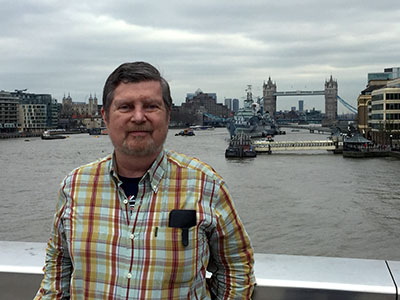
Paul

A Quick Trip Back to Montclair: Last week, I took a brief trip back to Montclair. I went on the same flight as Paul. There had been a blizzard in the Northeast the day before (which made everything involved with the trip more complicated), so the plane was packed. We bounced in at the end, leading to a serious bout of motion sickness. The tenants were a little late moving out due to the snow, but left everything reasonably nice. I was worried that the snow would make it impossible to do what needed to get done, but it turned out OK. I hired some friends of James and Hannah to move our furniture back into the house from the basement and the carriage house. There is still a lot to do before the house is back to being completely fixed up, but it is at least livable. Alex will be coming up to drop off Stella shortly after we return.

Exercising Like a Baby: I have been doing this exercise with Massimo, my trainer, in which you lie on your back with your back pressed into the floor, breathing through your stomach. You then raise your arms and legs and alternate moving them back and forth. It is quite a workout for your core. The other day he told me that the exercise is based on what a three-month old does, while lying in a crib. By lying there, waving their arms and legs around, they build up the strength that allows them to crawl and stand. He had gone to a course on this and there is a whole system of exercise based on the movements of babies.

Brexit Begins: The whole Brexit thing will begin on Wednesday, when Teresa May issues the long-awaited Article 50 notification, beginning the two-year withdrawal process. It is very tempting to compare Brexit with Trump. While both are short-term disasters, there is at least a pretty good chance that the Donald will be gone by 2020 and much of the damage that he and the Republicans will do in that period could theoretically be undone. But Brexit is a more permanent mistake and the British are going to have to live with it for a long time.

It didn’t necessarily have to be this way. Buy May has been seduced by the dark side, the far right anti-Europe Tories, who have pushed her and her government into the most strident and destructive position possible. This lunatic fringe that is now in control of policy would be perfectly happy if the negotiations with the EU failed and Britain found itself with no trading agreement, leaving it stuck trading under WTO rules. The financial industry will take a big hit either way and London will lose a lot of jobs, but no agreement will make it worse. And it is hard to see how Britain’s car industry will work without the free-flowing of parts from Europe to English factories. And the country cannot actually function without migrants. The hospitals are already becoming stressed as EU nurses are deciding to leave and go back to where they feel welcome. They won’t be able to close the borders to all immigration as monsters like Farage want, so the xenophobes will be unhappy and the economy will suffer. Right now they won’t even do something as simple as guarantee that EU citizens in Britain (many for a long time) will be protected. What some of the Tories are clearly hoping for is that they will be able to undo the environmental and working protections which are part of the EU, changing the UK into a low-cost, no regulation “Free Market”, which will help the rich, but further harm the poor voters who supported Brexit. The chances of this not being an ugly disaster seem very slim. Trump is more obviously horrifying, but Brexit could prove to be much worse.

Another Thing I’ll Miss: It isn’t just the restaurants, which are very good in our neighborhood. It is the fact that we have become regulars at a number of restaurants and are recognized as such.

Almost caught up.


Paul’s Visit: Part 2-Theatre and Stuff

During Paul’s stay, we went to the Hampstead Theatre and the Old Vic, two of our favorite theatres, each for the last time during our current stay here. We will certainly be back and will see productions at both venues, but we will never have the chance again to religiously attend every performance they produce.

“Filthy Business”: First, we went to the Hampstead Theatre (after dinner at Bradley’s, our favorite restaurant in an area surprisingly devoid of good places to eat). We saw what I am pretty sure was the first performance ever of a new play, “Filthy Business”, by Ryan Craig. It is a story about a family that owns a shop in East London that sells scrap rubber products. The matriarch of the family has her two boys in the business and wants to keep them there. And there is another generation that she has her eye on to continue the business. Sara Kestelman (who we saw in the “Intelligent Homosexual’s Guide….” last fall) was stunning as the conniving matriarch, Yetta. She dominated the stage in much the same way that Yetta dominates her family. Yetta is a Jewish immigrant and a survivor and an archetype of all of the hard-working immigrants who built London (and, as such, has a relevancy in the era of Brexit) and Kestelmen gives an award-winning performance. Dorian Lough was wonderful as Leo, the son who wanted to get out of the business but could never escape Yetta’s manipulations. And Callum Woodhouse (seen in “The Durrels” on TV), as Leo’s son Mickey, who clearly doesn’t belong in the shop, becomes the real focus of the play in the second act. The real dramatic tension in both acts is whether Leo or Mickey can escape the business and Yetta. Leo can’t but Mickey ultimately does after some entertaining twists, turns and surprises. The supporting cast of family and shop employees is typically first-rate. The set is interesting (although the turntable broke own briefly) and the scene changes were a bit clunky in the first preview performance. Judie complained that she didn’t find any of the characters likable. I’m not sure I agree with that, but even if it is true, I think it is far more important for a play to set up a situation with plausible dramatic tension involving well-developed characters. I think “Filthy Business” clearly accomplished this. I enjoyed myself. (It opened to great reviews.) I am going to miss the Hampstead Theatre a lot.

“Rosencrantz and Guildenstern are Dead”: It is the 50th anniversary of this play, which burst onto the scene and made Tom Stoppard famous, beginning his remarkable career. For the occasion, The Old Vic cast Daniel Radcliffe and Joshua McGuire as the title characters, with David Haig as the Player. The writing is stupendously clever, so densely packed that you feel pressed to keep up with the flow of words. The conceit of having the two characters and the Player occasionally finding themselves in the middle of “Hamlet” and then, just as suddenly, on their own again is brilliant. It was interesting that Radcliffe chose to play (or was cast as) Rosencrantz, as he is the slower and less glib of the two leads. Guildenstern gets much more of the clever and funny lines. It is not that Radcliffe wasn’t very good. He just seemed to be playing against type or at least eschewing the flashier part. I also don’t recall the Player as being as powerful a character as Haig played him. He is an important balance to the confused and somewhat helpless pair. Indeed, one of the thoughts which I had as the play progressed (which I’m sure is not an original insight) is how much the play owes to “Waiting for Godot”. Both feature a bewildered couple, waiting for something to happen to them–probably death. Sporadic busts of activity fail to clarify anything and only lead to a sort of despair, although Stoppard’s existential losers are far funnier than Becket’s. I’ve been wondering since seeing this play whether it is one of those plays that is somewhat foolproof–so clever that it will aways be good if you can maintain the pace. I’ve concluded that it would be pretty easy to do an unsatisfying production. Director David Levaux and the cast deserve credit for a production that seems as fresh and shockingly inventive as it must have seemed fifty years ago.

St. Paul’s Cathedral: Paul and I decided to go to St. Paul’s Cathedral. I’d been once before with someone who was visiting (Peter and Andrea?) We got the audio guide, which does a surprising amount of proselytizing until you figure out which parts to skip. The original St.Paul’s, which was made of wood, with a lead roof, burned to the ground in the Great Fire. (The nearby booksellers all moved their merchandise there in the face of the inferno, which couldn’t have helped.) Wren’s design for the new cathedral was controversial, not the least because it was reminiscent of the hated Vatican. Wren had to do away with much of the ornamentation that he wanted because it was seen as too Catholic. Much of the current mosaics and painting was not added until the Victorian Era. The whole thing is very impressive. You can climb to the top of the dome, if you like doing that. I made it up to the Whisper gallery that looks down into the cathedral. (There are better view points in London that the top of St. Paul’s, partly because in other view points, you get to see St. Paul’s.)

I though that the best part of St. Paul’s was the crypt. It contains all kinds of interesting tombs. They were mostly of dead military officers for a while, but then it was apparently opened to enlisted men (in plaques) and artists and politicians and others. The biggest displays were for Lord Nelson, The Duke of Wellington and Winston Churchill, the only three people to have state funerals in the Cathedral (although Winston is actually buried elsewhere). The one with the best story is Nelson’s. Nelson, as every British school child knows, was killed by a French sniper, just as his victory at the Battle of Trafalgar was assured. At the end of a spectacular hero’s funeral, Nelson’s sarcophagus, which was under the dome of St; Paul’s, was lowered through a hole cut in the marble floor to its current resting place. The sarcophagus itself was designed for Cardinal Woolsey, when he was still in Henry VIII’s good graces. Woolsey fell very much out of favor and among the many things he lost (including his life), was the vessel for his burial, which Henry appropriated. Henry was planning to adapt it for his use, but he died before it was finished and succeeding monarchs never got around to doing anything with it either. So the thing ended up sitting in Windsor Castle, losing bits of ornamentation along the way, until it was donated by the crown to be used for Nelson’s funeral.

Bunhill Cemetery: Continuing in the same vein, we took Paul to see Bunhill Cemetery, which is near our flat and across the street from where John Wesley lived. (It is possible I wrote about this place before.) Bunhill is short of Bone Hill and it is where the non-conformists, i.e., the people  who weren’t Anglican, were buried (if they were sufficinetly important). (It was illegal for Anglicans to be buried in The City and Bunhill is just outside where the wall had been and where the line of the City ends.) Lots of famous folks are buried there, including DeFoe, Blake, Bunyan and Richard Price, the radical Unitarian Minister who preached at our New Unity church at Newington Green. In early spring it is beautiful with daffodils and other flowers profusely blooming. The most interesting tomb in Bunhill is for Dame Mary Page, not because of who she was, but because the inscription on the back, which says “In 67 months, she was tapped 66 times. Had taken away 240 gallons of water without ever repining at her case or ever fearing the operation.” It is thought that she had Meig’s Syndrome, which caused water to build up around her lungs. Stop for a second and think about 240 gallons of water and just how much that is. Photos follow.


Catch Up: Paul’s Visit Part 1-The Old Bailey

I think this may be the longest I’ve gone without posting since I started this blog. I got completely distracted by the visit of Paul Weeks, my friend from college, which was immediately followed by a short and exhausting trip to the US to get our house back from the tenants. So I will probably do two or three posts, as opposed to one gigantic post, in order to catch up.

General Thoughts on Paul’s Visit: Paul was my friend and my suite-mate for my last semester at Bowdoin. He wound up marrying Judie’s roommate and best college friend, Gigi. Paul and Gigi ended up in Bangor, Maine (Paul is a Maine guy), where Paul practiced law for many years. Gigi had a long fight with cancer and died about a year ago. About three years ago, Paul had a blood clot on his spine, which, despite various surgeries and treatments, has left him semi-paralyzed from the waist down. He can walk short distances with a walker, but for the kind of traveling around London that was required for his visit, he needed a wheelchair, which we borrowed from a friend.

Dealing with someone in a wheelchair was a new experience for me. To begin with, there were places where we simply could not go (i.e.: the Underground, The Tower of London, Kew Gardens, etc.) And everything took a lot longer, for a variety of reasons. Bathrooms were sometimes an issue. On the plus side, everyone we met (who wasn’t walking along obliviously staring at their smart phone) was incredibly nice and went out of their way to try to be helpful. The London buses are great for wheelchairs and the entrance fees for everything was reduced and I got to go in free as his companion/pusher. Taxis here hold a wheelchair in the back seat easily and have ramps. I developed a whole new appreciation of sidewalks. Is it smooth? (Cobblestones must be avoided at all costs.) Is it level? Where is the curb cut-out? Small steps which I had never even noticed (like the ones to get into New Unity) were suddenly an obstacle to be taken seriously. It is a bit tiring too. Paul and the chair probably weighed in the range of 200 pounds. And I had to lean forward a bit while pushing, which eventually got to my back. I was happy to push him about, just I was delighted to have him visit. But the added complexities caused by Paul’s relatively manageable disabilities was a revelation.

Our Visit to The Old Bailey: One of the things that Paul expressed interest in doing was a visit to see a part of a trial at The Old Bailey. If you have ever been a litigator (or a fan of “Rumpole of The Bailey”), it is just one of those things you have to do. I contacted our friend, Phil Saunders, who is a barrister with the City of London, and asked for advice on getting Paul in and on what case to see. To my surprise and delight, he and his fellow City barrister (also named Phil Saunders), arranged for us to be let in the back entrance and to be met by their friend, Charlie. This turned out to be Charles Hently, who is in charge of the operations at The Old Bailey. His official titles are The Secondary of London and Under Sheriff, and High Bailiff of Southwark. He took us up to his office, served us coffee and sat with us for 40 minutes telling us stories about the problems running an old courthouse, which sometimes host trials of terrorists. He is worried about the Conservative government’s budget cuts (in the name of austerity and shrinking the size of government) which has forced him to layoff guards and make do with an antiquated security system. He had some great stories about fights that had to be broken up during trials and recesses and told us another about having snipers on the roof for a big case and subsequently having the roof spring leaks because the snipers coffee cups had blocked the downspouts. He then took us on a short personal tour of the old part of the building, featuring a truly spectacular Grand Hall with a dome. (While there has been a court and/or a prison on this site for many centuries, the actual building today was built in 1907 and expanded in 1972. But a part of it is still built on the old Roman wall.) There are six old courtrooms and twelve new ones.

Mr. Hently told us that he had planned to take us to a murder trial involving four defendants (The Old Bailey is reserved for trials for murder, terrorism or especially ugly and notorious felonies), but he had found out that morning that three of the defendants were planning to turn on the fourth and he didn’t want us in the public gallery with the families in case a fight started. So he dropped us at a murder trial and introduced us to one of the defendant’s barristers, who gave us a little background. The victim had been slashed and stabbed in the chest, following a prolonged session of drinking and drug taking with the accused, who left and returned with his brother after an argument. The defense was apparently that the victim was depressed and crazy and killed himself. (A bit unlikely, but I guess you have to go with what you’ve got.) The part of the trial we got to see was a bit boring, as it involved a professional crime scene investigator identifying photos of the carnage (but not including the body) and of the remains of the emergency medical crew’s attempts to save the victim. The barrister for the prosecution asked so many leading questions that Paul and I were looking at each other, thinking “Why no objection?” It reached the point where the barrister was basically testifying and the witness had nothing to do but say yes once in a while. A bit weird from a lawyer’s point of view. (I could see why the defense didn’t want to interrupt too often and prolong the obvious, thereby possibly annoying the jury. But I would have said something.) Anyway, it was a truly memorable morning.

I’d encourage you to read up on the history of the Old Bailey. Here is my favorite story: In 1670 William Penn (later to found Pennsylvania) and William Mead were tried for preaching to a crowd in the street, after having been ejected from their meeting-house. (It was illegal to have non-Anglican services at the time.) After the trial and instructions from the judge, four members of the jury refused to vote guilty. They were berated by the Judge and sent back. After further deliberation, the jury acquitted Mead and found Penn guilty of a lesser charge (“preaching to an assembly”). The jury was locked up overnight without food or heat. The next day, the jury stuck to their verdict, despite bullying from the bench, and were locked up fora second night. On the third day, the jury acquitted both Mead and Penn. The judges accepted the verdict after quizzing each juror and then fined each one for following their own “judgments and opinions” rather than the advice given by the court and imprisoned them until the fines were paid. Four of the jurors refused to pay (you’ve got to love them by this point) and remained in prison while they appealed the fines. The higher court threw out the fines as improper and set the precedent that jurors should rule according to their conscience, the rule of jurisprudence that has been followed ever since.

More to come

Miami, March 1 and Martha and George

Well, it is March 1st and the finishing line of our London adventure is now clearly in sight. Frankly, I’m not really looking forward to this last month or so, since it will involve lots of logistics and packing and flying and figuring out details, some of which I will almost certainly miss and have to scramble to fix. I hope I will be able to ignore the stress and annoying details of the next month and enjoy our last weeks here. Helping me do that will be the visit of Paul Weeks, my long-time friend (suite-mate at Bowdoin and married to Judie’s college roommate Gigi). I am looking forward to that.

Miami Beach: Judie had been encouraged to take some vacation time and travel outside of the UK in connection with the visa issue we had. So about two weeks ago, we decided to go to Florida. Judie wanted to visit the K&L Gates office there and we needed to get something notarized to open trust accounts in connection with bequests to our kids and their cousins under the will of Judie’ Aunt Neanie (too long a story). (One of the things we discovered here is that, consistent with the British desire to make simple administrative acts as difficult as possible, it is very difficult to get things notarized. While in the US, everyone can be a notary, in the UK there are very few. And it was not clear that a British notarization would work for the US bank, which meant making an appointment at the US Embassy and paying $50 per signature.) So going to Miami to get something notarized is not quite as ridiculous as it sounds. We contacted Chris and Nancy, who often spend time in Miami Beach at this time of year and, although they hadn’t really planned to go, they decided it would be fun to meet us there. So we made our airline and hotel reservations and spent 23-27 February at the Setai Hotel, a place that they had been to many times.

The Setai is a ridiculously fancy and expensive hotel. We managed to get a deal that brought the price down to simply expensive from the normal stratospheric, although they got us back on the drinks and lunches, etc. ($28 hamburgers, $15 and up and up for a glass of wine, etc.) But it was great fun lounging by the pool in sunny low 80s weather each day, taking walks to see the art deco buildings, going out to increasingly great dinners and just generally relaxing. There was some sort of food and wine festival going on up and down the Beach, but the tickets were pricy and that wasn’t why we were there, so we skipped it. After living in London, Miami Beach seemed particularly exotic. All of the semi-clothed, tanned people walking, biking, jogging and skate boarding around the place in their brightly colored clothes was quite the contrast to the poor Londoners marching through one gray day after another, all fashionably dressed in black. It felt incredibly self-indulgent just walking down the street in shorts, sandals and a Hawaiian shirt.

“Who’s Afraid of Virginia Woolf?”: Since 1 March is also the first Wednesday of the month, it was time for Judie’s Women’s Group to take the flat for the evening, which means that I was off for a solo theatre experience. So I went to see “Who’s Afraid of Virginia Woolf?” at the Harold Pinter Theatre in the West End. I’d seen the Burton and Taylor movie any number of times. The most memorable viewing was when I saw it at Smith College and left the Hall where it was shown and came out to the house and swing where it was filmed. Very eerie. About ten years ago, we saw a wonderful version on Broadway with Bill Irwin (amazing–won the Tony) and Kathleen Turner. In this production, Martha was played by Imelda Staunton, who was the big draw as she is a multiple Olivier Award winner, albeit mostly for performances in musicals. I thought she was extremely good. Her Martha was earthy, smart, bitter, angry, frustrated, funny and sad. Each time you see the play, you should see a different Martha and that was the case here. It is really such a wonderful part and such a great play that I think you inevitably have a good to great production if you have actors willing to give their all to the characters. I do think that the greater role in the play is George as he goes from utter degradation in the first act (“Humiliate the Host”) and cuckolding in the second act (“Hump the Hostess”) to taking control and getting in his own punches, leading to the shattering conclusion (“Get the Guests” and “Bringing Up Baby”). Conleth Hill (probably best known for his role in “Game of Thrones”) was funny, weak, exhausted, furious, impotent and powerful in a fascinating performance. The visitors, Nick (Luke Treadway, winner of awards for his role in “Curious Incident”) and Honey (Imogene Poots) were both very effective in creating fully-realized characters in a play that is dominated in so many ways by their hosts. I particularly like Poots’ Honey, who was not simply a mousy, drunken, vomiting cipher, but had some real personality buried down there. The part of Nick is the hardest to play since you are not supposed to like him, but I thought Treadway’s Nick managed to combine attractiveness with repulsiveness effectively. The direction allowed George and Martha to start lightly, making anyone who didn’t know what was coming to feel like it was a comedy (although if you did know what was coming, it was hard to laugh too hard). Then, of course it builds and builds to a series of flagellations. The set was wonderful. It captured a lovely living room that had been lived in for a long time, was crowded with stuff and not very neat and had seen better days–a visual parable for George and Martha themselves. “Virginia Woolf” is not exactly a comfortable play to sit through, but it is one of the great works of American Theatre and is something that you have to see once in a while to remind yourself just how powerful the theatre can be. I’m glad I got to see this again.

Punishment for our Self-Indulgence: I suppose it was the fates’ retribution for having too much fun in Miami. Our trip back was the worst flight ever. It began innocently enough when American Airlines could not find our reservations and told us we had to check  in at British Air, even though it was a joint flight. We walked a quarter mile to BA and found a long check in line with two agents and at least a 45 minute wait. (At least when we made it to the front, we were helped. Some people waited in line for as long as an hour only to be sent over to American.) Of course, by the time we reached an agent, we could not sit together and there were only middle seats. Bad news for a nine hour flight in economy. But worse was to come. I found myself seated next to a woman with a 20 month old on her lap. To make matters worse, the child had not yet learned to talk at all and could only communicate with grunts and screams. She had one of those bulkhead crib things for him, but seemingly every time she got him into it and asleep, the seatbelt light would come on and the flight attendants would come and insist that he be removed, thereby waking him up and causing him to cry/shriek. So between the tiny seats and my little neighbor doing an audition for “The Miracle Worker”, I didn’t get much sleep and ended up feeling like I’d been in an accident. Then, after staggering off the plane, we got to sit around trapped for ten minutes in a golf cart thing that we had gotten to ease Judie’s walk with her bad knee. And finally, after fighting our way through customs and laboriously explaining our visa situation to a skeptical border agent, we went to the baggage claim for Miami to find no bag for us. After another ten minutes, we were told that there were separate baggage claims for American and British Air, even though all the bags came off the same plane and our bag was there. We slept well when we finally got back to the flat.