On our third day in Portugal, we went on an all-day tour of Sintra, the mountain town that was the summer retreat of the monarchy and other assorted rich people for many centuries. It is a place of great beauty which would probably take a long weekend or more to see properly. It is a 30-40 minute drive from Lisbon. We climbed hills until we reached the center of the town of Sintra, which is dominated by the Palácio Nacional de Sintra, an imposing building with weird conical towers. It is on the site of an old Moorish fort, captured as the Portuguese moved down the peninsula, gradually taking the country back from the Moors. The fort was converted to the current palace during the 14th to 16th centuries. We stopped to take pictures, but didn’t go in as there were more spectacular sights awaiting us.


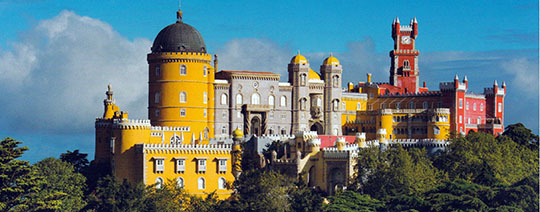
From the town, we drove all the way to the top of the mountain. It was a long way up. Perched at the very top is the Palácio Nacional de Pena, an utterly remarkable building. It was built by the German-born Dom Fernando, the King of Portugal and a cousin of Prince Albert. (Actually, by the 1800s pretty much all of European nobility was related.) Fernando was known as the “artist king” and he bought the abandoned monastery at the top of the mountain to build his dream palace. It is preserved in the same state as when the royal family lived there. (The end came for the royal family in 1908, when Dom Carlos and his 8-year old son were assassinated–in suspicious circumstances–and his elder son abdicated two years later, leading to creation of the Republic of Portugal.) The palace is surrounded by a massive park, with many structures, but we did not have the time to do the exploration, which would have taken the rest of our day. So we confined our stay to marveling at the extravagant architecture of the palace and admiring the views. You had to keep reminding yourself that people actually lived here.


After the palace, we really only had the time to see one more thing, as we had decided to go back to Lisbon along the ocean, a much longer route. So we decided to go to the Quinta de Regaleira, a spectacular palace of an eccentric millionaire. (Sintra was the place where all the rich people in Lisbon built their summer homes, many of which are still used by the same families, although some are now museums.) The palace itself is ornate, if not exactly beautiful. But the real thing you go to see is the gardens. They were apparently designed with references to Masonic orders, the Knights Templar, alchemy and the like. There are lots of buildings and small towers, waterfalls, grottos and mysterious tunnels. One of the tunnels leads to the Initiatic Well, a subterranean 100 foot tower complete with a spiral staircase. It is all very unusual and oddly beautiful.


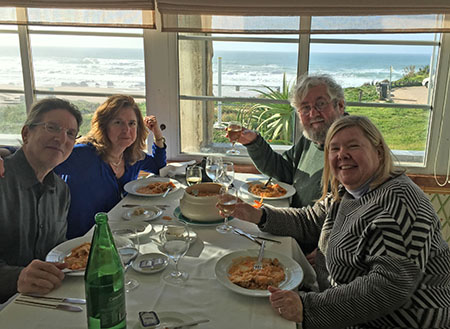
After this, we drove through Sintra and down to the Atlantic coast, which took quite a while as there were hills and mountains in the way. The ocean drive was very pretty, interspersed with small villages and dunes until we got close to Lisbon. We stopped for lunch along the way at a restaurant recommended by our driver and had seafood with rice and vinho verde. (One of the odd things about Portuguese menus is that they offer red, white and green wines.) It was all delicious and scenic. As we went further, we came to Cascais, a very toney suburb, which our driver told us is where rich people now live. It was a fishing village at one point, but underwent a big change during World War II, when a number of rich Brits built estates along the water as sanctuaries from the war. After the war they built hotels and made other investments and the area is now booming.
That night, we went to a restaurant, Senhor Vinho, noted for its Fado performances. The food was good (we took a break from seafood), but the performances were what was really memorable. Fado is a style of Portuguese singing. Accompanied by two guitarists, the singers are incredibly emotive. Imagine Edith Piaf or Billy Holiday in Portuguese, only more so. It was fun to see a series of singers (three women and one man) each sing their hearts out. By the last set, we were the only patrons left (it was a Monday night), which could have been uncomfortable, but was kind of a treat.
We woke to rain our final day, so we went to the Museu Nacional de Arte Antiga, Portugal’s National Gallery. Some nice paintings. My favorite part was the Japanese screens commemorating the Portuguese traders arrival in old Japan. Judie and I wandered around a bit after that, had a bite eat at a sidewalk cafe and stopped for a glass of cherry liqueur at A Ginjinha, a tiny storefront bar that has been selling this cherry liqueur and only that cherry liqueur for that 150 years.


 nickinshoreditch
Amazing what you all saw and did. Casablanca to Lisbon… here’s looking at you kid…
LikeLike
Being there made me think about the “Flight to Lisbon” that everyone wanted to be on. It seems to have ben a odd safe spot during WWII, which I guess is why all the rich Brits built estates on the ocean (ease of escape in an emergency?) and why Victor Laszlo and Ilsa had to get there.
LikeLike