I was sitting at home last Thursday a little after 4:45, thinking I needed to get ready to leave to go to dinner and the theatre, when my phone buzzed and, when I looked at it, I was stunned to discover that we had a reservation for high tea at The Ritz at 5:30. This was a present from Judie’s sister, Linda, for Christmas and we had booked it some time ago and then completely forgotten about it. Thankfully, my phone hadn’t.
I called Judie and broke the news to her. She had a conference call scheduled for 5:00, so she called The Ritz to see if we could reschedule. We couldn’t, but they told her that we could be late. I went on line and cancelled our dinner reservations. As all that was going on, I was scrambling around to get dressed well enough that I could meet the dress code for tea. (We were going to the damn Ritz and they have standards.) I found our theatre tickets for the night and managed to get downstairs by 5:00. I hit the sidewalk and realized it was raining. No time to go back for an umbrella and by the time I had cut through the Old Spitalfield Market, the rain was beginning to mix with snow, the first I had seen in London. (The next morning it actually snowed less than an inch and London was almost paralyzed.) The one thing about London is that once you make it to the Tube, things move pretty quickly. The trains come every two or three minutes. So it didn’t take that long to get from Liverpool Street Station to Holborn and then switch to the Piccadilly line for Green Park. I got out of the station and there was The Ritz across the street. I had somehow managed to get there by 5:45 and Judie arrived just after 6:00.
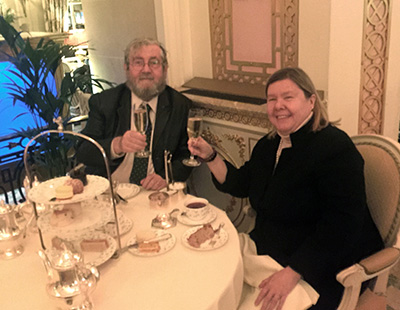
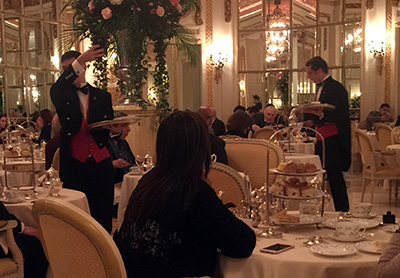
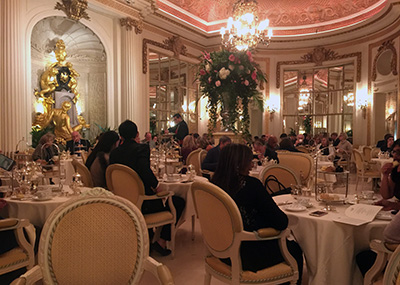
Once we got there (and caught our breath), it really was great fun. The tea is served in a gilded dining room by waiters (all men) in tails and red vests and bow ties. It would have better if the all sounded like Jeeves. But, this being London in 2017, most of them had vaguely Eastern European accents. Linda had given us the Champagne tea, so we got to start with tea (from an extensive tea list) and flutes of their house bubbly. To eat, there were a variety of little crustless sandwiches (I was starving) and scones and clotted cream, and cakes and various little pastries. It was all very delicious, if ridiculously overpriced. But you are paying for the atmosphere and the feeling of being transported back to an earlier, simpler age, when rich people could meet in a golden room and entertain themselves with murmured conversation, while a piano tinkled in the background. A couple of photos follow.
Love-Lost and Found: The Royal Shakespeare Company are performing two plays in repertory at the Royal Haymarket Theatre (Samuel Foote’s theatre, if any of you recall me writing about the play “Mr. Foote’s Other Leg”). After tea at The Ritz, we walked over and saw “Love’s Labour’s Lost”. It is one of Shakespeare’s early comedies and is relatively rarely performed, possibly because its references to persons of the day and it literary allusions became less familiar to audiences. It is the story of the King of Navarre and three of his associates, who all agree to foreswear the company of women for three years of philosophical studies. As soon as they do so, of course, the beautiful Princess of France with three lovely members of her court appear. The four men meet them out of politeness, but refuse to let them into the house due to their vow, and are instantly smitten. The play has wonderful language (it is sometime accused of being overwritten, but I found the lines, often in rhyming couplets, to be lovely). It is quite funny. My favorite scene was one in which each of the men appear on the roof, working on their odes of love, hide as each one appears and finally discover each other and the fact that they each are violating their vows. There are a number of other very funny scenes including one in which the four men improbably disguise themselves as Russions to visit the women, who are not fooled in the slightest and end up fooling the men. The was particularly wonderful repartee between Lord Berowne (Edward Bennett) and Rosaline (Lisa Dillon, who we had seen earlier as the lead in Stoppard’s “Hapgood” at Hampstead Theatre). The play is set in pre-World War I England (you just have to ignore all of the French references), which is really more reflected in the overall look of the truly incredible set and the costumes, at least until the end. The end is a bit of a surprise. The women had been rather toying with these four men’s affections for much of the play, but at the end accept their love. But rather than marry on the spot, as would be the conclusion of most Shakespearean plays of this type, they tell the men that they must wait a year, since the King of France has just died. As the play ends, the four men appear in army uniforms and march off to war, leaving you to wonder if the love will ever be consummated or will be lost. It is kind of a bittersweet ending. I have to admit that I probably would have enjoyed this pay more if I had been more familiar with it. As it was, I had to work hard to follow the language and the twists and turns of the plot. Bennett and Dillon were delightful in the leading roles and Nick Haverson, in the comic role of Costard, the gardener, was a riot. Another memorable performance was John Hodgkinson as Don Armando.
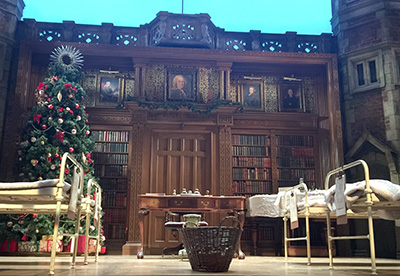
The next night, we were back to see “Much Ado About Nothing”, which was set in England just after World War I. Bennett and Dillon, were back, this time playing the central couple, Benedict and Beatrice. Unlike the prior night’s play, we were familiar with the play (I’d guess that many people are, even if they get confused by the names of Shakespeare’s plays sometimes). We’d seen it back in the 1980s with Derek Jacobi and Sinead Cusack (see related story below) and many people have seen the movie version with Kenneth Branagh and Emma Thompson. I came away even more impressed with Edward Bennett than I had been the night before. He is utterly at ease with Shakespeare’s language and has a true gift for comic timing and was charming in both parts. He looked vaguely familiar and it turns out that we saw him playing one of the scientists opposite Nicole Kidman in “Photograph 51”. He might be best known for appearing in “Hamlet”, where he was the understudy for David Tennant about ten years ago and was called on to perform on opening night when Tennant injured his back and could not go on. “Much Ado” is a tremendously entertaining play that is terribly romantic. It was very clever for the Royal Shakespeare Company to pair it with “Love’s Labour’s Lost”, as there are a number of parallels between the two plots. This production really went for the laughs and had a good deal of slapstick staging. There were some really belly laugh moments. But I did find Haverson’s performance of Dogberry to be so over the top as to be almost painful, even if it was quite funny. The same set was still remarkable (see the photo below that I took before the play began), the cast was top notch and it was a completely satisfying evening of theatre.
Vaguely Related Story: The same time we saw Derek Jacobi in the Royal Shakespeare production of “Much Ado”, he was also performing in “Cyrano”. He was, as you would expect, just wonderful. We took my father to the show, since it was one of his favorite plays and his response after seeing it was “Yeah. He was good. But he’s no Jose Ferrer.”, which was kind of ridiculous, but reflected his feeling that he had seen the ultimate performance of the part that simply could not be topped. Actually, it seems to me, this sort of attitude interferes with the simple enjoyment and magic of theatre. “He’s no Jose Ferrer” subsequently became a recurring line that we would cite when we would see a play that was a re-staging of something we’d seen earlier (especially when we were with our friends Peter and Andrea). For example, we would see Jim Parsons in “Harvey” and say “He’s no Jimmy Stewart”, not as a criticism, but in recognition that there are many ways to interpret a role and to perform it and that what makes seeing a play again played by a great actor and/or troupe of actors is actually the thrill of seeing something interpreted differently.
 nickinshoreditch