Paris and Beyond

Mea culpa: I am in something of a trough. I have not been writing frequently enough. It is partly because I feel guilty about posts that exceed 1500 words (as this one does). So I tend to cut them off, figuring that I’ll just put it in the next one. Of course, by the time I get around to the next one, I’ve got too much to write about and it is lost (if I even remember it). Some good thoughts lost. I could try to blame all of this on a persistent cold or the generally depressing environment of London in winter. But is more simple sloth. This sort of ennui has extended to my painting. I  have grown tired of my landscapes and feel like doing something different, although I have been not sure what. And I feel like I would like to try a different approach to portraits as well. When this happens, I go to museums, seeking inspiration from the masters.

Paris–Art and Food: Honestly, is there a better reason to go to Paris? Especially in January, when it is absolutely freezing? And you catch a cold as soon as you arrive? I had some memorable meals, two with Judie and two solo lunches. There were a bit pricey and utterly delicious. It is probably just as well we didn’t move to Paris (as was a possibility at one point early on the process). I would have ended up like that Monty Python character who explodes after a huge meal. What I ultimately found to be more interesting than the food was the people:

  • One evening, Judie had one of dinners for clients, potential clients and friends. Someone cancelled, so I got to attend. It was an interesting and high-powered group. It was a great evening and a very long conversation. (We closed the restaurant.) The turning point of the evening was when Judie played one of her ice-breaking games. In this one, she asked everyone there to say the worst job they had ever had. It seems kind of simple, but after it was done, a number of the guests commented that French people would never play such a game, since it was unheard of to speak about failure in such a public way. They were all delighted in an odd way and the evening took off from there. We talked about ways to bring people together, religion, politics, why gift cards don’t work in France. On the latter subject, we were told that everyone in France can have bank account and a debit card very easily, so they either give a real gift or transfer cash. It is a different gift-giving culture.
  • On our final day, I went to Bistro Volant for lunch. I’d read that it a classic bistro and it was near to our hotel, just off the Place Vendome. I discovered that Parisians eat lunch at 1:00. When I got there at noon, the place was empty, but there was only one table available. The food was delicious, of course. The sweetbreads were probably the best I’d ever had–crispy on the outside and meltingly soft in the middle. As the bistro filled up over the next 45 minutes, I noticed that a pretty big percentage of the clientele were businessmen. At least 2/3 of the diners were men in suits, all earnestly talking. There were four men next to me. One was an American who was giving them a talk about how his firm believed that Trump would impact business. It was an interesting view of the concern he is causing throughout the world. I can’t say that I learned much that I didn’t already know from reading the NY Times, but I suppose French businessmen don’t read the Times. He was sitting four or five feet from me and I had to resist the temptation to correct him or to say “You are not taking the possibility of him blundering into a war or the turmoil his administration will cause or the real possibility of endless scandals and litigation.” But I didn’t.

I went to three museums while I was there. I started at the Museé D’Orsay, which might be my favorite museum in the world. Every museum has Renoirs, since he was so prolific, especially towards the end of his life. But the D’Orsay has astonishingly great ones, which reminds you of how great he was and why everyone ran out to buy the mediocre nudes he churned out when he was old. There is the best group of Manets anywhere. I could go on and on. And of course, the museum itself is gorgeous. Usually, when I go to a museum, I take pictures of paintings that inspire me or give an idea of a new style that I might use. Unfortunately, on the way over, my phone decided to turn itself off in the middle of the Tuilleries and I could not get it to turn back on. I was afraid it had given up the ghost, but when I got back to the hotel and plugged it in, it revived. The slight sense of panic I felt at the thought that my phone was permanently dead was a reminder of just how much I rely on it, and not simply when I am traveling.

The next day, I went to the Pompidou Center, moving up the timeline of art to the Twentieth Century and beyond. I hadn’t been there since the 1980s. It’s its 40th anniversary this year. They have an enormous collection and can only show a tiny portion of it at any one time. (The have the largest Kandinsky and Rouault collections in the world. Both gifts from the artists’ families.) This particular exhibition seemed to concentrate on Russian artists and the impact of social and political movements in the 20th Century on art. There was a lot done by artists associated with the French Communist Party in the period from the 1930s to 1950s. (Picasso was member for while.) Lots of red and black. It wasn’t always breathtaking art, but it was interesting. The same general theme continued in their exhibit of new acquisitions. Lots of Russians. American artists were not terribly well represented, other than one room with a Rothko and a Jasper Johns etc. The one exception was a big exhibit devoted to “The Genius of Cy Twombly”. I feel odd saying this, but can someone explain to me just what it is that makes Twombly a genius? I didn’t find the vast majority of his works interesting at all. And I don’t know how anyone could call them beautiful. (We are actually seeing the play “Art” next week, which explores this very question.) Twombly was buddies with Robert Rauschenberg, whose art I also don’t “get”, although at least with Rauschenberg there is more going on. (Sometimes too much.) I have to assume that both men were consummate salesmen, who could come up with raps about the meaning of their pieces that were sufficiently compelling or mysterious or profound or timely or whatever, that collectors were convinced to pay millions for their works. Incidentally, if you ever go to the Pompidou Center, have lunch at the restaurant on the top floor. It is not cheap, but it has phenomenal views of Paris. Unfortunately, Paris was cold and foggy/hazy and generally miserable the entire time we were there, so while the views were nice, they were not worth photographing.

Our last day, after my lunch at Bistro Volant, I went to the L’Orangerie. The highlight of the museum and the reason that you have to visit it are two huge rooms containing eight gigantic Monet paintings from the Water Lily series. It is pretty astonishing to see so many of them in one place. (MoMA has (had?) that one lovely Water Lily room, but this is a multiple of that.) Below those galleries is a wonderful exhibit from the collection of Paul Guillaume, a Parisian art dealer who donated his collection to the museum. It has a representaive slection of the Impressionists and a large number of Modiglianis (his friend and client) and Soutine (another client). Chaim Soutine was someone I’d never really heard of and his paintings are very striking–somewhere at the intersection of impressionism and surrealism. The big temporary exhibit there was one about painting in America in the 1930s. It begins with Grant Wood’s “American Gothic” (apparently the first time it has been outside the US). There is a lot of Wood, Thomas Hart Benton, some Edward Hopper, lots of WPA artists and works from the Harlem Renaissance. It was an interesting view of the period and had works by artists who normally don’t get much attention. It spent a lot of time explaining American history of the era, which I didn’t really need to read. I think it is coming to the Royal Academy in London next, so I may see it again.

Things I Will Miss About London: I get e-mails all the time from various theaters announcing new plays or casting decisions. Today it was the Old Vic. Two days ago, it was the National Theatre. It is one the many reasons we see so many plays. It is painful to get these notices and realize that we won’t be around to see the plays.  I suppose we can (and will) become members of the Public and BAM and New York Theater Workshop and Roundabout and maybe Lincoln Center and others, when we return to NYC, but I am going to miss London theatre terribly.

Judie’s knee: After hobbling around in pain for the last month or so, Judie finally had an MRI and discovered that there really is something quite wrong with her knee. (Spontaneous osteonecrosis, which may not be quite as bad as it sounds.) The only way to treat it is to stay off it. Her doctor told her to take a taxi home. Of course, the problem was that Judie was scheduled to take a business trip to Washington, D.C. the next day (with a side jaunt to Tarboro to visit her mother). The doctor advised that she use a wheelchair at the airport. When she gets back, we are going to Lisbon the next weekend with Andrea and Peter. I have no idea how that is going to work. At some point in late February, we are thinking of going to a beach resort, where she can just sit and relax.

Visa Issues: K&L Gates hired a solicitor who specializes in immigration issues to deal with our visas. We were only able to get a six month visa last summer, because Judie had just started at the firm. We were initially told that we didn’t need to worry since we were leaving in April. Then she changed her mind and decided that we did need new visas. By this time, it was going to be a very expensive expedited version, which would require us to return to the US to be fingerprinted. (You might wonder why we couldn’t do it here or at the US Embassy. It is just the rules.) So what they decided is that, when we return from Lisbon (when our visas will run out in two days), we are to come in on a tourist visa. We were told to buy our plane tickets home on 3 April and plan a vacation or two (thus the plan to take a resort holiday). Judie is officially no longer working in the London office and she will not be able to work for UK clients. The plan is complicated by the upcoming visits of Terry Cummings on 22 April and the 10-day visit of Paul Weeks in early March. The fact that Judie can get a note from her doctor about her knee may be helpful. I can’t picture us being deported or denied entry, but there is a danger that this whole thing won’t work.

More to say, but this is already too long. Hopefully, I can remember to put it in the next post. Inspired by my museum visits, it is time to paint.

London in the Age of Trump

The Women’s March: The highlight of last week came on Sunday when we joined countless thousands of people in London for the Women’s March. I was the organizing force behind the turnout from our New Unity congregation, making announcements, figuring out a meeting place (the Animals in War Memorial on the edge of Hyde Park) and getting everyone formed up to march together. Going in, we had a picture of us all marching along with banners and signs and we believed it would be a good opportunity for a little free publicity for us. So we had a new banner made, which you can see in the photos below. We also had reusable signs made, but they never turned up. I thought we had a banner saying “Birthplace of Feminism” (in reference to Mary Wollstonecraft), but we couldn’t find it. Anyway, 25-30 congregation members met up with us at the Memorial and we added some miscellaneous Unitarians who were attracted by our Standing on the Side of Love shirts. So the organizing worked very well as we set off on the two block walk to Grosvenor Square, where the march to Trafalgar Square was scheduled to start.

Unfortunately, we never really got to march. As I understand was the case at venues around the world, the march organizers were apparently overwhelmed by the size of the turnout. Grosvenor Square was shoulder-to-shoulder and no one could go anywhere. After being there about an hour and half, we had made it half way around the square and were nowhere near starting the two-mile march. But we all had fun together, reading all of the signs and talking to the people around us. Judie and our friend, Susan, had both brought these combination cane/seat things for the march, since their knees are killing them. You can see them in the photo below. We all sang songs. “We Shall Overcome” and the UU standby “We Are a Gentle Angry People” (with improvised lyrics like “We Are Nasty Nasty Women” and the like). We weren’t moving but we were spirited. At about 1:30 Judie, Susan and I decided we’d had enough (and we were meeting people in an hour), so we left the march by getting out a side street. Judie and Susan were resting on their devices when we saw the rest of our group walking down the same street with the banner. They ended up walking along with a large number of people who had given up on the main march route, but they never reached Trafalgar. It was just as well, since I heard the next day from someone who had made it there that when he and his wife arrived it was so packed that no one could enter. (The official police capacity of Trafalgar in 20,000 and the CrowdSize app says it is 35,000. But there were lots of people who, like us, gave up along the way or left when they couldn’t get in there. A total of 50,000-100,000 marchers does not seem unreasonable.)

South Africa and Julia Child: On the same day as the march, we had made arrangements to meet our friends, Jane and Paul Jee, at the British Museum and then have them over to our flat for dinner. They wanted to see the special exhibition there about South African art, having gone on a two-week trip to South Africa in early December. It was a nice, relatively small exhibit, which combined ancient art and more recent native art, with recent works by current artists which drew on the history of art there. The exhibit sort of followed South African history, which for the last 400 years was most about how unspeakably awful the Boers, but more importantly the English, treated the local populace (which in the case of the English include the Boers). It is almost impossible to overstate the genocidal viciousness of the English during their long colonial period.

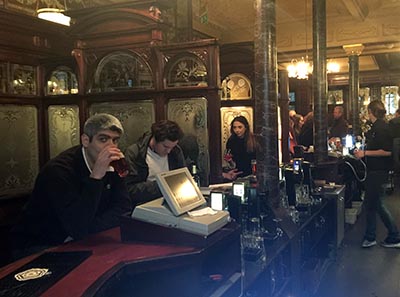
On the way back, Paul directed us to two wonderful pubs for drinks. The first was The Princess Louise, which featured a late Victorian interior of etched glass and dark wood and a number of little glass booths around a central bar. See below. You could imagine seeing it in a castle or a museum, but it was pub. The next one was the Cittie of York, another very old pub that has gone by different names over the centuries. Its interior had a very high ceiling and it felt like Henry VIII might come in after hunting at any moment.

princess-louise-pub

The plans for the march and museum made trying to figure out dinner a bit problematic. (and they had invited us over to eat too often to go out to a restaurant and possibly end up fighting over a check.) So it had to be something that could be mostly made ahead of time. I ended up making the Julia Child’s Boeuf Bourguignon recipe from Mastering the Art of French Cooking. It is perhaps her classic recipe (which is said to have led to the publication of the book), which I’d made before. This was by far the best one I’d ever made and, as a matter fact, was the best one I’d ever tasted anywhere. It may have been the fact that I used really nice meat or that I used a bottle of good Malbec or that I made it the night before and it got a chance to sit and soak up flavors. I served it with the classic sautéed mushroom and braised onions and sliced, boiled baby potatoes and a really nice Aloxe Corton. Heavenly.

The Moth in London: Earlier in the week, we went to a story slam in Shoreditch, which was a part of the NPR show, “The Moth”. Alex gave it to us as a Christmas present. They have these all over the US and they now have them in London once a month in Rich Mix, an arts center on Bethnal Green Road, less than ten minutes from our flat. Each event has a theme. The one this time was “Voyage”. When you arrive, you can put your name in a hat to be called to tell a story that can be no longer than six minutes. There are audience judges who rate each storyteller. Judie and both put our names in. I suspect that in an event like this in New York, there would have been 30 or more names, but the actual stories limited to 10 people. So I doubted that we would get picked. But I did! (We found out later that there were only fifteen volunteers.) I got up and told a story about water communions and the time that Hannah fell into the Nile trying to get some Nile River water to bring home. She was six years old and when she fell in she completely disappeared from view–much to my shock. As adrenaline rushes were coursing through my veins and I was about to race the three or four steps to the water’s edge to dive in, the boatman who had given us a tour of the lake was walking by and casually reached into the water and pulled Hannah out, depositing her, sputtering, sobbing and soaked on the shore, still clutching her film canister of water. It was a good story with a nice arc and a beginning that linked up with the end. (The majority of the other story tellers really did something closer to a stand-up routine about travel, rather than a real story.) I thought my story was pretty good, but I wasn’t close to winning. The judges who were all under 30 (like 95%+ of the crowd) seemed to vote for the ones they thought were funniest, rather than whether they were a coherent stories on the topic. But I’m not really complaining. It was fun. At the end, they had Judie and the other four folks who weren’t picked, get up and tell the first line of their story. Judie’s would have been about the importance of toilet paper when she was a student in Senegal. It was an entertaining evening and I’m glad we discovered the arts center. We’ll try to return.

the-moth

The P.M. is desperate to such up to Donald: British governments, especially the Conservative ones, all go on and on about the UK’s “special relationship” with the US and its president. I’m not sure that US Presidents ever had the same reciprocal warm and fuzzy feeling. As Teresa May has declared in favor of a “Hard Brexit” that will separate Britain from Europe, she needs to find a way to show that this policy is not simply screwing the UK economy by cutting off free access to its largest market. Thus, she hopes that Trump will be her lifeline and that they can develop some sort of trading partnership as soon as possible (which may legally not be for more than two years). Trump said nice things about Britain in a newspaper interview conducted by a creepily sycophantic Michael Gove (Cameron’s former Legal Minister and Brexiteer, who destroyed his career–at least for now–when he double crossed Boris Johnson after Cameron quit). Of course, it is extremely doubtful that Trump knew what he was saying or meant anything by it, but hopes a running high at No 10 Downing Street. May is racing over to visit the Donald shortly.

Health Updates: I don’t ever want this blog to evolve into a health commentary, but having mentioned stuff in the past, it seems fair to give an occasional update. Judie’s knee is not getting any better and she is going in for an MRI shortly. The blot clot in my leg (DVT) is basically resolved and I’ll be off blood thinners in a month or so.

Visa Problems: When we got our new visas last summer after Judie changed firms and our old visas automatically expired, they were good for six months. So they expire on the 9th of February. We had raised this with the K&L Gates immigration lawyer months ago and she advised us that there was no need to get an extension. Now she has changed her mind and we both need to get extensions. The problem is that (a) it will now be much more expensive since we are doing it at the last minute and (b) we have to apply from the US and have our fingerprints retaken there. It is idiotic, but there is not much we can do. Judie was already scheduled to go the D.C. in about a week, so it may be possible for her to get her visa at the same time. In theory, I could go along, but the solicitor hasn’t confirmed that either of us could actually get a visa at the end of January. It is all sort of up in the air. I doubt we will be deported or anything, but it is a bit of a mess.

Something We’ll Miss About London: Free museums and reasonably priced theatre tickets. I was looking at Broadway ticket prices the other day and was horrified.

Something We Won’t Miss About London: How dark it is in the winter time. Between the seemingly perpetual overcast and the shorter days this far North, it is just depressing.

Out On The Town

I was sitting at home last Thursday a little after 4:45, thinking I needed to get ready to leave to go to dinner and the theatre, when my phone buzzed and, when I looked at it, I was stunned to discover that we had a reservation for high tea at The Ritz at 5:30. This was a present from Judie’s sister, Linda, for Christmas and we had booked it some time ago and then completely forgotten about it. Thankfully, my phone hadn’t.

I called Judie and broke the news to her. She had a conference call scheduled for 5:00, so she called The Ritz to see if we could reschedule. We couldn’t, but they told her that we could be late. I went on line and cancelled our dinner reservations. As all that was going on, I was scrambling around to get dressed well enough that I could meet the dress code for tea. (We were going to the damn Ritz and they have standards.) I found our theatre tickets for the night and managed to get downstairs by 5:00. I hit the sidewalk and realized it was raining. No time to go back for an umbrella and by the time I had cut through the Old Spitalfield Market, the rain was beginning to mix with snow, the first I had seen in London. (The next morning it actually snowed less than an inch and London was almost paralyzed.) The one thing about London is that once you make it to the Tube, things move pretty quickly. The trains come every two or three minutes. So it didn’t take that long to get from Liverpool Street Station to Holborn and then switch to the Piccadilly line for Green Park. I got out of the station and there was The Ritz across the street. I had somehow managed to get there by 5:45 and Judie arrived just after 6:00.

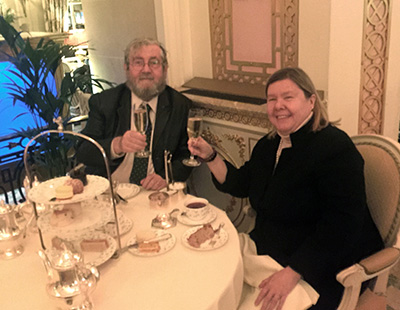
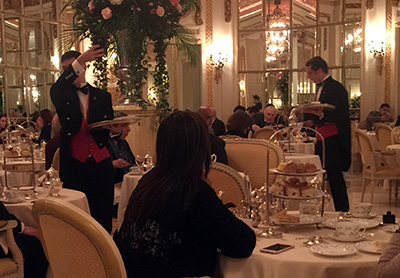
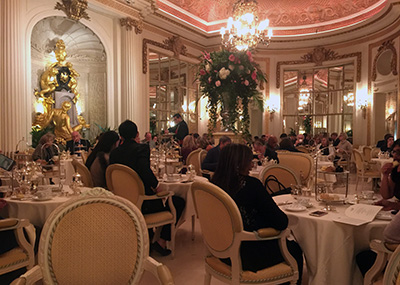
Once we got there (and caught our breath), it really was great fun. The tea is served in a gilded dining room by waiters (all men) in tails and red vests and bow ties. It would have better if the all sounded like Jeeves. But, this being London in 2017, most of them had vaguely Eastern European accents. Linda had given us the Champagne tea, so we got to start with tea (from an extensive tea list) and flutes of their house bubbly. To eat, there were a variety of little crustless sandwiches (I was starving) and scones and clotted cream, and cakes and various little pastries. It was all very delicious, if ridiculously overpriced. But you are paying for the atmosphere and the feeling of being transported back to an earlier, simpler age, when rich people could meet in a golden room and entertain themselves with murmured conversation, while a piano tinkled in the background. A couple of photos follow.

ritz1ritz2ritz3

Love-Lost and Found: The Royal Shakespeare  Company are performing two plays in repertory at the Royal Haymarket Theatre (Samuel Foote’s theatre, if any of you recall me writing about the play “Mr. Foote’s Other Leg”). After tea at The Ritz, we walked over and saw “Love’s Labour’s Lost”. It is one of Shakespeare’s early comedies and is relatively rarely performed, possibly because its references to persons of the day and it literary allusions became less familiar to audiences. It is the story of the King of Navarre and three of his associates, who all agree to foreswear the company of women for three years of philosophical studies. As soon as they do so, of course, the beautiful Princess of France with three lovely members of her court appear. The four men meet them out of politeness, but refuse to let them into the house due to their vow, and are instantly smitten. The play has wonderful language (it is sometime accused of being overwritten, but I found the lines, often in rhyming couplets, to be lovely). It is quite funny. My favorite scene was one in which each of the men appear on the roof, working on their odes of love, hide as each one appears and finally discover each other and the fact that they each are violating their vows. There are a number of other very funny scenes including one in which the four men improbably disguise themselves as Russions to visit the women, who are not fooled in the slightest and end up fooling the men. The was particularly wonderful repartee between Lord Berowne (Edward Bennett) and Rosaline (Lisa Dillon, who we had seen earlier as the lead in Stoppard’s “Hapgood” at Hampstead Theatre). The play is set in pre-World War I England (you just have to ignore all of the French references), which is really more reflected in the overall look of the truly incredible set and the costumes, at least until the end. The end is a bit of a surprise. The women had been rather toying with these four men’s affections for much of the play, but at the end accept their love. But rather than marry on the spot, as would be the conclusion of most Shakespearean plays of this type, they tell the men that they must wait a year, since the King of France has just died. As the play ends, the four men appear in army uniforms and march off to war, leaving you to wonder if the love will ever be consummated or will be lost. It is kind of a bittersweet ending. I have to admit that I probably would have enjoyed this pay more if I had been more familiar with it. As it was, I had to work hard to follow the language and the twists and turns of the plot. Bennett and Dillon were delightful in the leading roles and Nick Haverson, in the comic role of Costard, the gardener, was a riot. Another memorable performance was John Hodgkinson as Don Armando.

The next night, we were back to see “Much Ado About Nothing”, which was set in England just after World War I. Bennett and Dillon, were back, this time playing the central couple, Benedict and Beatrice. Unlike the prior night’s play, we were familiar with the play (I’d guess that many people are, even if they get confused by the names of Shakespeare’s plays sometimes). We’d seen it back in the 1980s with Derek Jacobi and Sinead Cusack (see related story below) and many people have seen the movie version with Kenneth Branagh and Emma Thompson. I came away even more impressed with Edward Bennett than I had been the night before. He is utterly at ease with Shakespeare’s language and has a true gift for comic timing and was charming in both parts. He looked vaguely familiar and it turns out that we saw him playing one of the scientists opposite Nicole Kidman in “Photograph 51”. He might be best known for appearing in “Hamlet”, where he was the understudy for David Tennant about ten years ago and was called on to perform on opening night when Tennant injured his back and could not go on. “Much Ado” is a tremendously entertaining play that is terribly romantic. It was very clever for the Royal Shakespeare Company to pair it with “Love’s Labour’s Lost”, as there are a number of parallels between the two plots. This production really went for the laughs and had a good deal of slapstick staging. There were some really belly laugh moments. But I did find Haverson’s performance of Dogberry to be so over the top as to be almost painful, even if it was quite funny. The same set was still remarkable (see the photo below that I took before the play began), the cast was top notch and it was a completely satisfying evening of theatre.

set-lll-and-maan

Vaguely Related Story: The same time we saw Derek Jacobi in the Royal Shakespeare production of “Much Ado”, he was also performing in “Cyrano”. He was, as you would expect, just wonderful. We took my father to the show, since it was one of his favorite plays and his response after seeing it was “Yeah. He was good. But he’s no Jose Ferrer.”, which was kind of ridiculous, but reflected his feeling that he had seen the ultimate performance of the part that simply could not be topped. Actually, it seems to me, this sort of attitude interferes with the simple enjoyment and magic of theatre. “He’s no Jose Ferrer” subsequently became a recurring line that we would cite when we would see a play that was a re-staging of something we’d seen earlier (especially when we were with our friends Peter and Andrea). For example, we would see Jim Parsons in “Harvey” and say “He’s no Jimmy Stewart”, not as a criticism, but in recognition that there are many ways to interpret a role and to perform it and that what makes seeing a play again played by a great actor and/or troupe of actors is actually the thrill of seeing something interpreted differently.

London Tales

Stoke Newington: On Monday, I went to Stoke Newington. My reason was to pick up a print of Mary Wollstonecraft in support of a drive to have a statue of her erected on Newington Green. (It really is shocking that she is not honored more in London and surprising that some rich woman has already funded a tribute to the Mother of Feminism.) The other reason for going there is that I have been curious about Stoke Newington, which I understand to be a fashionable, furiously gentrifying section of London. (And I can get there by just taking the 67 bus, which stops right outside the flat.) The part that I went to in order to get the print was very nice, with streets of two story connected houses and the sounds of power equipment indicating that renovations were in full swing. There was also an area of well-maintained estate housing (public housing in the US). As I walked north, the buildings got a bit grander and bigger, but a chilly rain started, so I decided to go back to the High Street and either find a place to eat lunch or go home. The High Street in the southern part of Stoke Newington was certainly bustling, but had more of a working class vibe. There were a lot more nail salons, hairdressers and kebab shops as oppose to barristas, galleries and cute restaurants. It appears that the ongoing gentrification that I’d heard about must be in the northern part of Stoke Newington. I thought about walking up there to check it out, but I was cold and wet and decided to leave it for another, sunnier day.

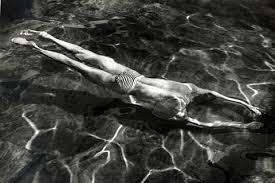
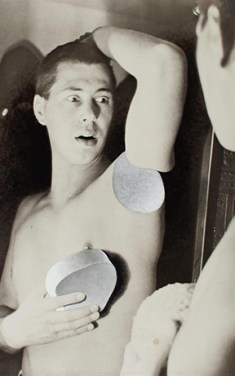
Elton John: Photography Collector: On Tuesday, I went to Tate Modern, where there was an exhibit of photographs from Elton John’s collection, which is one of the largest in the world. This one concentrated on his photos from the Modernist Period, basically 1915-1950. The audio tour featured Sir Elton himself talking about the selected photographs. It was pretty fascinating. It turns out that he began collecting photos in 1991, shortly after becoming sober and became obsessed by it. He now has thousands of photos. Early on, he set a record for the most ever paid for a photograph (since repeatedly broken). See below. It is tiny, taken by André Kertész in 1917, and inspired a generation of photographers, including all of the gay photographers who followed. Elton bought the original picture and the negative. The exhibit is full of iconic images, like Dorothea Lange’s “Migrant Mother”, lots of Man Ray photo-portraits and Weston, , Cunningham, etc. It is spectacular and it is just the tip of the iceberg that is his collection. At one point, he reveals that he has thousands of photos from 9/11, which they bring out every year to see if they should exhibit them. But they decide that, though they are beautiful, it is too soon. One more really amazing thing. Below is a manipulated photo entitled “Humanly Impossible”. In it, the photographer printed out the image and them added things that made it appear that his arm was cut off. He then re-photographed it. and all prints are of the second shot. Except Elton’s. He has the original print with the additions.

images.jpg    Herbert_Bayer,_Self_Portrait-xlarge_trans++1LE_aMoZ4j8b9yBU3fkF9-pCkqavLOFjGjHu2VCbiLk.jpg

A Brexit Note: Judie is a member of the Emerging Payments Association here in London. They represent and advise Fin Tech companies here in London and elsewhere. On Wednesday, they released a report on where they recommend their clients move in light of Brexit. (As you may know, such companies can currently “Passport” their UK license to the EU and need not go through the process of getting a license on the continent. It seems likely that this will end with Brexit. And whether it will or not, nobody can tell, so businesses have to begin taking steps now.) So the EPA was advising on how firms currently in London should consider moving some of their operation to Europe to avoid any Brexit related complications. On one level, this is not terribly big news if you are in the industry or even familiar with banking issues. But I’d say it is significant in that here is a British firm giving advice that will lead to loss of tens of thousands of jobs. Since May and the Conservatives have done little and said less about Brexit in the last six or seven months, it seems like everything has been conjecture. But this is real advice to real firms with real consequences. Of course, the papers didn’t cover it.

Things I Am Going To Miss About London: Taking a bus over London Bridge, getting off, wandering through Borough Market, stopping to get something to eat or buy something for dinner, then going out to the Thames and walking up past the Globe Theatre to the Tate Modern, going in a seeing an exhibit or two, then walking over the Millennium Bridge, checking out both the incredible views and the gum paintings under my feet and the ending up at St. Paul’s.

The Deserving Poor: In the Victorian era, George Peabody, an American merchant, established a trust to build housing for the “deserving poor”. The distinction between deserving and undeserving poor was a big concept in that era (and is an idea that was picked up by Republicans and US conservatives in the 1960s). It turns out that the first such housing that was constructed is directly across the street from our flat, although there is lot of housing for the deserving poor in the area, which has always had a large share of poor people, both deserving and underserving. Of course, if you are like me, you cannot hear that phrase without thinking of Alfred Doolittle’s speech to Henry Higgins, with which I will close this post:

Doolittle: What am I, Governors both? I ask you, what am I? I’m one of the undeserving poor: that’s what I am. Think of what that means to a man. It means that he’s up agen middle class morality all the time. If there’s anything going, and I put in for a bit of it, it’s always the same story: ‘You’re undeserving; so you can’t have it.’ But my needs is as great as the most deserving widow’s that ever got money out of six different charities in one week for the death of the same husband. I don’t need less than a deserving man: I need more. I don’t eat less hearty than him; and I drink a lot more. I want a bit of amusement, cause I’m a thinking man. I want cheerfulness and a song and a band when I feel low. Well, they charge me just the same for everything as they charge the deserving. What is middle class morality? Just an excuse for never giving me anything. Therefore, I ask you, as two gentlemen, not to play that game on me. I’m playing straight with you. I ain’t pretending to be deserving. I’m undeserving; and I mean to go on being undeserving. I like it; and that’s the truth. Will you take advantage of a man’s nature to do him out of the price of his own daughter what he’s brought up and fed and clothed by the sweat of his brow until she’s growed big enough to be interesting to you two gentlemen? Is five pounds unreasonable? I put it to you; and I leave it to you.

Higgins: Pickering, if we were to take this man in hand for three months, he could choose between a seat in the Cabinet and a popular pulpit in Wales.

You’ve got to love Bernard Shaw!

A Painting, A Play and A Panto

A New Painting: I feel like I have been working on this one forever. Of course, I actually had to redo the building completely at one point and I left it over the holidays for two weeks, so I really has been sitting in the kitchen for quite a while. The subject is yet another view from the Isle of Skye. I have lots of lovely subjects from there, but I need to find new subjects for landscapes, etc. I’m getting sick of the mainly green palette. I have had some problems with this one. First, the building wasn’t right and then the writing on it was crooked, so I had to start that part over. And I was never able to get the bottom left and center right. It is all very busy and the green algae on the stream coming out from under the distillery was impossible to capture. There are lots of layers down there. I finally decided that it finally looks OK and that I am really sick of it. Not one of my best efforts, but they can’t all turn out well, I guess. I’m sure that famous artists have had canvasses that they just throw away in disgust. (Probably not Picasso, who would just sell it for lots of money.) I’m not quite to that point with this one and it may be that I’ll go back at some point and see if I can improve it, but, at least for now, I am done with it. Here it is:

talisker-painitng

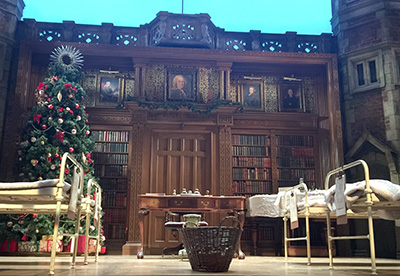
“This House”: Last Wednesday was another meeting of Judie’s Women’s Group in the flat, so I had to vacate. This has turned into my evening to go to the theatre by myself, trying to see plays that I don’t think will appeal to Judie that much. This time, I picked “This House”, playing at the Garrick Theatre in the West End, following an initial run at the National Theatre. It is very political play, set in the offices of the Whips of the Labour and Conservative Parties in the late 1970’s. This was the period before Thatcher became PM and Labor had tenuous control of the government, requiring them to constantly make sure that their MPs showed up for the votes and trying to bring over the votes of the various minor parties. It was real inside Parliamentary politics, which I found fascinating. For example, one of the subplots involved the tradition of “pairing”. This happens when an MP is ill or away on government business. The whips meet and such an MP is paired with an MP of the other party, thus cancelling their votes. As a result of a dispute during the play, the Conservatives stop the practice and the Labour whips have to go to great efforts to get their members in to vote. One very sick member is simply moved into a bed in an office. This invokes another Parliamentary tradition, “nodding through”, in which the vote of a member in the building but too ill to appear is counted anyway as a courtesy. This particular member is eventually sent home and, in the climactic scene, the Labour party is faced with a vote of no confidence which could end their government. They need the vote of this terribly sick guy. But they realize that calling him in to vote would probably kill him decide that this is where they have to draw the line. (They had previously drawn the line at nothing in struggling to retain power.) Labour loses the motion by that one vote, an election is called as a result and Thatcher is elected PM, as the play ends. The play is not about policy or the important ministers. It is all behind-the-scenes maneuvering and the characters are really appealing in a ruthless sort of way. The stars are really the Deputy Whips, who do most of the dirty work. The Conservative side is exactly the sort of upper crust types that you’d expect. Nathaniel Parker (Inspector Lindley on the TV mysteries and Henry VII in “Wolf Hall” on Broadway) plays the Deputy Whip and Malcolm Sinclair (a fabulous actor who is great at playing snotty upper crust types and who we already had seen in “The Meeting” and in “Show Boat”) was the Whip. The Labour side were appropriately working class blokes. Steffan Rhodri was brilliant as the Deputy Clerk. Phil Daniels was a wonderfully Cockney Whip in the first act. When he was forced to resign, the new Whip was played by Kevin Doyle (Mr. Moseley in “Downton Abbey”). Another great character on the Labour side was a young woman that they added to the team, played by Lauren O’Neill (who we saw in “Reasons to be Happy”) as even tougher than the men. This is “One of the Things I Will Miss about London” (you’ll be seeing this a lot in the coming months): not just seeing great actors, but seeing the same actors over and over in different parts.

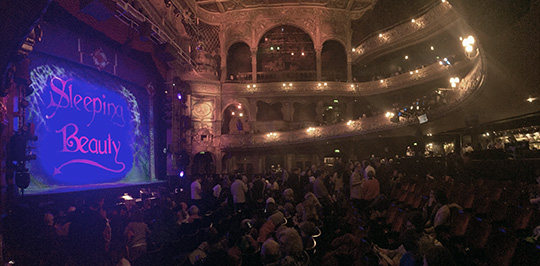
“Sleeping Beauty”: When Diane and Gene were visiting up before Christmas, they made a point of going to see a “panto”, which is a bit of an English tradition. We had never seen one. So, on Saturday, we went to one. It was the last weekend for Christmas pantos and we went to the Hackney Empire, what appears to be an old Music Hall theatre in diverse, working class Hackney (see photo below). It boasts one of the more famous pantos in London, a new one of which has been created and directed by the same woman each year for nearly 20 years. A panto is short for pantomime, but it is not really a pantomime. It is a form of family holiday entertainment, that includes music, big production numbers, comedians, traditionally including one dressed in drag, often a pie throwing scene, and lots of bantering with the audience. This version of Sleeping Beaty only loosely followed the plot, which was notably changed so that her nanny wakes her with the kiss and she becomes a warrior princess who goes to rescue the prince, who has been kidnapped by the evil witch. (The witch and her minions were all Caribbean, which reflects the demographics of Hackney.) The evil witch and Sleeping Beauty were played by talented women, with great big voices and the other star was the nanny, dressed in drag and played by Gavin Spokes, who we’d seen playing Nicely Nicely in “Guys and Dolls”. There was a long string of Brexit jokes included in the show, notably a song sung by the Nanny and the King called “Never Ask the People What They Want”. At the end the Nanny comes out in an outrageous dress that is half Union Jack and half EU flag. My favorite Brexit joke from the show was when the King announces that he is trying out a new court jester. He is asked “What happened to the old court jester?” and he answers “He is the new Foreign Secretary” (a fairly hilarious reference to Boris Johnson). The Nanny does all sorts of stuff with the audience. The best was when she went down to the stalls and picked out a hunky looking guy in the front and says he is not looking well and sprays him in the face with his special nanny elixer. He gives the spray bottle to the poor guys date and periodically through the show, stops everything and says “You are not looking well, Kieran. Please spray him in the face for me” and the guy’s date gleefully sprays him. A great running gag. The show ends with the Nanny coming out and reading out birthday wishes to kids in the audience, a joint sing-along and a big final number. Great fun.

hackney-empire

I think that I will make the following a running theme in the rest of the blog, appearing at the end of each one.

One of the Things We Will Miss About London: We will miss getting to walk over to the fitness club in the morning (or in Judie’s case recently, hobbling), going through our routines and then stopping at the local conveyer belt sushi restaurant for lunch afterwards.

One of the Things I Won’t Miss About London: The British, with one notable exception, don’t seem to invite people to visit them in the homes. Except for Paul and Jane Jee and a Bryan Cave Goodby Party, the only people we have been invited to visit are various American expats. Is this shyness? Is it some sort of house shame? Is it the fact that people seem to meet at pubs? I am not sure, but it has impeded our ability to become close friends with people here. I will say that it is a trait that the Brits appear to have lost on the voyage to Australia.

Back in London: Happy New Year

It has been a while since I have posted. I find it somewhat difficult to write on a phone and I am usually too distracted when we travel back to the States to do anything. This last trip was no exception and it didn’t help that I caught a cold upon arriving. It was a nice trip, if generally uneventful. We stayed at an airbnb in Montclair. It was perfectly nice, although it was a little hard to fit all five of us there comfortably, which gave Hannah an easy excuse to spend most nights staying with friends. So we saw a bit less of her that we had hoped, but (perhaps because of that?) she was in a great mood whenever we did see her.

A few highlights of our trip:

  • We went to the UU Montclair Christmas Eve service. It was great seeing everyone and Judie got to sing in the choir. The kids were with us and it was a pleasant evening. The service itself was a bit too Christian for me. This was probably thanks to our Interim Minister, whose style I am not crazy about. But he’s only the Interim and will be gone in six months or so and I know he is supposed to shake things up and challenge us to take a look at how we are doing things. It was certainly a change of pace from Charlie’s services. But the tone of the service was to religious for me and made me uncomfortable.
  • I made J. Sheekey’s fish pie for dinner on Christmas Eve. It turned out great. I think the kids were a little skeptical, but ended up enjoying it. The next day, I made a Rib Roast, with wild mushrooms. The airbnb had a nice kitchen that was well-equipped.
  • The airbnb host allowed us to hold our Yankee Swap party there and we had a big crowd (in a space that was a little too small for all of us). It was the usual good time. The hot gift was a “squatty potty”.
  • We went to the Metropolitan Opera on Boxing Day and saw “The Magic Flute”. It was the Julie Tamor production, so it was visually spectacular, with lots of puppetry and great costumes. It was an abridged version, presumably to make it more child friendly for the holidays, so we got out in less than two hours. But we missed out on a lot of Mozart, although we got to hear two great arias by the Queen of the Night.
  • Lots of dinners with friends.

Back in London: Being “on the road” is wearing, even when you are on the road in your home town. There was something very odd about renting a place and staying within minutes of our house. Not unpleasant, just weird. It was nice to get back to London and to our flat. I do think that I am beginning to feel the end coming, which is simultaneously sad and exciting. I find myself thinking about the move to come and the logistics of moving back into our house. At the same time, I keep thinking of things I really need to do before we leave (Visit Scandinavia? A day at the Old Bailey? More Theatre, naturally! Windsor Castle? Question Time at the House of Commons?) The list goes on, as time flies. We have tentatively planned our good-bye party for Saturday, 1 April (I’ve come to prefer the English way of expressing dates) at Super Tuscan, our favorite restaurant.

New Year’s Eve: We got back late on the 30th, so we had plenty of time to recover for New Year’s Eve night. We decided to skip trying to get to the Thames to see the fireworks near Big Ben and the London Eye. It is a mob scene that is so bad that they now require tickets to get any where near the River. We saw the fireworks last year on our boat excursion with the family, so we felt free to skip it this time.

We began  our evening by going to Ba Shan, a wonderful Hunan restaurant in Chinatown/Soho. Preserved duck eggs with chilis, fried prawns, cute little pork rolls, soft-shell crabs in a wok with tons of dried peppers, lamb in a sauce covered with fresh peppers, bok choy cooked with garlic and rice. I don’t know how anyone can have that meal and eat all of the peppers without spontaneously combusting. We picked most of them out and still had burning lips and tongues.

After dinner, we walked over to the Donmar Warehouse near Covent Garden to see Bernard Shaw’s “St. Joan”, starring the incredible Gemma Arterton. (We had seen her last spring in “Nell Gwynn” and I decided that I had to see her in this. I think I must have lucked out on returned tickets, since we go the last two tickets and they were literally in the center of the front row!) Judie was not sure about seeing a tragedy on New Year’s Eve, but Gemma did not disappoint. The play opens with Joan outside a castle and the lord’s men inside trying to convince him to see her, saying “there is something special about her”. He finally lets her in and when Arterton enters, there is something very special about her. She was transfixing from the moment she appeared on stage. The entire cast (the rest are all men) is superior, with some great performances. I especially liked Fisayo Akinade as a charmingly aware and effeminate Dauphin, Rory Keenan as The Inquisitor, and Elliot Levy as Cauchon, but as usual, it is hard to pick anyone out as the acting was so uniformly great. However, Arterton was just mesmerizing whenever she was on stage. She carries it all before her. It was made even more amazing by being so close. It is a performance I won’t soon forget.

The production itself was interesting. The scenes were all set in corporate board rooms, rather than the courts in a 15th century palace, with the scenes linked by “BBC newscasts”. (The first detailed the raise in egg futures since the hens had stopped laying, a problem that is miraculously solved when Baudricourt agrees to send Joan to see the Dauphin and go on to the siege of Orleans.) It made the point that Shaw’s play has real modern themes, without going overboard on it. (Interesting fact I learned: Shaw did not like to be referred to as “George”.) “St. Joan” was written shortly after she was canonized in 1920 (nearly 500 years after her death–the only saint ever killed by the Church itself and probably one of the few to be un-excommunicated 25 years after her death) and shortly after women’s suffrage was passed. It is sometimes referred to as Shaw’s only tragedy, although it also often said that there are not real villains in the play. And it is actually true that the Church and the various other protagonists were stuck in the middle of a French civil war and a war against the English and were struggling to do the “right thing”, at least from their viewpoint. (But I would have to say that the vile Warwick, the Englishman who arranges Joan’s betrayal, capture and ultimate death, seems pretty damn evil to me.) There is a fascinating scene (that is classic Shaw) in which Warwick and Cauchon, the French prelate, discuss the problems presented by Joan. Cauchon and the Church are concerned that Joan is bypassing them and speaking directly with God. (Only the Church is allowed to do that.) She is an existential threat to the Church’s power. At the same time, Joan is the first “Nationalist”, in that she claims that the king has the divine right to rule and that nationhood is supreme. If it is nation and king, rather than the aristocratic rule that resulted from the Magna Carta, this presents an existential threat to the control of the land and money by the English aristocracy. Warwick plans to spend a great deal of money to capture Joan and turn her over to Cauchon, but wants to be sure that she will be burned at the stake. Cauchon, as a cleric, cannot directly agree to that, but by the end of the scene, Joan’s fate is sealed. So the play is very much about men conspiring to get rid of a powerful  and threatening woman. It might have been interesting to set it in political party offices, since there is an interesting parallel to Hillary Clinton.

We got out after the show and Judie’s knee, which had been bothering her for weeks, was now stiff and very painful. We figured we could just take a taxi home, but discovered that all of London north of the Thames was closed to traffic from Westminster to Blackfriars. So there we were in the Soho/Covent Garden area, completely without traffic for once. It was kind of magical and it would have been fun to experience it. But Judie really couldn’t walk, so we found a pedicab to drive us to where the cars were allowed to go, finally caught a taxi and made it home in plenty of time to ring in the New Year. We went out on the terrace at midnight, but couldn’t see much. But we could certainly hear constant, deafening explosions for the next 10-15 minutes, while we watched the main event on TV. They really do the fireworks celebration well here in London. New York can’t really match it at all, since their ceremony is in Times Square, which is unsuited for a massive fireworks display.

Happy New Year!