A New Painting and Two More Plays

We are going back to the States for the holidays, leaving next Tuesday. We are looking forward to it. It will likely be my last trip back until we move back for good in early April. So I haven’t got too much time to catch up on this blog and finish up paintings in progress.

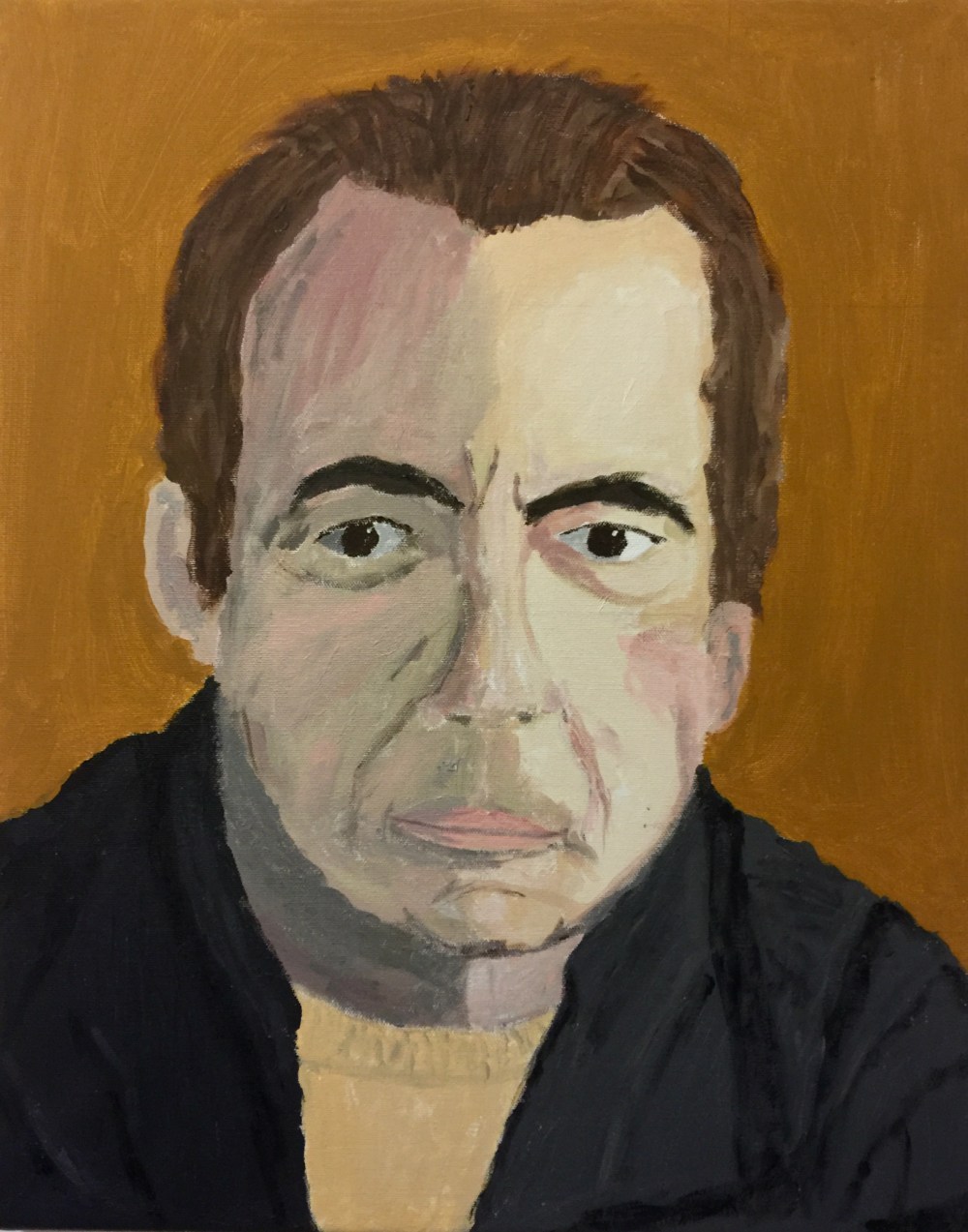
A New Portrait: Once again, I can’t say that this portrait looks exactly like the subject. The mouth isn’t quite right and he looks older than he should. And I had a lot of trouble with the ears. Despite that, I am fairly pleased with the progress I’m making doing these portraits. I may break down and take a class in it at some point because I suspect there are tricks in painting faces that would make it easier and better. It probably wont be until I get back to Montclair though, since that would be contrary to my ongoing artistic experiment, i.e. to see what happens if I paint without any lessons at all. The new painting follows:
andy-p

“Mary Stuart”: Last Wednesday was another of the New Unity Women’s Group meetings at our flat, so I had to vacate the premises. It’s better than trying to hide upstairs and it gives me an excuse to do something. So I decided to go see “Mary Stuart” at the Almeida Theatre in Islington. It’s blocks from New Unity’s second building and it is where I saw “Oil” with Chris A. last month. It is a play originally written by Friedrich Schiller in 1800 and adapted by the director, Robert Icke. One thing I’ve noticed in the last few months is that many plays make a point in the programs of drawing parallels between Brexit and whatever they are doing. For example, while I suppose that almost all of Shakespeare’s plays have political references, one has to strain to find Brexit in “King Lear” (and who really needs to ultimately when you have superstar actors playing the role). But, actually in this case, I could see it. The play is about the period when Mary Stuart, driven from Scotland and seeking sanctuary from Queen Elizabeth, is being held in jail and has been sentenced to death following a questionable trial. Mary is eloquently arguing for her life and freedom to jailers and ministers who have neither the power or inclination to grant her request. And Elizabeth has no desire to execute Mary, but is under great pressure from the public who hate Mary for being Catholic and suspect her of plotting to overthrow Elizabeth. She is being pushed by court intrigue and public opinion to do things that she doesn’t want to do. That has the whiff of Brexit for me. Ultimately Mary dies when the execution warrant, which Elizabeth means to hold onto, is accidentally delivered (and Mary has a hard Brexit.) One of the more unique things about the play was the beginning when the two main actors Juliet Stevenson and Lia Williams join the cast on stage. They are dressed the same. Lia Williams said “heads” and one of the actors flipped a coin, which determined that she would be playing Mary that night. Both of them were wonderful. The first act is more about Mary and the second more about Elizabeth. Juliet Stevenson is an actor who you would recognize immediately, either from countless BBC roles or for movies like “Bend it Like Beckham”. The supporting cast was typically first-rate. It probably would have been a good thing for the women’s group to go to.

“Wild Honey”: You know that you have become a real theatre geek when you see two different adaptation of Chekhov’s “Platonov” in six weeks. The first one was an adaptation by David Hare at the National Theatre to start the memorable three Chekhov plays in one day marathon. The one we saw last Friday at the Hampstead Theatre is an earlier adaptation by Michael Frayn. (Frayn is fluent in Russian, having been trained by the National Service during the Cold War. The only use he made of it was doing things like translating this play.) They were very different in their approaches. The original, Chekhov’s first play, only discovered after his death, is well over six hours long. So there is plenty to choose from. The Frayn version simply eliminates one of the subplots and characters in the Hare adaptation. He also stresses the farcical nature of the play and spends much less time on the financial problems of Anna Petrova and the other characters or Chekhov’s observations about country living, preferring to concentrate on the humor. Platonov dies completely differently at the end. Platonov was played by Geoffrey Streatfield, who had played the miserable title character, Ivanov, in the earlier Chekhov marathon. His portrayal was very funny, as were the rest of the cast. It was a production that was going for laughs rather than Russian drama and misery. This Anna Petrovna was far less elegant and more of a party girl (which actually made her infatuation with Platonov more believable). An enjoyable evening. Who know Chekhov could be so funny?
Brexit and a Theatre Weekend

Diana (a friend of Judie’s from high school) and here husband Gene have been staying with us. We used to see a lot of them back when we both lived in Brooklyn, a somewhat frighteningly long time ago. They moved off to Seattle years ago and we have rarely seen them since, so it has been fun having them visit.

Brexit Appeal: This week is the argument of the government’s appeal of the High Court decision holding that Parliamentary approval is needed to invoke Article 50 of the Lisbon Treaty, thereby starting the process of leaving the EU. It’s a case of major constitutional importance, so I was anxious to watch the proceedings, both as an interested citizen and as a former appellate lawyer.

Imagine my surprise when it turned out that the appellate proceeding turned out to be a cross between a Cricket Test Match and a particularly endless law school lecture. While the U.S. Supreme Court would have given the parties the usual hour for oral argument (or maybe two since it is such an important case), this proceeding is scheduled for four days. I mean, I know this is a major constitutional issue–but four days!? The lawyers for the government droned on for the entire first day and into the second. It was like one of those especially slow part of a cricket match in which neither side seems to be interested in doing much. But the second day picked, as the judges began to question James Eadie QC (whose is “Treasury Devil”, the term for the main lawyer for the Treasury) and poke holes in the government position. He fumbled about in a rather unimpressive way and the two government lawyers who followed him were worse.

But then Lord Pannick QC took the stage to argue against the government and in favor of parliamentary power. (To continue the cricket analogy, after a desultory first inning, the government declared and a great batsman took the pitch for their opponents.) He is apparently a legal superstar and, over next four or five hours, proceeded to prove it. He has a manner of speaking and explaining matters that makes everything he says seem completely reasonable. (Of course, it is easier when you have won below and have really good arguments.) He had the judges in the palm of his hand and it was a pleasure to watch him work. This is complicated legal matter, tying together the unwritten constitution, the prerogative rights passed down to the ministers from the monarchy, the interpretation of treaties and the laws enacting them and the application of common law and case law. Lord Pannick wove it all together brilliantly.

There were still other issues to be argued as I write this. Since certain Parliamentary powers were supposed to have been devolved to the legislatures of Scotland, Northern Ireland and Wales, don’t they get a say in this? And how about the recent Scottish referendum? And if the whole Brexit thing impacts the Good Friday Accords which settled “the Troubles” in Northern Ireland, how does that factor in? This is just the tip of the iceberg of messy issues that Brexit will engender.

But Brexit appears to be an inexorable thing, something like a lava flow. It almost certainly cannot be stopped, but is there a way to limit the damage that it could easily cause? In the middle of the Court hearing, Labour forced a Parliamentary debate on May’s refusal to reveal anything to them (or anyone else). She reacted by agreeing to provide a “plan” if Parliament agreed that Article 50 would be invoked by the end of March. (I’m betting that the plan won’t contain much.) Since this was just a motion and not an act of Parliament, which Lord Pannick’s argument would require, it doesn’t completely answer the Court case. But is does make it seem pretty irrelevant.

Four plays in Four Days: It all began last Thursday when we went to “Cymbeline”, which wrote about in my prior post. On Friday night, we went to the West End to see “Nice Fish”, a play created by Mark Rylance, based on the poems of Louis Jenkins. It is set on a frozen lake in Minnesota, where Ron (Rylance) and Erik (Jim Lichtscheidl) are ice fishing. The play is sort of about the two guy and about ice fishing, but it really very philosophical and about the nature of life in general. It is directed by Rylance’s wife, Clare Van Kampen. They are a superstar couple and it will be fun to see what they do in the future. (She is writing a screenplay of her amazing play, “Farinelli and the King”, which we saw about a year ago.) “Nice Fish” was originally produced by the Guthrie Theatre in Minneapolis and the cast, which is largely drawn from members of that company, was great. It is an absolutely lovely little play, with language so enjoyable that we bought a copy of the script on the way out.

On Saturday night, we wen tot the National Theatre with Diana and Gene to see their production of “Peter Pan”. This was the J.M Barrie play, not the musical. One major change that they made from the usual staging was to make Mrs Darling turn in Captain Hook, rather than having the husband morph into the role. And they made no effort to hide the wires and guys working the system that make Peter et al. fly about. (The changed “fairy dust” to “fairy string”.) So it was fascinating to see the guys moving into place as the next flying interval approached. There were lots of mainly upper class looking kids all dressed up with their parents in the audience, which was sort of sweet. (I wonder if working class kids get to go to weekday matinees, perhaps with their schools?) The programme had a special kid-friendly design, which was clever. It was all very nice, without exactly knocking your socks off. The most memorable thing about it, other than the staging, was the performance of Anna Francolini as Mrs. Darling/Hook. She was deliciously evil and the way she was swallowed by the crocodile was great theatre. Finally, an interesting factoid: London has one of the original children’s hospitals, now called the Great Ormond Hospital, which was supported by Barrie (and Dickens and Queen Victoria). Barrie ultimately gave the hospital the copyright to “Peter Pan”in 1929 and Parliament amended the Copyright Act in 1988 to provide that the “Peter Pan”copyright would never expire. So every performance of the play anywhere in the world assists sick children.

On Sunday afternoon, we went with Diane and Gene to see David Bowie’s “Lazarus”. I had seen it a month earlier when Chris was visiting. It’s still good and Michael C. Hall is still wonderful. The music is great, especially if you like Bowie’s sound. I found the theme of death and trying to deal with and find death more overwhelming this time. A nice, Bowie-like way to check out? It is a bit of a strange and violent production and I wonder if it will just end up being an oddity–a sort of footnote or coda on Bowie’s career. Or might it have some staying power as a work of theater? It isn’t really set in any time, so it won’t become dated in the way that “Rent” or “Hair” or countless other things have. I guess time will have to tell.

Between Two Continents

Judie and I were back in the States for ten days around the Thanksgiving holidays. We are returning for good sometime around the end of March and the trip was an affirmation of why this is a good thing.

We have a very comfortable life here in London. For me in particular, my routine of writing, painting, exploring, going to theatre and museums, vacationing and working with the people at New Unity is quite satisfying. I don’t miss having a car and we live in a great neighborhood and in a very nice flat. I truly enjoy walking around the neighborhood, going to the markets, eating the street food and generally sightseeing. Livin’ is pretty damn easy.

But returning to Montclair was a reminder that there is much that I am missing while living across the Pond. What it comes down to is community. The evening we arrived in New Jersey, we went to the Annual Auction at the UU Congregation, an event I had run for about ten years and then helped to run for five more. I was wonderful seeing all of our friends, who were excited and surprised to see us. Judie and I did really feel like returning heroes, which was incredibly gratifying. And I just kept running into people I knew, either while walking down the street or going to pick up coffee or standing in line to get bagels. This, of course, virtually never happens to me in London and it is really nice to be in a location where there are connections everywhere you look. We got to stay with Ivy and Debbie and have lunch with Peter and Andrea and then dinner with Karen & Jerry and Bob & Karen. And then we went to Boston for Thanksgiving and got to see family and many of my lifelong friends. We really got to wallow in love and affection for a week. We will never get those sort of feelings here.

For me, probably more that for Judie, there is another dimension to all of this. In London, I am not even a small fish in a big pond. I am more like plankton, except in the little fish bowl that is New Unity. Judie is more recognized through her work and the connections she is making in legal and business circles here. So for me, it was nice to return to a place where I have at least some level of gravitas as a congregational leader, former councilman and serial volunteer for many causes. It is a feeling that I rarely experience in London and the recognition felt good.

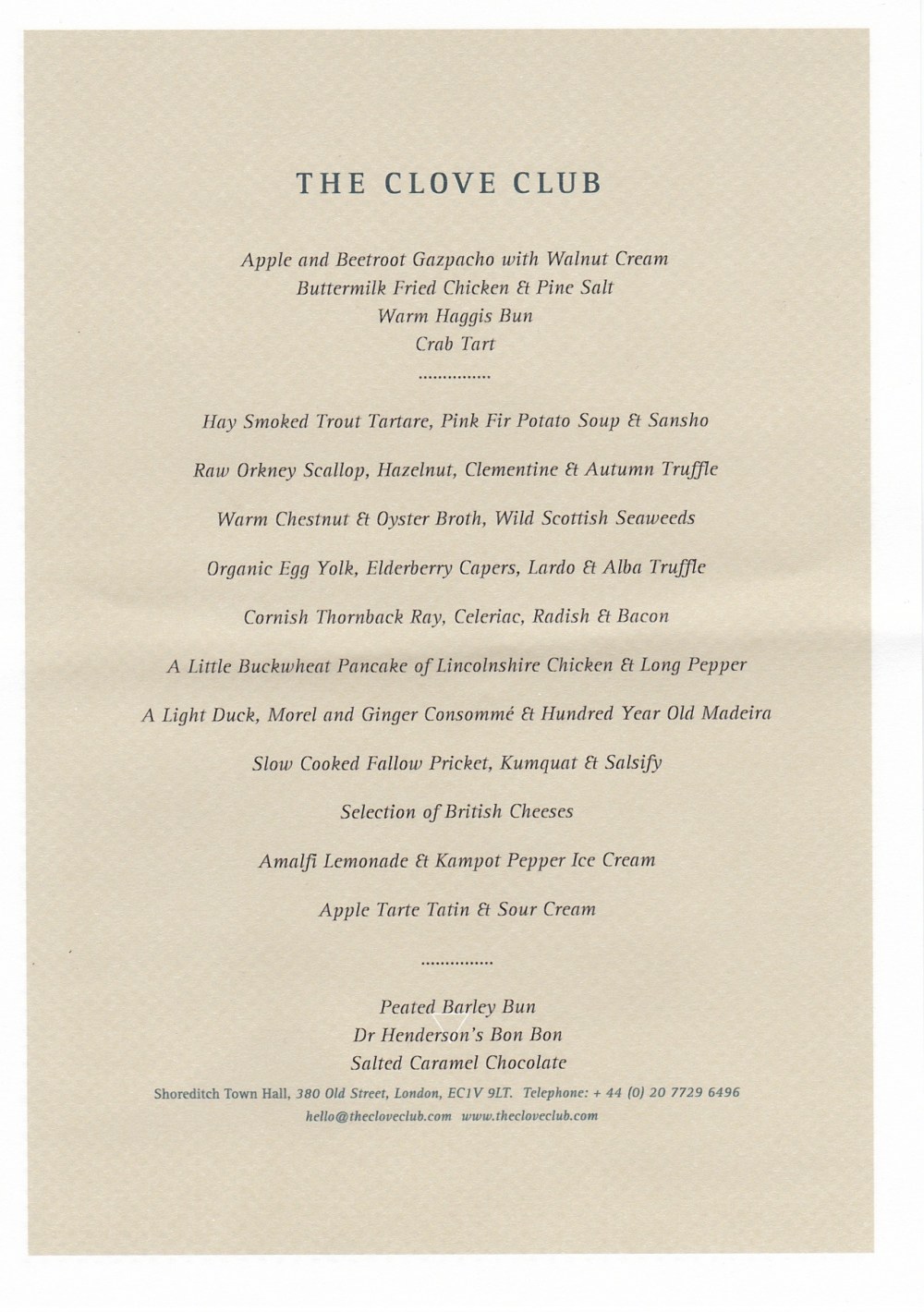
We returned to London, where Judie’s sister Linda and her friend Chris were already at our flat. The next day was my birthday and we went to the Clove Club, a spectacular restaurant located in a part of Shoreditch Town Hall, a 10 minute walk. It was quite a meal, comparable to going to Per Se (only half the price). Very attentive service and a delicious multi-course meal. The menu is below:

clove-club-menu

It is impossible to pick out the most delicious of these dishes. The most memorable was probably the one that started with a glass of 1908 Medeira. We drank that (amazingly layered tastes and a fabulous nose), while the wine steward told us about the house that made it. We left a little in our glasses and he poured a warm consommé of duck, morel and ginger over it. We also ordered the wine pairing. Judie got the regular one and I go the premier one, so we ended up tasting 20 wines while we were at it. When it was all over, almost three hours later, we blissfully walked home. You can’t do that in Montclair.

The next evening, it was another walk, this time a 20 minute stroll to the Barbican Theatre to see the Royal Shakespeare Company’s production of “Cymbeline”. It is one of Shakespeare’s last plays and is rarely performed. It is also one of his few plays that is not based on another story (which he then retells incomparably better than the original). The plot is pretty convoluted. It centers around Innogen, a princess whose two siblings were stolen in infancy. She has displeased Queen Cymbeline (the production changes the king to a queen and the Queen Mother to the Duke) by marrying Posthumus, a commoner, rather than the Duke’s son, Cloten. Her husband is banished and she eventually has to flee as well, dressed as a boy, when Posthumus is fooled in to thinking that she has been unfaithful and tries to have here killed. She is pursued by the vengeful Cloten. In the meantime, in a wonderful parallel to Brexit, Cymbeline and the Duke decide that Britain doesn’t need to be part of the Roman Empire and refuse to pay taxes, causing a war. There are battle scenes, Posthumus returns, Cloten is beheaded by one of the stolen children, now grown, who Innogen unknowingly meets in the forest before taking a draft that makes her appear dead. I’ve left out at least one whole subplot and various twist and turns. There is a pretty implausible denouement in the final scene in which all is revealed and everyone lives happily ever after (except the headless Cloten and the evil Duke). The performances were wonderful, especially Bethan Cullinane as Innogen and Marcus Griffiths as Cloten. We had actually seen much of the cast in “King Lear” a week earlier. There was original music accompanying the play and some clever bits of staging. There is a kind of hilarious scene when Innogen wakes from appearing dead and finds herself lying next to the headless Cloten, dressed in Posthumus’ clothes (too complicated to explain here). It was a bit like the “Romeo and Juliet’ scene on acid. The whole thing was extremely enjoyable, if typically long. So long, in fact, that we had to walk back to the flat to get some food since most of the restaurants in that area were closing.

So the past two weeks was a period in which I was reminded that my heart is in Montclair and that it will be easy to move back home. But at the same time, I was reminded how wonderful it is to live in London. We mean to enjoy the next four months of this experience and look forward to our return to Montclair and to many visits to London.