You Say You Want a Revolution?: This was a special exhibit at the Victoria & Albert Museum that got great reviews. It’s basic idea is that the 1960s music and culture changed the world in various ways (feminism, ecology, computers, etc.). It could easily be criticized as a bit Boomer-centric in its pitch, but I think it did capture something about the excitement and feeling of possibilities that were so prevalent in the 1965-1970 period. And the collection of stuff that was in the exhibit was very impressive. There were so many amazing artifacts of the era, that it is hard to pick out any one to talk about here. I was afraid, as we walked through the first gallery, that the whole thing would be about American culture. But, when you think about it, that whole explosion of music and cultural change were at least as big in London, so a lot of the exhibit was about looking at the parallels in what was happening, especially between London and San Francisco. Everyone who attended got an audio set, which automatically picked up different music and other clips as you walked around. So for each subject, you automatically heard music that was appropriate to the gallery that you were in, which worked great. There were lots of album covers and books, which were real trips down memory lane. Chris and I both commented that we felt like we had read many of the books and either owned or knew someone who had a majority of the albums. It was a wonderful multimedia experience, dipped in huge dollops of nostalgia. Walking through it, looking at the various kids and young people checking it all out, I couldn’t help thinking how weird it was that a part of my life is now thought of as history. Ultimately, the final feeling was a sort of regret for me. There had been this feeling, expressed in the exhibit, that there was a real revolution taking place and that, after the sixties, the world was going to be a different and better place. Anything seemed possible, which was made that who time so exciting, but, in the end, the change that occurred was just incremental.
“Oil”: This was a play at Almeida Theatre. I’d never been there, although I knew the neighborhood since it was a block away from New Unity’s Islington building, where I often go for meetings. The play was written by Ella Hickson, a playwright with a good resume and directed by Carrie Cracknell, coming off directing “The Deep Blue Sea” at the National Theatre. And it starred Anne-Marie Duff, who is spectacularly talented (and who I saw last fall in “Husbands and Sons”). But it turned out to be one of those “nice try”sort of productions. It was a series of scenes, most of them pretty good. But each of the scenes were more like mini-plays than part of one coherent story. All were vaguely related to oil and they all featured a mother (Duff) and her daughter (Yolanda Kettle). The two leads were great and supported by a wonderful cast. But the play covers a period of about 150 years, so while the mother and daughter are in each scene (the daughter is in utero in the first), their characters are not consistent and don’t exactly grow in any meaningful way. And the somewhat apocalyptic final scene, when it appears that oil has run out, was trying a bit too hard to make some sort of point about oil. The whole thing was not completely unenjoyable and there were enough good moments and fine acting that it gave you some hope, it ultimately never came together and was just a frustrating mess. Too bad.
A History of Art in an Afternoon: On Wednesday, we went to Somerset House and the Courtauld Institute. Somerset House is an amazing palace near the Thames. Now it is probably best known for the traditional ice skating there in the Holidays. There is, of course, a great history. The land was given to Jane Seymour’s brother by Henry VIII and Elizabeth I lived there when Mary was Queen. For more history, you can look here if you’re interested. The Courtauld Institute was begun in 1932 and is based on the art collection of Samuel Courtauld, who had a particularly amazing incredible set of Impressionist paintings, with a number of truly iconic canvasses. Going to these sort of galleries always inspires me to go and paint, so I took a lot of photos while I was there. Below is a Seurat painting called “Young Woman Powdering Herself”. It is of his twenty-year old lover, who was pregnant when the portrait was done. It dawned on me that this is “Dot” from “Sunday in the Park with George”! If you are a fan of that musical, as I am, you’ll be interested in seeing this.
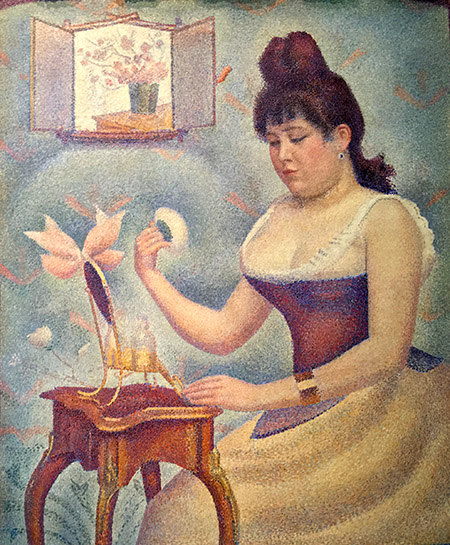
The other interesting thing about this painting is that there was an infrared scan done by conservators, which revealed that under that picture of flower in the upper left is the only known self-portrait of Seurat. It is said that a friend made fun of it, so he painted over it. That sounds like the George you get to know through Sondheim.
While we were walking through the galleries, Chris mentioned that Impressionism is his favorite genre of painting and that he doesn’t really like anything that followed it. So I took him to the Abstract Expressionism exhibit at the Royal Academy. It is a bit of a Greatest Hits exhibition of the greatest artists of the period, which made the art hard not to like. I do suspect that second-tier Abstract Expressionist works would not be as enjoyable to view as lesser Monets and van Goghs, and, in that respect I agree with Chris that Impressionism is a greater period. But it was fun to follow one with the other, especially since it was possible to see the progression from one to the other.
“Lazarus”: That evening, we went to see “Lazarus”, the David Bowie musical which has just arrived from its sold-out premier at the New York Theater Workshop (where Judie and I were long-time donors, referred to as Repeat Defenders). I was quite surprised to be able to get tickets, especially since Bowie is an even bigger deal here than he is the States. As you may know, the musical is based on the book and movie “The Man Who Fell to Earth”, which I had unfortunately never seen or read. (I might have been able to figure out what was happening easier.) Most of the music was specifically written for the musical, although there are a few Bowie hits like “Changes” and “Heroes”. It was directed by Ivo van Hove, whose “out there” style we know from NYTW productions. He is now very famous. It stars Michael C. Hall, who most people would know from “Dexter” and “Six Feet Under” on television. He was wonderful and very Bowie-esque, with a singing voice very reminiscent of later Bowie. The other actors were highlighted by Sophie Ann Caruso and Amy Lennox. I think the play follows only the end of the plot of “The Man Who Fell to Earth”. The main character is miserable and just wants to return to his own world, having failed in his first attempt to build a rocket. The whole thing is a bit strange and I have to say I had no idea what was going on for the first 20 minutes (although the music was good). It came into some sort of focus eventually, but was all a bit like a Becket play set to music. I think it is really a rumination about death, which, of course, makes sense as Bowie was dying (although no one knew it). Going to the play was fun since it was at a newly constructed theatre near King’s Cross Station (much bigger than NYTW, but we were in the third row). It is neighborhood that is exploding with interesting new buildings, mostly residential in an area that was once warehouses and a place where no one went, much less lived or went to theatre and restaurants. That was little bonus to going to “Lazarus”, which is quite a remarkable and unusual work of art. It is the kind of thing that I would be tempted to see again, because I suspect that I would get more out it the second time.
 nickinshoreditch