Time, Intelligent Guides and iHo

Where Does The Time Go?: We found out today that daylight savings time had ended. We hadn’t even realized it. Our clocks, phones and computers all reset their clocks automatically (which meant that we got up at the “usual” time). My cheap watch that I bought at Spitalfields had stopped because I accidentally wore it into the shower and Judie’s watch was wrong, but we figured that she just hadn’t reset it right after all of the traveling. So we went through the entire day blissfully unaware that the time had changed until it seemed oddly dark at 4:30. Good thing our appliances are more aware than we are.

Intelligent Guides: On Saturday night, we went to see “The Intelligent Homosexual’s Guide to Capitalism and Socialism with a Key to the Scriptures” at Hampstead Theatre (where they refer to it as “iHo”). I’ll get to the play in a minute. But the name gave me a bit of a “madeleine moment”. When we were cleaning out things after Everett (my father) had died, we came upon a book entitled “The Intelligent Woman’s Guide to Socialism” by George Bernard Shaw. It was clearly my mother’s book and I think it may have been inscribed “Elizabeth Mahoney”. It brought to mind a picture of my mother as a young woman living in Greenwich Village, having just met this interesting young lawyer. She realized what his political leanings were and ran out to buy a book to learn more about socialism (maybe on his recommendation). In my mind, I owe my very existence to Shaw and this book. You may think this is a fantasy of my overactive imagination (and maybe it is), but consider that they kept that book for about sixty years and that my middle name Fabian refers to Shaw’s socialist Fabian Society. I’m just sayin’….

Getting back to the play, it was just a fabulous production. It is written by Tony Kushner. In the interview in the programme, Kushner said he had written this big and complicated play around 2009 and that he has been working on it ever since, assisted by the casts that have performed it. He thinks he is now ready to publish it, which he finds difficult to do, since he has trouble finding his works really finished (he is still fiddling around with the second half Angels in America). The director was Michael Boyd, who was the Artistic Director of the Royal Shakespeare Company for ten years, among other things. The cast was incredible and they had to be to perform this.

It is an impossibly layered play. One one level, it uses the classic Miller/O’Neill/Williams device of gathering a family around a kitchen table and having them tear each other to bits. That part alone would have been a great play. But the play was also about the history of radical Italian-Americans, the American Communist Party, the history of the Labor Movement in America, the 1973 Longshoreman’s strike, the guaranteed annual income that certain longshoremen received to settle the strike, and the future of radicalism and the labor movement. I have probably left out a theme or two, but you can see there was a lot to talk about. And the characters did talk and talk (it’s along play of about three and half hours), often at the same time. Just like a real family they did not take turns and there were often two or more arguments going on simultaneously. It was hard to take it all in. And because this a Tony Kushner play, there was whole other layer added about homosexuality and the difficulty of two of the characters to maintain relationships.

The story is about an imagined family of a real person, Vito Marcantonio, who was a radical Congressman, representing East Harlem until his opposition to the Korean War led to his defeat. At the center of the play is Vito’s fictional nephew Gus, a longshoreman and labor organizer and committed lifetime communist, who was one of the guys who received a guaranteed annual income as a result of the 1973 strike and hadn’t worked (except as an organizer) in the ensuing 30+ years. Gus is living in a now very expensive brownstone (I think in Carroll Gardens, Brooklyn) with his sister, a former nun who later went off to work with the Shining Path. Gus has decided he wants to sell the house and kill himself and has called his family together to tell them the news. There is his eldest son Pill, a history teacher living in Minnesota with his long-time husband and who is trying to figure out his relationship with his lover, a male prostitute. The second child is MT, a labor lawyer and lesbian, whose wife is about to have a baby with sperm donated by Vito, the baby of the family, who works as a contractor and has a traditional family. Also wandering through is MT’s ex-husband, who is helping Gus sell the house and a woman who is assisting Gus to kill himself (his earlier attempt to slit his wrists had been unsuccessful). Put that all together, give it a shake and watch it explode. This play was one that hit a lot of buttons for me (besides the mere name, as I discussed above). The fact that the other central character MT was a labor lawyer was one obvious link. And I have met union guys like Gus in my life.

I won’t try to describe this all any further, since it was so complicated with so much going on and so many subplots to follow and thoughts to digest. I found it fascinating. The accents of the British actors were spot on. It never occurred to me that they were anything but New Yorkers. Two particularly stood out: David Calder was just wonderful playing Gus. And Tasmin Grieg was riveting as MT. But the entire cast was terrific. For a play as long and as complicated as it is, the evening seemed to go quickly. The production had an overwhelming momentum, which only let up at the very end, when Gus is trying to decide whether to kill himself.

A great night of theater.
Chris Visits: Part 2-Museums and Theatre

You Say You Want a Revolution?: This was a special exhibit at the Victoria & Albert Museum that got great reviews. It’s basic idea is that the 1960s music and culture changed the world in various ways (feminism, ecology, computers, etc.). It could easily be criticized as a bit Boomer-centric in its pitch, but I think it did capture something about the excitement and feeling of possibilities that were so prevalent in the 1965-1970 period. And the collection of stuff that was in the exhibit was very impressive. There were so many amazing artifacts of the era, that it is hard to pick out any one to talk about here. I was afraid, as we walked through the first gallery, that the whole thing would be about American culture. But, when you think about it, that whole explosion of music and cultural change were at least as big in London, so a lot of the exhibit was about looking at the parallels in what was happening, especially between London and San Francisco. Everyone who attended got an audio set, which automatically picked up different music and other clips as you walked around. So for each subject, you automatically heard music that was appropriate to the gallery that you were in, which worked great. There were lots of album covers and books, which were real trips down memory lane. Chris and I both commented that we felt like we had read many of the books and either owned or knew someone who had a majority of the albums. It was a wonderful multimedia experience, dipped in huge dollops of nostalgia. Walking through it, looking at the various kids and young people checking it all out, I couldn’t help thinking how weird it was that a part of my life is now thought of as history. Ultimately, the final feeling was a sort of regret for me. There had been this feeling, expressed in the exhibit, that there was a real revolution taking place and that, after the sixties, the world was going to be a different and better place. Anything seemed possible, which was made that who time so exciting, but, in the end, the change that occurred was just incremental.

“Oil”: This was a play at Almeida Theatre. I’d never been there, although I knew the neighborhood since it was a block away from New Unity’s Islington building, where I often go for meetings. The play was written by Ella Hickson, a playwright with a good resume and directed by Carrie Cracknell, coming off directing “The Deep Blue Sea” at the National Theatre. And it starred Anne-Marie Duff, who is spectacularly talented (and who I saw last fall in “Husbands and Sons”). But it turned out to be one of those “nice try”sort of productions. It was a series of scenes, most of them pretty good. But each of the scenes were more like mini-plays than part of one coherent story. All were vaguely related to oil and they all featured a mother (Duff) and her daughter (Yolanda Kettle). The two leads were great and supported by a wonderful cast. But the play covers a period of about 150 years, so while the mother and daughter are in each scene (the daughter is in utero in the first), their characters are not consistent and don’t exactly grow in any meaningful way. And the somewhat apocalyptic final scene, when it appears that oil has run out, was trying a bit too hard to make some sort of point about oil. The whole thing was not completely unenjoyable and there were enough good moments and fine acting that it gave you some hope, it ultimately never came together and was just a frustrating mess. Too bad.

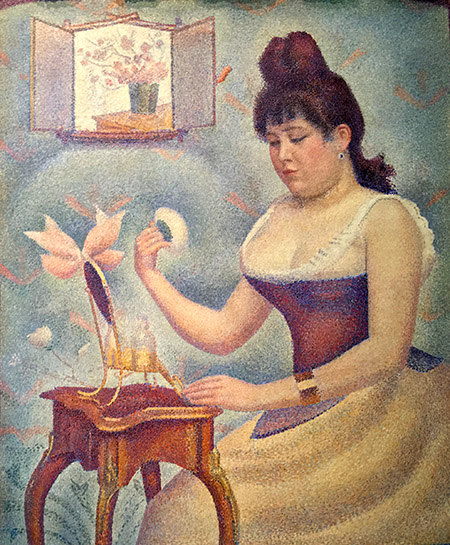
A History of Art in an Afternoon: On Wednesday, we went to Somerset House and the Courtauld Institute. Somerset House is an amazing palace near the Thames. Now it is probably best known for the traditional ice skating there in the Holidays. There is, of course, a great history. The land was given to Jane Seymour’s brother by Henry VIII and Elizabeth I lived there when Mary was Queen. For more history, you can look here if you’re interested. The Courtauld Institute was begun in 1932 and is based on the art collection of Samuel Courtauld, who had a particularly amazing incredible set of Impressionist paintings, with a number of truly iconic canvasses. Going to these sort of galleries always inspires me to go and paint, so I took a lot of photos while I was there. Below is a Seurat painting called “Young Woman Powdering Herself”. It is of his twenty-year old lover, who was pregnant when the portrait was done. It dawned on me that this is “Dot” from “Sunday in the Park with George”! If you are a fan of that musical, as I am, you’ll be interested in seeing this.

dot

The other interesting thing about this painting is that there was an infrared scan done by conservators, which revealed that under that picture of flower in the upper left is the only known self-portrait of Seurat. It is said that a friend made fun of it, so he painted over it. That sounds like the George you get to know through Sondheim.

While we were walking through the galleries, Chris mentioned that Impressionism is his favorite genre of painting and that he doesn’t really like anything that followed it. So I took him to the Abstract Expressionism exhibit at the Royal Academy. It is a bit of a Greatest Hits exhibition of the greatest artists of the period, which made the art hard not to like. I do suspect that second-tier Abstract Expressionist works would not be as enjoyable to view as lesser Monets and van Goghs, and, in that respect I agree with Chris that Impressionism is a greater period. But it was fun to follow one with the other, especially since it was possible to see the progression from one to the other.

“Lazarus”: That evening, we went to see “Lazarus”, the David Bowie musical which has just arrived from its sold-out premier at the New York Theater Workshop (where Judie and I were long-time donors, referred to as Repeat Defenders). I was quite surprised to be able to get tickets, especially since Bowie is an even bigger deal here than he is the States. As you may know, the musical is based on the book and movie “The Man Who Fell to Earth”, which I had unfortunately never seen or read. (I might have been able to figure out what was happening easier.) Most of the music was specifically written for the musical, although there are a few Bowie hits like “Changes” and “Heroes”. It was directed by Ivo van Hove, whose “out there” style we know from NYTW productions. He is now very famous. It stars Michael C. Hall, who most people would know from “Dexter” and “Six Feet Under” on television. He was wonderful and very Bowie-esque, with a singing voice very reminiscent of later Bowie. The other actors were highlighted by Sophie Ann Caruso and Amy Lennox. I think the play follows only the end of the plot of “The Man Who Fell to Earth”. The main character is miserable and just wants to return to his own world, having failed in his first attempt to build a rocket. The whole thing is a bit strange and I have to say I had no idea what was going on for the first 20 minutes (although the music was good). It came into some sort of focus eventually, but was all a bit like a Becket play set to music. I think it is really a rumination about death, which, of course, makes sense as Bowie was dying (although no one knew it). Going to the play was fun since it was at a newly constructed theatre near King’s Cross Station (much bigger than NYTW, but we were in the third row). It is neighborhood that is exploding with interesting new buildings, mostly residential in an area that was once warehouses and a place where no one went, much less lived or went to theatre and restaurants. That was little bonus to going to “Lazarus”, which is quite a remarkable and unusual work of art. It is the kind of thing that I would be tempted to see again, because I suspect that I would get more out it the second time.

Chris Visits: Part 1

While Judie was off on her bi-coastal tour of the U.S., my old college friend, ex-roommate and best man came for a quick visit. I suspect that Judie helped push him into deciding to come, fearing what I would do if left alone of two full weeks. It was great to have him. We did an awful lot while he was here. I’ll break it up into two or three posts.

Eating: I don’t write all that much about restaurants here, which is a bit shocking considering (a) how wonderful the restaurant scene is in London generally and Shoreditch in particular and (b) how much time I spend eating out. The food scene here has a diversity and a wild willingness to experiment with flavor combinations that makes it very exciting, even more so than NYC in my opinion. To add to all of that ongoing creativity and pushing the envelope, it is now truffle and game season, allowing the British to indulge their love of eating all sorts of birds. (In the following discussion, I will try to provide a link to the restaurant menus where possible the give you a feeling of London cuisine.)

We started at St. John Bread and Wine, just down Commercial Street from the flat, one of the landmarks in the food revolution in London. It is where the great Fergus Henderson’s first restaurant opened. We went there for lunch shortly after Chris arrived. The smoked sprats (sardine-like fish), the cold venison with celeriac slaw, brawn (a sort of pate made out of boiled pig’s head) and the Eccles cake were especially memorable. That evening, we went for food at Sichuan Folk, a shockingly good Chinese place around the corner. The green beans with garlic and pork crumbles and the fish stood out. The next day, we walked through Kensington Gardens, planning to eat at the Serpentine Sackler Gallery, but it was closed so we ate at the Food Hall at Harrods. There are a number of specialty food bars to eat at and we chose the fish one. Lovely meal and the Victorian tile work, made by Royal Doulton, was just stunning. That evening, we ate at Lotus, a sort of haute cuisine Indian restaurant near Trafalgar Square. In keeping with game season, our dishes included Pigeon Masala Dosa and Muntjac Mal Daas (a kind of small deer in aromatic gravy). For old times sake, we also stopped at the Cork and Bottle in Leicester Square, where we had miraculously run into each other over thirty years earlier, for a few glasses of wine.

On Tuesday, we looked around for a pub lunch near Kew Gardens, but ended up settling for Pizza Express, a decent chain and our least memorable meal. That evening, we were in Islington for a play and did get to a local pub for a pre-theater pint and something they called rocks, a sort of English samosa stuffed with savory fillings. After the play, we stopped for a meal at a slightly snooty French restaurant on Upper Street. The next day, we went to Lyle’s, my favorite lunch place. It is run by acolytes of Fergus Henderson and is just a treat every time I go. We had grilled razor clams, grouse, a great pumpkin and shaved chestnut dish with a whey cream sauce (among other delights). That night, we were in the emerging neighborhood behind King’s Cross Station (to see David Bowie’s “Lazarus”) and ate at Caravan , where the highlights included blue cheese and peanut wontons, jalapeno corn bread, soft shell crabs with kimchi and wonderful croquettes. We closed Chris’ culinary tour with lunch on Thursday at Super Tuscan, our favorite restaurant in London, where we concentrated on truffles; gnudi with black truffle sauce, truffle arancini, little stuffed pastas with shaved black truffles and fresh tagliatelle with cream sauce and two ounces of shaved white truffles. (We finished with a bang.) And all of this talk of eating delicious fungus is a great segue to a marvelous adventure earlier in the week:

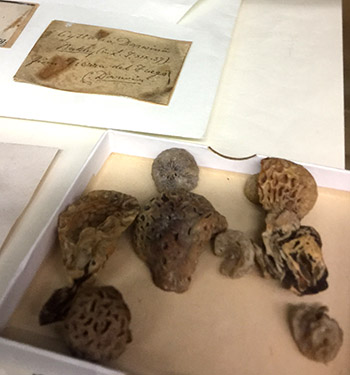
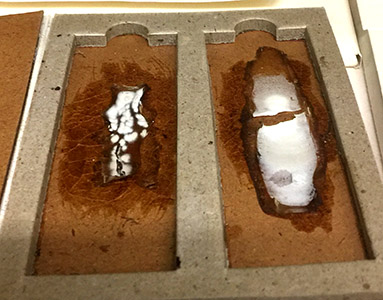
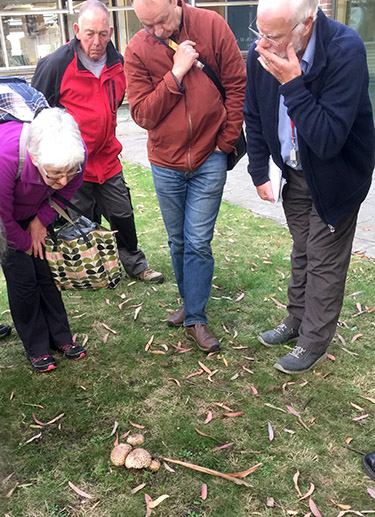
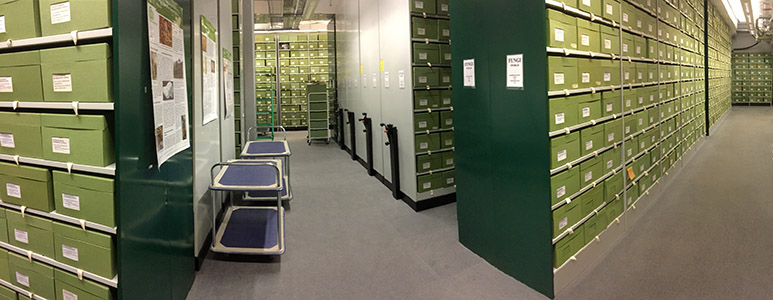
Kew Botanical Gardens: I had actually never been to Kew Gardens, but it was a reasonably nice day, which got better as it went along and ended up beautiful, so we took the Tube out there. We discovered that on Tuesdays (which it was) they had special tours led by scientists working in the labs there. So we signed up for a tour about fungi at Kew and, after wandering about the greenhouses for an hour or so, we presented ourselves to be guided. Our leaders were charmingly eccentric and nerdy and advised us, straight off, that there were far more varieties of fungi at Kew than plants, leading to their opening quip that it really should be called Kew Fungus Gardens. They led a group of about twenty hearty souls tromping to all sorts of corners of Kew that we might not have seen, poking around under trees and in piles of wood chips. We saw many varieties of toadstools and other sorts of fungus growing on and under the trees. There was a young guy of the tour in a singlet, who initially looked more like a soccer hooligan than a nature lover, but he ending up knowing almost as much about fungus as the guides and was even better at finding samples. Having him along really go our mycologist leaders even more geekily wound up about the fungus they were seeing than one might have expected. The tour, which was supposed to be an hour, took far longer and was a really great jaunt. It ended in front of the lab building, which had a huge set of mushrooms growing right out front, which they excitedly advised us had been coming back every fall since 2012. Then they invited us down into the lab, where they have endless number of boxes containing fungus samples, over 1,300,000 in all. All pretty incredible, but they saved the best fungus for last, showing us a fungus sample that Charles Darwin had picked off a tree in South America and some of the actual, original penicillin culture that Alexander Fleming had used in (accidentally) discovering antibiotics in 1928. Seeing the latter was a little like seeing the Rosetta Stone. They don’t give these tours very often, so probably something like 100 non-scientists a year get to see this stuff. Some photos of all of this follow. The first one is the Darwin fungus, the second one is the original penicillin culture and the bottom one is some of the fungi collection.

fungus-darwinfungus-penicillinfungus1fungus2

A New Portrait and Thoughts from London

A New Portrait: After going to the Royal Academy and seeing the David Hockney exhibit, “82 Portraits and a Still Life”, I decided that I was going to try to do a series of portraits and to have two paintings going at a time, one a portrait and the other a landscape. (Hockney is said to have quipped that the are really only three kinds of paintings: portraits, landscapes and still lives.) I’ve discovered that it’s hard to do portraits. I guess this isn’t a really great insight, but I thought after my first attempt (a portrait of Judie that wasn’t a bad painting, but didn’t really look like her), I might have learned something that would make the second attempt better.

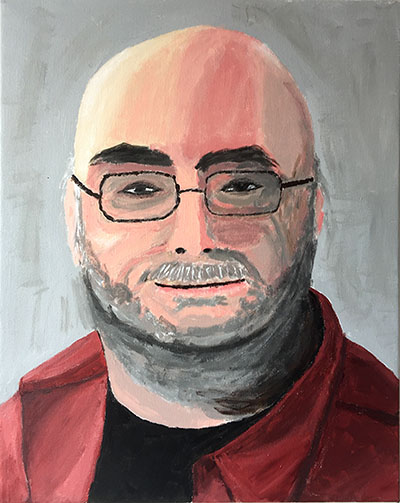
For the second one, I decided to try a portrait of my friend and former roommate, Chris, based on a good photo of him from our trip to France in June. One of the first things I learned is that it is tricky painting someone with a beard. I even went back to the Hockney exhibit to see how he did it. He didn’t really. Only one of the 82 was not clean-shaven. So that wasn’t all that helpful, but, upon close inspection, I did note how the area under the chins of his portraits were always extra dark, so I tried to incorporate that. The other thing Hockney does that is really kind of magical is to add bright or unusual splotches of colors to the faces that seem like that they can’t work but do. I have no idea how it occurs to him to do that (and I’m not going to try).

I kept at this portrait, pushed along by a deadline in my mind. Chris is coming for a quick visit on Sunday and I decided I should try to finish it before he arrived. The result is below. I actually think it is a pretty good painting and it looks more like Chris than the first one looks like Judie, but it still doesn’t really capture him. Of course, while Hackney’s portraits are great, I don’t really know exactly what his subject actually look like. For all I know, the paintings don’t really look like his subjects (although I kind of doubt it.) So I’ve been thinking that maybe I should try doing portraits of people I don’t know as well (or even don’t know at all). My expectations would probably be different and I might be less disappointed by the results.

chris

When Will the Countdown Begin: For quite a long time, I felt like I was visiting London. And then that changed. Looking back, I’m not sure that I can remember a bright line, where I felt that I actually live here, but I know that it happened. I’ve always known that this time here would be a temporary thing, but the end was sufficiently distant that I didn’t feel like a transient resident. I still don’t, but I can begin to feel that ending. In roughly five months, we will back at our home in Montclair, putting the furniture back in place and trying to restart our lives. I know that it is coming and I occasionally think about the logistics of the move and what I am going to do with myself when I get back. At the same time, I am feeling very present in London here and now and that is a good thing. I have real sense of neighborhood in Shoreditch and Spitalfields and Broadgate, etc. And we both have a strong feeling of commitment to New Unity and its community. I sometimes wonder if I could do more good over the next few years trying to help out with New Unity than in taking some role at UU Montclair. Perhaps that will all change once the countdown to the move begins, which I suspect will be sometime in January. Right now, it is just a faint tug. By then, it will be an increasingly strong pull.

I’m Counting on You, Lord, Please Don’t Let Me Down: I think the following is a sign of something, but I can’t decide what that is. Sir Philip Green is an ostentatiously rich Brit, who is reminiscent of Donald Trump. (According to Wikipedia, he was considered for the Donald role in the UK version of “The Apprentice”.) Unlike Trump, he actually did support a number of charities and in 2007 he was knighted. It gradually emerged that he engaged in all sorts of tax avoidance schemes and conspicuously spent huge amounts of money on himself and his family. He was a Cameron confidante and generally the kind of rich guy lots of people grew to hate. He seemed to buy and sell various retail businesses. His big troubles began after he bought the “High Street” department store chain, BHS. He proceeded to drive it into bankruptcy, not only costing all of the workers their jobs, but also a great chunk of their pensions. It has been an ongoing scandal. Green seems to be perceived as such an awful guy that even lots of Conservatives  hate him and they normally have never met a rich guy they won’t toady up to.

This week, the House of Commons held a hearing about taking his knighthood back. It seemed a bit weird to me that you could do that. I’d think that everyone getting a knighthood assumes that it is lifetime, irrevocable honor. Think again, Elton John and Paul McCartney! The humorous thing about the whole thing is that, while the MPs got to make endless outraged speeches, it turns out that the House of Commons has no power to revoke a knighthood, so it is just a meaningless recommendation to whoever actually does have the power. Is this an act of faux populism? An easy way to fake concern for the little guy, while systematically shredding the NHS and the safety net? Is it some sort of weird Brexit response?

Fawlty Government

My Fawlty Towers Theory of British Politics: Consider Basil Fawlty. He hates the French and the Germans. He dislikes immigrants, although his business relies on one. He toadies up to rich people and loves the monarch. He agrees with the Major that things were so much better in the past, when Britain had an Empire. He isn’t really stupid, but he usually acts without thinking about the consequences or having a coherent plan. When things go wrong, he blames everyone else. I have just described Theresa May and the “Hard Brexit” Conservative Party. The tragedy is that they don’t have the equivalent of Polly to clean up Basil’s messes. (It is impossible to see Jeremy Corbyn filling that role. The NY Times has an op-ed piece describing his many failures including his coddling of anti-semitism in New Labour.)

It would be nice to think that there is a chance that the Tories might come to their senses, but the lunatic fringe seems to be firmly in control and May is so desperate to be Prime Minister that I don’t think she cares. There are a few grown ups in the Conservative Party, but I don’t hold out much hope for them. One especially crazed backbencher has proposed that the Treason Act be amended to include any disparagement of Brexit! The long-standing split in the Conservative Party between delusional eurosceptics and more traditional Conservatives (i.e., between the Basils and the Pollys) is not going away. May might find it harder and harder to keep her coalition together as the reality of Brexit (and the resulting economic hardship) nears.

I sometimes feel that we are living through the end of time here in London. The government seems utterly committed to shortsighted and delusional policies that seem incredibly destructive. This wonderful, multicultural London–the financial center of Europe–seems to be facing a sort of existential threat. It is a great city and always will be, but it seems likely that it will be diminished. I find it depressing.

Are UKIPing me? UKIP is the xenophobic party whose sole purpose was to get Britain out of the EU and to get foreigners out of the country. Their leader was the unspeakably creepy Nigel Farage (most recently seen praising Trump after the second debate as a silver back gorilla). The political pressure of UKIP was a factor in Cameron agreeing to the whole Brexit referendum. Having now achieved his horrible dream, Farage retired as leader of UKIP. All hell then broke loose.

First a woman, Diane James, was elected as the new leader (which surprised me, since I didn’t think they had any women in leadership positions). This arguably progressive step lasted less than three weeks. The she resigned “to spend more time with her family”. My theory is that she suddenly realized that she had become of a leader of party of guys overdosed on testosterone, who were essentially unmanageable. Farage came back briefly and then retired again. One of Farage’s protégé, MEP (Member of the European Parliament) Steven Woolfe, threw his hat into the ring and was the favorite, but then got into a fight with another UKIP member at a meeting at the European Parliament and ended up hospitalized with severe injuries close to a coma. (It is a bit hard to figure what UKIP politicians are even doing in the European Parliament, but they got elected and seem to spend most of their time insulting everyone.) On Monday, Woolfe resigned from UKIP, disclosing what everyone already suspected–that he had been cold cocked by one of his UKIP mates (who claims self-defense). Woolfe said that UKIP is ungovernable (which Diane James had figured out) and that he no longer wanted to lead a party that he described a having “something rotten in its core” (not a big surprise to me) and in a “death spiral”. Yet another British political party falling apart.

Meanwhile in Scotland: The Scottish National Party (SNP), led by the impressive Nicola Sturgeon, has emerged to become the serious opposition party. It is hard for them to be really effective in that role, since they are pretty small in Britain as a whole. The SNP is stepping into a vaccuum, since Corbyn never seems interested in the bother of governing.  They are like the “smart cousin” of UKIP in that their core belief is that Scotland should leave the UK, although that is the only sense in which they are comparable. Having lost the referendum a few years ago, that plan was on the back burner until the Brexit vote, which the people of Scotland rejected. Sturgeon has used this as a rallying cry for a new independence referendum, although at this point, the polls are very close and it is not clear that she would succeed. She is trying to use the threat as a way to get Scotland a seat at the Brexit negotiating table, in order to protect Scotland’s interest in continuing free trade with the EU. She is very savvy and is making no commitments yet. But it seems clear to me that if the hard-core Brexiteers succeed in creating a complete break with the EU, she will have the excuse and the ammunition for a new independence vote.

Health: Since I’ve mentioned this in the past, I’ve raised some concerns with some of you. I’m fine. I’m taking blood thinners for clots in my leg, which is decidedly less balloon-like. I went to my GP for the gout and he gave me medication with the warning that many people become violently nauseous taking it. I took it, didn’t vomit, and can now walk without a limp. I’ve resumed exercising. Judie also lit a candle for me at New Unity a few weeks ago when I wasn’t there and I’ve been deluged with well-meaning expressions of concern whenever I show up. It’s a nice reflection of the sense of community that is so special about the place, but I’m sick of it.

Trump, Shylock and Brexit

Administrative Note: I’m going to change to the premium version of Word Press this weekend. This will change the address of this blog to nickinshoreditch.com. If you are signed up to get notifications by e-mail, this may not matter, but if you are used to just getting it through a browser, you won’t be able to find my blog using the current URL. So if you are looking for nickinshoreditch.wordpress.com and it isn’t popping up, then I’ve made the change. I’ll post an announcement on Facebook and one more right before I make the change.

Trump from a Distance: I have been blessed to be in London for this election season. Things like the interminable primary debates were on to late to watch (and I’m sure that I would have compulsively watched many of them, given the opportunity). I have missed endless Trump stories and hours upon hours of blathering by various talking heads. Which is not to say that the BBC doesn’t pay any attention to the election, it just has other stuff to cover and only spends a few minutes on the proceedings. Trump was, at first, an object of fascination to most Brits, who all wanted to know if he was a serious candidate and could someone like him actually get nominated. I have to say that I discounted Trump for far too long. After he was nominated, the questions changed from “How could he have been nominated?” to “He can’t win, can he?” to “My G0d, what is going on in America?” I have taken to compulsively checking FiveThirtyEight (Nate Silver), as well as the Times and the New Yorker and the Guardian to try to get a sense of what is going on in this miserable excuse for democratic process.

Now that the Trump campaign seems to be in a Trump-perpetuated death spiral, there is a palpable sense of relief here and I suspect in large parts of the US. But, even if Trump does lose and even if he loses in a landslide (which seems more likely than not), it is hard to feel very good about the future. It is difficult to picture Hillary being able to govern effectively, since she is unlikely to have a cooperative Congress, is reviled by so many and faces a Republican machine that will do what they did to Obama only much worse. The Republican Party seems likely to fracture and be in such a mess that it cannot be a responsible partner in government (recognizing that a significant percentage of their leaders have no interest in such a role anyway). And all of those angry Trump people, who have now been energized, are not going to go away. (And, unfortunately, neither will Trump.) Americans should not feel too smug about the defeat of Trump or claim that “It can’t happen here.” In fact, Trump proved that it could happen and if he was a not so clearly a bat shit crazy narcissist and sexual predator, he might very well have been elected  President next month.

“Merchant of Venice”: On Yom Kippur, of all days, we went to the Globe to see “The Merchant of Venice” with Jonathan Pryce as Shylock. Our seats were not great (don’t get seats on the side there if you ever go) and there was a major rain storm about 30-40 minutes into the play, which soaked the people standing in the pit. (The Globe has no roof, although the seats and the stage are mostly protected.) Then the temperature dropped and the wind kicked up and it was positively frosty. Not at all Venetian. (It is strange commenting on the weather when talking about a play.) Despite all of that, I did enjoy the performance. I had forgotten much of the plot other than the Shylock bits, particularly the sections in which Portia’s suitors are tested to see if they can marry her. These scenes were wonderfully done. The cast was typically very good. British actors just do Shakespeare really well, although sometimes overeager directors with weird interpretations let them down. Perhaps it is part of their training that accounts for it. Shylock’s daughter was played by Pryce’s real-life daughter, which was actually more of an interesting footnote than something which added to the overall performance. Rachel Pickup, who played Portia, the dominant part in the play, was marvelous. I suppose that you could play Shylock differently than Pryce did, but it is hard to imagine it being played any better.

merchant

Of course, the overriding theme that makes the play great and the thing that you come away thinking about is the anti-semitism. It is actually remarkable that Shakespeare was able create the character of Shylock since, as the programme points out, there were virtually no jews in England during Elizabethan times. (It was dangerous enough being the wrong type of Christian in the era.) This actually seemed to make the anti-semitism of that time even worse, as there were no actual humans to put the lie to the crazy tales and conspiracy theories that dominated. Shakespeare’s audience would certainly have been utterly anti-semitic and ready to accept any sort of evil characterization of a jewish money-lender. But Shakespeare went out of his way to make Shylock human (“If you prick us, do we not bleed?”) and, it seemed to me, showed that he was responding to horrible treatment over many years by Antonio and the other merchants of Venice, who repeatedly spit on Shylock in the course of the play. Pryce’s Shylock was so reasoned and aggrieved that I found myself rooting for him to get his pound of flesh. But, of course, there was no way that Shakespeare could allow the Jew to win and Portia snatches victory away from him and replaces it with ruin and the humiliation of forced conversion to Christianity. Pryce’s performance made it clear that it was the latter result that was by far the worst. But in a way, Shylock brought this on himself by his hatred and desire for revenge. And I think that was the real moral of this production: that unreasoning hatred and the compulsion to get revenge can only lead to calamity.

Brexit Update: For some reason, the New York Times has suddenly become interested in Brexit and its impact on the British economy and government and has published a number of articles this week. I suspect this might reflect concern over the weakening pound and how this will play out in the world economy. Here are few impressions from this side of the pond:

  • The pound has started to fall again, after seeming to stabilize after its initial plunge. I’d say that this reflects market worry about the future of the British economy. Until recently, you could kid yourself that it wouldn’t be that bad and that Theresa May wouldn’t let things get out of hand. You’d have been wrong. May made it clear at the Conservative Party Conference recently that Brexit was happening and that Britain would not accept any deal that included freedom of movement. The government later announced that it would not let any foreign nationals (even those who were teaching at the London School of Economics) participate in the Brexit negotiations (even though it is generally agreed that Britain is woefully short of experienced negotiators). And then it was announced that businesses would be required to disclose the number of foreigners it employed. As it became obvious that the xenophobic kooks were taking charge, the pound began to fall.
  • This led to the Great Marmite Controversy. Because the pound had lost almost 20% of it value, Unilever wanted to increase its price for the items it sells to Tesco, the largest grocery chain in Britain. A stalemate ensued and soon Tesco began to run out of the beloved yeast goo. This caused outrage, only in part because Marmite is actually produced in England. I think what really scared people is that this was a clear harbinger of price increases to come.
  • Meanwhile, back in Parliament, the tenuous Conservative majority was facing the same problems with delusional back-benchers that had bedeviled Cameron. This group of 100 or more MPs keep talking about “sovereignty” and returning Britain to it position of greatness. So far, their big idea is to re-commission a Royal Yacht for the Queen, with the supposition that everything will return to Rule Britannia. It would be pathetically funny if it all weren’t so serious. May’s honeymoon period seems to have run its course.
  • Just this week, the highest British court has begun to hear a case which seeks a “constitutional” ruling (there is no written Constitution here) that May and her ministers cannot unilaterally invoke Article 50 to begin the process of leaving the EU. It is argued that the treaty that would be abrogated was ratified by Parliament and therefore can only be terminated by that body. Anther argument that the entire basis of unwritten British constitutional law is that Parliament is paramount and that an irreversible act of that import must be taken by that supreme legislative body. These seems like winning arguments to me. If the suit is indeed successful, turmoil is certain.
  • And then there is Boris Johnson and the Brexit troika of ministers. Last week, BoJo said that the aim of Britain in the negotiations with the EU is to “have our cake and eat it to.” This was instantly denounced by European leaders and seemed to harden their negotiating resolve (not that BoJo and his buddies have any sort of negotiating position beyond bluster). The European President suggested that Johnson buy a cake, eat it and see what he had left.
  • In the background, Judie’s bank clients are asking for advice about where to move their offices. Dublin, Frankfort and Paris may scoop up a lot of EU banking business that has been centered in London, which would be a complete disaster for the post-industrial British economy. A “hard Brexit”, in which the banks would lose their “passporting rights” (i.e., the ability to apply their British license throughout Europe) would make this inevitable. But this complete break from Europe is exactly what the most delusional MPs insist upon.


Four Plays and 100 Kazoos

Administrative Note: I’m probably going to change to the premium version of Word Press, so that I can publish photos of higher quality and you won’t have to see advertising. This will change the address of this blog to nickinshoreditch.com. If you are signed up to get notifications by e-mail, this may not matter, but if you are used to just seeing it through a browser, you won’t be able to find this using the current URL. So this is a warning: If you are looking for nickinshoreditch and it isn’t popping up, then I’ve made the change. I’ll post more warnings as it happens.

Four Plays in Twenty-Seven Hours: This was a kind of a crazy idea. The National Theatre has been having a special “Young Chekhov” event in which you see three plays normally done in repertory on individual nights, all in one day. I signed us up for it, not realizing that we also had tickets at the Old Vic the night before. So it really was a marathon.

It all started with “No’s Knife” at the Old Vic. It isn’t exactly a play. It was more of a performance piece based on selections from Samuel Becket’s “Texts for Nothing”. On one level, it was an amazing interpretation by Lisa Dwan, a dancer, actor, writer and Beckett expert, as she used movement and voice changes and odd, bleak scenery and a mist machine to enliven some of Beckett’s most obscure ramblings. On the other hand, it was so plotless that it made “Waiting for Godot” seem like “The Importance of Being Ernest”. There was a lot of existential despair, reflections on nothingness and ruminations about death. There were many good moments, but the whole thing wasn’t cohesive and, in fairness, was not intended to be. We both found it difficult to concentrate fully on the stream of thoughts that were being expressed for the full 70 or 80 minutes. It was one of those things that made you feel intellectual for simply being there and a dolt for not being able to find some sort of deep theme (beyond misery and death) or a trenchant comment on the modern world. An odd evening.

The next morning, we were off to the National Theatre, which was made difficult by the weekend closure of all of the tube lines that went anywhere close to it. The three plays on the day were the early works of Chekhov and the whole thing was the inspiration of David Hare, who also created new versions of the plays. The first play, which began at 11:45, was “Platonov”, also known as “The Play Without a Title” when Chekhov wrote it at about age 20, while a medical student. It was discovered 20 years after his death and performed sporadically until 1960, when an edited version first to use the tile “Platonov” was performed with Rex Harrison as the lead. Like most Chekhov plays, it is set in a country villa and I think might be characterized as a tragic farce. The set, which was used for all three plays (since they are all mostly set in country villas) was absolutely spectacular. In this case, the villa was the home of the widow Anna Petrova, played by the wonderful Nina Sosanya, who we’d seen before. The main character, played by Scottish actor James McArdle, is supposed to be the most interesting and handsome man in the community. Like seemingly all Chekhov characters, he has money problems and is unhappy with how his life has gone. He is a bit of a misogynist but is also irresistible to women, with whom he has a series of affairs, despite being married and a father. The fact that the women in play fall for him unhesitatingly, despite his flaws, really annoyed Judie (and she regards this portrayal of women as typical of Russian writers). Putting that reasonable objection aside, McArdle did play Platonov with considerable charm and humor and there were large sections of the play that were very funny, at least until it all begins to catch up with him in the last act and a tragic ending is assured. I found the whole production to be lively and immensely enjoyable. It is a play with a number of juicy parts and the cast was great. It turns out that “Wild Honey”, by Michael Frayn, which we are going see at the Hampstead Theatre later this year, is his adaptation of “Platonov”. I’ll be curious to see if it is different.

After  a quick lunch at House, the National Theatre’s on-site restaurant, we were back in our seats at 4:00 for “Ivanov”. This was Chekhov’s first complete play and the first ever performed (in 1887). It was an initial disaster, but was restaged triumphantly two years later after Chekhov rewrote it. This play is also set in country villas and has more tragedy and less humor than “Platonov”. Ivanov, played by Geoffrey Streatfeild,  is unhappy, has money troubles, and feels like he has wasted his life. In short, he is a typical Chekhov character. (What must life have been like in the late 1800s in Russia?) His wife, played by Nina Sosanya, is dying of TB and her doctor, played by James McArdle, is an insufferable prig whose idea of the truth helps to ruin the lives of both of them. There are some other characters who give a truly amusing view of the life in that era and who keep the proceedings moving. Unfortunately, Ivanov, at the center of the action, is simply clinically depressed for the entire play and cannot get himself out of it, despite the efforts of a young neighbor, played by Olivia Vinall, to pull him out of it. It is all a effective and dauntingly realistic realistic look at dealing with profound depression. (You keep thinking “Give this guy some medication!”) But it seems to me that the main character must develop over the course of a play and Ivanov cannot and does not. It isa one note role, leading to a one note performance. We are ultimately left waiting for his inevitable suicide. The play had moments, but was the least satisfying of the three, one I would not be tempted to see again.

Finally, it was back to the Olivier Theatre at 8:00 for “The Seagull”, a more familiar Chekhov work. The set contained a good deal of water, which was used somewhat in the first two productions, but was more central to this one, which is set in a country villa on a lake. There are two interconnected plots. One concerns the relationship between Irina, the owner of the estate, a spectacularly vain and famous actress, played with wonderful self-centered energy by Anna Chancellor, and her son Konstantin, played by Joshua James, who had also had a central role in”Platonov”. Her belittling of him and the destruction of his dreams is one theme. The other involves Nina, a young, talented and beautiful woman, played by Olivia Vianall (again–more on that below), who is a neighbor and beloved by Konstanin. She is casually seduced and ruined by Trigorin, (Streatfeild is back in this role), a famous author and the lover of the actress. As in all of three plays, there is a large company of interesting characters, all played with wonderful gusto. This play is ultimately about the dreams and ambitions of the young being thwarted by their elders and is consistent with the prior two plays, in which both the two young protagonist’s youthful dreams and ideals have been unmet, leaving them in a state of perpetual disappointment. And it turns out that the other running theme of the three plays is that if you are a character in a relationship with one played by Olivia Vinall, you are doomed. In “Platonov”, she is the jilted mistress whose life is ruined by Platonov and who shoots him at the end. In “Ivanov”, she is the well-meaning young woman intent on saving Ivanov by marrying him, only to see him shoot himself. And in “The Seagull”, she is the lovely, ruined Nina, who returns in the final act to see Konstantin and delivers the final blow to him by saying that she will always love Trigorin (thereby providing more evidence for Judie’s theory about female characters and Russian authors), which leads Konstantin to shoot himself. Which is how our day of theater ended, shortly after 10:30.

100 Kazoos: The next morning, we went to New Unity. It was the tenth anniversary of Rev. Andy’s first service there and a group from the Sunday Gatherings Team decided it was important to celebrate it and finally roped me into participating. I had two ideas which I implemented when the group agreed. First, I bought blank cards and envelopes and markers, so that everyone could create a card for him at a point during the service. (I didn’t think that the organizers gave people enough time  to finish, but I suspect some people just continued to work on their messages during the collection.) The planning group wanted to do something special and less serious and I suggested that we play “For He’s a Jolly Good Fellow” on kazoos. It seemed like something that had both English and American elements. So we did it. I bought 100 plastic kazoos, which we passed out at the end of the service, as the Music Director gave a quick lesson on kazoo playing. (Most of the congregation had never touched a kazoo before!) A joyful noise was made.

The End of Alex’s Visit and a new Painting

A New Painting: I think it is easier to start with this and I’ve decided I like having the new paintings lead off these blog posts. The painting below is based on a photo that Nancy Prince took and published on Facebook. I liked the composition. It could probably go with my earlier painting from the Isle of Skye to begin a Stone Wall Series, although I’m not really that interested in stone walls as a theme. I actually had this essentially done weeks ago, but kept fiddling with it and, I suppose, improving it very slightly. I seem to have recently settled into a semi-realistic, semi-impressionistic style. It’s not that I mind it, because I think some of the resulting paintings are visually pleasing, but I also feel like I should be pushing myself a bit more. This led me to try the Georgia O’Keeffe tribute and the more recent foray into portraiture, based vaguely on the Hockney show I saw. I’m not ready to settle down yet. Here’s the latest one:

mailboxes

The End of Alex’s Visit or “Oh, My Aching Feet”: There was one thing that was noticeably different about Alex’s visit from any prior visits by our children in that it was the first time a child visited who was working (in the sense of having a real job) and actually had to take time out to answer e-mails, take a call and do some work. Alex is working on the first draft of his story for Audible about life in America during World War II. The first episode for which he is responsible focusses on the lead up to the war and the fight between the isolationists, like Lindbergh and Father Coughlin, and Roosevelt and those who saw the dangers ahead and the need to get involved int he war. So he had to spend about ten hours of his trip (at various times) researching the story and listening to potential audio clips.

It was probably just as well because it allowed me to keep up with things a little. And it turned out that I developed a mild case of gout in my right toe. I’d had it once or twice before and it always went right away when I blasted it with a pain-killer like Aleve. Unfortunately, you can’t take them when you are taking blood thinners, so I was in this annoying pain when I walked, which made me limp and which made my other leg eventually get sore, particularly since I ended up doing a lot of walking around with Alex. It has been a weird few weeks, health-wise.

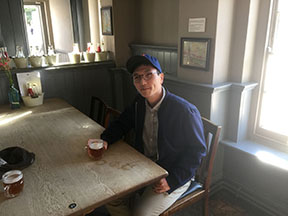
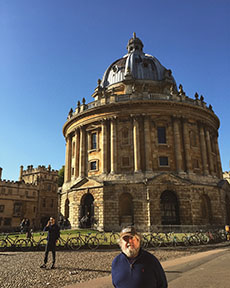
Oxford: Alex really wanted to go back to see his old haunts at Oxford, so last Wednesday we took the train up and spent the day wandering about, seeing his old college and where he had classes, visiting pubs and the like. As I turned out, it was moving in day for freshmen, so we were actually able to get into St. Ann’s College (which is noramlly off-limits) and walk around a bit and take a picture of Alex in front of his old room. St. Ann’s is one of the newest colleges at Oxford and a little outside the center of town, which led to more walking. It is a bit of an architectural hodgepodge and, while it is not really ugly, it lacks the drop-dead gorgeousness of most of Oxford. To make up for that, we walked over to Magdalen College (pronounced “maudlin”) and paid to get in and wander about. It was started in the fifteenth century and is constructed of that lovely honey-colored stone that dominates much of Oxford. What makes Magdalan especially memorable is that within its grounds is a deer park–and not a small one–complete with what looked like several dozen deer, including a large stag off in the distance. There is a tradition, undoubtedly centuries old, that when the monarch visits Oxford, he or she comes to eat at Magdalan College and a deer is killed and served. We also visited the Royal Oak pub (Alex’s favorite from his St. Ann’s days), the Bear Inn (famous for it collection of hundreds of school ties all over the walls and ceilings and which allegedly dates from 1242), and The Eagle and Child (where C.S. Lewis and Tolkien and their buddies drank). We had a wonderful lunch at the scenic Cherwell Boathouse (Great wine list) and dinner at the Turf Tavern (the legendary ancient pub where, among other things, Bill Clinton did not inhale). Throw in a walk to see the music faculty’s building and it was quite a day. According to my iPhone, we walked over 20,000 steps, more than eight miles. Some photos of the day follow:

oxford1   oxford2oxford3   oxford4

Friezing in Regent’s Park: For anyone who has been reading this from the beginning (and thank you for your patience), you may recall that last year at about this time I went to the Frieze Art Fair in Regent’s Park. It is a massive fair of modern art, featuring scores of galleries selling their art in a huge tent that must cover several acres. It was not the greatest idea to go there with aching feet the day after the Oxford trip, but I wanted to see it with Alex and it was fun, if a bit painful to the pedal extremities. There was, once again, some interesting sculptures in Regent’s Park, but the real show was inside. As you walked in there was a sculpture overhead, which you realized, as you got closer, was made of pantyhose. Odd but attractive. One of the early things we went to was a virtual reality work in which you sat on a sculpture of a giant snake, put on a virtual reality mask and found yourself on the snake and surrounded by all sort of weird figures and scenes. That experience alone made the whole visit worthwhile. As was the case last year, there was an awful lot of works which seemed to me to be pointless at best. Maybe I just need to hear the artist’s rap about why this scribble/pile of meaningless junk/splashes of paint are a meaningful reflection of society or whatever. It seemed to me that the ratio of things that I thought were clever/pretty/interesting to just pure crap was lower this year. But there were still some remarkable items. A sinuous, acrylic, wall-mounted sculpture, which refracted light and constantly changed colors as you moved around it. Small clear boxes containing the most intricate tiny sculptures, seemingly made of tiny threads, which turned out to be webs made by tiny spiders. Some interesting exhibits using live people. Some lovely sculptures in various mediums. And on top of all of the art were the people. It was the first day, so a lot of potential buyers were there, in expensive yet casual attire, talking seriously with gallery reps and air kissing each other. It was quite the scene. Some photos follow:

Alex Visits: Art, Spurs and Branagh

Alex has been visiting the past week or so from Philadelphia. So I have been doing a lot a stuff with him and doing less painting and writing and New Unity stuff. I have also been distracted by doctor’s appointments and medical tests about my swollen left leg. It turned out to be blood clots and I am now on blood thinner medication. Not great news, but at least I know what it is and I’m being treated. The only real bad thing is that this means that I cannot fly long distance for three or four weeks, so I am going to miss accompanying Judie on her next big tour of the U.S., which starts in about a week. That trip includes a visit to see Hannah in Olympia, which is the only part of it that I am upset about not doing. Anyway, enough about my health, which I don’t like to write about.

White Hart Lane: White Hart Lane is the name of the stadium where the Tottenham Hot Spurs play. Alex has always wanted to go to a Premier League football (soccer) match and I managed to find tickets on Stub Hub for a game between Tottenham and Manchester City. (All the Premier League games are sold out, at least around London, so it was surprising to get tickets for a game, especially one between two top squads.) Manchester City came into the game undefeated under their new coach, Pep Guardiola, who they lured from Bayern Munich for a gigantic amount of money. (Man City is the richest team in the Premier League and also routinely buys all the best players, so they are a kind of international squad.) Tottenham is also very good, but the Spurs’ best player, Harry Kane, was injured for the match.

White Hart Lane turned out to be a relatively intimate stadium, holding 35,000 or so. It is being replaced by a big, new stadium, which is under construction next to it. I’m sure it makes economic sense and the amenities at the current stadium are a bit primitive, but I’m glad we got to experience what seemed to us to be more of the real thing. One of the things we noticed right away was all of the Korean fans. The Spurs have a forward, Son Heung-Min, who has recently been scoring a lot of big goals, especially with Kane out, and he has become a fan favorite. So there were lots of Korean (and probably other Asian) fans in attendance, many sporting Son jerseys. Our seats were in the corner, right near the goal line and seventeen rows up, so we had a great view of the action at our end, but couldn’t see one of the far corners.

We got there entirely too early since we had to pick up tickets and were expecting a lot more security than there was, but game time finally came and the stands filled up. As the game began, the stadium began singing a Spurs song to the tune of the “Battle Hymn of the Republic”. We were thinking “Isn’t that cool” and then we figured out that we were seated in the part of the stadium where the most lunatic and loyal Tottenham supporters sat. The entire corner of the stadium we were in neither sat down or stopped singing (except to cheer or scream at the ref or the Man City players) for the entire rest of the game. It was deafening. I am certain that the players on the field couldn’t hear each other at all. And the fans didn’t have just one song. They had a whole repertoire and seemed to magically go from song to song in unison. Some were just things like “When the Spurs Go Marching In”, while others were tributes to individually players or the coach. There was a  subset of anti-Arsenal songs and they sang a few. (I assume this is something like Red Sox fans chanting “Yankees suck” even when the Yankees aren’t there.) All the songs were to popular tunes and, when I looked on line, I discovered there are 200 songs in the Tottenham fan’s catalog.. They kept singing the song for the teenage future superstar Dele Alli, since he had a great game, but Son is apparently too new to have his own song yet. (I hope it doesn’t turn out to be racist.) The game was very exciting. The Spurs dominated the favored City squad and won by a very convincing 2-0 score, which might have been worse but they missed a penalty kick. Both teams were in attack mode for the whole game. It appears that is Tottenham’s style and City fell behind early and were under so much pressure that they had to attack. Son is great and, if he isn’t already the biggest deal in Seoul, he will be shortly. In the end,though, it wasn’t the game that I’ll remember. It will be the experience of being surrounded by fans singing and bellowing so loud that it was actually blowing my hair.

spurs1

“The Entertainer”: On Thursday night, we all went to see “The Entertainer”, the final production of Kenneth Branagh’s year-long series of plays at the Garrick Theater in the West End. The play, by John Osborne, may be best know as a vehicle for one of Lawrence Olivier’s greatest performances. It is the story of Archie Rice and his family. Archie is a failing Music Hall entertainer, in a time when the Music Halls are about to die. (There is also a side plot about the war in Suez–it is 1956–involving Archie’s two sons, which demonstrates the parallel Osbourne sees between the collapse of the Empire and the collapse of Music Halls.) As usual with Osborne plays, the characters are desperate and unhappy with a life of trying to make ends meet in an unfair social order. There are a number of scenes set in the Music Hall, in which Branagh is maniacally trying to entertain what you guess is a minuscule crowd, but his joke fall flat and he neither sings or dances all that well. (I suspect it is difficult to play a mediocre talent.) And then in the other scenes at Archie’s flat, the family just tears into each other. Gawn Grainger, who plays Archie’s dad (a legendary Music Hall performer who Archie cannot live up to), was especially memorable. But, typically, the entire ensemble of actors were terrific and it was fun to see Sophie McShera (Daisy in “Downton Abby”) do something very different. Branagh was wonderful, a big personality, gradually being beaten down by the new age and his own failings, but refusing to give up.

Ted and Wallace: Ted Hunter, a UUCM friend of ours, was in town this week. He works at the Arms and Armor section of the Metropolitan Museum in NYC and will become the Armorer for the Met when the current one retires later this year. It was lots of fun to see him and to have few beers at pub. He has encyclopedic knowledge of arms and armor and was in London to give a paper on the subject at a conference and to meet with his brethren in the field. He told us some good stories about armor in Britain. Apparently, the Royal Armor was moved from London to Leeds some time ago, apparently on the theory that it would revitalize tourism there. It hasn’t really, which he thinks is partly due to the fact that Leeds Castle is nowhere near Leeds, so that when people (like him) go to the more famous castle (which is this incredibly beautiful, historic castle, built on an island in Kent, by the town of Leeds), figuring to see the armor, they are disappointed because the armor is in the city of Leeds, in Yorkshire, which is many hours to the North.

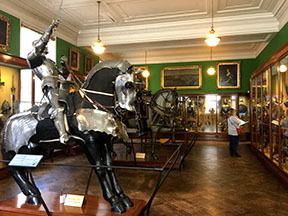
Ted told us that the best armor in London is at The Wallace collection, where I had never been, so Alex and I had a day of art the next day. We started at the Royal Academy to see the Hockney portraits, which I was particularly interested to see again since I had started my own portrait series. I picked up a few things about painting faces, although I also learned that I have no hope in mimicking Hockney’s style which combines unexpected colors in a way I could never hope to do. We dropped by the Abstract Expressionism exhibit too, before walking over to the Wallace Collection to meet Judie. It is housed in a big mansion in Marleybone, once owned by Duke of Hertford (who I think were from the line of Seymours going back centuries and were, in any event rich aristocrats of long-standing). It was an amazing collection of arms and armor (as promised) and each room had several books on reading stands in which you could read more about the individual pieces. Very nice idea. There was also a substantial collection of paintings, including four Rembrandts, “The Laughing Cavalier” by Hals and a number of other impressive works from the 1650-1850 period. It was all accompanied by lots of Louis XIV sort of furniture and decorations and tons of other things that they collected. It is quite a place and you cannot see any of the art or armor anywhere else. When the Duchess of Hertford donated it to the State upon her death in 1897, she stipulated that none of its contents can leave the house.

wallace-coll

I’ll leave the rest to another post. This is getting pretty long….