Myriad Experiences
Judie is off touring America, stopping at various K&L Gates offices, including Boston and Washington, and ending up in Chicago for a conference. When Judie is not around, I have even less order to my life than usual. I tend to eat at odd times and get lost doing projects or watching baseball on my computer. It is actually sort of fun when she is gone for about a week, as she is this time. She returns on Wednesday evening and Alex arrives that morning for an eight-day visit. Alex has finished up with his Every Zip Philadelphia project (which you can see and hear on the WHYY website). It was pretty successful, although I think it was too much management and not enough creativity for him. It wasn’t renewed and he has been hired by Audible to co-produce a multi-part audio series about how Americans experienced World War II at home. He was given a number of books to read and will have access to lots of archive interviews etc. The process of creating his two sections is about to start in earnest, so he is taking this break to visit us.
“There’s no crying in Baseball”: That’s what Tom Hanks’ character memorably said in “A League Their Own”. But it turns out that sometimes there is crying. For some reason, the Mets have been involved in the two most emotionally fraught games in the history of baseball. The first was in 2001, when the Mets played the Braves in the first game played in NYC after 9-11. The atmosphere surrounding the game was incredible and it was punctuated by Mike Piazza’s game-winning home run, the single most dramatic hit I have ever seen and what has to be the highlight of his Hall of Fame career. I thought I would never see another baseball game to compare to that.
Then on Monday night, the Mets visited Miami and the Marlins for the first game after the tragic death of Jose Fernandez, a game that he was actually scheduled to start. Fernandez was incredibly talented, with a simply amazing life story and was supposed to be a wonderful person. There was a very moving opening ceremony, with both teams on the field, which concluded with the Mets players going across the field to hug the Marlins players. Most of the Marlins players were teary-eyed or crying. When they switched to the broadcast booth, Gary Cohen, the main Mets announcer, was so choked up that he could barely talk and Keith Hernandez and Ron Darling were sitting there with conspicuously red eyes. Then, in the bottom the first, Dee Gordon batted right-handed for the first pitch in honor of Fernandez and then switched to his normal side and hit the third pitch for a home run (his first home run of the season and the first time in his career he had hit the ball into the second deck). He was clearly crying as he circled the bases and came back the dugout where he collapsed into the arms of his sobbing teammates. It was just unbelievable on any number of levels. A once in a lifetime baseball moment. Travis d’Arnaud, the Mets catcher, said he was crying watching Gordon round the bases and I doubt he was alone in that. There is crying in baseball after all.
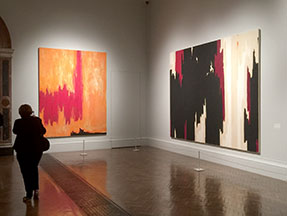
Abstract Expressionism: On Saturday evening, I went to a members’ private tour and party celebrating the opening of the Abstract Expressionism exhibit at the Royal Academy. As our guide/docent pointed out, the name is a bit deceiving, because many of the artists’ styles were neither abstract or impressionistic. It is sometimes called the New York School and NYC certainly became the center of the art world in that period, but many of the artists did not live or paint in NY. Tragedy was one theme as some of the most important artists died young, from suicide (Gorky and Rothko) to car accidents (Pollack). As you might imagine, there were some iconic paintings. There were some great Pollacks, including one huge early one he did on commission for Peggy Guggenheim’s apartment which was a breakthrough moment in that era. And there were great examples from Gorky, Klein, de Kooning (his series of paintings of women were amazing), Rothko (the early works were fascinating), Motherwell and Krasner (a highlight was the first painting she did after Pollack’s death). It was a wonderful exhibit and it was nice to have plenty of time to go back and wander through it after the tour, without being bothered by the usual crowds. For me, the great revelation was Clyfford Still. He became disgusted by the commercialism of the NY art scene and moved to Wyoming, where he painted the rest of his life. He sold practically nothing while he was alive, but now his work is in a museum in Denver, which I have to visit some time. There was a huge gallery of his work, which was breathtaking. See below for an example. There was also a party with a free champagne cocktail and a bar and a jazz singer, so it was all very festive, although I would have had more fun if I’d found someone to go with.
Immigration Detention Seminar: On Monday evening, I went to a meeting at the offices of Amnesty International (which it turns out is about four blocks from our flat) for a conference about the alternatives to Immigration Detention and role of civil society in making those alternatives happen. It was run by an organization called Detention Action. The audience seemed to be mostly immigration insiders–lawyers, advocates, NGO people and a sprinkling of government officials. It was too bad in a way, because some of the speakers were very interesting and for real reform to occur, they are going to need the support of a much wider group. There was a woman who is one of the leading immigration advocates in the Ukraine and, as you might imagine, they have some problems there that are hard to imagine, such as millions of displaced Ukrainians to deal with, in addition to all of the migrants, most of whom are really trying to get to Germany or somewhere. And there was a representative of Freed Voices, a group of former detainees, who spoke very movingly about how de-humanizing detention is and that there is no trust. I was given a big report, which I’m going to read.
Labour Conference: Jeremy : won his election by a landslide and this was followed by a Labour Conference in Liverpool in which the party tried to unify and to explain what they want to do. To me, what was most interesting about the process was the fact that the party out of government actually laid out a fairly detailed program. They take the whole idea of a party platform much more seriously here. It really is a nice political concept, where the opposition party must have a formal “shadow” government which says, with some specifics, what they would do if they were in power. The other nice thing about this system is that the BBC and the media in general (although maybe not the Murdoch press) really give deep coverage these kind of policy matters and engage in a real discussion and questioning about what the party is saying. It is a level of substantive and detailed analysis that is utterly absent in the American media (except on PBS and NPR to some extent). There are a lot of problems with the British system, but they really take politics and the issues much more seriously here, from Question Time to the Shadow Cabinet system to the media coverage.


 nickinshoreditch