O’Keeffe, Stones and New York

Georgia on My Mind: I finally went to the newly expanded Tatre Modern and I am now thinking a lot about Georgia O’Keeffe. As I walked through the amazing exhibit of her art from 1915 through the 1960s at Tate Modern, I kept thinking about how I could try to adopt some portions of her style to what I am trying to paint. I’ve already started playing around with this idea and have a half finished painting in the kitchen. I really need to go the museums more often. It so often leads to inspiration.

O-Keffe

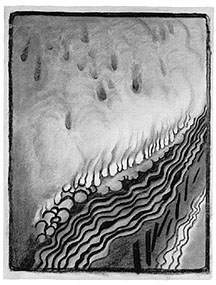
Other than the art itself, the highlight of the exhibit for me was learning more of O’Keeffe’s amazing life story. She knew she wanted to be an artist at the age of 12 and in 1915 she was teaching art in South Carolina and creating charcoal drawings. She sent some of them to her friend Anita Pollitzer in New York, one of her fellow art students, who she had been corresponding with about the art scene there. Pollitzer decided to show the drawings to Alfred Stieglitz, the famous photographer who also ran the most influential, avant-garde gallery in NYC. Stieglitz was blown away and contacted O’Keeffe immediately, starting a professional relationship, love affair and marriage that would last until his death in the mid 1940s. Her charcoal drawings were included in a group exhibit at his gallery in 1916 and she was on her way. (The one below was one of them and was an attempt to express the feeling of a headache.) The first room of the Tate exhibition included both the O’Keeffe’s charcoal drawings that were at that first exhibition and Stieglitz’s photos of the exhibition itself and the room was designed to mimic the original exhibition space you saw in the photos.
O-Keeffe charcoal

This sort of attention to detail continued throughout the exhibit. In the room highlighting O’Keeffe’s New York phase, for example, they had not only her iconic paintings looking down on Manhattan from the 30th floor of the hotel where she lived with Stieglitz but also the photos that he had taken of the same views. Her paintings in New Mexico were accompanied by photos of the same vistas by Ansel Adams, who was often her traveling companion. (Stieglitz decided that New Mexico was O’Keeffe’s place and not his and mostly stayed in New York for her visits to Ghosts Ranch.) The exhibit did what I think a really great artist’s retrospective has to do. It contained numerous examples of her art over the years, including some of her most iconic works. And it also gave you an idea of what Georgia O’Keeffe was like and what drove her to paint in the way that she did. I’ve always loved her work and now I know why.

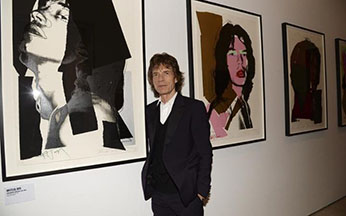
It’s Only Rock and Roll, but I Like It: On Thursday afternoon, Judie (who really needed a break from the law firm move stuff) and I went to the Saatchi Gallery near Sloane Square to see an exhibit celebrating the Rolling Stones. It had been curated with a lot of input from Mick and Keith (and maybe some of the others) and was a remarkable look back at their career. The Stones appear to have had an unusual sort of self-awareness about what they were doing and saved a huge amount of material over the years. The entire archive must be overwhelming. There were big sections about their music and their extensive studio work in recording (and creating) their music, which actually runs somewhat counter to their image as one of the greatest concert bands ever. In a way, what was even more interesting was how involved they were in all of the design elements of their tours, albums and performances. So there were samples and stories about the creation of their album covers and tour posters and the original designs and samples for the lips and tongue logo. There was a large section about what they wore when performing, with fashion designers and Mick and Keith talking about the various phases they experienced, all accompanied by the actual clothing and videos of them performing while wearing it. There was a period where they were very tight with Andy Warhol, who designed album covers like “Sticky Fingers” and also did a series of striking portraits, which were there of course. And one of the odder parts of the whole exhibit was a recreation of the flat where four of them lived around 1962, when they were all about 20 or so. It was a spectacular mess. The whole thing was very creative and detailed and a real visual and aural treat. It ended with a 3D video of the Stones performing “Satisfaction”. These guys were more than just a great rock and roll band. They were artists. The exhibit moves the New York in November.
Stones

“New York, New York”: We’ve been here eleven months now, which is past the halfway point of our stay. I am already starting to anticipate our return and have been feeling a bit sad and nostalgic about the idea of leaving London. At some point, I think I will write a post about all of the things I am going to miss about living here. I’ve even pondered the idea of staying for an extra month or two. Then last night, Judie was playing the Jonathan Schwartz Show (from WNYC) on the Internet and Frank Sinatra came on, signing “New York, New York”. This instantly brought back memories of being at Shea Stadium in 1986. The Mets had just won the World Series and the Mets played that song (which they didn’t usually do) and over 50,000 people (including us) roared along at the top of our lungs. It is the ultimate song about New York (and Frank sings it better than anyone). It really reflects how New Yorkers view their city with the lines like “if you can make it here, you can make it anywhere” (actually like London) and “a city that never sleeps” (unlike London). My little town blues melted away and I realized how much I am looking forward to returning home.

Back in the USA: On Sunday, Judie and I return to America for a little over two weeks. Judie will be visiting her mother in North Carolina, going to a conference in San Francisco (her first appearance as a K& L Gates attorney) and then coming back for “Sister’s Weekend”, our annual family reunion in the Catskills. I’ll be mainly hanging out in Montclair, going to a Mets game, playing a little golf and spending the weekends in Liberty. We extended our stay by a day or two so that we could celebrate Hannah’s 20th birthday with her and we will be going to Philadelphia to visit Alex and Lucy and see their new apartment. Finally, we will hopefully be able to get our new visas, since our current ones are through Bryan Cave and expire when Judie leaves the firm. K&L Gates will have a boutique immigration law firm helping us and will pay for expedited service and says it can be done. The new visa will only be good for six months, which only gets us to early February of next year, over a month before our tenants leave our house. We’ll cross that bridge when we come to it. So we’ll be seeing some of you soon. My pace of blogging will probably slow or even stop during this period.

Cursed to live in Interesting Times

It is said that there is an old Chinese curse: “May you live in interesting times.” I am feeling particularly cursed right now. In addition to the current Brexit soap opera and the implosion of the British parties, there is the Hilary/Trump horror show and an incipient race war. And if that wasn’t enough to make me crazy, there was the terrible attack in Nice followed immediately by the wild night of the attempted coup in Turkey. I thought about lighting a candle at New Unity on Sunday hoping for a week without news. But with the party conventions approaching in America and the Labour Party here sharpening their swords in preparation for hari kari, I am probably hoping in vain.

Judie’s Big News: Speaking of interesting times, one the things that has made the last couple of months extra interesting is that Judie has been exploring the possibility of leaving Bryan Cave, her law firm for the past eleven years. Well, the exploration is over. Judie is leaving Bryan Cave and moving the K&L Gates, another huge multinational law firm. Judie just told the people in the BC London office and they were predictably very nice and understanding about it. It is a very long story that Judie should tell, but, basically, BC had stopped appreciating her. It is a wonderful law firm and was the perfect firm for Judie in mnost ways over the past decade.But now, she needed a firm that could better deal with the kind of tech companies and startups that seek her out. K&L Gates seems to fit her practice much better than the current BC. (The Gates in the name is from a Seattle-based firm that was absorbed into the legal conglomerate. He was a named partner whose son got very involved in the computer industry. You may have heard of him.) The next month or two may be a bit chaotic and bumpy (“interesting”), but this was a move that needed to be made unless Judie wanted to simply coast into retirement. It doesn’t affect our London stay.

George: This bit of news in “interesting” in its worst sense. George Griggs is someone I’ve known since the fall of 1970. We have kept up over the years, talk on the phone and see each other and our families periodically. We are close friends. We hadn’t heard from him for a while and since we are going to be back in the US for two weeks pretty soon, Judie sent him a note asking if he was around. When he wrote back, he revealed that he had some kind of weird cancer in and around his eye. He recently underwent an operation which removed one eye, leaving him somewhat disfigured. This is shocking and distressing news for me and for our many mutual friends. I have so many memories about him, which I’d relate but I don’t want to make this sound like a eulogy, since he is very much alive and hopefully cancer-free now. But I am shaken.

Back to Lords: I wouldn’t have predicted or believed this, but I ended up going to a second day of the Test Match. One of Judie’s partners had access to an extra pair of unused tickets. I thought that they might be in the pavilion area, which would have been truly fun, but it turned out that they were in the in the first row of the upper grandstand. Much better seats, if for no other reason than they were in the sun and it was a beautiful summer day. We were surrounded by people drinking champagne and eating sandwiches as I tried to explain what was going on to Judie and our neighbors filled in some of the gaps in my knowledge. Behind us we two gents with those sort of landed gentry accents that comedians make fun of. They were wearing the orangish and yellowish Lords ties and spent the day talking about hunting, real estate, the “good chaps” they knew in powerful positions, their cricket memories and other things that the upper crust types discuss over the course of a long afternoon. Listening to them was like being upstairs in Downton Abbey with Lord Grantham. The cricket was spectacularly cricket-like. There was one stretch of well over an hour in which Pakistan, who were now batting again, made absolutely no effort to score a run, just tapping balls into the ground or letting them pass. I imagine that there was some kind of strategy involved, but it escapes me. It didn’t seem to work that well because Pakistan didn’t appear to have added enough to their first inning lead, giving England a real chance to win the match when they ended up batting the next day. But the English batters crashed and burned and didn’t even make it to the fifth day. The television commentators were disgusted.

Abbey Road: We left a little early and went out the back of the Cricket Grounds and walked down Groves End Road to the intersection of Abbey Road, where the Abbey Road Studios are located. There was the street crossing from the Beatles album with lots of people walking across the crosswalk and taking each others pictures. We of course did the same and the photos are below. I can’t imagine why anyone would want to drive down Abbey Road since traffic was backed up due the constant pedestrian crossings, which made it tricky to get a good picture.


Cricket, Boris and Hips

My Sweet Lords: On Thursday, I went to Lords Cricket Ground. It bills itself as the home of cricket and is to cricket what St. Andrews is to golf. (If that analogy means nothing to you, feel free to skip ahead.) It seemed like something that I really had to do since I understand cricket from my days in Australia and appreciate it on a certain level. Lords is in St. Johns Wood, which is an inner suburb of London and therefore incredibly easy to reach. I went to see a Test Match between England and Pakistan (which was actually sold out, so I had to buy tickets on line.) Since it was a Test Match, play began at 11:00 and went to 6:30, with breaks for lunch and tea. I only saw the first day of the match, which will go on for four (!!) more days. Pakistan was up first and it was looking good for England, who captured their fourth wicket just after lunch, leaving Pakistan at 134 for 4, with four of their five top batters out. But England didn’t pick up another wicket for four hours as two guys you’ve never heard of put together a 150 run partnership. England picket up two more wickets right before the end of play of the day to turn things back slightly in their favor. I won’t subject you to any more cricket talk.

Lords consists of an old pavilion which is for members only and big new grandstands. Paul Jee, who I went with, told me that his brother-in-law tried to join and was on the waiting list for 28 years. If you do become a member, you get to wear a hideous mustard yellow and reddish burgundy colored striped blazer and sit in the Pavilion with the other members, who must all wear a jacket and tie. The remainder of the stands (where I sat with the rest of the hoi polloi) are relatively modern and are surrounded by bars and food stands. But almost everyone appeared to have brought their own food and drink. Indeed, when I got on the Jubilee tube line to St. John’s Wood, it seemed like every other person had a cooler or back pack or both. Drinking and eating are an important part of the experience, since so little actually happens on the field. It is much more boring than watching cricket on TV, where you don’t really have to pay that much attention. But when you are there and it is live, you end up watching it and nothing much happens. Unlike baseball, which at least has an occasional pivotal moment (3 and 2, 2 outs, runners moving or stud pitcher vs. big slugger with men on), Test cricket has no moments. Here is a typical bit of action: the bowler (pitcher) runs about 100 feet and finally hurls the ball towards the batter, who just taps it into the ground and doesn’t move (he doesn’t have to). Someone picks it up and tosses it to another guy who spends 15-20 seconds rubbing the ball against his leg. He then passes it to another guy, who passes it to another guy, who finally gives it to the bowler who is walking back to begin his run up again. This whole process takes at least two minutes. Then you repeat it. Endlessly. They were supposed to play 90 overs (which each consist of six pitches), but they couldn’t complete them by 6:00, so they were given an extra thirty minutes and still couldn’t finish. There is always tomorrow and the next day and the day after that…. It is really more of a social even than a sporting event. Everyone just sits around chatting and drinking and eating.

You might think why would anyone watch this? Well, it was filled to capacity (which is 30,000–I looked it up) and nobody left, except to go to the bars or the Veuve Clicquot tent. It is really a sport for a much earlier time, with its languid pace, and provides an excuse to drink all day. So while it isn’t a compelling sport to watch, being there for a day is incredibly British and oddly entertaining. (But you’d have to be lunatic to go to all five days.) It is clearly not a sport designed for the working classes, who would never have had the opportunity to take a day off to sit around and watch twenty-two guys all dressed in white play this obscure game.

Boris is Back: The ashes of his most recent flame out were still smoldering, when the phoenix named Boris emerged to become the nation’s Foreign Secretary. It was a kind of stunning move by Theresa May. Assuming that Boris does not undergo a personality change, why would she put such an undiplomatic person in the position of Britain’s main diplomat? Some theories:

  • It was a part of her overall strategy to put the Brexiteer leaders in charge of trying to work out how Britain will leave the EU. If it all goes badly, as it probably will, she will be able to point to these appointments and say that she took Brexit seriously and tried to make it work and try to blame it all on them. Boris was the face of the Brexit camp and fits this theory. Since she reportedly hates Michael Gove, who is toxic right now after his betrayal of Boris anyway, Boris was the choice.
  • Boris is the most (some would say only) charismatic leader among the Conservatives and would not have let his recent fall from grace make him shut up. She probably thought that it is better to have Boris inside the tent pissing out than outside the tent pissing in.
  • May is pretty boring, especially compared to Cameron, who, for all of his many faults, really can be quite funny and entertaining. Someone has to entertain the masses and the Murdoch readers and Boris is the perfect guy to do that. He is a wonderful clown and could be a useful distraction.
  • It gets Boris out of the country for long periods of time.
  • If Boris turns out to be great at the job, which is not impossible since he is a smart person, she gets the credit for appreciating his potential to grow up. If he crashes and burns, she can just fire him and the rest of can wait and see if he rises up yet again.

Hip, Hip Hooray?: Judie and I joined a health club last week. Its claim to fame is that when it first opened its doors to women, a very young Diana Spencer joined before leaving for a bigger role. My hips have been killing me and my physiotherapist recommended a series of exercises. Of course, now not just my hips, but all of the other muscles in my legs hurt as I finally exercise for the first time in over a year (other than lots of walking).


A New Painting and Political News

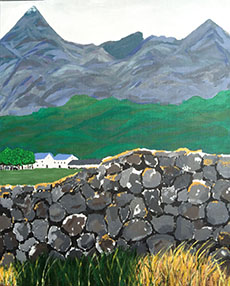
New Painting: I feel like I often struggle with paintings, trying to fine tune them and seeking a look that I sometimes cannot quite accomplish. I find myself stuck sometimes. The result is that I don’t seem to be able to paint some thing in a smooth, step-by-step sort of way. I marvel at artists who can just sit down and bang outa painting. But my most recent painting was a bit different. I picked out the picture and the painting just emerged bit by bit. As you can see, it is really four stripes, and I did them one by one, but what was nice was that each of them emerged relatively effortlessly, although each took a bit of time. Maybe it is a sign that my technique is improving. The painting is of a view during a walk on the Isle of Skye. It doesn’t quite capture the beauty of the Isle of Skye (and the photo of the painting isn’t that great), but I like it.

Skye Painting

Britain is Stumbling Towards Something: It is all bizarre, but it seems like it might be coming to some sort of an end. It is at least an end from the Conservatives point of view. Of course, I’ve been thinking this for the past three weeks and some new convulsion has always followed. Indeed, Labour now seems to descending into its own internecine fighting and a really ugly fight.

Conservatives: The internal war in the Conservative Party has really been going all year. The whole Brexit referendum was really about the split in the Conservative Party and Cameron’s desire to get the Eurosceptics to finally shut up. Well, that didn’t work very well, did it? The ugliness in the Brexit campaign was all from the Conservative’s side (and the utterly creepy Neil Farrage of UKIP, of course), so it was inevitable that retribution would follow the vote. What was kind of surprising was that the bloodletting did not occur behind closed doors but, instead, were spectacular public executions. Now, somehow or other (and if you want to assume that there was some sort of back room conspiracy here, you would not be alone), the Tories decided that nine weeks of inevitably nasty campaigning to choose the next PM would just prolong the agony, so Andrea Leadsom decided (was forced?) to fall on her sword and withdraw, leaving us with Theresa May as an unelected PM. This is probably about as good a result as was possible under the circumstances. May is experienced and reputedly tough. She is certainly right wing, without being too far right. A Conservative election would have forced her to say what she believed and wants to accomplish as PM, so this sudden ascension leaves some mystery about what Britain is really getting. But in the short term at least, Britain does get some semblance of stability, which it desperately needs. In the longer run, May is probably doomed to failure since there is really no way to negotiate an exit from the EU that doesn’t make huge parts of the population massively unhappy. She will either have to give in on immigration and agree to freedom of movement to get free access to the market or protect the borders and cause a recession. She can’t win. But it will take a while for it all to happen and at least the appearance of a firm hand at the wheel might keep the pound from sinking to parity with the dollar by year’s end, as some predict. As I finish this post, May is meeting with the Queen, in the antiquated ceremony in which the Queen asks her to form a new government.

Labour: What a mess! Angela Eagle decided to announce her challenge to Jeremy Corbyn on Monday morning. It is unlikely that the Conservatives did it on purpose (but if they did it was really Machiavellian), but Leadsom gave her surprise announcement withdrawing from the race at the exact same time, effectively preempting Eagle and Labour’s moment. Corbyn has showed no inclination to do anything other than fight this, so a major Labour fight is now in the offing, with a permanent party split or breakup looking somewhere between possible and inevitable. The big immediate question was whether Corbyn needed the support of 51 Labour MPs to run or would he allowed be to run automatically as the challenged leader. Labour’s rules aren’t clear but they ultimately decide to let Corby run automatically. There is still a chance of litigation challenging this. While the sitting Labour MPs are largely united in their contempt for Corbyn as a leader, they also are worried that Corbyn would win any vote of the huge and growing Labour membership. It is hard to predict the outcome of all of this. It does seem likely that the supporters of this challenge will eventually be challenged themselves by Corbynistas. Eagle’s offices have been attacked and the Corbyn people are already plotting to get her constiutency to attack her with a vote of no confidence. The anti-Corbyn MPs are getting death threats. I do think Corbyn means well, but he thinks he is leading a movement rather than a political party and doesn’t completely control that movement. He doesn’t seem concerned about the possibility of an election. So you can see why the sitting MPs, looking at potential electoral slaughter and without a leader who seems cognizant of his political role, are fed up. But the left wing movement people love Corbyn and regard the PMs concerns as treason. So just as the Conservatives have gotten together behind May, Labour appears to be in absolute chaos. It is all really a shame because Britain really could use an effective party to counter the Conservatives.

Flowers, Franklin and Politics

Hampton Court Flower Show: When you consider that we have not been especially avid gardeners, it may seem odd that we have been to two flower shows in about five weeks. They just seem like very English things to do. I do think that many British people are very caught up by their gardens, although I wonder if this might be a class thing, since you have to have some money to have a place to have a garden. This flower show one was next to Hampton Court Place but not actually on the grounds of the palace or the extensive palace gardens. (The palace was originally built by Cardinal Wolsey in 1515. He gave it Henry VIII to try to forestall the inevitable when he lost favor in the whole Anne Boleyn controversy. But it only gained him a brief reprieve. Henry and later monarchs did many renovations and expansions, so it is a bit of a hodgepodge of styles. The last monarch the actually use it was George II. We’ll have to go back and visit the palace sometime.)

I think I enjoyed this show more than the Chelsea Flower Show that we attended with Robbie and Bob in late May, mainly because it was less crowded. The area dedicated to this show is much larger and we went on the first day, which I think is limited to Royal Horticultural Society members. It just wasn’t such a mob scene and it was easier to see and get refreshments, etc. And, finally, it was a lovely summer day, with sun and temperatures in the low to mid 70s. Portions of the flower show are aimed at selling you plants and every sort of garden thing you can imagine from tools to outdoor furniture to incredible sheds to garden sculptures of all sizes. Of course, we have no use for any of that in London, although it gave us something to think about for Montclair next year. So the main thing we did was look at all of the various sample gardens. Some were silly and some would be so expensive to recreate that they weren’t much use. But a number were very nice and gave us images of what we might do in Montclair when we return next year.

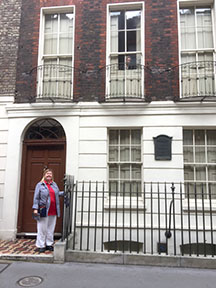
Fourth of July: It is obviously not a holiday at all here (although we did see some fireworks from the terrace of our flat that night for some reason). We decided that we ought to do something to mark the occasion, so we went to Ben Franklin’s house. It is part of an 18th century development of Georgian row houses near to Charring Cross Station and Trafalgar Square. They claim that it is the only standing house where Franklin lived. He lived there from 1757 to 1775, leaving when he was basically deported for treasonous acts against England. (He left his wife in Philadelphia the whole time, as she was afraid of sea travel, and never saw her again.) While he was there, he represented various American interests and was eventually the de facto American ambassador. He also did a variety of scientific experiments and met with thinkers in England and around Europe. He is said to have run up and down the stairs of the house carrying weights, attempting to figure out the relationship of exercise to heart rate. He also designed the lightning rod that was used for St. Paul’s (winning a contest). It remained on the Cathedral until the early 1900s, when it was destroyed by a large lighting strike! While at this house, he also invented the Armonica in 1761. This is an instrument based on the sound you get when you rub the edge of a crystal glass. It had a series of bowls on a spindle attached to a treadle, which turned the bowls. It was easier to play that glasses filled with water and more precisely tuned. It became so popular that composers such as Mozart,Beethoven and Strauss wrote pieces specifically for it. The house had one (refitted with an electric motor) that we could play.

The house itself was a boarding house in Franklin’s day and later became a small hotel after the nearby train station was built. The windows were all blown out in the blitz, but the place was not hit. At points it was derelict and abandoned and home to squatters who removed and sold all the marble fireplaces but one. But other than that and a few Victorian additions from when it was a hotel, the building is essentially unchanged from when Franklin lived there. He lived in one large room on the second floor, overlooking the street. The place has the Franklin stove that would have been in his room, but it is too heavy to put on the old floors. (The house is leaning over a bit as it is.) The other tenant in the building, other than the landlady, was a famous anatomist who ran a small school and dissected bodies. This meant that the house had to be visited by grave robbers in the middle of the night, since that was the only way to get cadavers that the time. It is easy to imagine Franklin seeing the bodies being brought in and going downstairs to watch or participate in the dissections. When the house was bought and renovated for the museum in the 1990s, thousands of bits of bones were dug up from the back garden, representing at least 20 bodies.

Ben Franklins House 5

British Political Update: The pace has slowed, as it had to. The bombshell-a-day politics after the Brexit vote couldn’t possibly continue. This doesn’t mean that things will turn out well. It is simply going to take time for the inevitable to happen, which I suppose gives one hope that cooler heads will prevail and that somehitng might be worked out over the next two or more years that won’t be as bad as the impact of leaving the EU looks right now. In the meantime, Nigel Farage, the detestable head of the UKIP party, announced his resignation, saying that he had accomplished all that wanted by getting Britain out of the EU. He promised to stay around in his role as a member of the European Parliament (it is hard to imagine anyone worse for that position) to make sure that Britain actually leaves.

The other two parties continue to try find their way. Corbyn is stubbornly hanging on as Labour Party leader, although he has utterly lost the support of the vast majority of Labour MPs. He clearly thinks that he retains the support of the rank and file and would survive a challenge. There is some speculation in the press that his support is weakening among the members and that the unions are fed up with him, but no one really knows. There was one theory that he was waiting for the Chilcott Report on Blair and the Iraq War to come out so that he could denounce Blair in Parliament as a war criminal and then resign. But that turned out to be wishful thinking by those who want him gone. Labour really needs a resolution to all of this since they are just getting increasingly weak and divided. If Corbyn remains in place, the Conservative would have to be tempted to call an election, which could be very bad for Labour’s very future.

On the Conservative side, the party members are going to get to choose between Theresa May and Andrea Leadsom, now that the other Tory MPs have expressed their distaste for Michael Gove, who seems to be viewed as a psychotic Machiavellian figure now. (It is possible that Boris may ultimately come out ahead of Gove in this whole political drama. He retains some support and is still the only really charismatic Tory figure. And he will miss all of the mess surrounding the Brexit negotiations, which will inevitably tarnish the next PM.) As for the near future, Theresa May is clearly competent and experienced. She is somewhere in the Cameron wing of the party, which means that she is a “compassionate conservative” who seems to favor all of the usual conservative economic dogma without being Neanderthal on social issues. She reminds a lot of people of Thatcher, which is a little scary. Andrea Leadsom, on the other hand,  is a bit of an unknown. She was an important figure in the Brexit movement, which is really her main claim to fame in this vote and has gotten her support from the big Eurosceptics. She is much further to the right than May, as far as I can tell. She has been stressing the fact that she is a mother (clearly trying to disparage the childless May) and can therefore be trusted somehow. But she has also come out against marriage equality and rights for pregnant women. It sounds like the majority of the country is hoping that May wins, but it isn’t up to the country. It is up to 130-150,000 Conservative party members, who are old and white and male. It is far from impossible that that group could pick Leadsom.

Of course, this all seems like a Gilbert and Sullivan operetta compared the mayhem taking place in the US. Between Trump, the collapse of the Republican Party, the utter dysfunction of the system of government, the revival of racism and police violence and the worsening gun violence (if that is possible), America is looking pretty horrifying from this distance.

Two Plays, Wales(!!) and more

The best theater experiences for me are when you go to see something with no real expectations that you are going to see something special and find yourself watching a lovely gem, something that you could only see in a theater. This happened to us on consecutive nights this week.

“Flying Lovers of Vitebsk”: I bought these tickets simply because a play about Marc Chagall sounded like ti might be fun. It was staged at the Sam Wanamaker Playhouse, a part of the Globe Theatre complex. (Wanamaker was the force behind the building of the Globe and this Playhouse is a miniature version of the Globe. I like it better.) The play was a magical little gem. It is a small scale production with two actors and two musicians who occasionally pop up in a scene. Marc Antolin, who played Chagall, had an innocence and grace that reminded me of Chaplin, or Keaton or Harold Lloyd. I think this connection was because of his look and the fact that he acted with his whole body, as his performance combined acting, singing and dancing. Audrey Brisson, who played Bella Chagall, was a combination of Helena Bonham Carter and a Cirque de Soleil dancer, with a lovely singing voice. Together, they were great. The play, with combines the prose with singing and dancing was about the loving relationship between Marc and Bella. But it was more than just a love story. It was also about Chagall’s obsession with his painting and career (which had some ups and downs until he left Russia) and Bella’s desire to fill her artistic potential through writing. And it is about anti-semitism, first from the tsar, then from the Bolsheviks. And it was also about the small, market town of Vitebsk. When Marc and Bella were growing up in the early 1900s, there had “sixty synagogues and two churches”. By the end of World War II, it had been utterly destroyed along with Jewish culture. Bella wrote a book about Vitebsk and I’d guess that much of this piece was based on that. It drew you in to these two remarkable characters and the special world in which they tried to live. Memorable.

“Three Penny Opera”: The next night, we went to the National Theatre to see Three Penny Opera. I bought these tickets just because it was the National Theatre doing it, but our one experience seeing the show (with Alan Cummings and Cyndi Lauper as I recall) was so underwhelming that I cannot recall a single thing about it. Not this time. I have been trying to figure out what made this production so wonderful. I think perhaps the main thing is that it had a tremendous new adaptation by Simon Stephens, who is probably best known for “The Curious Incident of the Dog in the Night-Time”. It also boasted a very clever production with an interesting way of moving the flats on the set. The music used the band as part of the play itself at points. The ensemble cast was typically great.  (The big name in the cast is Rory Kinnear, who played Macheath (Mac the Knife) and was compelling.) It is unfair to pick out anyone in the cast since there were no bad performances, but Nick Holder as a truly slimy and bizarre Mr. Peachum and Haydn Gwynne as awful and destructive Mrs. Peachum were especially memorable. The whole production had a dark and very creepy tone and the feeling that something horrible was about to happen. It made a point of its cynicism about society inherent in the play and even related it slightly to the whole mess currently taking place in Britain. The Brecht/Weil duo didn’t write catchy tunes, except “Mac the Knife” of course, but the songs fit into the plot and were rather Sondheim-like in nature. I have an entirely new appreciation for the genius of Brecht and Weil as a result of this evening, which, unlike the prior version I saw, I won’t soon forget.

Wales: As you may or may not know, Wales beat Belgium the other day to reach the semi-finals of the European Cup. This was no minor victory, since Belgium was ranked #2 in the world and Wales had basically  never won any game of consequence since pretty much forever. The fact that they have advanced, while England was humiliated by Iceland has to make it all the more sweet for the Welsh. All of Wales is apparently on cloud nine and all the Welsh are suddenly football fans. And it is not a fluke. They play very well together and have some extremely good players and one great player in Gareth Bale. They have real chance to beat Portugal in the semi-finals. Portugal probably has more talent and features Ronaldo, but they have not played well as a team yet and have only barely made it this far. It would be nice if Wales can keep going, if for no other reason than to distract people from the ongoing mess that the British have created for themselves.

Miscellaneous Thoughts: In no special order:

  • It is tempting to feel sorry for Boris Johnson and his betrayal by Michael Gove, killing his dream to be Prime Minister. But he dragged Britain into a gigantic disaster, largely thinking about his own political career, without having any real idea of what he would do if Brexit won. If you are still in doubt that Boris is a jerk, read this article from the Guardian.
  • The whole Brexit run-up and result seem to have encouraged racist louts and given them a feeling of free rein to engage in contemptible behavior. Racist incidents are up by as much as 500% according to some reports. It is the same phenomena that makes some Trump supporters feel free to engage in misogynist. homophobic and racist activity. This week, racist and xenophobic graffiti appeared on a small building in Newington Green, across the street from New Unity. We tried to figure out what to do and I suggested that we go and paint over it with something about love, but that wasn’t practical, of course. So we ended up creating a banner out of bed sheet with the message “Wherever You Come From, You Are Welcome Here”, which is how Andy starts our services. After the service today, everyone who wanted joined in writing messages on it and in coloring the letters. It was nice response, I thought. See below:
  • You may remember that moment earlier this year when Christie destroyed Rubio in a debate, effectively ending Rubio’s chance of being nominated but also killing his own chances. The same thing appears to have happened to Gove. His betrayal of Boris is looking like a murder/suicide.
  • I tried painting out on the terrace of our flat today. Great light but too much wind. I’ll have to take another shot, but for now, it is back to the kitchen table.
  • It is Sunday, which means that I could actually watch a Mets game. I’m basically limited to Sundays and an occasional Saturday or holiday, since I can’t see staying up until the middle of the night on a regular season game. I do miss Gary, Keith and Ronnie though. It doesn’t feel like summer with out them. Of course, it hasn’t felt much like summer here anyway…. The Metsies have been hanging in there, mainly due to their pitching, without really playing especially well. The should have at least one or two hot streaks in them. If so, they still seem like a playoff team to me. If they keep playing as they have been, they will play meaningful games in September (which is all I ever ask for) and will be close to making the post-season.

Liverpool

On Monday and Tuesday of this week, Judie and I visited Liverpool (she had a conference). I wasn’t expecting much, other than some Beatles stuff. I was expecting to visit a run-down and grubby, kind of depressing old port city. I was pleasantly surprised.

Some Liverpool History: It was formally founded in the early 1200s by King John (of Magna Carta fame) to give him a port for his invasion of Ireland. As our Beatles guide pointed out, this ultimately backfired, as the Irish ended up invading Liverpool as the result of famines, etc. There are more Irish in Liverpool than any city other than Dublin.

The key moment in Liverpool history was when they figured out that, by installing locks in their docks, they could keep the water level high, despite the huge tidal changes in the harbor, making the harbor much more efficient. They eventually built miles and miles of docks, all connected by an elevated railway. It was some impressive engineering. The other thing that helped Liverpool is that it was the closest English port to the New World as well as the new manufacturing and production centers of the nascent Industrial Revolution. This combination led to Liverpool becoming the center of the slave trade from the 1700s until it was finally outlawed in the early 1800s. The boats would be loaded in Liverpool with goods to trade in Africa for slaves, who were transported to various parts of the New World and traded for things like sugar and cotton, which were brought back to Liverpool and sold. The cotton would be sent out to nearby mills and the cloth then sold. Liverpool became an enormous trading center and very rich.

The rich people in Liverpool did what rich people do. They built huge ostentatious buildings. As a result, Liverpool has an amazing collection of 18th and 19th century architecture. And this is just what survived the German bombing in World War II. As an important port and industrial center, Liverpool was a target and suffered extensive damage. But what really destroyed Liverpool was the advent of container ships. They made the old dock system obsolete and eliminated the need for longshoremen and everyone else connected with unloading ships and storing the cargo. (The identical thing happened in New York City.) The unions fought this, but it was a losing battle and Liverpool suffered greatly. It has made a relative comeback. The downtown area is fixed up with museums along the water and the few remaining docks renovated to be tourist destinations with cafes and shops. There are nice restaurants and new hotels. And there is all of that great old architecture. It makes for a nice city to visit, although I wonder if the underlying economy is going that well. I’d guess that globalization has passed a lot of its residents by. The communities surrounding Liverpool all voted to leave the EU.

While I was there, I went to the Tate Museum’s Liverpool Annex and saw a good exhibit of the work of Francis Bacon and Maria Lassnig. There was a Museum of Slavery, which I guess is an effort to atone for the past and was nicely done. And I went to the Maritime Museum, which had big exhibits about the Titanic and the Lusitania. (The Titanic was actually built in Northern Ireland and never docked inLiverpool. But since it was owned and operated by the White Star Line, which like Cunard and other ship lines was headquartered in Liverpool, it went down with Liverpool painted under its name.)

Beatles: The big interest for us in going to Liverpool was to do the Beatles tour. It is really a kind of industry there, with a museum at the Albert Dock, countless shops selling Beatles stuff and various tours available. I’d guess that this is an industry with a shelf life, as I wonder if future generations will have the interest that the baby boomers do. We went to the Beatles Story museum on Albert Dock, which was not as schlocky as I feared it might be. It was mostly recreations of places in Beatles history and lore, but it had lots of information and pictures and a decent audio guide. But the most enjoyable thing we did was a Taxi Beatles Tour with Gareth and his Taxi, Michelle.

We learned a few things about the Beatles that we didn’t know.

  • Although The Cavern Club is more famous (but is actually a recreation) since the Beatles played there close to 300 times and were “discovered” by Brian Epstein there, the more significant club is the Casbah Coffee Club. This was in the basement of Pete Best’s house and the walls were painted by John, Paul and George. It is where they first performed. It is still owned by the Best family and can be visited. The original painting is still there.
  • Mona Best, Pete’s mom, was the band’s manager until Pete was fired as drummer and replaced by Ringo. The firing of Pete was very unpopular in Liverpool, where he was a local favorite. At the first post-Pete gig, there were protests in the street and George showed up with a black eye when a fan punched him in the face.
  • The lads didn’t really want a drummer at all, but had to have one to play in Germany, so they hired Pete.
  • The school that Paul and George went to was closed. Paul led a campaign to reopen it and appears there for graduations and to give a master class. The school is now called the Liverpool School of Performing Arts.
  • Strawberry Fields was an orphanage that John used to hang out at as an unhappy teen. (His father deserted him and his mother was forced to give him up to a domineering aunt.) It burned down at one point and John paid to have it rebuilt. But it has since closed and is completely overgrown. All you can see is the gate.

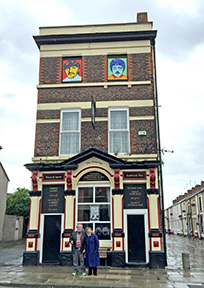
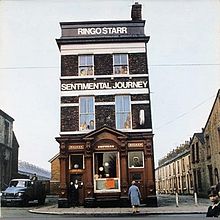
Some Pictures: On the Taxi Tour, we went to homes of all four Beatles. John and Paul’s are owned by the National Trust. Pictured below is the pub where Ringo’s mother would have gone. Their house is down the street to the right. It is on the cover of Ringo’s album “Sentimental Journey”.

Ringo Pub   Sentimentaljourney

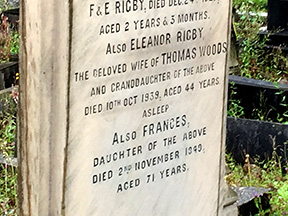
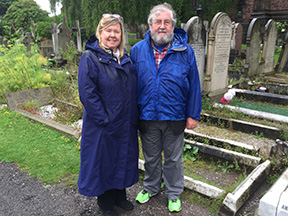
We went to see the grave of Eleanor Rigby. There is also a grave of someone named MacKenzie, but Gareth assured us that it could not be “Father MacKenzie”. It is in a church yard that John, Paul and George would have known and loitered in.

Rigby 1   Rigby 2

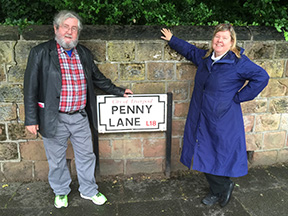
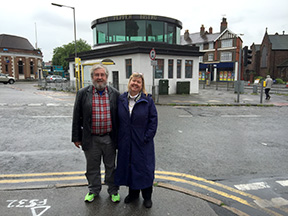
These pictures are from our stop at Penny Lane, both the Lane itself and the shopping district known as Penny Lane where they would have hung out. The pictures are of Penny Lane, the shop of “the barber showing photographs of every head he’s had the pleasure to know”, the corner bank with “the banker with the motorcar”, “the shelter in the middle of the roundabout” (where the bus that Paul and George took to school would have stopped) and the station of “the fireman with the hourglass” (which closed last year). Very strange….

Penny Lane   Penny Lane Barber   Penny Lane Bank   Penny Lane Roundabout   Penny Lane Firehouse