My last post got a bit long. I was trying to get ready for our two-day trip with Robbie and Bob and didn’t have the time to break it up. I appear to have made this one a bit long too.
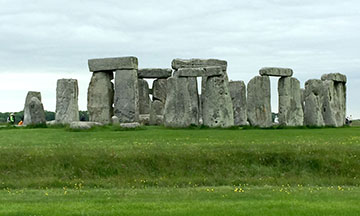
Stonehenge: On Tuesday morning, we caught a train to Salisbury, rented a car and drove to Stonehenge. Judie and I had been there over 30 years ago and I recall it as a muddy path from a car park to a monument surrounded by a chain link fence and a few signs. It has been fixed up in quite a nice way in the decades since, with a big visitors center, car park and a bus to the site. The admission includes an audioguide, which provides all kinds of information about who built Stonehenge (not the Druids, who came much later), where the stone came from (some of it was a special, magical blue stone all the way from Wales) and speculation on what it was used for. A great deal of archaeological work has been done, both at the site and in the surrounding area in the past thirty years and they know a lot more about it. The weather that day was overcast and threatening and there was a gale-like wind blowing, making for an evocative, if chilly, experience. It really is quite amazing. The idea that Stone Age people hauled chunks of rock weighing as much as 30 tons for many miles and then shaped it using nothing but stone tools and ended up with mortise and tenon joints and rocks that line up perfectly with the solstice is mind-boggling. It had to have taken a big part of the population of the day, not only simply to move and shape the stones, but to feed the workers, make the tools and rope , and organize things. On top of all of that, it is also a simply beautiful piece of sculpture.


Bath: There are at least three things that make Bath a very special place. First, it is ancient. The mineral spring that is the reason for its existence drew pagan tribes to the area for religious and possibly healing purposes for many of thousands of years. (A lot like Stonehenge.) The Romans found the springs and built a large complex of Baths on the site, which were covered over for a thousand years or more and then rediscovered (more about that below). Second, it is an architectural treat. When Bath was rediscovered in the Georgian Age by the gentry desiring to get the health benefits of a mineral water spa, the town was redesigned and built-in honey colored local sandstone, mostly under the direction of George Wood and his son, creating a lovely cityscape that is essential unchanged in the intervening 250 years. And third, partly because it is so unchanged, it evokes thoughts of Jane Austen, who lived there, set two of her books, “Persuasion” and “Northanger Abbey” there and whose other books often seem informed by her experiences there.
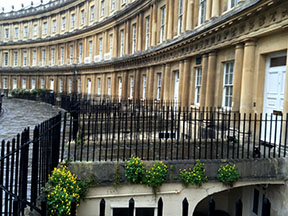
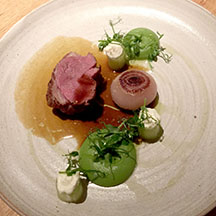
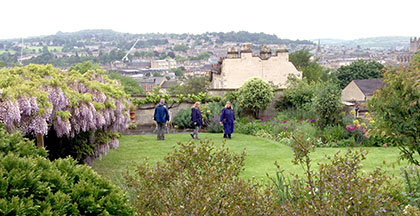
Because Stonehenge required a lot more time than we’d planned and we decided to stop at lovely country pub for lunch, we didn’t get to Bath until late in the afternoon. We went to our hotel, Paradise House, a small place located on a hillside overlooking Bath and the surrounding countryside. It had a delicious breakfast, great service and a spectacular garden. It is actually one of the few older buildings in that neighborhood, as most of the area was wiped out in the “Bath Blitz”. (In 1942, the Germans bombed Bath, supposedly in retaliation for earlier RAF bombings of two German town with little military importance. You can still see scars on the buildings in Bath and many had to be substantially restored after the war.) Judie stayed in the room to work and Robbie and Bob and I walked down the hill into Bath, but by the time we got there it was after 5:00 and most of the tourist things to do were closed. With three hours to kill before dinner (Judie had a 7:00 call), we walked around the town , checking out the architecture and general scene, stopping for a glass of wine to rest (Bath is hilly), and then walking some more. The streets of the town are lovely, especially if you ignore the fact that the street level on the commercial streets is mostly chain stores. We walked up a long curving path to the Royal Park to see the Royal Crescent. The Crescent is a spectacular semi-circular ring of buildings built high on a hill overlooking Bath. It was designed by George Wood, who died five days after the first foundation stone was laid, and finished by his son. The most unusual thing about it is that it was built as a facade and then sections were sold to wealthy individuals who had their own architects build the actual premises out the back. So a lovely unified face and a hodgepodge rear. It turned out that the path we walked was built later so that the wealthy people in the crescent could be transported down to the baths without having to go down the main streets. But our favorite place was The Circus, a complete circle of three of these crescents, with a park with big old sycamores in the middle. It was designed by the younger George Wood and was just perfection. We finally made it to the Olive Tree for dinner, footsore and hungry, where Judie met us and we were rewarded with a truly delicious meal.

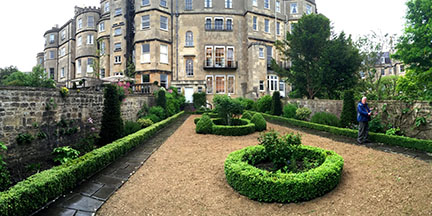
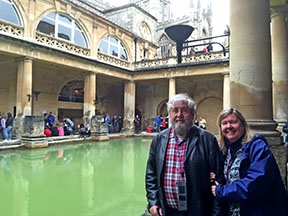
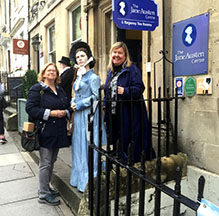
The next day, after spending some time in the hotel’s marvelous garden, we went into Bath and headed for the Roman Baths. Just like Stonehenge, it was much better than the place we recalled visiting over 30 years ago. A lot more excavation had been done and the whole museum area was more informative. And once again the admission included an audioguide, which added to the information about the whole thing that we were able to learn. (The audio guide included additional commentary by Bill Bryson, which sounds like a great idea, but it turned out that he merely stated the obvious or resorted to being annoying.) You could see the spring bubbling and steam rising from it and the whole thing is great feat of engineering. Since we were lat there, they appear to learned a lot more about the religious functions of the baths and the range of people who came from all over the Roman Empire to visit them. Their excavation of the Temple was impressive and cleverly presented, using video to fill in the missing bits and pieces. You could see where the water of the old spring area had been lifted to provide for the King’s Bath in the 1500s. It is kind of incredible that the whole thing was covered over and “rebuilt” by the Brtish and eventally virtually forgotten. The whole tour concluded with an opportunity to taste the spring water, which was warm and oddly “minerally”, but not really unpleasant. The whole tour took a long time, but ti was worth it. With our time to leave on the horizon, we chose to go to the Jane Austen Museum. We learned quite a bit about her life in Bath. She resided in a number of places in the city, partly because she and her sister and mother lost most of their income after her father’s untimely death. Although she wrote “Nothanger Abbey” on her first visit to a relative, the period when she actually lived there was relatively unproductive. But it led to a number of her great works, until she died too young at the age of 41. I suspect there are better places to visit in Bath, but Judie and Robbie are big Austen fans. One other thing about Bath are the references to the fact that it was a social hub in Georgian England, with the entertainment and social scene directed for 50 years by Beau Nash, a dandy and gambler, whose semi-official tile was Master of Ceremonies.

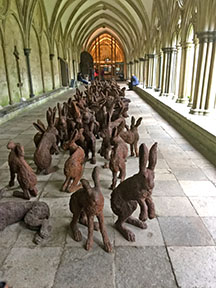
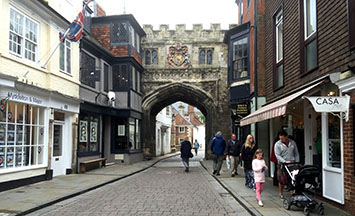
Salisbury: Annoyingly, our rental car company closed at 5:30 and had no provision for dropping the car outside of office hours, so we had to leave Bath a bit earlier than we would have liked (or we would have been stuck with the car until the next morning with nowhere to stay). We made good time returning and had an extra 45 minutes or so to go and check out Salisbury Cathedral. It is one of the biggest cathedrals in England and has the tallest spire. The interior is very impressive and suitably ancient, with things like choir stalls dating from the 1200s and the oldest working clock (1386). The interior is immense with high, vaulted ceilings. The choir was rehearsing for an upcoming service, which added a nice touch. There were a few pleasant surprises. First, the walk to get to the Cathedral, through an old part of the town, was lovely. Second, the Cathedral was surrounded, by large modern sculptures, most of anthropomorphic rabbits, and there were more inside. See below. And finally, the Cathedral contains one of only four known copies of the Magna Carta (and it is said to be the best preserved one), set in its own special Charter House, which is a little jewel of a building in intself. (Probably not coincidentally, King John’s brother, who helped negotiate the Magna Carta, is buried in the Cathedral.) We got to go in a see it, accompanied by a guide/docent. Very cool.


 nickinshoreditch