We are finally back from a fairly exhausting trip with our old friends, Chris and Nancy, that saw us go to World War I battlefields around Verdun in France and then up to Edinburgh and the Isle of Skye. Lots of driving and riding in cars (something we haven’t done much in many months), plus trains and the ferry across the Channel (so we got to see the White Cliffs of Dover, which always remind me of the movie “Help!”).
The World War I trip was one that we would never have planned, but Nancy has been researching her family history and wanted to go to where her Great Uncle Arthur had been killed. She arranged the whole thing, including our own tour guide, so all Judie and I had to do was get out our credit cards and tag along. I was worried it might be a bit tedious, but it turned out to be both fascinating and fun, thanks in large part to our guide, Major Tim Pritchard-Barrett.
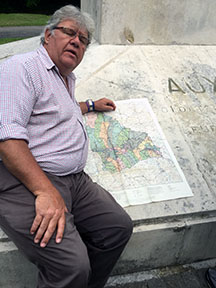
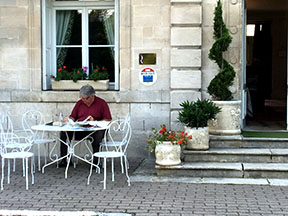
Major Tim: Our guide was a former major in the Welsh Guards (who fought in the Falklands War). He was from an upper crust family in Northern England and went to private schools and Sandhurst (the UK equivalent of West Point). (One twist for him is that he also had roots in South Carolina.) He had that patrician sort of snobby English accent and freely expressed his prejudices against immigrants, gypsies and, especially, the French (lazy sods). So on the one hand he was a bit of a jerk, but at the same time he was interesting and had one of those dry, British senses of humor. Most important, he had encyclopedic knowledge about World War I and military history and really knew the ground we were covering. He had done research specifically for Nancy and was able to pinpoint, with amazing precision, where her Great Uncle Arthur had marched and fought and where he had died when the hand grenade he was carrying was hit by a shot and exploded. While he was a bit of a mixed bag personally (especially since we spent so much time in a car with him), as a guide he could not have been better. Photos below. Notice him studying up for the day.
Where We Were and Some Historical Context: Most World War I tours, especially the British ones, concentrate in the Somme area, near Flanders, where the British French and German armies slaughtered each other for four years for no particularly good reason. The American forces never got up to that part of the War and, instead ended up near Verdun, supporting the French troops. This was partly because General “Black Jack” Pershing, who led the American Army, rejected the French idea that American troops be slotted into the lines wherever needed in a piecemeal fashion. Pershing insisted that the Americans be together in one fighting force. So they ended up West, around Verdun. That area is one of those places where battles had been taking place for centuries. It is near Waterloo and other Napoleonic battles, was the center of the Franco-Prussian War of 1871 (in which the Germans had taken back most of Alsace and Lorraine, leaving France only the area around Verdun) and later World War II. I’d guess that people like Charlemagne marched through there and neolithic cave men probably smashed each other with bones there. The French were absolutely determined to keep Verdun and the Germans were determined to take it, so there had been years of awful fighting in the area by the time the Americans showed up with their impossibly green troops. (Major Tim told us that shortly after the Americans arrived at the lines, the Germans did a quick “Welcome to France” raid in which they killed a bunch of soldiers and withdrew taking over 100 prisoners.) But, of course, more and more American soldiers kept arriving and by the time of the Armistice, Pershing had two full armies and plans to march well into Germany. America may have formally joined the war in 1917, but by the time the Americans were really ready to fight, it was the summer of 1918 and there were only two campaigns in which they fought:
The Saint Mihiel Salient: Saint Mihiel is a town south of Verdun on the Meuse River and on the train line which was supposed to supply the French in Verdun. The Germans managed to capture it early in the War and had never lost it. Their successful offensive had created a kind of triangle sticking into French territory along the battle front, which for some reason is called a salient. It is mostly flat fields along the middle of the salient with wooded hills along the sides. In a battle that went from the 12th to 15th of September, the American and French forces attacked from the sides of the triangle, leaving Saint Mihiel itself alone, until they met in the middle, effectively cutting of the German troops in the town and forcing their surrender.
Meuse-Argonne Campaign: This is the more difficult and well-known American war effort. It is where Sgt. York became famous, where the “Lost Battalion” fought and where Great Uncle Arthur died. The American forces attacked to the North over a terrain of forested hills and ravines, separated by open fields. The Americans, did great the first two days, as the Germans dropped back to heavily fortified lines and then the offensive bogged down and the fighting got very ugly. At one point, there was some pressure to replace Pershing, according to Major Tim, but that never really got anywhere.
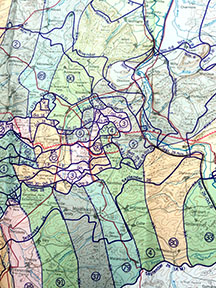
Helping us understand all of this were some incredible maps of the American battles, created after the war by Major Dwight D. Eisenhower for book he wrote analyzing the U.S. operations in France. The maps seem to be staple part of many of the newer monuments. See below.
I’ll write more about my impressions of all of this and add some more stories in the next post. But before that, I need to mention a few non-War things:
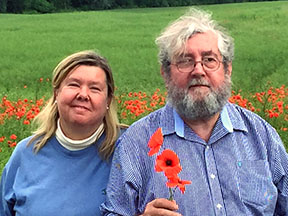
There had been torrential storms before we came and the rivers in the area were over their banks in many places. You may have read that the had to close the Louvre at that time to move artwork to higher floors. This made the off-road explorations that Major Tim took us on a bit problematic. But it meant that everything was beautifully green and the poppies were growing like crazy.
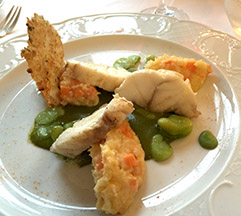
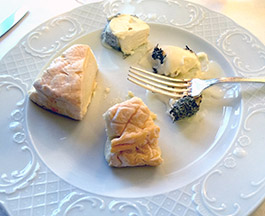
We stayed at an amazing French chateau (see below) called Chateau du Monthairons. In addition to being beautiful, it had wonderful meals and we ate there twice and once in Verdun. During World War I, it had been used as a French Field Hospital and it had lots of pictures of that. During that period, the composer Maurice Ravel worked there as an ambulance driver and there is a story posted about a moment when this unknown driver found a piano in the hospital and shocked everyone by sitting down and playing beautiful music. (During World War II, the Chateau was German Officers’ Headquarters. There were no pictures displayed of that.)

 nickinshoreditch