Our trip to France was filled with all sorts of interesting events and places where we learned a great deal about what happened a hundred years ago. Before I go through them, though, I have say that our overall feeling was one of sadness, mixed with a certain bewilderment at the totality of what we were seeing and hearing. The war itself was unspeakably awful. The trench warfare, the endless bombing, the sides separated by less than 100 yards at many points, forested areas reduced to stubby and muddy rubble, the ever-present danger of poison gas attacks, and countless men dying in miserable conditions. And what for? So the Kaiser could have an empire to match the English and French? Because the British seemed incapable of going more that 20 years without getting into a war? Just because these nations and monarchs had been fighting in Europe for untold centuries and just did it out of habit? Just a mind boggling waste of human life.
Nobody was there: One of the eerie thing about touring around this area was how empty it was. There were very rarely other people at any of the battle sites or monuments, except for an occasional American at a cemetery. And much of the area is farm land, so, other than a random guy on a tractor there was no sign of life between the towns. But what was really weird was that the towns themselves were empty as we drove through them and most of the houses were shuttered. Maybe they all go to work in the bigger towns like Verdun? But we also didn’t see any kids. It gave it all a surreal quality.
Trenches, bomb craters and other remains of war: Early on the first day of touring (as opposed to traveling), we stopped along the side of a road through the wood that had once been a Roman road. When I stepped a few feet off the road into the woods, I immediately saw a large hole and then about ten or twenty feet to my right was another hole. And crisscrossing area were linear cuts into the earth. These were old trenches that had been built along the road and artillery craters caused when the trench system along the road had been systematically bombed. The craters and trenches had been filled in over the years by leaves and stuff, but they were still clearly visible. The incredible thing was that they were just everywhere you looked that wasn’t being farmed for miles and miles. The landscape was still seriously scarred, even after over a century. But these weren’t the biggest scars. Those were enormous craters, often twenty or more feet deep even today and up to hundred feet or more in diameter, caused by mines. Both sides had engineers who would dig underground tunnels out to a certain point, fill the end with explosives, backfill and then set it off. This mining could be offensive, since it would destroy whatever was above it, but it was also defensive, as it would create a deep crater that would stop tanks and that no soldier in his right mind would venture into. These were everywhere too. The first place we saw a lot of them was at a bluff overlooking the Saint Mihiel Salient, a hell hole similar to the one I describe below. This is where Great Uncle Arthur’s regiment had left for the Battle of Saint Mihiel. We also saw the remains of concrete bunkers and fortified gun emplacements.
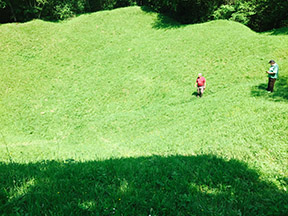
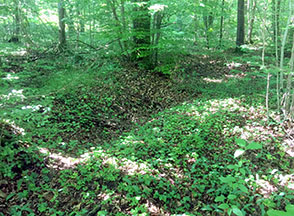
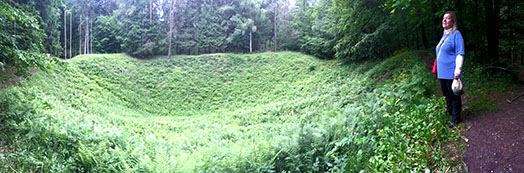
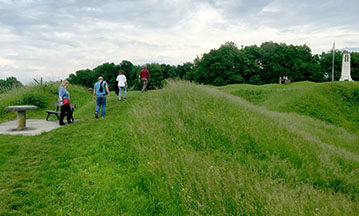
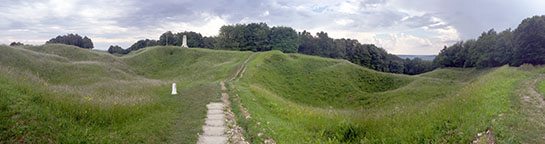
Butte de Vauquois: This was an incredibly powerful example of the lunacy of the War. Vauquois had been a little town up on a woodsy hill, overlooking the valley leading to Verdun. The French and Germans fought over it for four years. The town was completely destroyed, all the vegetation was blown to bits and the two sides were dug in on opposite sides of the top of the butte, separated by around 30-40 yards. In between them were a series of extremely deep, undoubtedly muddy craters caused by huge mine explosions, which must have made any direct assault all but impossible. But, just in case, there was barbed wire and those iron spike things, which are sill rusting away there. The trenches and craters are also still there, as are the communication trenches snaking down the hill and many smaller craters caused by artillery attacks. You can stand there now, surrounded by grass and trees and flowers and can admire the view down the valley and the small monument. But it doesn’t take that much imagination to realize that you are standing in a place that was once hell on earth.

Machine guns and other weaponry: I think I had always imagined World War I as soldiers in trenches firing at each other across a no-man’s land in a sort of fighting that was essentially close quartered. It turns out that, while that was true, weapon technology had changed the style of war in the Twentieth Century. Large artillery could fire accurately over ten miles and the smaller artillery had ranges of many miles. What was even more surprising to me was the range of the fixed machine guns, which was well over a mile. If you were charging across a field, you wouldn’t even hear the shots before the bullets reached you. The machine games were positioned and aimed so that they would fire obliquely against an advancing line, trying to hit down the line, rather than spraying fire by moving the gun. As a result, when troops were advancing across open terrain, they would avoid staying in a line and would be separated by as much ass 30 yards, so that incoming artillery could not take out groups of men. You had to imagine those poor soldiers going through an open field, probably slogging through mud and over barbed wire, sometimes up and down steep hills and getting mowed down by machine guns and artillery so far off that they couldn’t possibly see them. And the soldiers they were trying to actually engage might be ahead in the tree line, in trenches or other reinforced places, firing at them as well, and possible also out of sight.
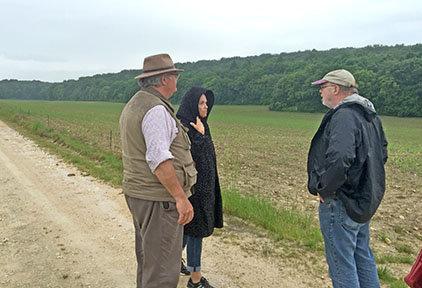
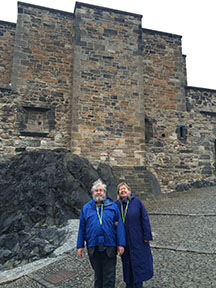
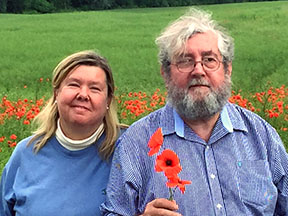
Uncle Arthur: I have to admit that I was a bit skeptical about going on a trip that was focused on Nancy’s Great Uncle’s death. It seemed like we would be spending too much time on a trivial moment in a larger story. But it turned out that the focus personalized the tour in a way and gave it a larger meaning. Rather than simply going from monument to cemetery to the next battle site or line of trenches (which we did plenty of), we were either following his trail or at least relating what we were seeing to what he must have experienced. His regiment had been in support at the beginning of the Meuse-Argonne campaign, but they eventually switched and relieved the unit in front of them. Major Tim determined from the maps and other research that he had been fighting in a forest near Brieulles-sur-Meuse and Dannevoux when he was killed. In the photo below, you can see Major Tim and Nancy, next to those exact woods and certainly no more than a quarter mile from where he died.
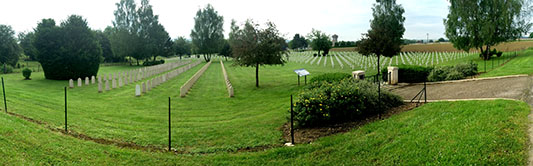
Cemeteries: This whole area is dotted with cemeteries. There are a huge number of French cemeteries, which tend to be smaller. (The one below is bigger than most.) Their crosses are often made of concrete, which degrades and, perhaps because there are so many little cemeteries to maintain, they are sometimes slightly overgrown with broken crosses (which Major Tim, of course, attributed to French character flaws). Most of the French cemeteries had Muslim tombstones, which were in a different shape. In some, these were put in a separate area and set facing Mecca (see below), while others were just mixed in and facing like all of the others.
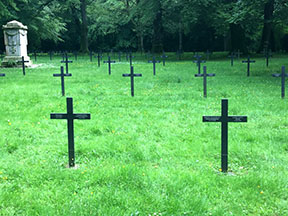
There were also a surprising number of German cemeteries. The regular German soldiers were not sent home for burial and I was mildly surprised that the French didn’t get rid of them. These cemeteries would often have as many as four soldiers to a cross. The crosses were thinner and made of metal and were very attractive. I was interested to see stars of David on many of the crosses, representing, of course, German Jews who had died. Major Tim told us that Hitler had issued an order that prohibited his German troops fro desecrating those Jewish burial sites, on the grounds that they had died for the Fatherland.
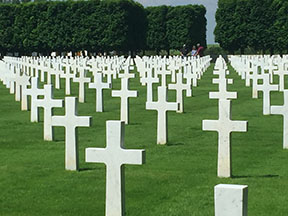
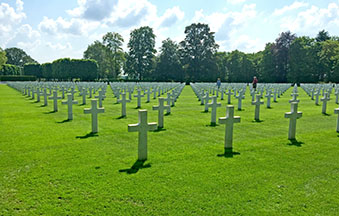
The American cemeteries were very different, in that they are very large and immaculately maintained. American families had a choice between bringing their dead home for burial or leaving them to be interred with their comrades in arms. The two that we visited, one for Saint Mihiel, containing nearly 5000 dead and the one for Meuse-Argonne, which contained over 14,000, were gorgeous, with grass that would make a golf course jealous and beautiful rows of trees and flower beds. Nancy was able to visit the graves of four other Maine farmboys who had been in Great Uncle Arthur’s regiment, although he had been sent home for burial.
There is something about the geometry of all of those crosses, especially all of the white marble crosses in the large American cemeteries that was incredibly powerful. The patters and the lines of sight keep changing as you walk through, which somehow reinforces the fact of the number of dead that are present. Some pictures follow, but don’t really capture this.
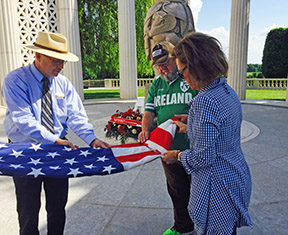
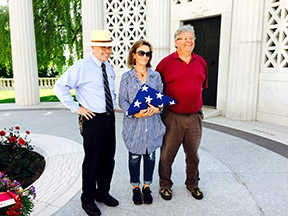
Flags: While we were at the American cemetery for Saint Mihiel, we were looking at the views when Major Tim said “Hey. That looks my friend Jeff.” Jeff was someone who he knew as the superintendent of a different cemetery. He had been transferred and was now in change of this one. He greeted us, showed us around, answered our questions and showed us where they are systematically replacing the old headstones. He took us to his office, where he gave Nancy advice on her searching and told us anecdotes. As that was ending, he said “It’s almost five o’clock. Would you like to help me take down the flags?” The cemetery had two big poles with large flags and we got to take them down. And then he directed us on how to properly fold a flag, so that you end up with a perfect triangle. Doing that, surrounded by thousands of headstones, was a powerful moment.















 nickinshoreditch