A Busy Week: Traditional Activities and two plays
Judie and returned from Spain Sunday night and were greeted in our flat by Barbara and Mike, who had just finished their tour of Northern England and Scotland.They are a couple we only see rarely and it is fun to catch up with them. Mike is someone who, like me, likes to stay up drinking red wine and talking. Let me just say that I had a lot of recycling to do by the time he left. They left at the crack of dawn on Wednesday to return to Albuquerque. The next day, Judie’s sister Robbie and her husband Bob arrived and a whole new round of events started.
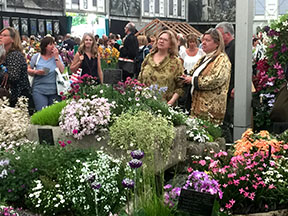
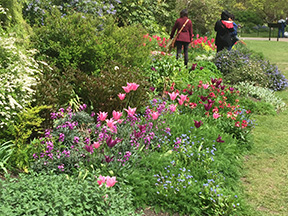
The Chelsea Flower Show: On Friday, we met Robbie and Bob at the Flower Show, after they had spent the early afternoon at the V&A Museum. It is one of the biggest flower shows around and was quite an event. It was mobbed with people checking out an endless number of beautiful flowers and a number of show gardens. It is run by the Royal Horticultural Society and a good part of it is an incredibly fancy trade show, where you can get seeds and flowers for you own garden, along with garden sculptures, garden furniture, garden gates and pretty much anything that might be possible to put in a garden. Jenny Bakshi, who isa landscape designer in Montclair, was there with Phil and her brother, so we got to meet up with them. There was one “eccentric” garden that would activate every 15 minutes and the trees and topiaries would spin around and bushes would come up out of the ground and flowers would rotate around a little house. Ridiculous , but cute. There was another one that was dedicated to the end of slavery. Many of the big ones had water and/or sculptures and/or houses. And then there were little cute ones that were more like incredibly nice backyard gardens. I’ve been thinking about doing some gardening improvements in Montclair when we get back (and have been since the “Painting the Modern Garden” exhibit at the Royal Academy), so this all gave me some ideas.
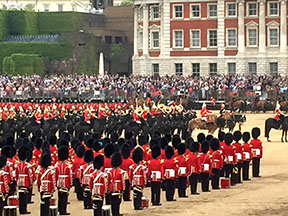
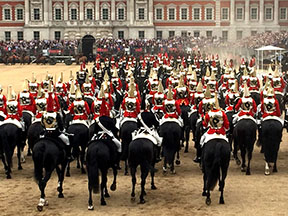
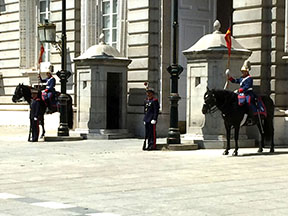
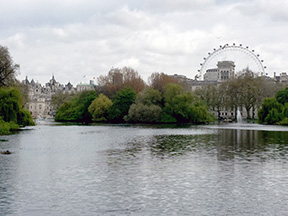
Trooping the Colors: The next morning, we were off to see Trooping the Colors. Actually, what we were seeing was a rehearsal of the event. The formal Trooping the Colors before the Queen will be held on June 11th and televised around the country. It is something like the Changing of the Guard at Buckingham Palace, only on steroids. It takes place on the Horse Guards Parade Ground, just across for St. James Park, which is about the size of two football fields. A huge number of soldiers with the red coats and black fur hats marched in, each with its own band. There was all of this very fancy marching around, with one of the groups carrying the Colors (which appeared to be a fancy UK flag). Everyone stood when it went by, like a slow motion wave. There were also guardsmen on horses, some with red highlights in their uniforms and others with black, but all wearing shiny helmets. And there was horse-drawn artillery too. There were hundreds of them all on the field. It was really an amazing spectacle, and we didn’t even get the flyover that will end the real event. One has to wonder what all of that pomp and circumstance costs and whether it is really worth it. But it is one of those things that the British do and it has to be said that they do it really well. A few pictures follow:
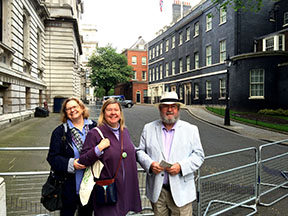
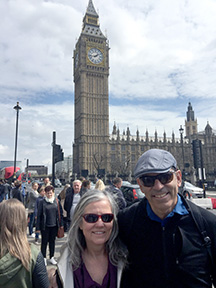
One of the special benefits of going to this event was that our seats required us to enter via Downing Street, which is normally closed to the public. Here we are 100 feet from Cameron’s front door:
A Guided Walk: On Saturday afternoon, we went on a guided walk from St. Paul’s to the Monument to the Great Fire of 1666, via Bankside. We had an entertaining guide (Johnnie) who delivered a sort of stream of consciousness patter as we walked from place to place. A few of the best nuggets:
- An artist named Ben Wilson became famous for creating tiny painting on the chewing gum left on Millennium Bridge. He apparently lies on a yoga mat and paints the tiny bits of gun pushed in the bridge grating. The police arrested him once for doing this, but he could not be convicted since he pointed out that he was not defacing public property by painting on the bridge because he was actually painting on garbage. He may have moved on to different locations (or perhaps a different medium), but there are still numerous of these little paintings all along the bridge. Most people, including me, never see them because your eye is drawn to the beautiful views of St.Paul’s, Tower Bridge, the skyline and the Thames. A sample gum painting is below.
- Next to the Globe Theatre on Bankside is a small and old white building, which has a plaque stating that Christopher Wren lived there while building St. Paul’s, so he could watch the progress from across the river. Good story, but it isn’t true. In fact the sign was put on the house by its Norwegian owner in the 1930s as a joke. That area had been nearly destroyed during the blitz and there were plans to knock down that house and the two old houses next to it for a development, but the sign made it appear to be an important landmark, so it was spared from the wrecking ball.
- All along Borough High Street, there used to be alleys containing pubs and inns. This is where travelers would pull in with their horses or coaches as they approached London Bridge, which was the only way to cross the Thames for hundreds of years. There is only one of these places left, a pub called The George. Its buildings are pretty ancient and it is actually owned by the National Trust, which operates the pub. I have to go sometime. It is nearby the place where the tavern that is in Canterbury Tales was located. It was the place where the pilgrims met and told their stories before leaving.
- There were a series of bridges at the site of the current London Bridge. The most noted one was the one that was covered with a virtual little city of buildings. At the southern edge was a gate and on top of the gate were heads of traitors and criminals and pirates, mounted on pikes. According to Johnnie, the reason it was the only bridge across the Thames for centuries was that the boatmen’s guild was able to pressure the government into not constructing new bridges, thereby protecting their trade. When the Westminster Bridge was finally built, the guild received a large compensation payment.
- There is a theory that theaters like the Globe based their designs on the big inns like the George. The inns would have pubs with rooms to let above them which had balconies overlooking the alley. This would be on both sides of the alley and it is thought that there would b performances at one eld of the alley, with most just standing in the alley and the more well off being able to watch from the balconies.


“Showboat”: On Saturday night, we went to see a production of “Showboat”, the Hammerstein and Kern musical that gave us “Old Man River”. It is seen by some as the first true piece of modern musical theatre, premiering in 1927. It was the first time that the songs in a theatrical piece were completely linked to the plot. And there were scenes about black and white relations that must have seemed revolutionary at the time. We had front row seats, which were actually cheaper than the seats behind us. It was a good production. It actually had an American, Chris Peluso, playing the leading man, which seems unusual in a London production. It seems to me that you see more Brits on Broadway than vice versa.) Gina Beck, who played Nola, the female lead, had a great voice. The actor playing Captain Andy, Malcolm Sinclair, was someone we’d enjoyed in the Hampstead Theatre production of “The Meeting” and he was quite good, although his Southern accent sort of came and went. It was fun and there are a few great songs besides “Old Man River” (the show’s presentation of this song was very moving), like “Only Make Believe’, “Can’t Stop Lovin’ That Man of Mine”, “After the Ball” and “Bill”.
“Elegy”: Tonight, we went to see “Elegy” at the Donmar Warehouse, a famous small theater in the West End. Written by Nick Payne, it is based on the premise that a form of brain surgery can correct brain diseases, but that in curing the disease, you lose parts of your memory. This presents an impossible dilemma to the main characters. Do they do nothing and let a loved one slowly die an ugly death. Or do they save the person, knowing that in doing so they will not be the same person. And by waiting to do the surgery, savoring the relationship that still exists, they cause more memory to be lost in the surgery, leading to a situation in which all memory of the relationship is erased. The play begins post surgery as Carrie (played by Barbara Flynn) tries to cope with the fact that her wife, Lorna (played by Zoe Wanamaker), who she still loves deeply, doesn’t know who she is. The play then proceeds in backward chrononology, until the end, when the first scene is replayed, but now the audience has the memory or what has led up to it and it resonates completely differently. It is like the first scene is Lorna’s point of view and the last scene is from Carrie’s.
We are off to Bath tomorrow morning with Robbie and Bob, so I have to finish this…..



 nickinshoreditch