“The Painkiller” and Other Musings

“The Painkiller”: On Thursday night, we went back to the Garrick Theatre (with Linda) to see the Kenneth Branagh Theatre Company’s production of “The Painkiller”. It was hilarious. The play was adapted by its director, Sean Foley, from a farce by the French writer Francis Veber. It is set in two hotel rooms with a connecting door. In one is Dudley (played by Rob Brydon), a depressed photographer, in town to take pictures of a big trial across the street, who is planning to kill himself if he cannot convince his wife to return to him. In the other room is Ralph (played by Branagh), a hired killer who is there to assassinate the defendant in the trial as he arrives at the courthouse. What could go wrong? Well, pretty much everything in this wild farce. There the dialog is very funny and there is a large amount of truly brilliant slapstick humor. Branagh is constantly being hit by doors or other objects or kneed in the groin. At one point he is mistakenly given a shot of a narcotic (intended to calm down the suicidal Dudley) and has a stretch in which he is barely able to stand and slides down seats lands on the floor in a number of riotous ways. It all goes on at an appropriately breakneck pace, which accelerates when a policeman comes to ask about someone who was seen out on the ledge of Ralph’s room (one of Dudley’s suicide attempts) and the arrival of Dudley’s wife. The lunacy is punctuated by appearances by the hotel clerk (played by Mark Hadfield, who we had seen earlier in the year in “The Meeting” at Hampstead) who seems to arrive just as Dudley and Ralph have fallen in to a position of apparent sex. There is no point in trying to describe the action any further, since it is so antic and so much of the humor is pure slapstick. The leads were wonderful, as was Hadfield and rest of the cast. It is just great to go to the theatre once in while and laugh hysterically.

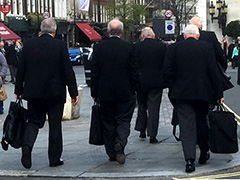
More on the Freemasons: So it turns out that those big briefcases that the masons were bringing to their big meeting (see the prior post) contained their aprons, which apparently you wouldn’t want to wear dirty or wrinkled to such an event. According the site for the Freemason’s Hall in London (I have to go to visit the museum and library some time):

The Masonic apron is the badge of membership for Freemasons. It symbolises the protective apron worn by stonemasons and in its original form was a complete lambskin. When a member joins he completes three ceremonies or ‘degrees’. After finishing the first he receives a plain white apron, for completing the second the apron has sky blue rosettes on the lower corners. The master mason’s apron with its sky blue edges and rosettes is the sign of completing the degree ceremonies. If a mason progresses through the ranks of freemasonry the apron becomes more elaborate with upside down ‘T’ shapes replacing the rosettes for lodge masters and dark blue and gold decoration for more senior ranks. These more senior ranks have two aprons, one richly decorated in gold embroidery for best and one in blue silk embroidery for normal wear.
So I’m guessing the guys with huge square cases were the senior masons with the really snazzy embroidered aprons and that having one of those big, fancy, leather cases is a masonic status symbol.
The Hillsborough disaster: Sometimes stuff happens here that creates a huge response and I have no idea why it is such a big deal. Earlier in the month, the comedienne, writer and actor Victoria Wood died and commentators were near tears. I had no idea who she was. More recently an inquest verdict about the Hillsborough disaster got banner headlines and CNN-like news coverage. Again, I had no idea. It turned out that about 27 years ago, 96 people died at a Liverpool football game when too many fans were allowed into the stands, leading to fans being crushed to death. The whole thing was initially blamed on drunken louts and hooligans. But what really happened was that the police had mistakenly left a gate open and allowed too many people into one part of the stands, which were terribly designed. The inquest not only established this, but found that, almost as the incident was occurring, the police began a cover up that was designed at denigrating and blaming the dead and injured for the the police incompetence. It goes very high up, including some Conservative politicians, although there may not be enough evidence to show that the politicians were complicit in the earlier cover up. It is pretty disgusting and the newspapers, which printed all the awful things the police told them, are falling over themselves apologizing. It is all pretty disgusting. Some officials, including the Chief of Police at the time, are going to end up going to jail.
Not a Good Time to Get Sick: The junior doctors went out on strike this week. They had been staging smaller actions for the past few months, but this was a full-scale strike. The Tory Health Minister is Jeremy Hunt, a typical rich twit whose main claim to fame is that he co-wrote a book on how to dismantle the National Health Service (NHS). He is predictably attacking the doctors, even as he has ignored all efforts to reach a settlement of the dispute. (Perhaps he views the doctors to be like the miners in the 1980s and thinks that this is his Thatcher moment.) The underlying problem is that the Conservatives have been gradually cutting support for the NHS. leading to a shortage of doctors, without any plan to train new ones or to allow for immigrant doctors. So the doctors, especially the junior doctors in the hospitals where most of the NHS action takes place, are terribly overworked and the patient experience is gradually degrading (which some argue is exactly what the Conservatives want since it will allow them the privatize the NHS more easily). The current dispute is due to the government imposing a contract without the Doctors Union’s agreement, which will require doctors to work more on the weekends. The theoretical excuse for this is that the death rate is higher on the weekend (but that may be because sick people stay in the hospital over the weekend, while healthier people are generally released). The doctors point out that this change will only make them work even longer hours or decrease the number of doctors during the week when most patients are there. Either is bad for the doctors and terrible for the patients. It has been suggested that the Conservative theory about weekend death rates be addressed in some sort of trial rather than changing the whole NHS structure, but Hunt won’t agree, which makes the theory that this is part of an insidious Tory plot to destroy the NHS seem plausible.

“The Caretaker” and the Soane’s Museum

Judie’s sister Linda arrived as Jane and Judy left on Tuesday and I spent Wednesday doing some London Stuff with her.

“The Caretaker”: We went to the Old Vic to see a production of “The Caretaker”. It is one of Harold Pinter’s earlier great plays, first performed in 1960 with Donald Pleasance and Alan Bates. It is a play about three men who are broken in various ways. It all takes place in a wreck of an attic festooned with junk. It begins as Aston, the tenant of this dump, brings a vagrant (Davies) back with him. The vagrant ends up staying there for some time. Aston has a threatening younger brother, Mike, who actually owns the place, who comes around periodically. Actually very little happens over almost three fascinating hours, over-layered with a feeling that something just dreadful will befall these guys. This is the kind of play that you can probably play in different ways. In this version, the humor is stressed, but only up to a point. Daniel Mays is just terrific as Aston, who  has a famous speech in which he talks about his time in an asylum, delivered in a masterful low-key way. (Pinter’s directorial instructions had been that Aston should be a man who has not had a conversation with any one for ten years and will not peak to anyone for twenty more when the play ends.) Mick, played by George MacKay, is also wonderful and is menacing just in the way he speaks and pauses and stares at Davies. He has some famous long riffs which he delivers in a stunning way. The play really revolves around Davies, who never leaves the stage. He is played by Timothy Spall (probably best known for playing Peter Pettigrew in the “Harry Potter”movies and J.M.W. Turner in the recent biopic). He plays him as a disgusting, smelly, selfish bum, who is simultaneously repulsive and appealing, funny and horrifying, dangerous and helpless. I thought it was an effective interpretation and it was certainly entertaining. It’s Pinter, so it is an odd and sometimes uncomfortable night out. But by the end, you are glad that you went, which I think is the essence of good theatre.

Sir John Soane’s Museum: This is a museum I had been meaning to go to and, since Linda wanted to go, I went along. John Soane was a well-known neo-classical architect in the the period 1780-1830. He was the youngest son of a bricklayer, but apprenticed to an architect and created himself. Much of his walth came from his wife’s uncle. He designed a great number of buildings in the neo-classical style (including the Bank of England) and believed that building in this style would cause Londoners to behave like the great Greek and Roman civilizations and lead to a sort of golden age. But his theory never really caught on and eventually the neo-classic style fell out of favor and many of his buildings were torn down, often replaced by neo-gothic structures, which Soane hated, (The neo-gothic architects had the own, similar theory that the gothic look would recall the piety of the middle ages and lead to a religious rebirth. It turns out that architecture can do many things, but it cannot change the behavior of men.) Anyway, over aperiod of years, Soane purchased three buildings at Lincoln Inn Fields and completely renovated them. The interior is designed in a unique and clever way. He is responsible for the design of art museums that brings in natural light through skylights, etc. and he uses these ideas to bring light into his house, even the basement. His picture room, which holds paintings by Hogarth and Canaletto and others, is relatively small but holds a large number of paintings by having a number of walls that swing out to reveal more artwork. Very clever. And he also collected all sorts of classical statuary and remnants, which are in a colonnade and in his study and other places. His oldest son died and his youngest was a gambler and a reprobate, so Soane decided to leave his homes and their contents to the people of England and the museum was created by a Act of Parliament shortly before his death. It is quite a place.

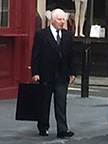
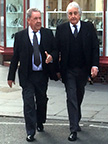
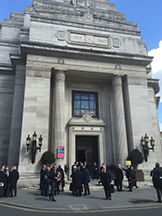
Freemasons: After that museum, Linda and I were walking toward Covent Garden when we saw a big building with Stars of David on the doors and a large crowd outside. It was a great big Art Deco building and it turned out to be the Freemason’s Grand Temple. Normally, we might have been able to go in (as I understand the interior is striking), but on Wednesday there seemed to be a big freemason’ enclave and literally countless older men in black suits were all converging on the place. There was camera crew there filming it. I looked it up later and it was the annual investiture of Grand Officers, a big ceremony for which tickets are required. (Since Freemasons are believed by conspiracy nuts to control the world secretly, I had been hoping that their meeting had some more interesting purpose–to decide how the Brexit vote would turn out or figure out what to do about Trump. So the stated purpose was disappointingly pedestrian, but, of course, who knows what they were really doing!?) Here are some shots of the guys in suits arriving, which don’t really do justice to the weirdness of it all. They were all carrying briefcases or bags that were a bit too large. Suspicious yet?

Freemasons6  Freemason 12  Freemasons9  Freemasons2

Miscellaneous Doodling and a New Painting

English Spring: As of yet, there has been little sign of anything I’d call spring. It is basically days struggling to get over 50 and night dropping below 40, with mostly cloudy days mixed with equal amounts of sun and rain. It’s not exactly depressing, but I am ready to put my L.L.Beans coat away. It is hard to imagine how bleak it must have been back when the air was incredibly polluted. There was actually a brief snow flurry today–first snow I’d seen all year here.

More Racist Comments from Boris: Not content to muck up the London mayoral election with a racist and anti-Muslim attack on Labour candidate Sadiq Khan, Boris and the “Leave” campaign did it again in responding to Obama’s support of the remain people. Incredibly, Johnson actually said that it was all because of Obama’s Kenyan heritage and resulting anti-British Empire upbringing (or something) that causes him to take the position, citing as proof that Obama had taken the bust of Churchill out of the Oval Office. (Obama coolly responded that he would think that most people would understand that he thought it appropriate to have bust of Rev. Martin Luther King Jr. in his office and that Churchill is well represented in the White House.) It is a kind of a minor tiff, but a sign that the “Leave” side are very concerned about the impact of Obama’s remarks, just as the attack on Khan is a sure sign that the Tories are going to lose the mayoral election. But the fact that they are pulling out the race card is disturbing. I had hoped that British politics was above American-style race-baiting. Nope.

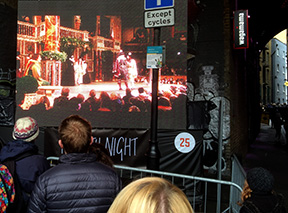
Shakespeare on the Thames: Over the weekend, it was the 400th anniversary of Shakespeare’s death. (Actually, it is unlikely that anyone really know the exact day that he died, but one of the days this past week is the one that is accepted.) They set up 37 video screen along the south side of the Thames and each one had an excerpt of one of his plays. (One screen for each play and each video was around 8-10 minutes.) Jane and Judy went earlier than me and saw close to 25 of them. I had a New Unity meeting and only saw about eight or nine. The films were often taken from productions at the Globe, but a number of them were filmed on location. The “Hamlet” I saw was filmed in Elsinore (and had the soliloquies done in Greek Chorus fashion by five great actors) and the “Henry V” was filmed in Agincourt. All the little films were good or even great and it was a tremendous concept.The whole thing was really a lot of fun and there were pretty big crowds, given the crummy weather. I am watching “Twelfth Night”with Mark Rylance below.

Shakespeare Thames.jpg

New Painting: This one is based on a photo I took in Italy over a decade ago. I started it about a month ago and couldn’t finish it before we went to Copenhagen and America. And then when I got back, I wasn’t sure what to do to it, so I started another one. I think I like working on multiple paintings at the same time. It gives me something to do even if I am sick of one of them or just stuck. I keep thinking I might go back and add some stuff to this one or one of the earlier ones. I’m somewhat torn about this. I have little doubt that I could improve some of my earlier paintings, since I have taught myself better technique over the last six plus months. But I also think that the most interesting this about these paintings, as a group, is the progression from start to now, and, if I go back and fix up the earlier ones, that will be lost. So I guess I won’t.

Tuscany Sunflowers

“Funny Girl” and a Seder

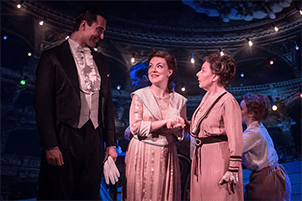
Our visitors, Judy and Jane, took us to see “Funny Girl” last night. They had managed to get tickets, although it is already sold out for most of its run and opened to rave reviews. I had never seen it on stage, although I, of course, saw the movie (with Barbara Streisand and Omar Sharif). The success of the show depends on the central performance of the role of Fanny Brice, the part made Streisand a star. Sheridan Smith, an accomplished British actress, was marvelous in the part. They did not try to recreate Streisand’s performance and her Fanny is a bit less broad, a bit more human and certainly a bit less Jewish that the way Streisand played it. She is a smallish woman and they played that for humor by surrounding her with tall chorus girls and a tall Nicky Arnstein. Her comic timing was great and her voice was good. You always wonder if British performers will capture the American sound. In “Guys and Dolls”, the accents were certainly American, but they failed to capture the Damon Runyon cadence. It was kind of the same thing here. The accents were neutrally American, in the modern sense, but you would not think that they were mostly Jews from Brooklyn. But it really didn’t make that much of a difference, partly because the performances were so strong and partly because, unlike “Guys and Dolls” (especially the role of Adelaide), the humor did not rely on the accent. In the end, it was a little odd that Fanny et al. lost their Jewishness, but it didn’t spoil the show. There were certainly a few moments, particualr during the songs “People” “Don’t Rain on My Parade”, where I couldn’t help recall Streisand belting it out with her other-worldly voice. But Sheridan Smith didn’t bother to attempt to recreate that sound and gave them her own interpretation and touch. I was never crazy about Omar Sharif in the movie and Darius Campbell’s portrayal was infinitely better. And it wasn’t just because he is a platinum-selling singer with a lovely voice. He really gave you the feeling that his Nicky Arnstein really loved Fanny. The fact that his Arnstein is a likable gambler rather than Sharif’s shifty gangster makes their relationship more romantic and less doomed from the start. The show was wonderful and Sheridan Smith got the second standing ovation we have seen since we got here.

funny-girl-2-574983

Seder shopping: This was a reminder that I am living in a secular country and that I am definitely not living in a US city. I decided that it might be nice to bring some Coconut macaroons to the New Unity seder and Andy asked me to bring horseradish and parsley and a lamb shank for the plate. The parsley was easy, but all of the local supermarkets sell their meat bone-free and encased in plastic. But we went out to dinner and I was able to order braised lamb shank and we put the bone in Judie’s backpack. The search for macaroons and horseradish was more problematic. It was a surprise, since not only is London an international city, but this was once the part of the city where Jews lived. But I would go to bakeries and grocery stores and almost no one had even heard of seders or Jewish-style macaroons (the French ones are easy to find). I did finally find a few macaroons when it occurred to me to go to Ottolenghi, a restaurant chain run by Israelis chefs. But they only had 4 or 5. I decided to try the Beigel Shop. The didn’t have macaroons and none of their many desserts were unleavened on Passover. They had at least heard of seders. I guess the fact that they spell bagel wrong should have been a clue. I never found any horseradish other than horseradish cream (the kind of thing you might put on a a roast beef sandwich or something). I even tried the Banglatown supermarket, which had a whole aisle of spices, some of which I’d never heard of, but no horseradish. (Rev. Andy did find horseradish in a store in Islington, so we had a complete seder plate.) It was a little weird to experience a Passover where no one seems to be aware that it is happening. And having it follow the un-Jewish “Funny Girl” sort of accentuated that. I probably should not have been surprised since this is such a secular place.

The Seder: This was the first Passover in over 20 years when we did not go a seder at the Rothbergs and we missed that continuity. But our Unitarian seder was very nice. It used a UUA Haggadah, which had all of the main elements of the traditional seder (glasses of wine, a shortened version of the exodus story, the plagues, the “Hillel sandwich”, etc.) and added some UU touches (ten modern plagues such as racism, homophobia and environmental degradation and added an orange to the seder plate the symbolize the quest for freedom by LGBT people). It capture the spirit of the seder ceremony in a UU sort of way and the food that everyone brought was great, even if it was all vegetarian. Judie’s traditional apple kugel might have been the best she has ever made.

Back in England and a Political Update

Happy Birthday to Liz: It is the Queen’s 90th birthday today. Even though it is her actual birthday, it is not “The Queen’s Birthday” celebration and holiday, which doesn’t happen until June. I assume that there is some justification for this odd rule and I imagine I could look it up, but I prefer to regard it as a British oddity. I frankly don’t pay much attention to the Royal Family and it is not a big part of life here, except on holidays or birthdays like today’s, although I imagine that that there some upper crust types for whom the Royals are a central focus. In thinking about the Queen, I will say that she has been remarkably successful in finding the right balance between her utterly irrelevant government function and her completely mindless ceremonial function. I assume that she must have an opinion on what is going on and whether she thinks the current PM is an utter twit, but she never lets it show. And she patiently attends all kinds of stupid events, even though she really doesn’t have to because, after all, she is the Queen. But it is the willingness to appear at the opening of a butcher shop, while scrupulously expressing no opinion on anything of substance that has kept the monarchy a part of British society. She deserves a lot of credit for maintaining what is, at the very least, an important symbolic and tourist institution. Hers will be tough shoes to fill.

Back in Shoreditch: I was walking down Commercial Street today and the panhandler (I wonder what the British term is for him) always outside of Tesco said “Hello. I  haven’t seen you around. Been on vacation?” Oddly heart-warming. I wandered around Old Spitalfield’s Market and ended up at Wright’s Seafood, where I stopped for £1 a pop oysters and chatted with the French waitress I know there. Then it was on the the incredible French cheese store a few doors down. The cheese in Britain and Europe generally is much better than the cheese you get in the USA, mainly because they aren’t as worried about unlikely diseases, which causes America to adopt rules that kill flavor. Then it was home to chat with the concierge. On Saturday, I will be running the New Unity seder. I was worried that no one was signing up and asked for another e-mail blast. We are now closing in on 30 attendees counting kids. Apparently, they are like Montclair UUs and prefer to wait until the last minute to commit.

Visitors: Tomorrow, Judy Strachan and Jane Gaertner, UU Montclair friends, arrive for a visit. This will begin a stretch during which someone will be staying in our spare room every day until June 25th. I am looking forward to seeing everyone and to sharing our London life with them, but there are things about my new life (like painting and writing) that I don’t want to lose to being a host and tour guide. I will have to keep that balance in mind over the next two months.

Brexit is Getting Ugly: As the campaign toward the referendum proceeds, things are getting increasingly ugly and I anticipate that it will get worse. If this were happening in the US, there would several polls a week trying to forecast the vote and CNN would have innumerable talking heads analyzing the horse race. Thus far, the coverage has been less poll-driven here. To a surprising extent, the campaign is very personal, as it seems to be all about the popularity of David Cameron. He is the most significant politician in Britain and the leader of the “Remain” side. So the “Leave” people have concluded that their best strategy is to attack Cameron and diminish his credibility, even though, in most cases, he is the leader of their party. The whole “Panama Papers” contretemps last week (which was really about his father) actually had nothing to do with the facts (that he is the privileged son of a rich father) and everything to do with Brexit strategy. It is hard to see how Cameron survives all of this. If the “Leave” side wins, he is certainly dead, as that would be the ultimate rejection of him and his policy by the populace. But even if the “Remain” side prevails, Cameron will be stuck leading a party in which at least half (and possibly more) of Conservative MPs have spent the last six months trashing him (actually the British would say “rubbishing”) and it is hard to see how they could go back to accepting him as their leader. Meanwhile, Jeremy Corbyn and Labour are in the odd position of supporting Cameron, since they almost unanimously do not favor leaving the EU, which must kill them since, in all other respects, I am sure that they loathe him.

So, in the midst of all of this endless sturm und drang, Obama arrives tomorrow. He will say Happy Birthday to QE2, but his real purpose is to express his opinion on Brexit and to support Cameron and the “Remain” people. Precisely what he says is probably less important that the fact that he is making the statement. Obama is very popular here, probably more popular than any British leader. The “Leave” side, of course, has said the he should just butt out, which probably reflects their worry over the impact he might have. The only significant foreign leader to endorse the “Leave” side thus far is the repellant French fascist Marine Le Pin (who is threatening to come to the UK to campaign, undoubtedly to the horror of the “Leave”side), so you can see why they might not want to hear from leaders in other countries. I fully expect Angela Merkel and every other significant European leader to follow Obama.

And if you though the Brexit Campaign is getting ugly: You may recall that the London Mayoral election is in two or three weeks. Boris Johnson is stepping down (and plotting to depose Cameron) and, while there are many minor candidates, the Mayoral race is between Zac Goldsmith, the Conservative Party candidate and son of a billionaire, and Sadiq Kahn, the Labour Party candidate and Muslim son of a cab driver. I haven’t read much about polling in this race either, but you have to think that internal Tory Party polls must be dismal, because Goldsmith and the Conservatives have launched an overtly racist attack on Kahn, attempting (predictably) to link him with radical Islamists. Cameron even joined in on this stupidity during Question Time this week, which seems like an incredible mistake in the context of the whole Brexit struggle and can only be explained by some sort of internal Conservative Party political calculation. Cameron’s remarks in Parliament were met with the Labour MPs chanting “racist” (one of the things you have to love about the British system). Kahn and his supporters dismissed it all as “desperate dog whistling” (I’m not sure what it means, but I love it). There is real chance that this whole racist tactic will explode int he face of Goldsmith Cameron et al. (and it will serve them right if it does), as it turns out that the the alleged radical IS imam has appeared with Conservative candidates as well and was contacted by Goldsmith in the past, seeking his support.
Visiting the USA

Oh, I’m so glad I visited the USA

Yes, I’m so glad I visited the USA

Anything I want, they had it right there in the USA.

Friends: Of course, the main attraction of my visit was to reconnect and visit with all of our friends. And it was unbelievably gratifying to go to to the UU Congregation or the Legislative Ministry Annual Meeting or to friend’s houses or even my dentist’s office and be greeted as a conquering hero or something. That feeling of love pouring over me from my community is something I will never forget and was a reminder (which I really didn’t need) that our stay in London must be temporary. I am happy to be here and terribly glad for this opportunity, but our visit was a striking reminder of how much we had left behind.

They had it right there in the USA: A real part of the fun of the return visit was to experience various parts of American culture that I had missed here. A few of the cheap thrills:

  • American appliances. Doing laundry in a real, functional washer and dryer was a ridiculous delight, after spending months trying to use the pathetic and useless machine in our flat. And it was nice to see a refrigerator larger than a big suitcase.
  • Driving: I hadn’t driven a car since the end of August, other than a weekend in Italy in October, so it was fun to drive around North Carolina, New York and New Jersey. I have come to realize that I don’t really miss driving all that much and I am delighted that I don’t have a car in London. But being able to get somewhere relatively instantly is a nice feeling and it allowed me to visit friends more easily on this trip.
  • Shopping: I did the tourist thing on this trip. Things like clothes and shoes and golf balls are quite expensive her in the UK, so I came to the USA with a half empty suitcase and proceeded to fill it with shirts, pants, suits and shoes. I had two Costco rebate coupons and went to Costco to spend them and came to the realization that there is very little at Costco that fits into a suitcase. So I ended up buying nice bottles of wine to bring with me when visiting friends.
  • Grocery Stores. I know that they have big, American-style grocery stores in other parts of London. They are just too far away for me to shop there. So it was nice to be able to walk into a big grocery store with lots of fresh options.
  • Old Places: Somehow, I expected more things to be different. But Corso 98, was the same for dinner and Tierny’s and Egan’s were unchanged. A few stores have closed and a few have opened. People I met who I didn’t know well often didn’t even realize I’d left.

Let’s Go Mets: I got to go to a Mets game with Alex and my fiend Harvey on Wednesday afternoon. We had the law firm seats, eight rows behind the visitor’s dugout and it was a beautiful, sunny spring day. The Mets, who weren’t hitting at all and had just lost four in a row to some lousy teams, beat the Marlins 2-1. That has started a streak where they’ve won five of six, easing the worry of Mets’ fans who are trained to expect the worst after years of heartbreak. They have the best team that they have had in thirty years and, in the absence of numerous key injuries, seem like a lock to be a playoff team. It will be painful to miss this season. I have MLB.TV, which would allow me to watch every game, but almost all of them start at midnight or later. People have suggested that I record them somehow and watch them the next day, but that really doesn’t interest me. I can see condensed games made up of each bit of action (so it is short), but then I miss the Mets announcers, and they are one of the joys in watching the games. Hopefully tis run of good teams will continue after we return next spring.

Montclair Politics: This is something that I care a little bit about and certainly know something about from my time on the Town Council. With the Town election coming up in May, it was a subject of discussion during my visit, but the main topic was why the current Council is running utterly unopposed. It isn’t like they have done a great job or done much of anything at all. They basically continued the plan that we put in place, which led to a decrease in the deficit. They have given in to developers repeatedly, leading to huge buildings at Vally and Bloomfield that are uglier than they needed to be. They have operated in secrecy and have tried to never take a position on anything. They gave up the long-time Council practice of seeking input from the community and barely even return calls or e-mails. It would be difficult to find a way to be less transparent than this Council. They appointed Sean Spiller to the Board of School Estimate, even though he had a grotesque conflict of interest. And, although the Mayor appoint the Board of Education members and the Council participates in approving their budget, they have acted like the Board of Ed is some alien body that they have never heard of. Their style of government is to avoid taking positions, avoid any form of leadership, avoid any input and to simply govern imperiously and paternalistically. One would think that there would be some reaction from the public at Council meetings or some questions raised in the Montclair Times (OK, I know the Montclair Times can barely cover an Easter Egg Hunt, so that may be unrealistic) and at the very least a challenge brought in this election. (It is hard to count Maureen Edelson as a real challenger to Sean Spiller, since she is an identified Republican leader in an overwhelmingly Democratic community. I don’t really agree with Maureen on any number of issues, but I’d still like to see her win, just to shake things up a little.) It is a bit depressing….


Copenhagen

I have one day in London between Copenhagen and flying to America and I am hoping to finish this post before I leave (although I may end up having to work on it on the plane, as much as I hate writing on my iPhone). There is a lot to get done today. At one point I was feeling compelled to finish a painting I have been working on for the past ten days and spent an hour or more on it. But I realized that I was unlikely to finish it and that it doesn’t make sense to try to make any kind of art under arbitrary time pressure. So the painting will sit in the kitchen until we return.

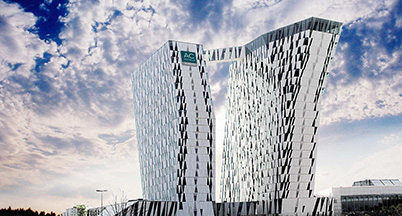
Copenhagen was a lot of fun. Judie barely made it out of the hotel and conference center, except for dinner, and then had to leave a day early (which was supposed to be her sightseeing opportunity). The hotel itself is one of the design landmarks of Copenhagen. It is located a bit outside of the city, but has its own station on the new Metro line, so you can get to downtown in about 15 minutes. A photo of the hotel is below. The rooms all have furniture by Danish designers. There is a bar on the top of one of the towers that we reached via that walkway on the top.

bella-sky.jpg

Miscellaneous thoughts: Since I don’t really have the time to write a real travelogue, It is easier to just give you some highlights and impressions:

  • The whole design thing is important in Copenhagen. There is an entire museum devoted to Danish design. I went there. It was pretty good. Lots of chairs. And there are many stores selling design items, be it furniture, jewelry, kitchen utensils, pottery or whatever. But the interior of the city is pretty old, with much of the architecture from the 1850-1920 period, I’d guess. Nothing too tall, which give the city a human scale. Not a whole lot of new architecture, except along the waterfront, which has some remarkable new buildings, like their new Opera House and the Library, called the “Black Diamond”, which is said to contain every Danish book every published.
  • The weather was unfortunately London-like (grey, slightly rainy and chilly). I don’t know why I was expecting nicer weather. I was traveling North. It was too bad because there is obviously the potential for lots of outdoor conviviality. And of course the gardens weren’t quite blooming and the trees were barely considering their leaves. Perhaps worst of all, the grey days muted the bright palette of the city.
  • I went to the re-opening of Tivoli Gardens, an old amusement park in the center of Copenhagen that supposedly inspired Walt Disney to create Disneyland. It is, of course, much smaller, but very pretty, even on a drizzly day. You could imagine what it would be like on a summer day, covered with flowers and jammed with customers, riding the various rides and eating at the many restaurants.
  • Copenhagen is very walkable. For one thing, it is essentially flat. And the downtown area isn’t all that big and it is possible to walk from one side to the other in about 30-40 minutes. The Metro system is pretty small, although they are in the midst of adding at least one new line, causing some ugly construction at what would be some of the lovely major squares. The cars are deigned to hold bicycles (although they aren’t allowed during rush hour). There are bike lanes everywhere, which are extensively used. There are just bikes parked everywhere. The Metro stations are surrounded by them.
  • I’m kind of sick of royalty and castles, so I skipped those sights. I did go to Amelienborg, which is a spectacular square made up of four palaces. They were supposed to be for rich merchants and other noblemen, but the royals took it over when their castle burned down and liked it so much, that the never moved back. The Queen still lives in one of them and, as a result, there are guards in funny uniforms in the square marching around. There was small and boring museum in one of the palaces, devoted largely to explaining and extolling the royal family, which goes back to the 900s.
  • That square is bisected by an avenue. At one end is a huge church. It was started with the idea that it would be made out of Norwegian marble. But that turned out to be too expensive, so construction stopped and it was left as ruins for almost 100 years (and much of the marble was stolen). Eventually, a Copenhagen businessman offered to finish it. My guess is that was a part of plan to surround it with expensive buildings, as the church is the middle of a square of beautiful buildings all clearly built together. The church is called the Marble Church, although there isn’t much marble in it. At the other end of the avenue is a beautiful park along the harbor (or rather what will be beautiful park in a few weeks), with the dramatic Opera House across the water.
  • I went on a boat tour the last day, fooled by the sun coming out briefly. But it disappeared as soon as we left and it was windy and occasionally spitting rain. I wanted to be outside so I could see better and take pictures and I almost froze. But it was a nice trip and I got to see the “Little Mermaid” statue and the canals of Christianhavn, which looks like a good place to visit. During the ride, I learned the the ubiquitous Bluetooth was invented by Norwegians and was named after Harald Bluetooth, Danish King in the early days, allegedly because Harald united Scandanavia in the same way that the technology unites different company’s apps and different hardware.

It would be nice to write more because Copenhagen was a nice trip and it looks like an extremely livable city. And I didn’t even get to the food scene and the restaurants we went to. It would also be nice to add some of the photos I took. But the taxi gets here at 7:00 tomorrow morning and I’m not finished packing.

Visitors and Travel

We’re getting ready to enter a really hectic period. We have travel planned, followed by lots and lots of visitors. I’m basically looking forward to it, but there is an element of dread as well. Ann Evan and Terry Stoeckert visited this week and it was great to see them. Having guest distracts me from writing or painting and their visit was no exception (although part of the problem this time was trying to get it together before we begin two weeks of travel). I’ve got to figure out balancing being a host for people I am anxious to see and still doing the artistic stuff that was my goal when I came here.

Ann and Terry were very relaxed visitors–no feeling that they needed to be out trying to see as much as they possibly could–so I let them go out on their own to see the Tate Modern and the Tower of London while I prepared for our trips. We did do a couple of great things:

Greenwich: Saturday was a lovely Spring day in London. A good day to be outside. So we decided to go the Greenwich, which is a reasonable ride from our flat. It was a bit mobbed and is a nice spot to visit. We saw the Cutty Sark, one of the last tea clippers that was retired and became a training boat for the Royal Naval Academy for many years. Very nice. But the highlight was the Royal Observatory. Created by Charles II (who we were familiar with from “Nell Gwynn”), it is on a spot picked by Christopher Wren on top of a hill with a magnificent view of London. The purpose of the Observatory was to try to figure out how to solve the problem of longitude, which would allow ships to know where they hell they were. I guess the idea was that if the stars were studied enough, you could somehow know where you were by looking up. It turned out that the answer was clocks. By looking at the sky, you can figure out the time where you are and the latitude. But it order to figure out the longitude, you had to know the time of the place where you started. By comparing the time where you are with the time where you started, it is possible to figure out where you are. The problem was that pendulum clocks could not keep time on the ocean. So Parliament offered a prize of £20,000 (an ungodly amount of money back in the late 1700s) to whoever could design an extremely accurate clock.

Ann Terry Greenwich

So the most interesting thing about the Observatory was the clocks. As you know if you read “Longitude” by Dava Sobel, this is the story of a man named John Harrison, a carpenter who was fascinated by clocks and set about to win the competition. He created four incredibly accurate clocks, each on an improvement on the previous one and, by the fourth one, had created a clock that lost virtually no time on a sea voyage to the British West Indies. The powers that be hated the fact that a non-scientist had figured this out and that it turned out that the answer wasn’t astronomical. They initially refused to pay Harrison the award, until King George III intervened. It is a great story (and a great book), which would take to  long to tell in detail. The really cool thing is that the Observatory has the actual clocks that Harrison built and they still work. It may sound stupid, but getting to see them was a thrill.

“Reasons to be Happy”: We went to the Hampstead Theatre and saw this play, written by Neil Labute, an American playwright of some note. It is the story of a divorced couple in which a crisis develops when the guy begins seeing his ex’s best friend, who is divorced from one of his best friends. The exposition is a bit long to explain these tortured relationships, but, by the second act, it gets going and was enjoyable and insightful. Interesting set and the usual good performances by some young actors. I particularly liked Tom Burke, who played the ex-husband trying to chose between his ex-wife and her appealing best friend, all the while trying to decide what he was doing with his life. In a lot of ways, he was the straight man who the other three characters played off and he played his part consistently low key and thoughtful, without getting the pyrotechnics that the other characters enjoyed. A few of the individual scenes were wonderful, although the play as a whole was a little uneven. It was the first play we’ve seen there that wasn’t wonderful, but it was still very good and a nice evening. (To make it better, we discovered a good restaurant near the theatre which I think will be regular spot.

Off to Copenhagen: As Ann and Terry left, we left for Copenhagen. Judie was at the Money 2020 Europe Conference and I went along for a ride. I’ve actually just returned and I may try to get in a blog about it before I leave for America tomorrow morning.