By the time we left Kedainiai, it was after 5:00 and I figured that Rimas would just take us back to Vilnius. But he suggested that, as long as Kaunas was on the way, we should just stop there and he could give us a driving tour. We recalled that Judie’s grandmother had said that it was her favorite city in Lithuania, so we agreed.
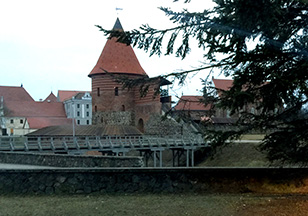
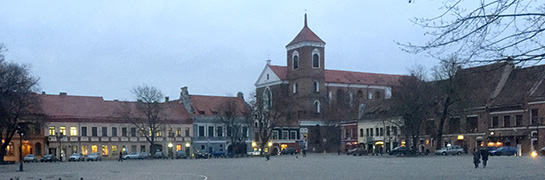
Kaunas: It was getting dark and we didn’t really have enough time to get much of an impression of Kaunas. It’s a fairly large city. We drove in through factories and other building that were probably built in the Soviet era until we reached the old part of the city. Rimas took us to the site of the old fortress, built along the river, which once guarded the city. Unfortunately, over the years a series of floods eroded the towers along the river and they finally collapsed, leaving a remaining complete tower and some walls. (Below) We then proceeded into the town and the main square, which was quite beautiful. (Below) We kept driving about looking at some lovely churches and other buildings. There is a well-known long avenue in Kaunas, which sounds a bit like the Ramblas in Barcelona. But by the time Rimas managed to get to place where you could drive across it (no cars allowed on it), it was so dark that it was hard to see much. A shame. While we were touring Kaunas, we were getting a running lesson on Lithuanian history and culture. One thing we learned is that basketball is the big sport in Lithuania (bigger than soccer) and that Kaunas is the leading basketball city with a huge new arena. The local team is one of the powerhouses in the European League and has been since the days of Arvydas Sabonis in the 80s. Sarunas Marciulionis was born in Kaunas and later played for the NBA’s Warriors. While there, he became friends with the Grateful Dead, which led to the Dead sponsoring the Lithuanian Olympic basketball team, resulting in their memorable tie-dyed warm-up suits. Lithuanian basketball has held a special place in my heart ever since.
Drive to Vilnius: It finally got too dark and too late, so we started back toward Vilnius. We stopped so that Rimas could get a snack and he bought some sour milk for us to try. This, believe it or not, is a Lithuanian specialty and is drunk (at least by Lithuanians) with most meals. I had the commercial version of the sour milk (Judie demurred), which tasted roughly like a mixture of sour cream and yogurt, only with the consistency of buttermilk. Rimas said the traditional version is left to sour naturally (rather than by adding something to speed the process), leading to more distinct flavors. One can only imagine….
On the road back to Vilnius, Judie, trying to make conversation, mentioned that we were thinking of visiting Russia. This led to a long diatribe from Rimas about how the Russians under Putin are thugs and that Russia is a mafia-like state that is not safe. Yes, he conceded, the Hermitage is a great museum, but go to the Louvre instead. If we want to meet Russians, he could introduce us to some, etc. This theme was repeated over the next two days (and was repeated by his wife). I think this reflects the history of Lithuania being invaded, dominated and abused by the Russians over the last several centuries. They are afraid of that happening again, especially after what happened with Putin in Crimea and the Ukraine. Putin justifiably scares the crap out of them and they are doubtful that NATO will protect them if push came to shove. An illustrative story: One the way back to Vilnius, Judie noticed that Rimas was running out of petrol (gasoline). She pointed it out and we came up to a Lukoil gas station, so she said, “Oh. You can fill up here.” but Rimas responded “Oh no. I can’t stop here. That’s Russian station.”
Arrival in Vilnius: As we pulled into Vilnius we stopped on hill to look to down at the old city. Since it was dark, the main thing we could see was a hill with three floodlit crosses. According to legend relayed to us by Rimas, the crosses commemorate the martyrdom of some Franciscan friars in the 1300s, who were murdered and thrown in the river. The crosses, which were first built in the 1600s are perhaps a form of atonement. They disappeared for a while while the Tsarist Russians were in control, were rebuilt but were then torn down by the Soviets (beginning to notice a pattern?) and then replaced after the collapse of the Soviet Union in the 1990s.
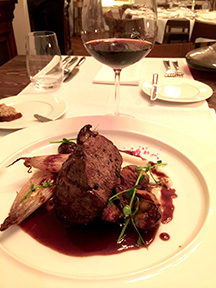
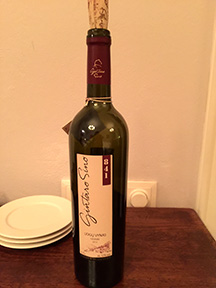
We then drove to our hotel, which was right in the heart of the old city. It was a bit hard to get there, since the whole city was setting up for the Fair of St. Casimir and many of the streets were either closed or partially blocked by stalls. We finally got to the Hotel Narutis, which is a wonderful boutique hotel that couldn’t possibly have been nicer. For dinner, they suggested Ertlio Namas, a nearby restaurant in an old historic building. We went expecting some type of heavy Eastern European food and were pleasantly surprised to find an elegant restaurant specializing in old Lithuanian recipes (although this had to be food served to royalty). The menu noted the date for each recipe. There was a nice wine list and, noticing our interest in the wine, our waiter brought us a sample of Lithuanian wine and glasses of Lithuanian dessert wines at the end of the meal. It was a fabulous night, but we paid for it the next morning.
Next Chapter: Fair of St. Casimir and our trip to Trakai
 nickinshoreditch