Miscellaneous Musings on Easter Weekend

Brighton and Easter Weekend: It is odd that a country this a-religious would have a four-day Easter weekend. I suppose I can understand making Good Friday into a holiday, since this was (historically at least) a very Christian country (although if you prayed the wrong way at the wrong point in time, you could be in deep trouble). But the Monday after Easter? I can only assume that the labor unions negotiated it as a holiday at some point and it became wired into things.

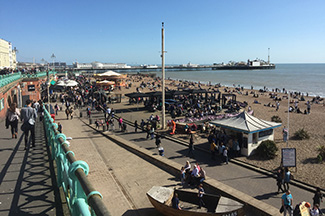
We decided to spend part of the weekend in Brighton. It is only an hour by train from London Bridge Station and the trains run all the time. Good Friday was a beautiful day and the trains were just packed. We thought maybe lots of people would get off at Gatwick Airport, but it turned out the masses were going the same place we were. After dropping our luggage at our hotel facing the beach, we wandered about. Calling Brighton’s sea shore a beach stretches the definition if you consider a beach to be made of sand. It is mostly large pebbles and there was a big construction project going on along the top of the beach, in front of where there a string of restaurants and pubs built-in underneath the promenade. All eateries were jammed and we ended up at place that had service that went from terrible to awful to infuriating to “Fawlty Towers”. (You literally could not have had worse service if you were scripting it to be intentionally terrible. Which kind of saved the meal, since it would have otherwise been so annoying that it might have spoiled the whole day. We left more amused at their utterly spectacular incompetence than angry.)

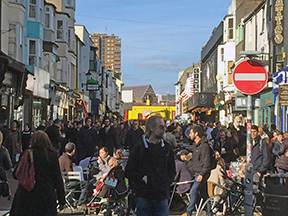
We spent the rest of the afternoon strolling through the cute little streets of the town (The Lanes and North Laine), which were mobbed with shoppers and gawkers on a sunny day. (Although it was in the mid 50s℉, a lot of the Brits treated the sudden appearance of sun and relative warmth as a chance to wear shorts and tee shirts.) There were all sorts of little stores and places to eat and drink. There is along pier that is sort of a poor man’s Coney Island, which we walked along to view the sunset and take too many pictures. We found some nice pubs and a very snazzy wine bar and ended the night at a lovely seafood restaurant.
Brighton1   Brighton2

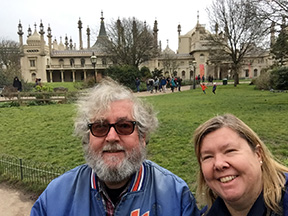
The next day, we went to visit the Royal Pavilion, a summer estate built by King George IV (and started while he was the Prince Regent) as a sort of pleasure palace. It is quite a spectacular and eccentric design, with a number of onion-shaped domes and increasingly ornate rooms, all designed in a “Chinese” style. It was set up for George and his friends to have endless parties. Poor George was stuck with a crazy father and indifferent mother, was forced to marry a woman he ended up despising and ended up grotesquely overweight and miserable. He became so heavy that he had to have a special bed constructed to slide him out and he had a tunnel dug to his stable there because he was embarrassed to have people see him walking over to see his horses. His only daughter, who he did love, died in childbirth (or we’d be referring the latter half of the nineteenth century as the Charlottean Era.) His successor kept using the Royal Pavilion, but Queen Victoria had no use for it since it was designed for a dissolute bachelor and not a proper queen with ten kids. So she stripped everything of value out of it and sold it to the City of Brighton. They eventually restored most of it (although the work is still going on) and a few of the original pieces have been lent back for display by QE II. There were a number of contemporaneous paintings of it, so it is an accurate reproduction. The renovation of the Music Room was in process when it caught fire in the 1970s and, just when it was almost re-renovated, the top of the dome over it broke off in a huge storm in the 1980s, crashed through the dome and ornate ceiling and embedded itself in the floor. But it is now done and you can lie on the floor and look up at the ceiling.
Brighton3   Brighton4

Saturday had turned into an extremely blustery day by the time we left the Pavilion and most of the big crowds were gone. I guess they had mostly come down as a day trip. We had a spectacular lunch at a place called Riddle and Finns (as wonderful as the prior day’s lunch had been comically bad), overlooking the beach and the bundled up Brits walking through the gale (although there were a few hardcore loonies who were sill in their shorts and tee shirts). Then it was back to the train for our return to London where we met Jenny (visiting from Montclair) and Phil Saunders for a relaxing dinner.

On Easter (the next day), we went out to Pleshy to visit Jane and Paul Gee and their family. It was really very nice of them to invite us to another family  occasion. We were a bit late because I decided we needed to bring something and and had to make some bruschetta, which ended up tasting and looking beautiful. We were further delayed when we learned that the train we normally take there had been closed for repairs. (This happens all the time. So much so, in fact, that British Rail and London Transport send out a weekly announcement detailing which lines are going to closed or delayed on which days.) Lovely lamb roast, too many cakes and some nice wines (in particular the ’03 and ’04 Chateau Batailley). During post-dinner tea, we watched “The Race”, which is the crew race on the Thames between Oxford and Cambridge. It seems to be a rally big thing here (or maybe it only is if you went to schools like Oxford or Cambridge). Still, it is televised extensively, with replays and analysis and summaries on the nightly news. We closed the day with a stroll to the Leather Bottle for a “cleansing ale” and then returned to London (via the Stansted Airport train).

Sports on British TV: Writing about the boat race on the Thames, which is treated like March Madness, reminds me of just how different sports coverage is here. There is no hint of the NCAA Tournament and no one seems to know about it. It is never even mentioned on the news, even the fifteen minute wrap ups shows. And I guess it is possible to watch some NBA games if you have the right cable package, but I don’t. It also gets no coverage and it will be interesting to see if the NBA Playoffs gets any attention. As for ice hockey–really, are you joking? Baseball gets no coverage either. American football (“gridiron”) is covered in some detail, as is the PGA (golf being a British thing after all).

So what do you get on British television? Well, there is tons of soccer, a lot of it not even good soccer. In addition to Premier League coverage, there are minor league games, games from various European leagues and from Scotland and Wales, replays of past games, highlight packages, reminiscing about past seasons or stars, and even MLS games from North America. It reached the point where I was flipping through the channels and found Sky Sport 5 covering two guys paying the FIFA soccer computer game! When soccer isn’t on, it is lots of rugby (a number of tournaments and leagues from around the world) and cricket (test matches, one day matches and the current innovation–20/20 cricket). And cricket is a summer game, so there will be more to come. There is professional netball (imagine women’s basketball without backboards or dribbling), professional badminton, endless darts tournaments and snooker contests and lots of golf and some tennis. I have at least yet to be subjected to lawn bowls, as I was in Oz, but maybe that is just in the summer. Oh and the British seem to love boxing, which is a dead sport in America, so there is lots of boxing and professional wrestling televised, but, mercifully, mixed martial arts has not taken hold here yet.

Talking about television and sports reminds me that Joe Garagiola recently died. If you are a baseball fan of a certain age (like my age), this has to have some resonance for you. He really was the voice of baseball for a period in the 60s and 70s and he went on to do some important things. For me it was a moment to be noted and it reminded me of something that I read from Garrison Keillor about living overseas. The problem with living overseas, he wrote, is that you find out that your favorite player, Harmon Killebrew has died and you can’t find anyone who even knows who Harmon Killebrew was. So it was with  Joe Garagiola: a minor moment of introspection and slight grief/memory moment that could not be shared since the common cultural background was missing.
 

Thoughts and Updates and the Evolution of a Painting

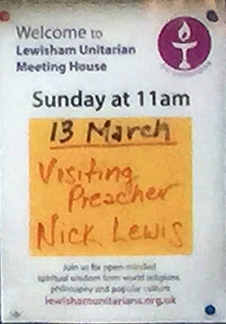
Preacher Man: On the 13th, I led the service at the Unitarian Church in Lewisham. I’ve talked about this plan in earlier posts. When I got there, there was a notice on the sign out front, announcing “Visiting Preacher–Nick Lewis”. See below. I’ll never see that again. The service went OK. There were only six people there and, as Andy told me later, when that happens, you don’t have any energy coming back at you. That was the case for me. They all sat there quietly (excepts for the Rabbi/Pope story, which got a laugh). At least they seemed to be listening. I had to provide the music interludes and do the meditation, so it was a lot of organizing. My sermon was essentially about growing the Unitarian movement through a commitment to social action. Between the Lewisham service and may talk on Law and Justice at New Unity, people have asked me lately if I am interested in being a minister. The answer is emphatically not.

Lewisham

British Political Update: One has to wonder if Chancellor George Osborne can survive his latest mess. You may recall that back in the fall he had to back down from a plan to balance the budget but cutting tax credits for poor people, a concept so cruel that the House of Lords (of all people) felt compelled to block it. This time he decided to help balance his budget by cutting benefits to the disabled. (A pattern is becoming obvious here.) All hell broke loose, the Minister for Welfare and Benefits resigned the cabinet and the Tories had to send out the brand new minister to say that they were taking it back and had no further plans to cut welfare benefits. For Osborne, it is bad enough that he must be universally viewed as heartless (although that is not, in itself, a problem for most Conservatives). It is far worse that he must now be seen as incompetent, at least politically. Great days for Boris Johnson and his plans to succeed Cameron (perhaps as soon as this year), since Osborne has been seen as Cameron’s heir apparent.

Underlying all of this is the vicious infighting in the Conservative Party over Brexit. Every day features a new claim or dispute and they are all starting to merge together. And much of the news coverage is not about the actual impact of leaving the E.U., but the soap opera that the Tories have become. Indeed, the resignation of Ian Duncan-Smith from the cabinet, which I referred to above, was immediately seen through the lens of Brexit, since “IDS” as the tabloid headline refer to him, is one of the leading Eurosceptics and the head of the Brexit wing of the party. The Labour Party is, of course, delighted by the endless internecine mudslinging and take every opportunity to point it out. One wonders if this will have any real impact on the balance of support for the parties, but it may be that Corbyn has been pushed into a box where he will not be able to actually capitalize on this mess. The thing is that this is a huge decision point for the U.K. and the whole thing is obscured by politics.

Meanwhile, U.S. politics is just depressing. At least Obama’s visit to Havana is a positive thing.
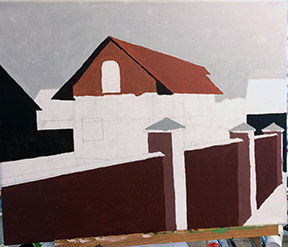
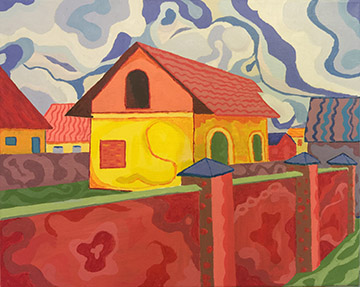
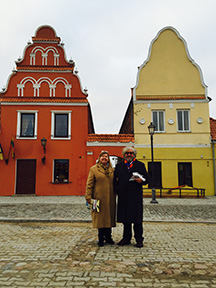
Evolution of a Painting: In doing the art I have been doing here, I sometimes feel that the process of creation is at least as interesting as the final result. I’ve just finished a painting that went through quite an evolution. It started out with a photo of some houses in Kedainiai in Lithuania. So I started the painting and reached a point where I just wanted a change. Below is the photo and the initial painting:

Kedainiai Painting 1        Kedainiai Painting 2

I liked the composition of the painting, but I found the colors boring and didn’t feel like doing a painting in all grays and browns. So I started looking through my “art ideas” file and came upon a photo I had taken of a painting at the National Gallery (I think). It is by someone like Kandinsky. See Below. I decided to use that as an inspiration and ended with the final product, which you can see right under this paragraph. It was fun to paint and I think the result is striking.

Kedainiai Painting 3     Kedainiai Painting 4


That Was The Week That Was

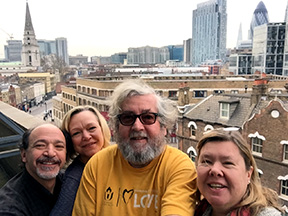
Karen and Jerry Fried visited over the past week and it was wonderful having them here. (The only drawback was that I didn’t have much time to write or paint.) Looking back, we did quite a bit, especially considering that they decided that they had already done the big tourist things. So we went out to eat at some of our favorite places (Lyles, The Rivington Grill, Dosa World, Sheekey’s Oyster Bar, The Modern Pantry) and saw some art (a display of planetary photography at the Natural History Museum and they went to see the Calder show at Tate Modern, which I had seen twice), went to the wonderful Churchill War Museum in the bunker under Downing Street and just generally walked around. It was a busy week. Some highlights follow.

Frieds

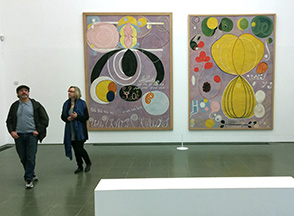
Two Museums in the Park: One thing that Karen definitely did want to do in London was go to and exhibit of paintings by Hilma Af Klint at the Serpentine Gallery, which is right by the Serpentine (a kind of lake in Kensington Gardens). Hilma was a Swedish artist and mystic with a fascinating story. She was influenced by Darwin and Rudolf Steiner and went through a period where her works were the result of automatic writing. She did not allow her works to be exhibited until twenty years after her death and it turned out that the first exhibit was not until 1986, over forty years after her death. So it was little wonder that I was unfamiliar with her. The exhibit covered a period from 1905 to 1922, her most significant period. Af Klint was probably the first modern abstract painter and created art in styles that the Dadaist and Surrealists didn’t get to for decades. They really were astonishing works, which were done in four or five series of works. And the exhibit often contained the complete series of paintings. It was all extremely memorable, especially one room which contained eight huge works, depicting childhood, youth, adulthood and old age. I’m not sure the picture below really captures the work:

Hilma

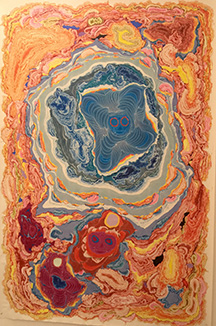
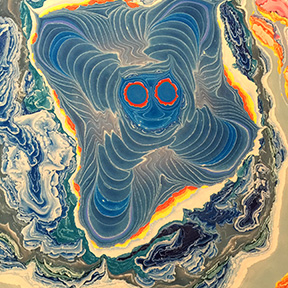
After than museum, we walked across the foot bridge over the Serpentine from Kensington Gardens to Hyde Park, where you find the Serpentine Sackler Museum. It had an exhibit called “Das Institut”, so we went, not expecting much. We first found a nice restaurant next to that museum. It was a lovely early spring day (perfect for a walk through the park), so we ate outside and had some very nice food basking in the sunshine. Once inside, we discovered that the exhibit was about a group of varied German artists who have joined together. Some of it was very good and some of it was of the head-scratching variety (“What is the point of this?”). There was a lot of boring neon stuff, but there were some very cool works that were made by swirling a special ink on top of water and then placing paper on top to absorb it. There was also some interesting glass art and some nice multimedia stuff. See below for a look one of those ink pieces.

Das Inst    Das Inst2

Two Plays: While Karen and Jerry were here, we went to two plays. (This was what they had gotten as winner bidders at the UU Montclair Auction.) The first was a new play by Wallace Shawn, “Evening at the Talk House”, playing at the National Theatre. On its face, it was a play about a reunion of a theatre group ten years after they had put on a play by the playwright/narrator. But you soon found yourself in a weird dystopian world in which theatre had been outlawed by the current leader and everyone who wasn’t famous amused themselves by targeting other people for death. There was tortured speeches justifying all of this activity as protecting society from dangerous people. (It was disturbing and strange, but how far is it from drone strikes that we use to kill those deemed a danger to the US?) Wallace Shawn was in it as a derelict actor whose friends had repeatedly beaten him as a warning (which he appreciated). The play was complicated and had a menacing feel. It all made for an uncomfortable and somewhat horrifying evening of theater and the reviewers either liked it or really hated it. On balance, I liked it. It certainly made one think.

Two nights later, we went to a play at the opposite end of the theatrical spectrum. We went to the West End and saw “Nell Gwynn”, a show that had originated at the Globe Theatre. It stars the utterly delightful Gemma Arterton (who I would say is soon to be very famous). I understand it is headed for NYC shortly. (Go and see it.) Set in Restoration England, it is based on the actual story of Nell Gwynn, who literally rose from the gutter (Cheapside) in a real-life Cinderella tale. She became one of the first women to appear on stage in London theatre, where King Charles II saw her perform and fell in love with her. She became his mistress and they had two children together. (The direct descendant of one of her sons has written a biography of her.) Their love affair lasted until Charles’ death. Nell died 18 months later, having been protected by him from poverty. Aside from Arterton, there were any number of great performances, with the King (David Sturzaker) and Nancy (Nell’s dresser and friend, played by Michele Dotrice) being particularly memorable. It combined music, some wonderful bawdy humor (and a few political jokes that they may need to change for American audiences) and a sort of joyful energy. You simply had to leave the theatre smiling.

Two dinners: While we were at it, we had two dinner parties while Karen and Jerry were visiting. Our other friends from UU Montclair, Scott and Jackie Leahy, were also visiting London and we wanted to get together for a meal so we decided to invite them over to the flat. We went to Borough Market to do some shopping and had a great time. My favorite greengrocer had all kinds of wild mushrooms and obscure vegetables. We got Monk’s Beard, various mushrooms and exotic Italian lettuces with bright colors. The we stopped at my favorite butcher and got pigeon breasts, venison steaks and wild boar and apple sausages. (We went a bit overboard.) We also did some cheese tasting (there was a stand specializing in blue cheeses soaked in various Italian dessert wines) and tried some olive oils and balsamic vinegars, stumbled on an Italian honey tasting and bought fresh bread. It was quite a meal, including some nice wines and a sparkling wine from England.

Two nights later we had the New Unity minister over for dinner. I made a potato and cabbage gratin (Andy is a vegetarian) and Judie made an chicken and artichoke dish (his wife, Miriam, is an omnivore). Karen made a salad and Andy and Miriam brought a delicious cake. It was great fun and all six of us got along famously. It was nice to get better acquainted.

More to come…..


Lithuania, Part 5

It was fun, but I’ve got move on. The Frieds arrive for a  visit within hours and I have other stuff I need to write about.

Our Sunday in Vilnius was mostly about shopping and leaving. We spent a lot of time wandering about the fair, sometimes accompanied by Rimas, who took us to his favorite vendors. It seemed like many of them come every year and he seemed to know a few of them. (Or it could have just been his gift for gab. He is extremely outgoing and loves to strike up conversations with people.)

We had planned to take the funicular up the hill to  the fortress on top that had guarded Vilnius for centuries, but it was closed and we didn’t have time to make the climb. It had been fairly intact until World War II, Rimas said. But then the Germans sensibly decided that it would be a great defensive position and put some big guns up there and the Russian destroyed most of it. There is a dispute about whether it should be renovated to its former glory or left as is. Actually there is little physical sign of the War in Vilnius, except for a library by the river, where the scars of bullets were left alone. Rimas really wanted to show us that.

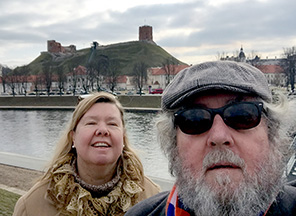
We did go to the castle that was at the foot of the hill that had the fortress atop it. It was reconstructed somewhat and is mostly dedicated to Lithuanian history, in more excruciating detail than we had time to read. It was nicely done and clearly researched to recreate the look and feel of the castle back in the day. It is still continuing. For example, they have put in these impressive wooden ceilings that get more intricate as you get closer to the throne room. The plan is to paint them, using period colors and designs. And they recreated the big stoves used to heat the rooms, based on ceramic fragments found in the rubble. There was a concert happening in the ballroom (or some big room) there, but we had to meet Rimas and family and could only stay for a few pieces.

vilnius1

A final highlight was going to the Franciscan church that Rimas and family attend for an evening mass. (The Soviets had used it as a warehouse, but the altar and other pieces must have been pushed to the back, as it seemed pretty intact.) His wife Dellia leads the choir and also would lead the congregation in the hymns. She has a great voice and played some kind of old Lithuanian folk instrument when the choir sang Lithanian folk songs prior to the service. The church was also having an art show in a room that was probably a chapel or something for the monastery. We also stopped at an Orthodox Christian church on the way. We learned that they have no seating and everyone stands for the whole service and that for much of the service the minister is behind a screen.

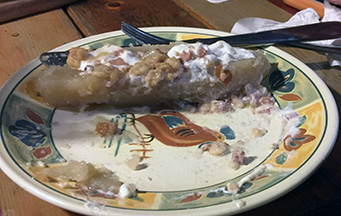
After the mass, we went to dinner with Rimas and Dellia. We ate potatoes that were somehow stuffed with ground meat. The English word for them is zeppelin, based on their shapes, as they are definitely not lighter than air. Judie got some last-minute shopping in while we were waiting for a table. It was cold and Dellia bought her a traditional scarf. When Judie put it on, she was actually transformed into a Lithuanian and people would come up and talk to her.

vilnius2     vilnius3

It would be nice to return some day for another visit. But when it is warmer…..

Lithuania, Part 4

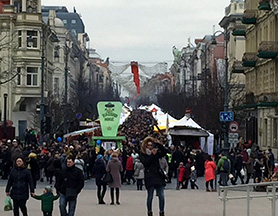
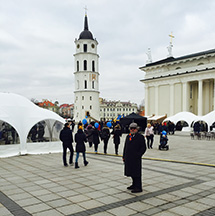
We finally staggered out of the hotel the next morning (slightly hungover) and found ourselves right in the middle of the Fair of St. Casimir. The fair is held every year on the weekend nearest to Casimir’s birthday (March 4th). It was, of course, banned during the Soviet occupation, but has now come back with a vengeance, according to Rimas. It is enormous, radiating out the main streets from Cathedral Square (which is the central square of old Vilnius). It was unbelievably crowded, which was impressive since it seemed like everyone there was Lithuanian. It is not a tourist destination, for some reason, and anyone who wasn’t a native seemed to be there by happenstance, like we were.

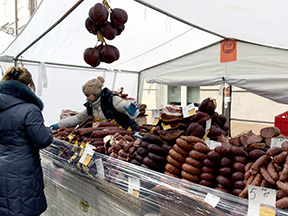
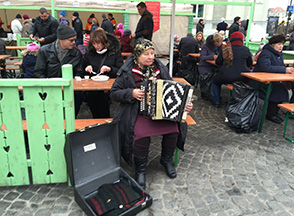
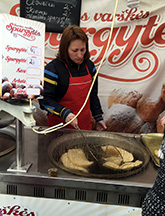
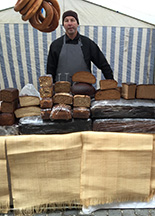
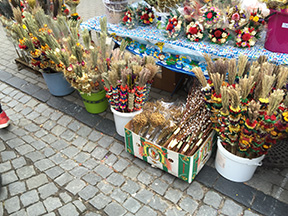
There was tons of stuff to buy. Lots of sausages, smoked meats and fish, cookies, pastries, loaves of rye and brown bread, local beers, wooden carvings, jewelry, traditional clothing, intricate bunches of dried flowers in all sizes, woolen or sheepskin slippers and shoes, paintings and artwork. There were musicians everywhere and stands selling snacks. In Cathedral Square, there was a stage that had singers and dancers performing all day long. Pictures don’t really do it justice, although some follow. Rimas, of course, had strong opinions about which stands had the best and most traditional goods. It was great fun and we kept going back (actually, one couldn’t avoid it).

feast1  feast3  feast6    feast2  feast4  feast5   feast

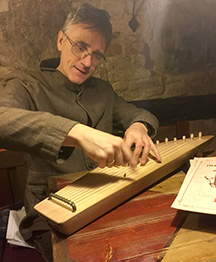
Trakai: Around noon, we met Rimas and his family for a trip to Trakai. He advised us that you simply cannot come to Lithuania with out going there. With him were his wife Dellia, his fifteen year old daughter, whose name sounded like Lucia, his eight year old daughter Elsa and his six year old son Gita. (These are all shortened versions of their longer full names and I have probably gotten the spelling all wrong.) There are three older sons. Alex’s friend from Oxford is now married and is getting a PhD in Sweden, the second son is also married and is at graduate school at Vilnius University. And the third son is an undergraduate at Oxford. (The fourth child, Lucia, is in high school and wants to go to Oxford or Vilnius U.) This is an absurdly accomplished family and we had to resist the temptation to jump to conclusions about Lithuanians based on them. Anyway, all of us piled into their big van and headed off. We exchanged stories about our families on the drive and learned that son #2 and son#3 have a folk group that was playing in Oxford and London that weekend. The name of the band is Kujeliai, which means something significant, but I’ve forgotten the story. If you search hard enough on the internet, you can find a recording of one of their songs, which are all in Lithuanian. They have a very professional looking CD, which came out last year, so it is slightly surprising that we couldn’t find it. Getting back to the main story, we expressing interest in the music and they put the CD on the car sound system. After a minute or so, the two little kids were singing along in the back seat and within another couple of minutes the parents joined in.

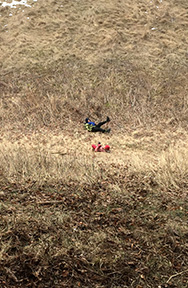
We stopped at old Trakai, which was where the rulers built the first of three castles. Rimas told us that the kings and dukes had built a string of castles and fortresses, spaced about 27 km (I think) apart because that was about how far a horse could go without stopping. That first fortification had been built up on a big hill and surrounded by a moat. But they found a better spot nearby on a peninsula and built a second castle. This is where Trakai is today. The first castle fell into disrepair and was eventually demolished to build a church and monastery and probably some other buildings. We were up on this big steep hill and Rimas was giving us a history lesson about where the moat had been and how much deeper it had been, when his two youngest kids suddenly hurled themselves down the steep slope and rolled and bounced to the bottom. We were startled and a bit concerned but he took it in stride explaining that they had a lot of energy.

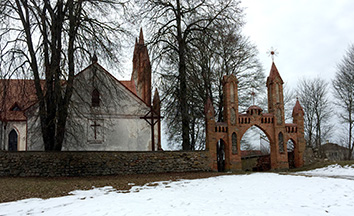
Old trakai    old trakai2

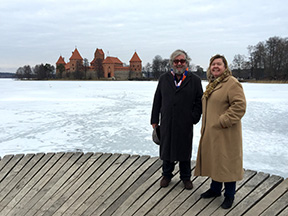
We proceeded on the Trakia, with Rimas explaining the local architecture and in particualr how you could tell the Jewish houses from the Karaite houses (Trakai was the major settlement for those Crimean Jews) from the homes of the regular Lithuanians. It is all about the shape and the number of window facing the street. As I recall, three windows means Karaite and the jewish houses were squarer, usually had two windows and were more often made of brick. Trakai is built on a small strip of land between two large lakes and is quite striking. We decided to skip castle #2 and proceed to castle #3, which is the most famous one. It was built on an island in the lake and was connected to the second cast by a long wooden bridge which would be burned if they were under attack. Nobody ever even tried to attack the castle, although the eventual advent of longer-range canons would have made it possible. We stopped for lunch in a very old and pretty restaurant on the lake. No eating outside though. It was quite cold and, as you can see from the photos below, the lake was frozen. We had Karaite meat pies for lunch. Very tasty.

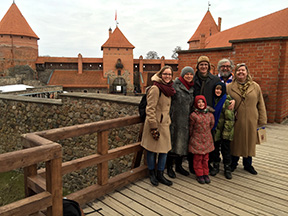
Th main castle itself was extremely beautiful. We took the tour through its many rooms. One of its innovations was a form of central heating in which large fires were lit in the basement and heat and smoke was channelled up trough the wall and under the floors, heating the rooms. The rooms had most likely been brightly painted with various scenes, but there is only vestiges of them left. The most impressive was a large hall in which the rulers had held court. Rimas said that he had been involved in Lithuania’s first international bond issue after independence from the Soviets and that the documents had been signed in that room. It is also used for concerts. To illustrate the point and the lovely acoustics, the eldest daughter began to sing a famous Lithuanian folk song. She was joined by her mother and they sang together in perfect harmony. The both have lovely voices and it was one of the more memorable moments of the whole trip. By the time they finished, a crowd had gathered, possibly thinking this was a scheduled act, and applauded when they were done. Here are some photos, which include the whole family.

trakai2   trakai1  trakai4

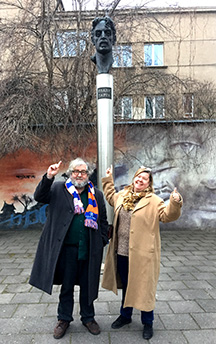
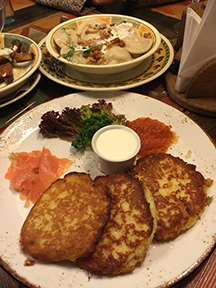
Peaches en Regalia: We drove back into Vilnius to drop us back near the hotel. On the way back, Rimas asked if we wanted to see the statue of Frank Zappa. I had heard of it. It had been erected in 1995, after Frank’s death and I think was supposed to reflect Lithuania’s freedom somehow. (As far as I know, Zappa was not at all Lithuanian.) We of course said yes and the obligatory photo is below. That evening we walked around trying to find a restaurant (after taking a nap), got lost and ended up in the old jewish ghetto. Old, narrow streets and old buildings. A few cute squares. We will have to return when it is day light. Next trip. We ended the day eating koldunais (dumplings), herring, fried rye bread with cheese curds and potato pancakes with smoked salmon at a restaurant specializing in Lithuanian peasant food. (Judie’s grandmother memorably make us koldunais once. I took a video which I think was played at her funeral.)

zappa     koldunais

Lithuania, Part 3

By the time we left Kedainiai, it was after 5:00 and I figured that Rimas would just take us back to Vilnius. But he suggested that, as long as Kaunas was on the way, we should just stop there and he could give us a driving tour. We recalled that Judie’s grandmother had said that it was her favorite city in Lithuania, so we agreed.

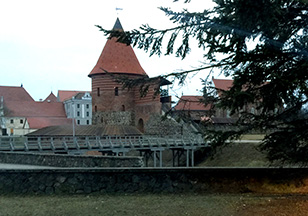
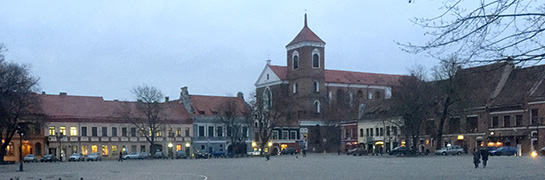
Kaunas: It was getting dark and we didn’t really have enough time to get much of an impression of Kaunas. It’s a fairly large city. We drove in through factories and other building that were probably built in the Soviet era until we reached the old part of the city. Rimas took us to the site of the old fortress, built along the river, which once guarded the city. Unfortunately, over the years a series of floods eroded the towers along the river and they finally collapsed, leaving a remaining complete tower and some walls. (Below) We then proceeded into the town and the main square, which was quite beautiful. (Below) We kept driving about looking at some lovely churches and other buildings. There is a well-known long avenue in Kaunas, which sounds a bit like the Ramblas in Barcelona. But by the time Rimas managed to get to place where you could drive across it (no cars allowed on it), it was so dark that it was hard to see much. A shame. While we were touring Kaunas, we were getting a running lesson on Lithuanian history and culture. One thing we learned is that basketball is the big sport in Lithuania (bigger than soccer) and that Kaunas is the leading basketball city with a huge new arena. The local team is one of the powerhouses in the European League and has been since the days of Arvydas Sabonis in the 80s. Sarunas Marciulionis was born in Kaunas and later played for the NBA’s Warriors. While there, he became friends with the Grateful Dead, which led to the Dead sponsoring the Lithuanian Olympic basketball team, resulting in their memorable tie-dyed warm-up suits. Lithuanian basketball has held a special place in my heart ever since.

Kaunas1   kaunas2

 Drive to Vilnius: It finally got too dark and too late, so we started back toward Vilnius. We stopped so that Rimas could get a snack and he bought some sour milk for us to try. This, believe it or not, is a Lithuanian specialty and is drunk (at least by Lithuanians) with most meals. I had the commercial version of the sour milk (Judie demurred), which tasted roughly like a mixture of sour cream and yogurt, only with the consistency of buttermilk. Rimas said the traditional version is left to sour naturally (rather than by adding something to speed the process), leading to more distinct flavors. One can only imagine….

On the road back to Vilnius, Judie, trying to make conversation, mentioned that we were thinking of visiting Russia. This led to a long diatribe from Rimas about how the Russians under Putin are thugs and that Russia is a mafia-like state that is not safe. Yes, he conceded, the Hermitage is a great museum, but go to the Louvre instead. If we want to meet Russians, he could introduce us to some, etc. This theme was repeated over the next two days (and was repeated by his wife). I think this reflects the history of Lithuania being invaded, dominated and abused by the Russians over the last several centuries. They are afraid of that happening again, especially after what happened with Putin in Crimea and the Ukraine. Putin justifiably scares the crap out of them and they are doubtful that NATO will protect them if push came to shove. An illustrative story: One the way back to Vilnius, Judie noticed that Rimas was running out of petrol (gasoline). She pointed it out and we came up to a Lukoil gas station, so she said, “Oh. You can fill up here.” but Rimas responded “Oh no. I can’t stop here. That’s Russian station.”

Arrival in Vilnius: As we pulled into Vilnius we stopped on hill to look to down at the old city. Since it was dark, the main thing we could see was a hill with three floodlit crosses. According to legend relayed to us by Rimas, the crosses commemorate the martyrdom of some Franciscan friars in the 1300s, who were murdered and thrown in the river. The crosses, which were first built in the 1600s are perhaps a form of atonement. They disappeared for a while while the Tsarist Russians were in control, were rebuilt but were then torn down by the Soviets (beginning to notice a pattern?) and then replaced after the collapse of the Soviet Union in the 1990s.

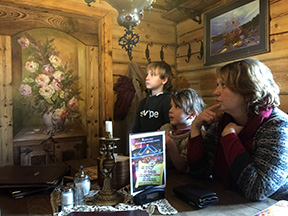
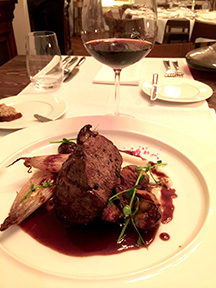
We then drove to our hotel, which was right in the heart of the old city. It was a bit hard to get there, since the whole city was setting up for the Fair of St. Casimir and many of the streets were either closed or partially blocked by stalls. We finally got to the Hotel Narutis, which is a wonderful boutique hotel that couldn’t possibly have been nicer. For dinner, they suggested Ertlio Namas, a nearby restaurant in an old historic building. We went expecting some type of heavy Eastern European food and were pleasantly surprised to find an elegant restaurant specializing in old Lithuanian recipes (although this had to be food served to royalty). The menu noted the date for each recipe. There was a nice wine list and, noticing our interest in the wine, our waiter brought us a sample of Lithuanian wine and glasses of Lithuanian dessert wines at the end of the meal. It was a fabulous night, but we paid for it the next morning.

ertlio2     ertlio

Next Chapter: Fair of St. Casimir and our trip to Trakai

We Interrupt this Travelogue for a Message

As many of you may know, when we moved, we rented our house to a seemingly nice couple. Let’s just say first impressions aren’t always correct. They moved out, hired a lawyer and, after some ugly and depressing months, they left permanently. We’ve been trying to re-rent the place, which isn’t so easy in the wintertime.

We just signed a lease with new tenants and are hoping to be luckier this time. The good news is that we are going to stop bleeding money and we don’t have to worry about our home standing empty. The bad news is that the lease it for one year (although we gave them an option to leave early by giving notice), so we won’t be able to move back into it until March of next year.

This was not part of our plan, in which we envisioned returning to Montclair in time for Thanksgiving 2016. So things didn’t go as we expected, and there are certainly worse things than spending some extra months in London. But we really did want to be back in familiar places with all of our friends. Of course, we could come back and rent a place in Montclair or maybe do a house trade or something. We are hopeful of spending the Holidays in New Jersey this year, one way or the other.

This nice thing is that we are about to enter a period in which we are going to have lots of visitors. We are almost completely booked until the end of June! And we will both be back in mid-April for about a week (although Judie will be going to L.A. and Orlando and NYC for business), so that combination should deal with our feelings of homesickness. It should be fun.

And now, back to the travelogue.

Lithuania: Part 2

After went left Kedainiai, our lessons under the tutelage of Rimas began in earnest. Alex had warned us that when he was visiting with his friend (Rimas’ eldest son), they would get detailed instructions on what they were to see each day and would then be quizzed upon their return. So I did some studying before we left. Before resuming the travelogue, here are some of the things I learned. (Hope it isn’t too boring!):

The Last Pagan Country: Lithuania was the last holdout in Europe to Christianity (or to Islam or Judaism for that matter). It didn’t happen until 1387. This made Lithuania a target of crusades by the Teutonic Knights, who spent several hundred years attacking Eastern European countries and acquiring territory in the name of Christianity.

The Biggest Country in Europe: Around the same period, through a combination of diplomacy, marriages and wars, Lithuania became the largest country in Europe. It comprised most of what is now Belarus, the other Balkan states and a large part of Poland. (Rimas told us that Latvia and Estonia had no real history and were creations of other powers, which is essentially right, if a bit Lithuanian-centric. They both had a separate ethnic identity but never existed as independent states until they were created in 1918.) During this period the country was ruled by someone who was the Grand Duke of Lithuania and the King of Poland. From this peak, the country gradually shrunk, under attack from the Tartars and the the Muscovites from the East and groups like the Teutonic Knights from the West.

The Battle of Grunwald: This was one of the biggest and most important battle in the history of Medieval Europe. It has incredible resonance in Lithuania and Poland and altered the course of history. But people in the West have never heard of it. Despite the conversion in 1387, the Teutonic Knights continued their campaign against Lithuania/Poland. In 1410, this all culminated in the battle between the Knights and the Polish and Lithuanian armies. The Knights first attacked the Lithuanian Army and after hours of fighting, the Lithuanians retreated. (The interpretation of this is contested. Some view it as a simple retreat. This is certainly the Polish view. However, Rimas told us the Lithuanian version, which is that Lithuania had learned this tactic in battling the Tartars, who employed it to great effect. It requires great discipline to retreat and then re-form, rather than simply fleeing.) The Teutonic Knights, believing that they had routed the Lithuanians, then turned on the Polish Army and were engaged in battle with them when the Lithuanians returned and attacked them from behind. The Teutonic Knights were essentially completely wiped out. Prussia could probably have been taken, but it was left to survive. But Prussia ceased to be threat or a force in Europe until Bismark, hundreds of years later.

Saint Casimir: He was the younger brother of one of the rulers of Lithuania and Poland. He had short and unsuccessful military career as the equivalent of a prince and concentrated more on doing good works and being generally pious. He died at a young age, probably of tuberculosis. The event that lead to his sainthood occurred about 30 years after his death. Polotsk is a city in what is now Belarus. In the early 1300s, it was absorbed by Lithuania. In 1518, it was under siege by the Muscovite army, in one of the endless number of Lithuanian-Muscoite conflicts. The Russian attackers ran out of food and had to cross the river to find some. This permitted the Lithuanians to reinforce Polotsk and their force then went out to attack the Russians. But they could figure out how to get across the river until a mysterious figure on a horse (you guessed it–the long-dead Casimir) showed up, led them across the river and disappeared. A Lithuanian ruler later petitioned Rome for sainthood for Casimir based on this “miracle” and about a hundred years later it was granted. He is now the Patron Saint of Lithuania and is generally pictured holding lilies, a symbol of purity. There is a miraculous three-handed painting of him in the Vilnius cathedral. According to legend, the artist had tried several times to paint over the hand, but it kept reappearing. So he is often painted with an extra hand, undoubtedly symbolizing something or other.

Lithuanian Tolerance: This was a tolerant country, especially when viewed in the context of its time. They were welcoming of other people and in 1573, the Warsaw Confederation guaranteed religious tolerance (for at least the higher born), the first such document of its type. While the level of tolerance ebbed and flowed, it was certainly far greater than the other nation-states of Medieval Europe. They also invited Germans, Armenians and Jews to come and settle in Lithuania. Crimean Karaites, a group not ethnically Jewish, but who decided to accept the Jewish religion (sans rabbinic teaching) and came to live in and around Trakai. They are pretty much gone now. Less than 500 are left.

Holocausts: The great age of Lithuania ended around 1700, brought on by a combination of a famine, an outbreak of the plague, a Swedish invasion in the 1650s (called the Deluge) and subsequent Russian invasions. What followed was almost three centuries of misery, mostly at the hands of the Russian. During the entire nineteenth century, for example, the Russians closed Vilnius University and generally tried to destroy the Lithuanian people. The Lithuanian language was banned for long periods of time. There was systematic ethnic cleansing. It is hardly surprising that Nazi troops were initially welcomed into the country. And the Soviet occupation following World War II was possibly even worse. Many Lithuanians were sent to Siberia, either to the gulags or to communities set up for them, in an effort to make Lithuania into a Russian state. Rimas’ father and grandfather were both sent to Siberia in the late 1940s and early 1950s. The Lithuanians view this whole history as a form of holocaust, and it seems justified. Vilnius has a Holocaust Museum dedicated to this history, located in the building that was once the KGB headquarters (and previously Gestapo headquarters). (We missed it this trip.)
Vilnius has a second Holocaust Museum, which details the extermination of the 200,000 or more Jews in the country during the Nazi occupation. There can be little question that the Nazis were helped by local collaborators, as is true in the rest of Europe. It is also true that a few jews were saved by Lithuanians. (Rimas told us a story about how his small home village had saved several jewish girls by hiding them and passing them from family to family.) In one notable incident, the Japanese Ambassador in Vilnius save thousands of jews by giving them exit visas. Then Tokyo found out about it and recalled him. He died a pauper. There is now a memorial to him in Vilnius. In some ways the Nazi genocide in Lithuania was even worse than in other parts of Europe (if that is even possible). They didn’t even bother to send tens of thousands of jews to death camps, choosing to just kill them in the woods. The surviving jews, living in the ghettos, were summarily executed as the Nazis retreated the Soviet advance. There is little point in trying to equate the systematic attempts by Russians and later the Soviets to eliminate all Lithuanian culture (as bad a that was) and the wholesale slaughter of the jews. Both were horrible, but the Nazi atrocities were incomparably worse.

There is much more pretty interesting history, but if you have made it this far (congratulations and thanks), I won’t subject you to it. Back the travelogue next time.

Lithuania: Part 1

We spent last weekend in Lithuania. I’m not sure exactly what we were expecting, but we were completely surprised by what we found. Lithuania is country with a rich history and shockingly cosmopolitan capital in Vilnius. There were two fortuitous things that made our trip especially magical: (1) we had Rimas, the father of Alex’s friend from Oxford escorting us around (more on him throughout) and (2) it just happened to be the weekend of the Fair of St. Casimir in Vilnius. It will take at least two posts to describe it all.

It all started inauspiciously. We flew in to Kaunas and Rimas, who had said that he would pick us up, was in Vilnius. We didn’t realize the confusion until we were through customs, but at least we had his cell number. The problem was that he was over an hour away and the Kaunas airport was tiny. (Rimas told us that it had been a military airport that Ryan Air had adopted as a destination.) Not much to do, but we managed to get beers and waited for him.

Rimas: Since he is going to be a central character in much of my descriptions of the trip, it is important to introduce him to you. His full name is Rimantas Juozas Vaicenavicius. He is a college professor, teaching statistics and finance at Vilnius University. He was formerly a government official who worked in those areas and did a fair amount of traveling and was involved in some interesting things. He seems to have encyclopedic knowledge of Lithuanian history and was determined to impart as much of it as he could to us over the course of two days. He is both eccentric and charming. It was a pure pleasure spending time with him (and his family (!)).
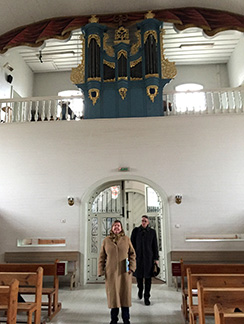
Kedainiai: The whole reason that we wanted to go to Lithuania is that Judie’s mother’s family is from there. Judie’s mother, and her parents and older bother (and some assorted other relatives) emigrated to the USA in the 1920s. Judie’s great-grandmother refused to leave and lived in Kedainiai until her death after World War II. It is relatively close to Kaunas, so we drove there after Rimas picked us up. It is in the more arable and flat part of Lithuania and we drove past fields that Rimas identified as rye and barley. The area is especially known for its cucumbers according to him. We finally found it and went to the Tourist Information office (he had never been there) and found out where some things were located. But they had no idea where Judie’s great-grandmother might be buried. We were hoping that it might be next to the church where her grandfather played the organ, but if there was ever an graveyard there, it was gone. So we never got to visit the grave. (Alex thought he found the graveyard when he visited in 2009, but it was pouring rain and he never found the actual grave.) We went to the church, but on the way, Rimas insisted we stop at a meat shop (these instructional detours were to become a theme of the trip). He showed us traditional sausages and other meats and suggested ones to buy. (He was very impressed by this little shop, which we would have just walked past if we had been there on our own.) The church itself was made entirely of wood and was quite striking. We were able to get inside and look around and see the organ, although we couldn’t get up to the choir loft and there was no one around. See a few photos below:
Kedainiai Church   Kedainiai Organ

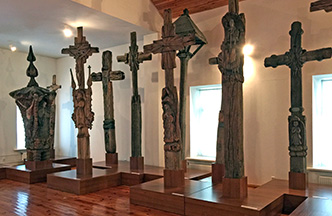
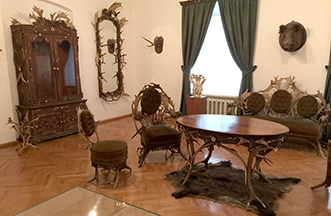
After that, we wandered about the town. We saw some photos at the town’s museum and the place hasn’t changed a whole lot in the past 100 years or so. Mostly old houses, although it is surrounded by newer apartment blocks and factories and stuff probably from the Soviet era. The museum itself was surprisingly informative. There were at least four people working there and I think the three of us may have been the only visitors, so we got a lot of attention and Rimas was full of questions for them. There was a big section about Czeslaw Milosz, a poet and writer who won the Nobel Prize in 1980. Although he was born outside Kedainiai, the world considered him to be Polish. (Poland and Lithuania go back a long way together. They were often jointly governed hundreds of years ago and most Lithuanians speak Polish.) A cultural center was built in his hometown and he returned to dedicate it. Lots of other stuff about the Lithuanian holocaust (more on that later) and a great room full of these carved poles with Jesus or some religious figure atop them and ofter covered by a little roof. They are all over the place, at least in that part of Lithuania, especially at road crossings. Rimas told us that the Russians removed most of these icons when they came in after World War II, although many were taken down and hidden by the populace. Most of the one in the museum were carved by the same artist, Svirskis, who Rimas told us had wandered the country offering to do the carvings for food and shelter. One other notable room contained furniture entirely made of antlers, which of course reminded me of Gaston and “Beauty and the Beast” (“I use antlers in all of my decorating”.) Pictures follow:

Lith Poles   Antlers

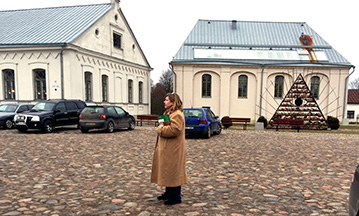
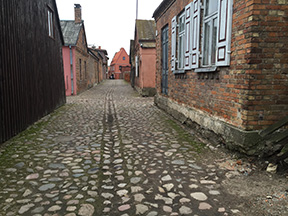
We continued to stroll around, stopping at one point (at Rimas’ insistence) for coffee and to sample traditional Lithuanian pastries. We went to the market square, where there were two old synagogues next to each other. (Photos below.) (Was one male and one female? Or maybe one replaced the first? There was no answer and, in fact, I’m pretty sure that there are no jews left in Kedainiai, which is a story for a later post.) At one point, we walked down a narrow street with impossibly old (and mostly empty) buildings. (Photos below.) If you took away the electric wires, you could have been in 1800s or earlier. Rimas loved it and wants to bring his kids to see it.

Kedainiai Synagogues  Kedainiai Lane

I think that is enough for now. I’ll add more tomorrow.

Kedainiai

Thoughts from London

New Piece of British Slang: A “chugger” is someone who comes up to you on the street and asks you to sign a petition and/or contribute money to their (usually charitable) cause. I looked up the etymology on line and the best I could find is that is a combination of charity and mugger.

Mimes for Queen of Heaven: Judie’s “Cakes” group had a meeting last night (their final one of the first half of the course).I went off to the Soho Theater and saw Trygve Wakenshaw, a mime originally from New Zealand, present his one-man show “Nautilus”. I’ve been a big fan of mime ever since I attended Tony Montanaro‘s mime school at Celebration Barn in South Paris, Maine in January of 1973. In addition to Tony, I have seen Marcel Marceau and, of course, the incredible Bill Irwin many times. Wakenshaw was an interesting mime/comedian. He is not a classic mime in that he uses his voice to add sound effects to what he does and sometimes talks. My first impression was–that seems like mime cheating–and it took me a few minutes to get past that and warm up to him. He is a good mime (you can tell he has trained), but he is after something else. His show, the third of a trilogy according to the handout, was a series of vignettes which gradually merged together and became more manic. A very enjoyable 75 minutes and for £12.50, you couldn’t beat the value.

I got back in time to see all of the ladies leave from the Cakes group and Judie and I went to dinner at Super Tuscan, perhaps our favorite restaurant in London. It is a small Italian restaurant in this little alley about five minutes from our flat. Wonderful, fresh food, with ingredients imported from Italy, an attentive staff (not always the case here) and an interesting wine list, hand picked by the owner, who loves to chat about them. For Montclair restaurant types, imagine a cross between Corso 98 and Fascino.

Vilnius, Here We Come: Judie’s mother was born in Lithuania and immigrated with her family in the 1920s. (Her great grandmother refused to leave and died there after World War II.) So going to Lithuania was on our list of things to do while we are in London. We are going this weekend. Alex has a Lithuanian friend he met while at Oxford. Juoazas is a violinist and he and Alex entered a music competition at Oxford, but unlike the other competitors, who played mostly classical pieces, they played Django Reinhardt and Stephane Grappelli gypsy jazz. They won. During a break, Alex went with Juoazas for a visit to Lithuania and had a memorable tour. He suggested that we contact Juoazas and his family. So we did and they insist that they will pick us up a the airport and give us a personal tour of Kedainiai (where Judie’s family came from) and Vilnius. This weekend is the Feast of Saint Casimir (the Patron Saint of Lithuania). This should be a great trip.

Self-Portrait: I decided to post my self portrait on Facebook and I really got a huge and gratifying response. I do think it is a very good painting and far and away the best thing I have done here. I’m thinking of creating a separate page on this site that will just contain all of the things I have done in chronological order. The progression is quite clear. It is a bit intimidating in a way. Having made this progress and having produced something that is as good as the self portrait turned out to be, what do I do next?