The Master Builder: We went to the old Vic with Peter and Andrea to see “The Master Builder” by Henrik Ibsen. It was adapted by David Hare and starred Ralph Fiennes. What is it about great Scandinavian artists (Ibsen, Munck, Bergman), that makes their works so dark and depressed? (Are there counter-examples I am missing? I hope so.) Maybe it is just because there is so little sun for a good part of the year? Anyway, although the play itself was predictably depressing (I’d never seen or read it), the performance was wonderful. Fiennes was predictably compelling and Linda Emond, a great American actor, was tremendous as the Master Builder’s tormented wife. But the real revelation was Sarah Snook, a young Australian, who just wowed me in her performance of Hilda, the young woman who comes to visit Fiennes and utterly charms him with her compelling personality (and then arguably causes his death). You have to believe that Hilda could just show up, out of the blue, and, by the sheer force of her personality, captivate and almost instantly change the life of Fiennes’ character. She did it easily. Keep an eye out for her. She is going to be a big star.
William Morris: Peter and Andrea love the wallpaper and designs by William Morris, and it was with a certain amount of trepidation that I accompanied them to Walthamstow, at the very end of the Victoria Line, to check out the William Morris Museum. I feared that I would be spending hours looking at wallpaper and fabric, but I was pleasantly surprised to find a well laid out and interesting museum. It was located in a big home where Morris’ wealthy family had lived in his youth. (His father’s commute to the City by stagecoach must have been daunting.) Morris became friends with many of the great artists of his days, including the members of the Pre-Raphaelite Brotherhood like Burne-Jones and Rosetti, who were his contemporaries. He employed many of these artists to design the furniture, stained glass, rugs, ceramics and other items that he ended up selling in his design business, and lots of those designs are in the museum. Morris was quite a businessman and the details of how he built his business were very interesting. Morris really understood the idea of the importance of one’s brand and I wonder if that was unique for his day. The style for which Morris is known (the Morris brand) has never really appealed to me, although I cannot deny that it is striking. (His book designs, for example, are wonderful works of art, but they are so concerned with referencing old Gothic manuscripts, including using a quasi-Gothic typeface that he invented, that they don’t look like fun to actually read.) But it was his politics that was the the biggest surprise for me. It turns out that Morris was one of the leading Socialists of his day and they had many of the tracts that he wrote, designed and printed. He also helped found the Society for the Protection of Ancient Buildings in 1877 to try to stop the demolition and “restoration” of old buildings that he believed was destroying the country’s architectural and cultural heritage. That organization, the fist one concerned with historic preservation, continues to be very active.
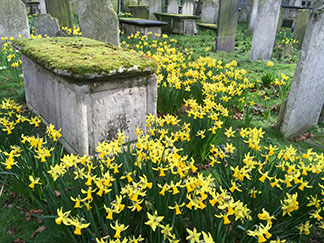
Bunhill Fields Cemetery: On Peter and Andrea’s last day, we managed to squeeze in a visit to this cemetery, relatively near our flat, before they had to leave for their plane. It started around 1549, when the St. Paul’s charnel house had to be cleared out to allow for new burials and thousand of cartloads of bones were dumped in a swampy area, allowing windmills to be constructed. (Bunhill was actually Bone Hill.) In 1665, London decided to use the area as a cemetery for those who could not be buried in the regular church yards, at the time mainly plague victims. But Bunhill eventually became the cemetery for Nonconformist Protestants and rich Jews. It contains what is described as a “who’s who of dissenters” in London intellectual life, with William Blake and Daniel Defoe being the headliners. I figured that a cemetery like that must contain a bunch of Unitarians, and, sure enough, right by the entrance gate was the grave of Richard Price, the minister of the Newington Green church who I have written about in prior posts. One of the nice things about the visit is that daffodils and some other flowers were blooming, although it seems a bit early for that. It was very pretty and made one feel as if spring is around the corner (although it probably isn’t). Maybe it is global warming? Here is a photo.
U.S. Politics: This seems like a great time to be slightly removed from U.S. politics. If I was in Montclair, I’d probably be watching at least parts of the debates and tuning in for the obsessive coverage on cable news. Here, the debates are on in the middle of the night and there might be 60-90 seconds on the campaign on a news show, if something has happened. I suppose I could watch CNN, and I do turn it on once in while, but I find that their endless, repetitive focus on one story alone would drive me crazy, even if its analysis wasn’t as moronic as it usually is. It will be interesting to see how the BBC and the other median outlets cover the London Mayoral election in May and the Brexit referendum, which is rumored for June or July. It seems to me that, in the U.S., wall-to-wall coverage and analysis of the mayoral race would have already begun. Not so here.
When Brits ask us about the election at all, they usually want to know about Trump, which is fair since he is the story that gets most of the focus. For me, the election is about two things: The Republican primary is like watch a gruesome car accident on a slow motion tape loop as they seem to be marching, lemming like, over a cliff. They seem bent on their own destruction and the issue is whether they can drag the country along with them. On the Democratic side, the issue to me is whether it turns out, after all of this time, that Hillary is actually a terrible campaigner and may be unelectable, leaving them with their own Jeremy Corbyn dilemma. And does all this mean that Michael Bloomberg will end up running?
 nickinshoreditch