Our friends, Peter and Andrea arrived last Wednesday for a visit, so I have been preoccupied with them. Then, over the weekend, we spent four days in Vienna, so I’m just getting around to writing and painting, while they go out to visit a friend in Shepherd’s Bush (a leafy London neighborhood near Notting Hill). I had planned to write one post about our trip to Vienna, but it was getting too long, so I’ll cut it off and finish the rest later.
Vienna is a beautiful city, with most of the important things to see concentrated in the center. It is not very big (less than 2 million) and is actually smaller than it was before World War I. It is very walkable and was distinctly uncrowded. I don’t know if we were just out of season, so there were not many tourists or if the place was envisioned by Franz Joseph to be a bigger place than it turned out to be. I won’t try to write a travelogue, which could be boring and will try to concentrate on some highlights of the city and our visit.
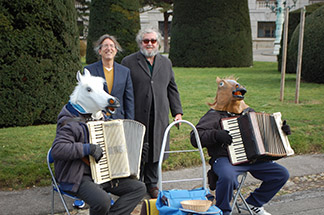
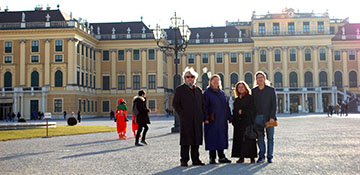
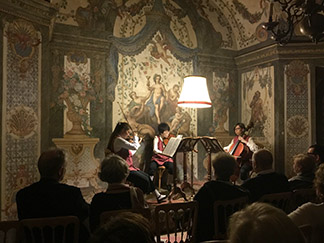
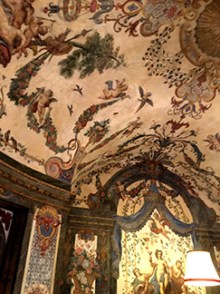
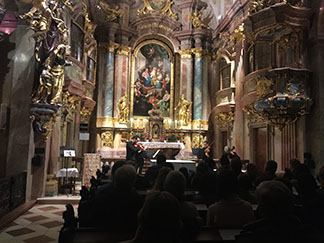
Mozart: Although Mozart was born in Salzburg, he came to Vienna as a child prodigy and his likeness is ubiquitous in the city. We had a tour guide (who was great) on Saturday and, as we walked around, she pointed out things like the building where Mozart gave his first concert in Vienna (at the age of four or five), the room in the Schönbrunn Palace (the Hapsburg’s summer palace, originally built in the woods outside the city, but now absorbed by the city and relatively close to the center) where Mozart first played for the Habsburg rulers, and several of the many places (she said 14) where he lived. (Mozart would move into nice apartment in Vienna when he had made a lot of money and then blow it all and have to move out. He did this repeatedly.) There is Mozart candy and lots of classical music performances, mostly featuring Strauss and Mozart, with Haydn and Beethoven often added. On Saturday night, we went to a concert at a place reputed to be the oldest concert hall in Vienna. Mozart had lived in that building for a period during 1781, when he had returned to Vienna. The hall itself, the Sala Terrena, was small (it seated, at most 70 and was not full), with vaulted ceilings and baroque frescoes from the mid 1700s. The acoustics were wonderful and it was pretty cool to sit there thinking that we were in the same exact spot where Mozart had performed. Inspired by the experience, the next night we went to see a similar performance at a beautiful old church. The music was lovely but it wasn’t quite as magical. A few pictures follow:
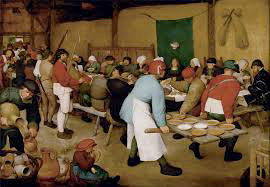
Klimt, Schiele and Kokoschka: Vienna was a city of great music and great composers for a long period, undoubtedly thanks to the support of a series of Habsburg emperors. And I think it might still fairly be characterized as a city of music, with its great Opera House and many other wonderful music venues. As for painting and sculpture, the Habsburg Dynasty had a number of collectors and the museums of Vienna have any number of paintings by the great artists, mainly French and Italian, who were active during the centuries when they held power. The collection of Breugels in the Kunsthistorisches Museum is absolutely incredible, containing several truly iconic works. The museum also has its share of works by Caravaggio, Reubens, Titian, Rafael, etc. And the building itself is striking, built by Emperor Franz Joseph in the 1890s specifically to house his art collection and impress the world.
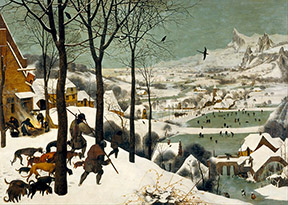
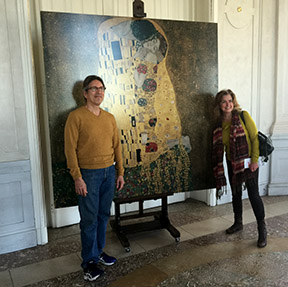
But unlike the world of music, which had its share of renowned Viennese composers, there really weren’t many great Viennese painters. (With the domination of French and Italian and Flemish painters, it sometimes seems hard to appreciate that there were some talented Eastern European painters.) However, Vienna did have one great period of painting, a time that began in the 1890s and ended in 1918 when Klimt and Schiele both died. I’m not sure I ever appreciated how wonderful these artists were until we visited the Belvedere Palace and viewed their extensive collection, which includes Klimt’s masterpiece “The Kiss” (and which has a separate “selfie room” next to the painting with a copy of the work–I forgot to bring my selfie stick however). Here are Peter and Andrea in the selfie room and a striking Schiele work.
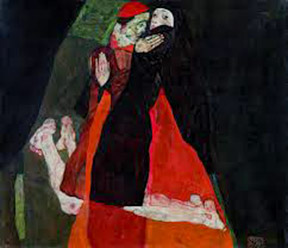
In addition to the usual collection, the Belvedere had a special exhibit which examined the paintings that Klimt, Schiele and their contemporary Kokoschka of women and how that reflected on the changes in the roles of women that were happening at the time. It was fascinating. Schiele was a genius, but a psychological mess who died very young, and his paintings of women showed it. Klimpt went from doing portraits of the bourgeoisie to increasingly strange and spacey works. Kokoschka, who I had absolutely nver heard of beofre the exhibit, was very talented as well. He hada tumultuous affair with a women named Alma, who hung around with the artist of that era. She dropped poor Kokoschka because he was too nutty and married Mahler (and later Walter Gropius). The distraught Kokoschka joined the army, but managed to survive World War I and went on to have a much longer career than his more noted contemporaries.
The Habsburg Dynasty: Our tour guide did a great job of explaining the Habsburgs to us, even taking us into the crypt of a church where they are all buried and you can walk along through their coffins sequentially. (One weird thing is that their hearts and intestines are embalmed and entombed somewhere else!) The Habsburgs were the leaders of the Holy Roman Empire for a number of centuries (until Napoleon put an end to it) and were an incredibly powerful and wealthy family. However, they intermarried so frequently over the years that they began to look rather strange, with long jaws and drooping lips and big noses. (it must have been a big problems for artists paid to paint or sculpt them. How to make them recognizable but not ugly?) There seem to be two of them that got most of the attention in the tours and museums: Maria Theresia and Franz Joseph. Maria Theresia was notable, in a sense, simply because she was a woman who succeeded in becoming the monarch in the 1700s. She had to win the War of Austrian Succession to accomplish it and ruled from 1740-1780. One of her sixteen children was Marie Antoinette. Among her many accomplishments was the introduction of compulsory education. She also created one of the world’s first public museums when she bought Belvedere Palace and transferred the Imperial art collection there.
Franz Joseph took over from his mentally incompetent uncle in 1848, as part of an effort to deal with the revolutions of the day. He served until 1916. He was a furious builder, expanding the Hofburg Place in central Vienna into a mind-boggling, gigantic complex and also building a number other ornate structures around it that are now museums. He tore down the moat and walls that surrounded the castle and center city and constructed the Ringstrasse, a wide circular boulevard which eventually became lined with palaces of nobles and fine homes of the wealthy. (A part of the plan for the Ringstrasse was to build an avenue too wide to be barricaded by revolutionaries.) Franz Joseph was a workaholic and his apparent building obsession seems odd, since, in many respects, he was glorifying the Habsbug dynasty just as the whole thing was beginning to collapse. (Maybe that was the point of it all.) He led a tragic life. His only son committed suicide after murdering his mistress, a scandal that they somehow managed to cover up for years. His wife, who was said to be the most beautiful woman in Europe, was assassinated in Geneva by an Italian anarchist, whose intended victim had not shown up as scheduled, so he decided to kill the next royal he saw. With no heir, Franz Joseph named his nephew to be his successor, but he famously was assassinated in Sarajevo, starting World War I.
More to follow…..
 nickinshoreditch