“Hangmen” and My Sermon, etc.

“Hangmen”: On Wednesday afternoon, I went to a matinee performance of “Hangmen” in the West End. I was actually planning to go in the evening until I noticed that seniors get reduced prices for matinees.Since I qualify as a senior over here (you just have to be 60 most of the time), I decided to take advantage of the bargain and got a good seat in an audience that seemed to be made up largely of white-haired people and students. We should take advantage of these discounts more. (I discovered a few weeks ago that we qualify to take London Transport for free since we are seniors and residents. It’s along process, but we should probably do it.

Anyway, back to the play. “Hangmen” is an very funny and extremely dark comedy by Martin McDonagh. If you are familiar with is other plays (“The Beaty Queen of Leenane”, “A Skull in Connemara”, “The Cripple of Inishmaan” and others) or if you saw the movie “In Bruges”, you will have an idea of what it was like. It is loosely based on the story of then end of executions in England in 1964. It centers around the hangman Harry Allen, who actually supervised the last hanging in England, and another character is Albert Pierrepoint, who was Britain’s best know executioner, having dispatched over 400 (although the competitive Harry complains in part of the play that  a lot of them were Germans during and after the war and they shouldn’t count). The play actually begins with a very funny scene(if you can believe it) about Harry overseeing the hanging of someone who is protesting his innocence and refuses to go quietly innocent. The rest of the play is set in Northern England, where Harry is running a pub habituated by a variety of amusing barflies and a strangely threatening stranger for the south. It is the anniversary of that questionable hanging that began the play and a reporter has come back to ask Harry about the recent official end of capital punishment. It is a wonderfully constructed play. It seems like it will just be funny take on capital punishment, but then you begin to think “Wait, what is going on here” as it takes a strange turn and just gets creepier and darker. You can’t help but laugh, but you feel uncomfortable doing so. Very good ensemble cast and a clever set. It got wonderful reviews. All of McDonagh’s plays reach NYC eventually. It is worth seeing when it comes.

An Election Just Happened: Did you know that Ireland had an election this week? I didn’t either, and I live a lot closer than you probably do. The media here is obsessed with the EU referendum, which, admittedly, is wildly entertaining. So the election in Ireland didn’t get much coverage until it happened. It resulted in a loss for the governing center-left party, which has overseen the recovery of the Irish economy after the 2008 meltdown. The center-right party, which had been in power when everything collapsed, made a comeback. But neither is close to a majority, as the results are splintered among multiple parties and it may turn out to be impossible to form a government (or what ever they cobble together won’t last). I have admit that I really don’t know what is going on over there.

My Sermon at New Unity: Today, I gave my sermon at New Unity. I was surprisingly nervous going into it, but it went very well, as far as I could tell. I got applause at the end. The readings worked out wonderfully and the guy who read the Dickens was great. At the end of this post is a link for my message (I think it will download as a Word document. If you can’t read it and want to do so, contact me directly.) It isn’t precisely what I said, since I used it as an outline and generally followed it, but did not read it (except for the quotes, of course). This is basically the way I did appellate arguments and summation when I was a lawyer. It was quite hard to condense all of my thoughts about the intersection of law and justice into a talk of ten minutes or so and make it approachable for non-lawyers.
Message

Law and Justice

I have been spending time this week getting ready for my sermon/message on Sunday about the intersection of law and justice and whether one can get justice in the courts. Early next week, I will either send a copy of my address or (perhaps) a link or something to a recording of it. New Unity streams its services and, I think puts Andy’s messages on line. So you will see something.

It is typical to have reading or two before the sermon in Unitarian or UU congregations. I assume this takes the place of the Bible readings that would have a part of the service in more Christian services. So I have picked two readings to sort of set the tone for my talk and I thought I’d share them with you all.

The first reading is from the first chapter “Bleak House”. It has a special meaning for me beyond the fact that it is an amazing piece of Dickens. My Civil Procedure Professor at Emory Law School read it at our first class with him. I can’t imagine, looking back, what he was thinking. Here it is:

The raw afternoon is rawest, and the dense fog is densest, and the muddy streets are muddiest near that leaden-headed old obstruction, appropriate ornament for the threshold of a leaden-headed old corporation, Temple Bar.…

The Lord High Chancellor [sits there] with a foggy glory round his head, softly fenced in with crimson cloth and curtains, addressed by a large advocate with great whiskers, a little voice, and an interminable brief, and outwardly directing his contemplation to the lantern in the roof, where he can see nothing but fog.

On such an afternoon some score of members of the High Court of Chancery bar … are mistily engaged in one of the ten thousand stages of an endless cause, tripping one another up on slippery precedents, groping knee-deep in technicalities, running their goat-hair and horse-hair warded heads against walls of words and making a pretense of equity with serious faces, as players might.

On such an afternoon the various solicitors in the cause, some two or three of whom have inherited it from their fathers, who made a fortune by it, are ranged in a line, in a long matted well (but you might look in vain for truth at the bottom of it) between the registrar’s red table and the silk gowns, with bills, cross-bills, answers, rejoinders, injunctions, affidavits, issues, references to masters, masters’ reports, mountains of costly nonsense, piled before them.

Well may the court be dim, with wasting candles here and there; well may the fog hang heavy in it, as if it would never get out; well may the stained-glass windows lose their colour and admit no light of day into the place; well may the uninitiated from the streets, who peep in through the glass panes in the door, be deterred from entrance by its owlish aspect and by the drawl, languidly echoing to the roof from the padded dais where the Lord High Chancellor looks into the lantern that has no light in it and where the attendant wigs are all stuck in a fog-bank!

This is the Court of Chancery, which has its decaying houses and its blighted lands in every shire, which has its worn-out lunatic in every madhouse and its dead in every churchyard, which has its ruined suitor with his slipshod heels and threadbare dress borrowing and begging through the round of every man’s acquaintance, which gives to monied might the means abundantly of wearying out the right, which so exhausts finances, patience, courage, hope, so overthrows the brain and breaks the heart, that there is not an honourable man among its practitioners who would not give — who does not often give — the warning, “Suffer any wrong that can be done you rather than come here!”

I really do love this. It is such a pretty powerful indictment of the law. But I’m not as disgusted by the law as Dickens was and that is not my message. (I’m sure a Dickens scholar would know what happened to him to cause this implacable enmity.) So I decided to follow this with a a more positive reading. (These are harder to find than I expected.) My second reading it from Atticus Finch’s jury summation in “To Kill a Mockingbird” and goes as follows:

But there is one way in this country in which all men are created equal- there is one human institution that makes a pauper the equal of a Rockefeller, the stupid man the equal of an Einstein, and the ignorant man the equal of any college president. That institution, gentlemen, is a court. It can be the Supreme Court of the United States or the humblest Justice of the Peace court in the land, or this honourable court, which you serve. Our courts have their faults as does any human institution, but in this country our courts are the great levelers, and in our courts all men are created equal.

It’s a great lead-in to my sermon. I might say that I  recognize that there is a danger in having wonderful readings preceding my remarks–that anything I say afterwards will seem clumsy. We will see.

More from London

It’s a Beautiful Day in the Neighborhood: Judie told me that I sounded kind of depressed and homesick in my prior post. Probably the latter, but not the former. Today, with Judie across the Pond, I finally ventured out of the flat in mid-afternoon to discover an absolutely glorious day that seemed like early spring. I wandered about, bought a paper and ended up at Wright’s Seafood at Spitalfields Market. Oysters a pound a pop. Had 18 of them and a carafe of wine and chatted with Iris, my favorite server there. Then it was down two doors to Androuet, which has French and English cheeses Americans can only dream about. I might go to the National Theater tomorrow to see “All’s Well That Ends Well” or maybe to the West End to see “Hangmen”. I may be a bit homesick, but I’m definitely not miserable.

It Turns Out That it is All a Soap Opera: British politics is so internecine and dominated by a relative small group of people, that coming into it the way I have is a bit like joining a long-running soap opera and trying to figure out what is going on.. Everyone else knows the background stories and I am trying to catch up. A few examples:

  • It turns out that Boris Johnson and David Cameron were at Eton together and were in the the same eating club. Boris was two years older, a prefect and an Etonian superstar. Everyone expected him to be a great leader of the country (and so did he). Cameron, in contrast, was just one of the guys. Don’t you think it must gall Boris to have Cameron become PM, when everyone at Eton thought it would be him? There is play to be written about this. (If you aren’t utterly bored by Brexit stuff, here is link to an Op-Ed piece by Boris from today’s Telegraph which cogently sets forth the case for leaving the EU, although it leaves some questions unanswered.)
  • It turns out that Conservative Mayoral candidate Zac Goldsmith’s billionaire father has been funding a major Out of the EU organization. Had I known that, I would not be surprised that young Zac joined the various rats deserting Cameron’s leaking Tory Party ship. (By the way, isn’t “Goldsmith”a great name for a billionaire?)
  • It turns out that Chancellor Michael Gove, is not just Cameron’s best bud. Some writers insinuate that he is Cameron’s brain as well. According to what I am reading, he is the smart guy in the Tory Party and Johnson/Gove would be the leadership team if Cameron falls. Johnson gives the Out side their popular leader and Gove gives them intellectual heft.
  • Continuing with the soap opera analogy, I am beginning to see Corbyn as a minor character, inserted for comic relief in the past, suddenly elevated to a major role when another character (Milliband) was killed off. Are we supposed to take him seriously or is he just a place holder while the producers try to recruit a more serious star? I’d guess it depends upon the ratings…..
  • Finally, the way Parliament works makes for much more soap-opera like drama. On the Monday after Cameron announced his agreement, he came for Question Time to promote the In side and promptly got into an oh-so-polite cat fight with Boris. It is only vaguely like Trump’s attacks on his opponents, but Trump’s insults are so crude, but the Brits really do it terribly well. (Can one imagine The Donald referring to Jeb as “my learned friend”?) In the US, if things are going bad, the politicians can just disappear and there is not much anyone can do. Here, they pretty much have to show up in the House of Commons and face others who are furious at them. It should be enormously entertaining.

Pitchers and Catchers: It was easy in the wintertime. But now baseball is starting and for the first time in thirty years, the Mets are powerhouse, a team that really should make the playoffs and is a reasonable bet to win it all. I’ve always appreciated Mets GM Sandy Alderson’s post-PED view of baseball and his strategy has been vindicated by what seems to me to be a triumphant off-season. As someone who probably watched at least a part (and too often all) of a hundred Met games a year when they were terrible, it just kills me that I will not be rewarded by wallowing in the upcoming season.

Boris’ Big Gamble and a New Painting

Boris’ Big Gamble: As you probably know if you have any interest at all, Cameron returned from Brussels last Friday with his negotiated deal for a “Reformed EU”. He met with his Cabinet in an apparently rare Saturday meeting and came out to announce that the government would be in favor of remaining in the EU and that the referendum will be held on June 23rd. Other than the US Presidential Election, this is almost the most significant vote that will occur in the world this year.

Right after the cabinet meeting, six cabinet members left by the back door (!) and immediately went to a gathering of the group in favor of leaving the EU. The weren’t really big names, with the biggest being Michael Gove, Cameron’s friend and the Minister for Justice. (This is like the Attorney General opposing the President on a key issue.) But as a group, they are a bit short on charisma. (They make Cameron look dynamic, when he has all the charisma of Hillary Clinton, at best.) So it was very important for the “outters” that the more flamboyant  Boris Johnson (a leading Conservative MP and London’s outgoing Mayor with obvious PM ambitions) joined the cause on Sunday. He instantly becomes the big name leading the effort to leave.

Many suspect that Johnson acted purely out of political calculation, rather than any real conviction. (Cameron said as much in response to the news.) As a political play, it is fascinating. Cameron is in a position in which he is going to lose the support of a significant part of the Conservative Party on this issue. If these rebels succeed in the referendum and Britain leaves the EU, that would have to spell doom for Cameron and he would likely resign or be forced to do so. His successor would presumably have to come from the Out camp and that would have to be Boris. So, if Britain votes out, Boris doesn’t have to wait until 2020 for Cameron’s terms to end and jumps over Osborne and all of the other potential PMs who stuck by Cameron on this issue. On the other hand, if Cameron wins and Britain votes to stay a part of the EU, Boris would be dead meat. The winners would exact vengeance I am quite sure. The only question is whether Boris’ career would be completely over.

Some other Things to Know about Brexit: This referendum will consume the UK over the next four months. And it should, since it will determine the future course of The United Kingdom (and whether it remains united) and possibly the entire idea of a united Europe. Here are some things that you may not hear about it in the States, being completely absorbed by Trump:

  • The election for the new mayor of London will occur in May and it will be interesting to see how it is impacted by the referendum. London is an area that apparently supports remaining in the EU. Will the Conservative candidate, billionaire’s son Zac Goldsmith, side with Cameron or Boris?
  • Scotland also appears to be solidly in favor of staying in the EU and its leaders are already hinting that if Scotland supports staying in and the referendum takes the UK out, they will hold there own vote about leaving the UK so that they can be part of the EU. You can expect the pro-EU side to make the argument that a vote to leave the EU will also be a vote to break up the United Kingdom.
  • Wales, meanwhile, is having its own legislative election in May. Polls seem to show that they are likely to support leaving the EU and that UKIP (a separate right-wing party–a bit like a British Tea Party, only not so batshit crazy) may actually win a few seats in Wales as a result of the xenophobia that seem likely to dominate the referendum. No one seems to be talking about Wales doing anything if the referendum result is opposed to the way the Welsh vote.
  • Northern Ireland also has a legislative election in May. Who knows what they’ll do? Having  Ireland (firmly in the EU) sharing the island (and borders) with them should have some impact (one would guess), but that relationship is so fraught, that it is hard for me to figure anything out over there.
  • So far, the “outters” seem to me to be mostly Trump-like xenophobes and old-line conservatives pining for the good old days when Britain was an Empire. Maybe Boris can widen their appeal. The other side appears to be the moderate Tories and Labour. Early polls seem to favor an out vote, but I wonder if that coalition can really win unless it can appeal more to the middle. But since the Campaign may largely be mindless fear-mongering from both sides, you never know.
  • One final thing: The polls were so utterly wrong in the last election, utterly missing the Conservative sweep, that there is very little faith in their predictive ability right now. And the pollsters themselves were so burned that they do not speak confidently. Will that mean that the referendum politicking will not be poll-driven?

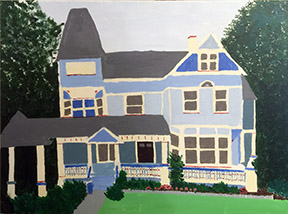
Another New Painting: Below you will see may latest painting, which is, of course, of our house in Montclair. I started out intending to use only really big brushes and to be bold. I didn’t lay the thing out in pencil or use a ruler, so the result is that the whole perspective is a bit off and the house is a bit askew. I thought about trying to fix it, but decided that I like it the way it is. I also though that it had a slight Edward Hopper quality that would be destroyed by detail, so I resisted the temptation to add to it.

One thing the painting almost certainly reflects for me is a bit of homesickness. It’s been nearly six months and, while Judie has been back to the US a few times on business, I have been here. And I recently realized that the initial thrill of living here has dissipated. At first there were countless new discoveries to make and it was just plain exciting to wander around, watch the ads on the telly, learn the language differences and listen to the accents, figure out the politics, see the sights, etc. London is a wonderful place to live and I am absolutely not complaining, but now I feel like I am living here, which is a significant evolution from my initial “stranger in a strange land” feeling. Here’s the painting:

House

Updates

The BBC Turns into CNN (briefly): Friday was the day that the long-waited renegotiated deal with the EU was supposed to come down, setting the stage for the in-out referendum rumored to take place in June. It was all supposed to be agreed upon at an “English Breakfast” in Brussels, with all the European leaders present. The BBC was there waiting to report the results. But then-Nothing. No agreement. Not even a breakfast (which eventually became brunch and then lunch and then tea and then dinner). Whether this was just stagecraft to convince the populace of the various countries that the negotiations were very tough and that no one was rolling over, we will probably never know. Cameron cleverly appeared somewhat exhausted in the photos. Anyway, there is BBC all ready to go and with no real story and not even many good rumors (and rumors that they had were incredibly dry details of changes to the wording of clauses). So for several hours, BBC turned into CNN. Lots of reporters and talking heads repetitively saying the same thing, with nothing to actually report. It had all the classic CNN elements except Wolf Blitzer. But after about two or three hours, BBC came to its senses, realized that there wasn’t going to be anything happening any time soon and reverted back to being the BBC.

Unitarian Speaking: I mentioned some time ago that I might be leading two Unitarian services. Well, it is happening. On the 28th, I am scheduled to give the message at New Unity, our regular congregation (“sermon” sounds to religious for them). Two weeks later, I will lead the service at the Lewisham Unitarian Church, which is a completely different sort of place and where I am afraid that I will be insufficiently  Christian.

At New Unity, the theme for the first quarter of the year has been Justice and I suggested that it might be good to talk about the intersection of Law and Justice and Andy basically said “Good idea. You do it.” So I’ve been drafting my message this week. It starts “I went to Law School thinking I’d be Atticus Finch”, which turns out to be pretty timely in light of the death of Harper Lee. It has been pretty hard to condense my thought in this area into a talk of only ten minutes or so. One of the things I realized as I started this process is that, while I am very well versed in American Law and process, I really know next to nothing about British law, other than both are based on Common Law. So I had to spend a day or two reading up on British legal history, how the courts are currently set up, how one appeals, how the court can strike a law down where there is no written constitution, etc., etc. I won’t bore you with this and I am certainly not going to put any of it in my message (for fear of putting everyone to sleep). But I felt like I had to have some vague idea of what I was talking about or I’d feel a bit like a fraud. The draft is about done and I’ll give it to Andy on Sunday. Once it is final and after I’ve given the message, I may decide to attach it to a later blog post.

As for Lewisham, I guess I’ll try to figure it out next week. I’m thinking of talking about how Unitarians can differentiate themselves from other Protestant congregations and the role of social action in all of that. I might make a push for Standing on the Side of Love UK. As I noted in a prior note about that congregation, it is both Christian enough that it made me a little uncomfortable and very small (and I don’t think the two things are unrelated). I have to tell a Story for Children of All Ages (even though they have no children attending), so I’m thinking of this:

Long ago, the Pope decreed that all the Jews had to convert to Catholicism or leave Italy. There was a huge outcry from the Jewish community, so the Pope offered a deal: he’d have a religious debate with the leader of the Jewish community. If the Jews won, they could stay in Italy; if the Pope won, they’d have to convert or leave.

The Jewish people met and picked an aged and wise rabbi to represent them in the debate. However, as the rabbi spoke no Italian, and the Pope spoke no Yiddish, they agreed that it would be a ‘silent’ debate.

On the chosen day the Pope and rabbi sat opposite each other. The Pope raised his hand and showed three fingers. The rabbi looked back and raised one finger.
Next, the Pope waved his finger around his head. The rabbi pointed to the ground where he sat. The Pope brought out a communion wafer and a chalice of wine.
The rabbi pulled out an apple. With that, the Pope stood up and declared himself beaten and said that the rabbi was too clever. The Jews could stay in Italy .

Later the Cardinals met with the Pope and asked him what had happened. The Pope said, “First I held up three fingers to represent the Trinity. He responded by holding up a single finger to remind me there is still only one God common to both our faiths.
Then, I waved my finger around my head to show him that God was all around us. The rabbi responded by pointing to the ground to show that God was also right here with us. I pulled out the wine and host to show that through the perfect sacrifice Jesus has atoned for our sins, but the rabbi pulled out an apple to remind me of the original sin. He bested me at every move and I could not continue.”

Meanwhile, the Jewish community gathered to ask the rabbi how he’d won. “I haven’t a clue,” said the rabbi. “First, he told me that we had three days to get out of Italy, so I gave him the finger. Then he tells me that the whole country would be cleared of Jews
but I told him emphatically that we were staying right here.” “And then what?” they asked. “Who knows?” said the rabbi. “He took out his lunch, so I took out mine.”

Hopefully the ten or so parishioners at Lewisham will find this amusing, although there is a risk that they will be annoyed. Well, I am an American abroad and will probably never be back there, so I’ll take that risk.


Politics, Painting and other Thoughts

Brexit Approaches? I am writing this on Friday, as Britain waits, with bated breath, for the PM to come out with his long-awaited renegotiated deal with the EU. Exactly why this Friday is the deadline isn’t clear to me, but I assume it can be extended. It’s been a strange negotiation, partly because it has been so public. Cameron basically announced his demands many months ago and it is clear that he is not going to get everything that he wanted, which will automatically give the euroskeptics grounds to downplay as too weak an agreement that they were never going to like anyway. Britain’s basic position is that we want to be kind of in the EU, so that we can get the benefit of the open market, but without being bound by all the same rules as everyone else. I would imagine that countries like France and the rest of the EU would have like to have told Cameron to stick his proposal where the sun doesn’t shine, but they know that a strong EU needs Britain, so they are engaging in a game of chicken. It appears that the agreement may even be delayed, which is in everyone’s interest, since each country has to convince their populace that they engaged in tough negotiations and emerged with the best agreement they could get.

You can read about the details of what Cameron got in the NY Times or some similar paper, so I won’t bother going over the various sticking points. No matter what he gets, it is hard to imagine that Cameron won’t endorse it as a great deal. He is too committed to remaining in the EU to turn down whatever gets offered. If he does or if there is no agreement, it is all over and Britain will exit this year. But he won’t, so there will be a referendum in June. It is increasingly clear that it will be a wild campaign. A number of Tories are going to jump ship on this issue, including some significant ones, possibly including London’s outgoing Mayor, Boris Johnson, who is thinking of trying to succeed Cameron. Corbyn, who was a euroskeptic as an MP, now appears to be a Brexit opponent. Strange bedfellows. The campaign itself looks like it will be full of scare tactics and probably short on real facts. It will be interesting to see how the whole thing compares with the ongoing Presidential dog and pony show. I think it is going to be close.

Frank Auerbach: Last week, I  went to Tate Britain with Peter and Andrea because they wanted to see the Turners and Andrea wanted to see their collection of paintings by William Blake. Since I was there, I decided to check out their special exhibit, a retrospective of Frank Auerbach. He is one of the great modern English painters and has had his studio in London for decades. He actually chose the paintings for exhibit. The exhibit was organized by decade, starting in the 1960s and each decade had at least one painting of the same area outside his studio. You could really trace his development. I have to admit, I wasn’t all that familiar with his work. I know I’d seen a few of his paintings at various exhibits, but that is different from seeing lots and lots of them all at once. He’s a bit of an expressionist, I guess.

One thing about his works is the sheer amount of paint that he uses. There is something rather thrilling about an artist who is willing to hurl such large amounts of material at the canvas. I was wondering if there is any way for me to experiment with that. But it is hard to get volume with acrylics, so I would probably have to switch to oils. They seem to sell structural paste for acrylics, so maybe I’ll see if that it a way around it.

“The Meeting”: On Thursday evening, we went to the Hampstead Theatre to see a play in their little, black box theatre. This theatre presents more experimental works than the main stage. “The Meeting” was a pretty good work in most respects. Each of the four characters was well developed and there were a number of good scenes. But somehow, it didn’t quite hold together as a play. The plot revolved around the negotiation of a business contract (fascinating for Judie perhaps, but inherently boring for most people) in which the good old boy representative of the other company was replaced at the last minute by a woman. It’s a concept with real potential and you can think of a number of ways that such a premise could go. But this play lurched around on this theme, never quite deciding what sort of woman this was. It was too bad, because I thought the performances were very good and the three male characters were wonderfully quirky. It was fun to watch, but ultimately not fulfilling.

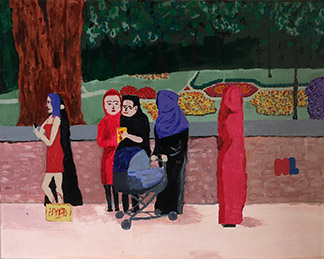
A Painting: I took a photo last September of a group of women waiting for a bus on Whitechapel. It seemed like a good idea for a painting. But I could never get it to look any good. So I would just give up and put it aside, come back to it, get disgusted and put it aside, come back again, etc. This has been going on for 3-4 months. I stopped trying to duplicate the photo months ago, which helped. An experienced artist probably would have just thrown the thing out and moved on, but I was too stubborn. I took it out again while Andrea and Peter were visiting and now–well, at least it doesn’t stink any more. I am declaring it finished so I can stop working on it.

Whitehall

Tales from London

The Master Builder: We went to the old Vic with Peter and Andrea to see “The Master Builder” by Henrik Ibsen. It was adapted by David Hare and starred Ralph Fiennes. What is it about great Scandinavian artists (Ibsen, Munck, Bergman), that makes their works so dark and depressed? (Are there counter-examples I am missing? I hope so.) Maybe it is just because there is so little sun for a good part of the year? Anyway, although the play itself was predictably depressing (I’d never seen or read it), the performance was wonderful. Fiennes was predictably compelling and Linda Emond, a great American actor, was tremendous as the Master Builder’s tormented wife. But the real revelation was Sarah Snook, a young Australian, who just wowed me in her performance of Hilda, the young woman who comes to visit Fiennes and utterly charms him with her compelling personality (and then arguably causes his death). You have to believe that Hilda could just show up, out of the blue, and, by the sheer force of her personality, captivate and almost instantly change the life of Fiennes’ character. She did it easily. Keep an eye out for her. She is going to be a big star.

William Morris: Peter and Andrea love the wallpaper and designs by William Morris, and it was with a certain amount of trepidation that I accompanied them to Walthamstow, at the very end of the Victoria Line, to check out the William Morris Museum. I feared that I would be spending hours looking at wallpaper and fabric, but I was pleasantly surprised to find a well laid out and interesting museum. It was located in a big home where Morris’ wealthy family had lived in his youth. (His father’s commute to the City by stagecoach must have been daunting.) Morris became friends with many of the great artists of his days, including the members of the Pre-Raphaelite Brotherhood like Burne-Jones and Rosetti, who were his contemporaries. He employed many of these artists to design the furniture, stained glass, rugs, ceramics and other items that he ended up selling in his design business, and lots of those designs are in the museum. Morris was quite a businessman and the details of how he built his business were very interesting. Morris really understood the idea of the importance of one’s brand and I wonder if that was unique for his day. The style for which Morris is known (the Morris brand) has never really appealed to me, although I cannot deny that it is striking. (His book designs, for example, are wonderful works of art, but they are so concerned with referencing old Gothic manuscripts, including using a quasi-Gothic typeface that he invented, that they don’t look like fun to actually read.) But it was his politics that was the the biggest surprise for me. It turns out that Morris was one of the leading Socialists of his day and they had many of the tracts that he wrote, designed and printed. He also helped found the Society for the Protection of Ancient Buildings in 1877 to try to stop the demolition and “restoration” of old buildings that he believed was destroying the country’s architectural and cultural heritage. That organization, the fist one concerned with historic preservation, continues to be very active.

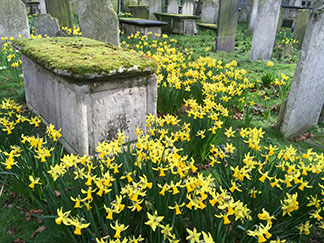
Bunhill Fields Cemetery: On Peter and Andrea’s last day, we managed to squeeze in a visit to this cemetery, relatively near our flat, before they had to leave for their plane. It started around 1549, when the St. Paul’s charnel house had to be cleared out to allow for new burials and thousand of cartloads of bones were dumped in a swampy area, allowing windmills to be constructed. (Bunhill was actually Bone Hill.) In 1665, London decided to use the area as a cemetery for those who could not be buried in the regular church yards, at the time mainly plague victims. But Bunhill eventually became the cemetery for Nonconformist Protestants and rich Jews. It contains what is described as a “who’s who of dissenters” in London intellectual life, with William Blake and Daniel Defoe being the headliners. I figured that a cemetery like that must contain a bunch of Unitarians, and, sure enough, right by the entrance gate was the grave of Richard Price, the minister of the Newington Green church who I have written about in prior posts. One of the nice things about the visit is that daffodils and some other flowers were blooming, although it seems a bit early for that. It was very pretty and made one feel as if spring is around the corner (although it probably isn’t). Maybe it is global warming? Here is a photo.

bunhill

U.S. Politics: This seems like a great time to be slightly removed from U.S. politics. If I was in Montclair, I’d probably be watching at least parts of the debates and tuning in for the obsessive coverage on cable news. Here, the debates are on in the middle of the night and there might be 60-90 seconds on the campaign on a news show, if something has happened. I suppose I could watch CNN, and I do turn it on once in while, but I find that their endless, repetitive focus on one story alone would drive me crazy, even if its analysis wasn’t as moronic as it usually is. It will be interesting to see how the BBC and the other median outlets cover the London Mayoral election in May and the Brexit referendum, which is rumored for June or July. It seems to me that, in the U.S., wall-to-wall coverage and analysis of the mayoral race would have already begun. Not so here.

When Brits ask us about the election at all, they usually want to know about Trump, which is fair since he is the story that gets most of the focus. For me, the election is about two things: The Republican primary is like watch a gruesome car accident on a slow motion tape loop as they seem to be marching, lemming like, over a cliff. They seem bent on their own destruction and the issue is whether they can drag the country along with them. On the Democratic side, the issue to me is whether it turns out, after all of this time, that Hillary is actually a terrible campaigner and may be unelectable, leaving them with their own Jeremy Corbyn dilemma. And does all this mean that Michael Bloomberg will end up running?


Vienna, Part 2

Continuing with some more stories from Vienna:

Sigmund Freud and Cafe Central: On Monday we had a late flight, so we went to the Freud Museum. Freud spend virtually all of his professional life in Vienna and lived in the same place for most of that time. The apartment where his practice was is now a museum. Freud abandoned it in 1938, when he fled Vienna, with his family and a few friends, when the Nazis took over. He had to pay a substantial fee to the Nazi government to get exit visas, but, with the help of influential friends, he did get out. (His sisters did not and they perished in the concentration camps.) Freud took all of his furniture, notes and his extensive art collection with him when he moved to London (where he died the next year) and the apartment was used by the Germans during the war and then rented out like any other apartment until around 1970 when a foundation purchased it to create the museum. Freud’s daughter, Anna (a significant figure in psychology in her own right), donated a few of the original pieces of furniture from the original office and the waiting room is supposed to be much like it looked in the 1930s. But the famous couch was not there. There are a few of his books and a some samples from his collection of antiquities. There was, of course, lots of information about Freud’s life and his work, which probably would have been more fascinating if I cared anything about psychoanalysis. There was also a special exhibit about Anna Freud and other trailblazing women in the filed of psychoanalysis, which was both well-done and went along with other things we had seen over the weekend dealing with the changing role of women in the early twentieth century.

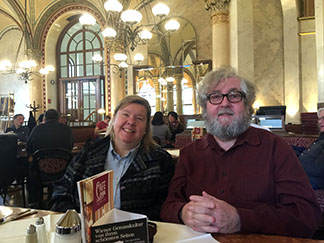
Afterwards, we walked around his old neighborhood and ended up at Cafe Central, where Freud liked to go after his walks and hang out. It really was the place to go in the 1910s, at least for a certain set. Lenin and Trotsky were also regulars at that time, as were Tito and Hitler and a substantial number of the Viennese literati. It was a beautiful room in what had once been a bank and the pastries were to die for. Here we are there:

Cafe Centrale

Lichtenstein: As we wandered around Freud’s neighborhood, we came upon the Lichtenstein Place (now a museum), which had been the home of the family that gave the name to the country. It turns out the Lichtensteins were a very wealthy Austrian family and somewhat influential in the Viennese court, where they wanted to increase their profile. So they bought what is now Lichtenstein and successfully maneuvered to have it recognized as a principality of the Holy Roman Empire, thereby significantly increasing their prestige and power. No one from the family bothered to visit the principality for over 100 years. It is oddly appropriate, in light of that history, that Lichtenstein is now one of the world’s great money laundering centers.

Vienna and the Jews: One of things about traveling in much of Europe is the presence of the Holocaust in the background. Vienna had a substantial Jewish population in 1938 and had one for many centuries. But in March of that year, it was the time of the Anschluss and the “invasion” of the Nazis. It is hard to really characterize it as an invasion, since a significant majority of the population favored the annexation by Germany and greeted Hitler with flags and salutes. Hundreds of thousands of Viennese came to cheer him as he spoke from a balcony of the Hofburg Palace, overlooking the huge Heldenplatz (Square of Heroes). After the war, in what our tour guide characterized as an act of “mass amnesia”, the Austrians convinced themselves that they were were the first victims of Hitler. Many of the wealthy and influential Jews escaped in 1938, as Freud did, but tens  of thousands were exterminated. There is a very nice Holocaust memorial–a sort of building made of books–although I wonder if it is a part of the regular tours, as it is a little out of the way and there weren’t many people there. Even move moving was a street in a Vienna neighborhood that had been largely a home to Jews before the War. (If they had stumble stones in Vienna, as they do elsewhere in Europe, it would have been hard to walk down that street and many others.) The current residents had researched the families that had lived on the street and created a memorial of keys with the names of each family attached to the key with a tag. There were over a hundred of them

Final Thoughts on Vienna: It would be easy to go on and on about the history, art and architecture of Vienna. It really is very charming and, unlike Germany and London and other parts of Europe, missed being demolished in the World Wars, giving it a trapped amber quality. It is also a small-feeling city, even though it goes on for quite a way when you drive out of its center and it certainly lacks the energy you feel in vibrant city Like London or Paris or Berlin. It was certainly a fun place to visit though….

Vienna, Part 1

Our friends, Peter and Andrea arrived last Wednesday for a visit, so I have been preoccupied with them. Then, over the weekend, we spent four days in Vienna, so I’m just getting around to writing and painting, while they go out to visit a friend in Shepherd’s Bush (a leafy London neighborhood near Notting Hill). I had planned to write one post about our trip to Vienna, but it was getting too long, so I’ll cut it off and finish the rest later.

Vienna is a beautiful city, with most of the important things to see concentrated in the center. It is not very big (less than 2 million) and is actually smaller than it was before World War I. It is very walkable and was distinctly uncrowded. I don’t know if we were just out of season, so there were not many tourists or if the place was envisioned by Franz Joseph to be a bigger place than it turned out to be. I won’t try to write a travelogue, which could be boring and will try to concentrate on some highlights of the city and our visit.

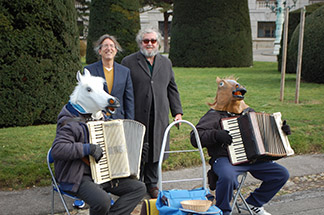
accordians  Vienna

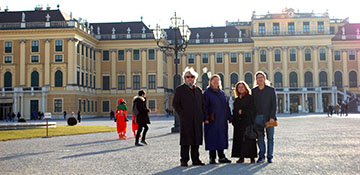
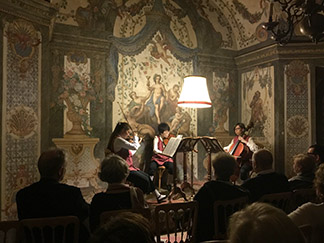
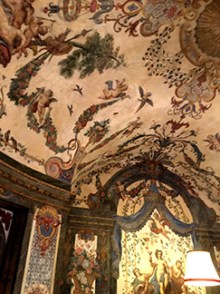
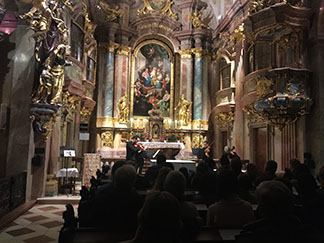
Mozart: Although Mozart was born in Salzburg, he came to Vienna as a child prodigy and his likeness is ubiquitous in the city. We had a tour guide (who was great) on Saturday and, as we walked around, she pointed out things like the building where Mozart gave his first concert in Vienna (at the age of four or five), the room in the Schönbrunn Palace (the Hapsburg’s summer palace, originally built in the woods outside the city, but now absorbed by the city and relatively close to the center) where Mozart first played for the Habsburg rulers, and several of the many places (she said 14) where he lived. (Mozart would move into nice apartment in Vienna when he had made a lot of money and then blow it all and have to move out. He did this repeatedly.) There is Mozart candy and lots of classical music performances, mostly featuring Strauss and Mozart, with Haydn and Beethoven often added. On Saturday night, we went to a concert at a place reputed to be the oldest concert hall in Vienna. Mozart had lived in that building for a period during 1781, when he had returned to Vienna. The hall itself, the Sala Terrena, was small (it seated, at most 70 and was not full), with vaulted ceilings and baroque frescoes from the mid 1700s. The acoustics were wonderful and it was pretty cool to sit there thinking that we were in the same exact spot where Mozart had performed. Inspired by the experience, the next night we went to see a similar performance at a beautiful old church. The music was lovely but it wasn’t quite as magical. A few pictures follow:

Mozart   Mozart2

St Ann Music

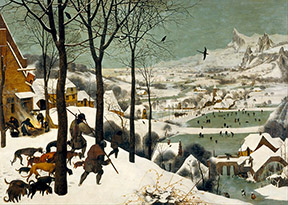
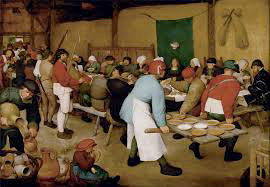
Klimt, Schiele and Kokoschka: Vienna was a city of great music and great composers for a long period, undoubtedly thanks to the support of a series of Habsburg emperors. And I think it might still fairly be characterized as a city of music, with its great Opera House and many other wonderful music venues. As for painting and sculpture, the Habsburg Dynasty had a number of collectors and the museums of Vienna have any number of paintings by the great artists, mainly French and Italian, who were active during the centuries when they held power. The collection of Breugels in the Kunsthistorisches Museum is absolutely incredible, containing several truly iconic works. The museum also has its share of works by Caravaggio, Reubens, Titian, Rafael, etc. And the building itself is striking, built by Emperor Franz Joseph in the 1890s specifically to house his art collection and impress the world.

Hunters snow    Peasant Wedding

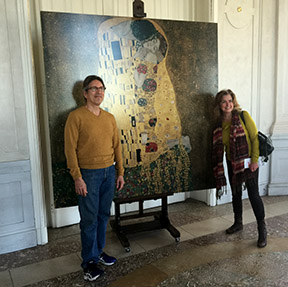
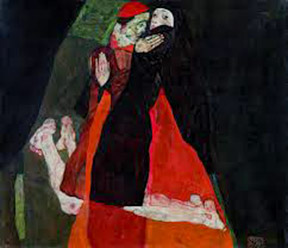
But unlike the world of music, which had its share of renowned Viennese composers, there really weren’t many great Viennese painters. (With the domination of French and Italian and Flemish painters, it sometimes seems hard to appreciate that there were some talented Eastern European painters.) However, Vienna did have one great period of painting, a time that began in the 1890s and ended in 1918 when Klimt and Schiele both died. I’m not sure I ever appreciated how wonderful these artists were until we visited the Belvedere Palace and viewed their extensive collection, which includes Klimt’s masterpiece “The Kiss” (and which has a separate “selfie room” next to the painting with a copy of the work–I forgot to bring my selfie stick however). Here are Peter and Andrea in the selfie room and a striking Schiele work.

Selfie Kiss   Schiele

In addition to the usual collection, the Belvedere had a special exhibit which examined the paintings that Klimt, Schiele and their contemporary Kokoschka of women and how that reflected on the changes in the roles of women that were happening at the time. It was fascinating. Schiele was a genius, but a psychological mess who died very young, and his paintings of women showed it. Klimpt went from doing portraits of the bourgeoisie to increasingly strange and spacey works. Kokoschka, who I had absolutely nver heard of beofre the exhibit, was very talented as well. He hada tumultuous affair with a women named Alma, who hung around with the artist of that era. She dropped poor Kokoschka because he was too nutty and married Mahler (and later Walter Gropius). The distraught Kokoschka joined the army, but managed to survive World War I and went on to have a much longer career than his more noted contemporaries.

The Habsburg Dynasty: Our tour guide did a great job of explaining the Habsburgs to us, even taking us into the crypt of a church where they are all buried and you can walk along through their coffins sequentially. (One weird thing is that their hearts and intestines are embalmed and entombed somewhere else!) The Habsburgs were the leaders of the Holy Roman Empire for a number of centuries (until Napoleon put an end to it) and were an incredibly powerful and wealthy family. However, they intermarried so frequently over the years that they began to look rather strange, with long jaws and drooping lips and big noses. (it must have been a big problems for artists paid to paint or sculpt them. How to make them recognizable but not ugly?) There seem to be two of them that got most of the attention in the tours and museums: Maria Theresia and Franz Joseph. Maria Theresia was notable, in a sense, simply because she was a woman who succeeded in becoming the monarch in the 1700s. She had to win the War of Austrian Succession to accomplish it and ruled from 1740-1780. One of her sixteen children was Marie Antoinette. Among her many accomplishments was the introduction of compulsory education. She also created one of the world’s first public museums when she bought Belvedere Palace and transferred the Imperial art collection there.

Franz Joseph took over from his mentally incompetent uncle in 1848, as part of an effort to deal with the revolutions of the day. He served until 1916. He was a furious builder, expanding the Hofburg Place in central Vienna into a mind-boggling, gigantic complex and also building a number other ornate structures around it that are now museums. He tore down the moat and walls that surrounded the castle and center city and constructed the Ringstrasse, a wide circular boulevard which eventually became lined with palaces of nobles and fine homes of the wealthy. (A part of the plan for the Ringstrasse was to build an avenue too wide to be barricaded by revolutionaries.) Franz Joseph was a workaholic and his apparent building obsession seems odd, since, in many respects, he was glorifying the Habsbug dynasty just as the whole thing was beginning to collapse. (Maybe that was the point of it all.) He led a tragic life. His only son committed suicide after murdering his mistress, a scandal that they somehow managed to cover up for years. His wife, who was said to be the most beautiful woman in Europe, was assassinated in Geneva by an Italian anarchist, whose intended victim had not shown up as scheduled, so he decided to kill the next royal he saw. With no heir, Franz Joseph named his nephew to be his successor, but he famously was assassinated in Sarajevo, starting World War I.

More to follow…..