This week we went to the Royal Academy to see the opening of “Painting the Modern Garden: Monet to Matisse”. This exhibit succeeds the Ai WeiWei exhibit that I loved. Because of the aforementioned screw-up with tickets that compelled me to join the Royal Academy, we went to a member’s preview, but it was still a bit too crowded. This show is going to be very popular and will be hard to get into. It will eventually go to Cleveland.
Much of it was focussed on Monet. There were lots of pictures from Giverny, covering the entire period that he lived there, from 1883 to his death in 1926. It included many water lily and Japanese bridge paintings, which let you see how Monet’s paintings of the same subjects not only differed as he painted them in one period, but also evolved over time. Toward the end of his life, he focussed completely on painting his water garden, continuing to paint as German troops neared his home during World War I and he could hear the artillery fire. While his family fled, Monet continued to stay and paint, feeling that it was his patriotic duty. His weeping willow canvases, finished towards the end of the war, were a haunting statement of his sadness at the inconceivable tragedy that had just occurred and the paintings of water lilies in that period (like the one below) were in darker blue hues. At the end of Monet’s life, he concentrated on his monumental works. Most of them went to the L’Orangerie Museum after his death, but one tryptic remained in his studio until it was sold by his son to three different museums many years later. This exhibit is the first time that the three huge panels have been seen together since that sale and were the climax of the exhibit (and I suspect the initial inspiration). But it was no more astonishing than many of his other canvasses of irises, water lilies, bridges and flowers.
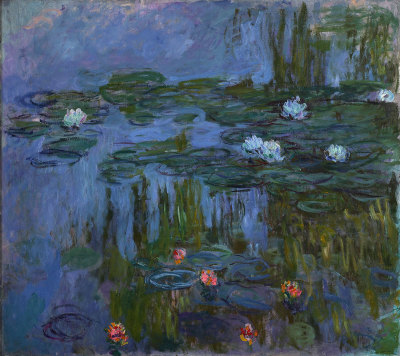
Just gathering together all of the Monet paintings would have made for an impressive exhibit, but this was so much more than that. It was also about gardening and the creation of the modern garden. Monet and many of his contemporaries were fascinated by gardens as a subject-matter for their art and began to construct their own gardens. This coincided with a huge general boom in gardening, as exotic plants from the Americas, Asia and Africa began to appear in Europe, as new transporting systems had been developed to allow whole plants to be shipped rather than simply seeds. (Phylloxera bugs in such exotic imported plants from the Americas ended up destroying the vineyards of Europe, but that’s another story.) Gardening was booming and an artist like Monet had a huge variety of flowers available as a palette to create their own horticultural art. He began designing gardens when he lived in Argenteuil in the 1870s and considered his garden at Giverny his greatest achievement. And the exhibit showed just how fascinated Monet was with horticulture. It had letters he sent, including one to the local authorities complaining about the delays in approving his water garden, catalogs he read and stories about his purchases. He was at the cutting edge of water lilies and got the new varieties that would grow outdoors in France.
And, the exhibit makes abundantly clear, it wasn’t just Monet. Countless other artists were represented. Renoir was one of the early artists with a garden and there was a wonderful Renoir of Monet painting in it. Camille Pizarro had a garden, but preferred to plant vegetables and was known as the one who painted cabbages. Pierre Bonnard lived nearby Giverny and he and Monet would visit each other’s gardens, although Bonnard preferred to let his grow wild. Max Liebermann developed extensive gardens outside Berlin and spent most of his life painting it (incredible wild brushstrokes). Emil Nolde was so taken with painting flowers that he also had a garden, as did Wassily Kandinsky, and both had works of astonishing colors. Van Gogh, of course was famous for painting flowers and fields (but was too poor to have his own garden), especially while in Provence, and influenced Munck to have a garden. Also represented were the more melancholy garden paintings of Spanish artists Joaquin Sorolla and Joaquin Mir y Trixit. I could go on and on. I don’t know how you could go to this show and not come away wanting to plant a garden. Of course, I can’t do that here, but I will definitely paint some.
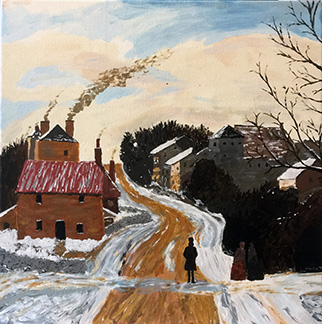
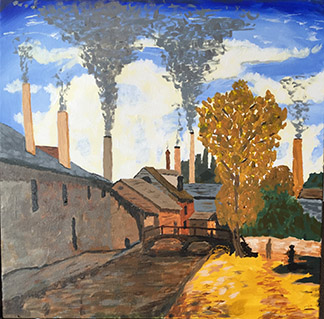
A new painting: The painting below is based on some impressionist painting I saw and photographed at some museum (maybe the National Gallery). I liked the composition and the idea of doing a wintertime picture appealed to me. But when I actually painted it, the whole thing just didn’t work. There were blobs of black and gray, which somehow worked in the original, but just looked like blobs of black and gray when I did it. So, for the first time since I started this painting experiment, I painted over a big part of what I had done. I completely redid the bottom left corner, making it into a path going to the left with some dirty snow representing a filed, perhaps on the edge of the town in front of us. I added stone walls in place of black spots (hedges??) and made the road sweep in a better way. Finally, I changed the gray blob into something that gives the impression of a castle. I like it much better. It has a sort of story now. We’re at the edge of a town, just getting out of the fields, on a winter day, having reached a path crossing the main dirt road. A man is walking up the road, as are two women. Perhaps they are going to market. The painting is below. (It is what I have decided is the second in ma\y smokestack series. I’ve also included the first one for those of who have not been following religiously.)
 nickinshoreditch
Nick, I love these two new paintings…Robbie
LikeLike
I’ve officially joined your fan club, and I would like to offer you a show at Unity Gallery when you come back across the pond!
LikeLike
It’s a deal. It will be interesting to track the progression….
LikeLike