Who knew Insurance underwriting was interesting? Definitely not me. When Ivy and Debbie were visiting (this was over a week ago–a real catchup story), I joined them for a tour at Lloyd’s of London. I was expecting to meet them at some old building in the City, since Lloyds has been around forever, but it turned out that Lloyds is in a new building designed by the architect responsible for Paris’ Pompidou Center–very modern with all of the internal parts on the outside. I’m sure that it caused a furor when it was built in 1986, but it now something of a landmark and is protected. We joined up with some other Americans with insurance ties and were met by one of the chief lawyers for Lloyds, who told us that we were being given the tour by the Head Waiter. I’m thinking “Head Waiter??”, but, as in many things here, the language was deceiving.
It turns out that Lloyds was started in the late 1600s in a coffee bar in the City. This was shortly after coffee started to be imported to England and coffee was a big and prestigious thing. The coffee bars were the beginnings of business as we know it today. Up until then, businessmen either meet in the street or in a pub to conduct their affairs. Coffee bars were the forerunners of modern offices or businessmen’s clubs. They began to specialize, so that you knew that if you wanted to do a particular sort of business or needed information on cargo on a particular ship, you would go to a particular coffee bar. And businessmen could begin to have something like office hours since one would know when and where they could be found. The coffee bar owned by Mr. Lloyd (there were 80 of them in the City then) came to specialize in men who were willing to insure the cargo being shipped to other places, and sometimes the ships themselves. This was when London was a huge port and international trade was complicated by storms and pirates and other events that made delivery a risky proposition. A group of wealthy individuals had begun to insure such deliveries in exchange for a premium. In order for this to work effectively, these men needed the best information possible and a way to spread the risk. Lloyd’s coffee bar allowed all the men in this field to be in one spot, eliminating the need to run all around the City trying to find other men willing to underwrite the risk. Equally important, that coffee bar became the place which had the information about every ship, its history, where it was going, what it was carrying and whether it was on time. Keeping this whole enterprise operating smoothly were the waiters of the coffee bar. The titles never changed, so the Lloyds Head Waiter is not a waiter in the usual sense, but instead is a significant corporate official.
Lloyds’ business is enormous today, but essentially unchanged, except for the fact that it finally allowed women to work there in 1974. (The head waiter explained that this was due to the tradition that women where not allowed in the coffee bars in the 1600s, a pretty weak story, but undoubtedly the corporate line.) It is not an insurance company. Instead, it is a facilitator, a place where a huge number of underwriters from many different companies gather and Lloyds get a cut of the business that goes on there. There are massive floors covered with desks, where the individual underwriters wait for brokers to bring a matter to them. (Each underwriter’s desk has a stool next to it for the brokers.) The brokers move around and eventually pick a lead underwriter (the underwriters specialize in various areas), who writes a policy with the various terms and conditions and agrees to take a portion of the risk, normally 5%. The broker then literally walks the policy around the floor, speaking to other underwriters, who can sign on to the policy, but not change its terms. Lloyds claims that this person to person process is actually more efficient than doing it through computers, which makes some sense. They are apparently running out of room in the gigantic building that they are currently in and are going to have to toss out tenants to fit in even more underwriters, so business remains good for them. The big change is that whole underwriting business is gradually expanding toward Asia, as you might imagine, and Lloyds now has an office in Singapore doing the same thing to eliminate the problems of time and language that would complicate their business model.
Besides getting this whole talk about this history of the insurance industry, there were a few highlights of the tour. On the main floor, there is a book which lists every lost ship in the world, which is updated daily and lists the details about how it was lost. It is still maintained and the head waiter who was giving us the tour is responsible for making the entries with a quill pen. (He has amazing handwriting.) Not many ships sink these days, but he showed us the most recent entry, a ship that had sunk off the coast of Indonesia eight days earlier. Then he showed us a book from 1915 that they have on display in a glass case, which showed seven ship lost on a single day and there may have been more on other pages. Five had been sunk by German submarines. Lloyds has books like this going back over 300 years. There was also a big display about Lord Nelson, which contained the log book from one of the ships on the edge of the British fleet that has a blow-by-blow account of the Battle of Trafalgar based on the semaphore signals that they received.
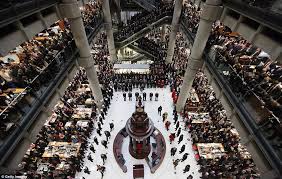
Probably the most famous thing at Lloyds is the Lutine Bell (above), which sits in the center of the main floor in an impressive wooden stand. Back around 1800, British businessmen agreed to send over £1,000,000 to Hamburg to prevent a market collapse there. The gold and coins were loaded on the HMS Lutine (which itself has an interesting history involving the French Revolution). The Lutine then sank off the coast of Holland in a storm and Lloyds as the insurer, paid back all of the money in several weeks. (They never insured the actual warships though.) Lloyds eventually sent an expedition to try to recover the gold and coins, but the ship had sunk on a sand bar with strong currents and the stuff was all completely dispersed and buried. (No one has found it to this day.) All they found was the bell from the ship, which went back to Lloyds as kind of consolation prize. From then on, it would be rung to signal the status of a missing ship, once if it was found, twice if was sunk. The bell finally cracked and was last rung when Queen Elizabeth came to Lloyds to celebrate its 325th anniversary.
This is a kind of esoteric post, but I found the whole thing to be fascinating.
 nickinshoreditch