Merry Christmas and Happy New Year

Here’s hoping that everyone has had (and will continue to have) a wonderful holiday season. It has been simultaneously joyful and a bit exhausting over here across the pond with the kids here.

I haven’t had time to do any art at all. I actually have been having urges to do something, especially after going to museums and touring around Paris, but there just isn’t time (and my painting table was appropriated to do a jigsaw puzzle that Judie got for Christmas).

And I’ve fallen behind on storytelling as well. In the next week, I’ll catch up with what we’ve been doing (although it sometimes seems like all we have been doing is eating and drinking and walking around).

Family Time and Harlequinade

We are in the midst of having the whole family here, so I’ve had less time to write on this blog or to paint. I feel a sort of responsibility to keep everyone entertained, although the kids are sometimes perfectly happy just hanging out in our flat, talking and watching television. James has been here for well over a week at this point and I suspected that he is starting to get sick of spending time with me, so I sent him off with Hannah today to do some sightseeing on their own. Meanwhile Alex and Lucy have taken off to Scotland to visit her ancestral home in some industrial town between Glasgow and Edinburgh whose name slips my mind. Spending the winter equinox in Scotland where it is perpetually raining, windy and dark this time of year wouldn’t be my choice, but I imagine that they are having a good time. It has been gratifying that the kids approve of Shoreditch as a cool neighborhood in which to live. Hannah was in one of the countless vintage clothing stores within blocks of our flat and said that I could just leave her there to die and James loves all of the street food opportunities.

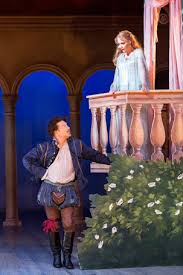
On Saturday night, we took everyone to see Kenneth Branagh’s production of “Harlequinade”. For the this year, Branagh has his own theatre company at the Garrick Theatre on Charring Cross Road, where he is putting on a series of plays in repertory. We missed getting tickets to “The Winter’s Tale” with Dame Judi Dench joining Branagh and others (they sold out in a flash), so we opted to see Sir Ken and Zoe Wanamaker in Terrance Ratigan’s “Harlequinade” and “On Her Own”. Zoe Wanamaker performed “On Her Own”, a fifteen minute monologue about a widow living on her own and having a conversation with her dead husband. It was very well done and maintained a certain dramatic tension as you wondered where it was going to go. It is the kind of thing that you don’t see in theater that often. “Harlequinade” is a farce, written around 1948, about a theater troupe touring the English hinterlands, bringing culture to masses as part of a post-war program that actually existed. (The play starts with a newsreel about the program fro the period.) Branagh plays the head of the company who is playing Romeo, although he and his wife are too old for the parts and sort of realize it. He is fatuous, egotistical and dotty and, as one of the other characters describes him, utterly incapable of doing anything other than acting. He is terrific and hysterical. The program notes say that Ratigan based the character on John Gielgud, who directed Ratigan in a student production of “Romeo and Juliet” while they were both at Cambridge, and on Alfred Lunt and Lynn Fontanne, who appeared in a number of his plays. There is a character in “Harlequinade” who is given one line in Romeo and Juliet by the Branagh character and is a running gag as he repeatedly rehearses and mangles it. It is the same part that Ratigan played when directed by Gielgud, and he is reported to have said his one line so badly that it always got a laugh. It is all a cute piece of fluff (which couldn’t quite figure out how to end) that was acted very well. It was written at the peak of Ratigan’s popularity. In less than ten years, his style of writing had been eclipsed by the likes of John Osborne and the post-war realists. (Branagh is going to be in Osborne’s “The Entertainer” in the spring, playing the role made famous by Lawrence Olivier.)

images         imgres

Alexander Calder and Other Stories

James and I went to see the new Calder exhibit at Tate Modern. The theme was performing sculpture. It started with his wire sculptures, which are works of pure genius. The wire portrait of Leger was worth the visit by itself. Then, according to the show notes, Calder visited Piet Mondrian in his studio and his entire world changed. He pretty much gave up most of his representational art in favor of abstract. There were a lot of motorized works from the 1930s, many of which had never been shown together since they were made. And then the mobiles, some of them with gongs worked into them, so they would randomly make sounds. It was all magical, in a way that few artists other than Calder can be. My only objection is that there were not enough breezes wafting through the exhibits and the mobiles were too static.

Judie and James and I were wandering around Mayfair, looking for a place to eat. We were walking up Regent Street, checking out the incredibly gaudy Christmas decoration, when we decided to cut down a little side street called Heddon Street. One of my discoveries in walking around central London is that there are lots of little side streets and alleys that are sometimes lined with restaurants and pubs. This was a tiny, L-shaped street with six or seven restaurants. We decided to try Heddon Street Kitchen, which advertised itself to be a Gordon Ramsay restaurant. We were eating our dinner in the lounge area (the dining room was full), when James said he thought he saw Gordon Ramsay. We scoffed, figuring why would he come to this little place out of all of the big and famous places he operates in London. But on the way out, we looked closer and it was him, sitting at a table of people including several who looked a lot like him. I read in the paper the next day that he was visiting his family from the US.

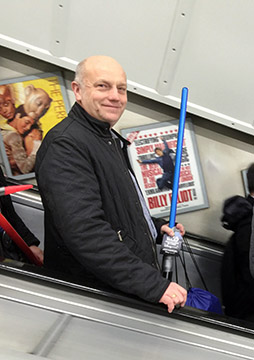
A few days later, James and I are on the Underground and I grabbed a seat next to this older, well-dressed guy and began to read my Evening Standard, the free paper that they give away all over the place. All of a sudden this guy across the way begins talking to the gent next to me. He had a ridiculous Cockney accent, so I couldn’t understand him at first, but I eventually figured out that the guy next to me was some sort of manager of the West Ham footie team. (I checked later and it was Sam Allardyce, who was the manager of West Ham, but is now the manager of Sunderland.) After an extended, semi-understandable conversation between the two, I ended up taking a cell phone photo for the fan guy.

After that, we got off the Piccadilly line in Leicester Square to go the Soho Theatre where we going to see an Australian comedian (who turned out to be pretty funny). We could barely get into the Square and it turned out that we had stumbled into the Star Wars premier. It was a madhouse, although we almost got to where the red carpet was somehow. (The security wasn’t great at that point.) We didn’t see Harrison Ford or any of the stars (although they were there later and the pictures were on the front page of the papers). After the comedy show, we went to dinner at this restaurant in Chinatown that we like and were walking back to the tube and found ourselves completely surrounded by people carrying light sabers. They accompanied us all the way back to Liverpool Street. See below. We were safe in case Sith warriors attacked.

star wars

Utterly Miscellaneous Thoughts

I went a private doctor last Thursday to get my bandage changed and learned the needles that are used to give jabs (shots) are called “sharps”. Thus, after giving a flu jab, the doctor is instructed not to throw the sharp in with the regular trash.

One of the things that Judie and I have noticed is that you never smell marijuana when you are walking around, which is very much unlike New York or other US cities. This is certainly a place with a drinking culture, but we both find it surprising, especially in a young, hip place like Shoreditch. Do the police crack down very hard on that sort of thing here? On the other hand, you do see people rolling their own cigarettes a lot in this neighborhood (more than in other parts of London). Maybe there is something in there in addition to tobacco?

Another thing you don’t see here are ads for Viagra and similar products, in contrast to the US, where you can’t watch sports on television for twenty minutes without being subjected to one. My British friends might contend that this says something about English men versus American ones, but I suspect it is probably more about the drugs being covered by National Health.

James arrived yesterday, after an endless, three-flight trip from Greensboro. The rest of the kids arrive during the week. Judie and I have been planning for this for months and are looking forward to the next few weeks.

I decided to some research about the building we are in. According to the Internet it was built around 1900 as a telephone exchange. It seems like a huge building for that, but I suppose that this was in the period when a human being would have to make the connection and this place was filled with operators. But that use could not have extended through the Twentieth Century, since I am sure that automatic switching took over by the 1930s at the latest. Fro the rest of the century, this must have been a nice structure in a fairly terrible neighborhood. Wikipedia refers to the building as an Art Deco tobacco works, so maybe that was its later use. The building led the gentrification of the area when it was converted into a residential building in 2000. (That would have been a great investment.)

Commercial Street (where we are) is a relatively new street for London. It was built in the 1830s to connect the east-west thoroughfare through Whitechapel to Spitalfields Market to the North. It was eventually extended up to the Shoreditch High Street. and when it was further connected to Old Street, it became a route to get around central London (which was actually the goal of the planners in the 1800s). It is now at the edge of the Congestion Zone. (In London, you have to pay a significant daily fee to drive in the center of the City.) This explains why there is a perpetual traffic jam outside our building until late at night.

Here’s an embarrassing way to join a museum: I decided to take James to see the last day of the Ai Wei Wei exhibit at the Royal Academy. But when we got there, the ticket taker pointed out that the tickets were for 5:00 AM (they had kept the museum open 24 hours for the exhibit’s last day and I’d read the website wrong.) But they agreed to credit us with the unusable tickets and let us in if we became members on the spot. Oh well. I like joining museums as a matter of principal and now our visitors can attend future exhibits….

Hedonist’s Gazette

If you are subscriber to the website of Robert Parker, the noted wine critic, you know about his Hedonist’s Gazette. It is a periodic column in which he talks about meals and wine tasting in great restaurants around the world. It is somewhat fun to read, even if it reviews restaurants that you will never be able to go to and describes wines that you will never afford. On Friday, I had a hedonistic day and what follows is my gazette. It was the 15th Annual Gentlemen’s Christmas. I was invited to join it by Paul Gee, the husband of a lawyer who Judie just hired at Bryan Cave and who came to our flat for Thanksgiving. One of the usual eight mates who normally participate had dropped out so there was an opening. One of the rules is that everyone has to wear a suit and tie.

The whole thing began at Hawksmoor Guildhall, one London’s finest steak houses. (This branch is located in the City  and there is another across from our flat in Shoreditch). In retrospect, I probably should have had the steak and eggs, but I thought I should pace myself, so I just got Eggs Royal (Eggs Benedict with smoked salmon instead of the bacon). I met John and two of his friends from Pleshy, the country town about an hour from London where they all live. The four of us split a bottle of English sparkling wine and each had a bloody mary. We were supposed to meet four other at the Seven Stars pub, so after finishing breakfast, we wandered across the City, stopping to check a roof view from next to St. Paul’s and making another stop for more coffee.

The Seven Stars pub is right behind the Royal Courts of Justice and is a hangout for lawyers after leaving the Old Bailey. The owner is the marvelously-named Roxy Beaujolais. We got there around 11:00 to discover that the other four had yet to arrive and, worse, that the Seven Stars was closed for a private party until noon. (Who would schedule a one-hour pub party before noon, one might wonder.) So after making some phone calls, Paul led us off to the Cheshire Cheese, an ancient London pub, dating back to the Great Fire. It was closed (and he received considerable grief for all of this), so we ended up at a ancient Portuguese wine bar called El Vino, on Fleet Street, where we had two bottles of sherry and the rest of the crew gradually found us. Then we went back to the Seven Stars, since that was a traditional part of this pub crawl, and had a pint of bitter.

From there, we walked over to the Quality Chop House (according to my iPhone, I walked over 19,000 steps that day). This is a restaurant that I actually first read about in a Parker Hedonist Gazette, so I was looking forward to it. We were led to a private room where we started with a magnum of Pol Roger champagne and proceeded to eat an incredible game menu over the next three or four hours. The Brits like to eat birds that most Americans would never touch. We began with a game tea, a very rich game broth, which we had with the rest of the champagne. That was followed by a pigeon leg that had been deboned, made into a pate, put back on the leg bone, fried and served with cranberry. This was accompanied by a game terrine with brioche and a jam made of damson fruit. By this point we were switching over to a Fleurie. We then had a course of teal breast (a kind of duck) with beetroot and horseradish. Then it was on to woodcock (a smallish ground bird), with a chicken liver pate and a fruit called greengage. Somewhere around here we switched over to a Dao wine that was fuller bodied than the Fleurie. By now, we reached the main course, pheasant and wigeon (another sort of duck). These were accompanied by amazing sides, including an incredible roast cauliflower with black truffle. Then it was on to truffled Tunworth (a kind of cheese) and then a meringue-based dessert. Somewhere in here, one of the gents pulled out a liqueur called Kummel, which is made from caraway seeds, much to the groans of much of the rest of the group (it seemed to be a running gag). I tried it and it was very sweet and had an interesting flavor, but I have to say it was hard to drink too much of it. We concluded with armagnac and other digestifs.

Some of us then staggered over to the Scotch Malt Whiskey Society, where one of the guys was a member. It has a huge number of single cask whiskeys which you can try. We each had two or three. This was the real killer for me, pushing me over the edge from pleasantly wasted to completely drunk. But it was fun trying the different flavors. I really needed to take a taxi home at this point, but it was rush hour so it was impossible. Fortunately, I was next to the Farringdon tube stop, so I somehow managed to get home.

A few things I learned: (1) You don’t toast the Queen until dessert. (2) One of the gents was going out shooting the next day and told me that it is shooting etiquette that you cannot shoot the pigeons that the beaters scare up into the air until you have shot a larger bird. (3) They are completely mystified by the US approach to guns, although I explained to them that the Second Amendment is all their fault, as it resulted from the British taking the guns away from colonial militias. (4) The Donald would probably be happy to know that he was a conversation subject. Horror mixed with bemusement seemed to be the prevailing attitude. (5) The British (or at least some portion of British society) really do like to eat various odd small birds and animals.

I slept very well that night.


Stories from Lunch and a new painting

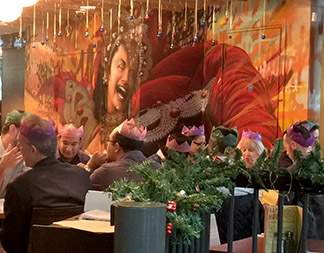
Judie and I decided to go lunch the other day at Spitalfields market. Since we decided to go where we could actually sit down, rather than eat the street food and try to find a place on a bench, we discovered that it was already “Holiday Lunch Season”. There were a number of large parties celebrating the season, probably from the many offices in Broadgate Centre and the other nearby towers. See the photo below of one such group. Christmas crackers and the accompanying silly paper hats are a big thing here and a number of the revelers in the restaurant were snapping their crackers (the first snap makes you turn your head, but after that it becomes background noise) and putting on the paper crowns. It seems to be a universal custom here, while in America, you rarely see it (although it became a Christmas custom for us after we lived in Sydney). You can get cheap crackers at Tescos and seemingly everywhere else. They come in a mind numbing range of prices and sizes. (I do wonder if the crackers on Brick Lane are any different.) And you can spend a small fortune on crackers at Harrod’s of at Fortnum and Mason’s.

xmas party

Fickle Finger Follow-up: While we were having that lunch, I got a call on my mobile. (Practically no one but Judie ever calls me, so it is always a surprise.) The conversation went as follows: “Hello.” “Can I speak to Nick Lewis?” “Speaking.” “This is Royal Hospital. Your surgeon would like you to come in tomorrow.” “What for?” “Um. Well.” “I’ve already got an appointment with a GP to get the dressing changed.” “But this is for your surgery.” “I had the surgery last Friday.” “You did?” “Yes. I can’t recall the surgeon’s name.” Long pause. “Ah…. Yes. I will take you off the waiting list. Please ignore this call. Goodbye.” A call that was both amusing a little frightening. People must get lost on these waiting lists. If I hadn’t called the scheduling clerk last week to see when I was going to be treated, I clearly could have been in that boat.

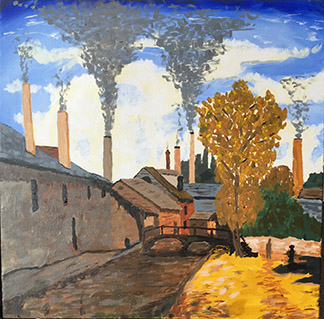
I finished another painting today (with the usual caveat that I am never sure if anything is really finished–that tree still bothers me). This one was based on a portion of a painting that we saw at Musee D’Orsay, while we were in Paris. It was a Monet, but the subject was very un Monet-like. It was in interesting painting exercise, which demonstrated to me, unsurprisingly, just how hard it is to do what Monet did. I am actually not displeased with the result, although comparing it to Claude would only be embarrassing. Here it is:

monet riff

New Painting: From There to Where?

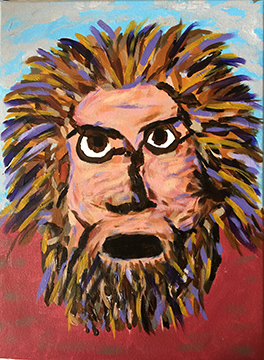
Well, I have finished (I think) a new painting. It is based on a photo of a mosaic at the British  Museum that I took. The photo is below. Somehow, I ended up with the painting that is also below. It kept evolving when I didn’t like earlier version and kept adding paint. I’ve reached the point where it stopped getting any better as I added still more colors, so I decided to stop. This is one that I may come back to at some point. I put another one aside to do this one because it just wasn’t working for me at all. Maybe I can revisit it now. Or maybe not.

Tileman before

Tileman after


Week in Review

Fickle Finger Finally Fixed: On Friday, I got my finger repaired. I was beginning to worry, because it was approaching a week and when I called the scheduling clerk at the Hospital on Thursday, I was told that it would probably be another week before there was room in the surgery queue. I could almost feel my finger starting to knit together in the wrong way, so this seemed like bad news. But he called back later in the day to tell me to come in the next morning. I got there and at 7:00 they announced to a room of waiting people that the wait to be treated could be as long as twelve hours. So getting into surgery by 11:00 and out of the hospital by 12:30 seemed like a victory.

The whole thing could have been so much worse. I really cannot complain at all. And it was a good way to get a look at the operation of the National Health Service. The care was a bit slow in coming, but it was ultimately good. It was pleasant to avoid having to spend time on insurance and how you are going to pay when all you want is treatment. (We are not covered by NHS, which I think is due to the type of visa we have, but no one has even mentioned money to me yet. I assume that they will eventually catch up with me.) And things must be far less litigious here, since I was largely spared signing my life away and getting pages of written warnings and instructions. The delay in getting surgery was only annoying for me, but you could see how this could be a real problem for someone who needs to go to work every day. These delays is a drawback to NHS, which otherwise seems to work pretty well

Another Political Update: On Wednesday, PM Cameron succeeded in getting the authorization to begin bombing Syria. If you are really interested in this story, the basics are covered very well in the New York Times and similar papers. So I thought I’d limit my comments to some side things that might not have been reported:

  • Public support for the bombing had been dropping over the prio week, down 11% to a pretty even split, which may have pushed up the timing of the vote.
  • Since Corbyn lost control of his Labour Party and had to allow his members to vote their conscience, there was no question that the motion would succeed and the big issue was how many would desert him. The final answer was 66. More than some predicted and less than a few other had predicted, but it might have been worse fo rhim.
  • The day before the debate and vote, Cameron suggested that those who opposed the bombing were “terrorist sympathizers”. This was probably a political move aimed at reminding the voters that Corbyn had supported Sinn Fein and other radical groups in the past. It was a dumb move that was universally decried, even by his supporters. He effectively ceded the moral high ground by making the issue political and was faced with endless demands that he apologize or withdraw his remarks during the more than ten hours of debate.
  • The debate went on for so long, even with the result preordained, that the Speaker had to limit the backbenchers to 3 minutes each. There were a number of good speeches on both sides. Cameron was OK. Corbyn seemed disjointed to me, but maybe that is just his speaking style.
  • Each side had good points to make, which is why public opinion was so split. The conservative argued that we are already bombing ISIS in Iraq anyway, the bombing is legal, we are supporting our ally, France, who asked for our aid, we should not let others do our work for us and if there is a chance that the bombing might protect British citizens, it must be done. Those opposed argued that, even if all that was true, there is no plan beyond simply dropping some bombs (Cameron doesn’t seem to have any coherent plan as yet), there is no reason to think that a few UK bombs will really make any difference and they might kill more innocents, shouldn’t we first be working with our allies to come up with something comprehensive and what is the big rush?
  • So the real drama was really whether the Labour party was splitting apart. And this dramatic theme came to a head at the end of the evening when the Labour Shadow Foreign Secretary, Hilary Bend, gave one of the final speeches, a really wonderful one, which was the precise opposite of everything Corby had said and which got a rare ovation from both sides. After that, the actual vote was an anticlimax. (Later in the week, Corby got a little good news when Labour won a by-election. It was traditional Labour seat with a great local candidate, so winning wasn’t that big a deal, but Corbyn sensibly treated it as a personal and party triumph.)

San Bernardino: While the debate and vote was going on in Parliament, the BBC would cut in once in a while with an update from the latest mass shooting, this time in San Bernardino. It was an odd counterpoint to the civilized and actually very thoughtful debate that was going on. The British, quite understandably don’t know quite what to make of all of the US gun violence. Here, the big concern is knife attacks, which have killed a relatively small number of poor and young people. (It is reminiscent of “West Side Story”, whose violence seems almost quaint today.) It seems like these shootings are happening with increasing frequency in America. I have a theory that the fear-mongering in the Republican primary is stirring up and giving the crazy and hateful a feeling of empowerment and justification. In the end, this one had elements of terrorism, although it sounds like it might be more complicated than that, so maybe the trigger was the Paris attack rather than my theory (or maybe a toxic combination of the two).

Other thoughts: I’ve been watching a British police drama called “Whitechapel”. It seems to involve mostly serial killers and is very dark and intense. One of the cool things about it is that is filmed right in our neighborhood, so there is an occasional scene each episode occuring somewhere we have been. I think it has been shown in the US on the BBC cable network. I love it and have been viewing past episodes, but it is too violent for Judie.

I never understood ugly Christmas sweater parties until the past week or two. There are an endless number of ridiculous Christmas sweaters for sale everywhere you look. Clearly, someone is buying these things.

We heard a wonderful sermon at the New Unity Unitarian Church on Sunday (the Minister prefers to call them messages and they are perhaps shorter than a typical sermon) on the subject of Hanukkah and terrorism and purity vs. love. It is supposed to be posted on the church website at some point. If so, I may provide a link at some point.

The took our curtains away for re-lining and for some reason they weren’t returned for weeks. It hardly mattered because the sun virtually never breaks through the clouds. It isn’t particularly cold or wet (unlike Scotland). It is just relentlessly gray.

We are preparing for the family visit. James is the first to arrive–next Sunday morning.

Catching Up, Part 4: Lloyds of London

Who knew Insurance underwriting was interesting? Definitely not me. When Ivy and Debbie were visiting (this was over a week ago–a real catchup story), I joined them for a tour at Lloyd’s of London. I was expecting to meet them at some old building in the City, since Lloyds has been around forever, but it turned out that Lloyds is in a new building designed by the architect responsible for Paris’ Pompidou Center–very modern with all of the internal parts on the outside. I’m sure that it caused a furor when it was built in 1986, but it now something of a landmark and is protected. We joined up with some other Americans with insurance ties and were met by one of the chief lawyers for Lloyds, who told us that we were being given the tour by the Head Waiter. I’m thinking “Head Waiter??”, but, as in many things here, the language was deceiving.

It turns out that Lloyds was started in the late 1600s in a coffee bar in the City. This was shortly after coffee started to be imported to England and coffee was a big and prestigious thing. The coffee bars were the beginnings of business as we know it today. Up until then, businessmen either meet in the street or in a pub to conduct their affairs. Coffee bars were the forerunners of modern offices or businessmen’s clubs. They began to specialize, so that you knew that if you wanted to do a particular sort of business or needed information on cargo on a particular ship, you would go to a particular coffee bar. And businessmen could begin to have something like office hours since one would know when and where they could be found. The coffee bar owned by Mr. Lloyd (there were 80 of them in the City then) came to specialize in men who were willing to insure the cargo being shipped to other places, and sometimes the ships themselves. This was when London was a huge port and international trade was complicated by storms and pirates and other events that made delivery a risky proposition. A group of wealthy individuals had begun to insure such deliveries in exchange for a premium. In order for this to work effectively, these men needed the best information possible and a way to spread the risk. Lloyd’s coffee bar allowed all the men in this field to be in one spot, eliminating the need to run all around the City trying to find other men willing to underwrite the risk. Equally important, that coffee bar became the place which had the information about every ship, its history, where it was going, what it was carrying and whether it was on time. Keeping this whole enterprise operating smoothly were the waiters of the coffee bar. The titles never changed, so the Lloyds Head Waiter is not a waiter in the usual sense, but instead is a significant corporate official.

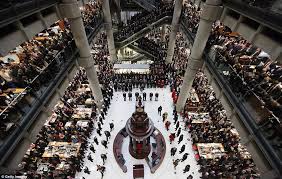
Lloyds’ business is enormous today, but essentially unchanged, except for the fact that it finally allowed women to work there in 1974. (The head waiter explained that this was due to the tradition that women where not allowed in the coffee bars in the 1600s, a pretty weak story, but undoubtedly the corporate line.) It is not an insurance company. Instead, it is a facilitator, a place where a huge number of underwriters from many different companies gather and Lloyds get a cut of the business that goes on there. There are massive floors covered with desks, where the individual underwriters wait for brokers to bring a matter to them. (Each underwriter’s desk has a stool next to it for the brokers.) The brokers move around and eventually pick a lead underwriter (the underwriters specialize in various areas), who writes a policy with the various terms and conditions and agrees to take a portion of the risk, normally 5%. The broker then literally walks the policy around the floor, speaking to other underwriters, who can sign on to the policy, but not change its terms. Lloyds claims that this person to person process is actually more efficient than doing it through computers, which makes some sense. They are apparently running out of room in the gigantic building that they are currently in and are going to have to toss out tenants to fit in even more underwriters, so business remains good for them. The big change is that whole underwriting business is gradually expanding toward Asia, as you might imagine, and Lloyds now has an office in Singapore doing the same thing to eliminate the problems of time and language that would complicate their business model.

Besides getting this whole talk about this history of the insurance industry, there were a few highlights of the tour. On the main floor, there is a book which lists every lost ship in the world, which is updated daily and lists the details about how it was lost. It is still maintained and the head waiter who was giving us the tour is responsible for making the entries with a quill pen. (He has amazing handwriting.) Not many ships sink these days, but he showed us the most recent entry, a ship that had sunk off the coast of Indonesia eight days earlier. Then he showed us a book from 1915 that they have on display in a glass case, which showed seven ship lost on a single day and there may have been more on other pages. Five had been sunk by German submarines. Lloyds has books like this going back over 300 years. There was also a big display about Lord Nelson, which contained the log book from one of the ships on the edge of the British fleet that has a blow-by-blow account of the Battle of Trafalgar based on the semaphore signals that they received.

Lloyds

Probably the most famous thing at Lloyds is the Lutine Bell (above), which sits in the center of the main floor in an impressive wooden stand. Back around 1800, British businessmen agreed to send over £1,000,000 to Hamburg to prevent a market collapse there. The gold and coins were loaded on the HMS Lutine (which itself has an interesting history involving the French Revolution). The Lutine then sank off the coast of Holland in a storm and Lloyds as the insurer, paid back all of the money in several weeks. (They never insured the actual warships though.) Lloyds eventually sent an expedition to try to recover the gold and coins, but the ship had sunk on a sand bar with strong currents and the stuff was all completely dispersed and buried. (No one has found it to this day.) All they found was the bell from the ship, which went back to Lloyds as kind of consolation prize. From then on, it would be rung to signal the status of a missing ship, once if it was found, twice if was sunk. The bell finally cracked and was last rung when Queen Elizabeth came to Lloyds to celebrate its 325th anniversary.

This is a kind of esoteric post, but I found the whole thing to be fascinating.

Catching Up, Part 3: Paris

The idea that one could easily take a short train trip and spend a weekend in Paris was always one of the appealing things about the London move for me. So that made it an obvious choice for my birthday weekend. We made the reservations before the recent terrorist attacks and never considered cancelling them. We figured, I think correctly as it turned out, that Paris would be one of the safest places in the world thanks to government overreaction to the atrocities. The police were everywhere, with security tightened further, at least where we were, by the imminent arrival of countless heads of state for the Climate Conference, with countless guns, cars, trucks, boats along the Seine and all of the police toys in evidence.
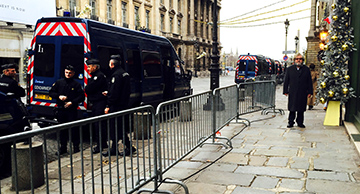
Gendarmes

It was pretty miserable weather. Chilly, windy and grey. The streets were more subdued that usual, thanks to the enormous police presence. But Paris was still absolutely gorgeous. Much prettier than London, although, in fairness, Paris has the advantage of not having been ruthlessly bombed during WWII. But I think that Paris was also one of the early adopters of building codes and urban design principles, which sort of suits the French OCD-like personality. London, in contrast, has always grown more organically, literally layer upon layer, helped along by periodic disasters like the Great Fire and the Blitz.

Taking the Eurostar train is a pleasure, despite starting the journey by going through two customs consecutively. (I wonder where you are when you are waiting on the line in the hundred feet between the English and French customs officials?) On the way back, Judie upgraded us to “premier”, which comes with a snack and wine. All very civilized, especially compared to the horrors of modern plane travel.

We were wondering if the stories of extensive cancellations would impact our trip and perhaps it did. When we checked into the Buddha Bar Hotel (an expensive hotel where we normally would not have stayed, but which Judie had found on sale on one of those websites like Orbitz) and mentioned we had come for my birthday, we were upgraded to an absurdly nice room that should have cost 1500 Euros a night. I am sure that it was because the hotel was surprisingly empty. See the photo below.
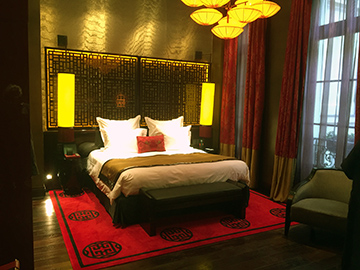
paris hotel

We went out for a stroll. The hotel was right off the ridiculously upscale Rue St. Honoré and near to the Place de la Concorde. Holiday decorations were already up. Very tasteful ones by the hotel, with pretty square lanterns hanging above the street. The Place de la Concorde had a garish ferris wheel and other lights and the Champs Élysées had pulsating lights on the trees lining the boulevard There was a Pére Noel Fair going up from the Place de La Concorde towards the Arc de Triomphe,adding more lights and decoration (and American Christmas music sung by Sinatra and Bing and others, which added a slightly surreal touch). We wandered through it. It seemed very French, with tons of cheese and charcuterie sellers, in addition to the vendors hawking ornaments and other holiday merchandise. There were stands where you could buy Escargot Bourgogne or Foie Gras sandwiches or melted cheese served any number of ways and lots of wine. If we didn’t have reservations for a special meal, we would have been tempted to stuff ourselves. It was hard not to think, as we walked through the masses of Parisians and tourists of all ages, that this would be a great terrorist target. I imagine this had to be in the back of everyone’s minds, but everyone was having a great time.
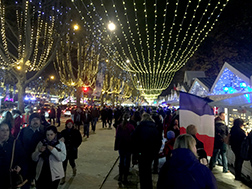
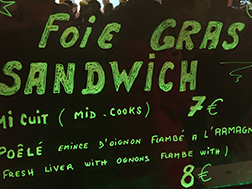
champs  foie gras  vin  cheese

Later that evening, after getting dressed up at the hotel we walked over to Lasserre for dinner. It is an old, two-star Michelin restaurant at which people like Salvator Dali, Audrey Hepburn, Andre Malraux, Marc Chagall, and Jean Paul Belmondo were regulars. It was a memorable evening and not just because it was so expensive. The restaurant itself was beautiful, from the small, brocade covered elevator that takes you from the reception room to the second-floor restaurant, to the multilevel room itself, decorated with yellow wallpaper, chandeliers and orchids everywhere. The ceiling had a painting of nymph-like women in diaphanous dresses. When we had been seated and drinking a glass of champagne, the ceiling opened up and we could see the sky (and a crane, alas) and feel the cool air enter the room. As quickly as it rolled open, it closed, a routine that was repeated about every fifteen minutes throughout the night. The waiter explained that the ceiling had been put in when everyone smoked, to clear the room of the smoke from all of those Gitanes. Now they just do it for tradition and for the fresh air, since one cannot smoke in Parisians restaurants now. We had the Tasting Menu and food was lovely, although not etherial. After looking at the very pricy cartes de vin, we went for the matching wines, which were good, with two memorable ones, a 2004 Puligny Montrachet (I would never had dared order a white wine that old) and a dessert wine from Southern France that was wonderful. It was really just the whole over-the-top experience, the waiters, the attentive service, the beautiful room, the moving ceiling, people watching at the other tables, and all of the little extras that came with the meal, that made the night memorable.
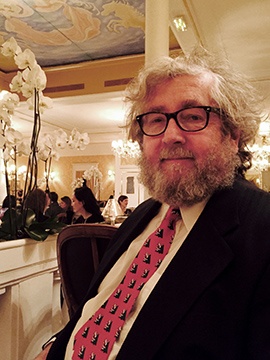
Lasserrre

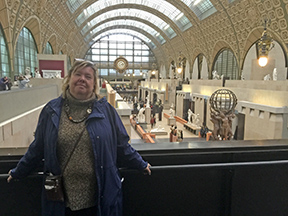
The next day, we slept in, recovering from our emergency room experience the night before. We walked over the Museé D’Orsay, a former train station which now houses a collection of Impressionist and Post-Impressionist art. We began the visit with an absolutely delightful lunch the museum restaurant, which was in an ornate room with a painted ceiling that had somehow been a part of the original train station. (It really came as no surprise that the food in a French museum would be very good.) The collection at the museum has just an incredible number of the iconic paintings of Renoir, Degas, Van Gogh, Monet, Manet, Toulouse-Lautrec, and all of the rest of that group of artists. You walk around and turn a corner and there is another one. I think that I could get a little closer to the paintings than in US museums. I got close ups of the brush strokes without setting off the alarms that would have sounded at MoMA. It wasn’t all that crowded, which I assume must be an intentional crowd control effort by the museum, since we had to wait on line to get inside. Since I have been painting, I think I look at these museums slightly differently. I marvel even more at technique and look for ideas. One final thought: we had recently seen a lot of relatively mediocre Renoirs (at the Barnes in Philadelphia and other museums), lots of the nudes that he seemed to do towards the end of his career (perhaps to make money from rich Americans?). But here, there was one spectacular Renoir painting after another, reminding me of just how great he was and confirming his place as the father of Impressionism.
d'orsay

So Paris is alive and well and beautiful. We plan to return with our kids for a few days right after Christmas.