On Wednesday night we went to the Hampstead Theatre and saw “The Moderate Soprano”, a new play by David Hare. Like “Farinelli and the King”, which we saw two days earlier, it was based on a true story. This time it was the creation of Glyndeborne as a British cultural institution, and, like “Farinelli”, it concerned music. It’s not really fair to compare the two plays, since they are so different in time and tone. “The Moderate Soprano” was a delightful evening of theatre, without quite reaching the heights of “Farinelli”.
I think that most people in England have heard of Glyndeborne, although I suspect that many of them think of it it as a place in Sussex where rich people take their hampers from Fortnum and Mason and sit out on a manicured lawn and listen to opera. “The Moderate Soprano” is the story of John Christie and his wife Audrey Mildmay. Christie inherited Glyndeborne shortly after World War I (in which he had been a hero but declined the DSO on the grounds that it should not go to officers, but to the regular soldiers) and planned to live there a a celibate bachelor, while teaching science at Eton. But he had a love of music and built a organ room there and, in 1930, held an event there at which Audrey Mildmay, a noted British Soprano–moderate was said to describe her singing style–was invited to perform. He fell madly in love with her and, although he was quite a bit older than she was, they were married a year later. They decided to expand the estate by adding a small opera house, where John hoped to hear his favorite composer, Wagner. John Christie was a great builder, a classic British eccentric, a fanatical lover of opera (and cars) and a man who deeply believed in getting what he wanted. He wanted to have a great opera house and, in order to reach his dream, ended up hiring three refugees from Nazi Germany, conductor Fritz Busch, director Carl Ebert and young producer Rudolph Bing (the same guy who would later run the Metropolitan Opera for many years). They outraged Christie by telling him that his hall was too small for his beloved Wagner and ultimately convinced him to let them start with Mozart, who he didn’t particularly like at the time. Against all odds, the venture was successful, as Ebert and Busch revolutionized British culture with their brilliant operatic productions. With the exception of the war years, when the house was used to house children evacuated from London, and a short period when Christie finally ran short of funds, the Glyndeborne Festival Opera has been a going concern since 1934. It helped found the Edinburgh Festival in 1947 and is now run by a trust, chaired by John and Audrey’s grandson.
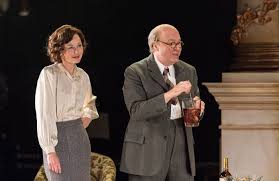 So that is the basic story that David Hare was given. (According to the interview in the programme, Hare was raised in Sussex and, of course knew of Glyndeborne, but knew nothing of the story until told of it by a producer of one of his plays.) His play is not simply about the construction of an opera house and the start of on opera festival. It is about the important role played by the German refugees (and thus has a real political resonance today), although the whole explanation of how Busch, Ebert and Bing got to Sussex was a bit long. It is also about the importance of art. (There is a great scene in which Christie why it is important to charge so much for the opera tickets. He says that business isn’t life and art something you do on the side. It is the reverse.) Most importantly it is about the deep love and synergy between Christie and Mildmay. Each was crucial to the enterprise and without the specific skills and determination of each of them, it would have failed. Their love and dependence on each other was played in a real and touching way as the play moved back and forth from scenes in 1934 to scenes where Audrey was nearing death, finally ending with John talking to Rudolph Bing many years later, long after Audrey had died.
This was a wonderful production. The Hampstead Theater seems to be one of those small theatres that acts as a feeder to the big West End houses. The last play we saw there, “Mr. Foote’s Other Leg” has moved there and I’d guess that there is a good chance that same thing happens with this one. “The Moderate Soprano” was directed by Jeremy Herrin, who has directed many productions, most notably, at least for me, “Wolf Hall” for Royal Shakespeare Company, which we saw on Broadway. If I have a complaint, it is that there was no music until the very end of the play, when there is a sort of flashback to opening night and Bush raises his baton for opening notes of the Marriage of Figaro. Roger Allam, a famous British stage actor whose face you’d recognize from PBS series and the first season of Game of Thrones, was simply terrific as John Christie. And the rest of the cast was also first-rate. Nancy Carroll (another familiar PBS face) was very affecting as Audrey, but each actor had wonderful moments.
On Monday we see “The Father”.
 nickinshoreditch