Catching Up, Part 1: The Fickle Finger

It’s been a while since I have written anything and enough has happened, as you will discover, that I’ve decide to break it into parts.

Last Friday, we had a Thanksgiving dinner. It seemed more sensible than trying to have it on Thursday, since it isn’t a holiday here, which would make it complicated to come and to go to work the next day. (One odd thing is that Black Friday isn’t a day off here, so in Britain it is just a seemingly random, American-generated excuse for excessive shopping. It makes no sense, but that doesn’t seem to stop commerce.) Thursday was Ivy and Debbie’s last night in London and our quazi-nephew Nate Anschuetz and his girlfriend Pua were in town for a wedding, so we all went out to La Chapelle, a lovely French-inspired restaurant close to Spitalfield’s Market, set in a beautifully restored old church. It was a great meal and a nice way to end a welcome visit from Ivy , Debbie, Annie and Charlotte.

Earlier on Thursday, I’d gone to Borough Market with a rolling suitcase and literally filled it with a turkey, miscellaneous vegetables and wild mushrooms, spices, oysters, smoked salmon and desserts. The turkey was so fresh that it still had a few feathers on it. On Friday, I spent most of the day cooking it all. We had thought about inviting a bigger group, but ultimately invited six people, which is probably the best size for this flat, given the limited seating and number of dishes we have here. There were two lawyers from Bryan Cave, one with her husband, one with a friend, Phil Saunders, the lawyer for the City of London (and romantic interest of Jenny Bakshi), who we met in Montclair and who later invited us to meet the Lord Mayor, and Anna Gier, who stayed with us during her gap year and is now attending Oxford and came down for the night. It all went very well. Although no one really knew each other, there was a lively conversation. And the food was good, if I do say so myself. (The gravy was the best I’d ever made.) We drank some really nice bottles of wine and everyone tottered out around 10:45. We were left to do the dishes with Anna and get ready for our trip to Paris the next day, where we planned to celebrate my birthday.

In the space of a few seconds, it all went wrong. I went over to pick up the immersion blender on the counter, to check to see if it was clean and put it away. I didn’t notice it was plugged in and I somehow pushed the switch with my little finger in harm’s way and instantly mangled the end of it. It was one of those things where I knew that it was not just a little cut and that I had really damaged myself. Lots of blood.

It was just after 11:00 on a Friday night and after making a phone number and finding out where the nearest emergency room was (they are called A&E rooms here, which stands for Accident and Emergency), we were off by taxi to Royal Hospital on Whitechapel, which is about ten minutes away. Over the next four and half hours, I got to experience the National Health Service first hand. The first thing you notice is that no one asks for insurance information or how you are going to pay for your treatment. I guess this is because at a big public hospital like that, the government essentially pays for everything and no one worries about the finances (except when the government decides to trim expenses, leading to fewer doctors and nurses). Al I really had to do was show them an ID.

I actually got the see the triage nurse pretty quickly. She confirmed that the end of my finger was a mess and that I’d cut an artery, which was why I was bleeding so profusely. She said I would need an x-ray to see if I had broken the end of my finger (which might have led to being admitted) and would have to see a plastic surgeon. Since it was around midnight, there were no plastic surgeons around, which meant coming back the next week. She sent me to get the x-ray and told me to come back to see here. I didn’t have to wait too long for the x-ray, went back, and she told me that the good news was that my finger wasn’t broken, but the bad news was that I had to see a doctor and there would be a two-hour wait.

I had read in the local papers that NHS didn’t employ enough of the young doctors who staff emergency rooms, resulting in tremendously overworked and dispirited doctors who are threatening to strike. An emergency (A&E) room in a public hospital on a Friday night is always going to be miserable place to be and this was an understaffed one in a less well-off area of London. The one saving grace was that the English don’t shoot each other, so there wasn’t that type of awful ER excitement. Still, there were lots of people in various bad states just sitting around waiting to see a doctor. Sometime around 3:00 I finally was seen by a young female doctor. I had never stopped bleeding and the temporary bandage was soaked. She pretty much confirmed what the first nurse had said, adding that I would need antibiotics. But she said that I really needed to stop bleeding or they would have to admit me (Goodbye Paris). She wrapped me up tightly with lots of gauze to absorb the blood and said she would be back to check on the bleeding. Then some other, more important case must have come up because she disappeared for about an hour. I had stopped bleeding and we finally asked a nurse if we could leave. No such luck. We had to wait for the doctor to prescribe the meds.

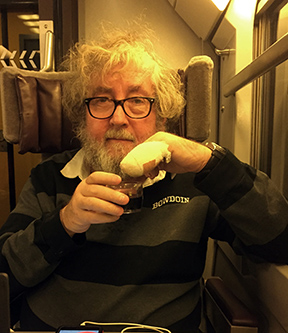
The doctor finally came back, looking harried (who could blame her), talked to someone on the phone and told me to come back on Monday to see the plastic surgeon on the second floor of the clinic at 10:00 and the nurses went through the procedure to get my medications dispensed. Then came the really huge difference between NHS and US medicine. I could just leave. There was nothing to sign. No written instructions about the medications or what to do about my finger. There was no written referral to the plastic surgeon. Still nothing about payment. No diagnosis. Nothing. It was a bit disconcerting. But the good news was that I was getting out of the hospital and going to Paris, albeit with a comically huge bandage on my little finger. See the picture of me below on the Eurostar train:
Train

We got back from Paris (more on that in Part 2 or 3) and this morning I went back the hospital to see the surgeon. I managed to find the right place and discovered that there was no record of any appointment for me and not much of a record of my stay on Saturday night. But I got to see a doctor anyway. First I got to see yet another great nurse, who got my mega bandage off and cleaned it all up and told me what the doctor was going to tell me. The doctor came in and told me that I would have to come back for the surgery and that it would be out-patient since they could just numb the finger. They would then thoroughly clean it up and put it back together. He said I had cut the plate of my fingernail, which would have to be repaired (and the remaining nail removed), so that a new fingernail could grow back properly. He also said that was an outside chance that I would need a skin graft on the end of the finger, but that it was hard to tell until it was all cleaned up. He said it was a fairly small operation and that they would try fit me in by the end of the week. He had written some of this down on a form, which I had to sign (finally), but they didn’t give me a copy. I just got a third of a page sheet titled “Information for patients having surgery” that had be ripped from a larger sheet. The nurse gave me a new, more reasonable sized bandage while all of this was going on and I left.

This all wasn’t much fun, but it really could easily have been so much worse. I’ll write more about this as it happens, but the next few posts will be retrospective. Incidentally, does the phrase “Fickle Finger”make you think of “Laugh-In”? Is there any other connotation?

Museums with Company

Our friends, Ivy and Debbie have been visiting this week with their daughters , Annie and Charlotte (arrived on Sunday, leaving Friday). It has been wonderful to have them here, especially since it is Thanksgiving week and I think we’d have been feeling a bit lonely if they hadn’t decided to come. And yesterday, we got a surprise visit from my brother-in-law, Hugo, who was on London on a two-day trip finishing up his brother Robert’s estate. We all had dinner at the flat. I tried making popovers, having ordered a pan, but they failed to rise properly (although they tasted good). I think this meant I put too much batter in the cups. I’ll have to try again

Yesterday, we went to do some sightseeing an a chilly day and found ourselves at the British Museum, partly because Charlotte is very interested in Egyptian history. So we wandered around looking at all of the Egyptian artifacts. It really is an incredible collection. Just seeing the Rosetta Stone is fascinating. And you can’t go there without seeing the “Elgin Marbles”, which is the large amount of friezes, sculptures and other stuff that Lord Elgin ripped off of the Parthenon around 1800, brought back to England and presented to the King. The Greeks, not surprisingly would like it all back and the Museum actually has a pamphlet in the hall where the Marbles are displayed explaining their legal position that the Ottomans let Elgin have the stuff (but which boils down to “We have them and we aren’t giving them back.”) It all reminded me of a John Oliver riff in which he said: “The entire British Museum is basically an active crime scene. If we start giving back everything we took from the empire, that building would be completely empty, except for one portrait of Alfred Lord Tennyson and a pair of Gary Oldman’s old running shorts, and that can’t happen.” There is also a similar dust-up with India, which wants the Kohinoor diamond returned, presumably back to the Peacock Throne. The diamond has a Maltese Falcon-like history, as it was repeatedly stolen or seized by various warring parties over hundreds of years in the Near East, until the British East India Tea Company finally took it around 1850. So maybe India’s claim is not as compelling as the Greek’s and, in any event, the diamond is part of the Crown Jewels (and is actually the centerpiece of the Queen’s crown), so it is clearly staying put.

Over lunch at the wonderful restaurant in the British Museum, we were discussing what to do next and we came across the Grant Museum of Zoology and Comparative Anatomy in a guide-book. It is part of the University College of London and short walk from the British Museum. One of the things they do here is put these blue plaques on houses of historical significance, so, as you can imagine, there are lots of them. On the walk over to the Grant Museum, we passed the place where Charles Darwin lived and the place where anesthesia was first administered, among various other sites.

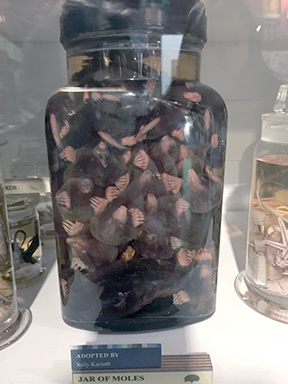
Jar of MolesThe Grant Museum itself was quite an eccentric treat. There were once lots of museums and university departments that collected skeletons, stuffed animals and other preserved dead things. But now, biological science is past the whole routine of dissecting and looking at and comparing species, presumably preferring to look at DNA–zoology usurped by biochemistry. So the Grant Museum is the last bastion of that lost art and it has been expanding as other universities eliminate their departments and dump their skeletons and skulls and jars of monkey brains in formaldehyde on the Grant, which seems to happily accept them. It really is a delightful, weird little place and the shock was that it wasn’t completely filled with little boys or odd old guys with bushy eyebrows, tweed jackets and hair coming out of their ears. The exhibit which gets the most notice, or at least is the one that seems to appear in guide books, is shown to the left. It is a big jar completely stuffed with all of these little moles floating in formaldehyde. It is hard to tell what it is at first until you look closer and see their little feet. There was also an area of slides of really tiny things, all back-lit, that was strangely beautiful. I also enjoyed the elephant heart and a collection of the skeletons of five dogs that had all been owned by the same person. You can see a Picasso anywhere, but this must be the only place where you can see a preserved monkey head next to the skeleton of an emu next to a case containing dodo bones.

Later, in the evening, we went to the Dennis Severs House, which is a sort of museum just around the corner from our building. Dennis Severs was an artist who lived there and gradually recreated the rooms into time capsules illustrating what life would have been like for a Huguenot silk weaving family over a period of time. Each room is a sort of still-life creation that is meant to give the feeling that you have entered the room just as the owner has left. They insist that you remain quiet as the noises that you hear (and the things that you smell) are part of the experience. It is all candle lit and there is an amazing level of detail. There is even a little bit of a plot to figure out as you move through space and time. Another completely unique experience.

A New Panting and Other Musings

We just got back form the O2 Center, where we saw a semi-final match in the ATP Tour finals between Raffa Nadal and Novak Djokovic. Djokovic won pretty easily. Too many unforced error by Nadal. You have to be at the top of your game to stay with Djokovic, and he wasn’t. It was still fun. We were in the Brayan Cave box, with a bunch of lawyers and guests. The O2 Center is pretty unremarkable. A big, typical arena surrounded by new construction. I don’t know what was there before (did they just raze everything that had been there or was there nothing much there?), but it is like a little mini-city rising up along the river. I can’t say it is all especially nice looking and it is a long way from anywhere (except Canary Wharf). I know that China builds entire cities like this out of thin air, designed to hold millions of people. Here they are just building these new, ugly neighborhoods….

After the game, we decided to try taking a boat down the Thames (kind of a huge, floating bus) because they were doing weekend work on some of the Underground and Overground lines and it was really complicated (multiple Tube changes) getting to the O2 for the event. (This comment makes me feel a little like Reginald Perrin. I am afraid that this is an impossibly obscure reference for most people. He was the main character on this old, very odd British comedy, which often began with him arriving to work late-again- and explaining that there was some problem on some road or train line.) Anyway, it was kind of cool taking the boat and we liked it so much we kept going to the Embankment pier, rather than getting off at London Bridge. I think I will add it to London transportation network.

I have been working on a painting for the past four or five days and I got sick of it, so I decided to try something else. I’ll probably get back to the unfinished one at some point. But it felt good to get away from it and  I did the one below in one day. It is also the biggest thing I have done. It’s based on a photo I took of a guy asleep on the Tube. I may call it “Underground Nap”. I find that I work in spurts on these things. When I get excited about something, I can’t stop working on it. The one I stopped doing was starting to seem like work.

Underground Nap

Photograph 51 and other thoughts

Photograph 51 was an x-ray photograph taken in 1952 by Rosalind Franklin and her research assistant Ray Gosling in a basement lab at King’s College in London. It is arguably one of the most important photos ever taken, certainly in the history of science, because it proved, for the first time, that DNA is the form of a helix. It led directly to Krick and Watson’s paper and model showing the building block of life itself. Watson had received a copy of the photograph and other research of Dr. Franklin without her knowledge or consent and never really adequately acknowledged her contribution. She died of cancer at the age of 37.

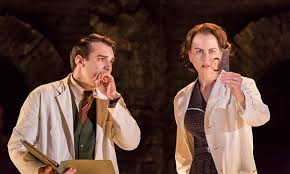
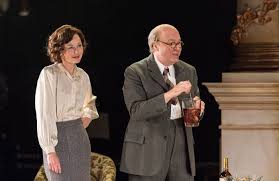
“Photograph 51”, which we saw last night, is a play by Anna Ziegler which looks at the scientists seeking to discover the nature of genes though the eyes of Rosalind Franklin, who was played by Nicole Kidman. It paints a picture of an incredibly brilliant Jewish scientist fighting the overwhelming sexism (and some anti-semitism) of her day. The rest of the cast are a Greek chorus of men, playing the other scientists and also imgresexplaining the science and moving the plot along. The play posits that, while Franklin was the greatest pure scientist of the group, it was her personal shortcomings that prevented her from being the person we associate with the discovery of DNA. She was untrusting and preferred to work essentially alone. She either lacked intuition or was afraid to make the intuitive leaps that Krick and Watson were happy to make, possibly because she, unlike them, was afraid to be wrong. She is portrayed as a repressed, almost asexual person (and a significant acting achievement is convincing us that Nicole Kidman is asexual and not good looking). She is respected and slightly feared, but not loved, by the male scientists around her. Her colleague at King’s College, Dr. Wilkins, tries to reach out to her in his own clumsy way, but she utterly rebuffs him. The play hints that, if they had worked together, we would be talking about Wilkins and Franklin as the discoverers of DNA. James Watson is portrayed as a real jerk and, to the extent that the play has a heavy, it is him. It all seems tragic, but in a way it isn’t because Franklin is portrayed as caring only about the science and not the race to be first, a race that she was unaware of. The only real tragedy is that she finally begins to like one of her fellow scientists, but just as there is a glimmering of a romance, she is stricken with cancer, which ultimately kills her fairly quickly. Nicole Kidman was wonderful and the ensemble cast is also great. I loved the set and the staging. It is a play that is more cerebral than visceral and it was enjoyable to learn about something new. But because the main character is so repressed emotionally needy, it was more frustrating than emotionally satisfying, which is not to say it wasn’t well written. Thanks to Kidman, the show is utterly sold out.

Something that Judie and I have noticed in the past and noticed again that night is that applause at the theater is completely different in London. They simply do not do standing ovations here. In New York, standing ovations are so routine as to be meaningless, given for even the most mediocre productions. One would have thought that when Nicole Kidman, a famous star who had just given a great performance, came out for a solo curtain call, the London audience might have risen. But they didn’t. Another difference is that New York audiences often applaud when the star actor first appears on stage (a practice that I don’t particularly like). They just don’t do that here.

5000 bullets. That is the number of bullets that French security forces used in their shootout with the terrorists in St. Denis the other day. Doesn’t that seem like an incredible number of bullets to be shot on a city street? Equally incredible is that all of that flying lead only resulted in the death of a single terrorist. (The other two deaths were the result of them blowing themselves up). This is one of those movie things that aways bothered me–James Bond or John Wayne or Han Solo or whoever running around with the other guys spraying bullets at him but never hitting him. It always seemed ridiculous. The French have shown in real life that maybe it isn’t.

As a result of the Paris attacks, PM David Cameron is having his own George W. Bush moment. He really wants to bomb ISIS in Syria. However, here they have the admirable philosophy that, in a functioning representative democracy, such action should not be taken without the consent of the people’s representatives in the House of Commons. (Constitutionally, that is also the way it should work in the US, but a functional Legislative branch is required and one does not exist at present.) Up until recently, there was limited support for such action, perhaps because the public and the Commons were still feeling burned by Blair’s foray into Iraq with W. Anyway, now the public is nervous and angry and Cameron is pushing for bombing and he will probably win. The Scottish National Party, which had been opposed to such interventions, is now open to considering the idea if there is a plan and, ideally, a UN mandate of some sort. (That may be a problem, since, as far anyone can tell, Cameron’s plan is “Let’s go over to Syria and bomb the crap out of them.”) In the meantime, poor Corbyn, who can’t catch a break (although much of his problems are because he never expected to be Labour leader and really came in without a coherent plan), is in a difficult spot. He is a lifelong, committed pacifist and a large portion, but not all, of Labour are very skeptical about these sort of military responses. They are saying some sensible things, like “We shouldn’t act in the absence of a UN resolution” and “I don’t see what is really accomplished by adding our bombs to all of the bombs being dropped by the US, Russia, France, etc.” But the whole thing is a stampede and Cameron is going to win, getting some disaffected Labour votes along the way, and Corbyn is going to look out of touch and irrelevant (again).

Good Food Show and other thoughts

I went to the BBC Good Food Show last Friday. I’d learned about it at a post-theater dinner with a lawyer from Judie’s office and her sister, who was working an Armenian food booth at the show whose big specialty was chocolate-covered dried fruit (delicious). The show was at a place called The Olympia in West Kensington. It had nothing to do with recent London Olympics. It is a series of big exhibition halls, the first of which was built in 1884 for covered agricultural shows. It was quite trek to the other side of London, but it is always fun to explore a new area and to extend my Underground knowledge. The show itself was about what you’d expect. Lots of booths, selling different sorts of food and expensive pots, pans and knives and lots of clever cooking gadgets (a few of which I got talked into buying and I am determined to use). Probably thanks to the incredible popularity of the Great British Bake-Off TV show on BBC, there was a huge area devoted to baking and cake decorating. There were classes on using fondant to create fancy cakes and all sort of related stuff and the place was mobbed with people of all ages and colors. I was half expecting to see the famous Nadiya (this year’s winner) signing autographs or explaining how to make some intricate dessert (maybe I was just there the wrong day). What I didn’t realize until it was almost time to leave was that on the mezzanine of this huge place, there were at least twenty wine tasting booths. It was probably just as well. I still went to three or four of them and met Oz Clarke, a famous English wine writer, and bought a case of New Zealand wine. The booths were divided by importer or by country (including Brazil–who knew that they make wine there.) While I was wandered around, I learned that flapjacks in England have nothing to do with pancakes and are instead a sort of glorified large granola bar made of oats, butter, brown sugar and “golden syrup” and seem to come with icing (which I’m willing to be they call something else here). I also joined the Royal Society for the Protection of Birds, which is somewhere between the Audubon Society and the Nature Conservancy. I also was proselytized by the Campaign for Real Ale (I may join) and tasted organic beers and obscure single malts.

It is the beginning of the flu season and we learned that flu shots (and all other injections) are called “jabs” here. Does a “jab” sound less painful or scary than a “shot”? At the very least, I’d say it is a better description of what is being done to you.

Last week, we saw the last “Lewis” episode. The left a little wiggle room for Lewis to return, perhaps in a cameo in a subsequent series focused on his partner, Sargeant Hathaway? We had recently been watching the early “Inspector Morse” shows, which featured a very young Kevin Whately as Detective Sergeant Robbie Lewis. So we’ve seen both ends of it and saw the growth of Lewis as a nuanced character. I will miss him, but Whately is getting older and he may have decided it is time. I was much sadder to see this series end than I was to say goodbye to “Downton Abbey”.

How much pomp and circumstance is too much? I suppose there is something very “British” about it and it is sort of fun. But at the same time, there is something that is a little creepy about these ostentatious displays of unearned wealth. And I’m not sure that most normal Londoners pay much attention to it at all. I wonder what the demographics of the spectators are at these events. We are thinking of going to Royal Ascot next July, which I think we have to do just for the sake of “My Fair Lady” alone. But what about the “Trooping of the Colors” in June? It is a hot ticket and, like Wimbledon, mere mortals must send in a letter and try to get tickets by lottery (which they call a ballot here). It is another spectacle and we will probably have visitors around then who would like to go. But I am wondering when (not really if) I am just going to get sick of it all. I am already done with the various Princes and Princesses.

To conclude: we bump into British bureaucracy again. We finally had a call with an accountant about the taxes that we need to pay here. We specifically wanted to know about paying something by the end of the calendar year since it results in a credit against US taxes. We were told that we probably cannot get a tax ID number by the end of the year. I was sunned, since in the US, you can go on-line with the IRS (which is never at the cutting edge of technology), and get a tax number in about five minutes. Even if they don’t have an online application here, you would think you could bring in the application and passport and proof of address to a Post Office and get it on the spot. Nope. It is a country of queues to stand in.


The Lord Mayor’s Parade and Paris

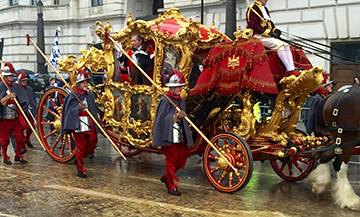
Lord Mayor ParadeJudie and I just got back from the Lord Mayor’s Parade. As faithful readers will recall, this televised ceremony marks the event, 800 years ago, when the King granted the City of London the right of self-government (via a Lord Mayor) on the condition that the Lord Mayor come to Westminster each year to swear allegiance to the crown. Back in those days, it wasn’t easy or safe to travel overland between the City and London, so the Mayor would take a special barge up. And that is how the whole celebration begins today–with a ride in a ridiculous barge up and down the river. As the whole thing evolved over the centuries, the Lord Mayor became elected by the Guilds, which would annually swear allegiance to him at Gulidhall. So that became part of the ceremony (although the election process has changed over the years and there aren’t exactly functioning guilds, which doesn’t stop them from existing in some honorary form and having individual halls–more like clubhouses–around the City). Now a new Lord Mayor is elected each year (in a process I described in an earlier post). It is generally some rich business type from the City, who, in addition to making a huge pile, has done enough good works to be knighted. So the ceremony had to add a swearing-in component, which includes a stop at St. Paul’s. So it is all very complicated. It starts with the morning barge trip. Then it is back to Mansion House (where the Lord Mayor lives) and the parade begins around 11:00 with the newly elected Lord Mayor bringing up the rear. It proceeds to St.Paul’s, for the blessing, and then on to the Royal Courts of Justice for the swearing-in. Then they all parade back to Mansion House n the afternoon.The parade itself lasts close to an hour and half, since there are countless marching bands, universities, business groups, charities, representatives of the old Guilds wearing silly robes and wearing funny hats, various branches of the armed forces carrying guns and waving, lots of groups on horse back and in uniform (including a band on horseback wearing lovely red velour capes), dignities in Rolls Royces and horse-drawn coaches which get increasingly ornate as the parade passes by, until the Lord Mayor of Dublin’s over-the-top coach comes along. And when you think that nothing can top that, the Lord Mayor’s coach absolutely does. The photo doesn’t do it justice. It was lots of fun to watch, even thought there was a light rain which essentially never stopped the whole time. (Brits watching next to us assured us that it always rains on the Lord Mayor’s Parade. No one seemed to care.) The whole thing usually ends with fireworks over the Thames, but they were cancelled in light of the terrorist attacks in paris the night before.

I was planning write about the Spitalfields Market bomb scare the other day. (Two unexploded WW II bombs were uncovered by a crew demolishing a building next door.) But after the real bombings and terrorist action in Paris last night, the old bombs seem quaint. It is truly horrible and very creepy to have this kind of thing happening relatively nearby. It makes one wonder if Europe may be looking at a series of incidents like this. And it certainly makes one think about personal safety in a different way. In a sense, it makes Europe more like America, where you are always wondering if some heavily armed lunatic will spring up and start shooting at people. (Of course, in the USA, we go for “Made in America”. We don’t have to import terrorists from global hot spots to terrorize us. We do it perfectly well ourselves.) Judie and I are scheduled to got to Paris in two weeks for a weekend visit for my birthday. On the one hand, the recent events freaks us out a little, if Paris has become a terrorist focus. On the other hand, after this carnage, Paris will probably be over-policed and very safe. We’ll see. We are also taking the kids there after Christmas.


Two More Paintings

I seem to do these in spurts. After a period when I can’t figure out what to do and spend time looking at photos/pictures and playing around on Photoshop, I finally find a subject (or, in this case, two subjects). At some point in the process, I reach a point where I think the painting just stinks and wonder if I should start over or toss the whole thing. So I take a break and go back later and something more decent begins to emerge. Eventually, it gathers momentum and I become obsessed with finishing it. (These are my “Finishing the Hat” days.)

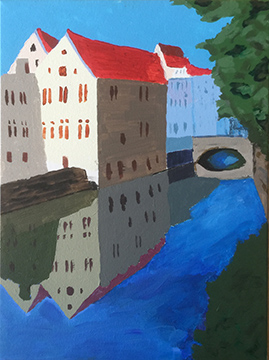
The two paintings are below. One is based on a picture of Bruges, one of the prettiest places on earth. The other is based on a photo I took of my cousin, Chris Olafson, reading a book or magazine at my sister Sally’s house. There are elements of each that I am pleased with and parts that just look wrong. But I’ve decided that I am finished with them, at least for now. It might be interesting to go back in four or five months and add or edit all of what I have done to date. In the meantime, I’m going for quantity, on the theory that the only way to get better at this is to do it often.

I’ve just bought a 16 x 20 canvas, which is bigger than anything so far, and a big brush. Now I have to figure out what to do with it.

Bruges                  Reader

Political Update and Other Random Thoughts

I went to Borough Market on Wednesday. I’ve complained before about how I’ve come to miss American supermarkets. Perhaps it is just this area of London, but there simply is no place nearby to get fresh fish or fresh meat. It turns out that the closest butcher or fishmonger is at Borough Market, so I will probably end up going there more. I’ve discovered that if I go early enough in the day, I can beat the mob scene that develops over lunchtime. The main reason I went was that couldn’t figure out where to buy a turkey for Thanksgiving. I was able to pre-order one at a butcher there and, while I was at it, bought some pheasant for dinner, tiny tomatoes (like red pearls), purple carrots, cheese and a raspberry tart.

On the way back, I passed Galvin Cafe-A-Vin and recalled that they are having a special breakfast on November 19th for the arrival of Beaujolais Nouveau in England. It’s a nice restaurant, so I reserved two seats. It should be fun.

Political Update: The November 16th issue of The Nation had an article about the election of Jeremy Corbyn as leader of the Labour Party. It seems a little late in picking up on a left-wing victory, one that would have to make the Nation folks happy. They tied it into the other victories that left-wing parties have recently had in Europe (most recently in Portugal)`, but were fairly realistic about Corbyn and his limitations. I’m doubtful that the left is actually on the rise (that is wishful thinking from the Nation, I’m afraid). It seems more likely that the middle is simply collapsing, since far right parties are also doing pretty well in European elections. And I’m not sure that any of this portends anything at all for America.

Meanwhile, George Osbourne continues to flounder about as a result of his ill-advised attempt to close his budget gap and pay for tax cuts for the wealthy by cutting support (tax credits) for the working poor. (The British call people who are working at low paying jobs, trying to support a family and to raise themselves up “Strivers”, which is the perfect word that explains and underscores public sentiment and disgust about how wrong-headed Osborne’s ideas are.) In the latest blow to Osbourne’s plan (and probably his limitless political ambitions as well), a Parliamentary committee controlled by his own party condemned the whole idea and suggested it be shelved for at least a year and then implemented gradually, if at all, while complaining that Osbourne’s Treasury was evasive and engaged in “obfuscation” about the overall impact of the proposals. And then former PM, John Major (Thatcher’s Conservative successor and a pretty right-wing guy himself) joined in the fun of kicking Osborne while he is down, attacking the “shocking” levels of inequality in Britain, a statement that recalled Captain Renault in “Casablanca”.

Not to be outdone by his ham-handed, self-designated successor, Cameron spent much of the week stumbling around trying to figure out what his current position is on British membership in the European Union. I think that Cameron wants to stay in the EU  and secretly realizes that the people who want Britain to leave are a bunch of Trump-like xenophobes and that Britain doesn’t need to shoot itself in the economic foot in that way. But he couldn’t bring himself to be unambiguously pro-EU in the last election, so he talked about how he was going to have some tough negotiations with the EU about Britain’s continued membership and hold a referendum. Faced with this bloviating and annoyed that Britain was insisting on negotiating without any specifics, the EU sensibly asked Cameron to send them (in writing) what he had in mind. Cameron finally got around to sending the letter and the answer was “not much really”. A Eurosceptic Conservative backbencher referred to as “pretty thin gruel” during question time in the House of Commons. Cameron really does not control his party on this issue and leaving the whole thing up to a possibly irrational electorate doesn’t seem like leadership. Although he is moving toward firm EU support and probably wishes he hadn’t promised a referendum, the whole thing is a mess for him and will probably get worse since, no matter what happens, virtually everyone will be unhappy.

While these sort of things sometimes fill the front pages of the newspapers, the back pages are more consistently about the demise of the Chelsea football team. Chelsea won the Premier League last year, but this year has managed to lose more than half the games it has played. This just doesn’t happen to a top Premier League team like Chelsea. There isn’t real parity in the Premier League. The top five or so teams (Chelsea is one of them) are always at the top, sometimes joined by one surprise team (West Ham this year). Chelsea’s collapse is a little like the Red Sox winning the World Series one year and then collapsing the next (oh wait, that happened?) and falling into last place for no apparent reason. Chelsea has a famous coach, who thinks a great deal of himself and is very outspoken and who loves to talk to and insult the press. (If you Boston fans want to continue the analogy, think of Bobby Valentine.)

Judie was invited to go to the Country Living Christmas Fair by the lawyer (actually a barrister) that she is in the process of hiring for Bryan Cave’s Payments Team in London (if the bean counters in America don’t manage to screw the whole thing up). She tried to get me to go, but it seemed like an event for mostly middle-aged white women to look a the sort of fussy decorations and little gifts that I don’t really like any way (not that there is anything wrong with that, he hastened to add). Judie went without me and had a good time.

Another Amazing Play and More Random Thoughts

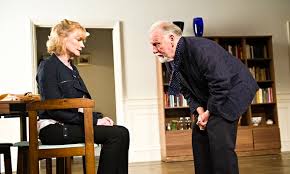
On Monday night, Judie and I went to see “The Father”, a pretty incredible play that was essentially about Alzheimer’s Disease. I was kind of dreading it, because I figured that a play with that subject just had to be depressing. And it was, but it was also wonderful. It is written by  French playwright and is up for various awards. The main character is André, the father, played by Kenneth Cranham, who seems sort of together at the beginning–a charming but forgetful older gentleman, but gradually deteriorates into addled confusion and finally terror, as his daughter, played by Claire Skinner, tries both to deal with his decline and to imgres-2manage her own life. What made the play truly amazing was all the things they did to capture the feelings and changes in perception that one experiences with that disease. For example, the actors playing his daughter or his caregiver or his daughter’s lover would change (but only once in a while, not consistently) from scene to scene, befuddling both André and the audience. The play was a series of vignettes and there was a blackout between each vignette, accompanied by music. As the play went along, the music became more disjointed and increasingly interrupted by pauses and static. There was a single box set and, as each scene began, you began to notice that a piece of the furniture from the prior scene was missing, until there was nothing on the stage. And then comes the last scene, where we find Andre in a hospital bed in a nursing home. It may seem simplistic, but I can’t begin to describe how powerful the effect was of the disjointed music, the disappearing furniture, the actor changes and confusion about where each scene was set. (André’s Apartment? His Daughter’s? London? Paris? It was never completely clear.) It imparted the feeling of confusion and things spiraling out of control and the gradual loss of reality that one supposes that an Alzheimer sufferer feels. It was really very disturbing and I was glad it was only 90 minutes. The final scene where the suave André from the fist scene has been reduced to a fearful and childlike state was really a masterpiece of acting and one I won’t soon forget. This was a production that created a powerful–one might say shattering–effect through a combination of the play, the acting, the staging and the set design. This was one of those things that I think only theatre can do.

It may seem like I am simply indiscriminate in reviewing the various plays we have seen recently, but we really have been on a remarkable run. The only play that I have seen in the last six or seven weeks that I might not recommend was “The Hairy Ape” (and I enjoyed most of it). And I though that “Farinelli and the King” was one of the best pieces of theater I have ever seen.

We went to a place called the “Cork and Bottle” the other night before seeing “Farinelli and the King”. It is an underground wine place near Leicester Square that serves food. It was kind of memory lane choice, because it a place that we went to the first time we visited London in 1984. A quick story about why it is a meaningful location for us: We were staying with our friends in Belgravia back then (they had been transferred by a law firm and we have since completely lost touch and I’m not even sure that I can come up with their names). We had plans to meet up with our friends, Chris and Nancy who were going to be in London at the same time, but lost the paper where we had written the name of their hotel. This was in the days before cell phones (fax machines were probably the state of the art then), so there was really no way to contact them. We even tried calling Chris’s job in Massachusetts, but he hadn’t left any info. So we gave up and went to the Cork and Bottle, which the guidebook said was the top wine bar in London. We were sitting there, sipping and nibbling, and looked up and there they were, standing at the bar right next to us! It is kind of amazing it is still open over 30 years later. Pretty good food and a really fun wine list.

On Friday, we went to Docklands to eat a The Gun, a 250-year-old pub/restaurant on the Thames, across from the O2 Centre. It was near the foundries which made the canons for the warships. Lord Nelson lived nearby and, according to the Gun’s website, would meet Lady Emma Hamilton is a room upstairs for secret assignations. It was nice, but it was too chilly to eat outside where we could have enjoyed the view along with the food. The pub is in a little corner of Canary Wharf where there are still old buildings and a feeling of what life might have been like when Britain ruled the oceans and London was the world’s great harbor. The rest of Canary Wharf is covered with gigantic new glass towers, walkways and little bridges along the water and inlets where ships once docked and the East India Company ruled. It was a bit like Houston with water. It was pretty sterile, I thought. And once you got beyond the center of Canary Wharf (as I walked over to The Gun, it was all construction of more towers and deserted areas of finished residential and office complexes. I found it depressing.

The final season of “Downton Abby” ended on Sunday night. I know I can’t talk about it since it hasn’t played in the US yet, but I will say that they left enough plot lines open that it is hard to believe that it is really over. According the newspapers, they are talking about a movie.

Another Historical Drama

On Wednesday night we went to the Hampstead Theatre and saw “The Moderate Soprano”, a new play by David Hare. Like “Farinelli and the King”, which we saw two days earlier, it was based on a true story. This time it was the creation of Glyndeborne as a British cultural institution, and, like “Farinelli”, it concerned music. It’s not really fair to compare the two plays, since they are so different in time and tone. “The Moderate Soprano” was a delightful evening of theatre, without quite reaching the heights of “Farinelli”.

I think that most people in England have heard of Glyndeborne, although I suspect that many of them think of it it as a place in Sussex where rich people take their hampers from Fortnum and Mason and sit out on a manicured lawn and listen to opera. “The Moderate Soprano” is the story of John Christie and his wife Audrey Mildmay. Christie inherited Glyndeborne shortly after World War I (in which he had been a hero but declined the DSO on the grounds that it should not go to officers, but to the regular soldiers) and planned to live there a a celibate bachelor, while teaching science at Eton. But he had a love of music and built a organ room there and, in 1930, held an event there at which Audrey Mildmay, a noted British Soprano–moderate was said to describe her singing style–was invited to perform. He fell madly in love with her and, although he was quite a bit older than she was, they were married a year later. They decided to expand the estate by adding a small opera house, where John hoped to hear his favorite composer, Wagner. John Christie was a great builder, a classic British eccentric, a fanatical lover of opera (and cars) and a man who deeply believed in getting what he wanted. He wanted to have a great opera house and, in order to reach his dream, ended up hiring three refugees from Nazi Germany, conductor Fritz Busch, director Carl Ebert and young producer Rudolph Bing (the same guy who would later run the Metropolitan Opera for many years). They outraged Christie by telling him that his hall was too small for his beloved Wagner and ultimately convinced him to let them start with Mozart, who he didn’t particularly like at the time. Against all odds, the venture was successful, as Ebert and Busch revolutionized British culture with their brilliant operatic productions. With the exception of the war years, when the house was used to house children evacuated from London, and a short period when Christie finally ran short of funds, the Glyndeborne Festival Opera has been a going concern since 1934. It helped found the Edinburgh Festival in 1947 and is now run by a trust, chaired by John and Audrey’s grandson.

imgres-1So that is the basic story that David Hare was given. (According to the interview in the programme, Hare was raised in Sussex and, of course knew of Glyndeborne, but knew nothing of the story until told of it by a producer of one of his plays.) His play is not simply about the construction of an opera house and the start of on opera festival. It is about the important role played by the German refugees (and thus has a real political resonance today), although the whole explanation of how Busch, Ebert and Bing got to Sussex was a bit long. It is also about the importance of art. (There is a great scene in which Christie why it is important to charge so much for the opera tickets. He says that business isn’t life and art something you do on the side. It is the reverse.) Most importantly it is about the deep love and synergy between Christie and Mildmay. Each was crucial to the enterprise and without the specific skills and determination of each of them, it would have failed. Their love and dependence on each other was played in a real and touching way as the play moved back and forth from scenes in 1934 to scenes where Audrey was nearing death, finally ending with John talking to Rudolph Bing many years later, long after Audrey had died.

This was a wonderful production. The Hampstead Theater seems to be one of those small theatres that acts as a feeder to the big West End houses. The last play we saw there, “Mr. Foote’s Other Leg” has moved there and I’d guess that there is a good chance that same thing happens with this one. “The Moderate Soprano” was directed by Jeremy Herrin, who has directed many productions, most notably, at least for me, “Wolf Hall” for Royal Shakespeare Company, which we saw on Broadway. If I have a complaint, it is that there was no music until the very end of the play, when there is a sort of flashback to opening night and Bush raises his baton for opening notes of the Marriage of Figaro. Roger Allam, a famous British stage actor whose face you’d recognize from PBS series and the first season of Game of Thrones, was simply terrific as John Christie. And the rest of the cast was also first-rate. Nancy Carroll (another familiar PBS face) was very affecting as Audrey, but each actor had wonderful moments.

On Monday we see “The Father”.