I went to the Royal Academy of Art today to see the Ai Weiwei exhibit. I’d heard of him as a famous artist and dissident in China and I’d heard enough about his work to know that he was some sort of conceptual artist whose art made political points. But I really wasn’t sure what to expect and I really wondered if I would like it at all. I did. His work is certainly not beautiful, but it is thought provoking and it was presented fabulously. As part of the admission, you receive an audio guide, which, as you might imagine, is crucial when you are dealing with conceptual and Chinese political art, since you need to know the story behind the work. The tour included the curators and Ai Weiwei himself talking about his work and his life. A few examples might give you the flavor of the Exhibit:
 One of the themes that keeps coming up in Ai Weiwei’s work is the recycling and repurposing of objects. He collected pieces of old temples and their furniture as they were being knocked down in Beijing in favor of new developments and saved them, using pieces of them to create art. When the earthquake stuck Sichuan in 2008, there was a suppressed outcry that much of the carnage (including the collapse of twenty schools) was due to substandard construction. He somehow clandestinely purchased tons and tons of the twisted rebar from these collapsed buildings and had it hauled off to his studio, where he employed a large number of workers to laboriously straighten each piece using sledge hammers. At one point, he was arrested and hauled off to prison, but the work continued. It took six years (!) and eventually led to this gigantic undulating work, entitled “Straight”, consisting of some impossible number of tons of rebar. While all this was going on, Ai Weiwei was outraged that the government refused to release the names of the over 5000 students killed in the earthquake, so he set up a cooperative that went out and spoke with people in the area and discovered thousands of names which were published in social media. On the walls of the room where “Straight” was displayed were the names of thousands of these students.
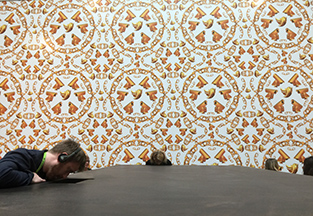 in 2011, Ai Weiwei was arrested and kept in a secret location for 81 days. He had two guards in his room with him at all times and the lights were never turned off. For reasons that were not explained, all of the furniture, including the toilet, and the walls were covered with foam and tape. Although he was forbidden to discuss what had happened to him and was on parole and without his passport, he nevertheless commemorated and protested his incarceration by constructing six huge, extremely realistic dioramas of him in his jail room, sleeping, being interrogated, walking back and forth with the guards, eating, taking a shower, etc. The dioramas were large black boxes with holes so that you peek in and see the scene. Some of the holes were on the top and you had to stand on a box to look down. If you can see the wallpaper in the background, that was designed by him and consists of surveillance cameras, handcuffs and birds.
The exhibit went on and on like this and was really quite fascinating. Ai Weiwei’s parents were dissident poets who were arrested for reeducation when he was one and he was forced to spend part of his childhood living in a hole in the ground covered with sticks as his father cleaned latrines. So it is no wonder that he is at odds with the Chinese Communist Party and the Government. He is so in their face that it is kind of a wonder that he has survived. I guess he became too famous to kill and all the Government can do is just harass him constantly and make his life as miserable as they can. One thing that was unsaid, but which occurred to me is that he must have some benefactors with some serious money behind him. He has a whole complex of studios and workshops outside of Beijing, where the things he collects are stored and a large number of carpenters and other kinds of workers construct his pieces. He is quite a character.
 nickinshoreditch